Category Archives: MLB Player Profiles
Get the Lowdown on all your Favorite MLB Superstars

Ichiro Suzuki: What Happened in 2011 to the Mariners Superstar and Looking to 2013
Friday September 16, 2011
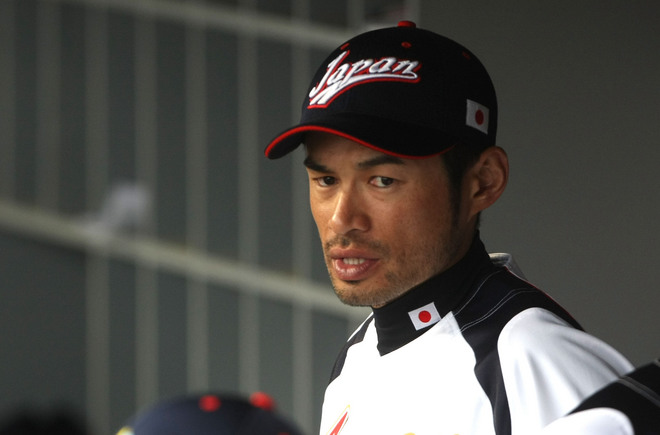
Sam Evans (Intern – MLB reports): When Ichiro Suzuki came into the league in 2001, people did not know what to expect from him. He exceeded any and all expectations, becoming the second MLB player all-time to win rookie of the year and MVP in the same season. The next eight years seemed easy for Ichiro; the highlight moment coming when he set the all-time hits record in a single season record in 2004 with 262. Not to mention, he became the first player in MLB history to have 200 hits in ten straight years.
Going into 2011, few analysts considered Ichiro’s production tailing off drastically. Sure, he was 37 years old, but he might be in better shape than any other player in the majors. In April of this year, Ichiro batted .328 and stole ten bases. However, in May and June he batted .210 and .282 respectively. This season has turned out to be Ichiro’s worst year in the majors by a large margin. From 2001 to 2010, he never hit below .303. In 2011, he’s hitting .272 with 5 HR and 72 RBI.
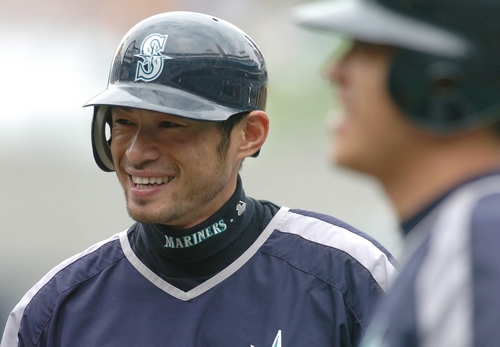 Ichiro’s production relies on his ability to get on base and create havoc on the base paths. Last year Ichiro had 53 infield hits, while this year he only has 32. Even though Ichiro’s 32 infield hits currently leads the majors, it is still the lowest total Ichiro has ever had in his career. It is not like these are cheap hits either, as former Detroit Third Basemen Brandon Inge commented to the New York Times on August 22,2009, “I wish you could put a camera at third base to see how he hits the ball and see the way it deceives you. You can call some guys’ infield hits cheap, but not his. He has an amazing technique.”
One of the arguments that has been set out in attempting to explain Ichiro’s decline this year has been that he is getting slower and slower. I disagree with this statement. He is on pace to steal 43 bases, which is right around his career average. In the field, Ichiro may have gotten a tad slower, but I think that is due to his taking bad angles to the ball, rather than a decline in his abilities. However, while not attempting to insult Ichiro as a player, it is apparent though that his intensity is a definitely a lot lower this year. This leads to the following conclusion in my opinion; Ichiro Suzuki is a human being. He is playing for a Mariners team that has not reached the playoffs since 2001. He has consistently been playing about 150 games a year, not including spring training. It seems like no matter how good of a season Ichiro has, the players and team around him are disappointing. After all, we are talking about the Mariners. A player can only take so much losing at a certain point, even the great Ichiro.
One factor explaining Ichiro’s off-year is bad luck. This is his first year with a BABIP under .300 (Ichiro’s career average is .352), and according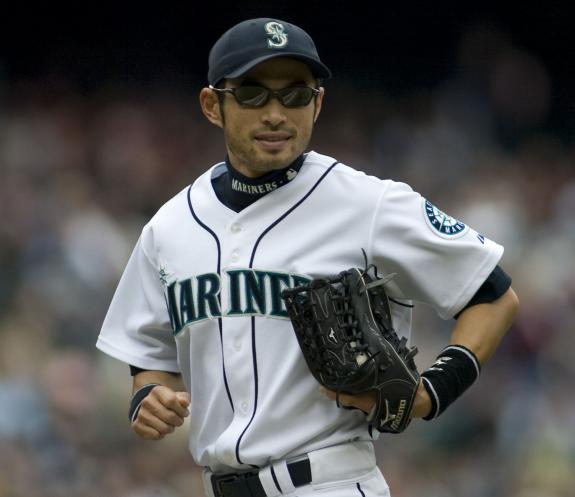 to Baseball Info Solutions, he has lost more hits than any other big leaguer on “good fielding plays.” No matter how you read the stats, the bottom line is that Ichiro has had a pretty bad year by his standards. He has played below-average defense, and at times looked lazy in the field. His On-Base-Percentage is at a career low .312, and he would need an incredible 30 hits in his last 13 games to reach 200 again. To make everything worse, Ichiro turns 38 in October.
Next year, will be interesting one for Ichiro Suzuki. It is his contract year and the Mariners are starting to acquire some legitimate pieces around him. A playoff year is probably out of the question, but a .500 year is very possible. Personally, I think he will bounce back and hit over .300 with another 200 hit season. With a better surrounding cast, I see glimpses of the old Ichiro returning. I don’t think he’ll ever return to the level he was on in 2004, but as long as he stays interested in the game, I think he will be an above-average right fielder for the next five years.
Without a doubt, Ichiro is a first ballot Hall-of-famer. He is the only player to have ten straight seasons of 200 or more hits. He also holds the all time record for hits in a single season with 262. Ichiro’s contract runs out at the end of 2012. The main question I believe is whether he will want to keep playing in North America. His friends and family are back in Japan, where he is a fashion icon. If Ichiro does continue to play baseball, I would be shocked if it were for a team outside of Seattle. When his career is finally over, most people will remember Ichiro for helping break the barrier between professional baseball in Japan and MLB. Overall, I expect most will remember Ichiro as being the greatest Japanese baseball player of all time.
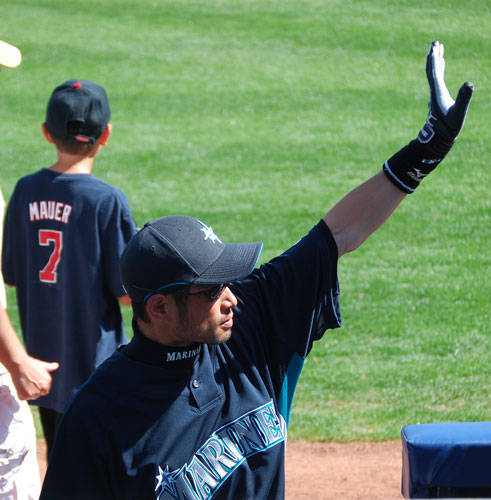
***Today’s feature was prepared by our Intern, Sam Evans. We highly encourage you to leave your comments and feedback at the bottom of the page and share in the discussion with our readers. You can also follow Sam on Twitter.***
Please e-mail us at: MLBreports@gmail.com with any questions and feedback. You can follow us on Twitter and become a fan on Facebook . To subscribe to our website and have the daily Reports sent directly to your inbox , click here and follow the link at the top of our homepage.

Adam Loewen and Dustin McGowan: Which Blue Jays Comeback is More Impressive?
Thursday September 15, 2011
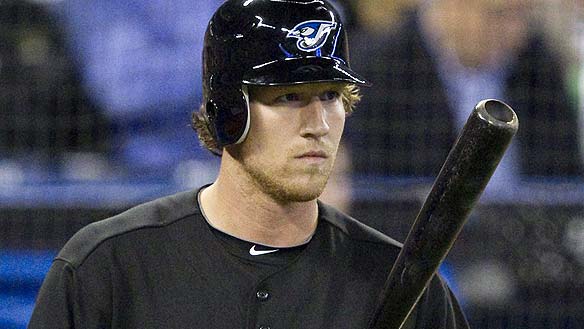
April Whitzman (Blue Jays Writer- MLB reports): Toronto Blue Jays fans have been asked a plethora of difficult questions this season, but none have been as tough as the following: Whose recent comeback is more impressive – Dustin McGowan’s or that of Adam Loewen?
When I was first tasked with writing this article, it was a question that I asked myself continually. Every time I responded, my answer would change. Comparable to many fans I spoke to, September 5th was a day in Blue Jays history that I will never forget. Dustin McGowan, after having three surgeries, and spending over three years away from the majors, got the call-up to return to the big leagues. I was excited for him that day and can only imagine how he must have been feeling on his return.
The same excitement McGowan felt playing in the majors, must have been shared by Adam Loewen. A former high draft pick of the Baltimore Orioles, Loewen was forced to change positions from pitcher to the outfield. Loewen could have quit baseball all together; however he didn’t, as he changed positions, and chose to sign with the Blue Jays as an outfielder. Although the Orioles tried to re-sign their once star pitching prospect, Loewen chose to sign with the Jays and begin his three-year journey back to the majors. Canadian born, Loewen chose to sign with the Jays as the team he grew up cheering for. As luck would have it, two days after Dustin McGowan’s return to the big leagues, Adam Loewen would be called up to the Blue Jays to make his triumphant return as well.
PRIOR TO INJURY
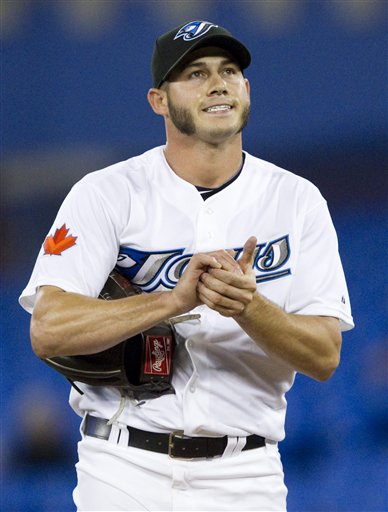 Prior to their injuries and subsequent recoveries, both players left the majors on a high. Dustin McGowan made 19 starts in 2008, accumulating a record of 6-7 with 4.37 ERA. Comparatively, in 2006, reaching the major league level at the age of 22, Loewen also made 19 starts, recording a 6-6 record with a 5.37 ERA. Injuries, however, soon took their toll. Dustin McGowan would endure a torn rotator cuff, a torn labrum, and torn cartilage in his left knee. Loewen, on the other hand, experienced a stress fracture to his pitching elbow.
MINOR LEAGUE JOURNEY
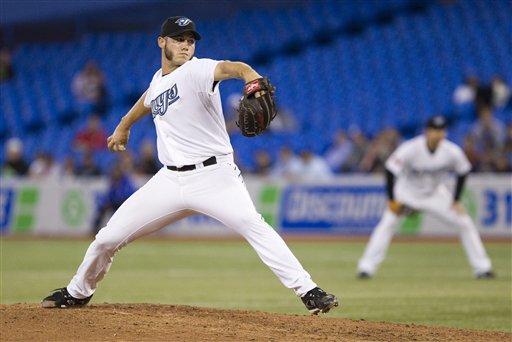
Dustin McGowan began his journey back to the majors July 2011, when he was back pitching in the minor leagues with the Dunedin Blue Jays. In seven games, he recorded a 0-2 record with a 2.87 ERA in 15.2 innings pitched, holding opponents to a 228 batting average. After a great performance with Dunedin, he was next sent to double-A. Through five starts with the New Hampshire Fisher Cats, McGowan saw both an increase in workload and results, including a record of 0-2 and a 2.47 ERA in 19.2 innings.
Loewen started out in high-A Dunedin in 2009 and hit .236 with 4 HR and 31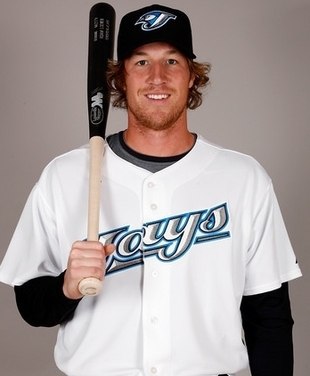 RBI with .695 OPS in 335 at-bats. Last year, in AA New Hampshire he had a .246 average, but the power numbers improved, as the former Oriole belted 13 homers and drove in 70 runs, while posting an OPS of .763. After the Fisher Cats were eliminated from the Eastern League playoffs, he also worked on his plate discipline and power in the Arizona Fall League. This year, Loewen has proven that all of his hard work as part of his journey has been worth it. In the hitter friendly Pacific Coast League, Loewen hit .308, with 17 home runs and picked up 84 RBIs. Most impressive was his .888 OPS.
SINCE MLB CALL-UP
On September sixth, against the Boston Red Sox, McGowan threw four innings, surrendering three runs on five hits. While he surrendered three walks, he also struck out five, the majority of them coming off his fastball, which was consistently hitting the mid 90s. During his first start in the MLB since 2008, on September 11th against the Baltimore Orioles, McGowan’s plate consistency wavered. He pitched three innings, allowing four earned runs, on three hits and five walks. He is presently sporting a 9.00 ERA in two games played.
BC native Adam Loewen made his first appearance with the Blue Jays the day after McGowan, on September 7th. In his first big league appearance as an outfielder Loewen went 1-3 with a run scored. His best game came September 11th, (also a McGowan Start) versus Baltimore, where he went 2-3, with a home run, which he belted to centerfield. However, many presume that Tuesday’s game against Boston, where Loewen went 0-4 with two strikeouts was his worst game thus far in a Blue Jays uniform. Yet, I would like to point out, Loewen made a stupendous catch over the centerfield wall during that game to rob a home run away from the Red Sox, which in my eyes made up for the poor day at the plate. The young Canadian is presently sporting a .300 average with three hits, two runs and a home run, with no walks and four strikeouts.
OVERALL
Both Adam Loewen and Dustin McGowan have come a long way since their respective career threatening injuries during the middle part of the decade. Each player symbolizes the heart and hustle motto that the Toronto Blue Jays have been preaching this year, as neither ever thought of quitting the game despite adversity. The determination Loewen and McGowan have each shown in wanting to come back to Major League Baseball has also been extremely impressive. Despite the small sample of success each has shown this month, I would suggest that both could be integral parts to a Blue Jays playoff run in the non-too-distant future. Thus, returning back to the central question of whose return was more impressive… I would have to say – – both.
What’s your opinion on the returns of Loewen and McGowan? You can comment below, reach us by email at MLBreports@gmail.com and you can add me on twitter at @Alleycat17. I look forward to hearing from you!
Please e-mail us at: MLBreports@gmail.com with any questions and feedback. You can follow us on Twitter (@MLBreports) and become a fan on Facebook . To subscribe to our website and have the daily Reports sent directly to your inbox , click here and follow the link at the top of our homepage.

Contenders for AL Rookie of the Year Award: Who Will Win?
Monday September 12, 2011
Sam Evans (Intern Candidate- MLB reports): With the regular season coming to an end, it’s time to start looking at baseball’s awards. The American League Rookie of the Year will definitely not be an easy choice for BBWAA voters. Even though the top candidates are pretty clear, there is still about 20 games left for most teams. This last month is important for candidates to solidify their numbers and argument for the award. Here is my opinion on who should win the award.
Three of the five last winners of the AL ROY award have been pitchers. When choosing who I think deserves the award one of my key requirements is playing time. In my opinion, a mediocre pitcher who pitched the whole season is more impressive than a position player who was only in the majors for half of the season. Also, I don’t think the team of the players record is important enough to be a consideration for voters. This award should be chosen for a player’s impact in the majors, not how hyped up of a prospect he is. So I’ll try to look past the shock value and breakdown some of the candidates.
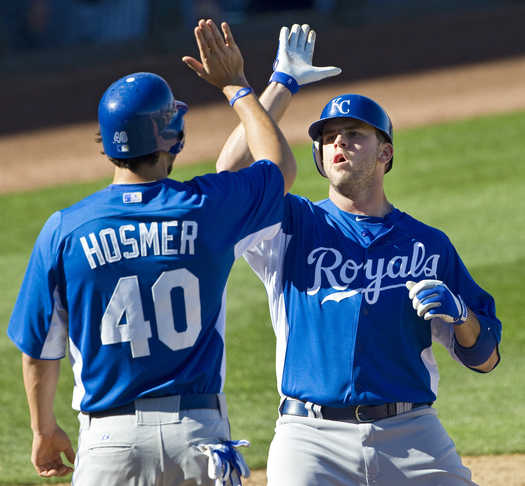
Eric Hosmer: Kansas City Royals
Hosmer made his Royals debut on May 6th and has been the Royals starting first basemen ever since. For the year, Hosmer has batted .286/.334/.462 with 17 HR and 69 RBI’s. He has been the consistent middle of the order bat that the Royals have lacked ever since Carlos Beltran got traded.
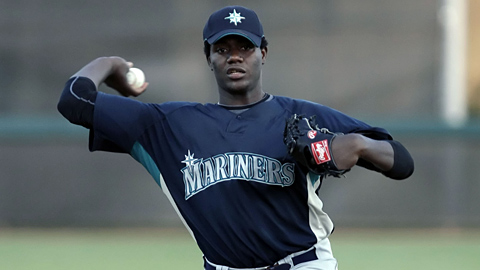
Michael Pineda: Seattle Mariners
When Pineda was named the Mariners fifth starter right before the season started, most Mariners fans didn’t know what to expect. Michael was an American League All-star and has slid into the Mariners #2 starter spot. His numbers have tailed off a little as the season has gone on, but the Mariners still haven’t made the decision to shut him down. He has a 3.72 ERA in 167 innings with 171 strikeouts. That’s more than Jon Lester and Matt Cain. Also as his 3.42 FIP suggests he has actually been better than his ERA suggests. However, he has pitched in a pitcher’s park this year which have probably helped his numbers.
Ivan Nova: New York Yankees
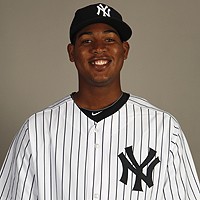 Nova just barely has eligibility, but he has had a surprisingly solid season as one of the Yankees backend starters. He is 15-4 with a 3.94 ERA and 87 strikeouts in 144 innings. Obviously, the number that stands out is the fifteen wins, which is impressive for any pitcher. Still, with the Yankees offense wins aren’t a great stat to judge performance. Speaking for myself, I just don’t think his numbers are impressive enough to be the 2011 AL Rookie of the year.
Jeremy Hellickson: Tampa Bay Rays
 Going into the season, there were pretty high expectations set for Hellickson. ESPN fantasy baseball teams were drafting him at an average of 163rd. He definitely has lived up to those assumptions and maybe even exceeded them. He is 12-10 with a 2.96 ERA and 109 strikeouts in 170 IP. Not to mention, he has done this while pitching in the toughest in baseball. He has had a lot of luck this season, as his 4.30 FIP and 4.57 xFIP suggest (courtesy of fangraphs.com). Also, he has the highest LOB% among all pitchers that have thrown over 100 innings.
Mark Trumbo: Los Angeles Angels of Anaheim
After the Angels received the news that Kendry Morales would start the year on the disabled list, the Angels first base options looked bleak. Trumbo was the favorite to win the job but wasn’t a very heralded prospect. Baseball America had him as the Angels 9th best prospect. Trumbo not only won the job, but he ran with it. On the season, he is hitting .256 with 26 HR and 80 RBI’s. He leads all rookies in homers, RBI’s, and SLG%( for rookies with more than 300 plate appearances). Not to mention, he has provided an above-average glove at first base. His batting average is not great, and his OBP% is under .300(.295), so he hasn’t been perfect this year. In the end, he has made contributions to his team unlike any other candidate.
Honorable Mentions: Dustin Ackley, Desmond Jennings, Jordan Walden.
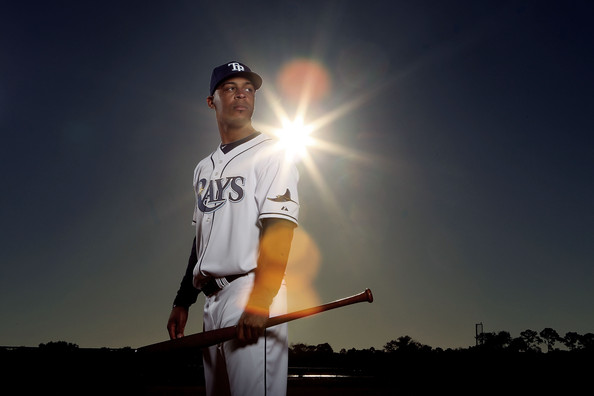 I think Ackley and Jennings didn’t play enough games to deserve the award, and Walden has been too inconsistent. However, if Jennings were to lead the Rays to an improbable playoff spot, I think he should win the award or receive strong consideration by the voters.
If I had a vote at the end of the day, I would vote for Trumbo- with Pineda, and Hellickson following. There is still plenty of time left, but in my mind Mark Trumbo deserves the 2011 American League Rookie of the year award.
***Today’s feature was prepared by one of our intern candidates, Sam Evans. We highly encourage you to leave your comments and feedback at the bottom of the page and share in the discussion with our readers. You can also follow Sam on Twitter.***
Please e-mail us at: MLBreports@gmail.com with any questions and feedback. You can follow us on Twitter and become a fan onFacebook . To subscribe to our website and have the daily Reports sent directly to your inbox , click here and follow the link at the top of our homepage.

Ian Kadish MLB Guest Blog: My Baseball Journey
Sunday September 11, 2011
MLB reports: We welcome today on the Reports, Blue Jays prospect Ian Kadish. The right-handed pitcher pitched for the Bluefield Blue Jays in the Rookie Appalachian League in 2011. With a 2-3 record, 2.67 ERA, 1.154 WHIP, 11/35 BB/K, the 23-year-old Kadish showed some very strong numbers pitching in the pen in his first professional season. With a bright baseball future ahead, we invited Ian to prepare a MLB Guest Blog describing his baseball journey for our readers. In his own words, we proudly present the story of Ian Kadish- pitching prospect, Toronto Blue Jays:

Ian Kadish (Guest MLB Blogger): I was recently approached by MLB Reports to be featured on their website. We got together to come up with an idea of what to do and we decided on a blog post about the path I took to get to professional baseball. Most of you guys that are close to me probably know the story already, but here it is again for the ones who don’t…
 I went to a small high school just North of Cincinnati, Wyoming High School. My graduating class was only 160 kids and football is the big thing there (Football is the big high school sport in Ohio). I actually thought I was going to play college football as a kicker. I thought I had a better chance at football than I did at baseball even though my childhood dream was to be a big league pitcher. I was not highly recruited for baseball and if it wasn’t for the summer program I played for, I would not have had the chance to play college baseball. I played for Midland Baseball and that is where I met one of the most influential coaches of my life, Mike Maundrell. Coach Maundrell taught me everything I know about pitching and taught me exactly what I needed to do to be successful. Midland is the best summer baseball program in the country and attracts kids from all over the country. There is a great number of major leaguers that have played for them and it was an unbelievable experience to be able to play for them. I learned more about baseball in those three years than I did at any point up until then. I committed to play baseball at Marshall University.
I spent four years at Marshall, earning my degree in Business Management with minors in marketing and entrepreneurship. In those four years, I learned a tremendous amount about baseball and life. I really think those four years prepared me for professional baseball because I lived on my own and learned how to deal with factors outside of baseball. I never really had great success in college baseball and at one point, I was ready to transfer out. My mom and dad are the only ones that know how many break downs I had because I was so frustrated. I was working harder than everybody and I was still not getting the results I wanted.
After my sophomore year, I went back home to play summer baseball in the Great Lakes League for the Cincinnati Steam. I went home because I needed to decide if I wanted to go back to Marshall or transfer somewhere else. That summer was the deciding factor because I got to spend time with my family and play with some very close friends that I had played with growing up. I went back to Marshall as a Junior and there was a new pitching coach. Joe Renner was a coach at Midland so I kind of knew him even though he was a new coach. I was very excited to work with him and after the summer I had, I was newly energized and ready to get back to work. I continued to work hard and ended up earning the Friday night starter role. This was a big jump for me because I had never started and the previous 2 years, I was pitching out of the bullpen. I struggled in the starter role and had again, another frustrating season.
After my Junior year, I went to play with the Rochester Honkers in the Northwoods League. Playing there was truly the best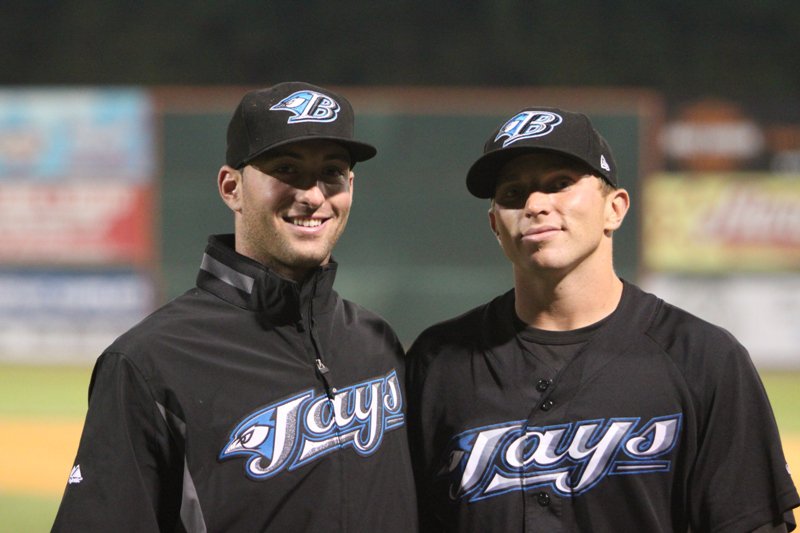 experience for me since playing for Midland. All the guys on the team were great guys and we all became pretty close. The guys on the team taught me how to have fun with baseball again and relax. I was taking the game way too seriously and was not playing up to how I thought I should be playing because I was too uptight. Going into my senior season, the coaches wanted to put me in the closer’s role and I couldn’t have been happier. I embraced the role and told myself I was going to have more fun that year. Senior year turned out to be much more fun than the previous three years because I was more laid back. After my senior season, I went home to wait and see what would happen with the draft.
I won’t lie, I was hoping I was going to get drafted, but as day three approached, I was slowly beginning to think that I was not going to get a chance to play professional baseball and keep my dream alive. My dad and I went golfing on day three of the draft just to try to get my mind off of things, but I was still thinking about it. I was on my phone all day and when I learned that it was late in the draft and I still had not gotten picked yet, I began to talk with my dad about where I go from there. I did not know if I wanted to go to grad school or try to get a job in the real world. As soon as the draft was over, we were just finishing golfing and that’s when I got the call. Nick Manno, the area scout for the Blue Jays, called me and explained the situation to me. He said he knew that money did not matter to me and he knew that all I ever wanted was a chance to prove myself and play. He offered me a free agent contract and I gladly accepted! My dream was still alive, and I couldn’t have been happier!
From there, I was off to Florida for a mini-camp and to keep my dream alive, just like every other little 12-year-old, to be a big league pitcher…

Thank you to Ian Kadish for preparing today’s MLB Guest Blog. Please feel free to contact Ian on Twitter (@BearJew36) or through his website (http://livinginthelifeofian.blogspot.com) for comments and questions. We also thank Ian for sharing the photographs used in today’s feature from his own private collection.
Please e-mail us at: MLBreports@gmail.com with any questions and feedback. You can follow us on Twitter and become a fan on Facebook . To subscribe to our website and have the daily Reports sent directly to your inbox , click here and follow the link at the top of our homepage.

Casey Bond Interview: Moneyball Movie Star
Friday September 9, 2011

MLB reports: In part two of our series on Casey Bond, we feature today our interview with the “Moneyball” star. Casey portrays former Oakland A’s pitcher Chad Bradford in Moneyball and will be promoting the movie this week in Toronto as part of the Toronto International Film Festival. Tonight is Casey’s big premiere at TIFF. Before the release of the movie, we had a chance to talk with Casey about his baseball and acting careers. From playing minor league baseball with the San Francisco Giants, Casey moved to acting and appeared on the Gene Simmons reality show “Family Jewels”. With the launch of his upcoming movie, MLB reports is proud to present our interview with Casey Bond:
MLB reports: Welcome to MLB reports Casey. It is a pleasure to be speaking with you and thank you for taking the time for us. From baseball player to movie star. You were originally drafted by the Giants in the 25th round of the 2007 draft. You made it all the way to AAA in your 2nd season. Tell us what it was like to be drafted by a major league team and play professional ball. What was the process like for you from the time you were drafted to joining your first team?
Casey Bond: Have the opportunity to play professional baseball for the Giants was a childhood dream come true. All I ever wanted to do as a kid was play professional baseball (like most kids). I worked hard, and took my talents and abilities to the professional level. A life long goal accomplished.
The process for me after I was drafted was just like most other guys that get drafted. The Giants called me and congratulated me, and then eventually gave me dates that I would be reporting to spring training. I continued to practice and prepare myself for spring training until I had to leave. Once I left, I joined everyone else with the organization, and we began to practice and train until we were told which team we would be on after we broke from spring training. It was very exciting getting to display my baseball skills on the highest level.
MLB reports: Your playing career ended in 2008. Why the decision to end your career so soon after getting drafted? Were injuries a factor?
 Casey Bond: I was released by the Giants, after coming off a fairly productive season as an everyday starter, and had a decision to make. I had offers from other teams to play, but the acting world was starting to pull me in its direction, so I decided to consider baseball a goal accomplished, and moved on to another goal in my life.
MLB reports: After baseball, you jumped into the acting ring. Were you always planning to be an actor? How did you get started in the business?
Casey Bond: Honestly, I can’t say that I always had plan on being an actor. It was something that I always had an interest in, but I never really pursued it until I started to take classes in Nashville during the off-season.
MLB reports: Before Moneyball, you were in the Gene Simmons’ show “Family Jewels”. Tell us a little more about the show and your role.
Casey Bond: My role on Gene Simmons Family Jewels was as the “Handsome Handyman.” I was hired to come in and help fix things around their beautiful home. It was a reality show, and I was able to put my craftsman skills to work on the show. They were a wonderful family, and I really enjoyed being a part of the show.
MLB reports: Interestingly, you were an outfielder for the Giants back in your playing days. Yet you are playing Chad Bradford in the movie. How did you get picked for the role?
 Casey Bond: It is a very strange coincidence that I am portraying an Oakland A’s player for the film. I always tell people I made it to the Big Leagues with the Oakland A’s it seems. I had to audition for the role, reading with the casting director and director first before displaying any of my baseball talents. I really had to bring my “A-game” acting in the room before I was able to show my skills as well. For whatever reason, when the baseball came along, I was able to teach myself to mimic Chad Bradford’s very unique submarine form. It just worked for me, and I almost wish I had pitched like that. Maybe I would have been set apart even more from the rest of the crowd. I was actually very accurate and effective against batters. After I displayed the acting and the baseball skills, I had a personal meeting with Brad Pitt, where we read the script and basically hung out for a while just talking about life, baseball, etc. It was basically a meet and greet. After this, I found out I was offered the role.
MLB reports: Did you get to meet the “real” Chad Bradford in preparing for the role? Tell us about the process you experienced from getting the part to preparing for the role of being Chad Bradford.
Casey Bond: I haven’t met Chad yet, but I talked to him on the phone for quite some time, gathering information that I could use toward playing the character. I asked him everything from his mental approach pitching, to the way he acted on the team and his time with the A’s.
MLB reports: Can you give us some background on your director Bennett Miller? How did you find the experience working with him?
Casey Bond: Steven Soderbergh did not direct the film, even though he was originally slated to direct it a few years ago. Bennett Miller directed the film, and he was a pleasure to work with. His most well-known work before this film was the movie “Capote.” It was very well received, and he was highly acclaimed for the work.
MLB reports: Which cast members did you work the most with during the filming of Moneyball? Who did you become closest with during and after the filming?
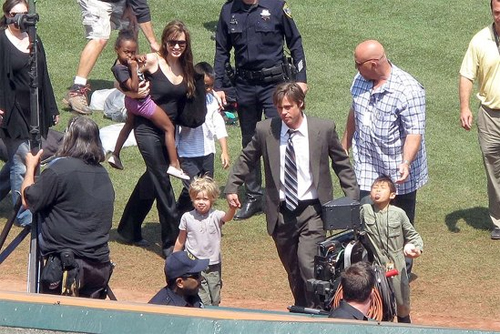 Casey Bond: I worked with a very large number of cast members. Brad Pitt, Phillip Seymour Hoffman, Jonah Hill, and Chris Pratt were among those. All of which were wonderful to work with, and a pleasure to be around. Brad really was a mentor on set, and through advice and sheerly through working with him, I was able to step up my acting game even further. I developed a lot of great relationships on set, as I was on the film for most of the duration of filming. I’m not sure if I could honestly say who I was closest with because it was such a great group of people, of which I was around everyone and interacted with every day.
MLB reports: Can you share one or two good stories from the set of the movie that readers would otherwise not hear about?
Casey Bond: There were some great times had on set. Plenty of practical jokes, especially since there were baseball players involved. Brad and Jonah pulled pranks such as altering each others golf carts on the Sony lot to “embarrass” the other person while they drove their cart to the set. Things such as putting the picture of their faces on the other persons cart, or altering the cart to make it stand out in the crowd.
Brad being a mentor to myself is another great story. A person in his position doesn’t necessarily have to reach out and help the other person with their advice or opinions as that can be left to the director, but he very openly did. He is obviously a legend, and any and all advice from him was wonderful, and I was so thankful for his kindness and thoughtfulness. Truly a very down to earth person who is there to work hard every day and put his best foot forward, which is how I feel a handle my business as well.
MLB reports: Mr. Brad Pitt. One of the last people I imagined becoming Billy Beane. Fans are interested as to how he did in the role. Tell us about Brad the baseball general manager? Is there an Oscar in his future?
 Casey Bond: This role played by Brad could be one for the ages in my opinion. He made some fantastic choices, and I think they will come across very well on the big screen. He truly has so many talents and abilities. If you just look at all of the different roles he has played, and played so well, those alone are a true testament to his versatility. All of the components are there for this film to be a huge success, and the way he plays Billy Beane shows his ability to be funny, serious, heart-felt, and compassionate. I’m excited to see the response to his performance, along with all of the other cast members on this film.
MLB reports: I am a huge fan of baseball movies. The fine line is maintaining an authentic feel. Having real players in the roles helps a great deal, including yourself and Royce Clayton. What did movie producers do to keep the feel and flow of the movie from a baseball perspective as being “real” rather than looking like a movie?
 Casey Bond: I don’t say this lightly…this film has the potential to be the most authentic baseball movie of all time. The individuals involved with this film were top-notch baseball players. I was fortunate to be an actor who had the professional baseball ability in my back pocket. The guys brought on this film even as extras all had experience from college to professional, and it will show on the big screen. Obviously, Royce had the most experience with around 10 years in the big leagues. I’ll put it this way…if we were to field a team from the people on set, we could most definitely compete with a lot of people. Truly some great talents in this film, which was so important. We have all seen the baseball movies which just don’t cut it as far as believability goes. This will be the one to outshine them all in the authentic department.
What was great was the fact that Bennett Miller, Brad, and everyone else wanted to make sure they got the baseball part right. They wanted to hear our opinions, and stuck with them. I was more than happy to add any and all of my baseball knowledge to this film, especially due to the fact that they listened intently and respected all of the intricacies of the game.
MLB reports: Was the real Billy Beane a part of this movie? Did he visit the set and have input into the movie? What about author Michael Lewis, was he a part of the movie as well?
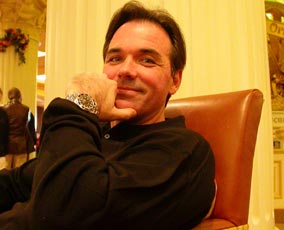 Casey Bond: Billy Beane was on set multiple times. I’m sure he had plenty of input in the sense that he was the man they could go to if there was a question. After all, his character is what the film is centered around. Michael Lewis was on set too, and I had a wonderful conversation with me. He noticed me right away and knew who I was playing (Bradford).
MLB reports: I don’t recall a baseball movie that was more anticipated than Moneyball (I personally cannot wait to see it). Where will this movie rank about the greatest baseball movies of all time? What is your favorite baseball movie of all time?
Casey Bond: This movie has a lot of hype, and all for good reason. It has an all start cast, and a wonderful story to back it up. Moneyball was a best-selling book, and it brings baseball, business, and life all together into one. Something everyone can relate to.
All baseball movies are different, and this one, for myself, will be the most authentic of all time. My favorite baseball movie of all time (at this point) is Bull Durham. It depicted the minor leagues perfectly, which is obviously something I am very familiar with. The language, interaction, and relationships were done so well. It’s just an amazing movie, especially if you have played baseball at that kind of level. It all makes sense.
MLB reports: You are in Toronto this week for the Toronto International Film Festival promoting Moneyball. How has the promotion circuit treated you thus far? Where are you off to after Toronto and what are the promotional plans for Moneyball?
Casey Bond: The promotional circuit for Moneyball has been wonderful. I have been doing red carpets, radio shows and interviews, interviews with all kinds of media, and am now off to Toronto for the Toronto International Film Festival, where I will be walking the Red Carpet as well.
After Toronto, I head back to L.A. for few days before going to Oakland, CA for the U.S. Premiere to walk the Red Carpet, as well is doing other promotional events in Oakland centered around the film. Its been a very exciting and busy time, and I love every minute of it, and can’t wait to do this with other projects in the future.
MLB reports: What is the future of Casey Bond? Do you have any projects currently in the works? What are your plans following the movie?
Casey Bond: The future for myself is to continue to work hard, and apply myself to the acting world (as I have been) just like I applied myself to being a professional athlete. Passion and hard work will translate into success. That is how it has always worked for me, and that is how life tends to work. If you work hard, and are passionate about what you do, you will be successful. I plan on never doing anything but that.
Lately, I have been doing quite a bit of print work for different companies like A.D.I.D.A.S., Muscletech, and others, along with doing commercials and constantly having other auditions. Lately I have also been working with legendary acting coach Larry Moss. Always have to be working on the craft. I have also started a small production company with a few friends out here, which has been a fun process. I love being a part of all sides of the entertainment industry. It has been busy since finishing up Moneyball, and once the film drops, I hope to gain even more attention and go work hard on other projects.

Thank you to Casey Bond for joining MLB reports today. Please feel free to contact Casey Bond on Twitter (@caseybond) or through his website (http://thecaseybond.com) and Facebook Fan Page for comments and questions. Casey will be CONSTANTLY providing personal behinds the scenes photos, videos, etc. of upcoming events that he will be a part of such as Red Carpets and premieres, as well as Moneyball media when the film comes closer to the release! Stay tuned for part two of our Casey Bond feature, with our interview coming up on MLB reports.
**Some of the photographs in today’s feature are courtesy of Peter Hurley**
Part one of our feature on Casey Bond: https://mlbreports.com/2011/09/07/bond/
Please e-mail us at: MLBreports@gmail.com with any questions and feedback. You can follow us on Twitter and become a fan on Facebook . To subscribe to our website and have the daily Reports sent directly to your inbox , click here and follow the link at the top of our homepage.
Casey Bond Guest Blog: From Giants Prospect to Moneyball Star
Wednesday September 7, 2011
MLB reports: Baseball movies have been part of the culture of the game for as long as most of us can remember. Classic films include The Natural, Bull Durham and Major League, among countless others. When baseball fans are not watching games at the ballpark or on television, they can often be found at the theatre or popping in a disc at home to watch a baseball movie. Fans also enjoy baseball documentaries, including the Ken Burns series. If not watching baseball in some capacity, a good baseball book is not usually far behind for a diehard baseball fan. Lovers of the game cannot get enough of their favorite sport and enjoy the game in many different capacities.
At MLB reports, we are big supporters of baseball books. We try to read as many new ones as we can to review on our site to encourage readership. Those books that we enjoy can sometimes also end up on the big screen and come to life. One of the most popular and talked about baseball books of all time, Moneyball by Michael Lewis, has in fact been made into a Hollywood movie. Starring Brad Pitt as Oakland Athletics GM Billy Beane, Moneyball has all the makings of being the next all-time classic baseball movie. Due out in theatres on September 23, 2011, Moneyball is a movie that everyone must see!
We are very fortunate today to have Casey Bond, one of the stars of Moneyball the movie, on MLB reports today. Casey in part one of a two-part feature, prepared a guest blog sharing his journey from outfielder in the San Francisco Giants organization to starring in Moneyball with Brad Pitt. In part two coming this week, we will be publishing our interview with Casey Bond. We appreciate Casey taking the time out of his schedule in preparing this feature. Casey portrays former Oakland A’s pitcher Chad Bradford in Moneyball and will be promoting the movie this week in Toronto as part of the Toronto International Film Festival, starting September 8th. For the very first Hollywood star on MLB reports, we proudly present actor Casey Bond, with his journey from San Francisco Giants prospect to Moneyball star:
Casey Bond (Guest MLB Blogger): For a little history on myself, I grew up in the south in the town of Peachtree City, GA, which is a golfing community about 30 minutes south of Atlanta. As a kid, all I ever wanted to do was play baseball and other sports, and to someday play professionally. Although I always had an interest in movies, I kind of put that interest to the side to concentrate on my athletic abilities. I was a multi-sport athlete in high school, and went on to play Division 1 baseball for both Birmingham Southern College (Birmingham,AL), and Lipscomb University (Nashville,TN). My first dream eventually came true, and I was drafted by the San Francisco Giants in the 25th round as an outfielder from Lipscomb University in 2007. I played for the Giants Organization for two seasons.
At the end of my time with the Giants, a very unique opportunity arose for me in the acting world. I began to take acting classes in Nashville, TN, as this was always something that I had an interest in, and felt like I had to at least pursue it to some degree. I told my great-aunt, who lives in Santa Monica, CA, that I had begun to dive into acting a little bit. The reason I told her was purely for conversation because she used to be an actress back in the day. She was in some things here and there, and I thought she would appreciate my effort. Well, she told her friend, who told his agent, about myself. I knew she was going to do this, but thought nothing of it because after all, I was still living in Nashville. For whatever reason, this agent decided he would call me up and tell me that he had an audition he could get me in. Being as fresh and naive about this entire acting and auditioning process, I didn’t realize that there were thousands of auditions happening every day in L.A.
So, I asked him what I needed to do to audition for this role in a national commercial. He told me that I had to be inL.A.tomorrow, and that he would get me into the audition. I took that as a great opportunity, and because I was so naive, I actually flew out toL.A.and went to the audition, and then flew back the same day. A week after this, the agent calls me again and tells me that they want to have me back to a callback, and that I had to be there the next day. So, I hopped on another plane to go to this audition, thinking how lucky I was to have an opportunity to even have an audition inL.A. I met with the casting director and producers, did the audition, and then literally flew home again the same day. Needless to say, my friends thought this was pretty cool stuff, and so did I because I really had no idea that this was happening constantly every single day inL.A. However, thanks to my foolishness, and perhaps drive to succeed when given a chance to do something special, I ended up booking the commercial, and flew out about a week later to film it.
This commercial was a national commercial. It got me into SAG immediately, which is such a hurdle to many actors in itself, and it basically gave me the opportunity to have this agent take me on full-time, move toL.A., and pursue acting with a full passion and pursuit. Long and crazy story, I know, but it is entirely the truth.
The inspiration to act was within me from the time I was little, but it wouldn’t reveal itself to me fully until I was done pursuing my first dream of playing professional baseball. Once I moved to L.A., I very quickly learned about the in’s and out’s of industry, and through my love of meeting new people and building relationships, I have so far been able to surround myself with some wonderful people who I have gotten to work with and learn from.
Now, I am working with the legendary acting coach Larry Moss, which in itself is an inspiring thing to be a part of. I am fully committed and involved in everything I can do to continue to be the best actor I can be, and I know that my past with professional sports and athletics has directly related to the carry over into the entertainment industry. Hard work and passion has paid off, and will continue to.
All of this led to Moneyball. First off, I auditioned at Sony a few times with the director (Bennett Miller) and the casting director. They liked me read both times, so they decided to have me go out to a baseball field to see if I could actually perform there as well. My character, Chad Bradford, was a submarine pitcher for the Oakland Athletics from Jackson, Mississippi who was a big Christian. You may already know, but if not, a submarine pitcher is one who nearly scrapes his knuckles on the ground when he is delivering the ball to home plate from the mound. I played outfield, so this was not something that I regularly did by any means. I had to go out to a field and work on this for hours before perfecting it. Needless to say, I went out and performed for Bennett Miller, and others who were there to help determine if I was the guy.
 I passed the “baseball test”, which I was hoping to considering that was such a large part of my past. Bennett then wanted me to come over to Sony for one last meeting. That meeting was a personal meeting with Brad Pitt. When I arrived, Brad immediately came up to me and shook my hand, and we went into conversation that lasted a long while. We didn’t even read through the script but once. We just needed to get together and hang out, make sure we were a good fit, which was no problem at all since he is such a stand up guy. He was truly a wonderful person to be around, and an absolute mentor on set while we filmed our scenes with one another.
Brad gave me advice during our scene, which you wouldn’t necessarily expect from him, given the position he is in. However, he was truly a mentor, and I very much learned from him. He is a master of his craft. To work with guys like Brad, Jonah, Philip, and Chris Pratt was definitely a game changer for myself as far as knowing that I could act on their level, and continue to develop and hone my skills as an actor.
First and foremost, be on the lookout for the film, which is going to be released September 23rd. The world premiere is at the Toronto Film Festival on September 8th. As for myself lately, I have been studying with Larry Moss, and have been doing quite a bit of print work lately for companies like A.D.I.D.A.S. and Muscletech. There are also some other things in the works right now, which I hope I can divulge in the near future.
Thank you Casey for preparing today’s MLB Guest Blog. Please feel free to contact Casey Bond on Twitter (@caseybond) or through his website (http://thecaseybond.com) and Facebook Fan Page for comments and questions. Casey will be CONSTANTLY providing personal behinds the scenes photos, videos, etc. of upcoming events that he will be a part of such as Red Carpets and premieres, as well as Moneyball media when the film comes closer to the release! Stay tuned for part two of our Casey Bond feature, with our interview coming up on MLB reports.
**Some of the photographs in today’s feature are courtesy of Peter Hurley**
Part two of our feature on Casey Bond: https://mlbreports.com/2011/09/09/bond-interview/
Please e-mail us at: MLBreports@gmail.com with any questions and feedback. You can follow us on Twitter and become a fan on Facebook . To subscribe to our website and have the daily Reports sent directly to your inbox , click here and follow the link at the top of our homepage.
Strasburg-mania Back With a Vengeance
September 6, 2011
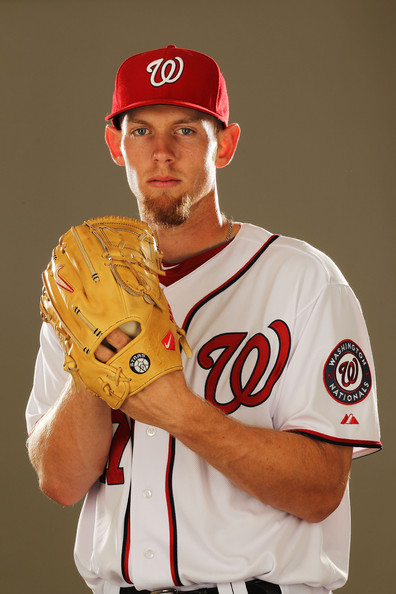
Rob Bland (Baseball Writer- MLB reports): The day so many people (namely the entire Washington Nationals organization) have been waiting for is finally upon us. Stephen Strasburg, ultra phenom, who I covered his rehab here last week at the Reports, started against the LA Dodgers. The hype that was produced was incredible, with every major US sporting website having a headline dedicated to Strasburg-mania. The twitter hashtag #MerryStrasmus has been coined and millions of people are tuning in to watch his first start since Tommy John Surgery.
 Strasburg is a big, strong kid who is known for his tremendous work ethic. It comes as no surprise that he was able to begin pitching less than a year after getting the surgery.
The weather today in Washington DC was wet and dreary, so manager Davey Johnson was close to pulling the plug on the start if the game was even delayed. The Nationals wanted to make sure Strasburg had enough time to warm up and be ready to pitch in the game. When the tarps were taken off the field around 6:45pm, Strasburg was in the middle of his warm-ups.
Dee Gordon led off the game with a double, but after that, Strasburg didn’t see any trouble the rest of the way. Matt Kemp grounded out softly in between fly balls by James Loney and Juan Rivera in the first inning. The second inning was vintage Strasburg, as he threw 3 fastballs between 95 and 97 mph with run and sink, then threw a change-up at 90 mph that Andre Ethier swung over for strike three. Aaron Miles was then disposed of with a 99 mph heater, and Rod Barajas hit a lazy fly ball to center field.
The fourth inning saw Strasburg get two more strikeouts and give up a single to Rivera. Gordon and Rivera’s hits ended up being the only two base runners against Strasburg. His outing ended in the 5th inning after a fly out, ground out and foul out.
Strasburg was dominant. His 4-seam fastball was 95-99 mph throughout his 56 pitch outing, 40 of which were strikes. His 2-seam fastball had great late life, sinking late and inducing ground balls. Only 6 breaking balls were thrown, and although they were pretty sharp and late breaking, it was clearly his 3rd best pitch. Breaking balls are usually the last pitch to come around after Tommy John surgery, because pitchers don’t start throwing it until later in their rehab.
Strasburg’s final line reads as follows:
5IP, 2H, 0R, 0ER, 0BB, 4K.
My pre-game prediction was:
5IP, 3H, 1R, 1ER, 1BB, 9K.
Aside from the strikeouts, I was pretty close. Strasburg is such a rare talent, that a rainy and cold Tuesday night game against a non-contender such as the Dodgers drew over 5,000 more fans than their average season attendance.
Strasburg-mania really hit Washington on a cold, damp Tuesday night. If he continues to pitch like this, the Nationals could be close to contending in 2012, but more likely in 2013 when Bryce Harper could be in the field on an everyday basis.
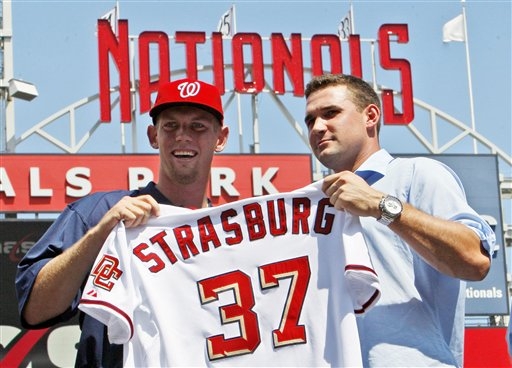
***Today’s feature was prepared by our Baseball Writer, Rob Bland. We highly encourage you to leave your comments and feedback at the bottom of the page and share in the discussion with our readers. You can also follow Rob on Twitter.***
Please e-mail us at: MLBreports@gmail.com with any questions and feedback. You can follow us on Twitter and become a fan on Facebook . To subscribe to our website and have the daily Reports sent directly to your inbox , click here and follow the link at the top of our homepage.

Strasburg-mania Returns to the Nationals September 6th
Saturday September 3, 2011
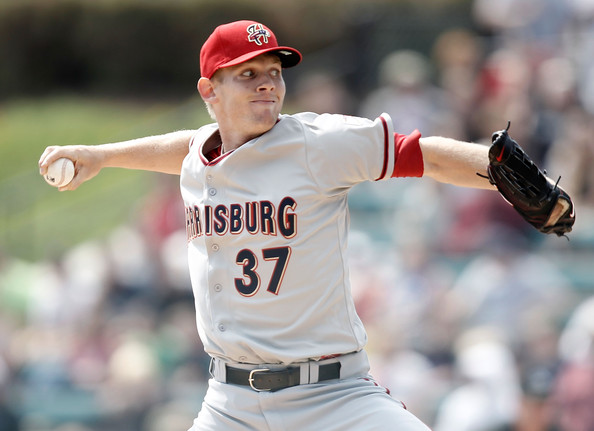
Rob Bland (Intern- MLB reports): Stephen Strasburg burst onto the MLB scene with the Washington Nationals in his first start on June 8, 2010 against the Pittsburgh Pirates. In his 7 inning gem, he struck out 14 batters with 0 walks, and only 4 hits allowed. Throughout the rest of the 2010 season, he relied on a fastball that averaged 97.3 mph. Strasburg also possesses a hard biting, 82 mph curveball and a 90 mph changeup. His 2010 season came to a grinding halt on August 21st that year, when he left a game against the Philadelphia Phillies in which he was dominating with elbow tightness. The Nationals’ front office and coaches all held their breath until after Strasburg’s MRI, which revealed a torn ulnar collateral ligament. Stephen Strasburg required Tommy John Surgery and would be on the shelf for a year.
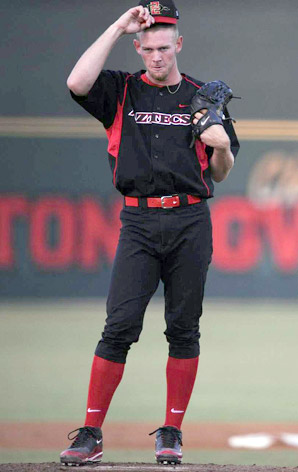
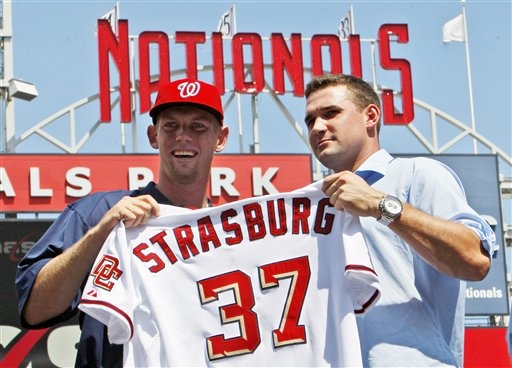 Strasburg had been previously dubbed as the best pitching prospect ever. Strasburg was drafted #1 overall out of San Diego State University in 2009 after what is arguably one of the best college careers for a pitcher of all time. Strasburg signed a $15.1 million dollar bonus just 77 seconds before the deadline that year. In the 2009 season leading up to the draft, Strasburg was pretty much unhittable. In 109 innings, he gave up only 59 hits and 19 walks, compared to 195 strikeouts.
Strasburg’s 2011 season has seen him start off with his rehab in Viera, Florida at the Nationals’ spring training facility. His first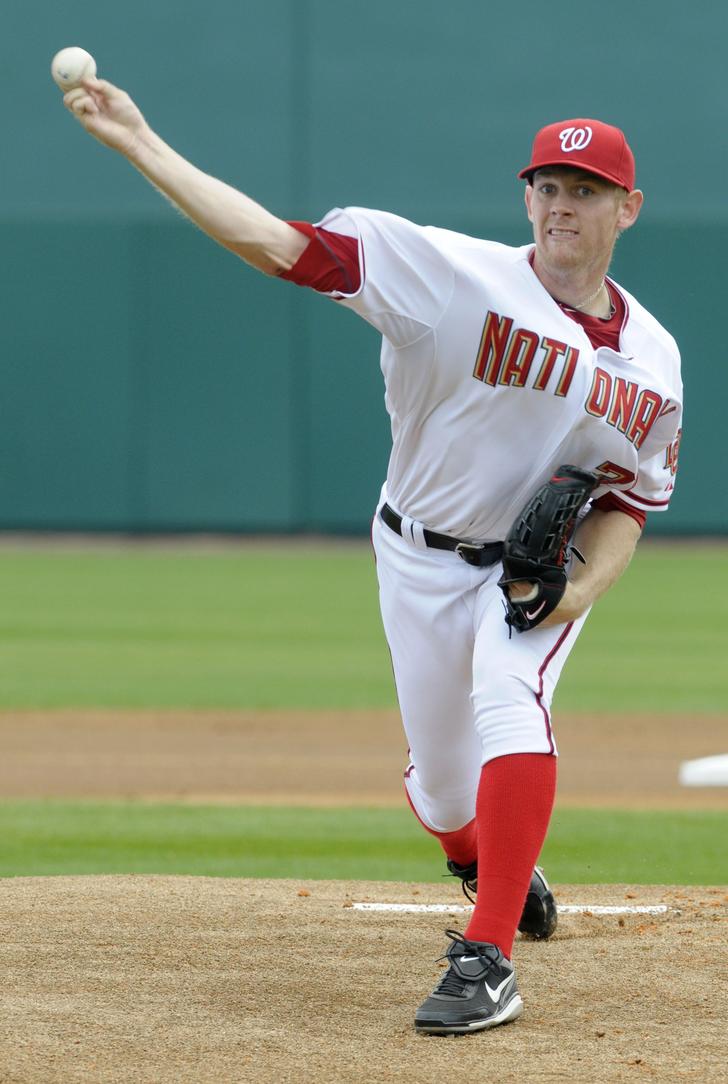 official appearance on his rehab stint was for the Hagerstown Suns of the South Atlantic League in Single-A. Strasburg pitched 1 2/3 innings as he was under a strict pitch limit, and gave up one run with 4 strikeouts. Every 5th day the phenom has taken the mound for Hagerstown, then Potomac in the Advanced A-ball Carolina League. He also pitched in AAA with the Syracuse Chiefs and for the Harrisburg Senators in AA. His last start was the most impressive of all. On September 1st, Strasburg toed the rubber for Harrisburg against the Portland Sea Dogs, Boston’s AA affiliate. Through 6 innings, he faced one batter over the minimum, with only one hit and 4 strikeouts. He also hit 99 mph on the radar gun a number of times.
Strasburg is expected to be called up to start on September 6th at home. He is actually tentatively scheduled to start 4 home games in the month, in part so that the Nationals can reap the benefits of increased gate revenue as well as being able to control game time starts in case of inclement weather.
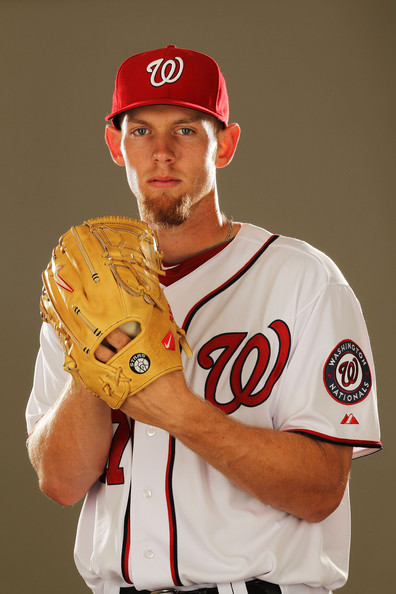 The fact that Strasburg took less than 12 months to be back on a mound is a testament to: a) the advances in the surgery, allowing for less rehab time; b) Strasburg’s work ethic; and c) Strasburg’s freakish body healing so quickly. Strasburg will surely be handled with kid gloves, as he has his entire professional career, never throwing over 100 pitches in a single start.
Strasburg seems to be healthy, and will be looking to be as dominant as his early career has shown. With ultra prospect Bryce Harper and young phenoms like Strasburg, Drew Storen and Ryan Zimmerman, including recently drafted Anthony Rendon and Matt Purke, the future actually looks bright for a franchise that has been hurting for a winner. With a growing fan base (and likely taking fans from the lowly Orioles), this young crop of players look to take the Nationals franchise from laughingstock to a true contender in the tough NL East.
Look for Strasburg’s first start of the season on September 6 against the LA Dodgers. Strasburg is a true rare talent that only comes around once a generation. So if you ever get a chance to see him live, I highly recommend you do so, because you could be a witness to history.
***Today’s feature was prepared by our Intern, Rob Bland. We highly encourage you to leave your comments and feedback at the bottom of the page and share in the discussion with our readers. You can also follow Rob on Twitter.***
Please e-mail us at: MLBreports@gmail.com with any questions and feedback. You can follow us on Twitter and become a fan onFacebook . To subscribe to our website and have the daily Reports sent directly to your inbox , click here and follow the link at the top of our homepage.

Adam Dunn: The Future of the White Sox Slugger
Wednesday August 31, 2011

MLB reports: Not every player can fit onto a particular MLB team. That is a baseball reality. In fact, there are very few, if any players that could produce the same statistics playing for any team. A player’s production is based on many factors, including home park, lineup, adaptability to particular cities and so on. When a team trades for a player or signs a free agent, the hope is that the new player will be able to meet or exceed previous production levels on a new team. Sometimes, the hope is that new environment will revitalize a stagnant player and breath new life into them. In the case of Adam Dunn, the Chicago White Sox signed him to a free agent contract last year. A large deal, 4 years for $56 million dollars. A fair deal in my estimation at the time. The White Sox by signing Dunn were hoping to land an established slugger to fit in the middle of their lineup. What they ended up with was quite different.
Take a look at Adam Dunn’s current production in comparison to his career numbers:
| BA | HR | RBI OBP | ||
|---|---|---|---|---|
| Regular Season | .163 | 11 | 40 .290 | |
| Career | .244 | 365 | 920 .374 |
 To say that Adam Dunn has been anything but a disaster since his arrival in Chicago would be an understatement. Prior to 2011, Dunn’s worst season produced an .819 OPS. That was in 2003, his 2nd full season in the majors that was cut short by injuries. Turn the clock and Adam Dunn sits with a .578 OPS this season with no likelihood of redemption. While some pointed to Dunn playing in a new league for the first time and starting off slow, a turnaround was expected at some point this season. Dunn has actually regressed to the point that he is benched by manager Ozzie Guillen at a frequent rate. A sad state of affairs for one of the game’s previously most consistent sluggers.
For a two-year stretch, from 2003-2008, Adam Dunn was a 40 home runs and 100 walks guy. In his last two seasons, Dunn played in a less than friendly hitters park in Washington and still hit 38 home runs per season. Moving to the White Sox, expectations were that playing in a hitter’s park with a deep lineup would produce possible MVP type numbers for the burly slugger. So what happened? Why the sharp regression?
Part of the issue has been the move to the American League. The adjustment has not worked for some hitters and we have seen NL hitters in the past that cannot play in the AL for whatever reason. Glenn Davis is one famous example that comes to mind, who moved from Houston to Baltimore and literally fell apart overnight. Dunn also is a full-time DH for the first time in his career. Some hitters never take as well to moving off the field and into a DH role, citing inactivity and removal from the full game experience as distractions from their hitting. Given though Dunn’s perceived weak fielding, at both first base and the outfield, a move to DH should have been a welcome change for him. Yet the move was another factor in his year-long slump.
The main culprit in my estimation is the fit, or lack of in Chicago. Perhaps it is the city, or the ballpark, teammates, media or his relationship with the manager. Whatever the reason, I ultimately believe that Adam Dunn and the White Sox simply do not mesh more than anything else. While a return to the field and/or the National League may help, first and foremost Dunn needs to get out of Chicago and start fresh.
 I think of Chone Figgins and his move from the Angels to the Mariners. Despite staying in the same division even, Figgins was never able to meet expectations in Seattle and regressed throughout his time with the Mariners. Had he stayed in Anaheim, the chances are higher that Figgins would have continued playing his game and not transformed into a shell of his former self. Carl Crawford in Boston and Jayson Werthin Washington are players that also signed big-ticket deals and also stayed in their respective divisions, yet faltered in the wake of big contract expectations. But the difference with Crawford and Werth is that they have shown some glimpses of life this season, while Dunn has shown none. I fully expect Crawford at least to be able to make the necessary adjustments and rebound by next season. In Dunn’s case, I do not see that happening without a trade.
Nick Swisher is a situation that I will point to as an example. From the moment Swisher was traded from the A’s to the White Sox, nothing went right. After suffering through the worst season of his career in Chicago, Swisher was traded to the Yankees for pennies on the dollar and blossomed in New York. The same will likely occur to Dunn. A move to the Yankees is a possibility, for a high-profile team that can afford to take on or part of most of Dunn’s salary. A trade for a bad contract is another one, with the Cubs for Zambrano or Giants for Zito as possibilities. Better yet, a move to the Angels could also be the answer. With Mike Trout ready to join an outfield of Peter Bourjos and Torii Hunter, the Angels may not have room for failed trade acquisition Vernon Wells. The White Sox could plug Wells into their outfield and Angels use Dunn to replace Bobby Abreu as DH. A long shot, but certainly a possibility.
No one can be sure if this season is an outlier or an indication of the beginning of the end for Adam Dunn. Based on his strong body of work until this year, I am willing to give him the benefit of the doubt that a rebound will occur. The White Sox might wait it out and give Dunn another shot next year. But then GM Kenny Williams has never been the patient type. After moving Swisher very quickly, I expect the White Sox to do the same with Dunn. This would be a classic buy-low situation for another MLB club. Expect many calls on Dunn in the offseason and a new team by 2012. Despite Dunn indications of having retirement thoughts due to his poor season, I cannot see him going down in this manner. Adam Dunn will be back. The only question is where.

Please e-mail us at: MLBreports@gmail.com with any questions and feedback. You can follow us on Twitter and become a fan on Facebook . To subscribe to our website and have the daily Reports sent directly to your inbox , click here and follow the link at the top of our homepage.

MLB Home Run Leaders: A Look at the Leaderboard
Monday August 29, 2011

MLB reports: We are coming to the last month of the MLB season. Readers are often requesting updates as to the hone run leaders and to handicap who will be the leading sluggers by year’s end. Taking a look at the current top 10 home run hitters in baseball, we find many familiar faces and some surprises. Here is our updated look at the mashers and bombers of baseball:
T-1: Curtis Granderson, New York Yankees (38)
Oh yes. The Grandyman can. The baseball world has gone Granderson crazy. From what appeared to be a hitter on the decline when he joined New York, Curtis Granderson has reinvented himself into an MVP candidate in 2011. Watching Curtis in Detroit, most expected him to be a 20 something home run hitter at most. Imagine that he has already hit 38 home runs with a month to go. It goes to show that baseball can be a very unpredictable sport and that New York still has the power to create miracles. I do not expect to see him on this board for the next five years, but for 2011 at least, Granderson has shot up to the top of the baseball mountain.
T-1: Jose Bautista, Toronto Blue Jays (38)
 A regular on this list all season, Bautista has picked up from where he left off last season. While unable to maintain the Ruthian pace he was on in the first half of the season, Bautista has maintained his strong numbers throughout the year. With his 38 home runs, Bautista has already walked 107 times and has a 1.098 OPS. MVP voters will have much to consider at the ballots this year.
3rd: Mark Teixeira, New York Yankees (35)
There are some certainties in life. Death, taxes and Teixeira home runs. This man is as steady as they come and despite the lack of flash and glitter, he always seems to get the job done. No surprise to see him this high up on the list. Teixeira is simply money in the bank. You never have to worry about him.
T-4: Albert Pujols, St. Louis Cardinals (31)
For all the talk of doom and gloom, Albert Pujols still made the top five list. A “down” season for Sir Albert is a .895 OPS and 31 home runs. Numbers that most players would die for, but not anywhere close to his high standards. As an impending free agent, I fully expect Pujols to remain in St. Louis. But with his statistics not at his norm, the Cardinals might be able to sign him at a slightly more realistic price tag. $22 million per season rather than $25 million perhaps.
T-4: Matt Kemp, Los Angeles Dodgers (31)
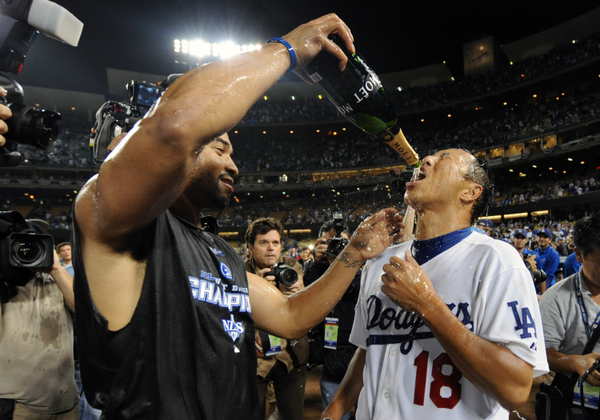 Matt Kemp, or Baby Manny as he was called as a young prospect (the second coming of Manny Ramirez) has blossomed this year. Together with his 31 home runs, Kemp has already driven in 100, has a .964 OPS and a .320 AVG. Getting much press as a NL MVP candidate, Kemp is finally beginning to fulfill on the potential he had shown in his career leading up to this season. People thought for some time he was good, but I don’t think many expected such a strong campaign. A young player on the rise, Kemp might only be scratching the surface on many productive seasons to come.
T-4: Mark Reynolds, Baltimore Orioles (31)
Our generation’s Rob Deer keeps plugging away with the long balls. Reynolds has a respectable 31 home runs thus far, but have come with a whopping 157 strikeouts. More disturbing though his .226 AVG. An all-or-nothing slugger throughout his career, Reynolds is not showing any signs of improvement. The signs are showing for him to bounce around baseball, eventually ending up as a platoon player or even to Japan.
T-7: Mike Stanton, Florida Marlins (30)
One of the youngest and brightest stars in the game, Stanton has exploded in Florida in a big way. Heralded as the next Dave Winfield, Stanton has not disappointed in 2011. With 30 home runs to go along with a .889 OPS, Stanton is showing that the promise and hype is for real. Rumored to be requested by the White Sox as part of the Marlins hoping to land Ozzie Guillen as a manager, the Marlins are surely happy they held onto their young slugger. Together with Logan Morrison and Gaby Sanchez, expect Stanton to blossom into a top ten player in baseball very soon.
T-7: Lance Berkman, St. Louis Cardinals (30)
 Once considered a top hitter in the game, Berkman had many question marks surrounding him after a down season last year. While many analysts thought the Cardinals were taking a risk by signing him, the Cardinals brass were confident in Berkman’s ability to rebound. Back in the NL Central and surrounded by Pujols and Matt Holliday in the lineup, Berkman has not disappointed. With 30 home runs, 77/75 BB/K, .289 AVG and .975 SLG, Berkman is getting MVP consideration as well as a lock as the NL Comeback Player of the Year. While Berkman cannot continue like this forever, expect at least 1-2 more solid seasons out of the seasoned veteran.
T-7: Dan Uggla, Atlanta Braves (30)
What a journey Uggla took this year. With a .232 AVG, one expect Uggla to be considered to be having an off-year. But with 30 home runs a 33-game hitting streak, Uggla has had his moments this year. Considered one of the best hitting second basemen in the game, power is a big part of Uggla’s repertoire. While the rest of the numbers are down, the long balls have remained constant. With his first year on a new team out of the way, expect a rebound from Uggla next season.
T-10: Prince Fielder, Milwaukee Brewers (29)
Considered to be one of the biggest prizes in the offseason free agent derby, Prince Fielder is having a fantastic campaign for the Brewers. Together with his 29 home runs, Fielder scored 81 runs, driven in 102, has 87/84 BB/K and hit .295, with a .955 OPS. The questions on people’s minds is whether he will stay in Milwaukee and if the biggest free agent contract this year will go to Fielder or Pujols. With Scott Boras as his agent, my money is on Fielder moving to greener pastures and commanding the top contract as a free agent. Together with Ryan Braun, Fielder gives the Brewers a strong team going into the playoffs in what is likely his last season in Milwaukee. Although number ten on this list, Fielder has shown the consistency this season to be considered one of the top hitters in the NL this season.
Please e-mail us at: MLBreports@gmail.com with any questions and feedback. You can follow us on Twitter and become a fan on Facebook . To subscribe to our website and have the daily Reports sent directly to your inbox , click here and follow the link at the top of our homepage.

Edgar Martinez Should Be Inducted Into Cooperstown: Future Mariners Hall of Famer
Friday August 26, 2011
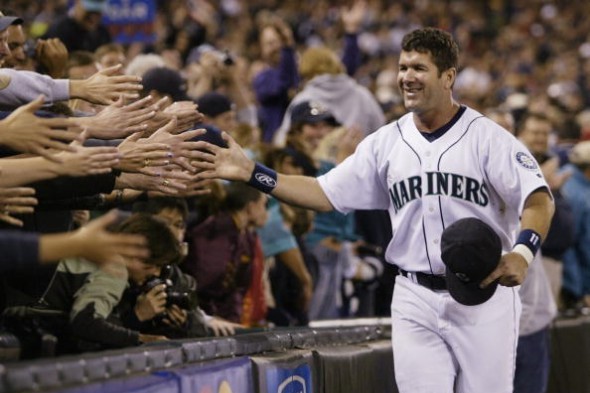
Sam Evans (Intern Candidate- MLB reports): When you think of the most consistent hitters during the 1990’s, most people think of Barry Bonds and Mark McGwire. One name that always gets overlooked is Edgar Martinez. He had a .312 career batting average, reached base more than 40% of the time, has never has been linked to steroids, and he arguably saved baseball in Seattle for years to come.
Some of the arguments against Edgar being in the Hall of Fame are that he hardly played in the field, was not a superstar, never won a world series, and that his numbers just aren’t good enough. As a Mariners fan, I definitely have bias but I’ll try to explain why I think Edgar should legitimately be in the Hall of Fame. First of all, if his numbers aren’t good enough, why was Andre Dawson’s statistics enough for him to be voted into the hall of fame? Let’s compare the two hitters:
Edgar (Career) .312/.418/.515. Wins Above Replacement (courtesy of fangraphs.com): 69.9
Andre Dawson: .279/.323/.482 Wins Above Replacement: 62.3
What’s the difference between these two? The Hawk is in the Hall of Fame, which Dawson deserved. Other Hall-of-Famers with a lower WAR than Edgar are Harmon Killebrew, Dennis Eckersley, and Jackie Robinson. There are over 230 former MLB players in the Hall of Fame. I think it’s amazing that Edgar is not one of them.
After Edgar missed the 1994 season due to injury, he became the Mariners full-time designated hitter. He would go on to be the Mariners starting DH for the next ten years. When asked how that would affect his Hall of Fame chances, Edgar replied, “There are a lot of different opinions about it. What I think is that the DH makes a daily contribution to the team, just like any position player who plays every day.” In 1973, major league baseball instituted the Designated Hitter as a real position. So why should this prevent a primary DH from ever reaching Cooperstown?
In his first season as a DH, Martinez won his second American League batting title, hitting .356 with an OBP of .479 and a slugging percentage of .628. Hall of famers Hank Aaron and Willie Mays never had a season with an OBP over .425. It is my estimation that Martinez wasn’t a superstar across the baseball scene because of where he played. If he played in New York, chances are it wouldn’t be this hard for him to get into Cooperstown. The low light of Edgar’s career is definitely though that he never won a World Series championship. Superstars that win the big one tend to be favored in the eyes of Cooperstown voters.
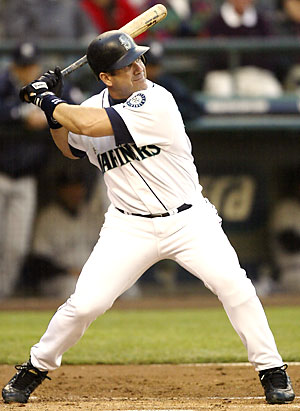 During the 1995 season the city of Seattle fell in love with the Mariners. After having just two winning seasons in their first sixteen years, Edgar and Ken Griffey Jr. led the Mariners to a 79-66 record. In the 1995 ALDS series between the Mariners and the Yankees, Edgar reached base 2/3 of the time and had two game winning hits. On October, 8, 1995, with the series tied 2-2, the Mariners battled back to score two runs and send the game into extra innings. After the eighth inning, the crowd started chanting “Randy! Randy! Randy!” Finally Lou Piniella gave in and Randy Johnson walked out to the mound to Welcome to the Jungle booming through the Kingdome’s outdated speakers. However in the top of the eleventh tragedy struck. A walk, bunt, and single put the Yankees in the lead, and with their stud pitcher Jack McDowell coming in to pitch the M’s chances looked pretty slim. With runners on first and third, Edgar ended up hitting a double down the left field line to win the series for the M’s. The Mariners were eliminated in the ALCS at the end by the Indians, but the effect of Edgar’s hit had MLB fans everywhere truly excited about Mariners baseball for the first time ever.
The thing is that he wasn’t just successful in the playoffs; Martinez won Seattle one of the more beautiful MLB ballparks, Safeco Field. Two months earlier, 50.1% of King county voters voted NO on a $410 million proposal for a new stadium, to keep the Mariners in Seattle. The state legislature later approved a new stadium for the Mariners, mainly due to public pressure. This led people to think what would have happened if it weren’t for Edgar’s clutch hit.
Edgar was known for his great batting eye, which resulted from a series of drills before every game he utilized to improve it. He also gave back to the community by founding the Martinez foundation, which helps give minorities’ access to proper education. When Edgar retired in 2004, Paul Molitor said, “He was one of the most feared right-handed hitters for a long time in this league. The amount of respect he has from peers speaks to the value of the offensive player he was.”
In 2010, Edgar’s first year eligible for the hall, he received 36.2% of the BBWAA votes. Martinez missed the 75% cutoff. This year he received 32.9 % of the vote. Who knows if Edgar will ever be in the Hall of Fame, this year definitely wasn’t encouraging. But in Bert Blyleven’s (elected in 2011, after 14 years of eligibility) second year on the ballot, he received only 14.1% of votes. So there is reason for optimism. Whether Edgar ever makes it to Cooperstown or not, he will always be a hero to Mariners fans and one of the best pure hitters in major league history.
***Today’s feature was prepared by one of our intern candidates, Sam Evans. We highly encourage you to leave your comments and feedback at the bottom of the page and share in the discussion with our readers. You can also follow Sam on Twitter.***
Please e-mail us at: MLBreports@gmail.com with any questions and feedback. You can follow us on Twitter and become a fan onFacebook . To subscribe to our website and have the daily Reports sent directly to your inbox , click here and follow the link at the top of our homepage.

RIP Mike Flanagan: Former MLB Pitcher with Orioles and Jays Passes Away
Wednesday August 24, 2011

MLB reports: We are sad to report that Mike Flanagan, ex-MLB pitcher was found dead in Baltimore County today. Flanagan was 59 years of age. While the news is still trickling in, it is currently being reported that Flanagan’s body was found on a trail near his home. The body has just been recently identified as being that of Mike Flanagan. After some distresses relating to finances, Flanagan apparently took his own life. A very spirited baseball man, Flanagan was a beloved figure in the sport and his death has sent shock waves through the baseball community. Mike Flanagan devoted his life to baseball and we are all very saddened by the new of his passing.
Mike Flanagan was originally a 7th round draft pick of the Baltimore Orioles in 1973. Flanagan spent 18 productive seasons in baseball, with 15 coming in Baltimore. In addition to pitching for the Orioles, Flanagan spent part of 4 years with the Blue Jays. Although he pitched only a short time in Toronto, Flanagan’s name is still tossed around as one of the all-time favorite Jays pitchers. Such is the effect this man had on pitching. But Flanagan will forever be linked with the Baltimore Orioles, the club that he came up with and ultimately retired from. Here is a look at the career numbers of Mike Flanagan:
| Year | Tm | W | L | ERA | IP | BB | SO | WHIP |
|---|---|---|---|---|---|---|---|---|
| 1975 | BAL | 0 | 1 | 2.79 | 9.2 | 6 | 7 | 1.552 |
| 1976 | BAL | 3 | 5 | 4.13 | 85.0 | 33 | 56 | 1.365 |
| 1977 | BAL | 15 | 10 | 3.64 | 235.0 | 70 | 149 | 1.298 |
| 1978 | BAL | 19 | 15 | 4.03 | 281.1 | 87 | 167 | 1.273 |
| 1979 | BAL | 23 | 9 | 3.08 | 265.2 | 70 | 190 | 1.186 |
| 1980 | BAL | 16 | 13 | 4.12 | 251.1 | 71 | 128 | 1.389 |
| 1981 | BAL | 9 | 6 | 4.19 | 116.0 | 37 | 72 | 1.250 |
| 1982 | BAL | 15 | 11 | 3.97 | 236.0 | 76 | 103 | 1.309 |
| 1983 | BAL | 12 | 4 | 3.30 | 125.1 | 31 | 50 | 1.324 |
| 1984 | BAL | 13 | 13 | 3.53 | 226.2 | 81 | 115 | 1.297 |
| 1985 | BAL | 4 | 5 | 5.13 | 86.0 | 28 | 42 | 1.500 |
| 1986 | BAL | 7 | 11 | 4.24 | 172.0 | 66 | 96 | 1.424 |
| 1987 | TOT | 6 | 8 | 4.06 | 144.0 | 51 | 93 | 1.382 |
| 1987 | BAL | 3 | 6 | 4.94 | 94.2 | 36 | 50 | 1.458 |
| 1987 | TOR | 3 | 2 | 2.37 | 49.1 | 15 | 43 | 1.236 |
| 1988 | TOR | 13 | 13 | 4.18 | 211.0 | 80 | 99 | 1.422 |
| 1989 | TOR | 8 | 10 | 3.93 | 171.2 | 47 | 47 | 1.357 |
| 1990 | TOR | 2 | 2 | 5.31 | 20.1 | 8 | 5 | 1.770 |
| 1991 | BAL | 2 | 7 | 2.38 | 98.1 | 25 | 55 | 1.108 |
| 1992 | BAL | 0 | 0 | 8.05 | 34.2 | 23 | 17 | 2.106 |
| 18 Seasons | 167 | 143 | 3.90 | 2770.0 | 890 | 1491 | 1.334 | |
| 162 Game Avg. | 12 | 10 | 3.90 | 203 | 65 | 109 | 1.334 | |
| W | L | ERA | IP | BB | SO | WHIP | ||
| BAL (15 yrs) | 141 | 116 | 3.89 | 2317.2 | 740 | 1297 | 1.323 | |
| TOR (4 yrs) | 26 | 27 | 3.94 | 452.1 | 150 | 194 | 1.393 | |
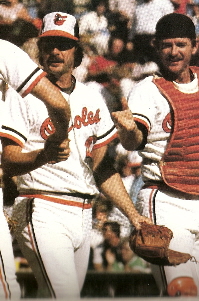
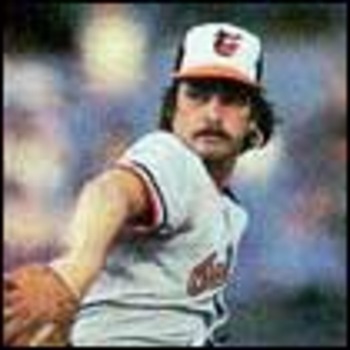 Flanagan made his major league debut in 1975. He started to come into his own in 1978, with a 19 win season and 4.03 ERA, to go along with his only all-star game appearance. The real breakthrough came in 1979, when Flanagan won 23 games, with a 3.08 ERA and a whopping 190 strikeouts. Flanagan that year won the AL Cy Young award, in addition to finishing 6th in the AL MVP voting. Flanagan played in the World Series in 1979 with the Orioles, losing to the Pirates. The Orioles and Flanagan were back though in 1983, beating the Phillies to win the World Series. In 1987, Mike Flanagan was traded to the Jays for hurlers Oswaldo Pereza and Jose Mesa. Flanagan played in the ALCS with the Jays in 1989, his final MLB playoff appearance. In 1991, Flanagan re-signed with the Orioles as a free agent and he continued with the Orioles until retiring in 1992. Mike Flanagan and the Baltimore Orioles will forever be linked in baseball history. Flanagan spent the majority of his career in Baltimore, the sight of his greatest baseball triumphs.
Following his retirement from the game, Flanagan continued in Baltimore in many capacities. In addition to serving in the broadcast booth, Flanagan served as the Orioles pitching coach, as well as Vice-President/Co-GM (unofficially with Jim Duquette). The man gave his heart and soul to the city of Baltimore and was a beloved sports figure in the eyes of the Orioles fans. It is a tragedy when the MLB family loses one of its members and today we have lost a great one in Mike Flanagan. We will remember Mike for his time in the game, as a player, broadcaster, coach and executive. I had the pleasure of watching Mike pitch on many occasions. He was a gamer. Flanagan always gave it his all and was a steady presence on every pitching staff that he played with. We thank Mike Flanagan for the memories and remember him fondly on this very sad day.
Please e-mail us at: MLBreports@gmail.com with any questions and feedback. You can follow us on Twitter and become a fan on Facebook . To subscribe to our website and have the daily Reports sent directly to your inbox , click here and follow the link at the top of our homepage.

Tyler Beede Chooses Vanderbilt over the Blue Jays
Saturday August 20, 2011
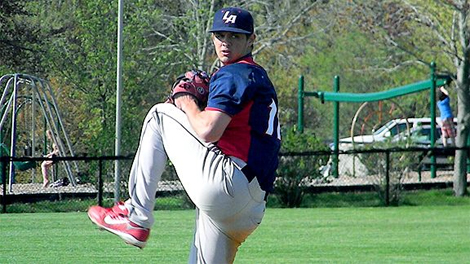
Before the 2011 MLB Draft, Auburn, Massachusetts native Tyler Beede signed a National Letter of Intent to attend Vanderbilt University. In the months leading up to the draft, Beede made it known to MLB scouts and cross-checkers that he was going to attend Vanderbilt. He felt as though the college experience and the education he would receive would be the best thing for him.
 Vanderbilt is also a member institution of the Southeastern Conference (SEC). The SEC is arguably the best conference in the NCAA for baseball as well as other sports. There has been a long line of first round draft choices that have been Commodores. In the last seven years, Vanderbilt has had 48 players drafted, while 6 of those have been in the first round. Jeremy Sowers (6th in 2004), David Price (1st in 2007), Casey Weathers (9th in 2007), and Mike Minor (7th in 2009) are the pitchers taken in the first rounds of their drafts for the Commodores. Vanderbilt also took part in their first NCAA College World Series in 2011, and hope to build upon that success. Vanderbilt head coach Tim Corbin has said that Beede has been in Vanderbilt baseball camps since his freshman year of high school, so it is safe to say that Tyler is extremely comfortable with the staff and surroundings.
When a player with as much talent as Beede chooses a successful program, it is often to create leverage in negotiating with a drafting team. There have been many players who sign with schools such as University of Texas, Louisiana State University, or University of California simply to earn a larger signing bonus in professional baseball. The stronger the player’s commitment to school, the more leverage he has to get the MLB team to offer top dollars. Since MLB teams generally don’t like to “waste” their pick and not sign a guy, they will often have to break the bank to make him sign on the dotted line.
When a player tells a scout that he wants X amount of dollars, it often scares teams away from that player, dropping him to later rounds, or out of the draft altogether. Tyler was drafted in the 1st round (21st overall) of the 2011 MLB Draft by the Toronto Blue Jays, although he could have gone sooner if not for his demands. The Blue Jays and GM Alex Anthopoulos were known to be planning an aggressive approach to this year’s draft, and even though Beede stated he wanted the big bucks, the Jays were confident that they could sign him. So confident that many people in baseball were calling for investigations that the Blue Jays had worked out a pre-draft deal with Beede for around $2M.
__________________________________________________________________________________________________________________
 For those of you who don’t know me, my name is Rob Bland, and like Beede, was a tall right-handed pitcher in high school. I may not have thrown as hard as Beede but I routinely flashed 89-91 mph on scouts’ radar guns. Scouts were behind the backstop for each one of my games from my junior year in high school on. I played for a prestigious program in Team Ontario and graduated to the Canadian Junior National Team and had a ton of great exposure. Before the 2002 MLB draft, I had signed with the University of Kentucky, also in the SEC, and told scouts I was going to school unless a lot of money was put in front of me. I was ranked in Baseball America’s top 150 draft prospects list, and I was told by some teams I could go as high as the 7th to 10th rounds. I went back and forth between school and professional baseball, but I felt I wasn’t ready to be a pro. My parents, like Beede’s, thought that I was mature enough to make this life-altering decision on my own. Education has always been very important to my family, and ultimately I decided that unless I was blown away by an offer, I would go to school. The fact that Beede has been on record of saying that he would have signed for $3.5M leads me to believe that he felt the same way. He had a number in mind, and unless it was reached, he would be perfectly content in attending college. I ended up requesting 3rd round money as a leverage tool (around $250,000 at the time). I figured that I would improve so much over the next three years that I would easily be a 3rd round selection at worst in 2005. Teams considered me “unsignable” and I was not selected at all. I went to the University of Kentucky where I struggled with adjusting to college life and could not stay healthy, spending most of my time in the trainer’s room, until finally requiring Tommy John surgery.
I could look back and say I should not have declared lofty demands and just taken what could have been given to me, but the reality is that I genuinely wanted to go to college. Beede has also been adamant that he wants to enjoy the college experience and step into a role where he can make a big difference. I also thought at the time that when I worked hard, I could improve and be drafted higher in the future. At the time I thought it was the right choice, but now I look back and wonder how I could have done in professional baseball.
I am not trying to compare myself with Beede, as he is obviously a much bigger talent, but there are some parallels. If he gets injured, or if he struggles and cannot figure college hitters and metal bats out, he could be losing out on a lot of money and a career in professional baseball.
I have no doubt that Beede’s talent will shine in the SEC, and he will again be drafted in 2014. However, I seriously doubt it will be as high of a selection, or that he will be offered the same $2.5M that the Blue Jays offered this year. With the next Collective Bargaining Agreement sure to stop the huge spending on the draft, players will not have the same bargaining power.
 I have heard many Toronto Blue Jays fans saying that Beede was foolish for turning down the money, or that they hope that he does not succeed and regrets his decision. Some have said that he is immature, or that he doesn’t deserve to play professional baseball. “Tyler Beede is greedy” and “Beede is a jerk” has been posted on Twitter . All of these comments are completely unfair because he is an 18-year-old kid and decisions like these are not easy to make. In my opinion, he made a very mature decision that 99.9% of us find easy to scoff at. Who can turn down $2.5M to do something they love to do? What people don’t realize is that he has a huge love for Vanderbilt and their program. He feels more COMFORTABLE at Vandy than he does in the Toronto Blue Jays organization right now. For a ballplayer, comfort breeds confidence, and Beede I am sure is brimming with confidence right now.
Is this a decision that Beede may regret in 10 years? Maybe. Is he dumb? Absolutely not. Beede will look to become the second Vanderbilt Commodore to be selected first overall in a future MLB Draft. If that becomes the case, Beede will make a lot more money at that time than he was offered by the Blue Jays in 2011 and have a solid university education behind him.
***Today’s feature was prepared by our Intern, Rob Bland. We highly encourage you to leave your comments and feedback at the bottom of the page and share in the discussion with our readers. You can also follow Rob on Twitter.***
Please e-mail us at: MLBreports@gmail.com with any questions and feedback. You can follow us on Twitter and become a fan onFacebook . To subscribe to our website and have the daily Reports sent directly to your inbox , click here and follow the link at the top of our homepage.

Mike Jacobs: Rockies Slugger Receives 50 Game HGH Suspension
Friday August 19, 2011

MLB reports: Major League Baseball commenced human growth hormone (“HGH”) testing in the minor leagues in the summer of 2010. It was only a matter of time before players began to get caught under the new system. Blood testing for HGH in the minors was the first step in bringing similar tests to the major leagues one day. With HGH testing now in place as part of the NFL’s new collective bargaining agreement, MLB cannot be far behind. With baseball’s agreement with the union set to expire in December of this year, expect HGH testing to be a big topic on the bargaining table. The first player to be caught in the minors using HGH and receiving a 50 game suspension is Colorado Rockies slugger, Mike Jacobs. With the first HGH culprit found, pressure will be intense on baseball to bring similar testing all the way to the major leagues.
 Mike Jacobs will forever be known as the first North American athlete to test positive for HGH. Although HGH suspensions have occurred internationally, Jacobs is the first athlete in a professional North American athlete to be tested and fail a HGH test. Things should have gone differently for Jacobs in his career. Originally a 38th round pick for the Mets in the 1999 draft, Jacobs rose from baseball obscurity to star with the Marlins from 2006-2008. Here is a look at Jacobs’ major league stats:
| Year 5 | Tm | R | HR | RBI | SO | BA | OBP | SLG |
|---|---|---|---|---|---|---|---|---|
| 2005 | NYM | 19 | 11 | 23 | 22 | .310 | .375 | .710 |
| 2006 | FLA | 54 | 20 | 77 | 105 | .262 | .325 | .473 |
| 2007 | FLA | 57 | 17 | 54 | 101 | .265 | .317 | .458 |
| 2008 | FLA | 67 | 32 | 93 | 119 | .247 | .299 | .514 |
| 2009 | KCR | 46 | 19 | 61 | 132 | .228 | .297 | .401 |
| 2010 | NYM | 1 | 1 | 2 | 7 | .208 | .296 | .375 |
| 6 Seasons | 244 | 100 | 310 | 486 | .253 | .313 | .475 | |
| 162 Game Avg. | 71 | 29 | 90 | 142 | .253 | .313 | .475 | |
| FLA (3 yrs) | 178 | 69 | 224 | 325 | .258 | .314 | .483 | |
| NYM (2 yrs) | 20 | 12 | 25 | 29 | .290 | .360 | .645 | |
| KCR (1 yr) | 46 | 19 | 61 | 132 | .228 | .297 | .401 | |
| NL (5 yrs) | 198 | 81 | 249 | 354 | .261 | .317 | .496 | |
| AL (1 yr) | 46 | 19 | 61 | 132 | .228 | .297 | .401 | |
2008 represented the best season of Jacobs’ career. He hit 32 home runs, to go along with 93 RBIs for the Marlins. But despite the strong power numbers, critics pointed to his .247 AVG and weak .299 OBP that year and labelled him a one-dimensional player. The Marlins agreed and traded Jacobs in October 2008 for current closer Leo Nunez. Jacobs originally joined the Marlins in November 2005 as a package of players for superstar Carlos Delgaldo. Big expectations were placed on Jacobs to replace Delgaldo ever since he joined the Marlins. While Jacobs had the strong power numbers in 2008, the team ultimately was not convinced that he would ever fulfill his potential. While Nunez went on to star in the Marlins bullpen, Jacobs lasted only one season in Kansas City, his last full season in the big leagues.
 In 2010, Jacobs spent parts of the year playing in the Mets and Blue Jays farm systems. He hit 21 home runs and drove in 93 in 120 games combined in AAA, with a .335 OBP and .482 SLG. This season, Jacobs played exclusively in Colorado Springs and put up inflated numbers in the hitting friendly Pacific Coast League. With 23 home runs in 117 games, 97 RBIs, .376 OBP and .534 SLG, there looked to be a chance for Jacobs to restart his major league career. At 30-years of age, Jacobs was looking to have a year-end cup of coffee with the Rockies and leave a strong enough impression to perhaps have a chance in spring training 2012. Reports had a call up imminent for Jacobs when news of the HGH positive test leaked out. The Rockies immediately released the slugger, who is now on the MLB sidelines.
Following the Marlins acquisition of Jacobs in 2005, I expected his career to develop differently. It was clear the power was going to be there. It was the rest of his hitting development that I expect to follow. To stay in the big leagues, Jacobs was going to need to learn patience and to hit lefties. Following his 2008 campaign, I still hoped in the back of my mind that those qualities would eventually come out. But they never in fact did. Looking back at his magical 2008 campaign, there were red flags that Jacobs had major shortcomings as a hitter. 25 of his home runs came against right-handed pitchers. Against lefties, Jacobs hit .218 with a .248 OBP and .429 SLG. At best, without improvement, Jacobs was likely destined to be a platoon player for the rest of his career. Now today, Jacobs stands as the new poster child for HGH cheating. A scarlet letter that will be difficult, if not impossible to remove.
 With Barry Bonds, Mark McGwire and Rafael Palmeiro gone from the game and the “steroid era” at an apparent end, the focus is now on HGH. Apparently very wide-spread in the game, baseball officials are said to be taking a hard stance to remove HGH use from the game. In suspending Jacobs, commissioner Selig indicated that baseball is on top of testing and is not hiding from the process. I expect HGH testing to be a part of the major leagues as early as 2012. Despite the tests and the threat of strict penalties, as Mike Jacobs has shown, athletes will continue to try to get ahead despite the risks involved. Jacobs came clean following his positive test, admitting usage to overcome injuries and regretting his decision to use HGH. The decision to use HGH will cost Jacobs more than 50 games. It resulted in his dismissal from the Rockies and likely removal from major league baseball all together. For a fringe player that was already hanging by a thread, having the HGH suspension on his resume will scare off many, if not most major league teams.
Mike Jacobs had his chances in baseball. While many sluggers before him are lucky to get one shot at the big leagues, Jacobs had several chances. Despite playing for three teams over six major league seasons, Mike Jacobs was never able to fulfill his vast potential. Like many left-handed home run hitters, Jacobs could never hit well against lefties and get on base at a high enough level to compliment his power bat. Now at 30-years of age, the legacy of Mike Jacobs will be as using HGH and failing the first North American test. While I expected Jacobs to be fighting for home run crowns at this point in his career, he now sits outside of baseball. A lesson to be learned for future sluggers. It is better to play clean and keep your reputation than cheat and get caught. Once the first failed test hits, any accomplishments in the past and future will always be tarnished. As Palmeiro, Bonds, Sosa and McGwire can attest, poor public perceptions never seem to go away. They just continue to linger, seemingly until the end of time.

Please e-mail us at: MLBreports@gmail.com with any questions and feedback. You can follow us on Twitter and become a fan on Facebook . To subscribe to our website and have the daily Reports sent directly to your inbox , click here and follow the link at the top of our homepage.

Flashback: Steve “Bye Bye” Balboni Profile
Monday August 15, 2011
MLB reports: Today we are taking a walk down memory lane to revisit one of our favorite players of all time. Steve Balboni, or better known to baseball fans as “Bye Bye” Balboni, was one of the prominent home run hitters of the 1980s. Balboni was an all or nothing hitter, either launching home runs or striking out at a high clip throughout his career. In the likeness of Rob Deer at the time and Mark Reynolds today, Balboni was the type of hitter that we do not often see in the majors anymore. Always want fun to watch and having left us with memories of moon shots off his bat, today we look back at the career of Bye Bye Balboni.
Balboni played for four major league teams over his eleven MLB seasons: the Yankees, Royals, Mariners and Rangers. His power numbers over his career speak for themselves:
| Year | Tm | HR | RBI | BB | SO | BA | OBP | SLG |
|---|---|---|---|---|---|---|---|---|
| 1981 | NYY | 0 | 2 | 1 | 4 | .286 | .375 | .714 |
| 1982 | NYY | 2 | 4 | 6 | 34 | .187 | .228 | .280 |
| 1983 | NYY | 5 | 17 | 8 | 23 | .233 | .295 | .430 |
| 1984 | KCR | 28 | 77 | 45 | 139 | .244 | .320 | .498 |
| 1985 | KCR | 36 | 88 | 52 | 166 | .243 | .307 | .477 |
| 1986 | KCR | 29 | 88 | 43 | 146 | .229 | .286 | .451 |
| 1987 | KCR | 24 | 60 | 34 | 97 | .207 | .273 | .427 |
| 1988 | TOT | 23 | 66 | 24 | 87 | .235 | .277 | .448 |
| 1988 | KCR | 2 | 5 | 1 | 20 | .143 | .156 | .270 |
| 1988 | SEA | 21 | 61 | 23 | 67 | .251 | .298 | .480 |
| 1989 | NYY | 17 | 59 | 25 | 67 | .237 | .296 | .460 |
| 1990 | NYY | 17 | 34 | 35 | 91 | .192 | .291 | .406 |
| 1993 | TEX | 0 | 0 | 0 | 2 | .600 | .600 | .600 |
| 11 Seasons | 181 | 495 | 273 | 856 | .229 | .293 | .451 | |
| 162 Game Avg. | 31 | 84 | 46 | 144 | .229 | .293 | .451 | |
| KCR (5 yrs) | 119 | 318 | 175 | 568 | .230 | .294 | .459 | |
| NYY (5 yrs) | 41 | 116 | 75 | 219 | .214 | .286 | .415 | |
| TEX (1 yr) | 0 | 0 | 0 | 2 | .600 | .600 | .600 | |
| SEA (1 yr) | 21 | 61 | 23 | 67 | .251 | .298 | .480 | |
 One may have expected Balboni to have more than 181 career home runs over his career. Consider though that over his eleven seasons, Balboni only played one full season (1985). In the Royals World Series championship year, Balboni was at his peak. He had a career high 36 home runs, to go along with his league leading 166 strikeouts. Balboni only had 400 or more at-bats in four major league seasons. Despite only having one full season of at-bats under his belt, Balboni had six or more seasons for of 20+ home runs. But it was not the memory of the number of home runs or strikeouts that Balboni that has lasted with us. It was the way he came to the plate and swung completely for the fences.
When Bye Bye Balboni connected for home runs, the sound of the ball launching off his bat was a thing of beauty. At 6’3″ and 225 lbs, Balboni was built like a tank. The bat looked like a toothpick in his hands and when he saw a fastball that was to his liking, the ball was either going to end up out of the yard or in the catcher’s mitt. A fan favorite wherever he played, Balboni was the picturesque cleanup hitter of the 80s. With a career .229 AVG and .293 OBP, Balboni was not a “moneyball” type player by a stretch of the imagination. But the 80s were a different time in baseball and Balboni fit the mold in his day. The power hitting first baseman/DH. A one-dimensional player (home runs and strikeouts), but a great deal of fun to watch for the fans.
Today’s game is built on young, athletic players with multiple-tools. As we have left the steroid era, MLB teams are shifting towards teams built on strong pitching, defense and speed. The 1B/DH types like David Ortiz and Travis Hafner are starting to disappear, as American League teams shift to using the designated hitter spot to rotate players rather than employing a full-time DH. As a result, we are unlikely to see many more Bye Bye Balboni’s in the major leagues again. Valentino Pascucci was the closest player that I could think of that resembled a modern-day Balboni. But in today’s game, Pascucci has barely received a cup of coffee at the majors, while Balboni enjoyed eleven seasons in the big leagues.
Bye Bye Balboni got to live the major league dream. He was a second round pick of the Yankees in 1978 and played five seasons in New York. Balboni was also quite a legend in his day in the minor leagues, assembling 239 career minor league home runs, together with 930 strike outs. Balboni was named MVP of the Florida State League in 1979 and 1980 in the Southern League. Today, Bye Bye Balboni continues his career as a coach, with different organizations in the minors. You can learn more about Steve Balboni by visiting his website, http://stevebalboni.com.
One of the players of his generation that will stick out in our minds forever, we thank Bye Bye Balboni for the home runs he hit and the excitement he brought to the game during every one of his at-bats. While the game has evolved to new levels, there is a part of us that will miss the burly sluggers in the game in the Bye Bye Balboni mold that are no longer with us. Thank you for the memories Steve and for the home runs!
If you have a favorite Steve Balboni moment or story, we would love to hear from you. Please leave your comments at the bottom of this article.

Please e-mail us at: MLBreports@gmail.com with any questions and feedback. You can follow us on Twitter and become a fan on Facebook . To subscribe to our website and have the daily Reports sent directly to your inbox , click here and follow the link at the top of our homepage.

Logan Morrison sent to AAA New Orleans: Marlins and Loria Censor LoMo
Sunday August 14, 2011

MLB reports: The Florida Marlins have one of the brightest prospects in the game in its system. Logan Morrison, the 23-year old first baseman/outfielder is seen as one of the next up-and-coming stars. I have compared him on many occasions to Will Clark and Mark Grace for his outstanding eye at the plate and smooth swing. Blocked at first base by incumbent Gaby Sanchez, Logan (“LoMo”) Morrison has transitioned himself into a fairly steady outfielder. Yet despite being one of the Marlins best offensive players and team leaders, LoMo finds himself headed to AAA as of last night.
At 56-62, 13.5 GB behind the 1st place Phillies, 2011 has been a lost season for the Marlins. Now is the time for the team to play its younger players, to get their feet wet and ready for next season. Further the Marlins are opening up their new stadium in 2012 and need to build hype and excitement in selling future tickets. With the team in last place, one would expect the Marlins to promote and push its best prospects and young players in selling the team to its fan base. But rather than encourage its players to promote the team and connect with the fans, the Marlins and its owner Jeffrey Loria have demoted LoMo to the minors. A big part of the reason is the social media known as Twitter.
For those of you not familiar or not active on Twitter, you may not know Logan Morrison is an active tweeter. Using the handle @LoMoMarlins, LoMo is one of the most popular athletes on the site and is often found speaking and joking with fans. In an age where athletes are either completely disconnected from fans or getting into hot water by being arrested/making inappropriate statements, LoMo is refreshing. Morrison is a clean-cut athlete who is outgoing and fun. I could not put specific numbers for you today, but I am sure that Morrison is singlehandedly responsible for building thousands of loyal Marlins followers, just based on his tweets. At 6’3″, 235 lbs, Morrison has the looks and ability to be the face of the Marlins. With the new stadium set to open up, I would expect the Marlins to promote the team around Morrison. Rather the team has alienated one of its top talents and in the process, angered the fan base it should be reaching out to.
For background, the process of sending down LoMo is further upsetting based on how much he gives back to the Marlins. He worked hard to learn a new position and become an above average outfielder. He plays hurt. He trains hard. LoMo is also active in the community giving countless hours back in charity work. Not that it should factor in his role on the team, but LoMo also lost his father to cancer in December 2010. As father and son were very close, the loss of dad was obviously very hard for the young man to overcome. I was very impressed that LoMo was able to go back on twitter and continue with his life in baseball, proving that he has a strong will and bigger heart. Being active in the support of fighting cancer and volunteering his time, LoMo has a true heart of gold. For the average superstar that collects a paycheque and goes home, LoMo stands above. The Marlins are lucky to have him and need to embrace his heart and passion rather than censoring him.
There is more to the LoMo demotion than meets the eye. There is always more to the story behind the scenes, likely more than we realize. Morrison was very critical of his teammate Hanley Ramirez, which the team did not appreciate. Although Hanley has been criticized for his lack of hustle and selfishness at times, Morrison was reprimanded by the team for speaking out. I was actually impressed that Morrison was acting as a team leader and making his teammates accountable to the team first and foremost. Then a recent story came out about Morrison not appearing at a team function and the team once again disciplining him. But as background, Morrison is very active in the community and making appearances for the Marlins. Apparently the team dropped the ball in organizing a function, which dissapointed Morrison to the point that he spoke out on the next function. Considering how much time Morrison gives, I do not believe the team is in a position to say that he did not make himself available. If anything, Morrison makes himself too much available and it appears the Marlins are taking him for granted.
Then there are the stats. LoMo was batting .249 at the time of demotion and the team indicated that he needed time to work on his game. Considering that LoMo has a .327 OBP, .464 SLG, 17 home runs and 60 RBIs, I cannot say that based on the numbers LoMo deserved to be sent down. The best place for LoMo to learn is at the majors and the Marlins need to help him get to the next level, not hurt him. But these types of actions are nothing new for team owner Jeffrey Loria. Ex-Manager Joe Girardi was let go due to personality conflicts with Loria. All Girardi did was join the Yankees and win a World Series title. Did I mention that Girardi was named 2006 NL Manager of the Year, weeks after being fired by Loria? Disgraceful in my opinion. A team owner should be on the sidelines letting his or her baseball people run a team. When an owner becomes bigger than their team, it is a problem. Loria loves the spotlight and being the centre of attention. As LoMo becomes a big star and most popular player on the team, the LoMo demotion smells more like a power play than a baseball move. It is not right and should not be acceptable in today’s MLB.
 Carlos Zambrano walked out on his team the other day, cleaned out his locker and threatened retirement. The player’s association has filed a grievance on his behalf. Perhaps a grievance should now be filed on behalf of LoMo. Major League Baseball needs to take action to protect a player like Logan Morrison who is hindered and unnecessarily punished by a team. If such an action could be taken, baseball would actually be saving Loria from himself. The longer LoMo is in the minors, the more likely he is to rebel and feel even more alienated from his team. For a baseball club in desperate need of fans and moving to its new stadium, the timing of this demotion could not have come at a worse time. Considering how much baseball has helped Loria over the years (purchase and sale of Expos, purchase of Marlins and subsequent new stadium), Loria has an obligation to manage the Marlins in a manner that is most conducive to make the team productive and competitive. The LoMo demotion may be argued by the team to be based on production. At the end of the day, this demotion is a power play and that just plain stinks.

Please e-mail us at: MLBreports@gmail.com with any questions and feedback. You can follow us on Twitter and become a fan on Facebook . To subscribe to our website and have the daily Reports sent directly to your inbox , click here and follow the link at the top of our homepage.

Remembering Hideki Irabu: Japanese MLB Pitcher and Link to Donnie Moore
Sunday August 7, 2011
MLB reports: Hideki Irabu was born on May 5, 1969 in Hirara, Okinawa. Irabu played in Japan (Nippon Professional Baseball) from 1988-1996 and then again from 2003-2004. In North America, we will most remember Irabu as a member of the New York Yankees from 1997-1999. Irabu also played with the Montreal Expos from 2000-2001 and the Texas Rangers in 2002. The baseball world sadly lost Hideki Irabu on July 27, 2011, an apparent victim of suicide. A loss to the baseball world at the tender age of 42, Irabu was survived by a wife and two young children.
 The story of Hideki Irabu is well-known in the baseball community. He had his contract purchased by the San Diego Padres from his Japanese club, the Chiba Lotte Marines. Irabu refused to sign with the San Diego Padres and stated his intention of only playing for the New York Yankees. The Yankees were able to swing a deal for Irabu’s services, for a package of players including Ruben Rivera and cash. Hideki Irabu ended up making his debut with the Yankees on July 10, 1997 and for his career pitched in 74 games for the Yankees over 3 seasons (64 starts). Irabu won back-to-back World Series rings in New York in 1998 and 1999. He was then traded to the Montreal Expos for Ted Lilly, Jake Westbrook and Christian Parker. A good haul for the Yankees considering the career spans of Lilly and Westbrook (had they stayed in New York). Irabu then signed with the Texas Rangers as a free agent and played out his last MLB season as a closer before returning to Japan to resume his NPB career. After a stint in independent baseball, Irabu apparently had the intention of returning to Major League Baseball, but alas a comeback was not in the cards. Reports have indicated that Irabu hung himself in his California home, with autopsy results to follow. Today we look at the career of Hideki Irabu and the road that led to his untimely passing this year.
When joining the New York Yankees in 1997, Hideki Irabu was labelled the “Japanese Nolan Ryan”. By the time he left New York, he was stuck with the moniker given to him by team owner George Steinbrenner “the fat toad”. Looking at Irabu’s MLB numbers, he unfortunately fell short of the Nolan Ryan comparisons:
| Year | Tm | W | L | ERA | SV | BB | SO | WHIP |
|---|---|---|---|---|---|---|---|---|
| 1997 | NYY | 5 | 4 | 7.09 | 0 | 20 | 56 | 1.669 |
| 1998 | NYY | 13 | 9 | 4.06 | 0 | 76 | 126 | 1.295 |
| 1999 | NYY | 11 | 7 | 4.84 | 0 | 46 | 133 | 1.335 |
| 2000 | MON | 2 | 5 | 7.24 | 0 | 14 | 42 | 1.665 |
| 2001 | MON | 0 | 2 | 4.86 | 0 | 3 | 18 | 1.500 |
| 2002 | TEX | 3 | 8 | 5.74 | 16 | 16 | 30 | 1.426 |
| 6 Seasons | 34 | 35 | 5.15 | 16 | 175 | 405 | 1.405 | |
| 162 Game Avg. | 11 | 12 | 5.15 | 5 | 58 | 134 | 1.405 | |
| NYY (3 yrs) | 29 | 20 | 4.80 | 0 | 142 | 315 | 1.362 | |
| MON (2 yrs) | 2 | 7 | 6.69 | 0 | 17 | 60 | 1.626 | |
| TEX (1 yr) | 3 | 8 | 5.74 | 16 | 16 | 30 | 1.426 | |
| AL (4 yrs) | 32 | 28 | 4.90 | 16 | 158 | 345 | 1.369 | |
| NL (2 yrs) | 2 | 7 | 6.69 | 0 | 17 | 60 | 1.626 | |
Injuries played a part in Irabu’s MLB career. Irabu had both knee and shoulder surgeries after leaving the Yankees and blood clots ultimately led to his retirement from Major League Baseball following the 2002 season. Bouts of heavy drinking, depression and rage also factored into Irabu’s career. But despite all the distractions and factors that led to his unravelling in baseball, Irabu did show some glimpses of promise. In addition to the two world series titles he earned in New York (despite playing in only one career post season game in 1999, giving up 7 ER in 4.2 IP to the Red Sox in the ALCS), Irabu had his best numbers during his time with the Yankees. He earned both of his career shutouts in New York. His best statistical season was 1998, where he went 13-9 for the Yankees, with a 4.06 ERA and 1.295 WHIP. As a closer for the Rangers in 2002, Irabu earned 16 saves. That unfortunately went together with a 3-8 record, 5.74 ERA and 1.426 WHIP. For a proud young man who fought hard on and off the field, his major league career was taken from him much too early. Despite attempts at a comeback, we never did see Hideki Irabu in a MLB uniform again after the 2002 season.
 In our society, it is much too easy to write off the passing of another human being, especially a celebrity, without considering the person behind the name. Granted Irabu faced many demons in his life and career. But I think some people feel the need to label a player like Irabu an alcoholic and rageaholic and simply write him off when learning of his passing. That is a tragedy in my estimation. When I learned of Irabu’s passing, my immediate thoughts led to Donnie Moore. For those of you not familiar, Moore was the Angels pitcher that gave up the tying and winning runs to the Red Sox in game five of the 1986 ALCS. Many critics pointed to Moore as the reason that the Red Sox ended up beating the Angels and advancing to the World Series. Moore was a popular target of Angels fans the following seasons and ended up shooting his wife and taking his own life. A tragic story in itself, Moore like Irabu suffered from deep depression. But without analyzing and comparing both men too much, I believe that it was the name calling and the reputations of each men that contributed greatly to their respective passings. Victories and failures take place on baseball diamonds each and every day. Moore in the playoffs and Irabu in New York, suffered their failures on some of the biggest baseball stages that you can find. Had their losses been forgotten and each man allowed to continue fresh, they may have enjoyed longer and productive careers in baseball. They may have also been able to enjoy their personal lives to a greater extent and still been with us today. But the stigma of failure which was likely reminded to Moore and Irabu for most of their last days on this earth, was likely too much for each to bear.
Hideki Irabu, being of Japanese descent, was a very proud man. Respect and reputation are considered very important in Japanese circles and criticism is often not taken very well. Irabu, like Ichiro Suzuki after him, had a lifelong battle with the Japanese media. Being of mixed descent, Irabu rarely discussed his background which was a difficult subject for him. Before coming to North America, the Japanese media labelled him with very strong nicknames, including the “Shuwozenegga” and “Kurage”, which translates to jellyfish, for the sting of his pitches. From there, being called the Japanese Nolan Ryan came with a set of expectations that Irabu could never live up to. If that was not bad enough, the “fat toad” comment by George Steinbrenner stuck with him to his very last days. It was my understanding that Irabu through most of his MLB career could not be in any baseball cities, especially New York without hearing some reference to the toad comment. For a proud individual that did not take criticism well, such a nickname probably stuck within him like a dagger. By no means do I directly blame Steinbrenner for Irabu’s suicide. Far from it, as Steinbrenner lately expressed remorse for his comments and publicly apologized for his remarks. But the choice of media and select fans to continue to remind Irabu of the nickname most likely helped contribute to his passing. We cannot bring Hideki Irabu or Donnie Moore back. But we can learn from their passings and help other athletes avoid similar fates.
I link the taunting of Irabu and Moore before him in public and media outlets to bullying in schools. We have read stories of children and teenagers being harassed in schools and outlets like e-mails and Facebook to the point that they are driven to taking their own lives. Words do hurt and a bully can be charged criminally. For those people that went up to Hideki Irabu in a restaurant and called him a “fat toad”, or approached Donnie Moore in a shopping mall and called him a “choke” and “failure”, think about the result of those actions in retrospect. Since athletes are in the public eye, that leads to many people feeling a sense of entitlement to judge and criticize players as they see fit. Irabu by earning over $15 million over 6 seasons in Major League Baseball, was apparently fair game as a target to all forms of criticism that people chose to throw his way. I have no issue with judging an athlete’s numbers on the field. Analysis and discussion is what sports is all about. But once we start with the name calling and viciousness, I feel that a line needs to be drawn.
Donnie Moore and Hideki Irabu chose to become professional athletes and were in the public eye. That does mean that their wins and losses will be known to millions and discussed and analyzed by many. But sports can go to extreme levels. Homes vandalized. Children harassed. Even murders. Critics and extreme “fans’ can go to dangerous levels in criticizing athletes. While extreme situations, they do take place all too often. These instances stem from bullying, which is not acceptable in schools with children but allowable in public forums with public figures. We as members of society need to draw the line of what is acceptable in reviewing and criticizing athletes. Although they choose to be in the public light, they are still human beings with real feelings and emotions. Hopefully more people will remember that the next time they hurl disparaging remarks at an athlete, whether it be in a stadium, restaurant, radio talk show or newspaper. Words do hurt and in the case of Donnie Moore and Hideki Irabu, they can also kill.
Donnie Moore, if you weren’t aware, played professional baseball for 13 seasons for 5 different teams. He had a career 3.67 ERA. His best season was 1985, where he has a 8-8 record, 1.92 ERA, 31 saves and 1.087 WHIP. He followed up the following season with 21 saves. He was an all-star in 1985, finishing 6th in A.L. MVP voting and 7th in A.L. CY Young voting. Moore also pitched two perfect innings for the Braves in the 1982 NLCS. But most people don’t remember those numbers. When they hear the name Donnie Moore, they think of the 1986 ALCS defeat and suicide. Hideki Irabu has now met a similar fate. Many people do not remember that Irabu was the man responsible for the Japanese posting system. By refusing to sign with the Padres, MLB helped institute the current posting system for Japanese players to come to North America. If not for Irabu, the entire system of transferring NPB players to MLB could be much different today. Irabu won two World Series rings and enjoyed some success in North America. Before that, Irabu enjoyed great success in Japan on the baseball diamond. But when people reflect on his passing, the main words that are spoken now are “fat toad” and suicide. Even in death, Irabu and Moore continue to be criticized and bullied. That is the saddest reality of all.
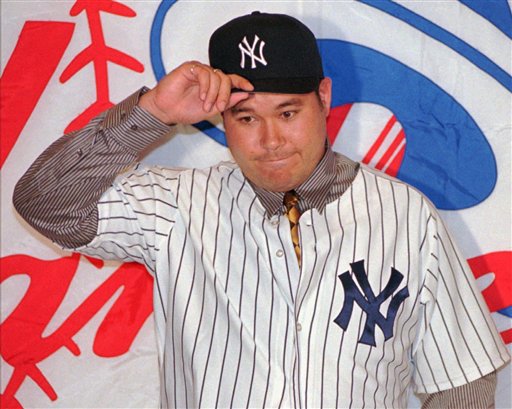
Please e-mail us at: MLBreports@gmail.com with any questions and feedback. You can follow us on Twitter and become a fan on Facebook . To subscribe to our website and have the daily Reports sent directly to your inbox , click here and follow the link at the top of our homepage.

Hiroki Kuroda: Pitcher Looks to be Possibly Traded From the Dodgers to Rangers
Monday July 25, 2011
MLB reports: One of the most underrated pitchers in the game is currently on the auction block. Los Angeles Dodgers hurler, Hiroki Kuroda, is currently being shopped to major league teams as the July 31st trade deadline is nearly upon us. The 36-year old Kuroda has been very consistent since joining the Dodgers, enjoying solid numbers despite a constant lack of run support. With a no-trade clause, Kuroda has the ability to refuse a trade in remain in the Los Angeles for the rest of the season. But with demand high for the hurler and teams likely to offer incentives (in the $1-$2 million range), it appears that Kuroda will be changing addresses in the next six days.
A veteran of the Nippon Professional Baseball League, Kuroda played from 1997-2007 with the Hiroshima Toyo Carp in Japan before coming over to North America. As a free agent outside of the posting system, Kuroda was free to sign with any major league team. In 2007, Kuroda signed a 3-year, $35.3 million contract with the Dodgers and last offseason re-signed for 1-year, $12 million. A look at his major league numbers show that Kuroda has been a solid and dependable veteran:
| Year | W | L | ERA | IP | H | BB | SO | WHIP |
|---|---|---|---|---|---|---|---|---|
| 2008 | 9 | 10 | 3.73 | 183.1 | 181 | 42 | 116 | 1.216 |
| 2009 | 8 | 7 | 3.76 | 117.1 | 110 | 24 | 87 | 1.142 |
| 2010 | 11 | 13 | 3.39 | 196.1 | 180 | 48 | 159 | 1.161 |
| 2011 | 6 | 12 | 3.19 | 127.0 | 122 | 33 | 97 | 1.220 |
| 4 Seasons | 34 | 42 | 3.52 | 624.0 | 593 | 147 | 459 | 1.186 |
| 162 Game Avg. | 11 | 14 | 3.52 | 207 | 197 | 49 | 152 | 1.186 |
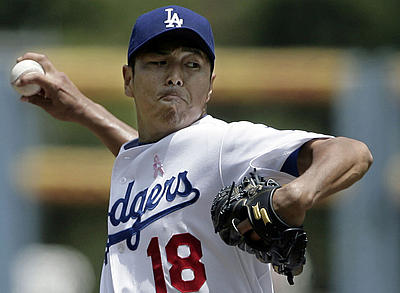 The teams that have pursued Kuroda are the Cleveland Indians, Texas Rangers, New York Yankees, Boston Red Sox, Milwaukee Brewers, Detroit Tigers, St. Louis Cardinals and Cincinnati Reds. Looking at the numbers, I don’t blame them. In some ways the second coming of Hideo Nomo, Kuroda may not be as flashy but he has been dependable. Except for 2009 when he suffered through injuries, Kuroda has pitched close to 200 innings every season since joining the Dodgers. This year has been one of Kuroda’s finest, with a 3.19 ERA and 1.220 WHIP, which have only led him to a 6-12 record on a meek Dodgers squad. With better run support, his record could easily be 12-6. Now with July 31st rapidly approaching, people are wondering whether a) Kuroda will waive his no-trade clause; and b) which team will acquire him.
I am surprised that more teams are not pursuing the hurler. With so few quality starters available at exorbitant prices, including Ubaldo Jimenez of the Rockies and James Shields of the Rays, Kuroda may be the best and most affordable quality starter available to a team that needs a starting pitcher for its stretch run. While Jimenez and Shields will take approximately 3 top prospects, Kuroda may only take 1 or 2 decent prospects. Not a high price to pay considering what a team will get back in return.
From the names thrown around, I would see the Texas Rangers and Detroit Tigers having the best chance to land Hiroki Kuroda, with the Rangers being the most likely to win the Kuroda derby. The Rangers have a great farm system and many solid prospects for the Dodgers to choose from. As well, the Rangers give Kuroda the best chance of winning a championship, having made it last year to the World Series. Other teams will surely take a run at the hurler, especially the Yankees and Red Sox. But when push comes to shove, expect Kuroda to grab his cowboy hat and boots and head to the lone star state. We don’t profess to have a crystal ball and anything can happen this week. The Los Angeles Dodgers will base their final decision on receiving full salary relief and the best prospects in return for their star pitcher. It is always fun to speculate at the trade deadline time. Let’s see which team ultimately offers the best package to acquire one of baseball’s best Japanese imports: Hiroki Kuroda.
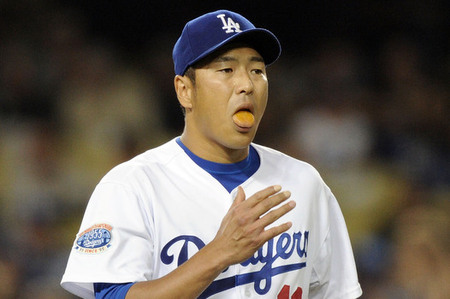
Please e-mail us at: MLBreports@gmail.com with any questions and feedback. You can follow us on Twitter and become a fan on Facebook . To subscribe to our website and have the daily Reports sent directly to your inbox , click here and follow the link at the top of our homepage.

Desmond Jennings, Tampa Bay Rays Makes His 2011 MLB Debut
Sunday July 24, 2011
MLB reports: Saturday July 23, 2011. The Tampa Bay Rays lose to the Kansas City Royals by a score of 5-4 in 10 thrilling innings. Joakim Soria got the win. Brandon Gomes got the loss. Eric Hosmer had the game winning hit. Just a normal Saturday night MLB game in Kansas City.
In the Tampa Bay loss, a new era begun in Rays baseball history. Desmond Jennings, the 24-year old top hitting prospects of the Rays, made his 2011 major league debut. Originally a 10th round selection back in the 2006 MLB draft, Jennings entering game action yesterday rated as one of the top prospects in the game.
Let’s take a look at the career statistics of Desmond Jennings:
| Year | Lev | R | H | HR | RBI | SB | BA | OPS |
|---|---|---|---|---|---|---|---|---|
| 2006 | Rk | 48 | 59 | 4 | 20 | 32 | .277 | .749 |
| 2007 | A | 75 | 122 | 9 | 37 | 45 | .315 | .866 |
| 2008 | A+ | 17 | 22 | 2 | 6 | 5 | .259 | .772 |
| 2009 | AA-AAA | 92 | 158 | 11 | 62 | 52 | .318 | .888 |
| 2009 | AA | 69 | 121 | 8 | 45 | 37 | .316 | .881 |
| 2009 | AAA | 23 | 37 | 3 | 17 | 15 | .325 | .910 |
| 2010 | AAA | 82 | 111 | 3 | 36 | 37 | .278 | .756 |
| 2011 | AAA | 68 | 93 | 12 | 39 | 17 | .275 | .830 |
| 6 Seasons | 382 | 565 | 41 | 200 | 188 | .294 | .825 | |
| AAA (3 seasons) | AAA | 173 | 241 | 18 | 92 | 69 | .283 | .806 |
| A (1 season) | A | 75 | 122 | 9 | 37 | 45 | .315 | .866 |
| AA (1 season) | AA | 69 | 121 | 8 | 45 | 37 | .316 | .881 |
| Rk (1 season) | Rk | 48 | 59 | 4 | 20 | 32 | .277 | .749 |
| A+ (1 season) | A+ | 17 | 22 | 2 | 6 | 5 | .259 | .772 |
Jennings had his breakout season in 2009 and looked ready to work towards his MLB debut in 2010. However injuries slowed him down and he spent the season developing his craft in AAA. Come this season and we see the Jennings of old. In 89 games, Jennings already had 12 home runs, 68 runs, 39 RBIs, 19 doubles, 3 triples. a .275 AVG and .830 OPS. Most telling is that Jennings has been successful on 17/18 stolen base attempts. With little to prove in the minors and the Rays needing a serious offensive boost at the major league level, Desmond Jennings got the call to join the team yesterday in Kansas City.
One of the few true five-tool prospects in the game, Jennings was slotted in the leadoff spot and playing left field for the Rays. Expected to play solid defense and ignite the Rays offense, Jennings did not disappoint. The final boxscore shows the following stat line: 2 for 3, double, triple, 2 runs, 1 RBI, 2 walks, 1 SO and 1 SB. That is how you fill a box score ladies and gentlemen. The Rays brass must be overjoyed at the success Jennings enjoyed in his first game this season. Shades of Carl Crawford and Rickey Henderson no doubt.
With such a big game played, the expectations will already be high for Jennings. People have to remember that he is still raw and developing as a hitter. He is also young and will take time to mature. With so many holes currently in the Rays batting order, Jennings will not be pitched to every game if he stays hot. The league will also start to put a book together on him and find the holes in his swing and game. While his two walks yesterday were impressive, Jennings was still striking out much more than he was walking in AAA this year. The potential is definitely there, as he showed yesterday. The expectations just have to be kept in check.
Rays fans have been calling for the promotion of Desmond Jennings since spring training. With the team in contention, the time was right to give Jennings the call. Long-term, I can realistically see him as a 20 home run, 50 stolen base type hitter. The power is definitely there and he should be an extra-base hit machine as he finds his groove at the major league level. With the art of the stolen base slowly coming back to baseball, Jennings should win several stolen base crowns before his time is done. With the trade deadline looming, the Rays are looking at acquiring more hitting prospects to beef up their offense. With Desmond Jennings at the top of the order, the Rays will have an offense that will compliment its superior pitching. The World Series may not come to Tampa Bay in 2011, but the road to the championship just got more clear. Welcome to the big leagues Desmond Jennings. Well done.
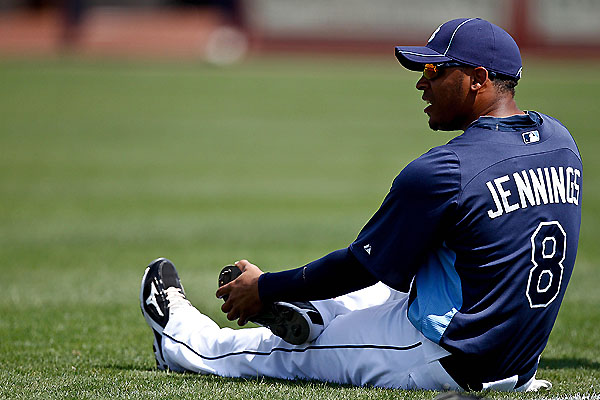
Box Score: Desmond Jennings 2011 Debut
| Tampa Bay | 110 | 011 | 000 | 0 | — | 4 | 11 | 2 |
| Kansas City | 000 | 201 | 001 | 1 | — | 5 | 10 | 0 |
| Tampa Bay | AB | R | H | BI | BB | SO | Avg. |
| Jennings lf | 3 | 2 | 2 | 1 | 2 | 1 | .667 |
| Damon dh | 5 | 0 | 1 | 1 | 0 | 2 | .279 |
| Zobrist rf-2b | 5 | 1 | 2 | 1 | 0 | 2 | .266 |
| Longoria 3b | 4 | 0 | 2 | 1 | 1 | 1 | .243 |
| B. Upton cf | 4 | 0 | 0 | 0 | 1 | 2 | .229 |
| S. Rodriguez 2b | 3 | 0 | 0 | 0 | 1 | 0 | .211 |
| b-Joyce ph-rf | 1 | 0 | 1 | 0 | 0 | 0 | .289 |
| Kotchman 1b | 5 | 0 | 1 | 0 | 0 | 1 | .329 |
| Shoppach c | 4 | 0 | 1 | 0 | 0 | 2 | .179 |
| c-Fuld ph | 1 | 0 | 0 | 0 | 0 | 1 | .244 |
| Chirinos c | 0 | 0 | 0 | 0 | 0 | 0 | .214 |
| E. Johnson ss | 5 | 1 | 1 | 0 | 0 | 3 | .197 |
| Totals | 40 | 4 | 11 | 4 | 5 | 15 |
| Kansas City | AB | R | H | BI | BB | SO | Avg. |
| Gordon lf | 5 | 0 | 3 | 1 | 0 | 2 | .302 |
| Cabrera cf | 5 | 0 | 0 | 0 | 0 | 0 | .294 |
| Butler dh | 5 | 1 | 1 | 0 | 0 | 2 | .288 |
| 1-Aviles pr | 0 | 1 | 0 | 0 | 0 | 0 | .211 |
| Hosmer 1b | 5 | 2 | 3 | 1 | 0 | 2 | .277 |
| Francoeur rf | 3 | 0 | 1 | 0 | 0 | 0 | .269 |
| Moustakas 3b | 3 | 0 | 2 | 3 | 0 | 0 | .202 |
| Pena c | 3 | 0 | 0 | 0 | 0 | 0 | .256 |
| a-Maier ph | 1 | 0 | 0 | 0 | 0 | 1 | .271 |
| Treanor c | 0 | 0 | 0 | 0 | 0 | 0 | .227 |
| Getz 2b | 3 | 0 | 0 | 0 | 1 | 1 | .253 |
| Escobar ss | 4 | 1 | 0 | 0 | 0 | 1 | .249 |
| Totals | 37 | 5 | 10 | 5 | 1 | 9 |
No outs when winning run scored. a-struck out for Pena in the 9th. b-singled for S. Rodriguez in the 10th. c-struck out for Shoppach in the 10th. 1-ran for Butler in the 10th.
E: Longoria (7), Jennings (1). LOB: Tampa Bay 11, Kansas City 8. 2B: Jennings (1), Damon (17), Zobrist (30), Longoria (18), Gordon (26), Hosmer (14), Francoeur (25), Moustakas (4). 3B: Jennings (1), E. Johnson (2). RBIs: Jennings (1), Damon (43), Zobrist (50), Longoria (49), Gordon (52), Hosmer (40), Moustakas 3 (8). SB: Jennings (1), Gordon (9). SF: Moustakas.
Runners left in scoring position: Tampa Bay 9 (Kotchman 3, Zobrist 2, Damon 2, E. Johnson 2); Kansas City 6 (Cabrera 2, Getz 2, Butler, Moustakas). GIDP: Johnson. DP: Kansas City 1 (Francis, Getz, Hosmer).
| Tampa Bay | IP | H | R | ER | BB | SO | NP | ERA |
| Niemann | 6 | 7 | 3 | 2 | 0 | 4 | 92 | 3.86 |
| Jo. Peralta | 1 1/3 | 0 | 0 | 0 | 0 | 3 | 17 | 3.80 |
| Howell | 2/3 | 0 | 0 | 0 | 0 | 1 | 12 | 7.94 |
| Farnsworth | 1 | 1 | 1 | 1 | 1 | 1 | 18 | 1.99 |
| B. Gomes L, 0-1 | 0 | 2 | 1 | 1 | 0 | 0 | 2 | 3.78 |
| Kansas City | IP | H | R | ER | BB | SO | NP | ERA |
| Francis | 5 | 9 | 3 | 3 | 2 | 6 | 104 | 4.65 |
| Holland | 3 | 1 | 1 | 1 | 1 | 6 | 40 | 1.20 |
| Crow | 1 | 0 | 0 | 0 | 2 | 1 | 26 | 1.88 |
| Soria W, 5-3 | 1 | 1 | 0 | 0 | 0 | 2 | 16 | 3.64 |
Crow pitched to 2 batters in the 10th. B. Gomes pitched to 2 batters in the 10th.
Holds: Jo. Peralta (14), Howell (4). Blown save: Farnsworth (4). Inherited runners scored: Soria 2-0. IBB: off Francis (Jennings).
HBP: by Howell (Francoeur). WP: Niemann. Balk: Howell.
Umpires: Home, Ted Barrett; First, Brian Runge; Second, Marvin Hudson; Third, Tim McClelland.
Time: 3:25. Announced attendance: 27,643.
Please e-mail us at: MLBreports@gmail.com with any questions and feedback. You can follow us on Twitter and become a fan on Facebook . To subscribe to our website and have the daily Reports sent directly to your inbox , click here and follow the link at the top of our homepage.

Top 5 Closers Available at July 31 MLB Trade Deadline
Friday July 22, 2011
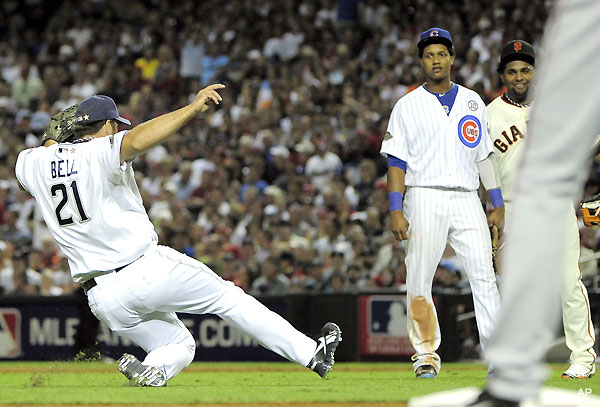
MLB reports: The MLB Non-Waiver Trade Deadline is rapidly approaching. With only nine days to go, MLB teams need to decide if they are buyers or sellers. Right up until July 31st deadline, the baseball world will be buzzing on potential deals. While transactions can occur after July 31st, the respective players will need to first pass through waivers, which makes trades more difficult to happen. Especially in the category of closers, who are sought after by almost every team. Whether to obtain a 9th inning stopper or upgrade their middle relief, the majority of MLB teams are currently on the prowl.
There are some contending teams would love to add a closer, including the Rangers and Cardinals. The host of other teams battling for a playoff spot are ready to take a current closer to pitch the 7th or 8th inning. To win today in baseball, you usually need 2-3 closer-type pitchers in your pen. The Brewers recently added Francisco Rodriguez to compliment John Axford. The New York Yankees signed Rafael Soriano to pitch in front of Mariano Rivera, although David Robertson has since grabbed the role. True closers will always be in demand and teams with playoff aspirations will always find room for these guys on their rosters.
As the line between buyers and sellers becomes less blurry, we take a look today at the top five closer candidates to be traded by the July 31st MLB Trade Deadline:
1) Heath Bell: San Diego Padres
The Rolls Royce of available closers, the Padres are talking to teams on a daily, if not hourly basis on the availability of Heath Bell. Nearly every team has been linked to Bell in the past few days, from the Rangers, Cardinals, Phillies, Red Sox, Jays and Tigers. The prize of the closing market, expect the Padres to demand a king’s ransom for his services. At least two top prospects, with one being major league ready should get this deal done. With 28 saves and a 2.45 ERA, the 33-year old Bell is having another fantastic campaign before his impending free agency. The Rangers and Cardinals are most in need of a closer, with the Rangers the most likely destination based on availability of prospects. The Rangers have the superior farm system and could match up best with the Padres. The Phillies and Jays are the dark horses according to reports and need to decide if they are willing to pay the price.
2) Brandon League: Seattle Mariners
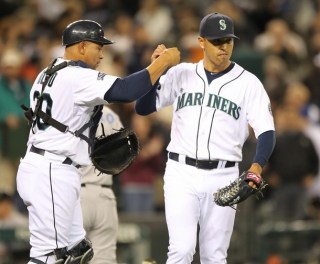 A first time All-Star in 2011, Brandon League has raised his stock this year and given the Mariners an interesting trade chip to work with at the deadline. League has chipped in 23 saves already this year, with a 3.35 ERA and 1.088 WHIP. With a team friendly contract and under team control for another season, League should draw much interest on the market. St. Louis seems like a logical choice, as the Cardinals will be looking for a long-term solution to their closing woes. I cannot see the Mariners dealing in their division and having to face League next year with the Rangers. A top prospect or two middle prospects should make this one happen. With the Mariners far out of contention and in complete rebuild mode, a top closer seems like a luxury that the Mariners cannot afford at the moment. The Mariners need offensive help and need it quickly, with League being one of many candidates likely to leave Seattle by July 31st to replenish the farm system.
3) Frank Francisco, Jon Rauch, Octavio Dotel, Jason Frasor: Toronto Blue Jays
 If Heath Bells is a Rolls Royce, the Blue Jays are running a used Ford dealership in their bullpen. Frank Francisco is like a used mustang with transmission problems, while Jon Rauch is a pickup truck without the V8 engine. The Jays have assembled a collection of the middle-of-the-road closers and setup men this year in their bullpen. Francisco will likely draw the most attention, despite his mostly awful numbers this year. At 31-years of age and throwing big time heat, Francisco still has potential. Rauch has served as the Jays closer for much of the year and could be in demand as well. Octavio Dotel, the eldest member of the pack, has bounced around during his major league career and could be a useful trade deadline pickup. The most effective reliever though for the Jays has been Jason Frasor and a smart team should consider him. While the Jays are unlikely to offer any true closers to contending teams, there are middle relief candidates to be had. Expect the Phillies to come calling and pickup one of the above.
4) Kevin Gregg: Baltimore Orioles
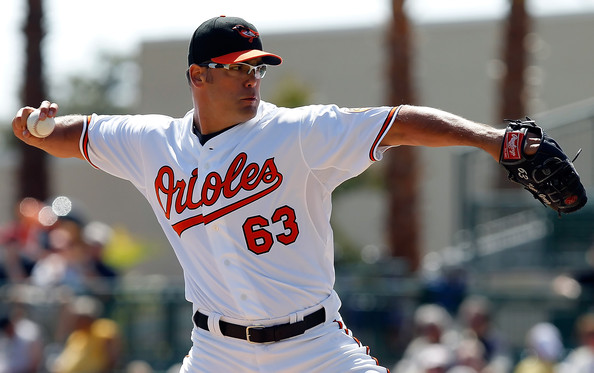 For those teams that like to play with fire, closers don’t get more dangerous than Kevin Gregg. A 4.00 ERA and unsightly 1.583 WHIP are not numbers that scream out lock-down closer. Gregg has shown though the ability to get hot at times during his career and will be considered by many teams over the next week. Signed through next year, the Orioles will look mainly for salary relief in shedding Gregg’s contract. Personally, I wouldn’t consider Gregg if I was running a team. But somehow he will likely move by July 31st.
5) Leo Nunez: Florida Marlins
 Another up-and-down closer in the Gregg mold, Leo Nunez is quietly having a very solid season for the Florida Marlins. Up to 27 saves, with a 3.22 ERA and 1.187 WHIP, Nunez might actually be the best affordable option on the closers market. The Rangers and Cardinals will sniffing around here, as will the Red Sox, Indians and Tigers. As the Marlins and Tigers have matched up well before in trades, I can see this swap happening. The Tigers have the ability to surrender a decent pitching prospect and can use Nunez down the stretch as Valverde insurance. With the Tigers in contention and the majority of their bullpen being fairly unstable for most of the year, Nunez might be a late inning option that the the Tigers can ill-afford to miss out on.
Send us your comments and opinions on available closers for the trade deadline. Other names thrown around have been Joakim Soria, Matt Capps, Joe Nathan, Andrew Bailey and Brian Fuentes. The trading of players, especially closers, is especially reliant on the competitiveness and status of a team in the standings. With so many teams still in their respective races, there are not as many top bullpen arms available at this point in the season. But come August, as more teams continue to drop out, expect to see even more trade activity. Exciting times, as the MLB pennant races continue to heat up, and baseball trade talk is on everyone’s lips.
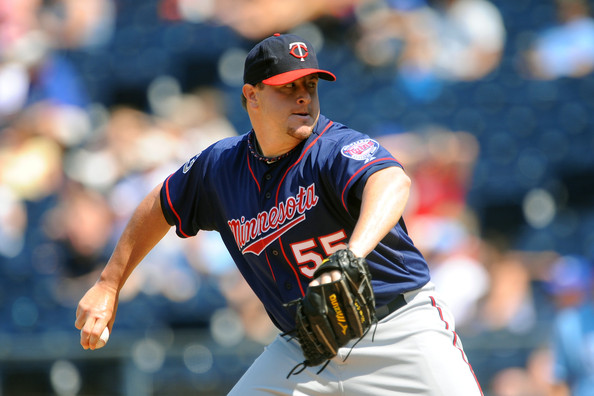
Please e-mail us at: MLBreports@gmail.com with any questions and feedback. You can follow us on Twitter and become a fan on Facebook . To subscribe to our website and have the daily Reports sent directly to your inbox , click here and follow the link at the top of our homepage.

Jair Jurrjens: Braves Ace of the Future or Trade Candidate?
Wednesday July 20, 2011
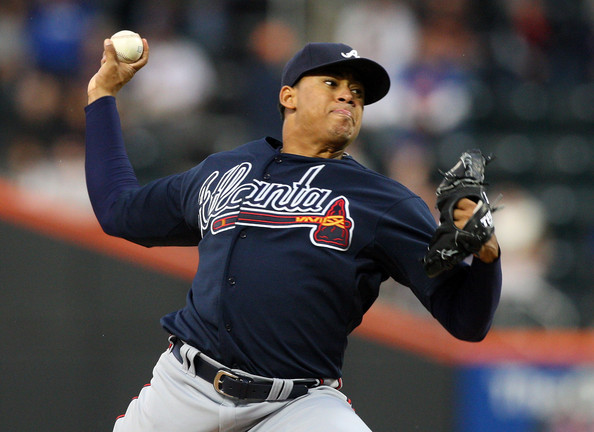
Rob Bland (Intern- MLB Reports): Now that the trade deadline is fast approaching, teams in contention are scrambling to find the pieces they desperately need to reach the playoffs. Teams that are out of contention are scouring other teams’ minor league affiliates in search of suitable trade partners. One man who is terribly busy fielding on calls on one of his biggest talents is the GM of the Atlanta Braves, Frank Wren. Opposing GMs have coveted his ace pitcher, Jair Jurrjens over the past few years. But now that Jurrjens has developed into a solid dependable pitcher who has exceeded his potential, Wren’s phone will be ringing right up until the July 31st non-waiver trade deadline.
Why Atlanta should hold on to their ace
Jair Jurrjens is young and controllable with an inexpensive contract. He is an inning eater, and a dependable arm that will give 6+ innings per game. Jurrjens is in his fourth full season, with the key variable that many people forget is that he is only 25 years old. At the halfway mark of this season, Jurrjens has a 12-3 record with a sparkling 2.26 ERA. Jair also induces a ton of ground balls, with a GB% of 48.2. When a guy can throw strikes consistently, it makes it much easier to be successful. Three walks per nine innings is a pretty good career mark, and he has seemingly improved almost every year, as Jurrjens currently sits at a 2.10 BB/9 for 2011. A young, controllable ace that is continually improving might be something that the Braves want to hold onto. Further, the Braves should even consider giving a long-term extension to Jurrjens given what he means to the ballclub.
Why Atlanta should trade Jurrjens
 Why would a contending team trade their ace, you might ask? Well, a guy like Jurrjens might be overachieving for a few reasons. First of all, the velocity on his fastball has dipped every season since his rookie campaign. His average fastball was once 93 mph, whereas it sits at 89 now. Now this could mean a couple of things, such as he has learned how to pitch and doesn’t need the velocity. However, his extra reliance on his change-up and slider; each of them up in usage about 3% over previous years, tells me that he knows his fastball isn’t quite as effective. Jurrjens doesn’t strike many guys out, and there is almost no way that he can maintain a 4.1% homerun per fly ball rate. His xFIP is exactly a run and a half higher than his ERA at 3.76, so a measure of his performance has been attributed to luck. Numbers can be sometimes be deceiving and in Jurrjens case, he might not be as good as his statistics appear to show. Sometimes its good to maximize a return when the market is at its peak and Jurjjens may very well be sitting at the top of his ceiling of potential. Otherwise, if Jurrjens does regress, he value will never be higher than it is at the moment.
Which teams could trade for Jurrjens
If the Detroit Tigers are willing to give up a ton of prospects for Ubaldo Jimenez, I believe they would do the same for Jurrjens. Same goes with the Red Sox and Yankees. Detroit has at least kicked the tires on many starting pitchers, including Derek Lowe, Aaron Harang, and Jeremy Guthrie. I see Jurrjens as an upgrade over those pitchers, so it would take a decent package to steal him away. The Rockies covet four top prospects for Jimenez, so I don’t see why the Braves wouldn’t try to get at least three top prospects for Jurrjens. He may not have the electric stuff that Ubaldo has, but he certainly has a track record of success.
Another fit to trade for Jurrjens that may fly under the radar could be the Indians. Mitch Talbot and Fausto Carmona have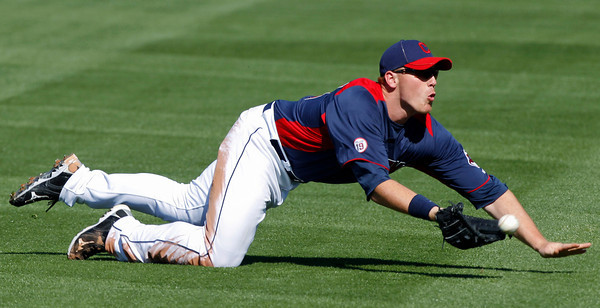 underperformed, and they desperately need an upgrade if they are to contend. This could cause a bidding war for Jurrjens. I can see righty Alex White, lefty Drew Pomeranz and outfielder Nick Weglarz being involved in such a deal. Prospects Jacob Turner (RHP), Andy Oliver (LHP) and Nick Castellanos (3B) may be included in a potential deal with Detroit.
In the NL, if the St. Louis Cardinals decide to make a push in the wide open Central Division, they may be looking at starting pitching help. Kyle McLellan and Jake Westbrook have both struggled, so it could be a possibility they get in the mix. Third baseman Zack Cox and starting pitcher Shelby Miller are possible candidates to be moved in such a scenario.
Verdict
Atlanta doesn’t appear to be actively shopping Jurrjens, but it would be in their best interest to at least gauge the interest of other teams. The Braves could get a return for Jurrjens that would be impossible to refuse. With some of the prospects named, the Braves could still contend, and restock their system for years to come. Until then, we expect Jurrjens to remain a Brave unless Frank Wren gets blown away a trade proposal. With the active trade winds blowing this year and numerous contending teams desperate for starting pitching help, anything is possible.
Editor’s Note: Today’s feature was prepared by our Intern, Rob Bland. Rob was selected from the many candidates who applied to write for MLB reports. Please feel free to leave comments and to welcome Rob aboard. You can also follow Rob on Twitter.***
Please e-mail us at: MLBreports@gmail.com with any questions and feedback. You can follow us on Twitter and become a fan on Facebook . To subscribe to our website and have the daily Reports sent directly to your inbox , click here and follow the link at the top of our homepage.
Carlos Beltran to the Giants: Mets Likely to Trade Slugger to San Fran
Tuesday July 19, 2011

MLB reports: The MLB rumor mill is working overtime as the non-waiver trade deadline of July 31st quickly approaches. With less than two weeks to go, the speculation is heating up as to which players will be changing uniforms. Francisco Rodriguez is already a Brewer and Jeff Keppinger was just traded to the Giants. But rumors persist that the Mets and Giants are not finished with their activity. With both superstars Jose Reyes and Carlos Beltran eligible for free agency at the end of the season, talk is that one or both players will be moved out of New York. With the possibility of the Mets trying to retain Reyes, the most likely scenario is Carlos Beltran changing addresses. At the center of the speculation is the San Francisco Giants. The defending World Series champions have been simply atrocious this year offensively. With their cleanup hitter Buster Posey out for the season, the team cannot afford to miss out on the Carlos Beltran sweepstakes.
The Giants were very fortunate to win the World Series last year. The playoffs are a tough road and requires the perseverance normally of a balanced team to make it to the end. The Giants, while solid in the pitching department, were essentially using smoke and mirrors to score runs last year. The team relied on the likes of Aubrey Huff, Cody Ross and Freddy Sanchez on offense. While useful role players, these players are not the big sluggers that are supposed to win championships. Now with Buster Posey out, the Giants are forced to rely on Eli Whiteside, Miguel Tejada, Aaron Rowand, Pat Burrell and company to score the team’s runs. Possessing one of the best, if not the best pitching staff in baseball, the Giants can ill-afford to limit itself offensively and essentially waste such strong pitching. To defend its championship, the Giants will have no choice but to beef up their offense.
Carlos Beltran has been one of the most consistent hitters in the game over the course of his career. Taking a look at his numbers, we see a consistently high level of production:
| Year | Tm | AB | R | H | HR | RBI | SB | BA |
|---|---|---|---|---|---|---|---|---|
| 1998 | KCR | 58 | 12 | 16 | 0 | 7 | 3 | .276 |
| 1999 | KCR | 663 | 112 | 194 | 22 | 108 | 27 | .293 |
| 2000 | KCR | 372 | 49 | 92 | 7 | 44 | 13 | .247 |
| 2001 | KCR | 617 | 106 | 189 | 24 | 101 | 31 | .306 |
| 2002 | KCR | 637 | 114 | 174 | 29 | 105 | 35 | .273 |
| 2003 | KCR | 521 | 102 | 160 | 26 | 100 | 41 | .307 |
| 2004 | TOT | 599 | 121 | 160 | 38 | 104 | 42 | .267 |
| 2004 | KCR | 266 | 51 | 74 | 15 | 51 | 14 | .278 |
| 2004 | HOU | 333 | 70 | 86 | 23 | 53 | 28 | .258 |
| 2005 | NYM | 582 | 83 | 155 | 16 | 78 | 17 | .266 |
| 2006 | NYM | 510 | 127 | 140 | 41 | 116 | 18 | .275 |
| 2007 | NYM | 554 | 93 | 153 | 33 | 112 | 23 | .276 |
| 2008 | NYM | 606 | 116 | 172 | 27 | 112 | 25 | .284 |
| 2009 | NYM | 308 | 50 | 100 | 10 | 48 | 11 | .325 |
| 2010 | NYM | 220 | 21 | 56 | 7 | 27 | 3 | .255 |
| 2011 | NYM | 328 | 54 | 94 | 14 | 59 | 3 | .287 |
| 14 Seasons | 6575 | 1160 | 1855 | 294 | 1121 | 292 | .282 | |
| 162 Game Avg. | 621 | 110 | 175 | 28 | 106 | 28 | .282 | |
| KCR (7 yrs) | 3134 | 546 | 899 | 123 | 516 | 164 | .287 | |
| NYM (7 yrs) | 3108 | 544 | 870 | 148 | 552 | 100 | .280 | |
| HOU (1 yr) | 333 | 70 | 86 | 23 | 53 | 28 | .258 | |
| NL (8 yrs) | 3441 | 614 | 956 | 171 | 605 | 128 | .278 | |
| AL (7 yrs) | 3134 | 546 | 899 | 123 | 516 | 164 | .287 | |
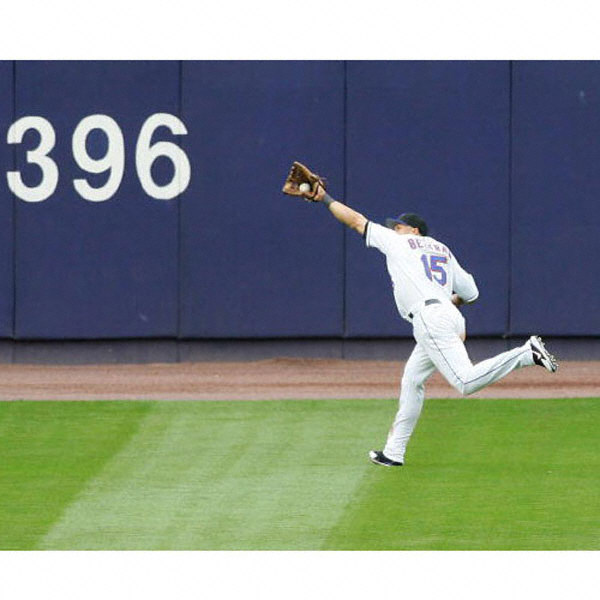 His resume speaks for itself. Beltran is a 1999 AL Rookie of the Year. He has won four Gold Gloves for his defensive work in the outfield. He won two silver slugger awards. A lifetime .282 AVG, .360 OBP and .495 SLG. In 2004 he hit the magical 30/30 mark (30 home runs, 30 stolen bases), and was actually two home runs short of 40/40. For the most part, Beltran in his prime could do it all. Hit home runs, hit for average, steal bases, catch and throw the ball like few players could. One of the few true five-tool players in the game. The aberrations we find in Beltran’s statistics were the last two years. Due to various injuries, particularly knee woes, Carlos Beltran was forced to miss much of the last two seasons and saw his production sharply decline. Now healthy and extremely motivated, Beltran has come back in a big way.
Beltran played in his sixth All-Star game this year in Arizona. While he rarely steals bases these days, the rest of Beltran’s game has returned as shown by his numbers. The only issue surrounding Beltran is whether his knee will hold up for the rest of the season and into the playoffs. From there, a team will need to determine his long-term health and abilities in awarding him a free agent contract. But from all indications, Beltran is a player that can still play ball at the highest level when healthy. An ideal fit for the Giants that lineup that desperately needs run production.
How bad has the Giants offense been in 2011? Going into tonight, the Giants as a team are hitting .243, with a .309 OBP and .363 SLG. The team has collectively hit 63 home runs and scored 356 runs. Yet somehow the team continues to sit in first place in the NL West, 3.5 games ahead of the Diamondbacks. If not for Matt Cain, Tim Lincecum, Madison Bumgarner, Ryan Vogelsong, Brian Wilson and the rest of the Giants pitching staff, the Giants would be in the basement of the division. The run of the Giants over the past two seasons has been incredible, but clearly linked to its pitching. To support its pitchers and put runs on the board, the Giants have to step up and beef up its offense. While Jeff Keppinger is a useful player, he will not be enough to get the job done. Rather, the Giants need to acquire a bomber, the way the Cardinals acquired Matt Holliday a couple of years ago in their playoff run. Or closer to home, when the Astros acquired Carlos Beltran in 2004. Beltran hit an incredible 8 home runs during the Astros playoff drive that year. Coincidentally, Beltran was an impending free agent that year as well. Fast forward to 2011 and the very same Carlos Beltran is available. Having a fantastic campaign, Beltran in 2011 has hit .287 to-date, with 14 home runs, league leading 28 doubles, with a .381 OBP and .512 SLG. Again during a free agency year. Definite playoff calibre numbers and a perfect fit out west in San Francisco.
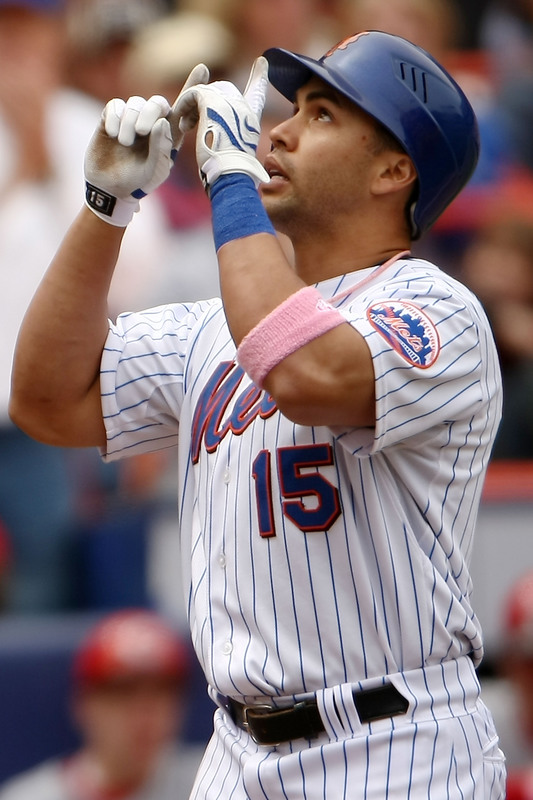 The Giants and Carlos Beltran are well suited for one another. San Francisco needs a strong cleanup hitter. Carlos Beltran wants to compete for a World Series championship and boost his free agency stock for one more prime contract. The odds of getting a ring don’t get any better than joining the defending world champions. Some experts have speculated that Beltran may not waive his no-trade protection to join the Giants. I am not buying that theory. The Giants are a terrific organization to play for, with highly regarded management, a fantastic ballpark in a beautiful city, and are one of baseball’s most historical and treasured teams. Beltran would look fantastic in a Giants uniform. What better way to showcase his abilities and earn his last free agency contract than by playing for a contender and fighting for a World Series championship.
Remember 1994, the year that Beltran was traded from Kansas City to Houston and played like a man possessed in nearly single-handedly leading the Astros to the World Series. That performance, combined with his numbers to-date, earned Beltran that off-season a 7-year, $119 million contract from the Mets. Now Beltran is on the cusp of free agency again and has the potential to “earn his pay” so to speak with the Giants in the same manner that he did with the Astros in 1994. With Scott Boras as his agent, Beltran will surely receive the advice that playoff performance equals free agency dollars.
The Giants will have a choice in making a pitch to the Mets for Carlos Beltran. They will either have to absorb the majority of the contract and provide fairly decent prospects, or have the Mets absorb a large chunk of money and offer 1-2 elite prospects in return. The Giants are well stocked in the minors and have excellent pitching at the major league level. The Mets may request Jonathan Sanchez off the major league roster or a combination of minor leaguers from the farm. Outfielder Thomas Neal and pitcher Zack Wheeler could be on the Mets wish-list. Or perhaps the Giants will be able to give up a package of lower level prospects and not lose their top prospects and major league level. The decision will boil down to the money involved and players offered by other teams in trade packages.
At the end of the day, much like the Yankees must acquire Ubaldo Jimenez from the Rockies (see our recent feature), the Giants have no choice but to trade for Carlos Beltran. The Yankees cannot afford to waste their superior offense without enough top-level pitching and the Giants in turn, need to surround their talented pitching staff with consistent run production. It is a lot of pressure to have a team win 2-1, 3-1 games night-in and night-out. Carlos Beltran has proven that he can carry a team on his back when he is on his game. Well, in 2011 he is definitely playing at his highest level in years. Beltran needs the Giants for his next contract and a chance for a ring, while the Giants need his bat and glove to increase their chances of a championship. The perfect marriage, expect Beltran to be a Giant by the end of July. This acquisition makes too much sense for the Giants and Brian Sabean will continue to stock his team on route to a possible back-to-back World Series run for the Giants. Carlos Beltran to the Giants. Not a question of if, just a question of when.
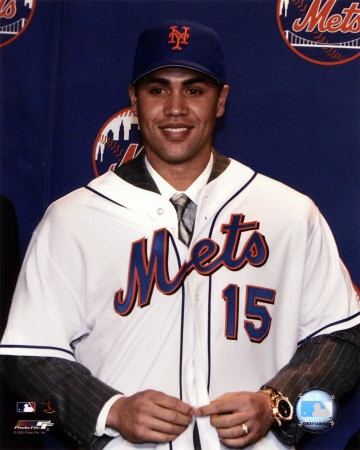
Please e-mail us at: MLBreports@gmail.com with any questions and feedback. You can follow us on Twitter and become a fan on Facebook . To subscribe to our website and have the daily Reports sent directly to your inbox , click here and follow the link at the top of our homepage.

Interview with Derrick Hall: President and CEO of the Diamondbacks
Monday July 18, 2011

MLB reports: Today on MLB reports, we bring you our biggest and most important interview to-date. From the executive side of baseball, we present our interview with Arizona Diamondbacks President and Chief Executive Officer, Derrick Hall.
Derrick joined the Diamondbacks in May 2005 after working in the front office of the Los Angeles Dodgers for many years. In September 2006, Derrick was named President of the Diamondbacks and later added the title of Chief Executive Officer in January 2009.
The Diamondbacks are very fortunate to have one of the most progressive and dynamic baseball leaders at their helm. Derrick developed the “Circle of Success” mission statement, the foundation for the management of the Diamondbacks. A true ambassador to the game, Derrick Hall is a tireless worker in promoting and developing baseball in Arizona. Derrick is often mentioned by many baseball commentators as a candidate to succeed Bud Selig as Commissioner after Selig’s contract expires following the 2012 season.
As part of our Q&A, we covered many topics with Derrick Hall. This year’s MLB All-Star game in Arizona, the hiring of Kirk Gibson and Kevin Towers, MLB realignment, the state of the Los Angeles Dodgers and even the possibility of Hall becoming MLB Commissioner one day were all covered. We now present Derrick Hall, Arizona Diamondbacks President and Chief Executive Officer:
MLB reports: Mr. Hall, Derrick. Thank you for joining us today on MLB reports. With the All-Star game held in Arizona this year, you must have been an extremely busy man. How did the planning go for the big event? How did the Diamondbacks and Major League Baseball make this year’s All-Star game different from those of past years?
 Derrick Hall: The All-Star festivities were extremely successful and we were told by many they thought the experience ranked up there with the best ever. I received zero complaints and heard rave reviews from all of my colleagues and fans. I am so proud of my hard-working staff. The fact that we brought nearly $70 million of economic impact to our region, in addition to $5 million in legacy community projects makes this All-Star summer a much-needed success.
MLB reports: It must be an incredible undertaking to put together the All-Star festivities. I had the pleasure of attending many such events and literally entire cities get taken over by the festivities. Can you give us an idea as to the amount of people working just for this project and what your role is in seeing the event from beginning to the end?
Derrick Hall: It is safe to say that over 2,000 individuals worked on the All-Star game, either from my staff or as volunteers. We oversaw all planning and coordination in conjunction with MLB Special Events. They put the Mid-Summer Classic on every year and have it down to a science. We then direct them based on our knowledge of our fans, economy and market.
MLB reports: On a personal note, you joined the Diamondbacks in 2005 and was named President in 2006. What factors were part of your decision in joining Arizona? What was the process like to becoming President and how quickly did you jump at the chance?
 Derrick Hall: I worked for the Dodgers for many years before coming over. It was always a hope and dream of mine to run the Diamondbacks. My wife is from Arizona, and we both attended and met at Arizona State University. It is a dream come true to be back home and changing the employee and fan culture on a daily basis. We are considered the most fan-friendly team in all of sports, and were just named the most positive sports team in the world by the United Nations. I am proud indeed.
MLB reports: Since becoming President, how has the role itself been for you? Please give our readers an idea as to your day-to-day functions and the various front office staff that you work with. Does the job today differ from what you expected when you first started as President?
Derrick Hall: My days are jam-packed, but I love it that way. I work closely with both the baseball operations side and the business side, but leave baseball decisions to the experts I have hired. I am responsible for all aspects of the organization and oversee about 350 full-time employees and 2,000 part-time and worldwide employees. It is similar to a large corporation and is a 365-day business.
MLB reports: The Diamondbacks have received great feedback on the hires of Kirk Gibson as manager and Kevin Towers as the GM. Please give us a glimpse as to your role in the hiring of each of these fine baseball men. How do you rate the job that each has done so far in their respective roles? Why did the team choose these individuals specifically?
 Derrick Hall: I first decided to make Kirk Gibson interim manager with the thought of him becoming permanent, but wanted my new GM hire to have a say-so because they need to work closely together. Before the end of last season, I concluded a GM search and hired Kevin Towers. I have known him for years and have always admired his reputation and track record. He agreed that Gibby should be our guy. They have been terrific. They have completely changed the culture in the clubhouse which is now one of accountability, results and grittiness. I could not be happier. We still have a long way to go, but for the first time in years, we are all on the same page, from CEO to GM to manager. And I am most proud of the coaching staff that Gibby has assembled, which I consider the best in the game hands down.
MLB reports: The 2011 MLB Draft is completed and the Diamondbacks appear to have done very well in stocking the farm. How do you view the players that your team chose and can we get a glimpse into the future Diamondbacks superstars?
Derrick Hall: We did very well according to the post-draft reviews and experts. It helped that we have the numbers 3 and 7 picks. And with those picks, we picked the best college pitcher and arguably the best high school pitcher respectively. We have been restocking our farm system over the last year or so, so are excited to be adding this talent to the list of prospects like Skaggs, Corbin, Parker, Holmberg, Goldschmidt and Owings to name a few. Trevor Bauer is very close to Major League-ready and could be an impact on our team soon, when focusing on our recent draftees.
MLB reports: The topic of realignment has been thrown around in many circles. I have proposed the idea of moving the Diamondbacks to the American League. What do you think of realignment in general and if given the choice, would the Diamondbacks move divisions at all?
 Derrick Hall: I would not be in favor of us moving to the American League. I personally am a big fan of the National League. I like its strategy and I enjoy seeing the pitchers hit. I am not a fan of the DH, but understand its place and like the fact that it prolongs players’ careers. We have established some great rivalries within our division and want to stay here. I also think there are better candidates for a move if one is needed. But not sure 15-15 works. That would include too much interleague throughout the season. I like interleague play as it is conducted now. However, I would recommend AL rules in NL cities and NL rules in AL cities.
MLB reports: “The Circle of Success” is a topic that is associated with Derrick Hall as President. Please give our readers the ideas behind the Circle and how it has worked in developing the Diamondbacks organization.
 Derrick Hall: I am so proud of the “Circle of Success.” We created it in 2007 and it is proudly displayed in our hallways and in everyone’s office. These are our five main areas of focus: (i) performance on the field, (ii) financial efficiency, (iii) community impact, (iv) culture in the workplace and (v) fan experience. We recognize and reward employees every day for excelling or displaying a commitment to these areas. We constantly refer to these, as well as our mission and values statement to remind our staff who we are and what we stand for.
MLB reports: Watching the turmoil surrounding the Dodgers must be painful for you, having spent so many years in the organization. How did you find your time in Los Angeles? Was it difficult to leave the team after being there for over a decade? What do the Dodgers have to do in your opinion to go back to the glory days as one of the proudest franchises in baseball?
Derrick Hall: It is sad, having been there more than a decade and beginning my career there. I learned under Peter O’Malley and developed my skills there. I began as an intern and worked my way up to Senior Vice President in a short amount of time. I am proud of that achievement and will always hold that franchise near and dear to my heart. The Dodgers will be fine, I know that. This is one of the most relevant brands in all of sports with too rich a history not to. With a brand that includes Scully, Lasorda, Koufax, Valenzuela, the Dodger Dog, Chavez Ravine and beach balls, I have no doubt this organization will bounce back and be a force to be reckoned with.
MLB reports: Fans must ask you all the time about the team’s big picture plans and chances of playoff success. Do the Diamondbacks have a 3/5/10 year type plan? With the goal of winning the World Series this year and future years I’m sure, how will the Diamondbacks get there?
 Derrick Hall: We will get there. We do have short and long-term plans, but they all include being competitive, and adding revenues that will in turn be added to player payroll. We needed first and foremost to bulk up our prospect list and minor league system. A market-size like ours needs to develop from within, and we are now in a strong position to do so. There are several teams doing just like we are with success, such as Cleveland, Pittsburgh, Colorado, Florida, to name a few. This is an exciting time for all of us with bright futures ahead.
MLB reports: What do you see as the future of Derrick Hall? If you had to look into crystal ball and see yourself in 10 years, where will you be? Any chance we will see you as a candidate as a successor to Bud Selig as the Commissioner one day?
Derrick Hall: I am often asked if I am a future Commissioner, which is a tremendous honor. I do not know what the future holds, but I am extremely content right where I am at. I want to bring a World Series back here before I do anything else. This organization is a great one, and I love all of my employees. What we are building here is special, and time has been flying. Ten years will feel like one, so if I still have the honor of leading this franchise, I will be grateful and satisfied.
MLB reports: Last questions Derrick. Why do you work in baseball? What do you love about this game? What are the positives in baseball as an industry and what areas need improvement? Are you happy/satisfied with the state of the game today?
Derrick Hall: I work in baseball because I love this game more than anything other than my family. And my family would tell you I love it more than them most of the time. You have to have love and passion for what you do. I often tell young employees that if you truly love what you are doing, you will never work a day in your life. I can tell you, what I do every day does not feel like a job. I love all of our employees, players and fans. I arrive at work every day with a smile on my face and challenge our staff to be pioneering and show leadership in the sports industry. I work in paradise and have my sites set no further than right here and right now. I feel the weight of responsibility to help grow the interest and intrigue in our game and to create technological solutions that will compete with the many options our youth, and future fans, have before them.
MLB reports: Thank you again to Derrick Hall for taking the time out of his very busy schedule to talking with us today and to sharing his insights and opinions with us. Derrick shed light on many pertinent baseball topics as part of this interview and we encourage everyone to leave your comments and feedback. We congratulate Derrick and the Diamondbacks organization on a stellar performance in hosting this year’s All-Star game. We also wish the Diamondbacks the best of success this year as they battle for a playoff berth. To stay current on the Diamondbacks and support the team, you can follow Derrick Hall on twitter.

Please e-mail us at: MLBreports@gmail.com with any questions and feedback. You can follow us on Twitter and become a fan on Facebook . To subscribe to our website and have the daily Reports sent directly to your inbox , click here and follow the link at the top of our homepage.

Vernon Wells Trade Discussion: Midseason Winners and Loser
Sunday July 17, 2011

Rob Bland (Intern- MLB Reports): January 21, 2011 is seen as a bit of a turning point in the history of the Toronto Blue Jays. General Manager Alex Anthopolous traded away long-time face of the franchise, Vernon Wells. Wells had been with the Blue Jays since he was drafted in the first round, fifth overall by the Jays in the 1997 amateur draft. After making his debut in 1999, he played in a Toronto uniform through the 2010 season. His name is littered across franchise record books, and he was a beloved figure in the clubhouse. On December 15, 2006, Wells signed a seven-year, $126 million contract extension, which at the time was the 6th largest contract in MLB history. Over the next few years, Wells’ lack of production and time spent on the disabled list, made his contract “unmoveable”.
That was of course until Alex Anthopolous took the helm as Jays GM, and was able to find a taker for Wells and the four years and $86 million remaining on the contract. Into the picture came Tony Reagins, GM of the Los Angeles Angels of Anaheim. It has been said that Reagins approached Anthopolous about Wells. One would think that in order for a deal to work, the Blue Jays would have had to send a large sum of cash to the Angels in order for the deal to go through.
The deal that was finally consummated was to send Wells and approximately $5 million to the Angels in exchange for OF Juan Rivera, and C/1B Mike Napoli. Rivera was seen as a throw-in, as his $4M contract was more than the Angels wanted to pay. Napoli had fallen out of favour in manager Mike Scioscia’s eyes; despite hitting at least 20 home runs in each of the three previous seasons despite receiving limited playing time. Toronto then flipped Napoli to the Texas Rangers for standout reliever Frank Francisco. The Rangers received the powerful, right-handed versatile hitter they coveted, and the Blue Jays thought they received the closer they needed.
It is quite obvious that no matter how any of those players perform, the Blue Jays are the big winner because of the payroll space they have cleared and can use to extend their star players, see Jose Bautista. However, this deal has not been so cut and dry. While Napoli has swung the bat with authority, Juan Rivera has been traded to the LA Dodgers, and Francisco has been awful out of the Jays bullpen.
Let’s take a quick look at each player’s production and how their respective teams have fared so far.
Mike Napoli
 Again performing as a part-time player at three positions, Napoli has been very solid for the Rangers. He has hit 13 home runs and driven in 34 RBI in only 187 plate appearances. While his average leaves something to be desired, he makes up for it in his ability to take walks and hit the ball to the gaps. With his OPS at .906, he has proven that he is a tremendously underrated player. His WAR through half the season is at 1.7, and he is on pace to break his career high of 2.6.
Juan Rivera
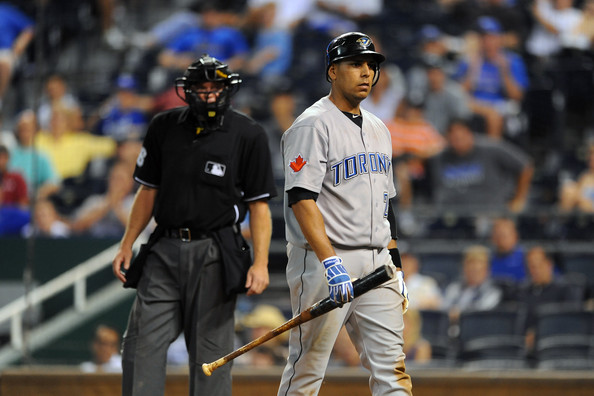 Because he was seen as a salary dump for the Angels, the Blue Jays took him on and saw him as the everyday left fielder and DH out of spring training. He was never able to get it going, and quickly fell out of favour in Toronto. His OPS sat at .666 when traded, with a limited ability to get on base and very little power. This on top of the fact that he played atrocious defense led to his -1.2 WAR. He was traded to the LA Dodgers for a player to be named later or cash considerations on July 12, 2011.
Frank Francisco
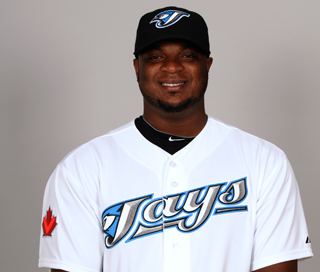 Seen as a pretty successful power arm for the late innings, Francisco was picked up from the Texas Rangers along with cash. He continues to strike out a ton of batters, (10.1 K/9), but he is giving up more hits than he has in the past. However, part of this is due to a batting average on balls in play (BABIP) of .359. His xFIP is actually almost two runs lower than his ERA, 3.56 as opposed to 5.40. I think that Francisco has been unlucky, and when it all evens out, it will show that he is at least a competent late inning reliever.
Vernon Wells
 Wells was obviously the big fish in this trade. He has the ability to be an MVP-caliber player (see his 2003 and 2006 seasons). He has two gold gloves in center field, as well as three All-Star appearances in his career. He has hit 30 home runs three times and driven in 100 RBI three times. Wells’ production in 2011 has been nothing short of horrendous. He has 14 home runs so far, but other than that, hasn’t done anything particularly well. His OPS is .671 with an OBP of .254. Wells is striking out in over 20% of his plate appearances, and walking in less than 4%. Now, you could look at his BABIP (.228) and think he has been unlucky, but it is that low because of his awful 10% line drive rate. With a flyball rate of 47% and by hitting a ton of infield flies, his BABIP won’t likely rise much. It is unlikely that Wells will ever return to being the player he once was.
VERDICT:
Taking a look at these stats, we can see that the Rangers were an instant winner. They gave up an expendable reliever, and gained a valuable bat off the bench. The Angels are the big losers in the deal, as they owe Wells over $60M over the next 3.5 years. That kind of production out of a left fielder is unacceptable for a team trying to contend for the playoffs. Toronto knew that with the trades they made, they would not be as good of a team without Wells. They are in a rebuilding mode, and the money they save can be used on drafting and developing young talent. Francisco could be a Type B free agent at the end of the year, so another draft pick could be theirs.
**The grand winner in this series of moves is the Blue Jays, as with the departure of Wells, they have been able to extend Jose Bautista with a five-year, $65M contract. They have been aggressive in international signings this month as well, and look to pour more resources into the draft. ***

***Thank you to Rob Bland for preparing today’s article on the Vernon Wells trade. You can follow Rob on Twitter.***
Please e-mail us at: MLBreports@gmail.com with any questions and feedback. You can follow us on Twitter and become a fan on Facebook . To subscribe to our website and have the daily Reports sent directly to your inbox , click here and follow the link at the top of our homepage.

Ubaldo Jimenez to the Yankees? Rockies May Move Ace to the Bronx
Saturday July 16, 2011
MLB reports: As an unbelievable as it may seem, there has been talk in baseball circles that the Rockies are taking calls on their ace pitcher, Ubaldo Jimenez. Start after start, game after game last year, Jimenez for the majority of 2010 was as unhittable as they come. Despite coming back down to earth in the 2nd half, Jimenez last year appeared in his first All-Star game and finished 3rd in the NL CY Young voting. He also pitched the very first no-hitter in Rockies history on April 17, 2010. With a young Rockies team that was expected to contend in 2011, the 27-year old Dominican Jimenez was expected to anchor the team. Now sitting with a 45-49 record, 8.5 games out of 1st in the NL West, the Rockies are on the fence as to whether they still have playoff aspirations this year. Further, the team’s brass needs to decide whether Jimenez is a part of those aspirations and future playoff runs. Media outlets have speculated that the Yankees are quietly making a run at Jimenez. There is a strong probability the trade could happen, but in my estimation, the Rockies would be making a colossal error if they do.
There is no denying the strength and ability of Ubaldo Jimenez. As the pitcher has slowly improved every year, especially noting his strong 2009 and 2010 campaigns, the hurler clearly has a world of potential. Taking a look at his numbers, the results speak for themselves:
| Year | W | L | ERA | IP | H | BB | SO | WHIP |
|---|---|---|---|---|---|---|---|---|
| 2006 | 0 | 0 | 3.52 | 7.2 | 5 | 3 | 3 | 1.043 |
| 2007 | 4 | 4 | 4.28 | 82.0 | 70 | 37 | 68 | 1.305 |
| 2008 | 12 | 12 | 3.99 | 198.2 | 182 | 103 | 172 | 1.435 |
| 2009 | 15 | 12 | 3.47 | 218.0 | 183 | 85 | 198 | 1.229 |
| 2010 | 19 | 8 | 2.88 | 221.2 | 164 | 92 | 214 | 1.155 |
| 2011 | 5 | 8 | 4.08 | 110.1 | 101 | 43 | 99 | 1.305 |
| 6 Seasons | 55 | 44 | 3.60 | 838.1 | 705 | 363 | 754 | 1.274 |
| 162 Game Avg. | 14 | 11 | 3.60 | 212 | 178 | 92 | 191 | 1.274 |
 With pitching at such a shortage, many baseball analysts are scratching their heads as to how the Rockies could possibly think about trading Jimenez. The San Francisco Giants proved last year that the World Series could be won almost exclusively on the strength of pitching. Tim Lincecum. Matt Cain. Madison Bumgarner. Jonathan Sanchez. The Giants had so many weapons to throw against its opponents every night and good young pitching at the end of day beats good hitting much of the time. The Rockies, ravaged by injuries and inconsistent performances, are unlikely to reach the postseason this year. But in the management of the team, the present and future must be considered. Look at Felix Hernandez on Seattle, Roy Halladay on the Phillies and Lincecum on the Giants. Every team that is trying to build a winner needs a stud pitcher at the top of its rotation. Jimenez is that guy for the Rockies and losing him on the roster will be a hole that will be difficult, to impossible to fill.
 So given the positives that Jimenez brings to the table, the issue remains how and why the Rockies could possibly consider moving him. There are a couple of main reasons in my estimation. Part of the equation is the performance of Jimenez this season. While he has been good, Jimenez for the most part has not been great. His record this year is far off from his most recent seasons, despite a strong rebound in his last few starts. Given his inconsistencies in 2011, the Rockies may be getting a little worried and looking to sell high before Jimenez starts to decline and/or injured. But given his strong resume to date, young age and rebound recently, I would like to think the Rockies are more intelligent than that. Players have their ups and downs, at all levels. It happens. Without a larger body of work for reference, it is almost impossible to reason that Jimenez is on his way down. His recent numbers tend to show otherwise. So while Jimenez may not be the same pitcher that we saw in early 2010, he is still the ace of the team.
So why the reports of trade talk with the Yankees? I will give you two words. Cliff Lee. The same Cliff Lee that was all set to be traded last year from the Mariners to the Yankees in a package including Jesus Montero. The deal was completed to the level that major media outlets were announcing the trade as fact. As the story goes on that one, the Mariners played the Yankees against the Rangers and took a package from Texas built around prospect Justin Smoak at the very last-minute. The Yankees were fuming to the level that they contacted the higher-ups in Seattle to complain about the conduct of their GM, Jack Zduriencik. The fallout was the Rangers making it to the World Series and the Yankees left at the altar without their prize. As a further dagger, Lee in his decision to sign with the Rangers or Yankees this past offseason, ended up going to the Phillies at the last-minute. Again, the mystery team coming at the last second out of the woods and the Yankees were left standing with egg on their face.
Do not underestimate the New York Yankees. They are the strongest and one of the proudest teams in baseball. The Yankees and their fans do not like to be left disappointed in the constant search for top talent. With Bartolo Colon and Freddy Garcia sitting in their rotation, the Yankees are clearly itching to make a move to bolster their rotation. While names like Jeremy Guthrie, Derek Lowe and Bronson Arroyo being thrown around, it starts to shed some light as to where the Jimenez talk is coming from. This is the Yankees and they do not like shopping at the Ford dealership. This is a team built on Mercedes and BMW’s. The problem is that the top cars, i.e. ace pitchers, are not readily available. After making runs at Felix Hernandez and Francisco Liriano, the Yankees are still in search of a strong #2 to compliment ace CC Sabathia. Considering that Sabathia can opt out of his contract during the coming offseason and possibly leave New York, the pressure is even greater to land a top starting pitcher. From all the names that have been tossed around, the one that makes the most sense is Ubaldo Jimenez.
When Jimenez is on his game, he is as Cliff Lee-like as you can get. Jimenez is a horse that has the potential to pitch a complete game shutout almost every game out. This is the type of numbers that the Yankees are looking for. Rather than waiting to what comes in free agency, the Yankees are trying to hedge their bets and make a run now. Any package for Jimenez will be built around uber-prospect Jesus Montero. Considering his strong bat, Montero could move from catcher to first base to replace the aging Todd Helton. The Rockies still have faith in their own young catcher, Chris Iannetta, who has taken longer to develop than expected. Montero would be great insurance and an almost guaranteed monster bat, in addition to the other prospects that would be headed to Colorado. A win-win for both teams if it happens, considering the bodies that would be moving as part of the trade. But still not quite if you consider the value of Jimenez to the Rockies.
 Other teams will sniffing around Jimenez as well. The Red Sox, Indians, Tigers, Angels and Rangers could all be considered in the mix. Jimenez would not come cheap and if the Rockies are smart, they will auction him off to the highest bidder. At the end of the day, this is a trade that the Yankees have to make. With little to no other options on the market, the Yankees have to overpay for Jimenez or risk failing to win a World Series despite the highest payroll in business. The Yankees lost out twice on Cliff Lee and need to do everything in their power to land an equivalent pitcher to their fold. While Ricky Romero or Jered Weaver would be nice acquisitions, realistically neither one will be made available by their respective teams. With Carlos Zambrano overpriced and inconsistent and Johan Santana a question mark for the season, at this point it is Jimenez or bust for the Yankees.
In considering this trade from a Rockies perspective, think how long the organization suffered from a pitching perspective. Despite always having strong hitting, the Rockies as an organization have been challenged to develop and maintain reliable pitching. Now that the Rockies have an ace in place, the team should be focusing on building around Jimenez rather than moving him. If the Rockies build their core of hitters and fail to have a deep and consistent starting rotation, the team will mean little come playoff time. The team will simply fall back into old habits and fail to adapt to the new Major League Baseball. With the steroid era past us, baseball is built around pitching and defense now for the most part. The Rockies, like every other team, needs good young pitching to contend. Jimenez has the potential to give them a high level of pitching for at least the next five years. If the Rockies feel they have a chance to contend during that time, they must hold onto him or risk setting themselves back even further.
Knowing that this is a trade that Yankees must make and the Rockies should pass on, the final question is whether this trade will happen. My heart says no, but my brain says yes. Despite all the reasons that the Rockies should hold onto Jimenez, it appears in my estimation that the Yankees will make an offer that Colorado cannot refuse. In fighting for World Series titles in New York, all necessary resources have to be acquired at any cost. Considering that the Yankees will include Montero and 2-3 more top prospects, the Rockies will have a hard time saying no. Perhaps the Yankees will include a couple of top pitching prospects in the package that will allow for a smoother transition for Colorado. But the reality is, that while prospects are intriguing and desirable, they are far from a sure thing. For every Derek Jeter that is drafted, developed and becomes a future Hall of Fame player, there are 1000’s of Todd Van Poppel clones that come highly touted and burn out just as quick. Ubaldo Jimenez has the experience and numbers that are proven. While I am always skeptical of pitching, based on injury risk (see Stephen Strasburg), the potential risk in this case by keeping Jimenez is worth the reward of the potential for future playoffs. This will be the one case where I advocate that a team hold onto their starting pitcher rather than cash in for prospects. But it is also the case where there is extreme speculation and rumors and I foresee the trade occurring. The Yankees are the Yankees for a reason. They usually get what they want. They want Ubaldo Jimenez and before July is done, he very well could be in pinstripes.
Please e-mail us at: MLBreports@gmail.com with any questions and feedback. You can follow us on Twitter and become a fan on Facebook . To subscribe to our website and have the daily Reports sent directly to your inbox , click here and follow the link at the top of our homepage.

Welcome Back Dontrelle Willis: D-Train Comeback with the Reds
Friday July 15, 2011

MLB reports: The D-Train is back baby. Kind of. It’s too early to tell. Dontrelle Willis burst onto the scene and looked to be a star in the making once upon a time. After four solid campaigns in Florida, 2007 was seen as an off-year for the ace of the Marlins. Drafted originally by the Cubs in the 8th round in the 2000 draft, Willis was shifted in a package of players including Julian Tavarez for Matt Clement and Antonio Alfonseca. Willis became an instant star in Florida and throughout the MLB community. He had his own television commercials promoting the sport and was considered one of baseball’s greatest ambassadors. In his 2003 NL ROY campaign, Willis made the All-Star team and won a World Series. Not a bad way to start a career. From there, Willis made his second and last appearance at an All-Star game in 2005 and finished second in the NL CY Young voting for top pitcher. With such a solid start to his career, few observers blinked when Willis was relatively ineffective in 2007. However, the misery was the sign of things to come. The road became bumpy and full of twists and turns that few expected. From the majors to the minors, back and forth, until few expected to see him back. Until this past Sunday, July 10th, when Dontrelle Willis returned to the major leagues, this time in a Reds uniform.
 Although the blip in 2007 may not have scared off most observers, it was enough to put the Marlins in a tailspin. On December 5, 2007, the Marlins shipped off their franchise hitter and pitcher in Miguel Cabrera and Dontrelle Willis to the Detroit Tigers, in exchange for prospects Cameron Maybin, Andrew Miller and four others. As legend has it, Tigers GM Dave Dombrowski approached the Marlins and gave a list of available prospects. The Marlins made their selections and the trade took no time to put together. Shortly after, Willis signed a 3-year, $29 million contract and Cabrera signed his monster contract to make him one of the top paid players in the game. The move of Cabrera was seen at the time as partially motivated by the clearing of Willis’ salary off the Marlins’ books. Despite off-field incidents involving alcohol related arrests and domestic abuse, Cabrera has been a perennial MVP candidate since joining the Tigers. Miller and Maybin, the centerpieces of the deal for the Marlins, have not played to expectations and have since moved on to the Red Sox and Padres respectively. Then there was Willis. While viewed at the time as giving the Tigers a top-of-the-rotation starter, Willis proved to be anything but. As the story goes, when Willis came to Detroit, he did not bring his fastball or his control and was run out-of-town in 2010 as a result.
Willis suffered for two and a bit seasons in Detroit, receiving his walking papers officially on May 30, 2010. During his stay in Detroit, Willis played for three different minor league teams in two years, making it all the way down to A-ball at different points. While a demotion to A-ball may have benefitted Roy Halladay in his younger years, the same could not be said for Willis. The jumping started, from the Diamondbacks to the minor league levels pitching for the San Francisco Giants organization. Then Willis signed with the Reds this past off-season a minor league deal with an invite to spring training. Despite playing well in spring training, Willis was still sent to pitch in AAA for Louisville to start the 2011 season.
Here are the career numbers of Dontrelle Willis as they stand today:
| Year | Tm | W | L | ERA | G | GS | IP | H | BB | SO |
|---|---|---|---|---|---|---|---|---|---|---|
| 2003 | FLA | 14 | 6 | 3.30 | 27 | 27 | 160.2 | 148 | 58 | 142 |
| 2004 | FLA | 10 | 11 | 4.02 | 32 | 32 | 197.0 | 210 | 61 | 139 |
| 2005 | FLA | 22 | 10 | 2.63 | 34 | 34 | 236.1 | 213 | 55 | 170 |
| 2006 | FLA | 12 | 12 | 3.87 | 34 | 34 | 223.1 | 234 | 83 | 160 |
| 2007 | FLA | 10 | 15 | 5.17 | 35 | 35 | 205.1 | 241 | 87 | 146 |
| 2008 | DET | 0 | 2 | 9.38 | 8 | 7 | 24.0 | 18 | 35 | 18 |
| 2009 | DET | 1 | 4 | 7.49 | 7 | 7 | 33.2 | 37 | 28 | 17 |
| 2010 | TOT | 2 | 3 | 5.62 | 15 | 13 | 65.2 | 72 | 56 | 47 |
| 2010 | DET | 1 | 2 | 4.98 | 9 | 8 | 43.1 | 48 | 29 | 33 |
| 2010 | ARI | 1 | 1 | 6.85 | 6 | 5 | 22.1 | 24 | 27 | 14 |
| 2011 | CIN | 0 | 0 | 3.00 | 1 | 1 | 6.0 | 4 | 4 | 4 |
| 9 Seasons | 71 | 63 | 4.11 | 193 | 190 | 1152.0 | 1177 | 467 | 843 | |
| 162 Game Avg. | 13 | 11 | 4.11 | 34 | 34 | 205 | 209 | 83 | 150 | |
| FLA (5 yrs) | 68 | 54 | 3.78 | 162 | 162 | 1022.2 | 1046 | 344 | 757 | |
| DET (3 yrs) | 2 | 8 | 6.86 | 24 | 22 | 101.0 | 103 | 92 | 68 | |
| ARI (1 yr) | 1 | 1 | 6.85 | 6 | 5 | 22.1 | 24 | 27 | 14 | |
| CIN (1 yr) | 0 | 0 | 3.00 | 1 | 1 | 6.0 | 4 | 4 | 4 | |
| NL (7 yrs) | 69 | 55 | 3.84 | 169 | 168 | 1051.0 | 1074 | 375 | 775 | |
| AL (3 yrs) | 2 | 8 | 6.86 | 24 | 22 | 101.0 | 103 | 92 | 68 | |
Since leaving Florida, Willis at best has been inconsistent to unusable. A starting pitchers that cannot consistently throw strikes and get hitters out will not last in the majors. Dontrelle Willis proved this in 2007, when his shrinking talent led him to a ticket out of Florida as he continued to bounce around, until last week when Willis pitched for the Reds. Quite a performance for a pitcher not expected to ever pitch again in the minors. Willis proved last Sunday he was back, if only for one shining moment.
On July 10, 2011, Dontrelle Willis made his first MLB start in over a year against the Milwaukee Brewers. Willis pitched 6 innings, giving up 2 hits, 4 earned runs and a 4/4 BB/K. Willis gets his next kick at the can this coming Monday, July 18th vs. the Pirates and James McDonald. Should be a powerhouse game, keep an eye on it if you can. This is no surprise, given how well Willis pitched for the Bats this year. In 13 starts, Willis had a 5-2 record, 2.63 ERA, 67 SO in 75.1 IP and only 20 walks, good for a 1.2o8 WHIP. Considering that Willis struggled at both the major league and minor league levels from 2008-2010, his strong start in AAA was seen as a possible sign of a comeback. Now after having his first MLB start under the belt, Willis can go out and simply pitch his game.
Willis was seen as battling an anxiety disorder during his time in Detroit and many experts were ready to write him off. Believe it or not, Dontrelle Willis still isn’t even 30 years-old yet, with his birthday coming up on January 12 2012. He is still young and has the potential inside of him. Without any major physical injuries or setbacks, Willis still has a good arm and has many innings in him to pitch. This year, watching Willis in spring training, he looked to have his head back on straight. He was playing the game the right way. Strong pitching and timely hitting to boot. But despite his spring success, Reds management decided to send Willis to AAA until his recall last week. It looks like Willis has undergone a transformation as far as simplifying his delivery and avoiding his non-traditional leg kick. From the Reds point of view, they may have landed the steal of the year with Willis in their rotation.
This story till boil down to the confidence and mental health of Dontrelle Willis. As long as the man can think positive thoughts and do his thing on the mound, good things will happen. As long as Willis stays healthy, he will succeed provided he keeps his head on straight. With more and more MLB players admitting to depression and anxiety disorders, it is clear that today’s game is as much mental as it is physical. One great thing about sports, especially baseball, is that fans love an underdog that makes a comeback. For a guy with a ROY, World Series ring and two All-Star appearances, you don’t see many comebacks bigger than that of Dontrelle Willis. With one start under his belt and another one coming back next Monday, Willis is making baby steps. Given his age and track record, the potential is there. Here is hoping that Willis can fulfill it.

Please e-mail us at: MLBreports@gmail.com with any questions and feedback. You can follow us on Twitter and become a fan on Facebook . To subscribe to our website and have the daily Reports sent directly to your inbox , click here and follow the link at the top of our homepage.

Derek Jeter: New York Yankees Captain Joins the 3000 Hit Club
Saturday July 9, 2011
MLB reports: Only in New York. Derek Jeter entered today’s play with 2,998 career hits. Only two hits short of the magical 3,000 mark. Up against tough lefty pitcher David Price of the Rays, there was no certainty that Jeter would achieve the mark today. But this being Jeter, playing in New York in front of the Yankees faithful, you knew that the captain would not disappoint. Jeter ended up putting on a show for the ages today that few will ever forget and cementing his place in history as one of the best Yankees of all time.
Jeter started off the afternoon with a lead-off single. Coming up in the 3rd inning, one hit away from 3,000, Jeter took David Price deep for a home run. The captain hit out of the park in every sense of the word. After celebrating the accomplishment, Jeter proceeded to have three more hits and finish the day a perfect 5 for 5. Jeter is only the second player ever to get five hits in getting to 3,000, Craig Biggio being the other in 2007.
To put this into perspective, let’s take a look at the exclusive 3,000 Hit Club that Derek Jeter has just joined:
|
Player |
Hits |
Average |
Date |
Team |
|
|
|
|
4,256 |
.303 |
May 5, 1978 |
Cincinnati Reds |
|
|
|
|
|
Ty Cobb |
4,191 |
.366 |
August 19, 1921 |
Detroit Tigers |
|
|
|
|
Hank Aaron |
3,771 |
.305 |
May 17, 1970 |
Atlanta Braves |
|
|
|
|
Stan Musial |
3,630 |
.331 |
May 13, 1958 |
St. Louis Cardinals |
|
|
|
|
Tris Speaker |
3,514 |
.345 |
May 17, 1925 |
Cleveland Indians |
|
|
|
|
Carl Yastrzemski |
3,419 |
.285 |
September 12, 1979 |
Boston Red Sox |
|
|
|
|
Cap Anson |
3,012 |
.334 |
July 18, 1897 |
Chicago Colts |
|
|
|
|
Honus Wagner |
3,415 |
.328 |
June 9, 1914 |
Pittsburgh Pirates |
|
|
|
|
Paul Molitor |
3,319 |
.306 |
September 16, 1996 |
Minnesota Twins |
|
|
|
|
Eddie Collins |
3,315 |
.333 |
June 6, 1925 |
Chicago White Sox |
|
|
|
|
Willie Mays |
3,283 |
.302 |
July 18, 1970 |
San Francisco Giants |
|
|
|
|
Eddie Murray |
3,255 |
.287 |
June 30, 1995 |
Cleveland Indians |
|
|
|
|
Nap Lajoie |
3,242 |
.338 |
September 27, 1914 |
Cleveland Naps |
|
|
|
|
Cal Ripken, Jr. |
3,184 |
.276 |
April 15, 2000 |
Baltimore Orioles |
|
|
|
|
George Brett |
3,154 |
.305 |
September 30, 1992 |
Kansas City Royals |
|
|
|
|
Paul Waner |
3,152 |
.333 |
June 19, 1942 |
Boston Braves |
|
|
|
|
Robin Yount |
3,142 |
.285 |
September 9, 1992 |
Milwaukee Brewers |
|
|
|
|
3,141 |
.338 |
August 6, 1999 |
San Diego Padres |
|
|
|
|
|
Dave Winfield |
3,110 |
.283 |
September 16, 1993 |
Minnesota Twins |
|
|
|
|
Craig Biggio |
3,060 |
.281 |
June 28, 2007 |
Houston Astros |
|
|
|
|
Rickey Henderson |
3,055 |
.279 |
October 7, 2001 |
San Diego Padres |
|
|
|
|
Rod Carew |
3,053 |
.328 |
August 4, 1985 |
California Angels |
|
|
|
|
Lou Brock |
3,023 |
.293 |
August 13, 1979 |
St. Louis Cardinals |
|
|
|
|
Rafael Palmeiro |
3,020 |
.288 |
July 15, 2005 |
Baltimore Orioles |
|
|
|
|
Wade Boggs |
3,010 |
.328 |
August 7, 1999 |
Tampa Bay Devil Rays |
|
|
|
|
Al Kaline |
3,007 |
.297 |
September 24, 1974 |
Detroit Tigers |
|
|
|
|
Derek Jeter |
3,003 |
.312 |
July 9, 2011 |
New York Yankees |
|
|
|
|
Roberto Clemente |
3,000 |
.317 |
September 30, 1972 |
Pittsburgh Pirates |
|
|
|
Derek Jeter is only the 28th player in MLB history to reach 3,000 hits. An incredible feat indeed. To put it further into perspective, every member of the 3,000 Hit Club is in the Baseball Hall of Fame, with the exception of Biggio (not yet eligible), Jeter (active), and Palmeiro/Rose (steroids, gambling). With 3,000 hits, a player almost guarantees his entrance to the Hall. With the exception of Rose and Palmeiro, every member of the 3,000 Hit Club has been a first ballot HOFer since 1962. Jeter certainly deserves all the attention that he is receiving today. Not only did he reach the mark, but he did it on baseball’s stage in the true style of a superstar.
Looking at Derek Jeter’s career numbers, the man has definitely proven to be one of the game’s greats:
| Year | AB | R | H | HR | RBI | BB | SO | BA | OBP | SLG | OPS |
|---|---|---|---|---|---|---|---|---|---|---|---|
| 1995 | 48 | 5 | 12 | 0 | 7 | 3 | 11 | .250 | .294 | .375 | .669 |
| 1996 | 582 | 104 | 183 | 10 | 78 | 48 | 102 | .314 | .370 | .430 | .800 |
| 1997 | 654 | 116 | 190 | 10 | 70 | 74 | 125 | .291 | .370 | .405 | .775 |
| 1998 | 626 | 127 | 203 | 19 | 84 | 57 | 119 | .324 | .384 | .481 | .864 |
| 1999 | 627 | 134 | 219 | 24 | 102 | 91 | 116 | .349 | .438 | .552 | .989 |
| 2000 | 593 | 119 | 201 | 15 | 73 | 68 | 99 | .339 | .416 | .481 | .896 |
| 2001 | 614 | 110 | 191 | 21 | 74 | 56 | 99 | .311 | .377 | .480 | .858 |
| 2002 | 644 | 124 | 191 | 18 | 75 | 73 | 114 | .297 | .373 | .421 | .794 |
| 2003 | 482 | 87 | 156 | 10 | 52 | 43 | 88 | .324 | .393 | .450 | .844 |
| 2004 | 643 | 111 | 188 | 23 | 78 | 46 | 99 | .292 | .352 | .471 | .823 |
| 2005 | 654 | 122 | 202 | 19 | 70 | 77 | 117 | .309 | .389 | .450 | .839 |
| 2006 | 623 | 118 | 214 | 14 | 97 | 69 | 102 | .343 | .417 | .483 | .900 |
| 2007 | 639 | 102 | 206 | 12 | 73 | 56 | 100 | .322 | .388 | .452 | .840 |
| 2008 | 596 | 88 | 179 | 11 | 69 | 52 | 85 | .300 | .363 | .408 | .771 |
| 2009 | 634 | 107 | 212 | 18 | 66 | 72 | 90 | .334 | .406 | .465 | .871 |
| 2010 | 663 | 111 | 179 | 10 | 67 | 63 | 106 | .270 | .340 | .370 | .710 |
| 2011 | 280 | 40 | 72 | 2 | 22 | 24 | 33 | .257 | .321 | .329 | .649 |
| 17 Seasons | 9602 | 1725 | 2998 | 236 | 1157 | 972 | 1605 | .312 | .383 | .449 | .832 |
| 162 Game Avg. | 659 | 118 | 206 | 16 | 79 | 67 | 110 | .312 | .383 | .449 | .832 |
| AB | R | H | HR | RBI | BB | SO | BA | OBP | SLG | OPS |
Derek Jeter, also known as Mr. November or Captain Clutch, has enjoyed a storybook career. AL ROY in 1996, five gold gloves, 11 All-Star game appearances, a World Series MVP and All-Star game MVP, 4 Silver Slugger awards, 4 World Series rings…the list goes on and on. For a man who grew up cheering for the Yankees, Jeter will one day have his plaque in Cooperstown and jersey retired in Yankee Stadium. Although clearly on the decline at age 37, which started to show rapidly last year, Jeter proved today that he still has some big hits left in his bat. Congrats to Yankee captain Derek Jeter, or as he will be known from now on, Mr. 3000.
Please e-mail us at: MLBreports@gmail.com with any questions and feedback. You can follow us on Twitter and become a fan on Facebook . To subscribe to our website and have the daily Reports sent directly to your inbox , click here and follow the link at the top of our homepage.

Autopsy Results are in for Randy Poffo (Macho Man Savage), Former Baseball Player and WWE Wrestler

Saturday July 2, 2011
MLB reports: Last month we profiled former WWE superstar Randy Macho Man Savage, who passed away May 20, 2011. At the time of the article, the cause of his death was unknown. We took the time in the interim to look at the man behind the “Macho Madness”, a wrestling champion and icon in the industry. A little known fact was that Randy Savage, born Randy Poffo, actually came up originally as a baseball player. To learn more about Randy Poffo the baseball player, click here to view our past feature. Today we learn about the cause of death behind the passing of Randy “Macho Man” Savage.
 What we knew until recently was that Randy Savage crashed his Jeep Wrangler into a tree near Tampa, Florida. Unfortunately, the first reaction for many was to suspect drugs and/or alcohol as the cause for the accident. A natural reaction, given that our society today that tends to be very jaded and suspect the worst of many of its heroes. While reports indicate that Randy Savage had prescription medications in his system, it does not appear that they were the cause for his accident. Both him and his wife were wearing their seat belts at the time of the crash and Randy’s wife Barbara Lynn only suffered minor injuries. The autopsy has revealed that Randy Savage suffered from an enlarged heart and artery blockage, which likely caused him to crash the vehicle. The medical condition likely caused Macho Man to lose consciousness right before the accident and drive the vehicle into a tree. That was the indication previously in a statement at the time of the incident from brother Lanny Poffo, also a former wrestler. The family did not necessarily know about his condition but suspected that Macho Man had a heart attack right before the accident. In this case, the family’s instincts were correct.
While it is very sad that Randy (Savage) Poffo was taken from this earth much to early, it is somewhat of a relief to at least learn the cause behind his unfortunate passing. With rumors always circulating in this age of the internet, the Poffo family can be relieved that Randy’s good name can be left intact. It is likely that Randy did not even know about his medical condition, as the prescription pills he was taking were apparently unrelated to the heart condition. Had he been diagnosed early, perhaps this misfortune could have been averted. In the meantime, I will continue to remember both Randy “Macho Man” Savage, the wrestler, as well as Randy Poffo, the baseball player. As discussed in his earlier feature, it would have been interesting to see what would have happened if Poffo had stayed with baseball instead of wrestling. Even had he not injured his shoulder, Poffo statistically likely would not have remained in the sport. His bat did not seem to be there and while there was always the chance he could have come around, Randy Poffo, the MLB player, was likely never going to materialize. Yet I will always think of what could have been if the Macho Man had never come to be, if baseball had worked out for him. But given the impact that Randy had on the wrestling industry and society as a whole by adopting the “Macho Man” persona, he definitely made the right choice. Rest in peace Randy Poffo Savage. You will be missed and remembered as a two-sport athlete/entertainer. Thank you for all the good times and MACHOOOOO MADNESS!

MLB reports: Our Please e-mail us at: MLBreports@gmail.com with any questions and feedback. You can follow us on Twitter and become a fan on Facebook . To subscribe to our website and have the daily Reports sent directly to your inbox , click here and follow the link at the top of our homepage.

Dillon Gee, Mets: The Toast of New York
Tuesday June 28, 2011
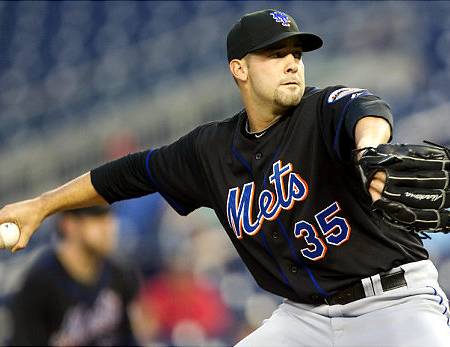
MLB reports: Our last feature was on Danny Espinosa, the Nationals rookie second baseman who is taking Washington by storm. For all the talk of Espinosa’s strong play, many readers wrote in to suggest that Dillon Gee should be at the top of the National League Rookie of the Year talk. For many MLB fans, the first question will be: Who the heck is Dillon Gee?
Dillon Kyle Gee was born and raised in Texas. The 25-year old right-handed pitcher went to high school and university in Texas. The New York Mets drafted the 6’1″ pitcher in the 21st round of the 2007 draft. That is where the story should begin and end. Most players chosen beyond the 2nd round have a very small chance of ever making it to AAA, let alone the majors. This is the not the case though for Dillon Gee, who as a 21st round selection has beaten the odds to make it to the show.
Before joining the Mets full-time this year, here is a snapshot look at Dillon Gee’s career numbers in the minors:
| Year | Tm | Lev | W | L | ERA | IP | H | BB | SO | WHIP |
|---|---|---|---|---|---|---|---|---|---|---|
| 2007 | Brooklyn | A- | 3 | 1 | 2.47 | 62.0 | 57 | 9 | 56 | 1.065 |
| 2008 | 2 Teams | A+-AA | 10 | 6 | 2.92 | 154.1 | 135 | 24 | 114 | 1.030 |
| 2008 | St. Lucie | A+ | 8 | 6 | 3.25 | 127.1 | 117 | 19 | 94 | 1.068 |
| 2008 | Binghamton | AA | 2 | 0 | 1.33 | 27.0 | 18 | 5 | 20 | 0.852 |
| 2009 | Buffalo | AAA | 1 | 3 | 4.10 | 48.1 | 47 | 16 | 42 | 1.303 |
| 2010 | Buffalo | AAA | 13 | 8 | 4.96 | 161.1 | 174 | 41 | 165 | 1.333 |
| 2011 | Buffalo | AAA | 1 | 1 | 4.63 | 11.2 | 7 | 5 | 8 | 1.029 |
| 5 Seasons | 28 | 19 | 3.78 | 437.2 | 420 | 95 | 385 | 1.177 | ||
| AAA (3 seasons) | AAA | 15 | 12 | 4.76 | 221.1 | 228 | 62 | 215 | 1.310 | |
| AA (1 season) | AA | 2 | 0 | 1.33 | 27.0 | 18 | 5 | 20 | 0.852 | |
| A- (1 season) | A- | 3 | 1 | 2.47 | 62.0 | 57 | 9 | 56 | 1.065 | |
| A+ (1 season) | A+ | 8 | 6 | 3.25 | 127.1 | 117 | 19 | 94 | 1.068 | |
Dillon Gee was good, but not great in his minor league career based on the above numbers. While he was stellar in the lower minors, Gee was not exactly “lights out” in AAA. In 221.1 innings pitched in Buffalo over parts of three seasons, Dillon Gee had a 4.76 ERA and 1.310 WHIP. By failing to dominate in AAA, one would have realistically expected Gee to require more seasoning before coming to New York or end up running the risk of getting lit up in the majors.
As you can see from Gee’s Mets numbers, quite the opposite has occurred:
| Year | Tm | W | L | ERA | G | GS | IP | H | HR | BB | SO | WHIP |
|---|---|---|---|---|---|---|---|---|---|---|---|---|
| 2010 | NYM | 2 | 2 | 2.18 | 5 | 5 | 33.0 | 25 | 2 | 15 | 17 | 1.212 |
| 2011 | NYM | 8 | 1 | 3.32 | 15 | 12 | 76.0 | 60 | 5 | 30 | 51 | 1.184 |
| 2 Seasons | 10 | 3 | 2.97 | 20 | 17 | 109.0 | 85 | 7 | 45 | 68 | 1.193 | |
| 162 Game Avg. | 18 | 6 | 2.97 | 37 | 31 | 200 | 156 | 13 | 83 | 125 | 1.193 | |
Dillon Gee’s numbers speak for themselves. 8-1 record, 3.32 ERA and 1.184 WHIP. While he walks a shade too many batters (30/51 BB/K), he gives up far fewer hits than innings pitched. Based on his minor league numbers, I do not expect him to keep up his current pace. The 2nd and 3rd times through the league, I expect NL batters will have a better book on Gee. As the amount of innings pitched increases as well in the hot summer months, Gee will likely wear down. In 2009, Gee missed most of the season due to a shoulder injury. The Mets will likely wear kid gloves with him to some extent and not over extend his arm or risk causing further injury.
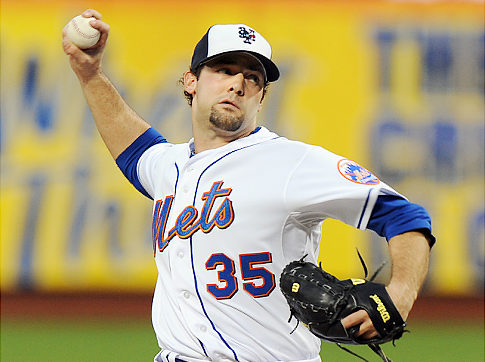 The New York Mets currently sit at 39-39, a .500 record with almost half a season completed. Not much was expected of a team with a great deal of scandal and turmoil surrounding it. One of the few bright spots though, in addition to the strong play and resurgent seasons by Jose Reyes and Carlos Beltran, has been the emergence of Dillon Gee. The patchwork pitching of the staff is nothing to write home about. Jonathon Niese, Mike Pelfrey, Chris Capuano and R.A. Dickey have combined with Gee to keep the Mets afloat and the team competitive in ball games. Chris Young fell early in the season and Johan Santana remains out following shoulder surgery. If not for the play of Dillon Gee, the Mets could have found themselves in the basement of the NL East. Instead, the team is in striking distance of the Braves for 2nd place in the division.
We should know by August if we have a possible Rookie of the Year in New York or another hot-shot prospect that had a couple of good months in Dillon Gee. With so much misery surrounding the Mets, it is a pleasure to see a bright hope emerge within its pitching staff. Dillon Gee this year evolved from an unknown minor leaguer that was considered a middle-of-the-road prospect to top starter status. Mets fans are hoping they have caught lightning in a bottle in Gee for the long-term success of its team. In the meantime, Gee will continue to pitch every fifth day in New York and give his team the best chance to succeed. That is really all the Mets can ask for at the end of the day.
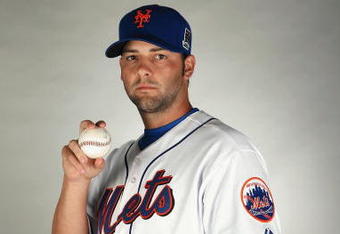
Please e-mail us at: MLBreports@gmail.com with any questions and feedback. You can follow us on Twitter and become a fan on Facebook . To subscribe to our website and have the daily Reports sent directly to your inbox , click here and follow the link at the top of our homepage.
 *** As a special note, the Dillon Gee feature represents the 100th article in the history of MLB reports. We wanted to thank you, the readers, for all your support. We hope that you enjoy reading our articles as much as we enjoy writing them. At the end of the day, it all comes down to one love for all of us: Baseball. ***

Danny Espinosa,Washington Nationals: Hidden National Treasure
Monday June 27, 2011
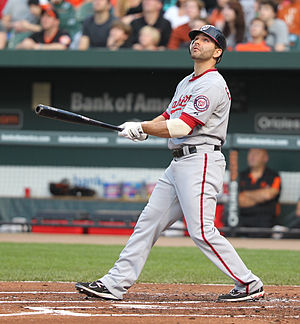
MLB reports: With the shortage of quality second basemen in baseball, teams are always on the prowl for the next Roberto Alomar or Ryan Sandberg. We often hear the names Dustin Ackley and Neil Walker thrown around. Sitting quietly in Washington though is one of the better all-around second basemen in the game. With each home run, the secret is starting to get out of the bag. The Nationals keep winning games and building towards the Bryce Harper and Stephen Strasburg era. But before the next can’t miss prospects make their mark, Washington already has a rookie assaulting the MLB record books. His name: Danny Espinosa.
The 24-year old Espinosa was born in California and selected by the Nationals in the 3rd round of the 2008 draft. He made his major league debut last year and retained rookie eligibility in 2011. The heir apparent to the shortstop position from once incumbent Christian Guzman, Espinosa moved to second for 2011, took a hold of the job and ran with it. Considering he had to learn a new position on the fly, Espinosa’s production is that much more impressive.
Here is a look at Espinosa’s numbers during his time in the minors:
| Year | Tm | Lev | AB | R | H | HR | RBI | SB | CS | BB | SO | BA | OBP | SLG |
|---|---|---|---|---|---|---|---|---|---|---|---|---|---|---|
| 2008 | Vermont | A- | 64 | 8 | 21 | 0 | 4 | 2 | 2 | 17 | 17 | .328 | .476 | .359 |
| 2009 | Potomac | A+ | 474 | 90 | 125 | 18 | 72 | 29 | 11 | 74 | 129 | .264 | .375 | .460 |
| 2010 | 2 Teams | AA-AAA | 481 | 80 | 129 | 22 | 69 | 25 | 11 | 41 | 116 | .268 | .337 | .464 |
| 2010 | Harrisburg | AA | 386 | 66 | 101 | 18 | 54 | 20 | 8 | 33 | 94 | .262 | .334 | .464 |
| 2010 | Syracuse | AAA | 95 | 14 | 28 | 4 | 15 | 5 | 3 | 8 | 22 | .295 | .349 | .463 |
| 3 Seasons | 1019 | 178 | 275 | 40 | 145 | 56 | 24 | 132 | 262 | .270 | .365 | .455 | ||
Now let’s take a look at what Danny Espinosa has produced in the majors:
| Year | AB | R | H | 2B | 3B | HR | RBI | SB | CS | BB | SO | BA | OBP | SLG |
|---|---|---|---|---|---|---|---|---|---|---|---|---|---|---|
| 2010 | 103 | 16 | 22 | 4 | 1 | 6 | 15 | 0 | 2 | 9 | 30 | .214 | .277 | .447 |
| 2011 | 277 | 39 | 67 | 12 | 4 | 14 | 47 | 9 | 2 | 22 | 70 | .242 | .323 | .466 |
| 2 Seasons | 380 | 55 | 89 | 16 | 5 | 20 | 62 | 9 | 4 | 31 | 100 | .234 | .311 | .461 |
| 162 Game Avg. | 581 | 84 | 136 | 24 | 8 | 31 | 95 | 14 | 6 | 47 | 153 | .234 | .311 | .461 |
In addition to have a top-rated glove defensively, Espinosa has produced quite well offensively in the majors. He is on pace for an outstanding 30+ home runs with close to 100 RBIs. Middle-of-the order type numbers are what we are projecting, not the standard second base type production. As with many rookies, Espinosa still has a difficult time making contact and his BB/K ratio will require substantial improvement for him to develop into a batting champion one day. But the numbers in the minors show a great deal of promise. The power has come at an early stage for Espinosa, it is the balance of his offensive game that needs to be rounded into form.
As with any young players, it is difficult and somewhat unfair to have comparisons to establish major league players, let alone ones of the Hall of Fame variety. But Danny Espinosa is showing some Ryan Sandberg type qualities at the plate at an early age with his strong power bat. Second basemen traditionally have strong gloves and any production offensively would be considered a bonus. Players of the Danny Espinosa variety do not come along very often. Washington currently sits with a 40-39 record, above .500 as we near the All-Star break. With the team playing explosive baseball (7-3 in last 10, 22-13 at home), the baseball world is starting to turn its attention to Washington. At the forefront is rookie Danny Espinosa. A possible All-Star come next month, expect to see Espinosa in many All-Star games to come. Come one October soon, we expect to see Espinosa, Harper and Strasburg competing for a World Series title. The word is out on Danny Espinosa, who will form a core for the next decade in building Washington into the next powerhouse team.

Please e-mail us at: MLBreports@gmail.com with any questions and feedback. You can follow us on Twitter and become a fan on Facebook . To subscribe to our website and have the daily Reports sent directly to your inbox , click here and follow the link at the top of our homepage.


 MLB Reports
You must be logged in to post a comment.