Author Archives: Jonathan Hacohen

Ian Kadish MLB Guest Blog: Part 1 – Recap of My 2011 Season
Friday September 30, 2011
MLB reports: We welcome back Blue Jays prospect Ian Kadish to MLB reports. The right-handed pitcher pitched for the Bluefield Blue Jays in the Rookie Appalachian League in 2011. With a 2-3 record, 7 saves, 2.67 ERA, 1.154 WHIP, and 11/35 BB/K, the 23-year-old Kadish showed some very strong numbers pitching in the pen in his first professional season. With a bright baseball future ahead, we are proud to announce that Ian has agreed to become a regular MLB Guest Blogger on the Reports, describing his baseball journey for our readers. In his own words, we present part 1 of 2 of our featured guest blog of Ian Kadish, the recap of his 2011 season:

Ian Kadish (Guest MLB Blogger): So MLB Reports asked me to do another blog entry because there was good feedback on the first one. This will be a 2-part entry, the first part looking back at my 2011 season and how it went and the second part will be about what my offseason will consist of and my expectations for 2012.
Part 1 – A Look Back at the 2011 Season
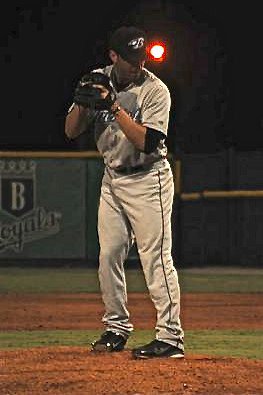 In my opinion, the 2011 season had its ups and downs as well a learning curve, both personally and as a team. The Bluefield team made a great first impression and was a big hit (no pun intended). It was the Blue Jays first year in Bluefield after a 52 year existence of the Baltimore Oriole organization. We surely set the bar high for next year’s team. From what everybody said, the Oriole’s didn’t win much in Bluefield and the fans didn’t show much support because they weren’t winning. We brought a Division Championship to Bluefield in our first year, which the fans were ecstatic about, but what surprised the team was how into the Bluefield/Princeton rivalry the fans were. I’m telling you, these fans went nuts when we played the Princeton Rays. They sold out the stadium every game of the series because of the close proximity of the two teams (only about 15 minutes). The rivalry was for the Mercer Cup. It’s called the Mercer Cup because the two teams are located in Mercer County. The Blue Jays won the Mercer Cup this year and I honestly think the fans were happier we won the Mercer Cup rather than the Division Championship! Princeton had won the Mercer Cup the past several years and it’s about time it’s back in Bluefield. We made it all the way to the League Championship vs. the Johnson City Cardinals, but came up just short. They won the best of 3 series to capture their second league championship in a row.
The team was a great group of guys. Everybody got along and a big reason why we were so successful was due to our chemistry. Everybody pushed one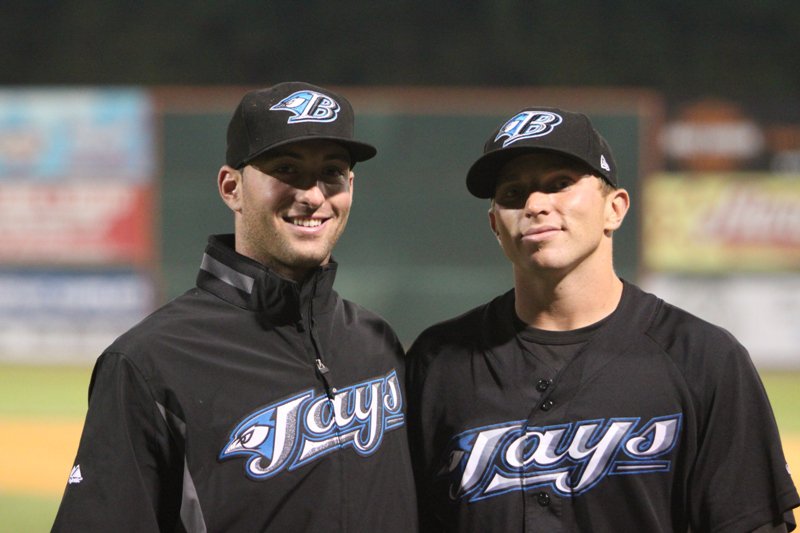 another and everybody picked each other up. We played as a team, just how our manager wanted us to play. He always said to put aside your personal goals and go after the team goals and your personal goals will follow. Our coaching staff was just as great. I can’t even begin to explain how much I learned from my manager. He taught me not only on the field, but off the field. I actually have a notebook full of quotes he said and lessons he would teach the team throughout the season. Now that I think of it, I still owe him a Marshall University clock and Montgomery Inn barbecue sauce (Montgomery Inn is a world-famous rib place in Cincinnati with the BEST barbecue sauce in the history of all barbecue sauces). He loves collecting clocks and has a great amount of them hanging in the locker room. I owe him a Marshall University one because I came into the locker room one day and saw a WEST VIRGINIA UNIVERSITY clock hanging from a wall. Marshall and West Virginia are HUGE rivals and it’s either one or the other…he told me if I got him a Marshall clock he would get rid of the West Virginia clock.
I could go on and on with the stories, but overall the season was a successful one, and one that made me want more…Now that it’s the offseason, I can concentrate on what I need to improve on and prepare for a strong Spring Training and 2012 season…
Up Next: Part 2 – Offseason and Expectations for 2012

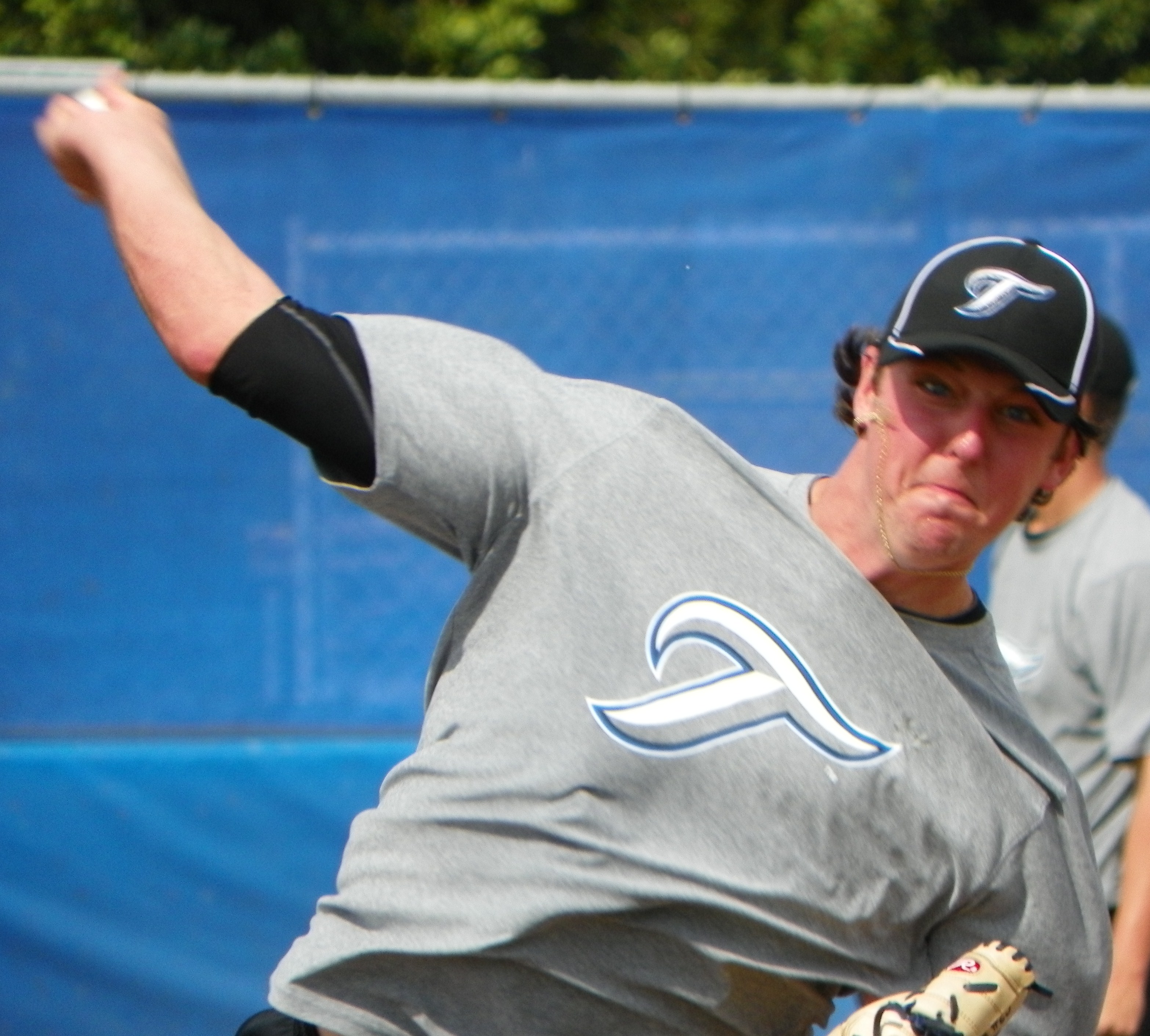
Thank you to Ian Kadish for preparing today’s MLB Guest Blog. Please feel free to contact Ian on Twitter (@BearJew36) or through his website (http://livinginthelifeofian.blogspot.com) for comments and questions. We also thank Ian for sharing the photographs used in today’s feature from his own private collection.
Previous Ian Kadish Guest MLB Blog Entries on MLB reports:
Ian Kadish Guest MLB Blog: My Baseball Journey September 11, 2011
Please e-mail us at: MLBreports@gmail.com with any questions and feedback. You can follow us on Twitter and become a fan on Facebook . To subscribe to our website and have the daily Reports sent directly to your inbox , click here and follow the link at the top of our homepage.
Interview with Deck McGuire: Toronto Blue Jays Prospect and 2010 1st Round Pick
Wednesday September 28, 2011
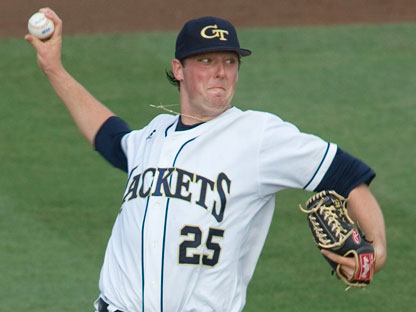
Jeff P (Guest Writer – MLB reports): Recently I had the honor to interview Deck McGuire, top MLB pitching prospect. Speaking to McGuire, I had the sense that he has the same goal as many other baseball players: working to prove that he the real deal. McGuire is a great guy and it was a pleasure interviewing him.
Firstly, I would like to relay some information on Deck, courtesy of Wikipedia:
“William Deck McGuire (born June 23, 1989 in Greensboro, North Carolina) is a professional baseball pitcher currently in the Toronto Blue Jays organization. McGuire who spent three years at Georgia Tech was drafted by the Toronto Blue Jays in the first round of the 2010 MLB Draft and is currently assigned to the Blue Jays’ Double-A affiliate, the New Hampshire Fisher Cats.”
Considering that he was a first round selection, Deck is one of the nicest guys you will ever meet in baseball. Plus he has one of the best baseball names in the game. Featured on MLB reports, I proudly present my interview with Deck McGuire:
Jeff P: Hey, Deck. First of all, I want to thank you for being with us today, it really is an honor to have you with us. I’m sure you have a busy schedule so, let’s get this started. First off, what was your reactions to being drafted, your thoughts, and the party post-phone call?
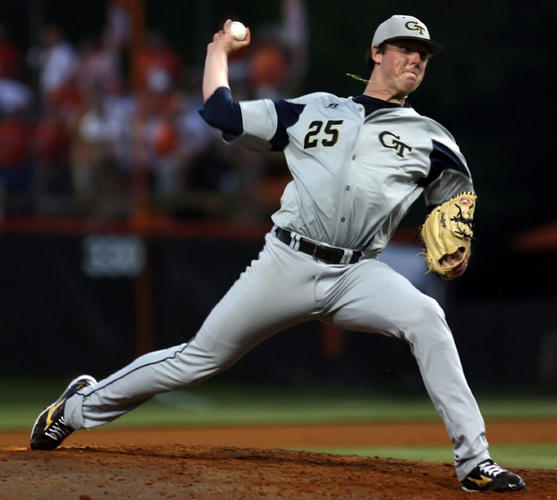 Deck McGuire: I actually didn’t get the true draft experience. We were playing against Alabama in the Regional Championship game, so I was actually in the dugout while we were playing to go to the Super Regionals. I found out in about the 5th inning but I was way more concerned with the game at that moment. Definitely the most bittersweet moment of my life because we lost, ending our season, and my time with the Jackets.
Jeff P: You recently had minor struggles going into Double-A, was it a difficult adjustment?
Deck McGuire: I don’t think it was really the adjustment but more that I never let myself get into a rhythm. I got away from some of the stuff that got me there and then I got a little banged up. I take it as a great experience and a chance to get better heading into next year.
Jeff P: Can you give us some information on your daily rituals? What do you do in the clubhouse, and what are your hobbies off the field?
Deck McGuire: I seem to get there pretty early and I love to play cards, I have a slight competitive streak! I love video games and golf off the field, probably the competitiveness again!
Jeff P: How does your height of 6’6″ affect your play on the baseball field?
 Deck McGuire: Besides being really intimidating!? Just kidding! It really helps when I’m on top of the mound because I can get the ball going down hill, so it is tougher for the hitter to pick up.
Jeff P: What do you find is the most special about playing for the different Blue Jays affiliates?
Deck McGuire: The diversity of locations! I got to play in Florida in the cold months and New Hampshire during most of the hot ones!
Jeff P: What kind of music can you find on your iPod?
Deck McGuire: Lots of country, a little rock, and even less rap.
Jeff P: Who was the most difficult hitter you have faced so far in professional, or college baseball?
Deck McGuire: Gordon Beckham. I faced him when he was at UGA and I was at Georgia Tech. His approach is unbelievable. In pro-ball it was Matt den Dekker from the Mets, same reason really, his approach changes pitch to pitch so he is really difficult to fool.
Jeff P: What baseball player would you most like to be compared to once you get to the big leagues?
Deck McGuire: I’d love to be compared to John Smoltz. He was one of my heroes growing up because he is really the player who can define a winner and a team guy wrapped into one. Starting or closing, he always got it done and did what his team needed to win.
Jeff P: As a minor leaguer, you already have several different pitches that you throw. Do you feel that your pitching arsenal will help you in your path to the big leagues?
Deck McGuire: Without a doubt! Something I have always prided myself on is my ability to throw a fastball, curveball, slider, and a change-up for strikes to any hitter and in any count.
Jeff P: I read recently that you have been compared to Jonathan Papelbon. Do you agree with this comparison?
Deck McGuire: Well the guy is a winner so that’s good, other than that I don’t think I see it. I mean he is a closer and throws fuel. I am a starter and rely more on my array of pitches to get the job done.
Jeff P: Do you think it’s fair to say that sometime next year, we will see you up in the MLB?
Deck McGuire: That would be awesome, but my goal is just to keep getting better. Whenever the Jays think I’m ready to help the big club win, then I am happy to give it my best shot.
Jeff P: You are proud to be a former Yellow Jacket. What were the big adjustments that you’ve gone through from college baseball to adjusting to professional baseball?
Deck McGuire: The 5-day rotation vs. having a week off in college.
Jeff P: I’m going to end off with this last thought. If you weren’t a baseball player, where do you think you would be right now in your life?
Deck McGuire: Gosh I’d like to think I would be in baseball somehow, but I might have played football at a smaller school or maybe gone to med school to try to be an orthopedic surgeon. I really don’t know. I know it is cliché, but being a pro baseball player has pretty much been my dream my whole life!
Jeff P: Thank you for taking your time out of your busy schedule for us today Deck. Much appreciated!
Deck McGuire: Thanks y’all!
Thank you again to Deck McGuire for taking the time to join us today on MLB reports. We highly encourage our readers to post at the bottom of the article any questions and/or comments that you may have for Deck. As well, please follow Deck on Twitter (@DeckMcGuire).
***Today’s feature was prepared by Jeff P, Guest Writer to MLB reports. We highly encourage you to leave your comments and feedback at the bottom of the page and share in the discussion with our readers. You can also follow Jeff on Twitter.***
Please e-mail us at: MLBreports@gmail.com with any questions and feedback. You can follow us on Twitter and become a fan on Facebook . To subscribe to our website and have the daily Reports sent directly to your inbox , click here and follow the link at the top of our homepage.

Baseball Book Review: The Fastest 30 Ballgames
Tuesday September 27, 2011

THE FASTEST 30 BALLGAMES – A BALLPARK CHASERS WORLD RECORD STORY; BY: DOUGLAS ‘CHUCK’ BOOTH, CRAIG B. LANDGREN & KENNETH A. LEE
(AuthorHouse: 2011)
Jonathan Hacohen (Lead Baseball Columnist – MLB reports): As you have probably guessed from my previous reviews, I have a great love for baseball books. I have read hundreds of them over the years and will read hundreds more before my time is done. As baseball seasons have gone by, it seems that the market has become more and more saturated with baseball reading material. With so many options and so little spare time, many baseball readers have a difficult time choosing which books to add to their collections. I can completely relate to this dilemma. Speaking from experience, when I select my next baseball book- I always look for an original and fresh concept. I look to learn, laugh and get lost in time. Let’s face it: with our hectic schedules, reading is supposed to be our time to unwind, relax and have an escape. I recently uncovered a baseball book that provided all of the above and more. A book that will become a must-own for every serious baseball fan. “The Fastest 30 Ballgames” is the title and is the subject of today’s book review.
 Every baseball fan that I know has either just come back from a baseball trip, is going on a baseball trip or is planning to one day take a baseball trip. The bottom line is that baseball fans love their baseball outings. Fans from all corners are discussing as we speak their dream of visiting Yankee Stadium, Fenway Park, Wrigley Field…and so on. We read about all of the major league stadiums. We listen to different teams play on the radio and watch their games on television. The next logical step is to visit those same parks in person. For most, if not all baseball fans, the dream of visiting new major league parks represents the ultimate dream vacation. In his book, The Fastest 30 Ballgames, author Doug Booth takes his readers through his tour of every single MLB stadium. What fans dream of experiencing, Booth has lived it. “The Fastest 30 Ballgames” provides readers with a journey through a baseball odyssey that has never been seen before. We get to live vicariously through Doug Booth. If a great book is to be an escape for its readers, then this book is just that. A really great book. When you finally complete this book, you will not only feel like you know every baseball park, but you will also have the sense of having been there. I got completely lost in the world of Doug Booth and the wonderful universe that is baseball.
I have never read a baseball book that is as expansive as “The Fastest 30 Ballgames”. This book works on so many levels. The first part walks us through Doug Booth’s attempts to set the Guinness World Record of watching games at all 30 major league parks in the fewest amount of days. Think baseball’s version of “Planes, Trains and Automobiles” meets “The Amazing Race”. Sometimes an exercise in frustration, while other times an exhilarating ride. Booth does it all and sees it all, in setting out to fulfil his goal. What I most enjoyed about Booth’s writing style is his honesty, passion and heart. To me, the first part of “The Fastest 30 Ballgames” is a raw diary of the life of Doug Booth. From picking his mode of transportation, tickets, accommodations and route to each city and ballpark, Booth recounts in great detail his life and experiences in hopping from one baseball park to another. Booth does not hold back from sharing the personal details of his life, which make his legend and tale that much more real and rewarding to read. I felt that I was with Booth every step of the way. Booth’s use of imagery was so vivid that I could literally picture his words in my mind, creating a sense that I was along for the ride. A sign of a talented author and one that believes in his work.
 Did Doug Booth set the world record you ask? Yes he did. After narrating in detail his near record-setting attempt in 2008, Booth went on to set the Guinness record the following year by watching baseball games in all 30 parks in only 24 days. If you do the math and take a look at a map, that is a very impressive feat. With weather, traffic, plane delays and countless other factors always lurking, Booth’s feat is mind-blowing. This book is worth reading just to find out how he was able to accomplish such an impossible feat. The reality is that very few of us, if any, will ever attempt what Doug Booth accomplished. When I completed “The Fastest 30 Ballgames”, I have to admit though that I felt the urge to continue my own baseball journeys. I started to calculate in my head all the baseball parks that I had already visited in my lifetime, and the ones that I still had left on my list. I started to visualize geographically where each stadium was located and how many I could visit per trip. From there, I calculated the number of trips and period of time I realistically thought it would take to complete the mission. As I was doing this, I realized that I was beginning to channel Doug Booth. I had the itch… and the only known cure was ordering tickets and getting on the road. Doug Booth had inspired me. I would assume that this was one of Booth’s goals in writing this book. By stirring the baseball excitement within me, I appreciated Booth’s own baseball travels and wanted to further trips of my own. Not only did I enjoy the book as a relaxing escape, but I was inspired and motivated. Another sign of a successful writer.
 It is one thing to say that a person wants to achieve a goal. It is another thing to actually do it. Armed with my the drive to see every major league park, part 2 of the book lays out how to make it happen. Co-author Craig Landgren prepared a detailed listing and ranking of all 30 MLB parks. From where to park, sit, buy tickets, food, best months of the year to attend, nearest attractions and closest stadiums, Landgren provides the perfect “AAA” type guide to visiting baseball stadiums. A book within a book, Landgren provides the ideal cheat sheet for every stadium in the “Ballpark Chaser Guides” section, as it is referred to in the book. For those that are interested (and if you are a baseball fan, you will be), be sure to visit Landgren’s site: http://Ballparkchasers.com. Ballpark Chasers is an on-line community of baseball die-hard fans, sharing information, stories and pictures on baseball travelling. For “The Fastest 30 Ballgames”, Landgren lays out beautifully the information and images of all 30 MLB parks. In essence, Booth sets you up by inspiring you to follow his baseball trips, while Landgren teaches you how to make it happen. “The Fastest 30 Ballgames” is part autobiography and part baseball travel guide. But fully 100% baseball. Just the way we like it.
The last part of the book is real life stories of “Ballpark Chasers”, real people like you and I, telling the story of their stadium trips. Reading each of their stories, I started to think and plot in my head what story I would be telling one day on the Ballpark Chasers website. I could identify with all of the individuals, as they were the same as me. Baseball fans who loved the sport passionately and enjoying watching the games immensely. I could identify with each of these Chasers and felt that I could one day be one of them. That at the end of the day was likely the reason for including their tales. Now I was inspired by Booth, had the guide to travel from Landgren and the reinforcement from other Chasers that my planned travels could one day come true. Like Booth, it was extremely enjoyable to read each and every one of these baseball tales. This part added to the authenticity of the book that its authors strived towards. I was glad to read all of the Chasers’ tales and look forward to one day writing a baseball travel story of my own.
I have a deep dark secret I need to share. Most baseball books take me several days to complete. With professional and family commitments, I will usually take 1-2 weeks to complete a book. “The Fastest 30 Ballgames” took me several weeks to complete. This was the longest amount of time I have ever taken to complete a baseball book. This is a compliment though to how much I thoroughly enjoyed reading it. “The Fastest 30 Ballgames” travelled with me everywhere this summer. From my bedside, to doctor’s offices, the cottage and even my trip to Cooperstown, it followed me each and every step of the way. When I picked this book up, I could literally not put it down. I found myself going back to certain chapters and sections, reading and re-reading certain portions. When I was watching ballgames on television, I would pull out the book and compare its descriptions to what was seeing before me in real-time. It takes a lot to get me excited and gushing. Booth and his co-authors were able to accomplish that in their baseball masterpiece.
With the playoffs around the corner, the MLB 2012 schedule was recently released this month. Perfect timing to pick up “The Fastest 30 Ballgames” and start planning your next baseball trip. After reading all the tips and insights into each major league city and park, I would not dare to plan a meal, hotel reservation or purchase ball tickets without consulting this book. The book is an enjoyable read and provides hours of fantastic baseball tales. But at the end of the day it is not just a storybook, it is also a key reference tool. With so much baseball information and knowledge available in this book, I am certainly glad that I read it. If you are a seasoned veteran or someone just introduced to the game: do yourself a favour and pick this book up. “The Fastest 30 Ballgames” will be one of the most enjoyable baseball experiences that you ever experience. Until you get to all 30 Major League Baseball stadiums yourself one day!
**The photographs in today’s feature are courtesy of Douglas ‘Chuck’ Booth**
*** To learn more about “The Fastest 30 Ballgames” and Doug Booth, you can follow Doug on Twitter (@ChuckBooth3024) and click here for Doug’s website, fastestthirtyballgames.com***
Please e-mail us at: MLBreports@gmail.com with any questions and feedback. You can follow us on Twitter and become a fan on Facebook . To subscribe to our website and have the daily Reports sent directly to your inbox , click here and follow the link at the top of our homepage.

Javier Vazquez Behind the Numbers: The Fantasy Value of Pitchers
Monday September 26, 2011
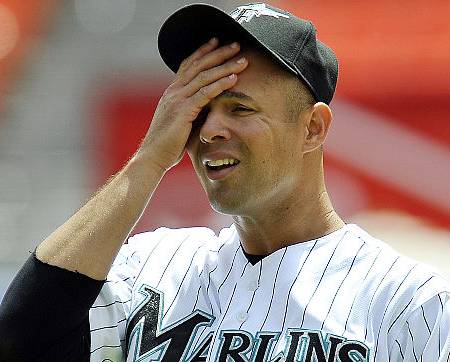
Peter Stein (Fantasy Baseball Analyst – MLB reports): After a historically bad start to the regular season, Javier Vazquez has finished the 2011 campaign on a hot streak to the delight of many fantasy owners who found the 35-year-old right-hander available on the waiver wire. He is ending his season and career with a bang, not allowing a run in his last 25 innings pitched and winning five consecutive starts. His 7 wins, 2.16 ERA, and 87 strikeouts in 87 innings make him one of the strongest starting pitching assets in all of baseball post all-star break.
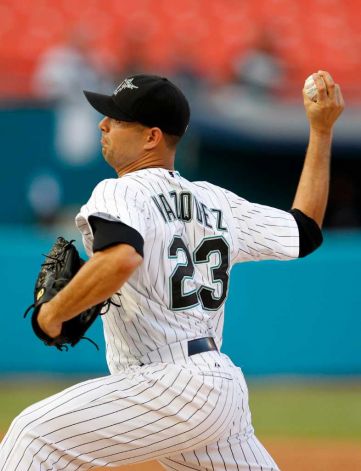 Going into the season I actually grossly overpaid for Vazquez and ultimately traded him away. I continued to monitor the pitcher because I knew what he was capable of doing on the mound. However, sitting at 5-8 with a 5.23 ERA at the all-star break, Javy lived up to the criticisms that he has endured throughout his entire career. On paper, Vazquez appears to be one of the most consistent pitchers of the past decade, earning double-digit victories in each of the past twelve seasons. Returning to the NL East, many people, myself included, had high expectations for Vazquez in 2011. After all, he is just two years removed his finest season as a professional with 15 wins and 2.87 ERA for the Atlanta Braves. But the guy is far from consistent. Season to season, month to month, and from start to start you never knew which Javy Vazquez you were going to get – just ask one of his former managers, Ozzie Guillen. http://sports.espn.go.com/mlb/news/story?id=3602173
New York Yankee fans are also all too familiar with Vazquez as well, as his stints in the Bronx in both 2004 and 2009 are reminiscent of A.J. Burnett’s 2011 campaign. There is no question that Vazquez is streaky and frustrating to own, for both real and fantasy managers.
However, Vazquez finished 2011, and he says his career, with one of the strongest stretches of his career – conveniently down the stretch for savvy fantasy owners.
So what took Vazquez so long to get his act together in 2011? The answer is actually very clear and it has everything to do with his velocity. To start the season, his average fastball velocity started around 86 miles per hour but steadily increased and finally reached the 92-93 miles per hour range for the second half of the season. http://www.fangraphs.com/pitchfxo.aspx?playerid=801&position=P&pitch=FA
As his fastball velocity increased, so did the frequency in which Vazquez used it. While it’s rare that a 35-year-old regains velocity, it is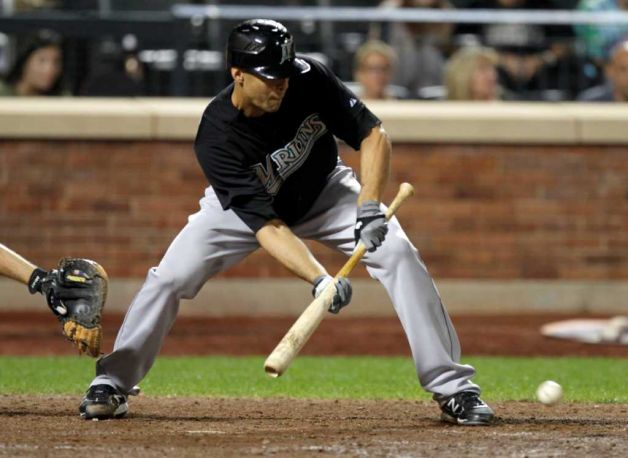 evident that it was the key to his success. The gain in velocity, coupled with a low-pressure situation in Florida in the NL East, allowed Vazquez to morph back into the pitcher he was in 2009. Although some players rely on velocity more than others, it certainly is a major factor in a pitcher’s success. Just look at Ubaldo Jimenez. With an average fastball velocity of 96mph in 2010, he put together a 19-8 season with a 2.88 ERA. In 2011, his velocity dipped to 93.9 mph and Ublado had trouble getting hitters out, compiling a 10-12 record with an ugly 4.47 ERA. Unless Ubaldo can have a Javy-like resurgence in velocity, he will be forced to improve his secondary pitches and will probably never again be a Cy Young contender.
This gets me to the point of the article. Many fantasy owners tend to ride players who are on hot streaks. But how can you predict these hot streaks when luck plays such a big factor? There needs to be an identifier for success, because all too many times we see players burst onto the scene with a few good starts but soon fizzle away. Sample size is very important, and Vazquez has demonstrated that he is capable of success. It was the gain in velocity and Vazquez’s placement in the NL East that made him a second half commodity. Therefore, before you trust a guy who is “hot”, be sure you do your research and find out why. Otherwise, you are simply gambling. With starting pitchers look for the factors that might contribute to a pitcher’s success: velocity, pitch selection, league and division, and ballpark.
Next week I will take this even further and discuss FIP and XFIP. If you play fantasy baseball and don’t know about www.fangraphs.com, do yourself a favor and familiarize yourself with the site and sabermetrics. This will give you a more accurate depiction of how a pitcher is throwing the ball and better indicators for future success, thereby eliminating the guessing games and searching for “hot streaks.”
***Today’s feature was prepared by our Fantasy Baseball Analyst, Peter Stein. We highly encourage you to leave your comments and feedback at the bottom of the page and share in the discussion with our readers. You can also follow Peter on Twitter (@peterWstein).***
Please e-mail us at: MLBreports@gmail.com with any questions and feedback. You can follow us on Twitter (@MLBreports) and become a fan on Facebook . To subscribe to our website and have the daily Reports sent directly to your inbox , click here and follow the link at the top of our homepage.

How Far Will the Yankees Go in the 2011 Playoffs? Prediction Time
Sunday September 25, 2011

Jeff P (Guest Writer – MLB reports): The Yankees entered the season with a troubled rotation, some great bullpen signings from the offseason, and a star-studded lineup.
As the season commenced, the Yankees had immediate troubles in the rotation. The troubles in the rotation started with their former number two starter Phil Hughes, who seemed to be dominant going into the year, yet wasn’t able to play due to a “Dead arm”. The rotation ended up being filled by a rookie (Ivan Nova), C.C. Sabathia, a struggling A.J. Burnett, and two veterans who weren’t very successful in the past few seasons (Colon and Garcia).
 The Yankees were up for the challenge, as they not only beat out the nearly untouchable Red Sox in the AL East division race, but also had a season full of historical baseball moments. Derek Jeter, became the first player in Yankee history to reach the 3,000 hit mark, as for Mariano Rivera, who is now the all-time leader in saves in Major League Baseball history.
Bartolo Colon, and Freddy Garcia unexpectedly became huge parts in lifting Yankees until the day they clinched the division spot. As for Ivan Nova, he won 16 games for the Yankees in the “Journey to the playoffs”. Now the Yankees are finished with that chapter and are now on a new journey: the “Journey to the World Series”.
The playoffs are about to start soon, as the Yankees are in the process of last-minute preparations. Unnamed sources have leaked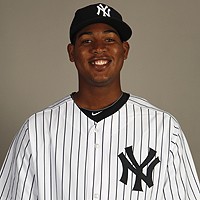 out that Ivan Nova will start game two, and A.J. Burnett will not appear as a starter in the playoffs. The Yankees’ playoff rotation is looking more favorable for Freddy Garcia to be the number three starter, as Bartolo Colon is going through a horrific slump. Colon’s ERA (earned run average) in September is well over a 6.50, resulting in his ERA surpassing 4.00 on the season. Therefore it is probable that Freddy Garcia will be named to start for the Yankees in the 2011 MLB playoffs.
There have been multiple questions concerning Jesus Montero’s spot in the Yankees playoff roster. To date, it seems likely Yankees will proceed to place him on the roster in place of Francisco Cervelli, as he is expected to come back later in the playoffs due to concussion symptoms.
Besides the rotation, bullpen, and the Yankees lineup, backups also take on a big role in the “Key to success”. The Yankees backups are looking extraordinary as the season is nearing an end. The backups will include a trio of Eric Chavez, Eduardo Nunez, Andruw Jones, and either Jesus Montero or Jorge Posada as of now. The backups are looking promising, and can take a big part in the “Journey to the World Series”.
The Yankees have a team full of playoff greats, such as Derek Jeter, Mariano Rivera, and others such as Alex Rodriguez, and C.C. Sabathia. There is a debate as to whether the veterans can lift the Yankees this year to championship Number 28. The answer is that the Yankees veterans have the promise playoff strength. Veterans such as Derek Jeter (also known as Mr. November), and Mariano Rivera, among others who have experience and the strength to lift the Yankees in the postseason. However, the Yankees veterans are aging, and as they age, they get less and less reliable. This leaves the backups with a huge role to fill.
The Yankees teams consists of youth, veterans, and a great deal of confidence. The confidence was within the clubhouse on Thursday, as C.C. Sabathia stated in an interview with MLB.com, that if he plays correctly he will win. With the attitude and the strength to do so, the Yankees could go far into the playoff race this year.
The Yankees will most likely play the Texas Rangers, or the Detroit Tigers. There is uncertainty which team as of yet, though each team has their ups and downs, and certain distractions they will have to face. Let’s take a look at the potential matchups:
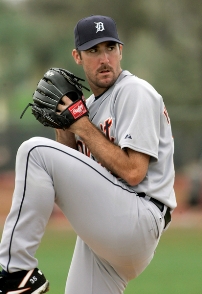 Detroit Tigers: The Tigers have an outstanding rotation coming into the playoffs. Max Scherzer, is a strikeout master, while Justin Verlander is just about a master of everything. Verlander has produced great success this year, as he is seeking to win the AL Cy Young, and possibly become the first pitcher to win the AL MVP award in the last 20 years.
Doug Fister will be a huge part of the Tigers playoff plans, as his ERA dropped below 3.00 recently. His September stats consist of four wins and a 0.69 ERA. Fister’s streak is looking unstoppable, and will be a hard match for the Yankees. The Yankees pitching isn’t looking very promising as of late, and the Tigers clearly win that category. If the Yankees can’t produce runs against the hard throwing Tigers’ pitching staff, it may be hard to get by them. The Tigers key hitters are Miguel Cabrera, Alex Avila, and Victor Martinez. With the Yankees pitching rotation banged up, the Tigers could prove to be a very difficult opponent.
Prediction: Yankees in five
Texas Rangers: All eyes are on the Rangers banged-up rotation now. C.J. Wilson, who has been having substantial success this year for the Rangers, is facing a problem to think about. As the offseason approaches, so does free agency. Free agency can affect not only the thoughts of players, but how they are playing. Thoughts are a very powerful thing, as on different occasions it can be hard to think about free agency when playing. The pressure is immense. Although in Wilson’s case, the pressure could prove to be a motivator to pitch well.
Alexi Ogando, Derek Holland, and Colby Lewis are among the other probable starters. All of them are decent pitchers, though they occasionally rely on help from their offense for run support, which will prove to be the main problem for the Yankees rotation.
The Rangers lineup includes Mike Napoli, Josh Hamilton, Nelson Cruz, and Ian Kinsler in the heart of their lineup. This will be an extremely difficult problem for the Yankees rotation, as Rangers seem to possibly have the best lineup in the majors. The Rangers offense may possibly even be better than the Yankees lineup. If the strength of the Rangers rotation and lineup continue to consume strength, the Yankees could be outmatched.
Prediction: Rangers in five
Assuming the Yankees play the Tigers, and proceed to the second round, with either the Red Sox/Rays (depending on who wins the wild card), or the Rangers, both series will be a close call and consist of exciting games to watch. The Red Sox are in a similar situation as the Yankees, as their pitching staff has averaged a 6.60 ERA in the last ten games played. If we have a Yankees and Red Sox matchup in the ALDS, it will likely go the full seven games- where anything is possible.
The Yankees have made history this year and accomplished feats over the years that no team has ever matched. Most importantly, the team wants to succeed. Success is a big thing for the Yankees organization. The Yankees are survivors, never give up, and always look to come back when down. This year has already been one big accomplishment, as the Yankees surpassed the Red Sox in the standings and possibly in making the playoffs. Now the team is looking for championship rings in the year of 2011.

***Today’s feature was prepared by Jeff P, Guest Writer to MLB reports. We highly encourage you to leave your comments and feedback at the bottom of the page and share in the discussion with our readers. You can also follow Jeff on Twitter.***
Please e-mail us at: MLBreports@gmail.com with any questions and feedback. You can follow us on Twitter and become a fan onFacebook . To subscribe to our website and have the daily Reports sent directly to your inbox , click here and follow the link at the top of our homepage.

J.P. Arencibia vs. Travis d’Arnaud: Who is the Jays Catcher of the Future?
Saturday September 24, 2011
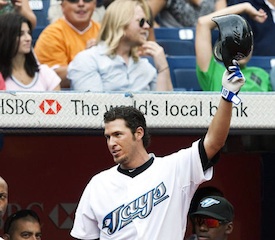
April Whitzman (Blue Jays Writer – MLB reports): Two weeks ago, I posted that the toughest question Blue Jays’ fans are dealing with right now is figuring out whose comeback, whether that of Dustin McGowan or Adam Loewen, is more impressive. Today I pose a question that some would say is equally hard to answer: who is the Toronto Blue Jays’ catcher of the future – J.P. Arencibia or Travis d’Arnaud?
What they have in common:
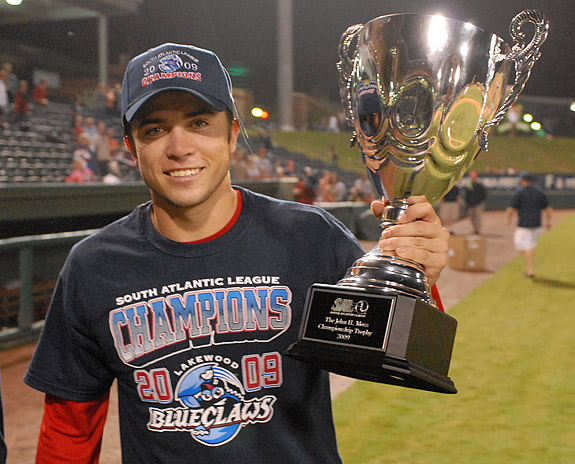
Interesting, while many people do not realize this, both catchers share their origin in common – the 2007 MLB first-year player draft. In fact, Arencibia was drafted 21st overall by the Blue Jays out of the University of Tennessee. As the 37th pick overall, the Philadelphia Phillies went with Travis d’Arnaud, out of Lakewood High School. At the time it was believed that the Jays were interested in d’Arnaud’s potential and would pick him with the 38th pick and move Arencibia to first base. Yet the Phillies chose the young star from Florida one slot before, forcing the Jays to choose left-handed pitcher, Brett Cecil. That said, a persistent GM, Alex Anthopoulos, would get his player; as the Blue Jays acquired Travis d’Arnaud two years later in the well-known Roy Halladay trade.
How they differ:
Defense
It is difficult to compare these players, as Arencibia has already made the jump to the majors while d’Arnaud just finished his season in AA New Hampshire. Arencibia has more professional experience having been drafted out of college, while d’Arnaud came out of high school. Here is a graph to compare how each player performed during their time at AA New Hampshire:

JP received the promotion from Dunedin to New Hampshire half-way through the season; his stats have been doubled to receive a more accurate comparison.
Both players are pretty evenly matched. Nevertheless, d’Arnaud has the slight advantage on errors committed, fielding percentage, and passed balls. Meanwhile, Arencibia has a higher caught-stealing percentage.
Despite one player being in the majors and the other in the minors in 2011, an interesting comparison can be depicted if we compare both catchers’ stats for this season:

With each player in their fourth year of professional baseball, these stats show how close their defensive game truly is. Having committed the same amount of errors, the same fielding percentage and only one passed ball being the difference between them, the biggest distinction is that d’Arnaud has the slight advantage throwing out base runners.
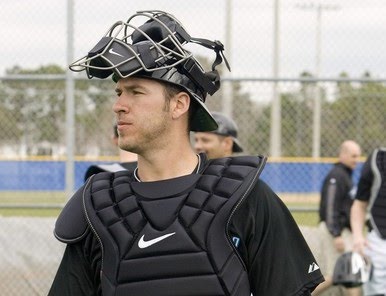 Don Wakamatsu, a former catcher himself, and now the Toronto Blue Jays bench coach has admitted that he has seen a drastic improvement in Arencibia’s defensive abilities. Wakamatsu credits the improvement to a significant amount of practice and hard work. He stated: “Arencibia has done a phenomenal job trying to understand how to get the most out of our pitching staff.”
Defensively, Arencibia has a good arm, but he struggles at times with blocking pitches in the dirt. In his minor league career, Arencibia threw out close to 30% of base stealers, though charged with 60 passed balls in 357 lifetime games.
In regards to his defense, Arencibia stated, “Defense is obviously first, and I know that, and whatever comes with the bat is secondary.” He continued: “I feel like my biggest thing is getting that pitcher through that game and I feel like I’m starting to get a real good understanding of my staff and giving us opportunities to win.” Since making these comments, Arencibia has improved his defense considerably in the second half of the season. For example, in the eighth inning of Friday night’s game against Tampa Bay, JP was able to throw out Rays outfielder B.J. Upton.
Comparatively, Travis d’Arnaud’s defensive skills are stronger. He has a great game-calling abilities and he has a strong arm. While his career caught-stealing rates have suffered due to inexperience, he has also improved his game by working on his footwork behind the plate. At 22 years old, d’Arnaud is already one of the better defensive catchers in the minors and he has plenty of time to develop into a premier defender in the big leagues. This was proven when he was named the Catcher’s Captain Award recipient for 2011 by Baseball America. The award is given to the catcher who displays strong defensive qualities, including leadership and dedication.
Offense
There is no denying that both players are also solid offensively. In 409 games in the minors, JP hit .275 with 121 doubles, 83 HR and 290 RBI. That said, he has also proven what he can do at the plate at the major league level as well. There is not a Blue Jays fan who does not remember J.P. Arencibia’s major league debut last year against the Tampa Bay Rays, as he launched the first pitch he saw over the left field wall for a home run. He later singled and doubled and capped the day with a home run to right field. That game showcased Arencebia’s talents and his ability to hit the ball for power.
Offense is where Arencibia and d’Arnaud differ most. Essentially, while JP hits for power but not average, d’Arnaud is a more complete player at the plate, as he hits for average and power. This year with the Fisher Cats, d’Arnaud was named the Eastern League MVP after hitting .313 with 20 homers and 77 RBIs. Here is how their 2011 numbers compare:

Prior to the 2011 campaign, many fans and analysts alike were not sold on d’Arnaud as anything more than a defense-first catcher.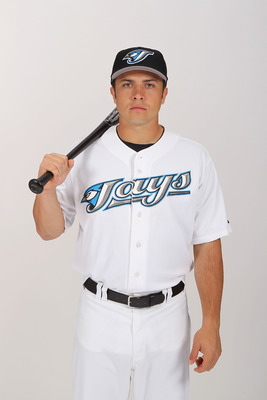 However, as his numbers this season have indicated, Travis experienced a bit of a learning curve early on in his career, as he made the jump from high school to the minor leagues. With his bat coming around this season, the offensive edge at this stage goes to d’Arnaud. It is evident that both players (as can be seen from the table above) need to work on the amount of times they strikeout, but other than that, both look solid at the plate and behind it.
Overall
Although both J.P. Arencibia and Travis d’Arnaud came from the same draft class in 2007, it appears that d’Arnaud has the greater upside. In essence, Arencibia has received the call to the majors quicker because he was able to develop in college before jumping to the professional ranks. As displayed through various charts, d’Arnaud appears to be more efficient both with his glove and bat. His numbers indicate that he could make the jump to the MLB as early as next year. In a recent interview with Fisher Cats beat reporter, Dave Gershman, d’Arnaud showed that he has the confidence to make it to the big leagues, as he stated: “Hopefully one day I can get up to Toronto, and play like I’m playing now. And who knows what will happen? Maybe I’ll be a good player.”
At the same time one cannot discredit J.P. Arencibia, as despite his quick progression to the MLB, he is still learning at the age of 25. Arencibia recently stated as much when he admitted, “On both sides of the plate I’ve been maturing and making adjustments in different things,” Arencibia says. “But it’s still a work in progress. You’re always trying to get better.” With catchers requiring the most seasoning from all the positions, Arencebia can still be considered to be at this stage ahead of the curve.
Whoever is chosen as the lead catcher, one thing is certain: the Blue Jays are blessed with two young catchers – both at the plate – and behind it! If the team’s worst problem is having two number one catchers on its roster within the next two years, then that is a great dilemma to have. It is very possible that one of the above (likely Arencibia) will be moved when both catchers have proven themselves at the major league level. Until then, with injuries and slumps being a reality of the game, the Jays will enjoy their abundance of talent behind the dish and lets the cards play themselves out.
As always, I look forward to hearing from you. Comment below, email MLBreports@gmail.com and follow me on Twitter at @Alleycat17.
Please e-mail us at: MLBreports@gmail.com with any questions and feedback. You can follow us on Twitter (@MLBreports) and become a fan on Facebook . To subscribe to our website and have the daily Reports sent directly to your inbox , click here and follow the link at the top of our homepage.

Drew Taylor Interview: The Story of an Intercounty League Pitcher
Follow @mlbreports Wednesday September 21, 2011
MLB reports: We are proud today to feature on MLB reports: Drew Taylor, former Philadelphia Phillies and Toronto Blue Jays prospect pitcher, currently playing in the Intercounty Baseball League. Based in Ontario, Canada, the Intercounty League has produced several major league players including Rob Butler, Rich Butler and current Brewers closer, John Axford. Drew’s baseball blood lines run deep, as his father Ron Taylor is former MLB pitcher himself. Part of the 1969 Miracle Mets during his playing career, Dr. Taylor is a long time team doctor for the Toronto Blue Jays. From getting signed by the Jays, having a World Series champion pitcher as a father, recovering from injuries and life in the Intercounty League and working towards becoming a doctor, we covered many topics with Drew. For a great baseball tale from a different part of the game, we present our recent interview with Drew Taylor:
MLB reports: Welcome to the Reports Drew. Thank you for taking time out of your schedule for this interview. First question we always like to ask: who was your favorite baseball player growing up, that you most idolized and patterned your game after?
Drew Taylor: I always loved to watch David Wells pitch when I was younger. As a lefty I learned a lot about setting up hitters and how to use a curveball effectively against left- and right-handed batters. I also loved his approach. He went right after hitters no matter who they were and rarely fell behind in the count. A true lefty – he was a character on and off the mound. I had the chance to get to know him a little when he was playing in Toronto. When I was in high school, I threw a bullpen in Spring Training for the Jays. I didn’t know I would be throwing that day so I only had my first baseman mitt with me. He gave me a glove to use and watched me throw giving me some pointers after the pen, very generous; he is the kind of guy that would give you the shirt off his back. I also learned a great deal from watching him that day in the way he treated people and engaged with fans asking for his autograph. Down to earth.
MLB reports: Which current MLB star do you most admire and why?
 Drew Taylor: I would have to say Travis Snider. I played with Travis our first year in the Blue Jays minor leagues and actually lived with him for the first part of the season. He came into the Jays straight out of high school and was thrust into a system that was known for drafting mostly college athletes. Here he was living with Jeff Gilmore, who graduated early from Stanford and had already begun a Masters in History and myself, already with Undergraduate and Masters degrees from the University of Michigan. But in truth, Travis was probably the most mature of the group of us. As I got to know Snider I found out why. He had faced a great deal for a kid of his age. There have been a number of articles written him since he broke into a big leagues focusing on what he and his family went through while he was in high school. If you haven’t read them, I suggest you look them up. I won’t go into all the details here, but in short when his mother was dealing with serious health issues, he was placed in a difficult situation at a very young age. As the only son, he stepped up to be a rock for his family. There are a lot of talented athletes that get drafted and Snider is definitely one of them. Sometimes though it is experiences like these that separate the men from the boys and dictate who will have the resolve and discipline to make the jump to the big leagues.
MLB reports: Reflecting on your career to-date, what are your proudest accomplishments on the baseball field?
Drew Taylor: I transferred for my sophomore year to the University of Michigan from Georgia Tech in 2003. I came into a program that had a great history but had struggled in the past few seasons, finishing only 21-32 the previous year. Rich Maloney had moved from Ball State to the Michigan to take the helm as head coach. He called each player in one by one before the season, sat us down and laid out what he expected of us. It was the first time a coach had talked to me that way. He demanded excellence and explained how each one of us as individuals could contribute to the team’s success. I owe a great deal to Rich and would not have had the success I had that year without his ability to inspire his athletes and instill confidence in them. He turned that program around and we ended up 30-27 that year, climbing to 43-21 and winning the Big Ten by the time I graduated. “Those who stay will be champions.” I personally ended up 9-1 in 2003, making the All-Big Ten and All-Region Teams and was given the Geoff Zahn award for Michigan’s top pitcher. After pitching only 9.1 innings the previous year, this was a big turnaround for me. Rich knows how to get the most out of his players and I hope he remains a college coach so I can send my kids his way one day.
MLB reports: You were signed in 2006 by the Toronto Blue Jays after the draft. Were you scouted by certain teams before the draft and were you expecting to be drafted?
 Drew Taylor: The most amount of attention I received was probably in 2001. My velocity shot up during my final year of high school and while pitching for the Ontario Blue Jays the summer before starting university. I had a number of clubs call and make offers, including the Rockies, Blue Jays, and Braves, to see if I would forgo school to sign professionally. But I was dead set on getting my education. While at Michigan, I had a great sophomore year going 9-1 and followed it up with a good showing in the Cape League which drew some attention again. Then during my draft eligible Junior year I ended up injuring my shoulder in my first start of the year. I tried to come back and pitch a couple of times, but ended up having to shut it down for the season. That effectively ended any chance I had of getting picked up in the draft, so I focused on my rehab, knowing that I would be back at Michigan the next year and would have to prove I could compete all over again. In 2006, the Blue Jays called right after my final game and signed me to a free-agent contract. I reported to camp two days later.
MLB reports: Being signed by your hometown Jays must have been very special. What were your feelings after the draft and what was the process like up until the time you were signed?
Drew Taylor: Being signed by your hometown team is always special, but there were so many things on the go I didn’t get much of a chance to sit down and enjoy the feeling. When I got the call I was in Michigan right after we got back from the NCAA Regionals in Atlanta. It was a little bit of a whirlwind because I had just got back to my apartment when I was told I was leaving again in two days. In those two days, I quickly packed up my apartment and hit the road for Toronto. Kevin Briand and Sean McCann were the scouts that signed me and I went down to the then named SkyDome to meet them and sign my contract. With the papers in, Kevin walked me down onto the field and it finally sunk in.
MLB reports; As a 6′ 5″ left-handed pitcher and being the son of an ex-major league hurler, what were the expectations you set for yourself once you joined the Jays system? Did you envision yourself in the major leagues one day and what was your plan to get there?
 Drew Taylor: Everyone who signs a contract, or for that matter who has played baseball at any level has thought about what it would be like to play in the majors. For me, I had a father who had done it for 11 years, and because of that I had the opportunity to be exposed to the game at a high level from an early age. I fully expected to make the majors and as soon as I signed professionally, I set out to realize that goal. Competition increases as you move up in the system and ultimately I never reached my goal of reaching the majors. There are a lot of talented players in professional baseball, many of the guys in the minors have the talent and ability to play in the majors, but lack consistency. At the major league level you have to be able to make adjustments within the same game or within the same at-bat. Realizing how to make these adjustments takes time and experience, which is one of the reasons athletes in baseball require time to mature and develop above other sports. The mental side of baseball is much more important than the physical… as Yogi Berra said “Ninety percent of baseball is mental, the other half is physical.”
MLB reports: For all the fans that have never experienced minor league baseball before, give us an idea as to what life is like in the minor leagues as compared to what people see in major league stadiums. The level of competition, amenities and support from the major league team for its minor league system- what is it like?
 Drew Taylor: Night and day. Have you ever watched Bull Durham? Its bang on. The minors consist of a lot of long bus trips, fast food, and tiny locker rooms. The other big difference that people do not realize is how little money players are paid in the minors. Bonus Babies get a big cheque at the beginning, but the weekly salary is barely enough to live on. I would love to see the Major League Baseball Players Union fight for better pay in the minors, but once you make it to the majors I assume those guys try not to even think about the minors again. I don’t see it happening. Another problem is that players in the US and Canada are entered into the draft, while international players are all free agent signs. This means that home-grown talent can only negotiate with the team that drafted them, while international players have the ability to shop around different teams and drive up their signing bonuses. We need to move to a world-wide draft. One thing I will say is that players who make it to the big leagues know what it is like in the minors because they came up through it. Many guys are very good to the guys at lower levels. Especially if they are back down in the minors for rehab starts. One guy that sticks out in my mind that always looked after the guys at the lower levels was Brandon League. He was down for rehab for a while in Dunedin one year and went out of his way for us.
MLB reports: Injuries unfortunately played a huge part in your career, as it affects many young hurlers. Please tell us what happened to you health wise and your path through injuries, surgeries and how health affected your career.
Drew Taylor: I only threw twice in my junior year at Michigan before it was painfully evident that something was not right. I ended up having a small tear in my rotator cuff and a strained bicep. I rehabbed and came back strong enough to get picked up by the Jays. My velocity had never returned fully after my arm injury in University, so I had to find other ways of getting hitters out than just blowing it by them. Additionally, I moved primarily to the bullpen after being a starter my whole life. My mental approach to baseball improved greatly, learning how to set up hitters and get them out not just by beating them with a pitch, but beating them with a pitch they didn’t expect. Instead of facing the same hitters many times in one game as a starter, I was now coming in relief and mostly only had to face batters once. I had to develop the ability to strike out a batter when I came on with runners on base and I focused on improving out pitches. My first year was in Pulaski Virginia in the Appalachian league facing a lot of young free-swingers. I used this to my advantage and ended up striking out 37 in 27 innings. As you move up through the system, hitters have a much better approach and wait for you to throw a pitch they are looking for or for you to make a mistake. You have to improve with them, or you will get left behind.
MLB reports: For those fans that aren’t aware, your father is Dr. Ron Taylor. A team doctor for the Jays, your dad was a star pitcher in the big leagues and played on World Championship teams. What influence did your dad have on your career? What was your relationship like growing up?
 Drew Taylor: My dad was a huge influence on me. He never pushed me into baseball, or medicine for that matter, they were both my choices. Once I made the decisions to pursue being a professional pitcher and then a doctor, his support and guidance was bar none. He had a great career in the majors for 11 seasons, winning two World Series with the Cardinals in 1964 and the Amazin’ Mets in 1969. I had a big leaguer at my disposal and he taught me things about playing at a level that very few have made it to. Even when we would sit down and watch a game on TV, we would be talking about setting up hitters and he would always ask me what pitch I would throw next. The biggest thing he taught me is how to deal with pressure and maintain focus and confidence – something I can take with me in all aspects of life. In 6 appearances in Major League post season games he threw over 10 innings without giving up a run. In 1964 he threw 4 innings in the World Series without giving up a hit, allowing only one base runner on a walk to none other than Mickey Mantle. There definitely were some expectations, and it was very tough to deal with when I had my arm injury and my future in baseball was in question. When I was released by the Phillies in 2008, I came home and he said something that will always stick with me. He told me if he “could only choose one career between baseball and medicine, it would have been medicine.” He has been able to help countless more people as a physician than as a pitcher. If I had kept playing baseball, my window to return to school might have closed. My brother Matthew, has also been a great guy to have around. What he lacked in talent he made up for in knowledge. I still talk shop with him when we watch games and he often comes out to watch me throw, giving me some pointers after the game, whether I want to hear them or not. He works in film, but I always thought he would be great in the front office or as a GM. He knows baseball, better than me.
MLB reports: To go along with the Jays connection, you mentioned to me that you know Pat Gillick well. Please tell us your relationship with Pat and the Phillies organization.
 Drew Taylor: After my second season with the Blue Jays, they let me go and I immediately got a call from the Phillies asking me to attend spring training in Clearwater next year. Pat is one of the greatest minds in baseball and has been a mastermind behind winning teams and franchises since he started as a General Manager. He is always at ground level watching his players from rookie ball up to the majors and has a huge presence at camp. When he was with the Blue Jays, he became great friends with our family and recently invited us down to watch the induction ceremony at Cooperstown. It was my first time there and a tremendous experience to see the rich history the sport has and its influence and presence in North America and around the world. Bobby Cox, who was also formerly with the Blue Jays was down at the induction as well and they told me the story of how I ended up being named Drew. My parents were deciding between Forrest or Andrew and Bobby suggested they just call me Drew. I am glad he did. Forrest Gump came out when I was 11… that would have been a rough year…
MLB reports: You currently play for the Toronto Maple Leafs of the Intercounty Baseball League in Ontario, Canada. Many famous players came through the IBL, most notably John Axford of the Brewers. For fans that are not familiar with the league, please tell us more about playing baseball in the IBL and the Leafs’ organization.
 Drew Taylor: The Intercounty Baseball League started in 1919 and was founded as a minor baseball league feeding the majors. Now it remains as an independent league. It has a great deal of variety in players and level of experience. Many of the players have had professional experience in affiliated ball and are at the end stages of their career. The rest of the players are comprised of current or former university and college athletes trying to get signed to professional contracts or who want to maintain playing baseball at a high level of competition. Ferguson Jenkins, Paul Spoljaric, Jesse Orosco, John Axford, Pete Orr, Rob Ducey, Rich Butler and Rob Butler are some of the major leaguers that have played in the league either before their major league career or afterwards. I have actually had the chance to pitch head-to-head against Spoljaric on a few occasions and it is always exciting to face off against a former big leaguer. The league has a shorter schedule and we don’t play every day, so it allows guys to maintain full-time jobs while playing, which is rather unique. I have been playing for the Toronto Maple Leafs for the past three years while being a full-time student at the University of Toronto and Mount Sinai Hospital.
MLB reports: I have read that you have been involved with a number of charity groups surrounding baseball and sports, tell us about that?
Drew Taylor: I have been getting involved in some charities that are doing great work in Toronto and across Canada. I recently participated in Strike Out Cancer in support of Mount Sinai Hospital with an all-star list of actors and hall of famers including Kurt Russell, Roberto Alomar, David Justice, Gary Carter, Gary Sheffield, Bret Saberhagen, Devon White, and others. This past year the event raised over 1.4 million for research and treatment of women’s cancers. We also participated alongside local athletes, actors, musicians, and personalities in the Bulletproof campaign which sells apparel in support of the Special Olympics. Another fun group of people, Jays Days, get together when the Jays are on the road to watch the game together at Opera Bobs. Proceeds from sales of ball-park hotdogs, popcorn, and refreshments go to Horizons for Youth, a 35 bed youth-shelter dedicated to helping homeless and at-risk youth in Toronto.
MLB reports: Having attended Michigan and with your father a doctor, a little birdy told me that you were looking at a career in medicine yourself. True or False?
Drew Taylor: True. I ended up passing on professional baseball out of high school to attend university as I wanted to become a doctor. After finishing my undergraduate and Masters degrees at the University of Michigan, I was signed by the Blue Jays. At the same time I signed I had sent in my application to medical school. I was accepted and had to make a tough decision. I decided that I would have the chance to go to medical school after playing, but only had one opportunity to play professional baseball. Thus I continued to play ball. I didn’t want to lose any momentum in medicine, so I applied to the University of Toronto and continued graduate school in the off-seasons. While with the Phillies and now playing for the Toronto Maple Leafs in the Intercounty League, I have been completing my PhD. I will finish this year and will be applying to medical school again.
MLB reports: How many more years to you see yourself playing baseball? When your playing career is done, do you see yourself staying in the game and in what capacity?
Drew Taylor: I will continue to play as long as I enjoy the game and my arm holds up. I broke my elbow this past year and it was a long season of rehab before I was back pitching again. I finished the year strong so it rejuvenated my desire to keep pitching. Once it is over for good I would like to stay involved with baseball and sports in general. My PhD is in Biomedical Engineering and ultimately I want to pursue a career in Orthopedic Surgery, possibly even specialize in upper extremity to compliment my experience dealing my own injuries. My dad is the team Physician for the Toronto Blue Jays. I would love to follow in his footsteps and serve a professional team.
Thank you again to Drew Taylor for taking the time to join us today on MLB reports. We highly encourage our readers to post at the bottom of the article any questions and/or comments that you may have for Drew. As well, please follow Drew on Twitter (@DrewWTaylor).
**Some of the photographs in today’s feature are from the private collection of our guest, Drew Taylor. **
Please e-mail us at: MLBreports@gmail.com with any questions and feedback. You can follow us on Twitter and become a fan on Facebook . To subscribe to our website and have the daily Reports sent directly to your inbox , click here and follow the link at the top of our homepage.

Albert Cartwright Interview: Phillies Prospect Returns to Baseball
Sunday September 18, 2011

MLB reports: We are proud today to feature on MLB reports: Albert Cartwright, Philadelphia Phillies prospect. Albert was originally drafted by the Houston Astros in the 2007 MLB draft. After four seasons playing in the Astros organization, Albert was traded in January of this year to the Phillies for reliever Sergio Escalona. 2011 tuned out to be a difficult season for Albert, as he was injured during spring training and unable to return to action. Fresh off his season-long rehabilitation, Albert is now heading to the instructional league and to resume baseball activity. Before his return, we had a chance to catch up with Albert and discuss many topics, including the trade, injury, growing up in the Bahamas and his career thus far in the world of professional baseball. Here is our interview with the second base prospect from the Philadelphia Phillies, Albert Cartwright:
MLB reports: Welcome to MLB reports Albert. It is a pleasure to have you on today. First question: growing up, who was your favorite baseball player, that you most idolized and patterned your game after?
Cartwright: Without a doubt Rafael Furcal. Growing up in the Bahamas, we never had the MLB network broadcasted and so watching baseball was limited to the few games that were shown on major networks. Of those games, I saw the Atlanta Braves the most. So I grew up watching Furcal and just loved the energy he brought to every game. He incorporated his speed into the game and I idolized his style as a young boy.
MLB reports: Which current MLB star do you most admire and why?
Cartwright: Jimmy Rollins. The excitement and spark that he brings every night to the Phillies is definitely worth admiration. Hopefully I will get the opportunity to meet and play with the great shortstop in the near future.
MLB reports: Reflecting on your career to-date, what are your proudest accomplishments on the baseball field?
Cartwright: Being able to play this great game of baseball every day as a career is an accomplishment on its own. I’m just blessed to be given the opportunity. But if I had to single out one proud accomplishment, I would have to say that I will never forget the night that I hit three triples in a single game.
MLB reports: What were your goals going into the 2011 season? You missed the 2011 season due to injuries. What happened to you after getting traded to the Phillies in the offseason and the extent of your injuries that led to your lost season in 2011?
Cartwright: The goal for the big picture is always to make it to the top. Coming into each season though, my goal is to win a championship, regardless which league I’m playing in. I believe that with a winning mindset, your numbers will always be where you want them to be at the end of the year.
Getting traded to the Phillies in the offseason was shocking; it definitely was a wonderful surprise. After I calmed down from the excitement, I knew that I had a job to do and so I tried to prepare myself for the season even harder than ever before. A week into spring training, I tore my Achilles. As I pivoted into a turn during a conditioning exercise, I felt a pop and my ankle gave out. I went into surgery a day later and have been rehabbing ever since. I’ve never had any complications with my legs before, so the injury was definitely unexpected. But everything happens for a reason. So I just have to stay positive and keep on pushing.
MLB reports: When you first found out you were drafted, what were your reactions? Did those reactions change over time? What was the process like being drafted originally by the Mets in 2006 and not signing with either team? What made you decide to finally sign with the Astros in 2007?
Cartwright: Getting drafted by the Mets was exhilarating because I felt that my hard work was finally paying off and that someone was seeing something special in me. My reaction though was not hugely different a year later when I was picked up by the Astros, although I must admit it was slightly more rewarding since the Mets told me they were not going to sign me after the draft-and-follow. I didn’t think that I was going to be drafted that following year but thankfully the Astros took me.
Deciding to sign with Houston was fairly easy since they presented me with a fantastic offer and I saw it as a great opportunity for me.
MLB reports: What do you consider your greatest baseball skill(s)?
Cartwright: Speed. Speed. Speed.
MLB reports: What facets of your game do you most wish to improve upon?
Cartwright: Definitely defense. There’s always room for improvement when it comes to playing defensively.
MLB reports: How do strikeouts and walks figure into your game? Do you see any of these items changing over time and to what degree?
Cartwright: Strikeouts and walks play a major role in my game. If I strikeout too much, then I am pretty much rendered useless because I can’t use my speed. If I’m walking and getting on base, I can take advantage of my speed and the manager can have some fun shuffling around plays that would work best with me.
I feel that as time progresses and the more experience I get as a player, the number of walks I have should increase and strikeouts decrease. I should be able to see the ball better and in turn, make better decisions as a hitter.
MLB reports: Long term what position do you see yourself playing? How do you see defense as part of your overall game? With Chase Utley entrenched at second, any plans to change positions?
Cartwright: Hopefully I’ll stay at second but with Chase Utley there, as you mentioned, breaking out may be a little harder. That said, I’m open to anything that comes my way that can land me into the big leagues. I’m a converted infielder and so going back to the outfield isn’t anything major. Anything I can do to help the team win is fine by me.
Teams that are good defensively, who can catch and throw the ball, are usually the ones in first place because they can minimize the other team’s scoring opportunity. Defense is equally important to my game as being great at the plate.
MLB reports: If you had to look into a crystal ball, when do you see your expected time of arrival in the big leagues and what do you think you need to do most to get there?
Cartwright: I would say 2012. Once I show that I can handle the stick, bunting, completing hit-and-runs, moving runners, stealing bases and going from first to third, I think that can get me there. I Just have to play the game the right way. I am anxious to get back into the game.
MLB reports: Has pro ball been everything you expected it to be thus far? What are some of the highs and lows you have experienced?
Cartwright: Pro ball has been everything I was expecting: long bus rides, always eating late, living out of a suitcase and always being on the move. But I love it. Getting back to the hotel room to find a freshly made bed is always nice too.
My first career walk-off hit was definitely one of the highs. I always dreamt of getting a walk-off hit. Low moments would include sustaining injuries including tearing my Achilles which led to missing the entire 2011 season. Also, breaking my wrist in 2009. Basically anytime that I wasn’t playing could be regarded as a low moment.
MLB reports: What do you do for fun when you are not playing baseball?
Cartwright: When I’m not playing baseball, I like to go to the beach, play video games, and hang around with friends. I guess you can say I’m a little boring in the offseason, but I welcome the relaxation after a season full of hard work.
In the locker room, you can really get to know your teammates and so far, everyone has been really cool. Since we spend so many hours of the day together, everyone kind of hangs out with everyone else. I can name though a few teammates who I still talk to on a regular basis, like Jay Austin, Marques Williams, Kody Hinze, Edwin Walker, and Chris Turner. We are all jokesters so most of the time we’re clowning around and making fun of each other. Other times we will get back to the hotel and play video games, usually MLB or Madden (although I have to admit that I can’t play Call of Duty to save my life).
MLB reports: Have your visited Philadelphia the city yet? How have you found the city thus far?
Cartwright: Unfortunately not. I would’ve definitely visited had I went to Reading at the start of the season. I am looking forward to exploring the city though next year.
MLB reports: Were you surprised to be traded from the Astros in the offseason? What was your reaction and feelings moving from the Astros to the Phillies? How has it been thus far being a member of the Phillies organization?
Cartwright: I was overwhelmed and excited yet very nervous because I knew that it meant new people and a new system to get familiar with. The trade came as a shock to me; I didn’t know what to expect. But it has been smooth sailing so far, minus the injury. We have a great facility and everyone I’ve met so far has been extremely welcoming.
MLB reports: If you could send one message to the Philadelphia Phillies fans, what would it be?
Cartwright: See you soon.
MLB reports: Born in Winter Haven, Bahamas, at what age did you come to North America and start playing baseball? What is the state of baseball in the Bahamas and can we expect to see many prospects come from there in the future?
Cartwright: I’m glad you asked. This has been a mistake on my profile from the day I started playing pro ball. I was born and raised in Nassau, Bahamas and moved to Delray Beach, FL in my sophomore year of high school to play baseball at American Heritage. From there, I went to Polk Community College in Winter Haven, FL. Now that I think about it, I’m not sure you can find any town by the name of ‘Winter’ in The Bahamas.
Baseball in The Bahamas is on the rise. There are a lot of young talents and I think we will have some more guys in the near future playing minor and major league baseball. As a matter of fact, a close friend from my hometown just made his breakthrough in the majors, Antoan Richardson with the Braves. He sets a great example, both for me and for all the young players back home: if you keep pushing, you will make it to the top someday. I am very happy for him!

Thank you again to Albert Cartwright for taking the time to join us today on MLB reports. We highly encourage our readers to post at the bottom of the article any questions and/or comments that you may have for Albert. As well, please feel free to contact Albert directly by Twitter (@acartwright12). He is very active on social media and welcomes your feedback!
**The photographs in today’s feature were provided by our guest, Albert Cartwright**
Please e-mail us at: MLBreports@gmail.com with any questions and feedback. You can follow us on Twitter and become a fan on Facebook . To subscribe to our website and have the daily Reports sent directly to your inbox , click here and follow the link at the top of our homepage.

Bob Kendrick Interview: President Negro Leagues Baseball Museum
Tuesday September 13, 2011
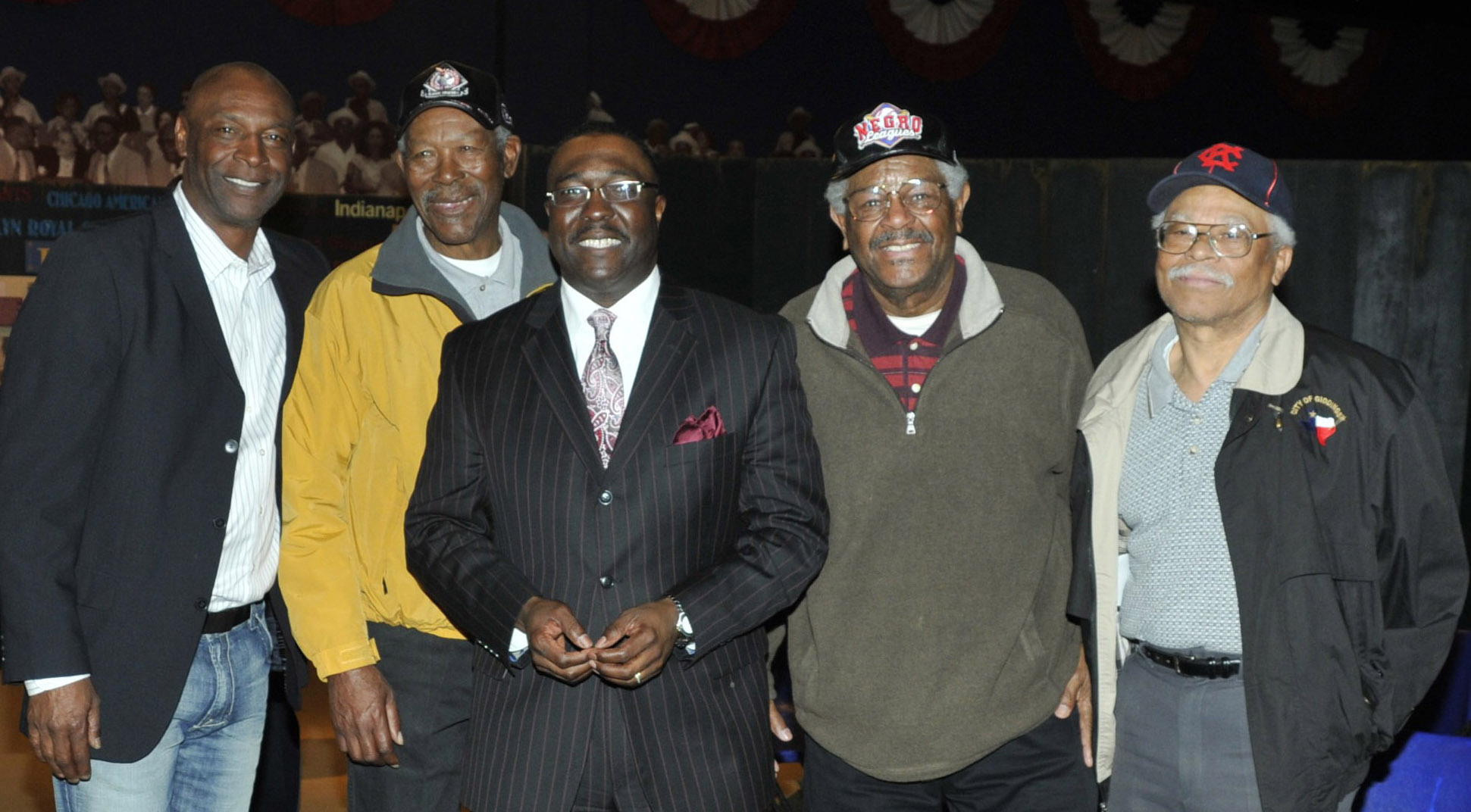
MLB reports: We are proud today to feature on MLB reports: the President of the Negro Leagues Baseball Museum, Bob Kendrick. It was an honor and privilege to get to know one of the finest and most important executives in the world of baseball. The Negro Leagues represents a key time period in baseball history. The NLBM is essentially the Cooperstown of the Negro Leagues, in Kansas City. Mr. Kendrick is responsible for overseeing the entire NLBM and has one of the most demanding and rewarding jobs that we have ever seen. His story is a fascinating one and we were glad to have Mr. Kendrick with us today to share it. For all fans of baseball and American history, the Negro Leagues Baseball Museum is a vital institution to visit. We present today our interview with the President of the NLBM, Mr. Bob Kendrick:
MLB reports: Hello Mr. Kendrick. It is a pleasure to have you on the Reports. Thank you for taking time out of your schedule to speaking with us.
You are President of the Negro Leagues Baseball Museum in Kansas City, Missouri. Please give our readers an idea as to what your job entails and the responsibilities of the President of such a fine baseball institute.
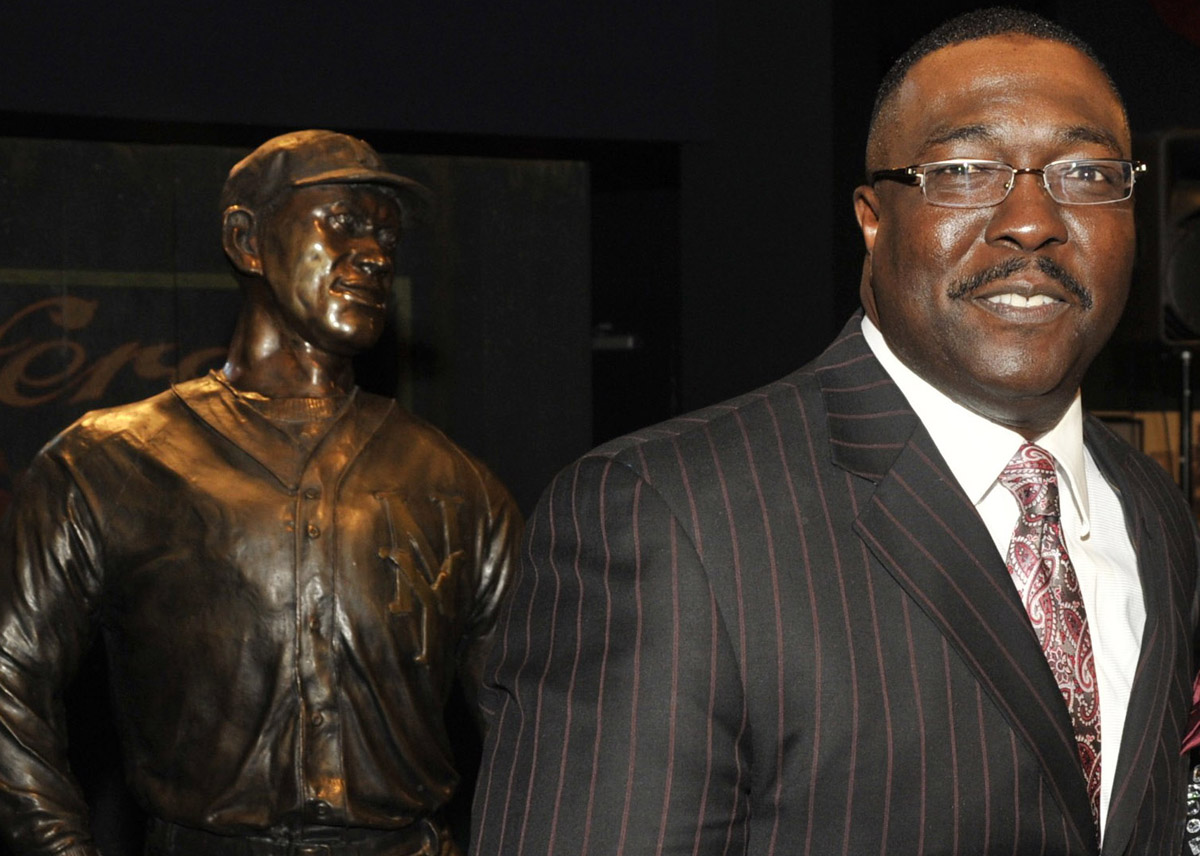 Bob Kendrick: My primary responsibilities are to provide effective leadership, management and operations of the Negro Baseball Leagues Museum and the development of the future John “Buck” O’Neil Education and Research Center. This includes managing a staff of seven; planning strategies to advance the mission and financial stability of the organization and develop and communicate goals and planning strategies with a local board and a national governing board for implementation. In addition, I’m also responsible for developing and managing community and corporate partnerships, programs, marketing, special events along with media, public and community relations.
MLB reports: What is the significance of having the museum in Kansas City? Was there ever a thought to build it beside Cooperstown?
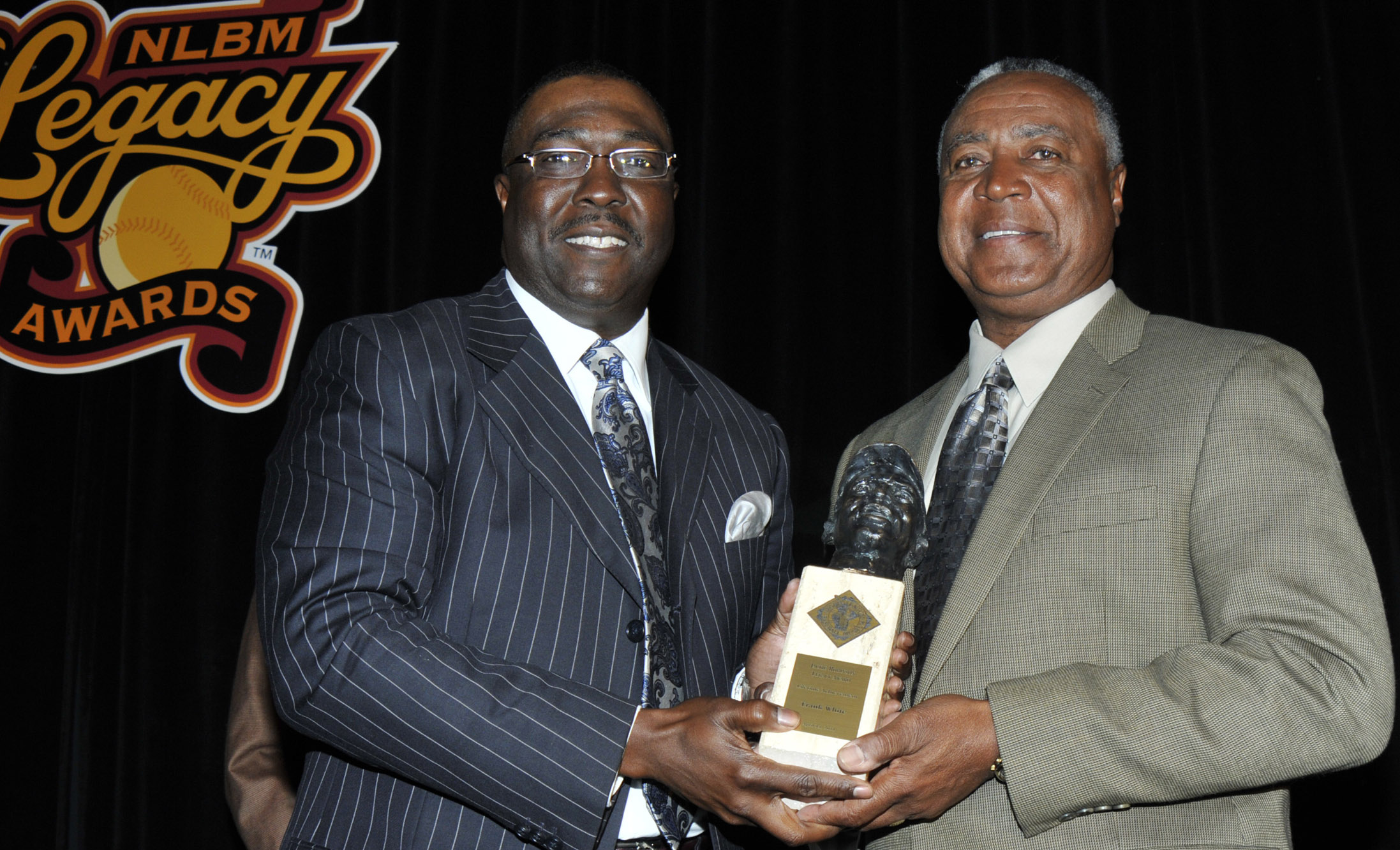 Bob Kendrick: Kansas City is the birthplace of the Negro Leagues and thus the rightful home of the Negro Leagues Baseball Museum (NLBM). In 1920, Andrew “Rube” Foster established the Negro National League in a meeting that took place in at the Paseo YMCA in Kansas City. Today, the NLBM operates two blocks from the historic Paseo YMCA and has designated the building as the future home of the Buck O’Neil Education and Research Center. There were never any intentions to build or move the NLBM to Cooperstown.
MLB reports: What does Buck O’Neil mean to the Negro Leagues Baseball Museum? How did the museum fare when he was alive and what has been the state of the museum since his passing?
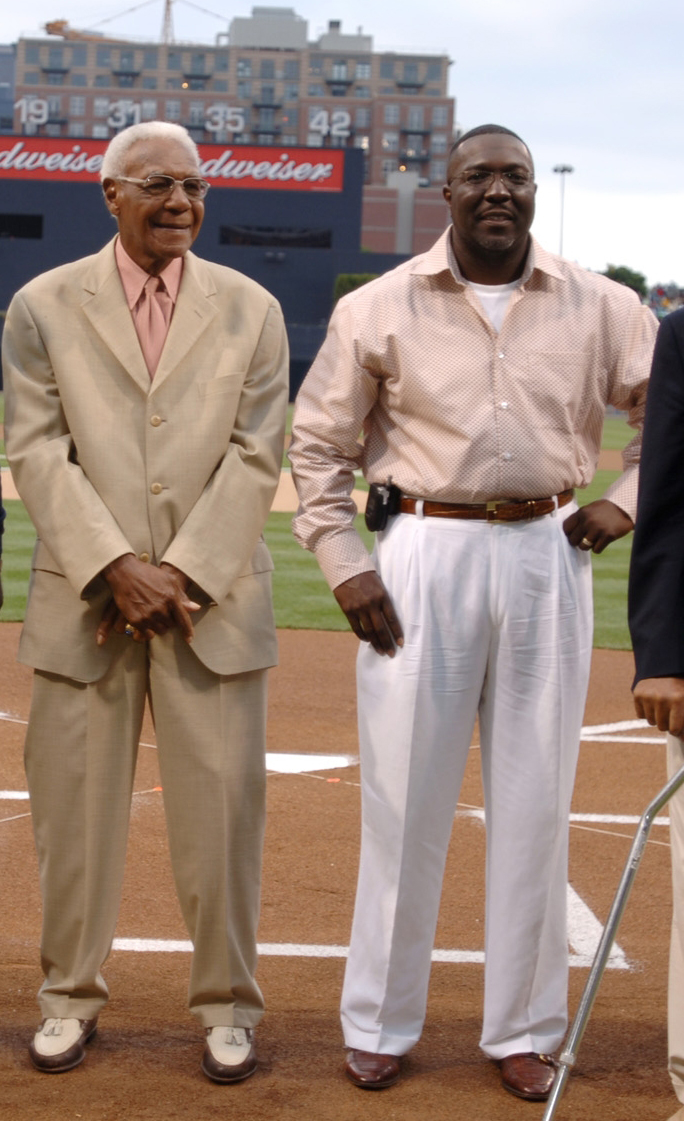
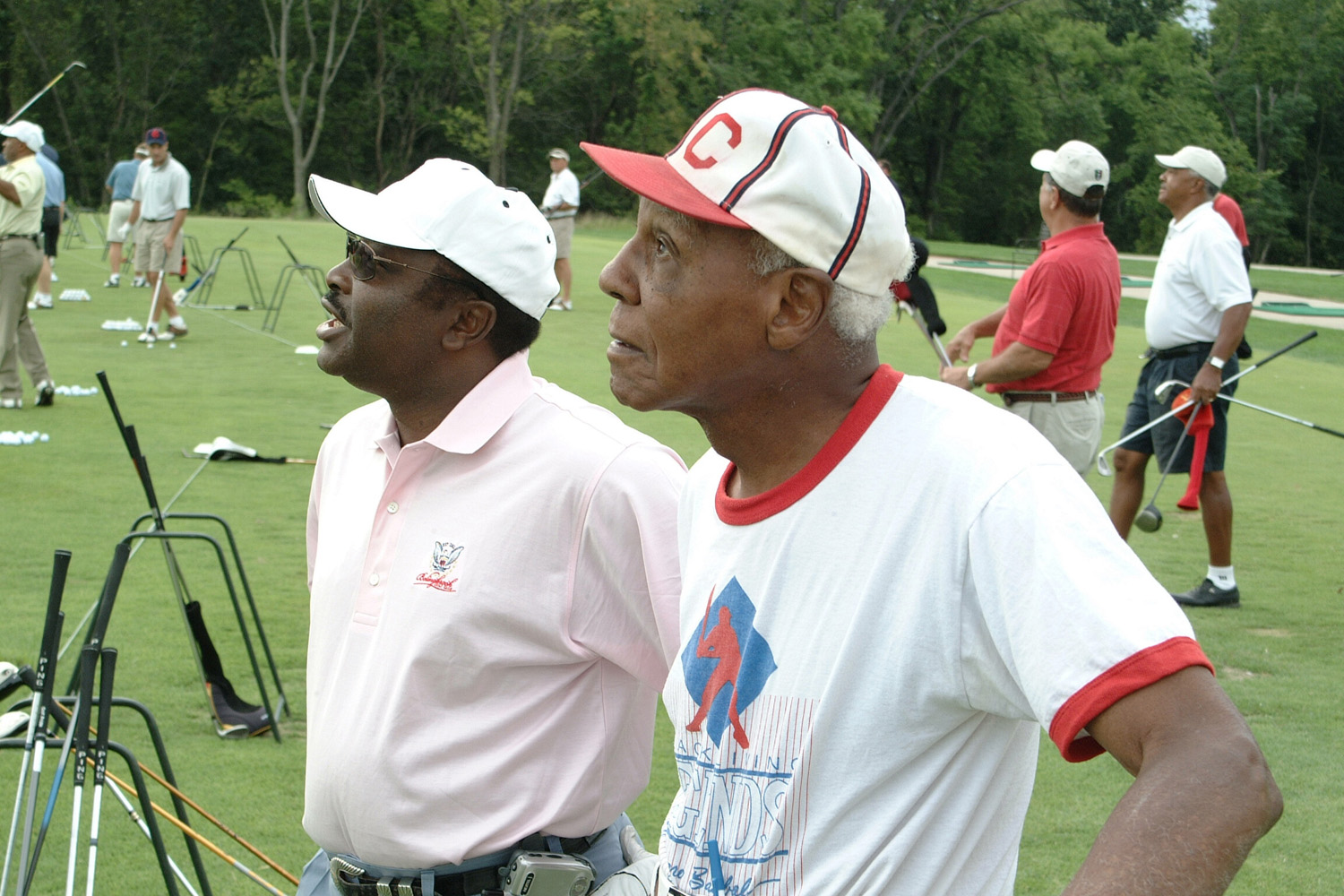 Bob Kendrick: Buck, along with the late Horace Peterson, were the co-founders of the NLBM in 1990. He served as the museum’s chairman for 16 years until his death in 2006 at age 94. Buck was the face of the NLBM and the museum’s inspirational leader and the person that is single-most responsible for its rise to prominence.
Buck’s death coupled with a down economy have definitely had an impact on the growth of the NLBM. To use a bad baseball analogy, Buck was our power hitter. When you take your power hitter out of the lineup you can’t expect that your offense is going to be as potent as it was with him in the lineup. The NLBM, like a lot of museums and particularly cultural institutions, have had its challenges but I feel strongly that we are poised to carry out Buck’s dream to sustain and grow this great institution.
MLB reports: Do you feel that there is pressure in your role to meet the expectations set by Buck O’Neil?
 Bob Kendrick: No. There will never be another Buck O’Neil! What I’ve tried to do is embrace Buck’s legacy and use it as additional motivation to see that his museum continues to be successful. If there is any pressure, it comes from the understanding that you are responsible for an institution that we want to see stand the test of time. Ultimately, no one will have greater expectations of me than I have of myself.
MLB reports: What are your favorite exhibits at the museum?
Bob Kendrick: The Field of Legends is an amazing and awe-inspiring display. It is the centerpiece of the NLBM and features 10 life-size bronze statues of Negro League greats cast in position as if they were playing a game. The players were chosen because they represent 10 of the first group of Negro Leaguers to be inducted into the National Baseball Hall of Fame in Cooperstown.
A 1952 photo of a young Hank Aaron standing at the train station in mobile getting ready to leave to join the Indianapolis Clowns of the Negro Leagues is one of my favorites. I believe that photo is the validating point in the exhibit that visitors start to grasp how special the Negro Leagues were and the incredible level of talent the leagues featured. All of sudden, the stories that we’ve shared about the exploits of Josh Gibson, Cool Papa Bell, Satchel Paige, and the other legends become more real because Hank is a name that everyone knows and understands how impactful his career was.
MLB reports: Are there new exhibits this year that are in place?
Bob Kendrick: We’re developing a new exhibit on the life and times of Buck O’Neil in recognition of his 100th birthday (Nov. 13). The exhibit, entitled “Right on Time” is adapted from Buck’s critically acclaimed biography “I Was Right On Time,” and will be a chronology of his life featuring rare family and baseball photos, videos and works of art from a team of professional artists that interpret the meaning and impact of Buck’s illustrious life. The exhibit is scheduled to open at the NLBM on Oct. 6 which would mark the fifth anniversary of Buck’s death. It will be on display until January 2012. The NLBM is developing plans for a national tour of the exhibit.
MLB reports: Why should a baseball fan take the trip to visit the Negro Leagues Baseball Museum?
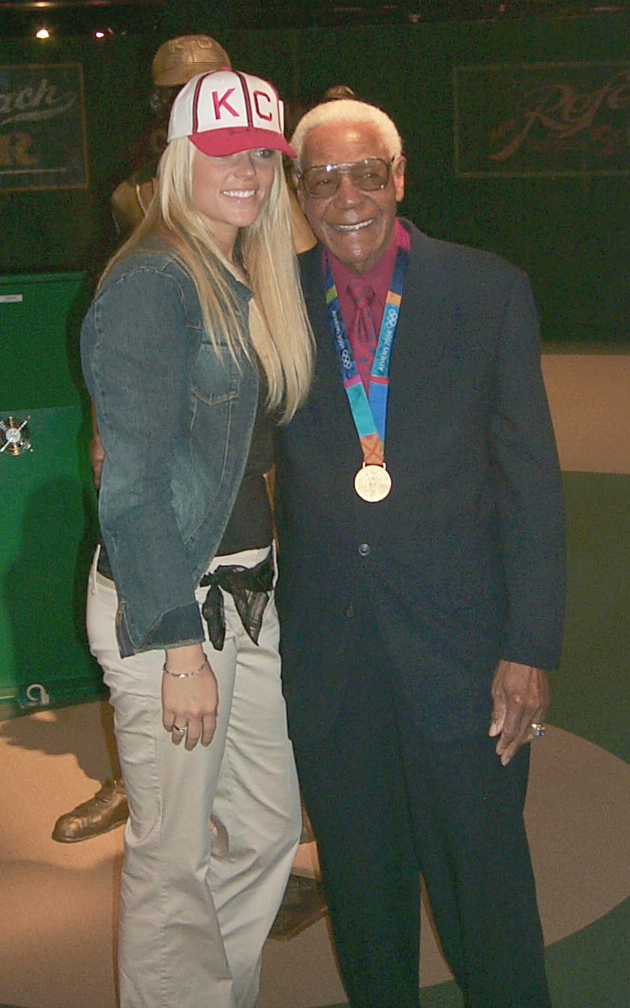 Bob Kendrick: I often said that there is no greater example of “love of the game” than there is when you bear witness to what the courageous athletes of the Negro Leagues endured to play baseball in America. Love of the game is something that every fan shares.
In some respect, as baseball fans, we’ve all been cheated by not having an opportunity to learn about America’s unsung baseball heroes prior to the rise of the NLBM. When you visit you going to meet some of the greatest baseball players to ever play the game. But more importantly, you are going to gain a perspective on how their determination, courage, passion and perseverance not only changed the game but America too.
MLB reports: You have rejoined the museum after a leave of absence. How did you find out you were offered the position of President and what was your decision-making process in deciding to accept the role?
Bob Kendrick: I left the NLBM in February of 2010 to accept the post as Executive Director of the KC office of the National Sports Center for the Disabled after being a part of the NLBM team for 12 years departing as VP of Marketing. I began having serious discussions with the museum’s board in March of this year. Betty Brown, chair of the museum’s board of directors, called on behalf of the board to offer me the job. On April 11, 2011 I began my tenure as President of the NLBM.
Like any major life-changing decision, I did a lot of soul-searching and had many discussions with my wife, Vanessa, and other members of my family. This was with the realization that sometimes the most difficult thing you can do is go back home. The NLBM had been home for me for 12 wonderful years and I was tremendously proud of what we had accomplished, but I honestly thought that chapter of my life was over. When this opportunity came about I didn’t want to make a decision with my heart and not my head, but I’d be lying if I said that my heart didn’t lead me back to the NLBM. It’s a tremendous honor to work with a great team and serve as leader of what I believe is one of the most important cultural institutions in the world.
MLB reports: It has been less than a year at the helm of the museum. What changes have you instituted since taking over?
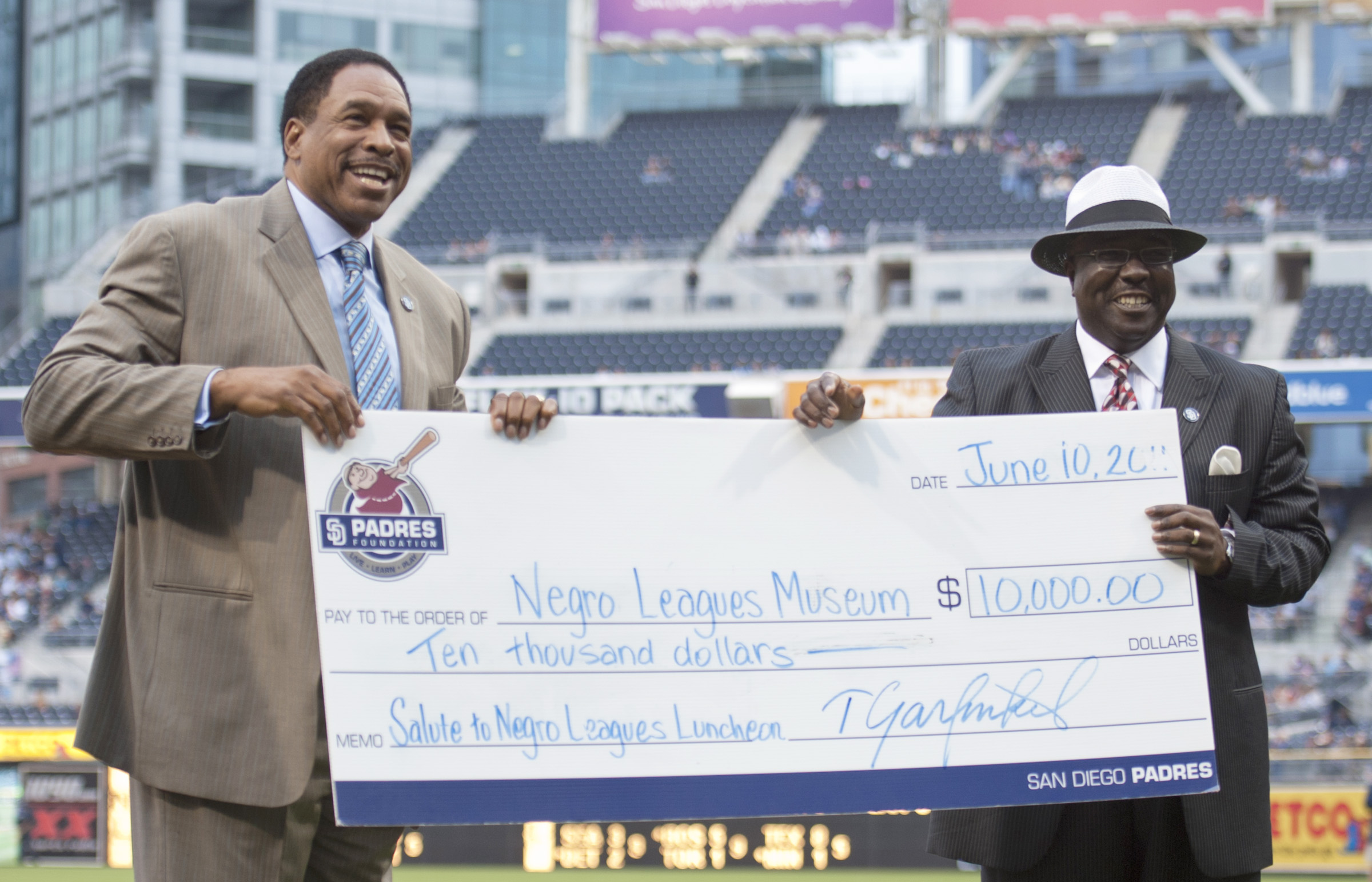 Bob Kendrick: My familiarity with the organization, staff and board has made for a pretty smooth transition. The staff, especially, have been great. For all of us, working at the NLBM is a labor of love and I’ve got a great team that has allowed me to move rather seamlessly into this new role.
My first few months on the job hasn’t been as much about implementing change as it has been about assessing all aspects of museum operations and the development of a tactical strategy to energize and generate operating revenue. We have a goal of balancing the budget by the end of this fiscal year which ends June 30 of 2012. I have every belief that we’ll be successful in attaining that goal.
Any initial change has come from a programmatic standpoint. In June, we brought back our popular Legends Luncheon series. In October, we will introduce the Rube Foster luncheon and will honor former Kansas City Chiefs football great Deron Cherry for his career and leadership on-and-off the field. The Legacy Awards will return on January 14, 2012. The event honors the best Major League Baseball players, managers and executives with awards named for Negro League legends.
MLB reports: I read that C.C. Sabathia recently visited the museum. Who are some other current and former players that have visited the museum? Any stories?
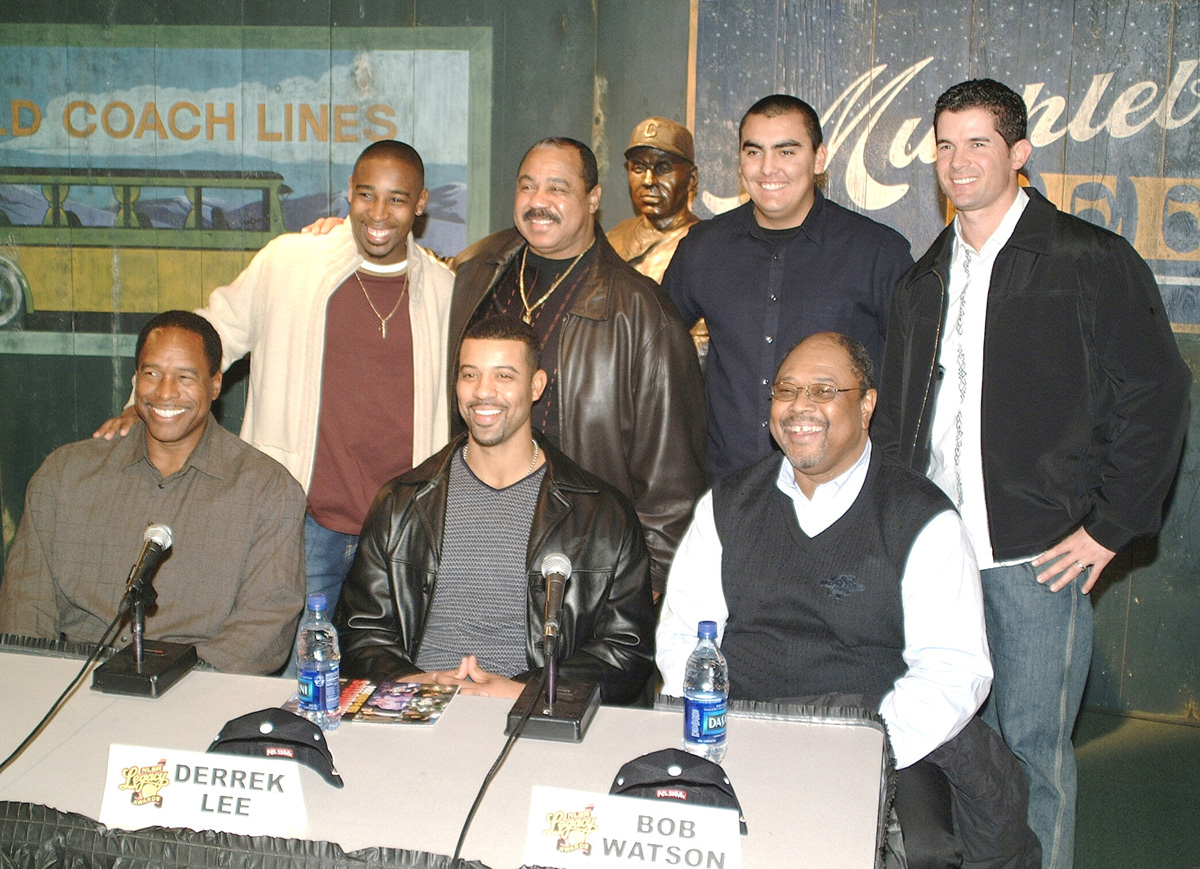 Bob Kendrick: CC has been a friend of the museum going back to his days with the Cleveland Indians. He always makes a point to visit when the Yankees are in town to play the Royals. While a member of the Indians, CC brought Cliff Lee to the museum. List of current current players includes: Derek Jeter, Albert Pujols, Ryan Howard, Prince Fielder, Torii Hunter, Justin Upton, Howie Kendrick, Chone Figgins, Derrek Lee, Jim Thome, Vladimir Guerrero, Jimmy Rollins, Juan Pierre and Jerry Hairston to name a few. Former Major Leaguers include: Hank Aaron, Willie Mays, Monte Irvin, Joe Morgan, Dave Winfield, Lou Brock, Ernie Banks, Ozzie Smith, Fergie Jenkins, Minnie Minoso, Jim “Mudcat” Grant, Ken Griffey, Sr., Jerry Manuel, Willie Randolph, John Smoltz, Buck Showalter, Roger Clemens, Barry Bonds, Bob Watson, Dusty Baker, Ozzie Guillen, Don Newcombe, Robin Roberts, Brooks Robinson, Maury Wills, Cecil Fielder, Rick Sutcliffe, Harold Reynolds, Frank White, John Mayberry, George Brett, Willie Wilson, Bo Jackson, Amos Otis and others.
Ryan Howard started visiting the NLBM before we knew who he was. At that time, Ryan was still in the Phillies’ minor league system. He’s never stopped visiting. He’s often said that he would visit as part of his ritual to prepare for Spring Training. He said he drew inspiration from their strength and dedication to the game that helped him deal with the difficulties he would encounter in the game.
MLB reports: What role do current and former players play in building and maintaining the museum? I personally think that current African-American players need to play a big part in attracting attention to the museum and inviting fans to learn and respect the past of the negro leagues. How has the process been to get players involved?
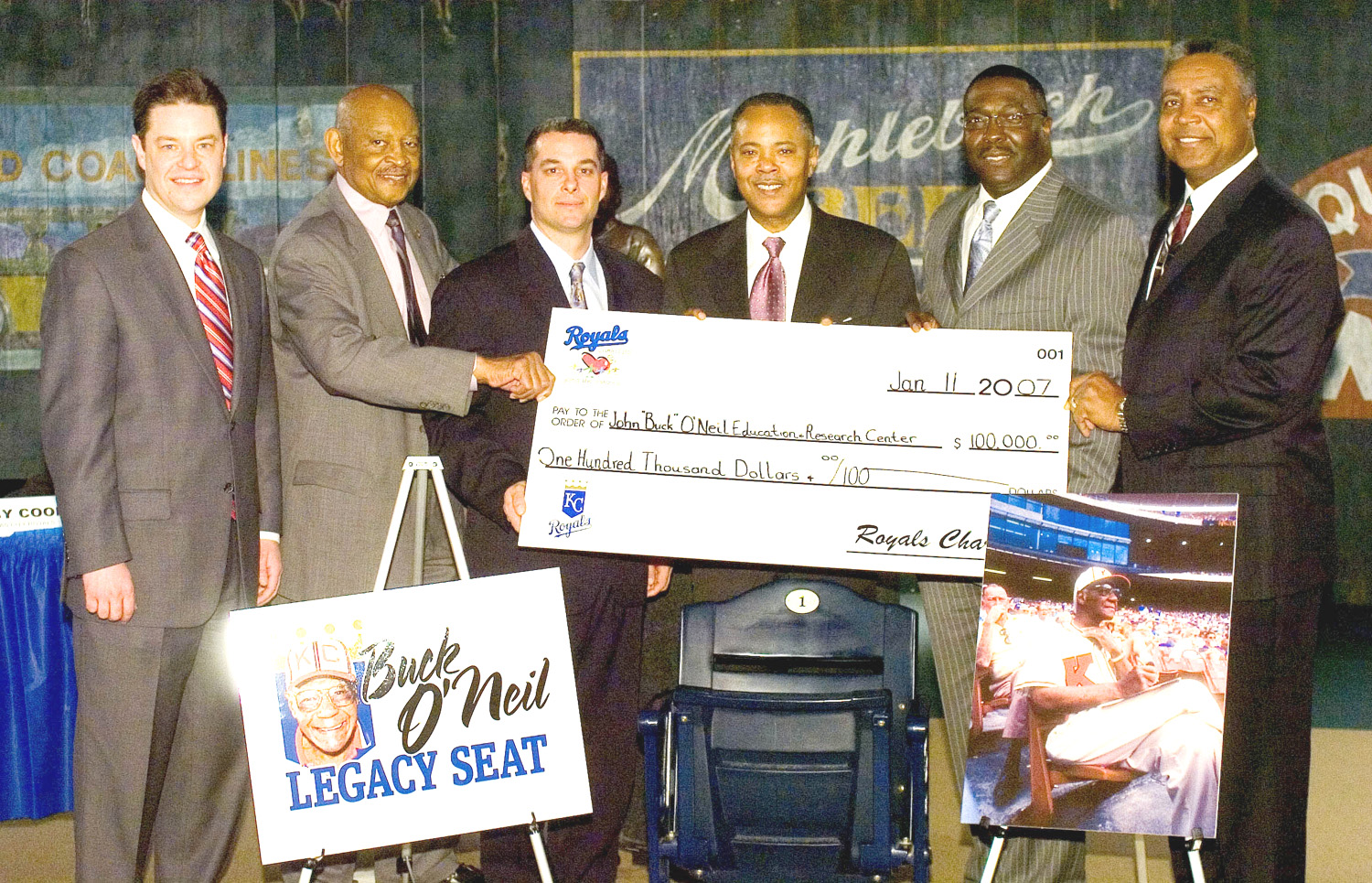 Bob Kendrick: We’ve made great strides in cultivating relationships with both current and former Major Leaguers. This takes on an even greater level of importance for the NLBM since the passing of Buck O’Neil. We’d like all baseball players to take more ownership in the NLBM and help us preserve this once forgotten chapter of baseball and American history. It obviously takes on an even great magnitude when we talk about the African-American and Hispanic baseball player. This is their story. Simply put, they would not have the opportunity to play the game they love had it not been for the sacrifice of those who played in the Negro Leagues.
MLB reports: Major League Baseball has teams play games yearly in Negro Leagues jerseys, which is a great way for fans to learn about the Negro Leagues. What other initiatives has MLB taken to assist in the education of the Negro Leagues? Does MLB and/or Cooperstown support the museum? If Major League Baseball sat down with you and asked what they could do to assist the museum, what would your answer be?
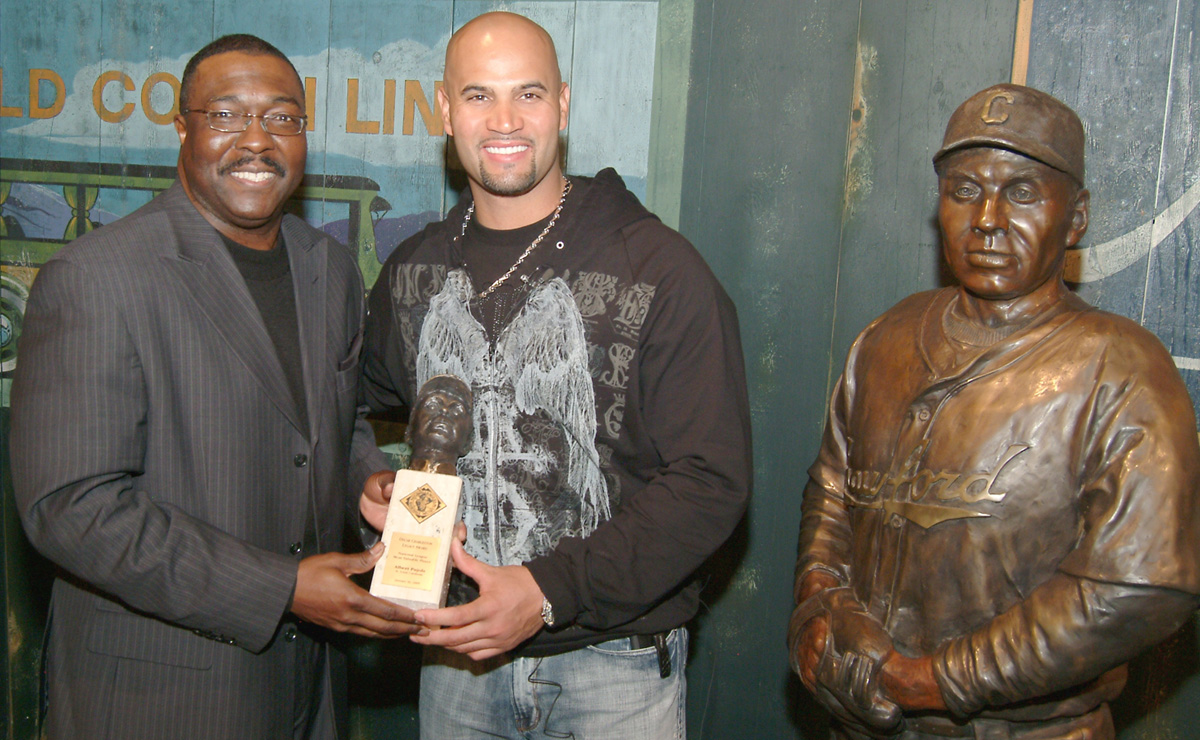 Bob Kendrick: Major League Baseball and its teams have played an important role in the success of the NLBM and helping educate fans about the history of the Negro Leagues. From the in-stadium salutes held by a number of teams, to celebrating Jackie Robinson, it’s all part of baseball’s embracing of the heritage of the game.
The museum has had (and continues to have) a meaningful and valued relationship with the National Baseball Hall of Fame.
In addition to funding, I asked MLB to create a national day of recognition for the Negro Leagues; partner with the NLBM on a national promotional campaign and provide leadership to serve on the museum’s board.
MLB reports: I have read many articles discussing the lack of interest in African-American boys in playing baseball, particular in inner-cities. With the lack of fields and the attraction of other sports, including football and baseball, it seems that baseball is having a hard time attracting African-American youth to the game. MLB is trying to encourage more participation through its programs. Is enough being done to get African-American children to play baseball?
Bob Kendrick: We want kids of all colors to play and enjoy the great game of baseball. The NLBM believes it has a social responsibility to make sure urban kids have the opportunity to play baseball.We want to use the history of the Negro Leagues as a tool to inspire kids to play. Progress is being made, but it is going to take a long and sustain collective effort. Major League Baseball has done a wonderful job, through its creation and support of initiatives like RBI and the various Urban Youth Baseball Academies, of creating opportunities for African-American kids to play the sport. But this is not Major League Baseball’s responsibility solely. If we are to reverse the trend, then baseball has to become important again to the African-American community.
MLB reports: Do you think that there is a correlation between the interest of today’s African-American youth in baseball and the interest in learning about the Negro Leagues Baseball Museum? I would be interested to hear your thoughts on the subject.
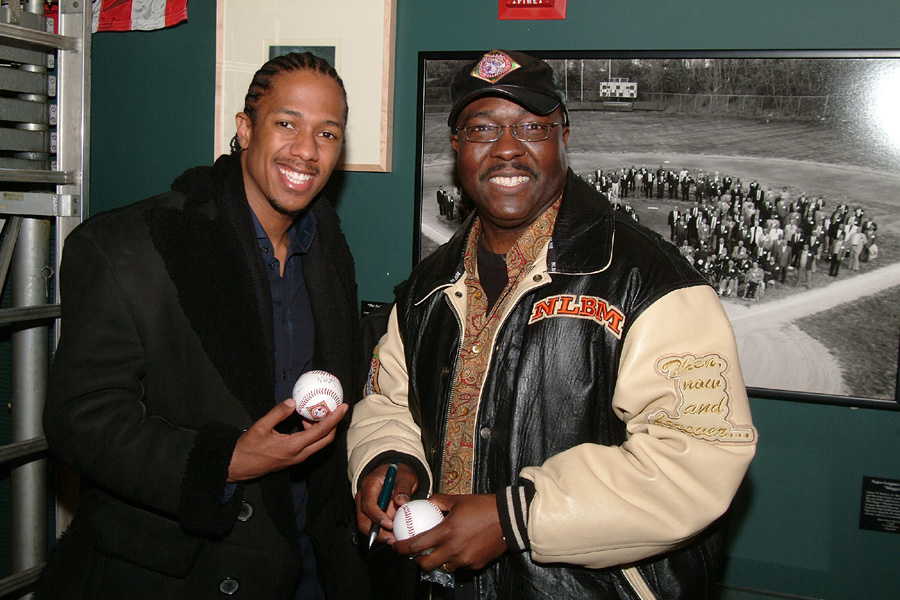 Bob Kendrick: We certainly believe the NLBM can serve not only as a resource to educate young people about the history of this country, but also inspire them by introducing them to men and women who overcame tremendous social adversity to play the game they loved. Urban kids who experience the NLBM can see people who looked just like them who were extremely successful playing, managing and owning baseball teams. The messages that stem from this powerful story transcends time, age, gender and race. Essentially, what the Negro Leagues teaches us is if you believe in yourself and you dare to dream then you can achieve anything you set your heart and mind to. That’s a universal message.
MLB reports: With the All-Star game coming to Kansas City, what events does the museum have planned as part of the festivities?
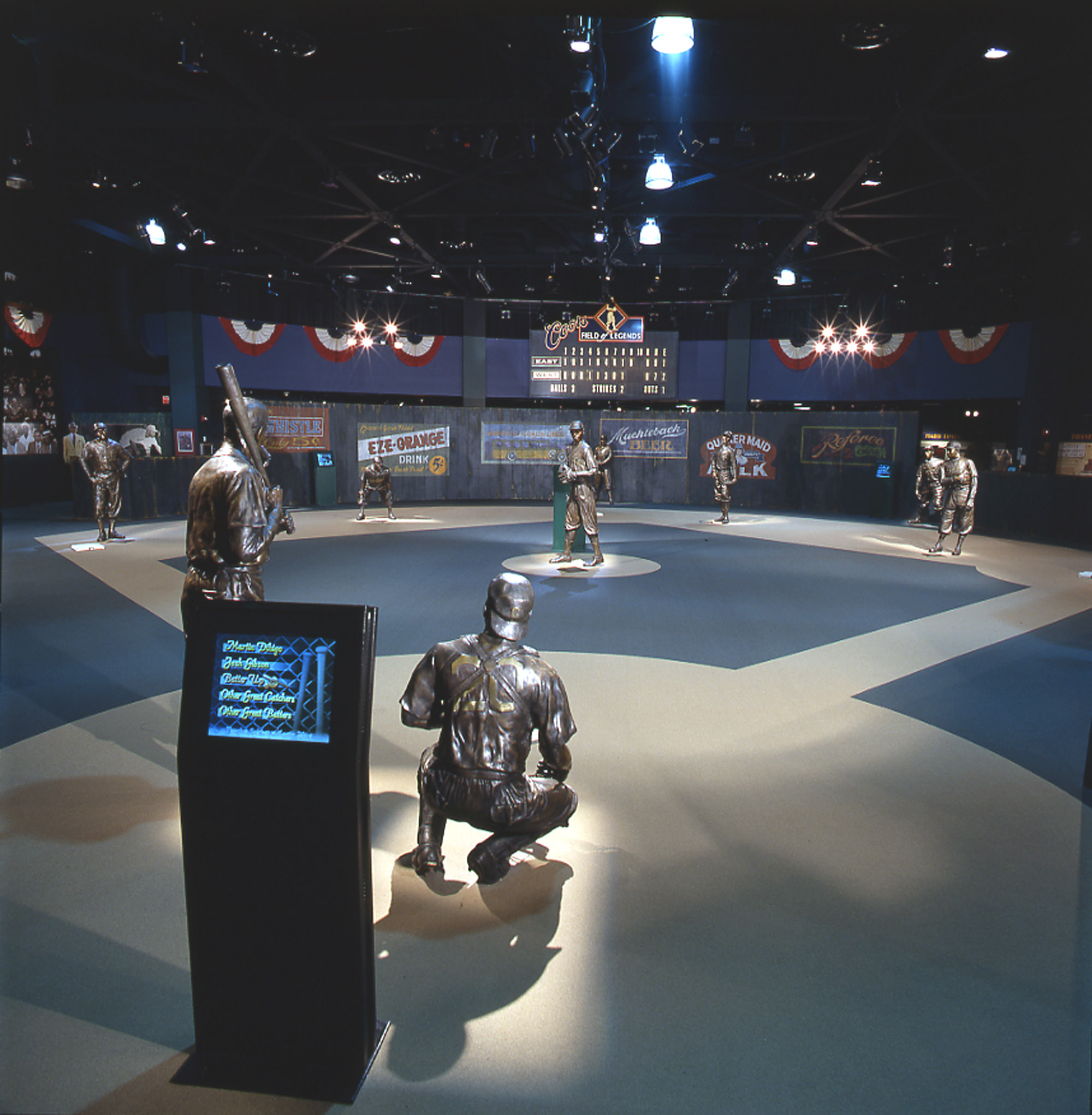 Bob Kendrick: First, I can tell you that no one is more excited about the All-Star game coming to Kansas City! There’s no doubt that the Kansas City Royals our great city will host one of the most memorable All-Star games ever. I’m confident that the NLBM will play a great role in helping make the event special.
We’ve already had great conversations with Major League Baseball and their event planning team about partnership opportunities for the 2012 All-Star game. Look for activities ranging from parties to player appearances to take place at the NLBM. Also, expect to see a new exhibition that will open in June of 2012 that will celebrate the players from the Negro Leagues who became Major League All-Stars. A planning committee is being developed to make sure we maximize the opportunities associated with the 2012 All-Star Game.
MLB reports: In five to ten years from now, what will be the future of the Negro Leagues Baseball Museum? What is your vision?
Bob Kendrick: Collectively, we are working to ensure the long-term sustainability of the NLBM. As we begin the next two decades of operation, we are dedicated to building a thriving, vibrant, cutting-edge institution that will not only celebrate and educate the public to the rich history of the Negro Leagues, but will continually challenge itself to make history relevant to an ever-changing society. Much of this will be solidified by the completion of the Buck O’Neil Education and Research Center which will provide an international headquarters for Negro Leagues history and social commentary on issues relative to race and sports.
MLB reports: If people would like to learn more about the Negro Leagues Baseball Museum and to visit, how do they go about getting more information? Also how can fans contact you with questions and comments?
Bob Kendrick: You can get more information about the museum at http://nlbm.com. Or, call the museum at (816) 221-1920. I can be contacted at bkendrick@nlbm.com or please follow me on Twitter @nlbmprez.
BUCK O’NEIL CENTENNIAL CELEBRATION: As part of our revenue generation plan, we’ve just launched a national individual fundraising campaign in remembrance of Buck O’Neil’s 100th birthday through the introduction of the BUCK O’NEIL ALL-CENTURY TEAM campaign. The effort is asking fans and friends to donate at least $100 in memory of Buck and in support of his museum. Every person who makes the $100 gift (or more) between now and Nov. 13, will have their name, family name or person they designate permanently recognized at the NLBM as part of a new display created to mark Buck’s milestone anniversary.
To sign-up for the BUCK O’NEIL ALL-CENTURY TEAM, visit http://nlbm.com or call the NLBM at (816) 221-1920.
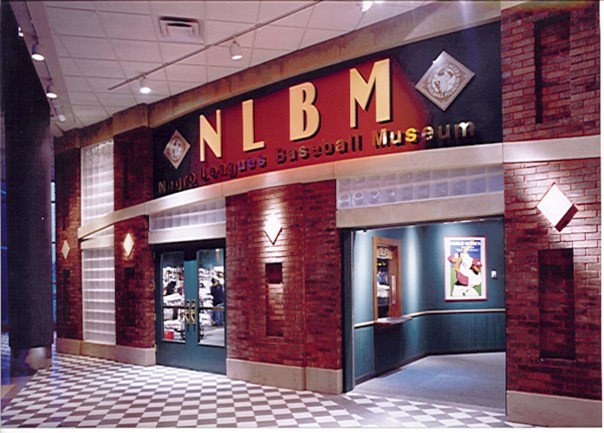
Thank you again to Bob Kendrick for taking the time out of his very busy schedule to joining us today on MLB reports. We highly encourage our readers to post at the bottom of the article any questions and/or comments that you have on the Negro Leagues Baseball Museum. As well, please feel free to contact Mr. Kendrick directly by e-mail or Twitter. He is very active on social media and welcomes your feedback!
**The photographs in today’s feature were provided by our guest, Bob Kendrick**
Please e-mail us at: MLBreports@gmail.com with any questions and feedback. You can follow us on Twitter and become a fan on Facebook . To subscribe to our website and have the daily Reports sent directly to your inbox , click here and follow the link at the top of our homepage.

Contenders for AL Rookie of the Year Award: Who Will Win?
Monday September 12, 2011
Sam Evans (Intern Candidate- MLB reports): With the regular season coming to an end, it’s time to start looking at baseball’s awards. The American League Rookie of the Year will definitely not be an easy choice for BBWAA voters. Even though the top candidates are pretty clear, there is still about 20 games left for most teams. This last month is important for candidates to solidify their numbers and argument for the award. Here is my opinion on who should win the award.
Three of the five last winners of the AL ROY award have been pitchers. When choosing who I think deserves the award one of my key requirements is playing time. In my opinion, a mediocre pitcher who pitched the whole season is more impressive than a position player who was only in the majors for half of the season. Also, I don’t think the team of the players record is important enough to be a consideration for voters. This award should be chosen for a player’s impact in the majors, not how hyped up of a prospect he is. So I’ll try to look past the shock value and breakdown some of the candidates.
Eric Hosmer: Kansas City Royals
Hosmer made his Royals debut on May 6th and has been the Royals starting first basemen ever since. For the year, Hosmer has batted .286/.334/.462 with 17 HR and 69 RBI’s. He has been the consistent middle of the order bat that the Royals have lacked ever since Carlos Beltran got traded.
Michael Pineda: Seattle Mariners
When Pineda was named the Mariners fifth starter right before the season started, most Mariners fans didn’t know what to expect. Michael was an American League All-star and has slid into the Mariners #2 starter spot. His numbers have tailed off a little as the season has gone on, but the Mariners still haven’t made the decision to shut him down. He has a 3.72 ERA in 167 innings with 171 strikeouts. That’s more than Jon Lester and Matt Cain. Also as his 3.42 FIP suggests he has actually been better than his ERA suggests. However, he has pitched in a pitcher’s park this year which have probably helped his numbers.
Ivan Nova: New York Yankees
Nova just barely has eligibility, but he has had a surprisingly solid season as one of the Yankees backend starters. He is 15-4 with a 3.94 ERA and 87 strikeouts in 144 innings. Obviously, the number that stands out is the fifteen wins, which is impressive for any pitcher. Still, with the Yankees offense wins aren’t a great stat to judge performance. Speaking for myself, I just don’t think his numbers are impressive enough to be the 2011 AL Rookie of the year.
Jeremy Hellickson: Tampa Bay Rays
 Going into the season, there were pretty high expectations set for Hellickson. ESPN fantasy baseball teams were drafting him at an average of 163rd. He definitely has lived up to those assumptions and maybe even exceeded them. He is 12-10 with a 2.96 ERA and 109 strikeouts in 170 IP. Not to mention, he has done this while pitching in the toughest in baseball. He has had a lot of luck this season, as his 4.30 FIP and 4.57 xFIP suggest (courtesy of fangraphs.com). Also, he has the highest LOB% among all pitchers that have thrown over 100 innings.
Mark Trumbo: Los Angeles Angels of Anaheim
After the Angels received the news that Kendry Morales would start the year on the disabled list, the Angels first base options looked bleak. Trumbo was the favorite to win the job but wasn’t a very heralded prospect. Baseball America had him as the Angels 9th best prospect. Trumbo not only won the job, but he ran with it. On the season, he is hitting .256 with 26 HR and 80 RBI’s. He leads all rookies in homers, RBI’s, and SLG%( for rookies with more than 300 plate appearances). Not to mention, he has provided an above-average glove at first base. His batting average is not great, and his OBP% is under .300(.295), so he hasn’t been perfect this year. In the end, he has made contributions to his team unlike any other candidate.
Honorable Mentions: Dustin Ackley, Desmond Jennings, Jordan Walden.
 I think Ackley and Jennings didn’t play enough games to deserve the award, and Walden has been too inconsistent. However, if Jennings were to lead the Rays to an improbable playoff spot, I think he should win the award or receive strong consideration by the voters.
If I had a vote at the end of the day, I would vote for Trumbo- with Pineda, and Hellickson following. There is still plenty of time left, but in my mind Mark Trumbo deserves the 2011 American League Rookie of the year award.
***Today’s feature was prepared by one of our intern candidates, Sam Evans. We highly encourage you to leave your comments and feedback at the bottom of the page and share in the discussion with our readers. You can also follow Sam on Twitter.***
Please e-mail us at: MLBreports@gmail.com with any questions and feedback. You can follow us on Twitter and become a fan onFacebook . To subscribe to our website and have the daily Reports sent directly to your inbox , click here and follow the link at the top of our homepage.
Ian Kadish MLB Guest Blog: My Baseball Journey
Sunday September 11, 2011
MLB reports: We welcome today on the Reports, Blue Jays prospect Ian Kadish. The right-handed pitcher pitched for the Bluefield Blue Jays in the Rookie Appalachian League in 2011. With a 2-3 record, 2.67 ERA, 1.154 WHIP, 11/35 BB/K, the 23-year-old Kadish showed some very strong numbers pitching in the pen in his first professional season. With a bright baseball future ahead, we invited Ian to prepare a MLB Guest Blog describing his baseball journey for our readers. In his own words, we proudly present the story of Ian Kadish- pitching prospect, Toronto Blue Jays:
Ian Kadish (Guest MLB Blogger): I was recently approached by MLB Reports to be featured on their website. We got together to come up with an idea of what to do and we decided on a blog post about the path I took to get to professional baseball. Most of you guys that are close to me probably know the story already, but here it is again for the ones who don’t…
 I went to a small high school just North of Cincinnati, Wyoming High School. My graduating class was only 160 kids and football is the big thing there (Football is the big high school sport in Ohio). I actually thought I was going to play college football as a kicker. I thought I had a better chance at football than I did at baseball even though my childhood dream was to be a big league pitcher. I was not highly recruited for baseball and if it wasn’t for the summer program I played for, I would not have had the chance to play college baseball. I played for Midland Baseball and that is where I met one of the most influential coaches of my life, Mike Maundrell. Coach Maundrell taught me everything I know about pitching and taught me exactly what I needed to do to be successful. Midland is the best summer baseball program in the country and attracts kids from all over the country. There is a great number of major leaguers that have played for them and it was an unbelievable experience to be able to play for them. I learned more about baseball in those three years than I did at any point up until then. I committed to play baseball at Marshall University.
I spent four years at Marshall, earning my degree in Business Management with minors in marketing and entrepreneurship. In those four years, I learned a tremendous amount about baseball and life. I really think those four years prepared me for professional baseball because I lived on my own and learned how to deal with factors outside of baseball. I never really had great success in college baseball and at one point, I was ready to transfer out. My mom and dad are the only ones that know how many break downs I had because I was so frustrated. I was working harder than everybody and I was still not getting the results I wanted.
After my sophomore year, I went back home to play summer baseball in the Great Lakes League for the Cincinnati Steam. I went home because I needed to decide if I wanted to go back to Marshall or transfer somewhere else. That summer was the deciding factor because I got to spend time with my family and play with some very close friends that I had played with growing up. I went back to Marshall as a Junior and there was a new pitching coach. Joe Renner was a coach at Midland so I kind of knew him even though he was a new coach. I was very excited to work with him and after the summer I had, I was newly energized and ready to get back to work. I continued to work hard and ended up earning the Friday night starter role. This was a big jump for me because I had never started and the previous 2 years, I was pitching out of the bullpen. I struggled in the starter role and had again, another frustrating season.
After my Junior year, I went to play with the Rochester Honkers in the Northwoods League. Playing there was truly the best experience for me since playing for Midland. All the guys on the team were great guys and we all became pretty close. The guys on the team taught me how to have fun with baseball again and relax. I was taking the game way too seriously and was not playing up to how I thought I should be playing because I was too uptight. Going into my senior season, the coaches wanted to put me in the closer’s role and I couldn’t have been happier. I embraced the role and told myself I was going to have more fun that year. Senior year turned out to be much more fun than the previous three years because I was more laid back. After my senior season, I went home to wait and see what would happen with the draft.
I won’t lie, I was hoping I was going to get drafted, but as day three approached, I was slowly beginning to think that I was not going to get a chance to play professional baseball and keep my dream alive. My dad and I went golfing on day three of the draft just to try to get my mind off of things, but I was still thinking about it. I was on my phone all day and when I learned that it was late in the draft and I still had not gotten picked yet, I began to talk with my dad about where I go from there. I did not know if I wanted to go to grad school or try to get a job in the real world. As soon as the draft was over, we were just finishing golfing and that’s when I got the call. Nick Manno, the area scout for the Blue Jays, called me and explained the situation to me. He said he knew that money did not matter to me and he knew that all I ever wanted was a chance to prove myself and play. He offered me a free agent contract and I gladly accepted! My dream was still alive, and I couldn’t have been happier!
From there, I was off to Florida for a mini-camp and to keep my dream alive, just like every other little 12-year-old, to be a big league pitcher…
Thank you to Ian Kadish for preparing today’s MLB Guest Blog. Please feel free to contact Ian on Twitter (@BearJew36) or through his website (http://livinginthelifeofian.blogspot.com) for comments and questions. We also thank Ian for sharing the photographs used in today’s feature from his own private collection.
Please e-mail us at: MLBreports@gmail.com with any questions and feedback. You can follow us on Twitter and become a fan on Facebook . To subscribe to our website and have the daily Reports sent directly to your inbox , click here and follow the link at the top of our homepage.

Casey Bond Interview: Moneyball Movie Star
Friday September 9, 2011

MLB reports: In part two of our series on Casey Bond, we feature today our interview with the “Moneyball” star. Casey portrays former Oakland A’s pitcher Chad Bradford in Moneyball and will be promoting the movie this week in Toronto as part of the Toronto International Film Festival. Tonight is Casey’s big premiere at TIFF. Before the release of the movie, we had a chance to talk with Casey about his baseball and acting careers. From playing minor league baseball with the San Francisco Giants, Casey moved to acting and appeared on the Gene Simmons reality show “Family Jewels”. With the launch of his upcoming movie, MLB reports is proud to present our interview with Casey Bond:
MLB reports: Welcome to MLB reports Casey. It is a pleasure to be speaking with you and thank you for taking the time for us. From baseball player to movie star. You were originally drafted by the Giants in the 25th round of the 2007 draft. You made it all the way to AAA in your 2nd season. Tell us what it was like to be drafted by a major league team and play professional ball. What was the process like for you from the time you were drafted to joining your first team?
Casey Bond: Have the opportunity to play professional baseball for the Giants was a childhood dream come true. All I ever wanted to do as a kid was play professional baseball (like most kids). I worked hard, and took my talents and abilities to the professional level. A life long goal accomplished.
The process for me after I was drafted was just like most other guys that get drafted. The Giants called me and congratulated me, and then eventually gave me dates that I would be reporting to spring training. I continued to practice and prepare myself for spring training until I had to leave. Once I left, I joined everyone else with the organization, and we began to practice and train until we were told which team we would be on after we broke from spring training. It was very exciting getting to display my baseball skills on the highest level.
MLB reports: Your playing career ended in 2008. Why the decision to end your career so soon after getting drafted? Were injuries a factor?
 Casey Bond: I was released by the Giants, after coming off a fairly productive season as an everyday starter, and had a decision to make. I had offers from other teams to play, but the acting world was starting to pull me in its direction, so I decided to consider baseball a goal accomplished, and moved on to another goal in my life.
MLB reports: After baseball, you jumped into the acting ring. Were you always planning to be an actor? How did you get started in the business?
Casey Bond: Honestly, I can’t say that I always had plan on being an actor. It was something that I always had an interest in, but I never really pursued it until I started to take classes in Nashville during the off-season.
MLB reports: Before Moneyball, you were in the Gene Simmons’ show “Family Jewels”. Tell us a little more about the show and your role.
Casey Bond: My role on Gene Simmons Family Jewels was as the “Handsome Handyman.” I was hired to come in and help fix things around their beautiful home. It was a reality show, and I was able to put my craftsman skills to work on the show. They were a wonderful family, and I really enjoyed being a part of the show.
MLB reports: Interestingly, you were an outfielder for the Giants back in your playing days. Yet you are playing Chad Bradford in the movie. How did you get picked for the role?
 Casey Bond: It is a very strange coincidence that I am portraying an Oakland A’s player for the film. I always tell people I made it to the Big Leagues with the Oakland A’s it seems. I had to audition for the role, reading with the casting director and director first before displaying any of my baseball talents. I really had to bring my “A-game” acting in the room before I was able to show my skills as well. For whatever reason, when the baseball came along, I was able to teach myself to mimic Chad Bradford’s very unique submarine form. It just worked for me, and I almost wish I had pitched like that. Maybe I would have been set apart even more from the rest of the crowd. I was actually very accurate and effective against batters. After I displayed the acting and the baseball skills, I had a personal meeting with Brad Pitt, where we read the script and basically hung out for a while just talking about life, baseball, etc. It was basically a meet and greet. After this, I found out I was offered the role.
MLB reports: Did you get to meet the “real” Chad Bradford in preparing for the role? Tell us about the process you experienced from getting the part to preparing for the role of being Chad Bradford.
Casey Bond: I haven’t met Chad yet, but I talked to him on the phone for quite some time, gathering information that I could use toward playing the character. I asked him everything from his mental approach pitching, to the way he acted on the team and his time with the A’s.
MLB reports: Can you give us some background on your director Bennett Miller? How did you find the experience working with him?
Casey Bond: Steven Soderbergh did not direct the film, even though he was originally slated to direct it a few years ago. Bennett Miller directed the film, and he was a pleasure to work with. His most well-known work before this film was the movie “Capote.” It was very well received, and he was highly acclaimed for the work.
MLB reports: Which cast members did you work the most with during the filming of Moneyball? Who did you become closest with during and after the filming?
 Casey Bond: I worked with a very large number of cast members. Brad Pitt, Phillip Seymour Hoffman, Jonah Hill, and Chris Pratt were among those. All of which were wonderful to work with, and a pleasure to be around. Brad really was a mentor on set, and through advice and sheerly through working with him, I was able to step up my acting game even further. I developed a lot of great relationships on set, as I was on the film for most of the duration of filming. I’m not sure if I could honestly say who I was closest with because it was such a great group of people, of which I was around everyone and interacted with every day.
MLB reports: Can you share one or two good stories from the set of the movie that readers would otherwise not hear about?
Casey Bond: There were some great times had on set. Plenty of practical jokes, especially since there were baseball players involved. Brad and Jonah pulled pranks such as altering each others golf carts on the Sony lot to “embarrass” the other person while they drove their cart to the set. Things such as putting the picture of their faces on the other persons cart, or altering the cart to make it stand out in the crowd.
Brad being a mentor to myself is another great story. A person in his position doesn’t necessarily have to reach out and help the other person with their advice or opinions as that can be left to the director, but he very openly did. He is obviously a legend, and any and all advice from him was wonderful, and I was so thankful for his kindness and thoughtfulness. Truly a very down to earth person who is there to work hard every day and put his best foot forward, which is how I feel a handle my business as well.
MLB reports: Mr. Brad Pitt. One of the last people I imagined becoming Billy Beane. Fans are interested as to how he did in the role. Tell us about Brad the baseball general manager? Is there an Oscar in his future?
 Casey Bond: This role played by Brad could be one for the ages in my opinion. He made some fantastic choices, and I think they will come across very well on the big screen. He truly has so many talents and abilities. If you just look at all of the different roles he has played, and played so well, those alone are a true testament to his versatility. All of the components are there for this film to be a huge success, and the way he plays Billy Beane shows his ability to be funny, serious, heart-felt, and compassionate. I’m excited to see the response to his performance, along with all of the other cast members on this film.
MLB reports: I am a huge fan of baseball movies. The fine line is maintaining an authentic feel. Having real players in the roles helps a great deal, including yourself and Royce Clayton. What did movie producers do to keep the feel and flow of the movie from a baseball perspective as being “real” rather than looking like a movie?
 Casey Bond: I don’t say this lightly…this film has the potential to be the most authentic baseball movie of all time. The individuals involved with this film were top-notch baseball players. I was fortunate to be an actor who had the professional baseball ability in my back pocket. The guys brought on this film even as extras all had experience from college to professional, and it will show on the big screen. Obviously, Royce had the most experience with around 10 years in the big leagues. I’ll put it this way…if we were to field a team from the people on set, we could most definitely compete with a lot of people. Truly some great talents in this film, which was so important. We have all seen the baseball movies which just don’t cut it as far as believability goes. This will be the one to outshine them all in the authentic department.
What was great was the fact that Bennett Miller, Brad, and everyone else wanted to make sure they got the baseball part right. They wanted to hear our opinions, and stuck with them. I was more than happy to add any and all of my baseball knowledge to this film, especially due to the fact that they listened intently and respected all of the intricacies of the game.
MLB reports: Was the real Billy Beane a part of this movie? Did he visit the set and have input into the movie? What about author Michael Lewis, was he a part of the movie as well?
 Casey Bond: Billy Beane was on set multiple times. I’m sure he had plenty of input in the sense that he was the man they could go to if there was a question. After all, his character is what the film is centered around. Michael Lewis was on set too, and I had a wonderful conversation with me. He noticed me right away and knew who I was playing (Bradford).
MLB reports: I don’t recall a baseball movie that was more anticipated than Moneyball (I personally cannot wait to see it). Where will this movie rank about the greatest baseball movies of all time? What is your favorite baseball movie of all time?
Casey Bond: This movie has a lot of hype, and all for good reason. It has an all start cast, and a wonderful story to back it up. Moneyball was a best-selling book, and it brings baseball, business, and life all together into one. Something everyone can relate to.
All baseball movies are different, and this one, for myself, will be the most authentic of all time. My favorite baseball movie of all time (at this point) is Bull Durham. It depicted the minor leagues perfectly, which is obviously something I am very familiar with. The language, interaction, and relationships were done so well. It’s just an amazing movie, especially if you have played baseball at that kind of level. It all makes sense.
MLB reports: You are in Toronto this week for the Toronto International Film Festival promoting Moneyball. How has the promotion circuit treated you thus far? Where are you off to after Toronto and what are the promotional plans for Moneyball?
Casey Bond: The promotional circuit for Moneyball has been wonderful. I have been doing red carpets, radio shows and interviews, interviews with all kinds of media, and am now off to Toronto for the Toronto International Film Festival, where I will be walking the Red Carpet as well.
After Toronto, I head back to L.A. for few days before going to Oakland, CA for the U.S. Premiere to walk the Red Carpet, as well is doing other promotional events in Oakland centered around the film. Its been a very exciting and busy time, and I love every minute of it, and can’t wait to do this with other projects in the future.
MLB reports: What is the future of Casey Bond? Do you have any projects currently in the works? What are your plans following the movie?
Casey Bond: The future for myself is to continue to work hard, and apply myself to the acting world (as I have been) just like I applied myself to being a professional athlete. Passion and hard work will translate into success. That is how it has always worked for me, and that is how life tends to work. If you work hard, and are passionate about what you do, you will be successful. I plan on never doing anything but that.
Lately, I have been doing quite a bit of print work for different companies like A.D.I.D.A.S., Muscletech, and others, along with doing commercials and constantly having other auditions. Lately I have also been working with legendary acting coach Larry Moss. Always have to be working on the craft. I have also started a small production company with a few friends out here, which has been a fun process. I love being a part of all sides of the entertainment industry. It has been busy since finishing up Moneyball, and once the film drops, I hope to gain even more attention and go work hard on other projects.

Thank you to Casey Bond for joining MLB reports today. Please feel free to contact Casey Bond on Twitter (@caseybond) or through his website (http://thecaseybond.com) and Facebook Fan Page for comments and questions. Casey will be CONSTANTLY providing personal behinds the scenes photos, videos, etc. of upcoming events that he will be a part of such as Red Carpets and premieres, as well as Moneyball media when the film comes closer to the release! Stay tuned for part two of our Casey Bond feature, with our interview coming up on MLB reports.
**Some of the photographs in today’s feature are courtesy of Peter Hurley**
Part one of our feature on Casey Bond: https://mlbreports.com/2011/09/07/bond/
Please e-mail us at: MLBreports@gmail.com with any questions and feedback. You can follow us on Twitter and become a fan on Facebook . To subscribe to our website and have the daily Reports sent directly to your inbox , click here and follow the link at the top of our homepage.
Casey Bond Guest Blog: From Giants Prospect to Moneyball Star
Wednesday September 7, 2011
MLB reports: Baseball movies have been part of the culture of the game for as long as most of us can remember. Classic films include The Natural, Bull Durham and Major League, among countless others. When baseball fans are not watching games at the ballpark or on television, they can often be found at the theatre or popping in a disc at home to watch a baseball movie. Fans also enjoy baseball documentaries, including the Ken Burns series. If not watching baseball in some capacity, a good baseball book is not usually far behind for a diehard baseball fan. Lovers of the game cannot get enough of their favorite sport and enjoy the game in many different capacities.
At MLB reports, we are big supporters of baseball books. We try to read as many new ones as we can to review on our site to encourage readership. Those books that we enjoy can sometimes also end up on the big screen and come to life. One of the most popular and talked about baseball books of all time, Moneyball by Michael Lewis, has in fact been made into a Hollywood movie. Starring Brad Pitt as Oakland Athletics GM Billy Beane, Moneyball has all the makings of being the next all-time classic baseball movie. Due out in theatres on September 23, 2011, Moneyball is a movie that everyone must see!
We are very fortunate today to have Casey Bond, one of the stars of Moneyball the movie, on MLB reports today. Casey in part one of a two-part feature, prepared a guest blog sharing his journey from outfielder in the San Francisco Giants organization to starring in Moneyball with Brad Pitt. In part two coming this week, we will be publishing our interview with Casey Bond. We appreciate Casey taking the time out of his schedule in preparing this feature. Casey portrays former Oakland A’s pitcher Chad Bradford in Moneyball and will be promoting the movie this week in Toronto as part of the Toronto International Film Festival, starting September 8th. For the very first Hollywood star on MLB reports, we proudly present actor Casey Bond, with his journey from San Francisco Giants prospect to Moneyball star:
Casey Bond (Guest MLB Blogger): For a little history on myself, I grew up in the south in the town of Peachtree City, GA, which is a golfing community about 30 minutes south of Atlanta. As a kid, all I ever wanted to do was play baseball and other sports, and to someday play professionally. Although I always had an interest in movies, I kind of put that interest to the side to concentrate on my athletic abilities. I was a multi-sport athlete in high school, and went on to play Division 1 baseball for both Birmingham Southern College (Birmingham,AL), and Lipscomb University (Nashville,TN). My first dream eventually came true, and I was drafted by the San Francisco Giants in the 25th round as an outfielder from Lipscomb University in 2007. I played for the Giants Organization for two seasons.
At the end of my time with the Giants, a very unique opportunity arose for me in the acting world. I began to take acting classes in Nashville, TN, as this was always something that I had an interest in, and felt like I had to at least pursue it to some degree. I told my great-aunt, who lives in Santa Monica, CA, that I had begun to dive into acting a little bit. The reason I told her was purely for conversation because she used to be an actress back in the day. She was in some things here and there, and I thought she would appreciate my effort. Well, she told her friend, who told his agent, about myself. I knew she was going to do this, but thought nothing of it because after all, I was still living in Nashville. For whatever reason, this agent decided he would call me up and tell me that he had an audition he could get me in. Being as fresh and naive about this entire acting and auditioning process, I didn’t realize that there were thousands of auditions happening every day in L.A.
So, I asked him what I needed to do to audition for this role in a national commercial. He told me that I had to be inL.A.tomorrow, and that he would get me into the audition. I took that as a great opportunity, and because I was so naive, I actually flew out toL.A.and went to the audition, and then flew back the same day. A week after this, the agent calls me again and tells me that they want to have me back to a callback, and that I had to be there the next day. So, I hopped on another plane to go to this audition, thinking how lucky I was to have an opportunity to even have an audition inL.A. I met with the casting director and producers, did the audition, and then literally flew home again the same day. Needless to say, my friends thought this was pretty cool stuff, and so did I because I really had no idea that this was happening constantly every single day inL.A. However, thanks to my foolishness, and perhaps drive to succeed when given a chance to do something special, I ended up booking the commercial, and flew out about a week later to film it.
This commercial was a national commercial. It got me into SAG immediately, which is such a hurdle to many actors in itself, and it basically gave me the opportunity to have this agent take me on full-time, move toL.A., and pursue acting with a full passion and pursuit. Long and crazy story, I know, but it is entirely the truth.
The inspiration to act was within me from the time I was little, but it wouldn’t reveal itself to me fully until I was done pursuing my first dream of playing professional baseball. Once I moved to L.A., I very quickly learned about the in’s and out’s of industry, and through my love of meeting new people and building relationships, I have so far been able to surround myself with some wonderful people who I have gotten to work with and learn from.
Now, I am working with the legendary acting coach Larry Moss, which in itself is an inspiring thing to be a part of. I am fully committed and involved in everything I can do to continue to be the best actor I can be, and I know that my past with professional sports and athletics has directly related to the carry over into the entertainment industry. Hard work and passion has paid off, and will continue to.
All of this led to Moneyball. First off, I auditioned at Sony a few times with the director (Bennett Miller) and the casting director. They liked me read both times, so they decided to have me go out to a baseball field to see if I could actually perform there as well. My character, Chad Bradford, was a submarine pitcher for the Oakland Athletics from Jackson, Mississippi who was a big Christian. You may already know, but if not, a submarine pitcher is one who nearly scrapes his knuckles on the ground when he is delivering the ball to home plate from the mound. I played outfield, so this was not something that I regularly did by any means. I had to go out to a field and work on this for hours before perfecting it. Needless to say, I went out and performed for Bennett Miller, and others who were there to help determine if I was the guy.
 I passed the “baseball test”, which I was hoping to considering that was such a large part of my past. Bennett then wanted me to come over to Sony for one last meeting. That meeting was a personal meeting with Brad Pitt. When I arrived, Brad immediately came up to me and shook my hand, and we went into conversation that lasted a long while. We didn’t even read through the script but once. We just needed to get together and hang out, make sure we were a good fit, which was no problem at all since he is such a stand up guy. He was truly a wonderful person to be around, and an absolute mentor on set while we filmed our scenes with one another.
Brad gave me advice during our scene, which you wouldn’t necessarily expect from him, given the position he is in. However, he was truly a mentor, and I very much learned from him. He is a master of his craft. To work with guys like Brad, Jonah, Philip, and Chris Pratt was definitely a game changer for myself as far as knowing that I could act on their level, and continue to develop and hone my skills as an actor.
First and foremost, be on the lookout for the film, which is going to be released September 23rd. The world premiere is at the Toronto Film Festival on September 8th. As for myself lately, I have been studying with Larry Moss, and have been doing quite a bit of print work lately for companies like A.D.I.D.A.S. and Muscletech. There are also some other things in the works right now, which I hope I can divulge in the near future.
Thank you Casey for preparing today’s MLB Guest Blog. Please feel free to contact Casey Bond on Twitter (@caseybond) or through his website (http://thecaseybond.com) and Facebook Fan Page for comments and questions. Casey will be CONSTANTLY providing personal behinds the scenes photos, videos, etc. of upcoming events that he will be a part of such as Red Carpets and premieres, as well as Moneyball media when the film comes closer to the release! Stay tuned for part two of our Casey Bond feature, with our interview coming up on MLB reports.
**Some of the photographs in today’s feature are courtesy of Peter Hurley**
Part two of our feature on Casey Bond: https://mlbreports.com/2011/09/09/bond-interview/
Please e-mail us at: MLBreports@gmail.com with any questions and feedback. You can follow us on Twitter and become a fan on Facebook . To subscribe to our website and have the daily Reports sent directly to your inbox , click here and follow the link at the top of our homepage.

What Can a Parent Do: A Guide to Being a Baseball Parent
Monday September 5, 2011
MLB reports: I had the pleasure of meeting James Lamb through social media this year. As parents and through our mutual love of baseball, we have enjoyed several baseball discussions and debates. As a professional scout for the Florida Marlins, James is very active in Major League Baseball and is extremely knowledgeable on the sport. Many of our discussions though centered on parenthood, including being a baseball parent. James own son, John Lamb, is a prospect with the Kansas City Royals. Having been through the process of having a son drafted to a major league team, James’ story is a fascinating one. I learned about James also through his websites, http://pbdad.com and http://baseballpg.com. Being a father myself to a five-year son with another baby boy on the way, I started discussing with James the journey of becoming a baseball parent. That is where the concept of this article was born. We are very fortunate to have James Lamb as our MLB Guest Blogger today. For all current and future baseball parents, you will find James insights and tips extremely valuable. We proudly feature on the reports, James O. Lamb, with A Guide to Being a Baseball Parent:
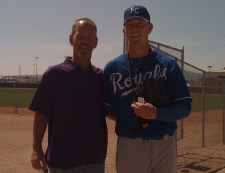
James O. Lamb (Guest MLB Blogger): Baseball has an infinite number of stories about the players, personnel, coaches and fans whom are associated with the game. One thing that is common among all the unique stories is having parents during the path of participating with the game. I realize the common thread is obvious, but the job of parenthood is key to success as a citizen first and athlete second. There are multiple positions affiliated with the game of baseball throughout the many steps of participation on the field. Surely there are some instances of tragedy where a child loses a parent, or maybe both, but the relative or friend that steps up to facilitate the child assume a very important role in their life. So what can a parent do to help their son play baseball? Try to take a walk with your kids in the game of baseball.
I will never claim to have all the answers but being the father of a current professional baseball player in the Kansas City Royals organization and also a scout for the Florida Marlins, I do have a small clue about the game of baseball. Routinely I’m asked questions about things associated around the great game of baseball. Some ask about youth ball, some ask about the high school challenges, some ask about playing college baseball, some want advice about improving their son’s skills, and many more want to know about the path of their son playing in professional baseball. What is the most important thing a parent can do for their son around the game of baseball? What should a parent do about extra instruction? When should a parent leave the dugout and let someone else control their son’s participation on the field? The examples of questions go on and on covering a huge variety of topics. There all good questions, but I’m reminded by a comment my grandfather made to me when I was very young… the only stupid question is the one never asked. It’s very obvious that many parents have no clue about the game and steps to play for a long time and that is fine. Sound advice for the baseball parent can be discussed in a wide variety of ways, but for the purpose of this article I will address the key ingredients to help any parent with their challenges around the game. I have made mistakes during my walk of being a parent but hopefully some of these experiences can be beneficial during your journey. Take a walk with your kids in the game of baseball and you just might be pleasantly surprised.
Wait for your son to ask you about playing the game. Take them to games and hope they catch the bug and desire to play. It will happen sooner or later if your son wants to learn how to throw, catch or hit. Don’t rush this step of the baseball career. If you already missed this important step, or ignored the obvious, it will eventually be exposed and unlikely they will be a fan of the game. Not the end of the world by any means, but I see players on a regular basis in the high school level, and even college, that illustrate major resentments. The further I dig or observe it becomes extremely obvious the player does not play for the right reasons. Way too much work is necessary for baseball success and the desire simply must be from within the individual, not someone else. The best approach to baseball starts early through desires from the player not the parent. Parents cannot do the work needed for the player’s opportunity to play the game at the highest level, nor can they write a check for their son’s chance to be in the show. Don’t force the game on kids!
Allow them to be kids. Let them enjoy playing the game of baseball. This directly ties into the previous point, I know, but if parents don’t have a sound grip on the foundation of the game of baseball, there will be some serious challenges around the dinner table. Even if the only time you use the table is during the holidays. Kids need to be kids as long as possible and cannot be expected to be perfect on the baseball field. The game of baseball is failure based during half of the game. The offensive side is the glaring example of failure associated with baseball and must be accepted during the early years of playing. Parents that expect more hits, less strike-outs, more wins or higher expectations than the statistics of an average big leaguer are setting their kids up for some serious challenges in baseball and in life. I can say that in retrospect I too was a victim of high expectations during my son’s playing youth baseball. I realize it is difficult to allow our kids to fail with dignity but if we, as parents, push too hard… our young men will likely have years of therapy in their future due to our high unrealistic expectations during their youth. The games your son plays during the ages of 5 to 17 will not impact their careers of playing for a long time, but the negative reaction to possible failure during those games could keep them from wearing a uniform quicker than necessary. If you allow them to fail with integrity, I guarantee you will see them succeed around the game. It is imperative that the kids are allowed to be kids during the early years of playing baseball. The longer they can play with fun in their hearts the higher the likelihood they will be in love with the game enough to survive the challenges ahead. Don’t forget that they are kids while they play!
 Let them experience other sports during their youth. Don’t be in a hurry to have your son play 100+ games a year. Way too many kids are simply playing too much baseball during their youth. This approach to playing baseball is an epidemic now in some areas of the United States where the weather permits games and tournaments to be scheduled practically year round. The idea of missing out on baseball development is driven by good marketing from a bunch of ill-advised individuals and corporations. Some players in the professional level are falling victim to a growing statistic of arm problems before their careers are complete and in certain circumstances a player’s career comes to an abrupt halt due to injury. Recently, I have struggled with this situation via hindsight of my own son’s amateur baseball career. John went down earlier this year in a Double-A level game with the Northwest Arkansas Naturals in the first inning against the third batter. Maybe he played too much during his youth, and maybe he didn’t, but this dad will always wonder if the amount of youth games really contributed to the Tommy John surgery before his 21st birthday. Parents should force their boys to rest or simply play another sport to help occupy their minds away from baseball during the typical off-season periods of baseball. If you live in California, Nevada, Arizona, Texas or Florida try to pretend there is snow on the ground during the winter months and you might not need to endure the agony of watching your son‘s career stop against a huge brick wall. My son played youth basketball and even flag-football in an attempt to rest from the game, but his desires to play baseball usually won the household battles especially the closer he got to graduating from high school. The hundred plus game schedules should be a goal for the parent of a baseball player not part of the process for obtaining the professional opportunity of the game. Plenty of other things can provide their much needed rest.
Keep being involved with your son playing the game of baseball. Having been a coach for many years now throughout all levels of youth baseball following my son’s desire to play the game, I am still blown away by the number of parents that treat their son’s practice, games or training as nothing more than a form of childcare. It’s not necessary to be at every practice or game but the more the merrier, at least until they become high school players. Pushing your son’s out of the car at their practice and running errands prevent the chance of assuring he really is learning how to play the game, or more importantly, having fun. If he’s not having fun he should be doing something else to find his passion and genius in life. I played for a few real crappy coaches during my youth but my love and desire to play the game was my personal driving force to work hard and compete for a line-up spot. You’ll never know about your son’s desires if you’re busy getting your nails done or working your brains out to help your boss pay his mortgage. By watching your kids practice or play you’re giving yourself a chance to ensure their desires to participate. Popping into a practice without announcement will give you a clear perspective of their experience and it will have enormous benefit when your son finds you there taking part of their enjoyment, or lack thereof. Your son’s may lose their desires to improve if you’re not part of the experience needed for them to improve and develop during their amateur days of playing the game. I realize the huge challenges parents have to mange time in our fast paced economy and lifestyles but you really should make an effort to be actively involved with the baseball stuff. If you’re too involved your son will let you know that you need to back off. Over involvement is really very common during the wrong stages of a boy’s baseball career, but that is another article for another day. Keep staying involved during their baseball until they make the high school team, at least.
What can a parent do? Try to take a walk with your kid in the game of baseball. The experiences from walking side by side around the game will be life changing for everyone involved. Although a potential love affair with the game may create other obstacles down the road of life all of which depend on the level of involvement with baseball, one thing can be said for sure and that is a true respect for the game will be created. If a relationship is fully allowed to blossom, the benefits are unlimited by the amount of jobs associated in and around the game. Parents can have a profound impact on their kids both in and out of the ballpark. Being a good human being only adds to the true value of any ballplayer at any level. Talent, hard work, a dash of luck and tremendous humility can open many doors and reciprocal affair with baseball. I’m always looking forward to yet another unparalleled baseball story engrained by the individuality of the greatest game on earth.

© by James O. Lamb. All rights reserved.
Twitter @JamesOLamb
* Please be advised that this article and any additional comments, posts or opinions from the content do not reflect the opinions of the Florida Marlins, L.P., Major League Baseball, or any other affiliations of professional baseball. *
Thank you James for preparing today’s article. Please feel free to contact James O. Lamb on Twitter or through his websites for comments and questions. James is one of the brightest baseball minds that I have ever had the pleasure of speaking with and getting to know. We highly encourage our readers to subscribe to James’ websites to gain valuable information and insights.
Please e-mail us at: MLBreports@gmail.com with any questions and feedback. You can follow us on Twitter and become a fan on Facebook . To subscribe to our website and have the daily Reports sent directly to your inbox , click here and follow the link at the top of our homepage.

Sunday MLB Insider Report: Our Views on the Latest Baseball News
Sunday September 4, 2011

MLB reports: Here is our weekly look at Major League Baseball and the latest news, together with analysis and of course, our opinions:
I am about to finish the latest baseball book that I am reading and will be posting a review this week. “The Fastest Thirty Ballgames”, by Ballpark Chaser extraordinaire, Doug Booth. I don’t want to give away much of my report, that will be saved for the review. Needless to say, the book has inspired me to fulfil my goal of seeing all thirty MLB ballparks. While it takes me ordinarily a couple of days to a week to complete a baseball book, this particular book has taken me much longer. I have read and re-read this book over and over, going back to read favorite sections. For any baseball fan who loves baseball road trips or is thinking of taking one, this book is the perfect travel companion.
One of the biggest topics on the lips of Yankees fans is the contract status of C.C. Sabathia. After Ivan Nova, the Yankees have several question marks as to their rotation going into the playoffs. Bartolo Colon, Freddy Garcia, Phil Hughes and A.J. Burnett are all in the mix. But if Sabathia were to hypothetically opt out of his deal and test free agency, the Yankees pitching staff could collapse like a house of cards. It appears that Sabathia has enjoyed his time thus far in New York and plans to continue pitching as a Yankee. Although Sabathia will likely opt out, both player and team will do everything possible to keep the big guy in pinstripes. Sabathia will become even richer on a new deal, as Alex Rodriguez was on his decision to opt out and sign a new Yankees deal. For the team with the highest payroll in baseball, to contend it will re-sign its ace in the offseason.
Rumors are circulating that many MLB General Managers will be wooed to change teams in 2012. Brian Cashman of the Yankees, Andrew Friedman of the Rays and Theo Epstein of the Red Sox are all apparently in demand, as is Billy Beane in Oakland and Mike Rizzo in Washington. From all the best GMs that will be considered for the Cubs position, the only one I could see is Cashman. With his contract up in New York and the Steinbrenner regime exercising control in decision-making (see the Rafael Soriano deal), Cashman may have had enough and makes the move to the Windy City. All of the other GMs are in great positions, with little or no incentive to make the leap. Some have called for the Astros to make a strong play for Friedman, but I see him staying put in a great situation with a strong talent base. Friedman will see his team through to an eventual World Championship.
 I had several conversations with baseball people about the World Baseball Classic, with the third edition coming up rapidly in 2013. As discussed in a previous article, there are some changes to the WBC that have been instituted, including a qualifying tournament in the fall of 2012. New countries in the mix include Great Britain, France, Israel and Brazil. In all there will be 12 new countries, together with 4 holdover countries vying for 4 open spots into the tournament. From the 16 existing WBC countries, 12 were granted automatic berths into the tournament. The challenge facing MLB and WBC officials is to have eligible players play for their respective countries. One particular country I discussed was Israel. Imagine a team lead by Ian Kinsler, Ryan Braun and Kevin Youkilis. Quite the powerhouse offense. To have this tournament ultimately succeed, star players that are eligible for new and less known baseball countries need to play for these countries and increase the exposure of the sport in those regions. That is really what the WBC is all about.
For fans in Kansas City, Baltimore, Pittsburgh, Seattle, Washington, and San Diego, please be patient. Your teams will be better. It might be hard to believe and some of you must be sick of hearing it, but your teams have great young talent and each will be a contender one day. The only variable against you is time.
With their victory over the Giants last night, the Diamondbacks now hold a six game lead in the NL West. How Kevin Towers remained on the market so long before being hired in Arizona is beyond me. Derrick Hall and company have put together a nice young team, with strong management on the field and in the front office. Towers has put together the team and manager Kirk Gibson has molded them into a contender. It goes to show that a bleak situation can be transformed almost overnight, if you have the right people in place. Baseball, as much as any other sport, starts with the people in charge. A solid management foundation flows through the whole organization and can make or break a major league team. Arizona is the team of destiny in the NL West in my mind and while they will have a very difficult time passing the Phillies if they make the playoffs, just playing in October this year will be considered a huge victory for the team.
Outside of New York and Boston, many baseball fans are apparently sick of talking about the Red Sox and Yankees. For as much as fans may despise the teams, as baseball fans they should still respect them. Baseball, without the history and tradition of the Red Sox and Yankees, would have a large void. During my recent trip to Cooperstown (with a full report on my experiences coming soon), I was fascinated by the Babe Ruth exhibit and all the features on the two powerhouse squads. There are no guarantees that either the Red Sox or Yankees will be in the World Series this year. But having the teams in baseball is a good thing. Attendance figures on the road when either team in town shows the demand. You may hate the Red Sox and Yankees. But you love to hate them. For those of you that are either Red Sox or Yankees fans (can’t be both), you are some of the most passionate and knowledgable fans in baseball and I salute you.
 I have been speculating since spring training that Jonathan Papelbon will leave Boston and join the Phillies this offseason. I read some speculation this week that the Yankees may look to add him as the heir apparent to Mariano Rivera. I could only imagine the feeling in Fenway the first time Papelbon would step foot on the mound in Pinstripes. Unlikely to happen in my opinion, but speculating can be fun sometimes. Until I hear otherwise, I am predicting Papelbon to the Phillies.
With the playoff races in baseball almost completed, it is time to turn our attention to October and thinking about the teams that will play in the World Series. My picks at this point are the Rangers and Phillies. Call it a hunch. Call me crazy. I am seeing a Texas Philadelphia matchup and one of the best fall classics in recent history.
Finally, I made a point on Twitter yesterday that the regular season is almost done. If you have not made it a live game yet this year or even if you have gone to twenty or more games, try to attend as many September games as you can. When November hits, the winter can be quite a sad time for baseball fans. Unless you can make it out to Arizona or Mexico, chances are that you will not be able to watch winter ball. With the internet, those games can be found to be viewed on your computer. But as fans can attest, nothing beats a live ball game. Enjoy as many of those games as you can now.
Please e-mail us at: MLBreports@gmail.com with any questions and feedback. You can follow us on Twitter and become a fan on Facebook . To subscribe to our website and have the daily Reports sent directly to your inbox , click here and follow the link at the top of our homepage.

Adam Dunn: The Future of the White Sox Slugger
Wednesday August 31, 2011

MLB reports: Not every player can fit onto a particular MLB team. That is a baseball reality. In fact, there are very few, if any players that could produce the same statistics playing for any team. A player’s production is based on many factors, including home park, lineup, adaptability to particular cities and so on. When a team trades for a player or signs a free agent, the hope is that the new player will be able to meet or exceed previous production levels on a new team. Sometimes, the hope is that new environment will revitalize a stagnant player and breath new life into them. In the case of Adam Dunn, the Chicago White Sox signed him to a free agent contract last year. A large deal, 4 years for $56 million dollars. A fair deal in my estimation at the time. The White Sox by signing Dunn were hoping to land an established slugger to fit in the middle of their lineup. What they ended up with was quite different.
Take a look at Adam Dunn’s current production in comparison to his career numbers:
| BA | HR | RBI OBP | ||
|---|---|---|---|---|
| Regular Season | .163 | 11 | 40 .290 | |
| Career | .244 | 365 | 920 .374 |
 To say that Adam Dunn has been anything but a disaster since his arrival in Chicago would be an understatement. Prior to 2011, Dunn’s worst season produced an .819 OPS. That was in 2003, his 2nd full season in the majors that was cut short by injuries. Turn the clock and Adam Dunn sits with a .578 OPS this season with no likelihood of redemption. While some pointed to Dunn playing in a new league for the first time and starting off slow, a turnaround was expected at some point this season. Dunn has actually regressed to the point that he is benched by manager Ozzie Guillen at a frequent rate. A sad state of affairs for one of the game’s previously most consistent sluggers.
For a two-year stretch, from 2003-2008, Adam Dunn was a 40 home runs and 100 walks guy. In his last two seasons, Dunn played in a less than friendly hitters park in Washington and still hit 38 home runs per season. Moving to the White Sox, expectations were that playing in a hitter’s park with a deep lineup would produce possible MVP type numbers for the burly slugger. So what happened? Why the sharp regression?
Part of the issue has been the move to the American League. The adjustment has not worked for some hitters and we have seen NL hitters in the past that cannot play in the AL for whatever reason. Glenn Davis is one famous example that comes to mind, who moved from Houston to Baltimore and literally fell apart overnight. Dunn also is a full-time DH for the first time in his career. Some hitters never take as well to moving off the field and into a DH role, citing inactivity and removal from the full game experience as distractions from their hitting. Given though Dunn’s perceived weak fielding, at both first base and the outfield, a move to DH should have been a welcome change for him. Yet the move was another factor in his year-long slump.
The main culprit in my estimation is the fit, or lack of in Chicago. Perhaps it is the city, or the ballpark, teammates, media or his relationship with the manager. Whatever the reason, I ultimately believe that Adam Dunn and the White Sox simply do not mesh more than anything else. While a return to the field and/or the National League may help, first and foremost Dunn needs to get out of Chicago and start fresh.
 I think of Chone Figgins and his move from the Angels to the Mariners. Despite staying in the same division even, Figgins was never able to meet expectations in Seattle and regressed throughout his time with the Mariners. Had he stayed in Anaheim, the chances are higher that Figgins would have continued playing his game and not transformed into a shell of his former self. Carl Crawford in Boston and Jayson Werthin Washington are players that also signed big-ticket deals and also stayed in their respective divisions, yet faltered in the wake of big contract expectations. But the difference with Crawford and Werth is that they have shown some glimpses of life this season, while Dunn has shown none. I fully expect Crawford at least to be able to make the necessary adjustments and rebound by next season. In Dunn’s case, I do not see that happening without a trade.
Nick Swisher is a situation that I will point to as an example. From the moment Swisher was traded from the A’s to the White Sox, nothing went right. After suffering through the worst season of his career in Chicago, Swisher was traded to the Yankees for pennies on the dollar and blossomed in New York. The same will likely occur to Dunn. A move to the Yankees is a possibility, for a high-profile team that can afford to take on or part of most of Dunn’s salary. A trade for a bad contract is another one, with the Cubs for Zambrano or Giants for Zito as possibilities. Better yet, a move to the Angels could also be the answer. With Mike Trout ready to join an outfield of Peter Bourjos and Torii Hunter, the Angels may not have room for failed trade acquisition Vernon Wells. The White Sox could plug Wells into their outfield and Angels use Dunn to replace Bobby Abreu as DH. A long shot, but certainly a possibility.
No one can be sure if this season is an outlier or an indication of the beginning of the end for Adam Dunn. Based on his strong body of work until this year, I am willing to give him the benefit of the doubt that a rebound will occur. The White Sox might wait it out and give Dunn another shot next year. But then GM Kenny Williams has never been the patient type. After moving Swisher very quickly, I expect the White Sox to do the same with Dunn. This would be a classic buy-low situation for another MLB club. Expect many calls on Dunn in the offseason and a new team by 2012. Despite Dunn indications of having retirement thoughts due to his poor season, I cannot see him going down in this manner. Adam Dunn will be back. The only question is where.

Please e-mail us at: MLBreports@gmail.com with any questions and feedback. You can follow us on Twitter and become a fan on Facebook . To subscribe to our website and have the daily Reports sent directly to your inbox , click here and follow the link at the top of our homepage.

MLB Home Run Leaders: A Look at the Leaderboard
Monday August 29, 2011

MLB reports: We are coming to the last month of the MLB season. Readers are often requesting updates as to the hone run leaders and to handicap who will be the leading sluggers by year’s end. Taking a look at the current top 10 home run hitters in baseball, we find many familiar faces and some surprises. Here is our updated look at the mashers and bombers of baseball:
T-1: Curtis Granderson, New York Yankees (38)
Oh yes. The Grandyman can. The baseball world has gone Granderson crazy. From what appeared to be a hitter on the decline when he joined New York, Curtis Granderson has reinvented himself into an MVP candidate in 2011. Watching Curtis in Detroit, most expected him to be a 20 something home run hitter at most. Imagine that he has already hit 38 home runs with a month to go. It goes to show that baseball can be a very unpredictable sport and that New York still has the power to create miracles. I do not expect to see him on this board for the next five years, but for 2011 at least, Granderson has shot up to the top of the baseball mountain.
T-1: Jose Bautista, Toronto Blue Jays (38)
 A regular on this list all season, Bautista has picked up from where he left off last season. While unable to maintain the Ruthian pace he was on in the first half of the season, Bautista has maintained his strong numbers throughout the year. With his 38 home runs, Bautista has already walked 107 times and has a 1.098 OPS. MVP voters will have much to consider at the ballots this year.
3rd: Mark Teixeira, New York Yankees (35)
There are some certainties in life. Death, taxes and Teixeira home runs. This man is as steady as they come and despite the lack of flash and glitter, he always seems to get the job done. No surprise to see him this high up on the list. Teixeira is simply money in the bank. You never have to worry about him.
T-4: Albert Pujols, St. Louis Cardinals (31)
For all the talk of doom and gloom, Albert Pujols still made the top five list. A “down” season for Sir Albert is a .895 OPS and 31 home runs. Numbers that most players would die for, but not anywhere close to his high standards. As an impending free agent, I fully expect Pujols to remain in St. Louis. But with his statistics not at his norm, the Cardinals might be able to sign him at a slightly more realistic price tag. $22 million per season rather than $25 million perhaps.
T-4: Matt Kemp, Los Angeles Dodgers (31)
 Matt Kemp, or Baby Manny as he was called as a young prospect (the second coming of Manny Ramirez) has blossomed this year. Together with his 31 home runs, Kemp has already driven in 100, has a .964 OPS and a .320 AVG. Getting much press as a NL MVP candidate, Kemp is finally beginning to fulfill on the potential he had shown in his career leading up to this season. People thought for some time he was good, but I don’t think many expected such a strong campaign. A young player on the rise, Kemp might only be scratching the surface on many productive seasons to come.
T-4: Mark Reynolds, Baltimore Orioles (31)
Our generation’s Rob Deer keeps plugging away with the long balls. Reynolds has a respectable 31 home runs thus far, but have come with a whopping 157 strikeouts. More disturbing though his .226 AVG. An all-or-nothing slugger throughout his career, Reynolds is not showing any signs of improvement. The signs are showing for him to bounce around baseball, eventually ending up as a platoon player or even to Japan.
T-7: Mike Stanton, Florida Marlins (30)
One of the youngest and brightest stars in the game, Stanton has exploded in Florida in a big way. Heralded as the next Dave Winfield, Stanton has not disappointed in 2011. With 30 home runs to go along with a .889 OPS, Stanton is showing that the promise and hype is for real. Rumored to be requested by the White Sox as part of the Marlins hoping to land Ozzie Guillen as a manager, the Marlins are surely happy they held onto their young slugger. Together with Logan Morrison and Gaby Sanchez, expect Stanton to blossom into a top ten player in baseball very soon.
T-7: Lance Berkman, St. Louis Cardinals (30)
 Once considered a top hitter in the game, Berkman had many question marks surrounding him after a down season last year. While many analysts thought the Cardinals were taking a risk by signing him, the Cardinals brass were confident in Berkman’s ability to rebound. Back in the NL Central and surrounded by Pujols and Matt Holliday in the lineup, Berkman has not disappointed. With 30 home runs, 77/75 BB/K, .289 AVG and .975 SLG, Berkman is getting MVP consideration as well as a lock as the NL Comeback Player of the Year. While Berkman cannot continue like this forever, expect at least 1-2 more solid seasons out of the seasoned veteran.
T-7: Dan Uggla, Atlanta Braves (30)
What a journey Uggla took this year. With a .232 AVG, one expect Uggla to be considered to be having an off-year. But with 30 home runs a 33-game hitting streak, Uggla has had his moments this year. Considered one of the best hitting second basemen in the game, power is a big part of Uggla’s repertoire. While the rest of the numbers are down, the long balls have remained constant. With his first year on a new team out of the way, expect a rebound from Uggla next season.
T-10: Prince Fielder, Milwaukee Brewers (29)
Considered to be one of the biggest prizes in the offseason free agent derby, Prince Fielder is having a fantastic campaign for the Brewers. Together with his 29 home runs, Fielder scored 81 runs, driven in 102, has 87/84 BB/K and hit .295, with a .955 OPS. The questions on people’s minds is whether he will stay in Milwaukee and if the biggest free agent contract this year will go to Fielder or Pujols. With Scott Boras as his agent, my money is on Fielder moving to greener pastures and commanding the top contract as a free agent. Together with Ryan Braun, Fielder gives the Brewers a strong team going into the playoffs in what is likely his last season in Milwaukee. Although number ten on this list, Fielder has shown the consistency this season to be considered one of the top hitters in the NL this season.
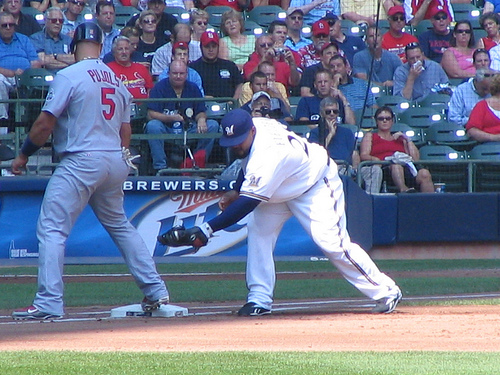
Please e-mail us at: MLBreports@gmail.com with any questions and feedback. You can follow us on Twitter and become a fan on Facebook . To subscribe to our website and have the daily Reports sent directly to your inbox , click here and follow the link at the top of our homepage.

Sunday MLB Insider Report: Our Views on the Latest Baseball News
Sunday August 28, 2011

MLB reports: Here is our weekly look at Major League Baseball and the latest news, together with analysis and opinions:
First our condolences to the Flanagan family, as the baseball world learned of the loss of ex-Orioles and Jays pitcher Mike Flanagan. Mike was a baseball lifer, having played the game and remained active as a coach, broadcaster and executive. The part of the ordeal that makes the story most tragic is how quickly speculation and then reports surfaced that his death was a suicide. In this age of social media, it is difficult to impossible to mask the facts behind a story. When rumors begin that are untrue, it is then often too difficult to bury them when they are later proven untrue. Once a story is put out into the world on the internet, it often remains there in people’s minds, if fact or faction. So when we think of Mike Flanagan, let’s remember him for the star pitcher that he was in the later 1970s and all the contributions he made to the game in all different capacities. Without having walked in his shoes, none of us could ever understand what was in his mind and the factors that led to his unfortunate passing. We cannot change the past. So when remembering Mike Flanagan, let’s remember him for his role in the game and not for the manner in which he passed away. I’m sure the Flanagan family would want it that way.
From a sad story to a literally bizarre tale, Lenny Dykstra is in the news once again. And for all the wrong reasons, again. The former World Series hero for the New York Mets and Philadelphia Phillies apparently was arrested for soliciting women on Craig’s List for fake jobs and then exposing himself to them. Looking to hire women for roles such as assistants and cleaning women, Nails according to reports has hit a new low. Once heralded as a business genius in business magazines, for his many business ventures including a string of car washes, Dykstra is now bankrupt and at the bottom of the barrel. I had a reader write in that questioned why ex-players like Dykstra and Flanagan pull stunts to get themselves into the news and cannot get away from the limelight. After my jaw dropped and blood boiled, I took some time to think about this comment. Overall, my response is that there is a difference between Flanagan, Dykstra and a publicity hound like Jose Canseco. Mike Flanagan passed in an unfortunate manner, but I think any reasonable person would not associate his death with a publicity stunt. Flanagan was a troubled soul but in no way looking for attention. Rather he was moving away from attention, likely looking for peace. To say that Flanagan was seeking publicity is extremely disrespectful to his legacy and family that was left behind. In the case of Dykstra, if the recent allegations are true, I also do not believe that he was seeking attention. To commit such crude and strange acts indicates that the man is disturbed and in need of professional assistance. Perhaps in some ways it is a cry for help, in other ways he may just have a giant ego and believes that he can do whatever he wants without repercussions. But it is extremely unlikely that Dykstra was hoping his actions would be publicized to the world and bring his name back to the spotlight. In a way it all comes back to Jose Canseco. In his truest form, Canseco only acts in a manner so that he will get his name into the public spotlight. From reality shows, boxing matches, independent baseball games, tell all books etc, Canseco’s singular purpose is to get attention. So while there are many ex-athletes out there in the world, let’s not all be so quick to group them into the Jose Canseco category. Some may have troubles, some may keep clean and we will never hear about them. But just because a story emerges about an ex-MLB player, let’s not be so quick to think that all of them are publicity hounds. Some want the exact opposite and enjoy their private time since their careers have finished.
Don’t look now Texas Rangers fans, but the Angels are hot on the heels of your team. The Rangers’ lead in the AL West is down to a mere 2.0 games with the Angels suddenly on fire. In their last 10 games respectively, the Rangers are 3-7 while the Angels are a mirror opposite 7-3. With the teams set to face-off today against each other, the gap could close even more. It seems that the Angels have caught fire at the right time, while the Rangers have cooled off. The Rangers are still scoring runs at a large clip, as they normally do in August in Arlington. But while the Rangers pitching is starting to fall short, the Angels pitching is on fire. Led by dual aces Jeff Weaver and Dan Haren, the Angels pitching looks unstoppable at this point. The Rangers will be tough to beat, with one of the best offenses in baseball led by Josh Hamilton, Ian Kinsler, Nelson Cruz, Michael Young and Mike Napoli. They also have a very deep end of the bullpen led by closer Neftali Feliz. But as the San Francisco Giants showed last year, strong pitching can beat good hitting to win at all. The Rangers have the bats and the Angels have the arms. While the Angels have some good bats, including Torii Hunter and Mike Trumbo, they are nowhere close to the level of the Rangers. It will be an AL West dogfight right to the end of the season. Baseball fans everywhere look forward to the September AL West showdown.
I read a really good article this week on the Sports Illustrated site. It was a look at the large contract signed by Jered Weaver and the Angels and analyzing the rationale behind it. The article made many strong points that I wanted to touch upon. While many analysts have argued that Weaver left tens of millions of dollars on the table, such is not always the case. Looking at the worst case scenarios of such a deal, the article brought up the Carlos Zambrano deal in Chicago and Brandon Webb not signing a contract with the Diamondbacks. Zambrano signed at the time a “team friendly” deal which the Cubs are now working very hard to get out of. On the flip side, Brandon Webb did not end up signing a long-term deal in Arizona and ended up getting hurt and costing himself millions. I would throw in as well the failure of Nomar Garciaparra to sign a long-term deal with Boston that ended up costing him millions due to later injuries suffered and likely saving the team in the long run. In the case of starting pitchers, you never know when one will get injured and waiting until free agency could result in injuries and lost wages overall. So while some view Weaver as having lost millions, others could look at it as gained millions and take the sure road to a rich contract and not gambling on what the future could bring. The bottom line is that Weaver is comfortable where he is and being paid handsomely to play the game he loves at home. Both the team and player are happy with the deal and everyone wins as a result. If Weaver gets injured or falters, the player will look as the victor. If Weaver dominates over the next five years, the team will appear as coming ahead. Without looking into a crystal ball, we will say that this was a fair deal for a player not yet eligible for free agency and we will call it a tie. As Chone Figgins in Seattle, Adam Dunn in Chicago and Jeff Weaver also in Seattle can attest, the highest dollar isn’t necessarily the best one for a baseball career. Staying in a productive situation can often best further a baseball career and lead to the most years played and quite often, the most dollars overall earned as a result.
 Finally, one of our favorite baseball topics: prospects. From the explosion in exposure of the MLB draft to the countless websites devoted to tracking baseball prospects, baseball fans are hot on the heels of future “stars’ like never before. In addition to the social media available reporting on prospects, teams have pressure to develop and call-up prospects at a quicker pace due to the dollar amounts involved. With top prospects earning bigger bonuses than seen back in the day, executives are feeling the heat to rushing these bonus babies to the majors. So the combination of big bucks and fan pressure is resulting in prospects climbing early to the majors at very young ages. So while Brett Lawrie may appear to be an early success for the Jays, teammate Travis Snider has failed to reach his potential yet and is doing the trek from the minors to the majors and back. Alex Gordon similarly came to the majors with a mountain of expectations and took many years to develop. Colby Rasmus burnt out in St. Louis for many reasons and found his way to Toronto. Matt LaPorta was traded by the Brewers to the Indians in the C.C. Sabathia trade and has failed to live up to Indians’ fans expectations thus far. But on the flip side we see a Paul Goldschmidt come up with the Diamondbacks with little fanfare around the majors and find success. We can look at hit and miss prospects all day, but my point is as follows. Baseball prospects take the longest to develop out of all the major sports. While the NBA and NFL do not have a minor league system per say and the NHL has one minor league level, Major League Baseball has several minor league stops. It is rare to impossible for a baseball prospect to make it to the show without spending time in the minors. While most baseball prospects realistically need 2-4 years in the minors to develop their game, many top prospects are being rushed like never before. I do not see this as a positive in the game and in many cases a hinderance to the development of the players. But with the baseball media machine at full blast and money being thrown at top prospects at record high levels, I cannot see the rushing of top prospects stopping any time soon. But I think we all need to step away for a moment and really think about what is best for these players careers. For every Brett Lawrie, there will be hundreds of failed prospects that will take time to develop. Alex Gordon this year is one of the few lucky ones, that has been able to turn around his career. But it took a position change and many failed attempts to get to this point. Analyzing and watching prospects is one of my guilty habits, I will admit it. I just hope that major league teams will give their top prospects the tools and ability to succeed, rather than set them up for failure. It is a fine line and one that many teams are still learning to walk on.

Please e-mail us at: MLBreports@gmail.com with any questions and feedback. You can follow us on Twitter and become a fan on Facebook . To subscribe to our website and have the daily Reports sent directly to your inbox , click here and follow the link at the top of our homepage.

RIP Mike Flanagan: Former MLB Pitcher with Orioles and Jays Passes Away
Wednesday August 24, 2011
MLB reports: We are sad to report that Mike Flanagan, ex-MLB pitcher was found dead in Baltimore County today. Flanagan was 59 years of age. While the news is still trickling in, it is currently being reported that Flanagan’s body was found on a trail near his home. The body has just been recently identified as being that of Mike Flanagan. After some distresses relating to finances, Flanagan apparently took his own life. A very spirited baseball man, Flanagan was a beloved figure in the sport and his death has sent shock waves through the baseball community. Mike Flanagan devoted his life to baseball and we are all very saddened by the new of his passing.
Mike Flanagan was originally a 7th round draft pick of the Baltimore Orioles in 1973. Flanagan spent 18 productive seasons in baseball, with 15 coming in Baltimore. In addition to pitching for the Orioles, Flanagan spent part of 4 years with the Blue Jays. Although he pitched only a short time in Toronto, Flanagan’s name is still tossed around as one of the all-time favorite Jays pitchers. Such is the effect this man had on pitching. But Flanagan will forever be linked with the Baltimore Orioles, the club that he came up with and ultimately retired from. Here is a look at the career numbers of Mike Flanagan:
| Year | Tm | W | L | ERA | IP | BB | SO | WHIP |
|---|---|---|---|---|---|---|---|---|
| 1975 | BAL | 0 | 1 | 2.79 | 9.2 | 6 | 7 | 1.552 |
| 1976 | BAL | 3 | 5 | 4.13 | 85.0 | 33 | 56 | 1.365 |
| 1977 | BAL | 15 | 10 | 3.64 | 235.0 | 70 | 149 | 1.298 |
| 1978 | BAL | 19 | 15 | 4.03 | 281.1 | 87 | 167 | 1.273 |
| 1979 | BAL | 23 | 9 | 3.08 | 265.2 | 70 | 190 | 1.186 |
| 1980 | BAL | 16 | 13 | 4.12 | 251.1 | 71 | 128 | 1.389 |
| 1981 | BAL | 9 | 6 | 4.19 | 116.0 | 37 | 72 | 1.250 |
| 1982 | BAL | 15 | 11 | 3.97 | 236.0 | 76 | 103 | 1.309 |
| 1983 | BAL | 12 | 4 | 3.30 | 125.1 | 31 | 50 | 1.324 |
| 1984 | BAL | 13 | 13 | 3.53 | 226.2 | 81 | 115 | 1.297 |
| 1985 | BAL | 4 | 5 | 5.13 | 86.0 | 28 | 42 | 1.500 |
| 1986 | BAL | 7 | 11 | 4.24 | 172.0 | 66 | 96 | 1.424 |
| 1987 | TOT | 6 | 8 | 4.06 | 144.0 | 51 | 93 | 1.382 |
| 1987 | BAL | 3 | 6 | 4.94 | 94.2 | 36 | 50 | 1.458 |
| 1987 | TOR | 3 | 2 | 2.37 | 49.1 | 15 | 43 | 1.236 |
| 1988 | TOR | 13 | 13 | 4.18 | 211.0 | 80 | 99 | 1.422 |
| 1989 | TOR | 8 | 10 | 3.93 | 171.2 | 47 | 47 | 1.357 |
| 1990 | TOR | 2 | 2 | 5.31 | 20.1 | 8 | 5 | 1.770 |
| 1991 | BAL | 2 | 7 | 2.38 | 98.1 | 25 | 55 | 1.108 |
| 1992 | BAL | 0 | 0 | 8.05 | 34.2 | 23 | 17 | 2.106 |
| 18 Seasons | 167 | 143 | 3.90 | 2770.0 | 890 | 1491 | 1.334 | |
| 162 Game Avg. | 12 | 10 | 3.90 | 203 | 65 | 109 | 1.334 | |
| W | L | ERA | IP | BB | SO | WHIP | ||
| BAL (15 yrs) | 141 | 116 | 3.89 | 2317.2 | 740 | 1297 | 1.323 | |
| TOR (4 yrs) | 26 | 27 | 3.94 | 452.1 | 150 | 194 | 1.393 | |
 Flanagan made his major league debut in 1975. He started to come into his own in 1978, with a 19 win season and 4.03 ERA, to go along with his only all-star game appearance. The real breakthrough came in 1979, when Flanagan won 23 games, with a 3.08 ERA and a whopping 190 strikeouts. Flanagan that year won the AL Cy Young award, in addition to finishing 6th in the AL MVP voting. Flanagan played in the World Series in 1979 with the Orioles, losing to the Pirates. The Orioles and Flanagan were back though in 1983, beating the Phillies to win the World Series. In 1987, Mike Flanagan was traded to the Jays for hurlers Oswaldo Pereza and Jose Mesa. Flanagan played in the ALCS with the Jays in 1989, his final MLB playoff appearance. In 1991, Flanagan re-signed with the Orioles as a free agent and he continued with the Orioles until retiring in 1992. Mike Flanagan and the Baltimore Orioles will forever be linked in baseball history. Flanagan spent the majority of his career in Baltimore, the sight of his greatest baseball triumphs.
Following his retirement from the game, Flanagan continued in Baltimore in many capacities. In addition to serving in the broadcast booth, Flanagan served as the Orioles pitching coach, as well as Vice-President/Co-GM (unofficially with Jim Duquette). The man gave his heart and soul to the city of Baltimore and was a beloved sports figure in the eyes of the Orioles fans. It is a tragedy when the MLB family loses one of its members and today we have lost a great one in Mike Flanagan. We will remember Mike for his time in the game, as a player, broadcaster, coach and executive. I had the pleasure of watching Mike pitch on many occasions. He was a gamer. Flanagan always gave it his all and was a steady presence on every pitching staff that he played with. We thank Mike Flanagan for the memories and remember him fondly on this very sad day.
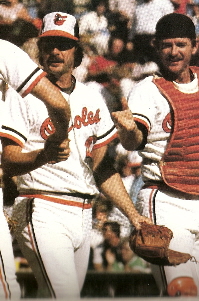
Please e-mail us at: MLBreports@gmail.com with any questions and feedback. You can follow us on Twitter and become a fan on Facebook . To subscribe to our website and have the daily Reports sent directly to your inbox , click here and follow the link at the top of our homepage.
The Sunday MLB Inside Reports
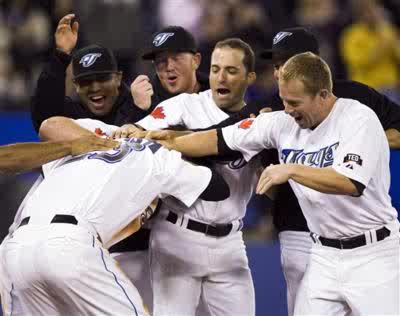
MLB reports: Greetings readers from Cooperstown, New York. I am on the road and writing today’s report on my BlackBerry. As I sit in my hotel and prepare to visit the Cooperstown baseball museum tomorrow, here are today’s reports:
Watching the Cubs and Cardinals playing the Sunday night game of the week, I had some thoughts. Firstly, ESPN loves Starlin Castro. He was on the tv set about 60% of the game and had his name mentioned about 3,000 times. He is good, but still young and raw. The hype needs to be toned down. Also nice home run showings by Jon Jay and Yadier Molina with a pair. But top prize goes to Albert Pujols for the bomb he hit off Lopez. That shot will put Pujols back on the map as he proves health and performance on road to new contract in the offseason. That home run may have earned another $20 million on his new contract.
The Tigers are looking good after this weekend. They currently sit in 1st place in the Central. The Indians are 4 GB, with the White Sox 5 GB. Watch out for the Sox as they are still in it. In my opinion, there is not a better catcher right now in baseball than Alex Avila. With power and patience at the plate, to go along with strong D, Avila is doing it all for the Tigers. Credit goes to Victor Martinez, a positive mentor to Avila and a great free agent acquisition for Detroit. On the flip side, Ubaldo Jimenez got rocked Sunday. The Indians starter does not look 100% on the mound and may have an undisclosed ailment.
The Braves bullpen combination of Venters and Kimbrel is downright scary for opponents. To go along with starters Tim Hudson and Jair Jurrjens, the Braves should take the NL Wild Card come October. The National League is officially on notice.
It looks like the Brewers are running away with the NL Central. A very deep team top to bottom, the Brewers were built for the 2011 playoffs. The Reds have been a big disappointment this year and the Cardinals simply do not have the pitching to match up with the Brewers.
Jose Bautista hit his major league leading 36th home run of the year. Bautista has done it all this year, showing power and patience at the plate with great D at 3B and the outfield. Perhaps the most valuable player to his team, expect Bautista to get many votes for AL MVP this year.
I enjoyed reading the Bill James Abstract today on the drive up to Cooperstown. Given James’ important contributions to the game, consideration should be given to putting James in the Hall of Fame one day. His contributions have been that important considering how much he has changed the game through statistical identification and analysis.
Baseball needs to stop digging in its heels as many decisions need to be made soon. Upcoming baseball discussions centre on realignment, expansion, adding wild card teams HGH testing, rookie salary caps and finding a replacement for Bud Selig. Expect much more information to come out as the current MLB CBA expires in December.
As a side note, it was a glorious drive up to Cooperstown this afternoon. When you enter the town, it really feels like being in small town USA. Many houses have American flags proudly displayed up front and there is grass, trees and baseball signs everywhere. For a baseball fan, there is no better place on earth than Cooperstown. If you haven’t visited, I highly recommend it.
Have a great night everyone and I wish everybody a great week. As the MLB pennant race heats up, be sure to support your favorite team. September is around the corner and playoff baseball will be here soon.

Mike Jacobs: Rockies Slugger Receives 50 Game HGH Suspension
Friday August 19, 2011

MLB reports: Major League Baseball commenced human growth hormone (“HGH”) testing in the minor leagues in the summer of 2010. It was only a matter of time before players began to get caught under the new system. Blood testing for HGH in the minors was the first step in bringing similar tests to the major leagues one day. With HGH testing now in place as part of the NFL’s new collective bargaining agreement, MLB cannot be far behind. With baseball’s agreement with the union set to expire in December of this year, expect HGH testing to be a big topic on the bargaining table. The first player to be caught in the minors using HGH and receiving a 50 game suspension is Colorado Rockies slugger, Mike Jacobs. With the first HGH culprit found, pressure will be intense on baseball to bring similar testing all the way to the major leagues.
 Mike Jacobs will forever be known as the first North American athlete to test positive for HGH. Although HGH suspensions have occurred internationally, Jacobs is the first athlete in a professional North American athlete to be tested and fail a HGH test. Things should have gone differently for Jacobs in his career. Originally a 38th round pick for the Mets in the 1999 draft, Jacobs rose from baseball obscurity to star with the Marlins from 2006-2008. Here is a look at Jacobs’ major league stats:
| Year 5 | Tm | R | HR | RBI | SO | BA | OBP | SLG |
|---|---|---|---|---|---|---|---|---|
| 2005 | NYM | 19 | 11 | 23 | 22 | .310 | .375 | .710 |
| 2006 | FLA | 54 | 20 | 77 | 105 | .262 | .325 | .473 |
| 2007 | FLA | 57 | 17 | 54 | 101 | .265 | .317 | .458 |
| 2008 | FLA | 67 | 32 | 93 | 119 | .247 | .299 | .514 |
| 2009 | KCR | 46 | 19 | 61 | 132 | .228 | .297 | .401 |
| 2010 | NYM | 1 | 1 | 2 | 7 | .208 | .296 | .375 |
| 6 Seasons | 244 | 100 | 310 | 486 | .253 | .313 | .475 | |
| 162 Game Avg. | 71 | 29 | 90 | 142 | .253 | .313 | .475 | |
| FLA (3 yrs) | 178 | 69 | 224 | 325 | .258 | .314 | .483 | |
| NYM (2 yrs) | 20 | 12 | 25 | 29 | .290 | .360 | .645 | |
| KCR (1 yr) | 46 | 19 | 61 | 132 | .228 | .297 | .401 | |
| NL (5 yrs) | 198 | 81 | 249 | 354 | .261 | .317 | .496 | |
| AL (1 yr) | 46 | 19 | 61 | 132 | .228 | .297 | .401 | |
2008 represented the best season of Jacobs’ career. He hit 32 home runs, to go along with 93 RBIs for the Marlins. But despite the strong power numbers, critics pointed to his .247 AVG and weak .299 OBP that year and labelled him a one-dimensional player. The Marlins agreed and traded Jacobs in October 2008 for current closer Leo Nunez. Jacobs originally joined the Marlins in November 2005 as a package of players for superstar Carlos Delgaldo. Big expectations were placed on Jacobs to replace Delgaldo ever since he joined the Marlins. While Jacobs had the strong power numbers in 2008, the team ultimately was not convinced that he would ever fulfill his potential. While Nunez went on to star in the Marlins bullpen, Jacobs lasted only one season in Kansas City, his last full season in the big leagues.
 In 2010, Jacobs spent parts of the year playing in the Mets and Blue Jays farm systems. He hit 21 home runs and drove in 93 in 120 games combined in AAA, with a .335 OBP and .482 SLG. This season, Jacobs played exclusively in Colorado Springs and put up inflated numbers in the hitting friendly Pacific Coast League. With 23 home runs in 117 games, 97 RBIs, .376 OBP and .534 SLG, there looked to be a chance for Jacobs to restart his major league career. At 30-years of age, Jacobs was looking to have a year-end cup of coffee with the Rockies and leave a strong enough impression to perhaps have a chance in spring training 2012. Reports had a call up imminent for Jacobs when news of the HGH positive test leaked out. The Rockies immediately released the slugger, who is now on the MLB sidelines.
Following the Marlins acquisition of Jacobs in 2005, I expected his career to develop differently. It was clear the power was going to be there. It was the rest of his hitting development that I expect to follow. To stay in the big leagues, Jacobs was going to need to learn patience and to hit lefties. Following his 2008 campaign, I still hoped in the back of my mind that those qualities would eventually come out. But they never in fact did. Looking back at his magical 2008 campaign, there were red flags that Jacobs had major shortcomings as a hitter. 25 of his home runs came against right-handed pitchers. Against lefties, Jacobs hit .218 with a .248 OBP and .429 SLG. At best, without improvement, Jacobs was likely destined to be a platoon player for the rest of his career. Now today, Jacobs stands as the new poster child for HGH cheating. A scarlet letter that will be difficult, if not impossible to remove.
 With Barry Bonds, Mark McGwire and Rafael Palmeiro gone from the game and the “steroid era” at an apparent end, the focus is now on HGH. Apparently very wide-spread in the game, baseball officials are said to be taking a hard stance to remove HGH use from the game. In suspending Jacobs, commissioner Selig indicated that baseball is on top of testing and is not hiding from the process. I expect HGH testing to be a part of the major leagues as early as 2012. Despite the tests and the threat of strict penalties, as Mike Jacobs has shown, athletes will continue to try to get ahead despite the risks involved. Jacobs came clean following his positive test, admitting usage to overcome injuries and regretting his decision to use HGH. The decision to use HGH will cost Jacobs more than 50 games. It resulted in his dismissal from the Rockies and likely removal from major league baseball all together. For a fringe player that was already hanging by a thread, having the HGH suspension on his resume will scare off many, if not most major league teams.
Mike Jacobs had his chances in baseball. While many sluggers before him are lucky to get one shot at the big leagues, Jacobs had several chances. Despite playing for three teams over six major league seasons, Mike Jacobs was never able to fulfill his vast potential. Like many left-handed home run hitters, Jacobs could never hit well against lefties and get on base at a high enough level to compliment his power bat. Now at 30-years of age, the legacy of Mike Jacobs will be as using HGH and failing the first North American test. While I expected Jacobs to be fighting for home run crowns at this point in his career, he now sits outside of baseball. A lesson to be learned for future sluggers. It is better to play clean and keep your reputation than cheat and get caught. Once the first failed test hits, any accomplishments in the past and future will always be tarnished. As Palmeiro, Bonds, Sosa and McGwire can attest, poor public perceptions never seem to go away. They just continue to linger, seemingly until the end of time.

Please e-mail us at: MLBreports@gmail.com with any questions and feedback. You can follow us on Twitter and become a fan on Facebook . To subscribe to our website and have the daily Reports sent directly to your inbox , click here and follow the link at the top of our homepage.

Tyler LaTorre: Interview with San Francisco Giants Catcher
Thursday August 18, 2011
MLB reports: Today on the Reports we are proud to feature Tyler LaTorre, a catcher with the San Francisco Giants.
The 28-year old LaTorre is a true example of perseverance. LaTorre bypassed the MLB draft and signed with the Giants in 2006, his favorite team as a youngster. After playing four seasons at UC Davis, LaTorre began his professional career in the Arizona Rookie League in 2006. This season LaTorre worked his way up the ranks to AAA Fresno and looks to be banging on the Giants door. With Buster Posey entrenched as the Giants starting catcher, the California native LaTorre continues to strive towards a future position with the big league club.
We are pleased to present Tyler LaTorre of the San Francisco Giants:
MLB reports: Welcome to the Reports Tyler. It is a pleasure to be speaking with you today. Growing up, who was your favorite baseball player? Which player did you most idolize and pattern your game after?
Tyler LaTorre: My all time favorite player is Ken Griffey, Jr. I was always number #24 when playing in little league and on up. Being a left-handed hitter myself, I idolized and mimicked his sweet swing and tried to play the game with has much fun as he did. In the end, baseball is still a game and is meant to be fun. Junior played the game with so much fun and made the game fun to watch.
MLB reports: Griffey is a very popular choice among current athletes we have spoken to. On the flip side, which current MLB star do you most admire and why?
 Tyler LaTorre: I am a huge fan of all major league players and I admire them all. I love watching big league swings and big league closers throwing hard with dirty off speed pitches. The MLB At Bat app for the iPhone is amazing. Multiple times a day I find myself watching big league swings and seeing what it takes to be a big leaguer. I want nothing more than to someday have people watching my swing on the MLB At Bat app.
MLB reports: Reflecting on your career to-date, what are your proudest accomplishments on the baseball field?
Tyler LaTorre: I have won two league championship rings. My proudest moment individually though, was getting a call to the big league spring camp this past year. I was only there for a couple of weeks, but it was a dream come true to be a part of the World Series Champion Giants Spring Training. I learned as much in those two weeks as I have learned in my four years in the minor leagues. I was truly blessed to have been given that opportunity.
MLB reports: What are your goals going into the 2011 season?
Tyler LaTorre: My goals for 2011 are like years past. When I get my opportunities, I have to take advantage of them. I am no longer a prospect and I have never been a player that gets 500-600 AB’s in a season. So when I get my plate appearances, I have to make the most out of them. So far in 2011, I feel like I have done that and I am trying to stay sharp even though the next opportunity might not be today or tomorrow, but a week down the road. Another goal of mine is to help my team win in any way possible. I hate losing and I’ll do whatever it takes to win. I would also like to stay healthy and play winter ball somewhere in the offseason.
MLB reports: When you first found out you were signed by the Giants, what was going through your mind? Why did you choose to bypass the draft and what was the process like choosing to sign with the Giants in 2006?
Tyler LaTorre: It was very surreal to me when I signed my professional contract with the Giants. It didn’t set in until I was sent to Arizona before being sent to Salem, Oregon for short season. I was a fifth year senior at UC Davis in 2006, and I put together a career changing season that got me a chance to play at the next level. Since I had already graduated and got my degree when my college season was over, I had up to one week before the draft to sign with a team or I would have had to wait on the draft. After my last college game I was offered contracts from some MLB organization, including the Giants. I could have waited for the draft to see where that might take me, but I had the ball in my court and I got to choose where I felt would be the best opportunity for my future. That choice was the San Francisco Giants.
MLB reports: What do you consider your greatest baseball skill(s)?
Tyler LaTorre: I feel like I am a great leader and that I have the ability to make my teammates better. I handle a pitching staff very well and pitchers trust me to make the right decision on the field to help the team. I take pride in pitch calling and controlling the other teams’ running game. I also like to think that I can handle the bat pretty well and I hit from the left side, so that’s a strong skill that I possess.
MLB reports: What facets of your game do you most wish to improve upon?
Tyler LaTorre: I am always looking for ways to get better in all facets of my game. I want to quicken my foot work when catching and hit for more pull side power. I also want to try to get some more leg strength to last a full season behind the plate if that opportunity ever arises. In 2010, I caught the majority of the final two months of AA and I figured out what it was like to catch everyday. That season took a toll on my body and I want to be prepared so that I never feel like that again. I would like to be strong and able to perform at the highest levels.
MLB reports: How do strikeouts and walks figure into your game? Do you see any of these items changing over time and to what degree?
Tyler LaTorre: To me, striking out is the worst thing that I can do when I have a plate appearance. Walking back to the dugout after a strikeout is a terrible feeling for me and I can’t stand letting my team down. I have always had a pretty good eye in the box and I feel I know the strike zone very well. Drawing a walk and getting on base for my team is a victory in itself, and I have always prided myself on having even strikeout to walk ratios in my career. Strikeouts are going to happen, they are a part of baseball. But I strive to make the pitcher work to get me out. I look to walk or put the ball in play to make something happen, and to battle and compete during every one of my at bats.
MLB reports: Long term do you see yourself staying behind the plate? How do you see defense as part of your overall game?
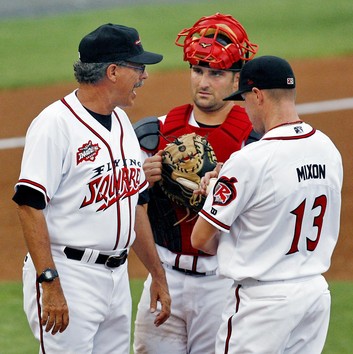 Tyler LaTorre: Catching is one of the funniest things I have ever done in my life. I love catching, blocking, calling a game, and winning baseball games. Nothing more satisfying than working as hard as I can for nine innings and getting that 27th out and walking out to the mound and shaking my teammates’ hands. However, I know the reality that there is only one catcher on the field at one time and there are prospects in this game that have to play. So ultimately whatever can get me in the lineup to help the team win is what I want.
MLB reports: If you had to look into a crystal ball, when do you see your expected time of arrival in the big leagues and what do you think you need to do most to get there?
Tyler LaTorre: I need a chance. I need someone or some team to take a chance on me and I need to show them they have made the right choice. I don’t have a timetable on when I will join the Giants. I wish it was tomorrow, but whenever that time may come or not come, I will always be ready to play and compete to the best of my abilities.
MLB reports: Has pro ball been everything you expected it to be thus far? What are some of the highs and lows you have experienced?
Tyler LaTorre: I didn’t really have many expectations. I am the type of person that takes things day by day and even pitch to pitch. I don’t worry about the past or future, I live in the right now and it has helped me stay focused my whole career. On the high side has to be my short season team in 2007 when we had the best winning percentage in all of baseball and won the Northwest League Championship. Also being a non-draftee, non-prospect in AAA right now competing at the level right below the big leagues is a pretty big high for me. On the low side, in 2007 I didn’t make a team out of my first spring training and was sent to extended spring staining in 110 degree Arizona. I honestly thought I wouldn’t make it out of there and was going to be released before I even had the opportunity to show my abilities. But I stay focused and dedicated to baseball and four years later I am in AAA and looking forward to each day and an opportunity to make the big league roster.
MLB reports: What do you do for fun when you are not playing baseball? Best friend(s) on the team that you most hang out with and what do you guys like to do to chill?
Tyler LaTorre: I love having a good time and laughing. Whether it is on the field, the plane/bus, or at our apartment in Fresno, I try to stay positive and have fun. I mostly hang out with Brett Pill, Jackson Williams, Brock Bond, and Brandon Crawford. We all have a great time together and play video games, go to the mall, Golf, whatever we can do to take our minds off playing this tough and grueling game called baseball. I would have retired from baseball a long time ago if I didn’t have such a fun group of friends in this game.
MLB reports: How has the Buster Posey injury affected the organization? Did it have a direct influence on your playing time in your opinion?
Tyler LaTorre: The injury hit me pretty hard. To see a friend in so much pain, made me sick to my stomach. I had to stop watching replays. Buster’s injury was tragic and put our minor league organization in a bit of chaos. We started moving catchers around, looking for trades, and signing free agent catchers. But it never got me more playing time, which was frustrating. The truth is that I haven’t really played that much this year. It doesn’t affect my drive though. I come to the field everyday expecting to be in the lineup and ready to help the team win.
MLB reports: A big thank you to Tyler LaTorre for joining us today on the Reports. We wish you the best of luck on your baseball journey and hope to see you playing for the Giants very soon. You have competed very hard to make it to this point in your baseball career and look for you to take the final step to the big leagues. We definitely encourage all our readers to feel free to contact Tyler with your comments and questions on his Twitter handle. Tyler is a must follow!

Please e-mail us at: MLBreports@gmail.com with any questions and feedback. You can follow us on Twitter and become a fan on Facebook . To subscribe to our website and have the daily Reports sent directly to your inbox , click here and follow the link at the top of our homepage.

E-MAILBAG: Ask the Reports, Wednesday August 17th
Thank you for reading the E-mailbag. Please send all your questions to mlbreports@gmail.com and please include your first name and City/Country.
We will be compiling a list of your questions from our e-mailbag and posting the responses on Wednesdays.
Wednesday August 17, 2011
Q: Watched the Tigers / Twins game today ( Aug 15th ) and was happy to see my fave player, Jim Thome hit 600. I consider him one of the best home run hitters of all time. My question to you: Thome has done most of his damage as a DH and on non playoff teams. What are his chances to make it to the Hall Of Fame and if he does go in, what hat do you think he will wear? From Larry, Nevada.
MLB reports: A great question Larry. I wouldn’t expect anything less from our #1 reader! Taking a look at Thome’s numbers, you may find a few surprises. Thome in his career has played 1102 games at 1B and 492 games at 3B. Thome did not become a full-time DH until 2006. Considering that he came up with Cleveland in 1991, I do not believe the DH role late in his career will affect him much, if any. The cloud of the steroid era may, as it seems that many big sluggers from Thome’s generation will have a difficult, if not impossible time getting into Cooperstown. But unlike Rafael Palmeiro, Barry Bonds and Mark McGwire, Thome is seen as one of the “clean” home run hitters of his generation. At 600+ home runs, a lifetime OBP over .400 and SLG over .550, I view Thome as a definite first ballot hall-of-famer. With 12 years and 334 home runs in Cleveland, I can guarantee you that Thome will go into Cooperstown as a member of your beloved Indians.
Q: Any insight on Wade Miley? From Joseph, Nashville.
 MLB reports: Great question, thank you Joseph. Wade was a 1st round pick of the Diamondbacks back in 2008 (43rd overall), after being drafted in the 20th round by Tampa Bay in 2005 and not signing. The 24-year old Miley is a 6’1″ left-handed starter in the Diamondbacks organization. Currently pitching in AAA after a recent promotion, Miley has a 3.64 ERA , to go along with a 4-1 record and 1.270 ERA. With this being his 4th season in the minors and showing steady development, it should come as no suprise that Miley got the call today as he has been promoted to the big leagues. With Jason Marquis on the DL, Miley may get a few spot starts for Arizona and at the very least, a spot in their pen the rest of the way. 2010 was a breakout season for Miley and despite some regression this year in AA, he has gotten better as the season has progressed. With the amount of pitching prospects in the Diamondbacks system, Miley will have a difficult time fighting for a rotation spot with the big club. Long-term I see him as trade bait for an organization that has room in its rotation for him or perhaps a bullpen role. He may yet develop into a solid #4 starter for the Diamondbacks, but at this point that remains to be seen. The future is still bright for Miley, but 2012 will be a big year for him in Arizona. We wish Miley the best of luck on his recent promotion, as he joins the first place Diamondbacks in the quest to win the NL West division this year.
Q: Sorry if I missed it, but have you done a report on the Angels CF, Peter Bourjos? That kid can fly? From Craig, Texas.
 MLB reports: I answered this one briefly on twitter but wanted to elaborate. I have received many questions on Bourjos this year, but have not filed a report on him to-date. It was a calculated decision, mostly due to the fact that not many fans have asked about him outside of Anaheim. Looking at the numbers, Bourjos is a steady, but not spectacular hitter for the Halos. .271 AVG, .328 OBP, .416 SLG, 5 home runs and 15 stolen bases. At this point, Bourjos is keeping a spot warm for future superstar Mike Trout. Originally a 10th round pick, the 24-year old Bourjos may blossom into a future superstar. But I have my doubts that will happen. Long-term I see Bourjos as a #4 outfielder on most teams, with the chance of becoming a good leadoff hitter if he can increase his on-base percentage. We will all continue to keep an eye on Bourjos, but be sure to keep expectations in check until a breakout occurs.
Q: Do you think that the Indians are going to get a RH bat? If so, who? And do you think they are going to win the Central? From Martin, Cleveland.
 MLB reports: Let the Indians theme continue! Many solid questions Martin, I take it that you are a big supporter of the tribe. One of the biggest surprises of the week was Delmon Young moving to the Twins to the Tigers. Probably one of the better right-handed bats was passed over by the Indians to their division rivals in Detroit. By passing Young over, my gut feel is that the Indians are likely done tweaking their lineup. With the additions of Kosuke Fukudome and Ubaldo Jimenez, the Indians will go with their current roster for the most part in battling for the AL Central crown. There is a chance that the team may add one more depth player, but I do not expect any real player of consequence at this stage. As far as the AL Central race goes, it is a 3-team race between the Tigers currently in 1st place, the Indians 3.0 games back and White Sox 3.5 games back. This one is too close to call. I will admit that I am very partial to the Tigers and like their chances at this point. While the Indians seemed to be a team of destiny at the start of the year, the Tigers look to be prime for a division title led by Justin Verlander. The Indians end the season going up against the Tigers in Detroit, while the White Sox face the Blue Jays in Chicago. The AL Central will come down to the final week, with my money on Detroit to take it all.
Q: Any news on Yu Darvish? Will we see him in North America next year? From Shane, Kansas.
MLB reports: Darvish is represented by an agent (Arn Tellem) and at 25-years of age would be a prime addition to any major league team. There has been a debate in baseball circles whether his Japanese club, the Nippon-Ham Fighters will post him, which really boils down to Darvish wanting to leave Japan to come to the major leagues. Despite mixed messages I have read in his interviews, it sounds like Darvish is ready to make the jump (and pocket the large paychecks that will follow). Expect Darvish to arrive in 2012, with at least 8-10 teams fighting for his services. The Yankees, Rangers, Red Sox, Blue Jays and many others will be fighting for his services. This one will simply boil down to which team is willing to pay the most and when Darvish is ready to make the change. As one of the best, if not the best pitchers not currently in North America, Yarvish should be an instant ace for the team lucky enough to land him. We will keep following this story and let you know as we have updates.

Thanks for the e-mails and keep them coming! mlbreports@gmail.com

E-MAILBAG ARCHIVE: Click here for the Archives of Ask the Reports
Please e-mail us at: MLBreports@gmail.com with any questions and feedback. You can follow us on Twitter and become a fan on Facebook . To subscribe to our website and have the daily Reports sent directly to your inbox , click here and follow the link at the top of our homepage.

Flashback: Steve “Bye Bye” Balboni Profile
Monday August 15, 2011
MLB reports: Today we are taking a walk down memory lane to revisit one of our favorite players of all time. Steve Balboni, or better known to baseball fans as “Bye Bye” Balboni, was one of the prominent home run hitters of the 1980s. Balboni was an all or nothing hitter, either launching home runs or striking out at a high clip throughout his career. In the likeness of Rob Deer at the time and Mark Reynolds today, Balboni was the type of hitter that we do not often see in the majors anymore. Always want fun to watch and having left us with memories of moon shots off his bat, today we look back at the career of Bye Bye Balboni.
Balboni played for four major league teams over his eleven MLB seasons: the Yankees, Royals, Mariners and Rangers. His power numbers over his career speak for themselves:
| Year | Tm | HR | RBI | BB | SO | BA | OBP | SLG |
|---|---|---|---|---|---|---|---|---|
| 1981 | NYY | 0 | 2 | 1 | 4 | .286 | .375 | .714 |
| 1982 | NYY | 2 | 4 | 6 | 34 | .187 | .228 | .280 |
| 1983 | NYY | 5 | 17 | 8 | 23 | .233 | .295 | .430 |
| 1984 | KCR | 28 | 77 | 45 | 139 | .244 | .320 | .498 |
| 1985 | KCR | 36 | 88 | 52 | 166 | .243 | .307 | .477 |
| 1986 | KCR | 29 | 88 | 43 | 146 | .229 | .286 | .451 |
| 1987 | KCR | 24 | 60 | 34 | 97 | .207 | .273 | .427 |
| 1988 | TOT | 23 | 66 | 24 | 87 | .235 | .277 | .448 |
| 1988 | KCR | 2 | 5 | 1 | 20 | .143 | .156 | .270 |
| 1988 | SEA | 21 | 61 | 23 | 67 | .251 | .298 | .480 |
| 1989 | NYY | 17 | 59 | 25 | 67 | .237 | .296 | .460 |
| 1990 | NYY | 17 | 34 | 35 | 91 | .192 | .291 | .406 |
| 1993 | TEX | 0 | 0 | 0 | 2 | .600 | .600 | .600 |
| 11 Seasons | 181 | 495 | 273 | 856 | .229 | .293 | .451 | |
| 162 Game Avg. | 31 | 84 | 46 | 144 | .229 | .293 | .451 | |
| KCR (5 yrs) | 119 | 318 | 175 | 568 | .230 | .294 | .459 | |
| NYY (5 yrs) | 41 | 116 | 75 | 219 | .214 | .286 | .415 | |
| TEX (1 yr) | 0 | 0 | 0 | 2 | .600 | .600 | .600 | |
| SEA (1 yr) | 21 | 61 | 23 | 67 | .251 | .298 | .480 | |
 One may have expected Balboni to have more than 181 career home runs over his career. Consider though that over his eleven seasons, Balboni only played one full season (1985). In the Royals World Series championship year, Balboni was at his peak. He had a career high 36 home runs, to go along with his league leading 166 strikeouts. Balboni only had 400 or more at-bats in four major league seasons. Despite only having one full season of at-bats under his belt, Balboni had six or more seasons for of 20+ home runs. But it was not the memory of the number of home runs or strikeouts that Balboni that has lasted with us. It was the way he came to the plate and swung completely for the fences.
When Bye Bye Balboni connected for home runs, the sound of the ball launching off his bat was a thing of beauty. At 6’3″ and 225 lbs, Balboni was built like a tank. The bat looked like a toothpick in his hands and when he saw a fastball that was to his liking, the ball was either going to end up out of the yard or in the catcher’s mitt. A fan favorite wherever he played, Balboni was the picturesque cleanup hitter of the 80s. With a career .229 AVG and .293 OBP, Balboni was not a “moneyball” type player by a stretch of the imagination. But the 80s were a different time in baseball and Balboni fit the mold in his day. The power hitting first baseman/DH. A one-dimensional player (home runs and strikeouts), but a great deal of fun to watch for the fans.
Today’s game is built on young, athletic players with multiple-tools. As we have left the steroid era, MLB teams are shifting towards teams built on strong pitching, defense and speed. The 1B/DH types like David Ortiz and Travis Hafner are starting to disappear, as American League teams shift to using the designated hitter spot to rotate players rather than employing a full-time DH. As a result, we are unlikely to see many more Bye Bye Balboni’s in the major leagues again. Valentino Pascucci was the closest player that I could think of that resembled a modern-day Balboni. But in today’s game, Pascucci has barely received a cup of coffee at the majors, while Balboni enjoyed eleven seasons in the big leagues.
Bye Bye Balboni got to live the major league dream. He was a second round pick of the Yankees in 1978 and played five seasons in New York. Balboni was also quite a legend in his day in the minor leagues, assembling 239 career minor league home runs, together with 930 strike outs. Balboni was named MVP of the Florida State League in 1979 and 1980 in the Southern League. Today, Bye Bye Balboni continues his career as a coach, with different organizations in the minors. You can learn more about Steve Balboni by visiting his website, http://stevebalboni.com.
One of the players of his generation that will stick out in our minds forever, we thank Bye Bye Balboni for the home runs he hit and the excitement he brought to the game during every one of his at-bats. While the game has evolved to new levels, there is a part of us that will miss the burly sluggers in the game in the Bye Bye Balboni mold that are no longer with us. Thank you for the memories Steve and for the home runs!
If you have a favorite Steve Balboni moment or story, we would love to hear from you. Please leave your comments at the bottom of this article.

Please e-mail us at: MLBreports@gmail.com with any questions and feedback. You can follow us on Twitter and become a fan on Facebook . To subscribe to our website and have the daily Reports sent directly to your inbox , click here and follow the link at the top of our homepage.

Logan Morrison sent to AAA New Orleans: Marlins and Loria Censor LoMo
Sunday August 14, 2011

MLB reports: The Florida Marlins have one of the brightest prospects in the game in its system. Logan Morrison, the 23-year old first baseman/outfielder is seen as one of the next up-and-coming stars. I have compared him on many occasions to Will Clark and Mark Grace for his outstanding eye at the plate and smooth swing. Blocked at first base by incumbent Gaby Sanchez, Logan (“LoMo”) Morrison has transitioned himself into a fairly steady outfielder. Yet despite being one of the Marlins best offensive players and team leaders, LoMo finds himself headed to AAA as of last night.
At 56-62, 13.5 GB behind the 1st place Phillies, 2011 has been a lost season for the Marlins. Now is the time for the team to play its younger players, to get their feet wet and ready for next season. Further the Marlins are opening up their new stadium in 2012 and need to build hype and excitement in selling future tickets. With the team in last place, one would expect the Marlins to promote and push its best prospects and young players in selling the team to its fan base. But rather than encourage its players to promote the team and connect with the fans, the Marlins and its owner Jeffrey Loria have demoted LoMo to the minors. A big part of the reason is the social media known as Twitter.
For those of you not familiar or not active on Twitter, you may not know Logan Morrison is an active tweeter. Using the handle @LoMoMarlins, LoMo is one of the most popular athletes on the site and is often found speaking and joking with fans. In an age where athletes are either completely disconnected from fans or getting into hot water by being arrested/making inappropriate statements, LoMo is refreshing. Morrison is a clean-cut athlete who is outgoing and fun. I could not put specific numbers for you today, but I am sure that Morrison is singlehandedly responsible for building thousands of loyal Marlins followers, just based on his tweets. At 6’3″, 235 lbs, Morrison has the looks and ability to be the face of the Marlins. With the new stadium set to open up, I would expect the Marlins to promote the team around Morrison. Rather the team has alienated one of its top talents and in the process, angered the fan base it should be reaching out to.
For background, the process of sending down LoMo is further upsetting based on how much he gives back to the Marlins. He worked hard to learn a new position and become an above average outfielder. He plays hurt. He trains hard. LoMo is also active in the community giving countless hours back in charity work. Not that it should factor in his role on the team, but LoMo also lost his father to cancer in December 2010. As father and son were very close, the loss of dad was obviously very hard for the young man to overcome. I was very impressed that LoMo was able to go back on twitter and continue with his life in baseball, proving that he has a strong will and bigger heart. Being active in the support of fighting cancer and volunteering his time, LoMo has a true heart of gold. For the average superstar that collects a paycheque and goes home, LoMo stands above. The Marlins are lucky to have him and need to embrace his heart and passion rather than censoring him.
There is more to the LoMo demotion than meets the eye. There is always more to the story behind the scenes, likely more than we realize. Morrison was very critical of his teammate Hanley Ramirez, which the team did not appreciate. Although Hanley has been criticized for his lack of hustle and selfishness at times, Morrison was reprimanded by the team for speaking out. I was actually impressed that Morrison was acting as a team leader and making his teammates accountable to the team first and foremost. Then a recent story came out about Morrison not appearing at a team function and the team once again disciplining him. But as background, Morrison is very active in the community and making appearances for the Marlins. Apparently the team dropped the ball in organizing a function, which dissapointed Morrison to the point that he spoke out on the next function. Considering how much time Morrison gives, I do not believe the team is in a position to say that he did not make himself available. If anything, Morrison makes himself too much available and it appears the Marlins are taking him for granted.
Then there are the stats. LoMo was batting .249 at the time of demotion and the team indicated that he needed time to work on his game. Considering that LoMo has a .327 OBP, .464 SLG, 17 home runs and 60 RBIs, I cannot say that based on the numbers LoMo deserved to be sent down. The best place for LoMo to learn is at the majors and the Marlins need to help him get to the next level, not hurt him. But these types of actions are nothing new for team owner Jeffrey Loria. Ex-Manager Joe Girardi was let go due to personality conflicts with Loria. All Girardi did was join the Yankees and win a World Series title. Did I mention that Girardi was named 2006 NL Manager of the Year, weeks after being fired by Loria? Disgraceful in my opinion. A team owner should be on the sidelines letting his or her baseball people run a team. When an owner becomes bigger than their team, it is a problem. Loria loves the spotlight and being the centre of attention. As LoMo becomes a big star and most popular player on the team, the LoMo demotion smells more like a power play than a baseball move. It is not right and should not be acceptable in today’s MLB.
 Carlos Zambrano walked out on his team the other day, cleaned out his locker and threatened retirement. The player’s association has filed a grievance on his behalf. Perhaps a grievance should now be filed on behalf of LoMo. Major League Baseball needs to take action to protect a player like Logan Morrison who is hindered and unnecessarily punished by a team. If such an action could be taken, baseball would actually be saving Loria from himself. The longer LoMo is in the minors, the more likely he is to rebel and feel even more alienated from his team. For a baseball club in desperate need of fans and moving to its new stadium, the timing of this demotion could not have come at a worse time. Considering how much baseball has helped Loria over the years (purchase and sale of Expos, purchase of Marlins and subsequent new stadium), Loria has an obligation to manage the Marlins in a manner that is most conducive to make the team productive and competitive. The LoMo demotion may be argued by the team to be based on production. At the end of the day, this demotion is a power play and that just plain stinks.

Please e-mail us at: MLBreports@gmail.com with any questions and feedback. You can follow us on Twitter and become a fan on Facebook . To subscribe to our website and have the daily Reports sent directly to your inbox , click here and follow the link at the top of our homepage.

Will the Diamondbacks Win the NL West in 2011?
Saturday August 13, 2011
MLB reports: With the playoffs just around the corner, it is time to slowly predict which teams will be making the cut in advancing to this year’s playoffs. One of the closest races is in the NL West, where the Arizona Diamondbacks and San Francisco Giants are going head-to-head in fighting for the division title. When the dust settles come October, we expect to see Arizona overtake the defending World Series champions and advancing to the playoffs.
The Diamondbacks with a 66-53 record are currently sitting two games ahead of the Giants in the standings. On a four-game winning streak and a 6-4 record in their last 10, the Diamondbacks have been fairly hot since the All-Star break. The Giants are headed in the opposite direction, currently on a two-game losing streak and a 3-7 record in their last 10. When looking at the overall compositions of the team, I believe the Diamondbacks are better constructed to make the playoffs.
Last year the Giants were successful in winning the World Series almost exclusively built on pitching. To be a playoff contender however, there usually needs to be a balance of both offense and pitching strengths on a ballclub. Taking a look at the Diamondbacks roster, I see that required balanced. The starting rotation is led by their big three, Ian Kennedy, Daniel Hudson and Joe Saunders. The bullpen has closer J.J. Putz and setup men, David Hernandez and Brad Ziegler. On offense, Miguel Montero, Paul Goldschmidt, Justin Upton, Kelly Johnson and Chris Young lead the way. Not a complete all-star team like the Yankees, but the Diamondbacks appear to have the best mix of components to take the NL West. In comparison, the San Francisco Giants appear to fall far short.
The Giants as usual have some of the best starting pitching in baseball this year. Tim Lincecum, Matt Cain and Madison Bumgarner are as solid as they come. Now add into the mix Ryan Vogelsong, Brian Wilson and the rest of the Giants bullpen and you have almost enough pitching to singlehandedly lead the team to the playoffs. Almost, but not quite in my estimation. While the Giants proved last year that offense alone can win a World Series, I do not see that happening again this year. Not with that offense. With team leader Buster Posey out for the year and new acquisition Carlos Beltran on the shelf, the Giants will not be able to score enough runs to over take the Diamondbacks. Pablo Sandoval cannot do it on his own and Aubrey Huff, Orlando Cabrera and the rest of the Giants batters simply can’t cut it. The Giants will be able to stay close in ballgames, but the reality is that runs are needed to win the necessary games to make it to the playoffs. While 2010 was a dream season, 2011 will now be a return to reality.
Much credit needs to be given to Kirk Gibson and his staff for turning a young and up-and-coming team and turn them into contenders almost overnight. While Gibson has made the right moves on the field, GM Kevin Towers has been the lightening rod behind the scenes. Strengthening the bullpen and beefing up the rotation with a mix of veterans and blossoming prospects has been the key for the team. Having their young hitters turn the page like Justin Upton and Miguel Montero to take the next step has been the turning point. If you compare the Giants and Diamondbacks just based on pitching, then San Francisco has the edge. But considering that the Diamondbacks can score runs and the Giants have one of the worst offenses in baseball, I see Arizona having the advantage. Giants fans should feel no shame, as the glory of their championship from last year will shine bright for many years to come. But until the team can find a stronger and balanced offense in its lineup, in the short-term the team has too many shortcomings on offense to overcome. As a result, expect Arizona back to the playoffs this year. As the Giants were a team of destiny last year, the Diamondbacks are the same team of destiny to win the NL West in 2011.

Please e-mail us at: MLBreports@gmail.com with any questions and feedback. You can follow us on Twitter and become a fan on Facebook . To subscribe to our website and have the daily Reports sent directly to your inbox , click here and follow the link at the top of our homepage.

Interview with Toronto Blue Jays Prospect and 2010 Draftee: Art Charles
Thursday August 11, 2011
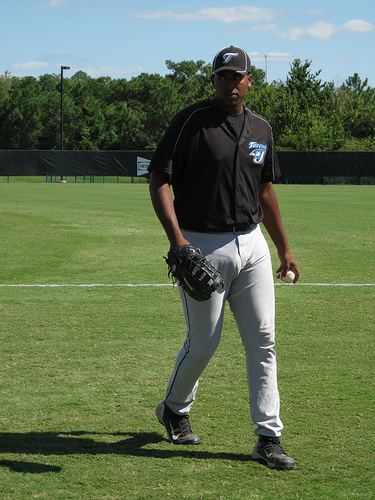
MLB reports: Today on the Reports we are proud to feature Blue Jays prospect first baseman, Arthur Charles. The 20-year old Charles was drafted by the Jays in the 20th round of the 2010 draft. After being selected by the Orioles in 2008 and the Royals in 2009, Charles signed with Toronto and started his baseball journey last year.
At 6’6″ and weighing a solid 221 lbs, Charles projects to flash a great deal of power at the first base position for the Jays. Currently playing for Bluefield in the Appalachian League, Charles has hit 10 home runs in 49 games, with an impressive .813 OPS. Art is one of the most charistmatic players that we have interviewed on the Reports. We can see him quickly becoming a fan favorite one day in Toronto. A name to keep an eye on in the Blue Jays organization, the Reports is proud to present our interview with Arthur (Art) Charles:
MLB reports: Welcome to the Reports Art. Looking to the past, who was your favorite baseball player growing up, that you most idolized and patterned your game after?
Art Charles: My favorite baseball players growing up would have to be Ken Griffey Jr. and Barry Bonds. These two sluggers were my idols and in whom I modified my game after. Griffey instantly stood out to me because I liked his swing and tried to modify mine to look like his. His swing was just so pure, smooth, and simple. Barry Bonds was the same way I loved his swing and how he hit so many home runs. I used to tell my friends that I would break his home run record and that one day I would be “that guy” in the big leagues hitting bombs and lasers everywhere in front of the world.
MLB reports: Great choices in Bonds and Griffey. We have seen Griffey in particular as a popular choice amond players. On the flipside, which current MLB star do you most admire and why?
 Art Charles: The current MLB player that I admire the most right now is Adrian Gonzalez. I enjoy watching Adrian Gonzalez a lot because he is not only a very good hitter for the Red Sox, but he is a great defensive player as well. His game is something that I now watch very closely for that reason. I would like to be that kind of player, an all around player. I want to be known as a threat and someone who will not only hit for power and average, but someone who has a golden glove at first base making plays and helping his team win on both sides, offensively and defensively.
MLB reports: Reflecting on your career to-date, what are your proudest accomplishments on the baseball field?
Art Charles: My proudest accomplishment of my professional career would have to be hitting a walk-off home run to against the Bristol White Sox this year. This moment isn’t just big for me because I hit the game winning home run ,but because there was a lesson to learn from it. In the top of that inning we were tied and one of the Sox’s players hit a ground ball to me that I made an error on, to give them the go ahead run. I was VERY disappointed, but I knew there was a chance that I would be up in the bottom half of the inning. Although I was heated, I told myself I was going to get up when my team needed me and I was not going to let them down again. I was going to win the game for us. Staying focused and visualizing my at bat, mixed with a little anger, had gotten me mentally prepared for the moment. It was a full count with two runners on and two outs, the kind of moment that you imagine when you are young. I then saw a good pitch and didn’t miss it. Instantly I knew I had just hit the game winning home run and met with my teammates at home plate to celebrate. I even had the shaving cream pie treatment and that made it one of, if not the most, memorable moments of my life.
MLB reports: A great experience Art. Thank you for sharing it with us! Reflecting back, what were your goals going into the 2011 season?
 Art Charles: My goals going into this season were to have quality at bats, hit balls hard where ever they might go, make plays on defense, do my part to help my team win, improve my game for the next level (offensively and defensively), get a promotion to one of our other teams, be a threat every time I step to the plate, work hard at everything I do, and be consistent on a daily basis. I knew that if I did all of those things, that the rest would take care of itself. Meaning home runs, RBI’s, doubles, and making plays in the field would come. I just wanted to make sure I took care of my business and controlled what I could control and let the rest fall into place.
MLB reports: When you first found out you were drafted, what were your reactions? Did those reactions change over time? What was the process like being drafted originally by the Orioles in 2008 and Royals in 2009 and not signing with either team? What made you decide to finally sign with the Jays in 2010?
Art Charles: When being drafted I was beyond excited. Being drafted three times by three different teams is not only an honor and an accomplishment, but also a very exciting and blessed process. Every time I was drafted I was very happy. The process of these drafts was very similar. When I was first drafted in 2008 to the Orioles I was still young, at 17, and needed to mature more and really prepare myself; not ready to make that move. In 2009 I was taken again to the Royals, but still the timing and things didn’t work out. Going into the 2010 season I knew this was the year that I was ready to become a professional ball player and in the 2010 draft the Jays picked me up. I felt this was a good fit for me and I was very comfortable with the scouts and staff I had met in the pre-draft workouts so I knew this was home.
MLB reports: What do you consider your greatest baseball skill(s)?
Art Charles: I consider my greatest baseball skill to be hitting the baseball with power to all parts of the field. I feel that hitting baseballs for power to all fields is what separates me from lots of other players, and its something that I will continue to do and get better at doing.
MLB reports: What facets of your game do you most wish to improve upon?
Art Charles: The parts of my game that I wish to improve on are every part of my game. I feel I need to get better offensively and defensively if I am going to be the all around player that I wish to become. Nothing in life comes easy and I learned that at a young age. So I will continually work hard to better myself and separate myself from others. To be the best I have to be, in fact better than the best. So my speed, agility, offense, and defense all have to improve.
MLB reports: How do strikeouts and walks figure into your game? Do you see any of these items changing over time and to what degree?
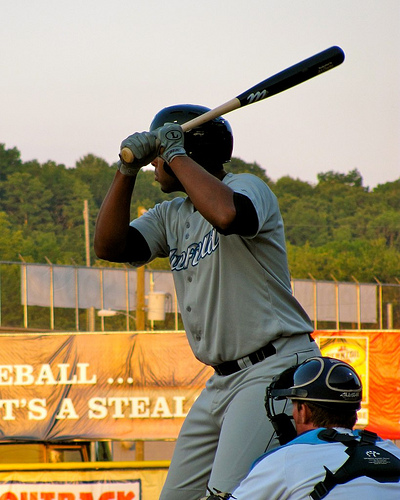 Art Charles: Strikeouts and walks are going to come. They are both part of the game. So far this season I have struck out more than I would have liked to, but that’s part of my learning process as a player. With those strike outs I have learned about how I might be pitched in counts, to be patient and get good pitches to drive, to see pitches up, and much more. It’s all part of the process that everyone goes through to get to the big leagues. Walks are also going to occur and that will be because I’m not chasing pitches, I’m being patient, and seeing the ball up. It’s easier said than done, but like I said it’s part of the process.
MLB reports: Long term what position do you see yourself playing? How do you see defense as part of your overall game?
Art Charles: Long term I see myself in the big leagues as a power hitting first baseman. I feel defense is just as important as hitting. I work on the both of them a lot because I know that if I want to become the player I envision myself becoming, I need to be good around the bag, pick up my teammates, and make plays. I feel that I am still improving defensively and will continue to get better. Defense is definitely part of my game I want polish.
MLB reports: If you had to look into a crystal ball, when do you see your expected time of arrival in the big leagues and what do you think you need to do most to get there?
Art Charles: If I could look into a crystal ball and see my expected time in the big leagues, I don’t know yet what I would see. I would like to be there within three years, but I am young and have a lot to work on and lots of improving to do. So I do not know at this moment what my expected time would be. There isn’t really one thing in particular to say I would need most to get there because to get to the highest level, you need it all.
MLB reports: Has pro ball been everything you expected it to be thus far? What are some of the highs and lows you have experienced thus far?
Art Charles: Pro ball has been everything I expected it to be and more. I can’t say there are any lows because I love what I do and I haven’t had any really long bus rides yet. But there are plenty of highs. One being which seeing myself improve as a player. There are many experiences playing that I have now, such as walk off wins, playoff pushes, fans, signing balls and playing for great skippers. Did I say the fans? I would have to say that one of my favorite things was having a little boy write me a letter thanking me for a handshake and telling me I was his favorite player. The fans are what make this game that much more fun and signing balls, bats, cards, and shirts was a great experience for me.
MLB reports: What do you do for fun when you are not playing baseball? Best friend(s) on the team that you most hang out with and what do you guys like to do to chill?
Art Charles: On a day off or after the game I like to lay down and relax to recharge my batteries a bit, listen to music, vibe out, stay up on my tweet game (@SirArthurC), talk to my family, and play Call of Duty (a favorite among players). Sometimes the guys will come to my room and we play video games or go to the mall. I have tons of movies so we watch movies, or play cards. The guys that you will probably catch me with the most are Aaron Sanchez, Christopher Hawkins, Cody Bartlett, Myles Jaye, Les Williams, or Noah Syndergaard.
MLB reports: Have you visited Toronto the city yet? How have you found the city thus far?
Art Charles: I have been to Toronto for a pre-draft workout in the Rogers Centre last year and it was a lovely place. I really enjoyed my brief stay, very nice city and even better people. The Rogers Centre was great and an unbelievable stadium.
MLB reports: If you could send one message to the Toronto Blue Jays fans, what would it be?
Art Charles: My message to the fans would be thank you for the love and support. It is very much appreciated and not forgotten. You guys are the best!
MLB reports: A big thank you to Art Charles for joining us today on the Reports. We wish you the best of luck on your baseball journey towards joining the Jays in Toronto one day. We definitely encourage all our readers to feel free to contact Art with your comments and questions on his Twitter handle. Art is very active on Twitter and is a must follow!
Please e-mail us at: MLBreports@gmail.com with any questions and feedback. You can follow us on Twitter and become a fan on Facebook . To subscribe to our website and have the daily Reports sent directly to your inbox , click here and follow the link at the top of our homepage.

E-MAILBAG: Ask the Reports, Wednesday August 10th
Thank you for reading the E-mailbag. Please send all your questions to mlbreports@gmail.com and please include your first name and City/Country.
We will be compiling a list of your questions from our e-mailbag and posting the responses on Wednesdays.
Wednesday August 10, 2011
Q: Once Anthony Rendon signs with the Nationals, do you see him moving to 2B? What’s your best guess? From Flips, parts unknown.
MLB reports: The Rice product, drafted 6th overall by the Nationals this year is likely to sign with the Nationals by the August 15th deadline. In the unlikely event that he does not sign, then the Nationals would get a compensation pick next draft. But luckily for Washington, Rendon is expected to join the club this year. With Ryan Zimmerman entrenched at 3rd base, many people have speculated at which position Rendon will end up. I have heard 2nd base tossed around, but the smart money is 1st base. Adam La Roche is a temporary solution for the squad and not the long-term answer. The Nationals appear to be set up the middle with Danny Espinosa and Ian Desmond. Rendon’s bat has never been a question. To get him quickly into the lineup, expect the Nationals to move him to 1st base right away after being signed. The outfield is another option, but more of a last resort.
Q: Will this be the year that the Texas Rangers win the World Series? From Anne, Dallas.
 MLB reports: If the Rangers had been able to sign Cliff Lee, my answer would have been yes. But they did not and the Halladay-Lee combination will lead the Phillies to victory in the fall in my opinion. Don’t get me wrong, the Rangers have an excellent team. An offense led by Josh Hamilton, Nelson Cruz, Ian Kinsler, Michael Young and company. C.J. Wilson as the ace. The bullpen trio of Neftali Feliz, Mike Adams and Koji Uehara. The Rangers can do it all. But firstly, just to make it to the World Series the Rangers will need to pass the Yankees and Red Sox. Even then, the Phillies if they end up as their opponent will be tough to beat. The Phillies have a solid offense core of Ryan Howard, Chase Utley and Hunter Pence. The bullpen has been steady, led by closer Ryan Madson. But it is the starting pitching that will see the Phillies through. With all the roadblocks in the Rangers path, I see them as a strong contender but not necessarily the favorites to win the World Series this year.
Q: Why is it legal to bulldoze a catcher when he clearly has the ball, but not a fielder at any other base? From G Homan, Ohio.
 MLB reports: You will have to check the rule book on this one. It is just as legal to take out a catcher as it is an infielder during play, but it depends on the nature of the play. A baserunner cannot run outside of the baselines to purposely run over an infielder or a catcher. But in the course of running the bases, runners can collide with an infielder as they would a catcher. Now the runners cannot purposely injure a defensive player, like using the spikes or an elbow to the face. But to reach base safely, a strong slide or collision is a part of the game and can happen at second base the same way it can at home. Despite cries to change the rules after the Buster Posey injury, strong and aggressive base running remains a vital part of the game.
Q: Will the Phillies get an arm for their bullpen through waivers? From Miguel, Philadelphia.
 MLB reports: Last time I checked, your team was stacked fairly well at the back-end of their pitching staff. Ryan Madson as closer. Brad Lidge, Antonio Bastardo, Jose Contreras (when healthy) and Kyle Kendrick. I wouldn’t be too worried about the pen. Some people are calling for Heath Bell still to go to the Phillies. But with the waiver process in effect, I can’t see Bell falling to the Phillies before getting snapped up earlier on waivers. Another arm or two might out there, but nothing too special. The Phillies most likely go with what they got and that is still much above most other pens in baseball.
Q: If you look at the numbers, you will find out that Indianapolis, IN and San Antonio, TX are the most populous cities without a MLB team. I would think size of market would drive who gets the next teams. It is obvious that MLB is financially doing really well. I would keep two leagues, and give the expansion teams to the AL, since they are the league with only 14 teams.
American League:
West Midwest East Atlantic
LA Angels Rangers Indianapolis Yankees
Oakland A’s KC Royals Tigers Red Sox
San Antonio Twins Indians Orioles
Mariners White Sox Rays Blue Jays
National League:
West Midwest East Atlantic
Dodgers Colorado Rockies Chicago Cubs NY Mets
Padres Houston Astros Cincinnati Reds Phil Phillies
Giants St. Louis Cardinals Atlanta Braves Florida Marlins
Dbacks Brewers Pitt Pirates Wash Nationals
I tried to used a US map,and place teams in divisions according to how the line up East and West. From Tom, Orange CA.
MLB reports: Very interesting alignment Tom. Indianapolis and San Antonio have been two very popular destinations for our readers in selecting the next two expansion MLB cities. There has been resistance by Bud Selig to further expand baseball. However, as discussed in our previous articles on the subject, baseball needs to add two more teams to balance out the leagues to 16-teams a piece. Also realignment is in order to create better geographical rivalries and even out the number of teams per division. So far, the most that we have heard is that baseball is planning to realign by moving one NL team to the AL by 2013 (as the 2012 regular season schedule has already been prepared in draft format). The problem with the 15/15 split is that an interleague game would need to be played most days, which does not seem like a worthwhile proposition. Houston by most accounts is the team most likely to move. So while we appreciate your thoughts, the expansion and radical realignment ideas are unlikely to happen… yet. If and when they do, we would like to see more shifting of teams to create new excitement and rivalries in baseball. But the framework you have laid down is a very good start. Thank you for sending it in.

Thanks for the e-mails and keep them coming! mlbreports@gmail.com
E-MAILBAG ARCHIVE: Click here for the Archives of Ask the Reports
Please e-mail us at: MLBreports@gmail.com with any questions and feedback. You can follow us on Twitter and become a fan on Facebook . To subscribe to our website and have the daily Reports sent directly to your inbox , click here and follow the link at the top of our homepage.

August 15th Deadline to Sign MLB Draft Picks: 1 Week Away
Monday August 8, 2011
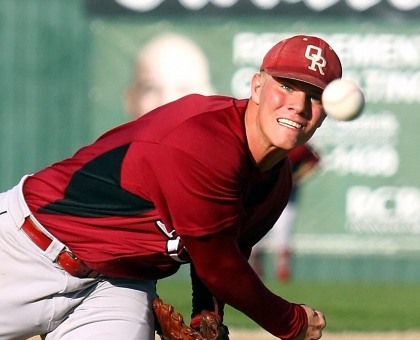
MLB reports: A popular topic on the Reports is the annual MLB Draft. Readers love to learn about baseball prospects and future stars. On June 6th, we summarized the first-round MLB selections and analyzed each player as selected by their respective club. With the excitement of the draft still in the air, the August 15th deadline to sign each drafted player is only 1 week away.
A quick recap of the draft rules for everyone. Players that were drafted by MLB teams this year must sign with their respective club by August 15th. If unsigned, the player will enter next year’s draft if eligible. In order to re-select the same player in a subsequent year, the team would need the permission of the previously drafted player.
 Another twist to the draft is that if a team is not successful in signing a pick by August 15th, the team would receive a compensation pick in the following year’s draft. For a player drafted in the first or second round that goes unsigned, the team would receive the same slot pick the following year as compensation plus one. For a player not signed in the third round, a compensation pick would be given in a supplemental round between the third and fourth rounds. So for example, the National drafted Aaron Crow with the 9th overall pick, 1st round of the 2008 MLB draft. When Crow did not sign, the National received as compensation the 10th overall pick in the 2009 draft, used to draft current closer Drew Storen, in addition to their existing 1st round pick (1st overall, which was used to take phenom Stephen Strasburg). However, if a team is unable to sign the player taken with a compensatory pick, the team would not receive another compensation pick in following years. Thus a team gets one chance to make-up a pick, so they better be sure they draft a signable player.
The story of signing MLB draft picks does not usually boil down to who signed, but rather who did not sign. Draftees usually wait to the final hour to sign their contracts, minutes to the midnight deadline. Sizeable contracts are handed out at the deadline, as players and agents attempt to one-up one another. With the current MLB collective bargaining agreement set to expire on December 11, 2011, players and agents realize that future rookie contracts may be limited in a hard-cap, set-salary structure arrangement. Thus many players would be well advised to sign their first professional contracts this year, rather than face the risk of the unknown future salary structure of rookies.
The biggest contract given to a 1st round pick this year so far has been Trevor Bauer, who signed a 4-year, $7 million contract with the Diamondbacks. Other 2011 1st round picks to sign contracts already include Cory Spangenberg with the Padres, C.J. Cron with the Angels, Sonny Gray with the Athletics, Kolten Wong with the Cardinals, Sean Gilmarten with the Braves, Joe Panik with the Giants, Jake Hager with the Rays and Kevin Matthews with the Rangers. To keep up-to-date on the 2011 1st round and supplemental MLB Draft picks signings, please click onto MLB Trade Rumors, a great baseball site that is maintaining a draft pick signing page.
As August 15th continues to approach, fans will continue to ask if and when the Pirates will sign Gerrit Cole, the 1st overall selection in this year’s draft. Dylan Bundy of the Orioles, Bubba Starling of the Royals, Anthony Rendon of the Nationals and so forth also remain out there. For all the anxious people worrying as to which players will sign, let us help alleviate your concerns. The majority of the top picks will sign with their squads before the deadline and will get good contracts. We will continue to cover the signing deadline and file a report when the final numbers are in. The signing period is like a game of musical chairs with a great deal of money being thrown around with pre-arranged partners. It will be interesting to see which draft picks are left standing without a contract in hand when the bell strikes midnight next week.
Please e-mail us at: MLBreports@gmail.com with any questions and feedback. You can follow us on Twitter and become a fan on Facebook . To subscribe to our website and have the daily Reports sent directly to your inbox , click here and follow the link at the top of our homepage.

Remembering Hideki Irabu: Japanese MLB Pitcher and Link to Donnie Moore
Sunday August 7, 2011
MLB reports: Hideki Irabu was born on May 5, 1969 in Hirara, Okinawa. Irabu played in Japan (Nippon Professional Baseball) from 1988-1996 and then again from 2003-2004. In North America, we will most remember Irabu as a member of the New York Yankees from 1997-1999. Irabu also played with the Montreal Expos from 2000-2001 and the Texas Rangers in 2002. The baseball world sadly lost Hideki Irabu on July 27, 2011, an apparent victim of suicide. A loss to the baseball world at the tender age of 42, Irabu was survived by a wife and two young children.
 The story of Hideki Irabu is well-known in the baseball community. He had his contract purchased by the San Diego Padres from his Japanese club, the Chiba Lotte Marines. Irabu refused to sign with the San Diego Padres and stated his intention of only playing for the New York Yankees. The Yankees were able to swing a deal for Irabu’s services, for a package of players including Ruben Rivera and cash. Hideki Irabu ended up making his debut with the Yankees on July 10, 1997 and for his career pitched in 74 games for the Yankees over 3 seasons (64 starts). Irabu won back-to-back World Series rings in New York in 1998 and 1999. He was then traded to the Montreal Expos for Ted Lilly, Jake Westbrook and Christian Parker. A good haul for the Yankees considering the career spans of Lilly and Westbrook (had they stayed in New York). Irabu then signed with the Texas Rangers as a free agent and played out his last MLB season as a closer before returning to Japan to resume his NPB career. After a stint in independent baseball, Irabu apparently had the intention of returning to Major League Baseball, but alas a comeback was not in the cards. Reports have indicated that Irabu hung himself in his California home, with autopsy results to follow. Today we look at the career of Hideki Irabu and the road that led to his untimely passing this year.
When joining the New York Yankees in 1997, Hideki Irabu was labelled the “Japanese Nolan Ryan”. By the time he left New York, he was stuck with the moniker given to him by team owner George Steinbrenner “the fat toad”. Looking at Irabu’s MLB numbers, he unfortunately fell short of the Nolan Ryan comparisons:
| Year | Tm | W | L | ERA | SV | BB | SO | WHIP |
|---|---|---|---|---|---|---|---|---|
| 1997 | NYY | 5 | 4 | 7.09 | 0 | 20 | 56 | 1.669 |
| 1998 | NYY | 13 | 9 | 4.06 | 0 | 76 | 126 | 1.295 |
| 1999 | NYY | 11 | 7 | 4.84 | 0 | 46 | 133 | 1.335 |
| 2000 | MON | 2 | 5 | 7.24 | 0 | 14 | 42 | 1.665 |
| 2001 | MON | 0 | 2 | 4.86 | 0 | 3 | 18 | 1.500 |
| 2002 | TEX | 3 | 8 | 5.74 | 16 | 16 | 30 | 1.426 |
| 6 Seasons | 34 | 35 | 5.15 | 16 | 175 | 405 | 1.405 | |
| 162 Game Avg. | 11 | 12 | 5.15 | 5 | 58 | 134 | 1.405 | |
| NYY (3 yrs) | 29 | 20 | 4.80 | 0 | 142 | 315 | 1.362 | |
| MON (2 yrs) | 2 | 7 | 6.69 | 0 | 17 | 60 | 1.626 | |
| TEX (1 yr) | 3 | 8 | 5.74 | 16 | 16 | 30 | 1.426 | |
| AL (4 yrs) | 32 | 28 | 4.90 | 16 | 158 | 345 | 1.369 | |
| NL (2 yrs) | 2 | 7 | 6.69 | 0 | 17 | 60 | 1.626 | |
Injuries played a part in Irabu’s MLB career. Irabu had both knee and shoulder surgeries after leaving the Yankees and blood clots ultimately led to his retirement from Major League Baseball following the 2002 season. Bouts of heavy drinking, depression and rage also factored into Irabu’s career. But despite all the distractions and factors that led to his unravelling in baseball, Irabu did show some glimpses of promise. In addition to the two world series titles he earned in New York (despite playing in only one career post season game in 1999, giving up 7 ER in 4.2 IP to the Red Sox in the ALCS), Irabu had his best numbers during his time with the Yankees. He earned both of his career shutouts in New York. His best statistical season was 1998, where he went 13-9 for the Yankees, with a 4.06 ERA and 1.295 WHIP. As a closer for the Rangers in 2002, Irabu earned 16 saves. That unfortunately went together with a 3-8 record, 5.74 ERA and 1.426 WHIP. For a proud young man who fought hard on and off the field, his major league career was taken from him much too early. Despite attempts at a comeback, we never did see Hideki Irabu in a MLB uniform again after the 2002 season.
 In our society, it is much too easy to write off the passing of another human being, especially a celebrity, without considering the person behind the name. Granted Irabu faced many demons in his life and career. But I think some people feel the need to label a player like Irabu an alcoholic and rageaholic and simply write him off when learning of his passing. That is a tragedy in my estimation. When I learned of Irabu’s passing, my immediate thoughts led to Donnie Moore. For those of you not familiar, Moore was the Angels pitcher that gave up the tying and winning runs to the Red Sox in game five of the 1986 ALCS. Many critics pointed to Moore as the reason that the Red Sox ended up beating the Angels and advancing to the World Series. Moore was a popular target of Angels fans the following seasons and ended up shooting his wife and taking his own life. A tragic story in itself, Moore like Irabu suffered from deep depression. But without analyzing and comparing both men too much, I believe that it was the name calling and the reputations of each men that contributed greatly to their respective passings. Victories and failures take place on baseball diamonds each and every day. Moore in the playoffs and Irabu in New York, suffered their failures on some of the biggest baseball stages that you can find. Had their losses been forgotten and each man allowed to continue fresh, they may have enjoyed longer and productive careers in baseball. They may have also been able to enjoy their personal lives to a greater extent and still been with us today. But the stigma of failure which was likely reminded to Moore and Irabu for most of their last days on this earth, was likely too much for each to bear.
Hideki Irabu, being of Japanese descent, was a very proud man. Respect and reputation are considered very important in Japanese circles and criticism is often not taken very well. Irabu, like Ichiro Suzuki after him, had a lifelong battle with the Japanese media. Being of mixed descent, Irabu rarely discussed his background which was a difficult subject for him. Before coming to North America, the Japanese media labelled him with very strong nicknames, including the “Shuwozenegga” and “Kurage”, which translates to jellyfish, for the sting of his pitches. From there, being called the Japanese Nolan Ryan came with a set of expectations that Irabu could never live up to. If that was not bad enough, the “fat toad” comment by George Steinbrenner stuck with him to his very last days. It was my understanding that Irabu through most of his MLB career could not be in any baseball cities, especially New York without hearing some reference to the toad comment. For a proud individual that did not take criticism well, such a nickname probably stuck within him like a dagger. By no means do I directly blame Steinbrenner for Irabu’s suicide. Far from it, as Steinbrenner lately expressed remorse for his comments and publicly apologized for his remarks. But the choice of media and select fans to continue to remind Irabu of the nickname most likely helped contribute to his passing. We cannot bring Hideki Irabu or Donnie Moore back. But we can learn from their passings and help other athletes avoid similar fates.
I link the taunting of Irabu and Moore before him in public and media outlets to bullying in schools. We have read stories of children and teenagers being harassed in schools and outlets like e-mails and Facebook to the point that they are driven to taking their own lives. Words do hurt and a bully can be charged criminally. For those people that went up to Hideki Irabu in a restaurant and called him a “fat toad”, or approached Donnie Moore in a shopping mall and called him a “choke” and “failure”, think about the result of those actions in retrospect. Since athletes are in the public eye, that leads to many people feeling a sense of entitlement to judge and criticize players as they see fit. Irabu by earning over $15 million over 6 seasons in Major League Baseball, was apparently fair game as a target to all forms of criticism that people chose to throw his way. I have no issue with judging an athlete’s numbers on the field. Analysis and discussion is what sports is all about. But once we start with the name calling and viciousness, I feel that a line needs to be drawn.
Donnie Moore and Hideki Irabu chose to become professional athletes and were in the public eye. That does mean that their wins and losses will be known to millions and discussed and analyzed by many. But sports can go to extreme levels. Homes vandalized. Children harassed. Even murders. Critics and extreme “fans’ can go to dangerous levels in criticizing athletes. While extreme situations, they do take place all too often. These instances stem from bullying, which is not acceptable in schools with children but allowable in public forums with public figures. We as members of society need to draw the line of what is acceptable in reviewing and criticizing athletes. Although they choose to be in the public light, they are still human beings with real feelings and emotions. Hopefully more people will remember that the next time they hurl disparaging remarks at an athlete, whether it be in a stadium, restaurant, radio talk show or newspaper. Words do hurt and in the case of Donnie Moore and Hideki Irabu, they can also kill.
Donnie Moore, if you weren’t aware, played professional baseball for 13 seasons for 5 different teams. He had a career 3.67 ERA. His best season was 1985, where he has a 8-8 record, 1.92 ERA, 31 saves and 1.087 WHIP. He followed up the following season with 21 saves. He was an all-star in 1985, finishing 6th in A.L. MVP voting and 7th in A.L. CY Young voting. Moore also pitched two perfect innings for the Braves in the 1982 NLCS. But most people don’t remember those numbers. When they hear the name Donnie Moore, they think of the 1986 ALCS defeat and suicide. Hideki Irabu has now met a similar fate. Many people do not remember that Irabu was the man responsible for the Japanese posting system. By refusing to sign with the Padres, MLB helped institute the current posting system for Japanese players to come to North America. If not for Irabu, the entire system of transferring NPB players to MLB could be much different today. Irabu won two World Series rings and enjoyed some success in North America. Before that, Irabu enjoyed great success in Japan on the baseball diamond. But when people reflect on his passing, the main words that are spoken now are “fat toad” and suicide. Even in death, Irabu and Moore continue to be criticized and bullied. That is the saddest reality of all.
Please e-mail us at: MLBreports@gmail.com with any questions and feedback. You can follow us on Twitter and become a fan on Facebook . To subscribe to our website and have the daily Reports sent directly to your inbox , click here and follow the link at the top of our homepage.


 MLB Reports
You must be logged in to post a comment.