Blog Archives

Projecting MLB Sluggers: The Top 5 in 2012
Tuesday November 22, 2011
Peter Stein (Fantasy Baseball Analyst – MLB reports): Accompanied with my projections and analysis, I profile the top-five fantasy baseball sluggers to target for 2012. I encourage your thoughts and feedback!
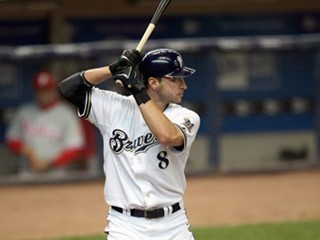
1. Ryan Braun
2012 Projections: .321 38 HR 119 RBI 108 R 32 SB
Given that he is at the prime of his career having just turned 28 on November 17, Ryan Braun ranks at the top of the list. He is the complete package and enjoyed a 2011 season that had fantasy owners drooling and was named the 2011 NL MVP today! He was a machine in all five of the standard fantasy categories with a .332 average, 33 home runs, 111 RBI’s, 109 runs and 33 SB’s. The exciting thing is that the will only continue to get better. The home run total has the potential to reach 40 and I don’t see reason why Braun won’t steal 30 bases again. Braun is by no means one of the speediest players baseball, but he is truly one of the smartest base runners. He steals at a career success rate of 80% and was only caught 6 times in 2011. Some people wonder about the effect that Prince Fielder’s potential departure will have on Braun, but I am not overly concerned. Braun is truly a special and hall of fame caliber player because he not only possesses all of the physical tools, but also is one of the game’s smartest players. He continually makes adjustments and just has such an impressive knowledge of the game that allows him to better utilize his talents than others.
2012 Projections: .312 39 HR 120 RBI 117 R 12 SB
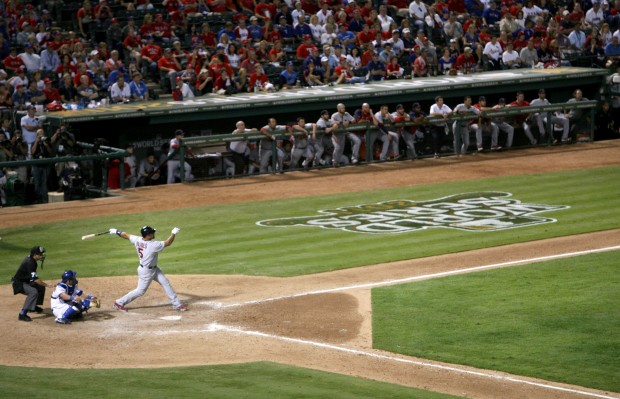 Albert Pujols has been the best fantasy player in baseball since he emerged onto scene in 2001. Ten Ruth-like seasons later, the slugger might find himself in a new uniform. Furthermore, his somewhat “down” season in 2011 has caused concern for many fantasy owners. But before we expect an A-rod-like decline, lets take a closer look at the numbers. Through the Cardinal’s first 54 games, Pujols batted .257 with 8 home runs and 28 RBI. That means in the team final 108 games, which included the time missed with the wrist injury, he batted .322 with 29 home runs and 71 RBI’s. That is the Pujols that we have all been accustomed to over the last decade. I will not go into detail explaining just how good Pujols has been throughout his career because you should already know by now. Last year was the first season he did not put up .300 30 HR and 100 RBI. He missed this feat by one RBI and one point of average, in a season that included an uncharacteristic 50 game stretch (contract issues?). I expect Pujols to be back in St. Louis next season, and all though he well on the back nine of his career, he is still too good and has a lot left in the tank. Expect the usual numbers, the type that he continued to put up despite his slow start to the season in 2011.
2012 Projections: .336 34 HR 122 RBI 109 R 2 SB
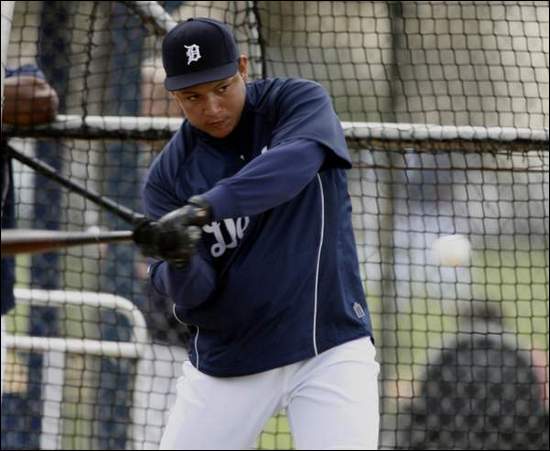 Did you know that Miguel Cabrera is only 28 years old? I sure didn’t. He has been an offensive force for almost a decade. In my mind, he is the game’s best pure hitter and will only continue to get better. He managed to have another elite season in 2011, despite all the controversy and off the field issues he had to deal with. He continues to improve at the plate and BB right is on the incline while his K rate declines. For these reasons, and his career .317 average, there is no reason to not expect his average to hover around .330. He is an average anchor for your lineup that will also exceed 30 HR and 100 RBI’s and runs. The only thing he does not do is steal bases. However, refer to my article last week, Cabrera is the type of average and power anchor that can allow your team roster a space for the one-trick ponies, i.e. Michael Bourn. Overall, just expect more of the same from Cabrera: which means elite production in four of the five standard fantasy categories, average, runs, home runs, and runs batted in.
4. Matt Kemp
2012 Projections: .296 33 HR 108 RBI 103 R 34 SB
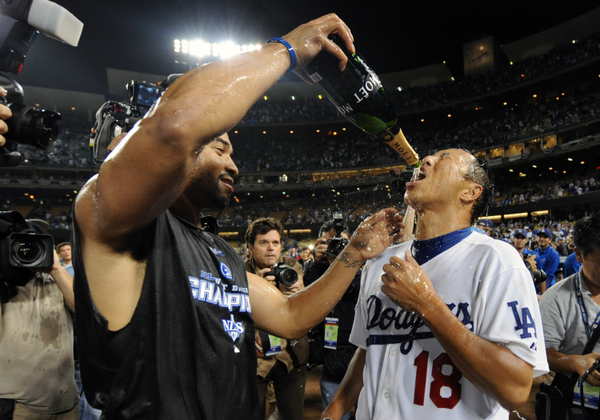 At 27 years of age, Matt Kemp is also just entering his prime. He missed a 40/40 season by just one home run and batted .326 and drove in 126 runs, which led to being the runner-up for the 2011 NL MVP award. However, he is easily the most difficult to predict on the list. If I expected him to improve upon or even just repeat his 2011 season, he would be at the top of the list. We simply cannot expect Kemp to be this fantasy-tastic again in 2012. Matt Kemp’s .380 BABIP lead all of major league baseball, however he does hold a career .352 clip, which is tops in baseball. Therefore, expect regression in his batting average in the .290-.300 range. Kemp also strikes out a lot, not like in 2010, but he still struck out in 23 percent of his at bats in 2011. When you are not putting the ball in play at a high rate, there is potential for a lot of volatility. Given his skill set, 2011 was essentially a best-case scenario for Kemp. The other four guys on the list make contact much more consistently and therefore have been more consistent throughout the career and are easier to project forward. Furthermore, I am not encouraged by the line up around built around Kemp. He is still elite, but it is unwise to expect him to repeat 2011. He will come down to earth but still provide across the board value for your team.
5. Joey Votto
2012 Projections: .316 32 HR 112 RBI 115 R 11SB
 At 28 years of age, Joey Votto is also in the prime of his career. His 2011 season, with heavy expectations after an MVP season, was a down season for Votto. A down season in which he batted .309 29 HR 103 RBI 8 SB. And if this type of season is Votto’s worst-case scenario, you can live with it! However, given his age and peripheral stats, all signs point to an improved season for Votto in 2012. Votto is a pure hitter who continues to gain better command over strike zone, as his walk rate his increased steadily in each of the four last seasons. The average will always be there for Votto, just a notch below Cabrera. The biggest concern for fantasy owners was the drop in power, form 37 to 29 home runs. However, Votto hit the ball in the air more often in the second half of the season and hit 16 post all-star HR’s in 260 at-bats, compared to just 13 in his 339 at-bats before the break. Furthermore, his .222 ISO was well below his 2010 season (.276) and career average of .237. Therefore, expect him to bounce back to the 35 HR territory with elite average. The true wildcard for Votto is what he does on the basepaths. He stole just 8 bases in 2011, but if he puts a greater emphasis on running like he did in 2010, with 16 stolen bases, then he has the potential to provide extreme five-category value to your roster.
Honorable Mention:
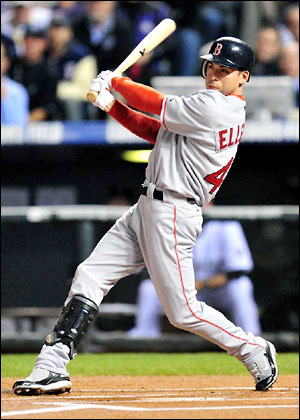
Jacoby Ellsbury: His .230 ISO in 2011 (career .152) explains his surprise 30-home run season. Ellsbury’s peripheral indicate he will be more of a .300 20 HR 80 RBI 40 SB type players, making him a notch below Braun and Kemp.
***Today’s feature was prepared by our Fantasy Baseball Analyst, Peter Stein. We highly encourage you to leave your comments and feedback at the bottom of the page and share in the discussion with our readers. You can also follow Peter on Twitter (@peterWstein).***
Please e-mail us at: MLBreports@gmail.com with any questions and feedback. You can follow us on Twitter (@MLBreports) and become a fan on Facebook . To subscribe to our website and have the daily Reports sent directly to your inbox , click here and follow the link at the top of our homepage.

Should Dale Murphy be Elected into Cooperstown?
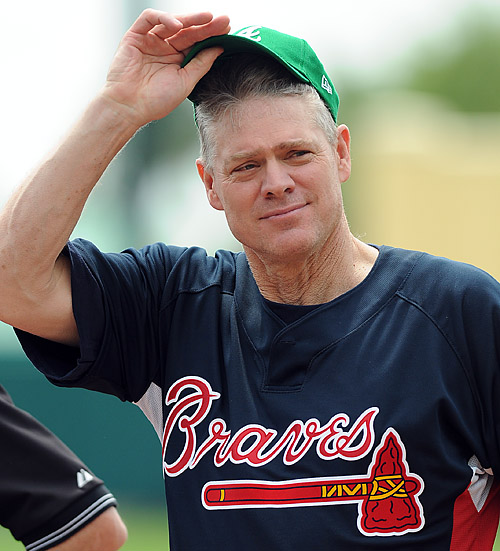
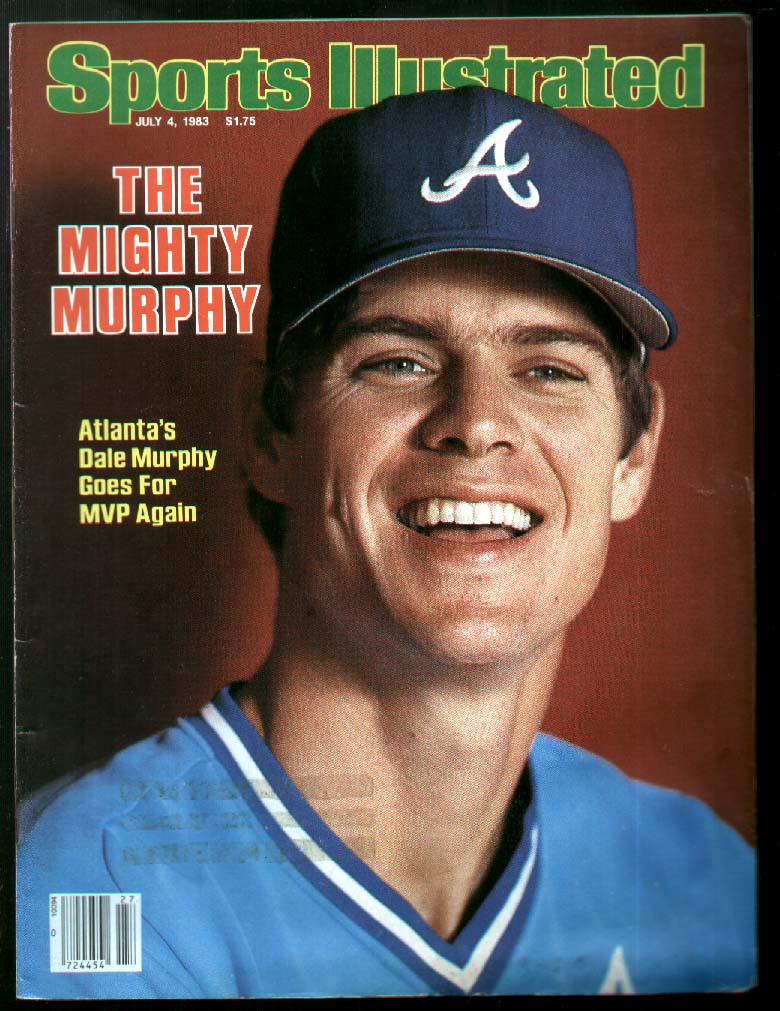 Sam Evans: Dale Murphy was one of the best baseball players of the 1980’s. He played in 2180 games, hit .265, with 398 home runs. Now, after twelve years of eligibility, Murphy still has not been voted into the Hall of Fame.
Dale Murphy was not a dominant player during his era. He was a very good player, he won two MVP’s and five straight gold gloves. However, when you look back at his two “peak” years, he only posted a 6.1 WAR in those years combined. We can’t fully be sure of WAR’s (wins above replacement) ability to fully show the defensive prowess of players, but either way that is not impressive enough for a Cooperstown candidate.
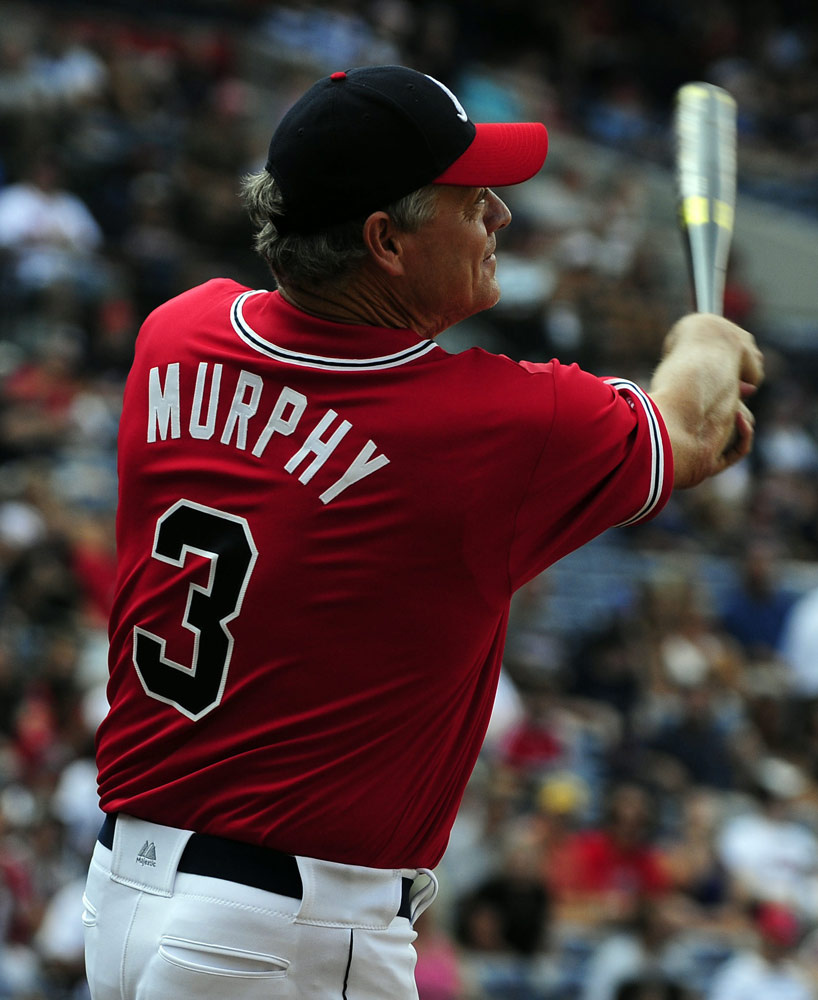 On the field, Murphy was an inspiration to others. He truly looked like he wouldn’t rather be anywhere else in the world. Off the field, he wasn’t any different. Just ask Joe Torre, who had this to say about Murphy, “If you’re a coach, you want him as a player. If you’re a father, you want him as a son. If you’re a woman, you want him as a husband. If you’re a kid, you want him as a father. What else can you say about the guy?” Murphy truly was an American hero as evidenced by his Lou Gehrig award and Roberto Clemente award.
From 1980 to 1989, Murphy had more total bases than anyone in the majors. He had a perplexing career in terms of statistics. He never dominated any one category. A typical season from Murphy would look along the lines of: 30 HR, 90 RBI, 130 K, 15 SB, and a .265 AVG. That is a pretty good year by all standards. The player that was most similar to this stat line in 2011, was Jay Bruce of the Cincinnati Reds.
 Let’s make one thing clear. Based on his statistics alone, Dale Murphy is definitely not a Hall of Famer. A 44. WAR is not enough for a Hall of Famer. That is in fact less than Red Sox fourth outfielder J.D. Drew. However, if you want to make a case for Murphy’s election by including his contributions to the game of baseball off the field, I can see a stronger case for his candidacy.
Last year, Murphy received only 12.6% of the BBWAA voted for the Hall. He has a long ways to go, in terms of voting, and not a lot of time to do it. I really am indifferent to whether or not Dale Murphy is Hall of Famer. If he makes it in, I will be pleased that his great character and steady numbers had been noticed. The bottom line is that regardless of whether he is eventually elected into Cooperstown, Dale Murphy should always be remembered as a tremendous player that truly was a role model to kids and adults who followed his career. Even if he does not fit the Cooperstown mold, he was one of the top players of his generation and should be regarded as a strong role model for future wave of Major League Baseball players to come.
 ***Today’s feature was prepared by our Baseball Writer, Sam Evans. We highly encourage you to leave your comments and feedback at the bottom of the page and share in the discussion with our readers. You can also follow Sam on Twitter.***
Please e-mail us at: MLBreports@gmail.com with any questions and feedback. You can follow us on Twitter and become a fan onFacebook . To subscribe to our website and have the daily Reports sent directly to your inbox , click here and follow the link at the top of our homepage.
Expanding the MLB Postseason: More Wild Card Teams Coming
Follow @mlbreports Friday October 21, 2011
MLB reports – Rob Bland: Expanding the playoffs has been a hot topic for many years now. While the move will not be as drastic as when the MLB added the first wild card team in each league, it has drawn the ire from a lot of critics. In 1994, MLB was to use the postseason system currently in place; however the season was cut short due to a player strike. It was then that the MLB went to three divisions in each league (East, Central, and West) as well as a wild card team (the best non-divisional winner record in the league). The American league Divisional winners would have been the New York Yankees, Chicago White Sox in the Central and Texas Rangers in the West (with a record of 52-61). Conversely, the Cleveland Indians would have been the wild card winners at 66-47. In the National League, the East would have been won by the Montreal Expos, who had the MLB’s best record of 74-40. The Central and West would have been won by the Cincinnati Reds and LA Dodgers, respectively, while the wild card winner would have been the Atlanta Braves.
However, due to the strike, which also shortened the following season, 1995 was the first year this system actually came into play. This season saw a shortened 144 game schedule. The NL East winners, Atlanta Braves had to go through the slugging Colorado Rockies; the first NL wild card team. They then faced the Reds, and the eventual World Series Champions Cleveland Indians. The Indians took a very peculiar path to the World Series. After leading the MLB with a 100-44 record, the Indians faced the Boston Red Sox, winners of the AL East, who had the 2nd best record in the American League. The Yankees were the wild card winners, who were defeated by the Seattle Mariners in the AL Division Series.
 The current Collective Bargaining Agreement between the commissioner, Bud Selig, with the MLB and its players’ union expires in December of this year, and an extension of five years is expected to be reached any day. One of the main hold-ups to a deal is the addition of another wild card team. The 2nd best non-divisonal winner would get into the playoffs. This may not seem like much, where every other major sports league in North America has at least 3 “wild card” teams, but in baseball, tradition is always at the top of people’s minds. Adding a team to each league’s postseason picture could lengthen the MLB season, which is something that is a major concern to most people involved in the process.
One option that was bandied around was to have the two wild card teams face off in a best 2 out of 3 series. The advantage of this short series is that both teams that didn’t win their division would have to play extra games while the winners get a short break to recuperate their injured players. Also, the extra games give opportunities to more teams to earn extra postseason revenue, which benefits the league. However, the extra 2-4 days off that the other teams would have to endure could also cause a team to lose its momentum gained at the end of the season.
However, it is believed that the MLB will go to a one game sudden death playoff between the two wild card teams. In my opinion, the biggest advantage to this is that it gives the winner of the game a monumental disadvantage going into the second round. The wild card teams would be forced to pitch their ace in the playoff, and therefore would not be able to pitch until at least game 3 of the next round. This means the team’s best starter would only get one start in a best of 5 series. Not only would the team with the best record in the league have home-field advantage, but they would see their opponent’s best pitcher in only one game.
In the current state of the MLB postseason, ten wild card teams have made it to the World Series, out of a possible 34 teams going back to 1995, including 2011. Roughly 29% of wild card teams make it into the World Series. If you figure that 1 out of 4 teams in each league make it to the World Series, or 25%, then you have a better chance of making it as a wild card than as a divisional winner. Four World Series have been won by wild card teams. 25% of World Series have been won by a team that should have a distinct disadvantage, but obviously do not. It is due to this that MLB must make it a bigger hindrance for not winning your division. Playing an extra game, extra travel and burning your ace are ways to weaken a wild card team’s chance of making it to the World Series.
With the union and MLB reps meeting every day trying to hammer out the extension for the CBA, you should see the added teams in the playoffs in 2012 or 2013. It is widely expected that the deal will be reached in the middle of the World Series to take advantage or the added publicity it would gain. I am fairly certain that the new playoff format will come into effect for the 2012 season, and there will be a lot of teams looking to push the envelope and make an appearance.

World Series: Game 2 Recap
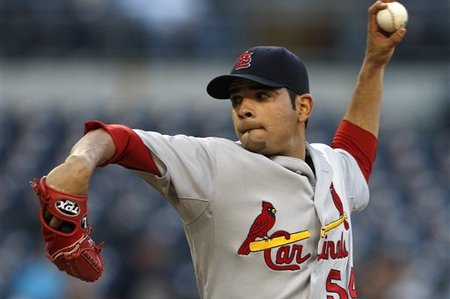 Game 2 was a bit of a surprise, as Jaime Garcia, whom many picked to implode in this guy, had a great start. Through 7 solid innings, he gave up only 3 hits and 1 walk to 7 strike outs. Colby Lewis was equally as impressive until the 7th inning, where he was able to strike Matt Holliday out to lead off the inning. David Freese then singled and Yadier Molina flew out. Nick Punto then hit a ground ball towards first base that went off of Michael Young’s glove and into right field, moving Freese to third. With runners on the corners and one out in the 7th, Alexi Ogando came in to face the hitter in the pitcher’s spot. That hitter: Allen Craig. The same hero of game 1 that hit a single to right field that scored the go ahead and eventual winning run. Craig promptly lined a ball to right field to score David Freese, breaking the dead lock.
What would a playoff game be without drama? Jason Motte came in the 9th to close out the 1-0 game. So far in the postseason, he had given up 1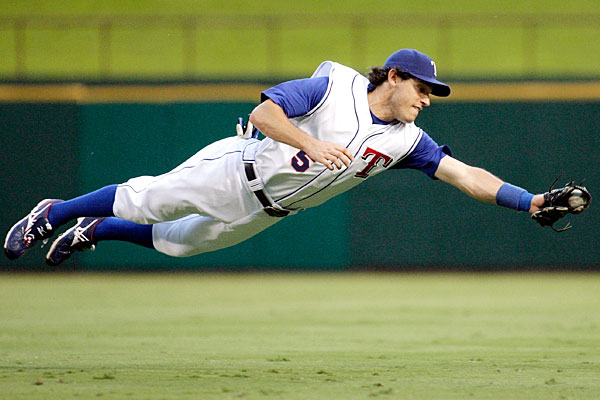 hit in 29 plate appearances. Ian Kinsler led off the inning with a bloop single off the end of the bat. Elvis Andrus came up to the plate and looked to get a sac bunt on the ground, but Kinsler decided to take matters in his own hands, and stole second base by the smallest of margins. Andrus then lifted a 2-2 pitch to center field for a single. While Kinsler was held at 3rd, Cardinals CF Jon Jay threw the ball wide of the cutoff man, which allowed Andrus to slide safely into 2nd base.
Manager Tony La Russa then yanked Motte for lefty Arthur Rhodes to face Josh Hamilton. On the first pitch, he hit a fly ball to right that scored Kinsler and advanced Andrus to third. Even more like La Russa, he brought in Lance Lynn to face Michael Young, who hit a 3-2 curveball deep enough to center to scored Andrus, and the Rangers lead the game 2-1.
Rangers closer Neftali Feliz took the mound in the bottom of the 9th and walked Yadier Molina on 5 pitches 97 mph or faster, hitting 100 on the radar gun with the first pitch. Nick Punto came to the plate, bunted two balls foul up around his eyes, then swung feebly to strike out. Feliz then struck out Skip Schumaker and induced a fly ball off the bat of Rafael Furcal to seal the victory.
With the series tied at one game apiece, an off day tomorrow and game 3 slated for Saturday night in Texas, this series is only going to get better. Keep checking MLB reports for your daily fix of updates on the World Series.
 Today’s feature was prepared by our Baseball Writer, Rob Bland. We highly encourage you to leave your comments and feedback at the bottom of the page and share in the discussion with our readers. You can also follow Rob on Twitter.
Please e-mail us at: MLBreports@gmail.com with any questions and feedback. You can follow us on Twitter and become a fan onFacebook . To subscribe to our website and have the daily Reports sent directly to your inbox , click here and follow the link at the top of our homepage.

There He ‘Gose’ Again: The Future of Base-Stealing Blue Jays’ Prospect, Anthony Gose
Tuesday September 20, 2011

April Whitzman (Blue Jays Writer – MLB reports): A native of Paramount, California, outfielder Anthony Gose was the Philadelphia Phillies second round selection in the 2008 Draft. Although a top prospect with the Phillies organization, Gose found himself in Toronto by the end of the 2010 season after a three team deal also including the Houston Astros.
PRE-BLUE JAYS
Glancing at his numbers from 2009, Anthony Gose led all minor league players with 76 stolen bases while hitting .259 with 20 doubles, 13 triples, seven home runs and 27 RBI. His walk-to-strikeout ratio was a bit cumbersome, however, as he walked 45 times, but struck out 132 times. After the season, MLB prospect writer John Sickels rated Gose’s performance, stating the following: “[I] Love [his] speed, youth, and the athleticism. Don’t like the high strikeout rate for a guy without much power. Most advanced of the uber-tools players collected in this system in recent drafts.”
In 2010, at 19 years old, Gose appeared in 103 games with Clearwater and 27 games with the Dunedin Blue Jays (A+). The 6-1, 190 lb., left-handed hitter collected 20 doubles, 13 triples, and seven home runs with 27 RBI while adding 45 stolen bases. While 45 steals sounds impressive, it should be noted that he was thrown out 32 times that season. That’s only a 58% success rate.
BLUE JAYS
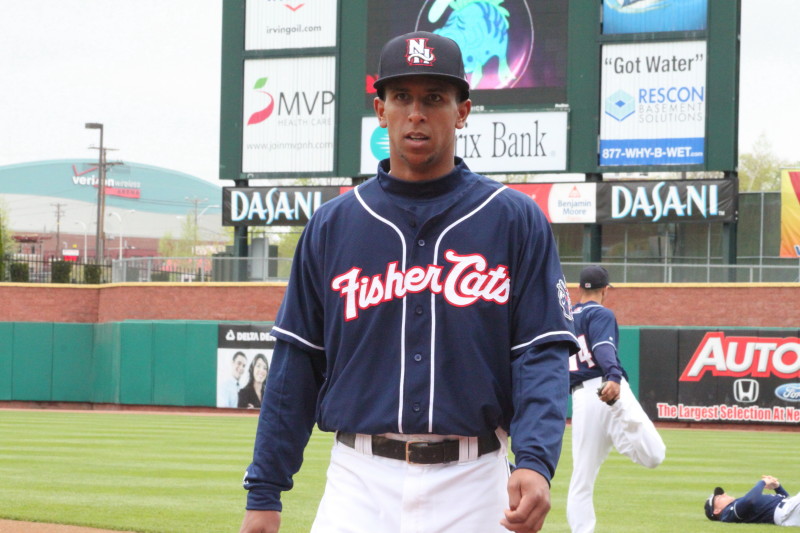 Joining the AA New Hampshire Fisher Cats in 2011, his first full season with the Blue Jays organization, Gose worked to improve his greatest asset – speed. This year he successfully stole 70 bases, only getting caught 15 times, going 23-for-24 in his last 24 attempts and increasing his stealing percentage to 82%. He then started to learn about when to steal, having the majority of his failed attempts coming at third base.
What’s more, along with base stealing, Gose saw improvement in the batters box, as he increased his power totals for the third straight year hitting 16 home runs, 20 doubles and seven triples. Unfortunately, his average has remained around the .250 mark (.253), comparable to the rest of his career in the minor leagues.
Another improvement for Anthony Gose this season was his patience at the plate. While only taking 41 walks in 2010, Gose took 62 walks in 2011 in a similar number of at-bats. He also saw though an increase in his strikeouts this season, as he had 154. Nevertheless when Gose doesn’t strike out and he does put the ball in play, he is batting .339, nearly 80 points higher than his regular average.
Not only has he improved at the plate, but Gose has also seen a rise in his game in the field. His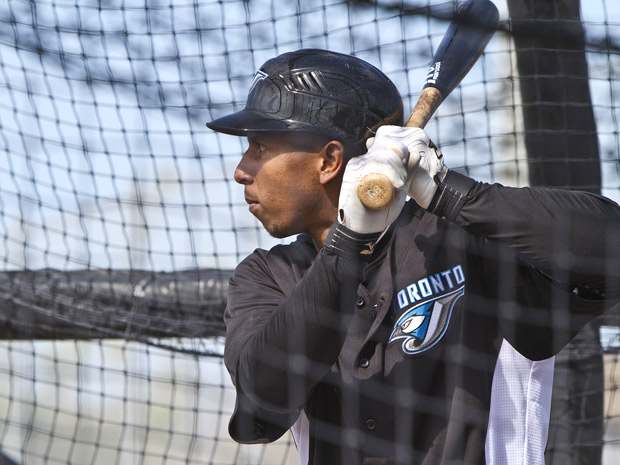 fielding was phenomenal in 2011, committing only three errors, giving him a .992 fielding percentage. Discussing his play in the field, Sal Fasano, the manager of the New Hampshire Fisher Cats, stated: “Gose has enough arm to play right or left in the majors. He caught a ball on the warning track in the right-centre, near the 375 sign, and threw out a guy at third — in the air.” Looking at the numbers, Gose had 15 outfield assists in 2010 and 14 assists this season. That can all be attributed due to his phenomenal range, as thanks to his speed, Gose is able to cover ground smoothly and regularly, making continual exciting plays in the field.
IN THE FUTURE
 In late July of this year, 24-year-old center fielder, Colby Rasmus was traded to the Toronto Blue Jays from the St. Louis Cardinals in a blockbuster deal that also involved the Chicago White Sox. The trade left many wondering if Gose still had a future with the Jays. Fasano’s response: “[Gose is] arrogant enough to think they will move players to make room for him.” However, many baseball analysts were not as optimistic and still wondered where he would fit.
There is no doubt that the Blue Jays have a deep farm system. Most would agree that the team has key players that they would be willing to move if the price was right. If nothing else, the Jays’ GM has shown a willingness to be aggressive in the trade market. With the addition of a strong and powerful first baseman, a dominating starting pitcher, and/or a ‘lights-out’ closer, the Blue Jays are likely to contend by 2013, the year that Gose will likely make the majors.
With Colby Rasmus at centre, Jose Bautista in right, and any one of Travis Snider, Eric Thames, Adam Loewen, and Rajai Davis to play left and/or be the fourth outfielder, it is anticipated that a trade will be coming during this off-season.
With the Blue Jays’ need for a first baseman, the Jays could consider a trade with the Cincinnati Reds who are in dire need of an outfielder. Could Yonder Alonso be the future first baseman for the team in blue and the speedy Gose the future Reds’ centerfielder? With the Astros also needing outfield depth, would it not be ironic if the Jays traded Gose for Brett Wallace? (While this is a very unlikely scenario, it would fill the needs for both teams). The Pittsburgh Pirates are another team in need of a solid outfielder. Thanks in part to a deep farm system, a trade with the Pirates could work. The Jays are also in need of a top starting pitcher and a closer, so any future trade could package off other prospects as well, including, but not limited to, Travis Snider and/or Eric Thames.
The future for Anthony Gose will surely become clear this off–season by recognizing what trades Alex Anthopoulos, deemed as the ‘Silent Assassin’, will make. Along with teammates Yan Gomez and Adeiny Hechavarria, Gose is also heading to the Arizona Fall League to work even more on his skills. Until a trade is consumated, it is evident with Gose, that the Blue Jays have a solid prospect that has a rare combination of top-notch speed, excellent fielding ability and top tools at the plate.
As always, I look forward to hearing from you. Comment below, email MLBreports@gmail.com and follow me on Twitter at @Alleycat17.

Please e-mail us at: MLBreports@gmail.com with any questions and feedback. You can follow us on Twitter (@MLBreports) and become a fan on Facebook . To subscribe to our website and have the daily Reports sent directly to your inbox , click here and follow the link at the top of our homepage.

Adam Dunn: The Future of the White Sox Slugger
Wednesday August 31, 2011

MLB reports: Not every player can fit onto a particular MLB team. That is a baseball reality. In fact, there are very few, if any players that could produce the same statistics playing for any team. A player’s production is based on many factors, including home park, lineup, adaptability to particular cities and so on. When a team trades for a player or signs a free agent, the hope is that the new player will be able to meet or exceed previous production levels on a new team. Sometimes, the hope is that new environment will revitalize a stagnant player and breath new life into them. In the case of Adam Dunn, the Chicago White Sox signed him to a free agent contract last year. A large deal, 4 years for $56 million dollars. A fair deal in my estimation at the time. The White Sox by signing Dunn were hoping to land an established slugger to fit in the middle of their lineup. What they ended up with was quite different.
Take a look at Adam Dunn’s current production in comparison to his career numbers:
| BA | HR | RBI OBP | ||
|---|---|---|---|---|
| Regular Season | .163 | 11 | 40 .290 | |
| Career | .244 | 365 | 920 .374 |
 To say that Adam Dunn has been anything but a disaster since his arrival in Chicago would be an understatement. Prior to 2011, Dunn’s worst season produced an .819 OPS. That was in 2003, his 2nd full season in the majors that was cut short by injuries. Turn the clock and Adam Dunn sits with a .578 OPS this season with no likelihood of redemption. While some pointed to Dunn playing in a new league for the first time and starting off slow, a turnaround was expected at some point this season. Dunn has actually regressed to the point that he is benched by manager Ozzie Guillen at a frequent rate. A sad state of affairs for one of the game’s previously most consistent sluggers.
For a two-year stretch, from 2003-2008, Adam Dunn was a 40 home runs and 100 walks guy. In his last two seasons, Dunn played in a less than friendly hitters park in Washington and still hit 38 home runs per season. Moving to the White Sox, expectations were that playing in a hitter’s park with a deep lineup would produce possible MVP type numbers for the burly slugger. So what happened? Why the sharp regression?
Part of the issue has been the move to the American League. The adjustment has not worked for some hitters and we have seen NL hitters in the past that cannot play in the AL for whatever reason. Glenn Davis is one famous example that comes to mind, who moved from Houston to Baltimore and literally fell apart overnight. Dunn also is a full-time DH for the first time in his career. Some hitters never take as well to moving off the field and into a DH role, citing inactivity and removal from the full game experience as distractions from their hitting. Given though Dunn’s perceived weak fielding, at both first base and the outfield, a move to DH should have been a welcome change for him. Yet the move was another factor in his year-long slump.
The main culprit in my estimation is the fit, or lack of in Chicago. Perhaps it is the city, or the ballpark, teammates, media or his relationship with the manager. Whatever the reason, I ultimately believe that Adam Dunn and the White Sox simply do not mesh more than anything else. While a return to the field and/or the National League may help, first and foremost Dunn needs to get out of Chicago and start fresh.
 I think of Chone Figgins and his move from the Angels to the Mariners. Despite staying in the same division even, Figgins was never able to meet expectations in Seattle and regressed throughout his time with the Mariners. Had he stayed in Anaheim, the chances are higher that Figgins would have continued playing his game and not transformed into a shell of his former self. Carl Crawford in Boston and Jayson Werthin Washington are players that also signed big-ticket deals and also stayed in their respective divisions, yet faltered in the wake of big contract expectations. But the difference with Crawford and Werth is that they have shown some glimpses of life this season, while Dunn has shown none. I fully expect Crawford at least to be able to make the necessary adjustments and rebound by next season. In Dunn’s case, I do not see that happening without a trade.
Nick Swisher is a situation that I will point to as an example. From the moment Swisher was traded from the A’s to the White Sox, nothing went right. After suffering through the worst season of his career in Chicago, Swisher was traded to the Yankees for pennies on the dollar and blossomed in New York. The same will likely occur to Dunn. A move to the Yankees is a possibility, for a high-profile team that can afford to take on or part of most of Dunn’s salary. A trade for a bad contract is another one, with the Cubs for Zambrano or Giants for Zito as possibilities. Better yet, a move to the Angels could also be the answer. With Mike Trout ready to join an outfield of Peter Bourjos and Torii Hunter, the Angels may not have room for failed trade acquisition Vernon Wells. The White Sox could plug Wells into their outfield and Angels use Dunn to replace Bobby Abreu as DH. A long shot, but certainly a possibility.
No one can be sure if this season is an outlier or an indication of the beginning of the end for Adam Dunn. Based on his strong body of work until this year, I am willing to give him the benefit of the doubt that a rebound will occur. The White Sox might wait it out and give Dunn another shot next year. But then GM Kenny Williams has never been the patient type. After moving Swisher very quickly, I expect the White Sox to do the same with Dunn. This would be a classic buy-low situation for another MLB club. Expect many calls on Dunn in the offseason and a new team by 2012. Despite Dunn indications of having retirement thoughts due to his poor season, I cannot see him going down in this manner. Adam Dunn will be back. The only question is where.

Please e-mail us at: MLBreports@gmail.com with any questions and feedback. You can follow us on Twitter and become a fan on Facebook . To subscribe to our website and have the daily Reports sent directly to your inbox , click here and follow the link at the top of our homepage.

Jonny Gomes Traded to the Nationals and Yonder Alonso Called Up by Reds
Tuesday July 26, 2011
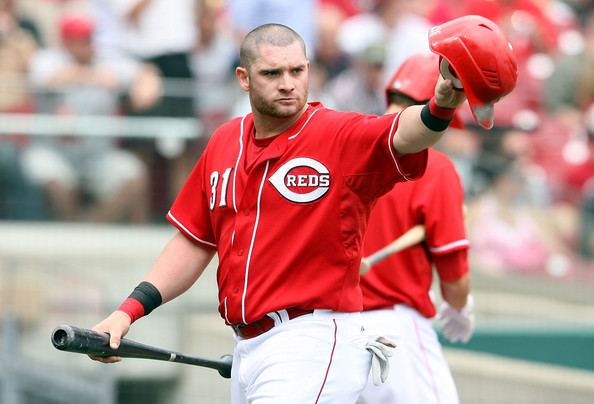
MLB reports: The trades are trickling in very slowly thus far as the MLB trade deadline approaches. First Wilson Betemit was traded last week to the Tigers by the Royals. Now, Jonny Gomes is off to Washington with cash in exchange for two minor leaguers. Of most significance is the Gomes move allowing the Reds to call up super prospect Yonder Alonso. The question is whether the Reds are showcasing their rookie outfielder in a potential blockbuster trade or have called him for good to man left field for the next decade in Cincinnati.
 Gomes was the darling of the Reds faithful the past two seasons. He slugged 20 home runs in 2009, playing in only 98 games. He followed up with an equally strong campaign last year, blasting 18 home runs with 86 RBIs and 77 runs scored. The Red had signed Gomes after the 2009 season to a 2-year, $2.55 million contract which looked like a bargain going into it this season. The 2011 season however, has not been kind to Gomes. Entering play today, Gomes was batting a paltry .211, with a .336 OBP and .399 SLG. After receiving every day playing time to start the year, Gomes was relegated to part-time duty as the season progressed. A change in scenery was in order and with prospect outfielder Yonder Alonso on the horizon, roster space needed to be opened up.
Gomes is now off to Washington to play out the string. The Nationals, in dire need of an offensive boost, took a chance on the 30-year old Gomes in the hope that he will be able to reclaim some of his past magic with Washington. The Nationals did not hurt themselves, as Gomes comes at a very reasonable salary which will be subsidized by the Reds and cost the team only two fringe prospects. Plus as a potential type “B” free agent at the end of the year, the Nationals would receive a compensation draft pick for Gomes if he is offered arbitration by the team and does not accept. Given Gomes’ offensive potential, it was a low-risk and high-reward move for a team that needed to send a message to its fans that it was serious about contending. Even though the team is out of the penant race this season, the Nationals needed to remain competitive through September to send the right message to its fanbase. Jonny Gomes is a step in the right direction in that respect.
The prospects headed to the Reds are pitcher Christopher Manno and outfielder Bill Rhinehart. Manno, a 38th round pick of the Nationals back in 2009 and then again in the 26th round in 2010 has shined since joining the organization. The 22-year old Manno, a 6’3″ left-handed pitcher, has a 1.47 ERA over 2 seasons in the lower minors, with 13 saves, only 32 hits given up in 61.1 IP and 25/98 BB/K. Rhinehart, 26-years of age, was drafted in the 11th round in 2007. Having made it all the way to AAA in 2010, Rhinehart was playing this season in AA. Up to the time of this trade yesterday, Rhinehart was enjoying his finest professional season to-date. Hitting .283 with 21 home runs, 59 RBIs and .963 OPS, Rhinehart was exhibiting great pop in his bat. But given that neither Manno nor Rhinehart are established major league players and are fringe prospects at best at this point in their careers, the Nationals have to be considered the winner of this trade. They acquired an established major leaguer without giving up any of their top prospects.
From the Reds’ perspective, the bigger corresponding move is the recall of Yonder Alonso. With his .296 AVG in AAA with 12 homer runs and .860 OPS, Alonso had little left to prove in the minors. Scouts have never questioned his bat, as he has displayed the rare combination of power and patience from a very young age, far advanced for his years. The only knock is his defense, as Alonso is a converted outfielder after having been blocked at first base by perennial MVP candidate Joey Votto. But all the reports that we have seen is that Alonso has progressed well in learning the outfield to the point that he is considered adequate. Although he is no danger of ever winning a gold glove, Alonso’s bat more than compensates for any defensive shortcomings. The debate for the next five days will be whether Alonso is remaining with the Reds or being shipped in a blockbuster. My gut is that he is staying put.
The two biggest names being linked to the Reds in trade talks is Ubaldo Jimenez of the Rockies and James Shields of the Rays. Either player would cost a substantial package in return, including possibly Homer Bailey, Aroldis Chapman, Devin Mesoraco, Yasmani Grandal and Yonder Alonso. The package that I have read for both players would be centered around Alonso and 1-2 more top prospects in the Reds’ organization. From all indications, the Reds are in on the two superstar hurlers but are attempting to hold onto their top prospects if possible. In a perfect world for the Reds, they would be able to land Jimenez while only giving up Bailey and Grandal. But the Rockies, like the Rays, will demand a package that includes Alonso and/or Mesoraco. A deep price to pay talent but reasonable, considering the upside and the high level of talent that would be coming back to the Reds.
At the end of the day, I believe that the Reds will regret it if they move Alonso. He is rare hitter that will be an All-Star for many years to come. While top flight pitching is hard to find and develop, it usually comes at a high price and risk. Pitchers, given the strain and wear and tear they put on their arms, are the most likely position to be injured and thus come with the highest risks and question marks. The hope is that the Reds appreciate the talent that they have in Yonder Alonso and continue to cultivate and develop him. With such a deep pool of talent, they should still be able to make the headliner trade they are shooting for without giving up their top rated young hitter. They were able to move Gomes to Washington to make room for Alonso, now hopefully we can sit back and watch Alonso combine with Mesoraco, Votto, Phillips and Stubbs to form the newest version of the Big Red Machine. The Reds are on the verge of putting together something very special. Hopefully they stick to the plan.

Please e-mail us at: MLBreports@gmail.com with any questions and feedback. You can follow us on Twitter and become a fan on Facebook . To subscribe to our website and have the daily Reports sent directly to your inbox , click here and follow the link at the top of our homepage.

Hiroki Kuroda: Pitcher Looks to be Possibly Traded From the Dodgers to Rangers
Monday July 25, 2011
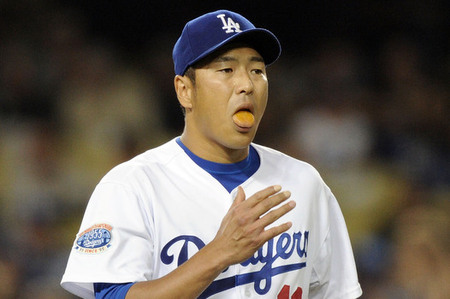
MLB reports: One of the most underrated pitchers in the game is currently on the auction block. Los Angeles Dodgers hurler, Hiroki Kuroda, is currently being shopped to major league teams as the July 31st trade deadline is nearly upon us. The 36-year old Kuroda has been very consistent since joining the Dodgers, enjoying solid numbers despite a constant lack of run support. With a no-trade clause, Kuroda has the ability to refuse a trade in remain in the Los Angeles for the rest of the season. But with demand high for the hurler and teams likely to offer incentives (in the $1-$2 million range), it appears that Kuroda will be changing addresses in the next six days.
A veteran of the Nippon Professional Baseball League, Kuroda played from 1997-2007 with the Hiroshima Toyo Carp in Japan before coming over to North America. As a free agent outside of the posting system, Kuroda was free to sign with any major league team. In 2007, Kuroda signed a 3-year, $35.3 million contract with the Dodgers and last offseason re-signed for 1-year, $12 million. A look at his major league numbers show that Kuroda has been a solid and dependable veteran:
| Year | W | L | ERA | IP | H | BB | SO | WHIP |
|---|---|---|---|---|---|---|---|---|
| 2008 | 9 | 10 | 3.73 | 183.1 | 181 | 42 | 116 | 1.216 |
| 2009 | 8 | 7 | 3.76 | 117.1 | 110 | 24 | 87 | 1.142 |
| 2010 | 11 | 13 | 3.39 | 196.1 | 180 | 48 | 159 | 1.161 |
| 2011 | 6 | 12 | 3.19 | 127.0 | 122 | 33 | 97 | 1.220 |
| 4 Seasons | 34 | 42 | 3.52 | 624.0 | 593 | 147 | 459 | 1.186 |
| 162 Game Avg. | 11 | 14 | 3.52 | 207 | 197 | 49 | 152 | 1.186 |
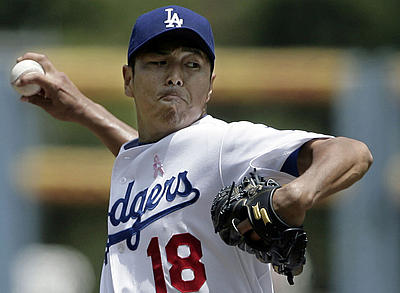 The teams that have pursued Kuroda are the Cleveland Indians, Texas Rangers, New York Yankees, Boston Red Sox, Milwaukee Brewers, Detroit Tigers, St. Louis Cardinals and Cincinnati Reds. Looking at the numbers, I don’t blame them. In some ways the second coming of Hideo Nomo, Kuroda may not be as flashy but he has been dependable. Except for 2009 when he suffered through injuries, Kuroda has pitched close to 200 innings every season since joining the Dodgers. This year has been one of Kuroda’s finest, with a 3.19 ERA and 1.220 WHIP, which have only led him to a 6-12 record on a meek Dodgers squad. With better run support, his record could easily be 12-6. Now with July 31st rapidly approaching, people are wondering whether a) Kuroda will waive his no-trade clause; and b) which team will acquire him.
I am surprised that more teams are not pursuing the hurler. With so few quality starters available at exorbitant prices, including Ubaldo Jimenez of the Rockies and James Shields of the Rays, Kuroda may be the best and most affordable quality starter available to a team that needs a starting pitcher for its stretch run. While Jimenez and Shields will take approximately 3 top prospects, Kuroda may only take 1 or 2 decent prospects. Not a high price to pay considering what a team will get back in return.
From the names thrown around, I would see the Texas Rangers and Detroit Tigers having the best chance to land Hiroki Kuroda, with the Rangers being the most likely to win the Kuroda derby. The Rangers have a great farm system and many solid prospects for the Dodgers to choose from. As well, the Rangers give Kuroda the best chance of winning a championship, having made it last year to the World Series. Other teams will surely take a run at the hurler, especially the Yankees and Red Sox. But when push comes to shove, expect Kuroda to grab his cowboy hat and boots and head to the lone star state. We don’t profess to have a crystal ball and anything can happen this week. The Los Angeles Dodgers will base their final decision on receiving full salary relief and the best prospects in return for their star pitcher. It is always fun to speculate at the trade deadline time. Let’s see which team ultimately offers the best package to acquire one of baseball’s best Japanese imports: Hiroki Kuroda.
Please e-mail us at: MLBreports@gmail.com with any questions and feedback. You can follow us on Twitter and become a fan on Facebook . To subscribe to our website and have the daily Reports sent directly to your inbox , click here and follow the link at the top of our homepage.

James Shields to the Reds for Alonso and Grandal: July 31st MLB Trade Deadline Rumor

Saturday July 23, 2011
MLB reports: We are now only eight days away from the MLB non-waiver trade deadline and the rumors continue to fly fast and furious. Along with the Carlos Beltran and Heath Bell sweepstakes, the names Ubaldo Jimenez, Josh Willingham, Brandon League, Hunter Pence and Hiroki Kuroda have been tossed around as possible candidates to be moved next week. Another big time name has recently been thrown into the mix that we will be looking at today. James Shields, “big game James”, one of the top starting pitchers on the Tampa Bay Rays may very well be playing for a new team very soon. The Cincinnati Reds are apparently calling and with big prospect bats sitting on the farm, the Reds may very well have the necessary bait to haul in one of the biggest fishes on the trade market.
The 29-year old James Shields was drafted by the Rays in the 16th round of the 2000 MLB draft. Shields made his major league debut in 2006. Here is a quick rundown of his lifetime statistics:
| Year | W | L | ERA | IP | H | BB | SO | WHIP |
|---|---|---|---|---|---|---|---|---|
| 2006 | 6 | 8 | 4.84 | 124.2 | 141 | 38 | 104 | 1.436 |
| 2007 | 12 | 8 | 3.85 | 215.0 | 202 | 36 | 184 | 1.107 |
| 2008 | 14 | 8 | 3.56 | 215.0 | 208 | 40 | 160 | 1.153 |
| 2009 | 11 | 12 | 4.14 | 219.2 | 239 | 52 | 167 | 1.325 |
| 2010 | 13 | 15 | 5.18 | 203.1 | 246 | 51 | 187 | 1.461 |
| 2011 | 9 | 8 | 2.53 | 156.1 | 118 | 40 | 151 | 1.011 |
| 6 Seasons | 65 | 59 | 4.02 | 1134.0 | 1154 | 257 | 953 | 1.244 |
| 162 Game Avg. | 13 | 12 | 4.02 | 224 | 227 | 51 | 188 | 1.244 |
A definite innings-eater, James pitched almost 1000 innings over his first five seasons, making him one of the most consistent and reliable pitchers in the game. A lack of run support has definitely hurt Shields over the years, as he had the numbers to obtain more wins had the Rays offense been able to support him better. I have watched too many instances of Shields pitching complete or near complete game losses, despite only giving up 2-3 runs per game. 2009 and 2010 were not kind to James in some ways, as some analysts viewed Shields as having hit his peak and starting to decline. Going into 2011, nobody knew what James Shields the Rays would be getting. The steady ace that the team enjoyed for the majority of his career or the 2010 inconsistent version. Looking at Shields at the halfway mark of the season, he is enjoying by far his greatest season in the majors. A sparkling 2.53 ERA and 1.011 WHIP, Shields has been everything that the Rays could have expected more. But with success comes many questions, with the most pertinent being what the Rays should do with James.
The whispers and talk has been growing by the day that the Rays may be looking to move Shields by July 31st. The Reds have been the team most linked to the Rays, given their desire to bolster their rotation and the deep farm of prospects they can offer the Rays. The Reds are sitting on some of the top prospects in the game that are currently blocked at the major league level. Yonder Alonso, 1B/OF is considered one of the best hitters not at the major league level. Alonso would represent the centerpiece of a potential Shields deal. Born in Cuba and having attended the University of Miami, Alonso is often compared to his friend Alex Rodriguez, based on his combination of power and patience at the plate. Not bad company at all. The 24-year old Alonso was drafted 7th overall in the 2008 draft by the Reds and has quickly advanced in their system. Currently in AAA, Alonso sits at a .297 AVG, .871 OPS, with 12 home runs and 46/59 BB/K. The Rays, desperately in need of bats, currently have Casey Kotchman manning first. Alonso would be a perfect fit in taking over the first base job for the next decade. He is a special hitter that does not come along very often. While a pitcher of Shields stature is not easy to replace, the Rays would be filling a huge void in their lineup by adding Alonso. Dealing from strength to fill a need is smart baseball management and the reason why we are discussing the trade of Shields today.
In addition to acquiring Yonder Alonso, the Rays would be adding a number one catcher to their system in either Yasmani Grandal or Devin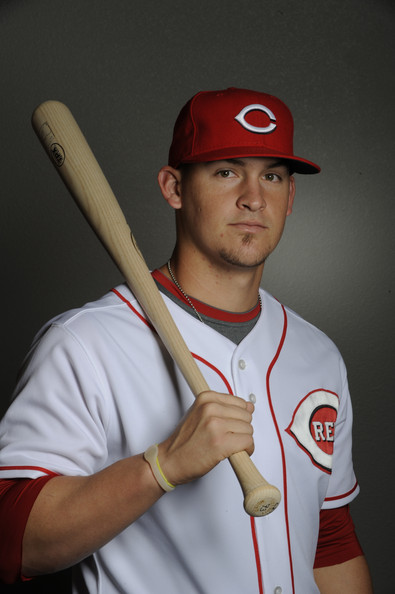 Mesoraco. I have seen both names thrown around, but my gut is that the Rays will end up receiving Grandal. Mesoraco was featured by us back in June. The likely Reds catcher of the future, Mesoraco is expected to get the call either this year or next at the latest to replace incumbent Ramon Hernandez. With a solid backup in Ryan Hanigan, the Reds have an abundance of catchers, a strength considering that few major league teams have potential superstar backstops playing in their lower levels. The 22-year old Grandal was born in Cuba and played in Miami, similar to Alonso. Drafted 12th overall in the 2010 MLB draft, Grandal recently got the call to AA. Mesoraco on the other hand, is 23-years of age and was drafted 15th overall by the Reds in the 2007 MLB draft. Mesoraco is back for his second tour of duty in AAA, hitting a solid .309 and .895 OPS, with 10 home runs and 54 RBIs. After battling injuries in his career, Mesoraco hit a combined 26 home runs over 3 levels last season and has not slowed down since. The Rays would be thrilled to receive Mesoraco in a Shields trade, but Grandal is considered by many to actually be the more talented backstop. A win-win either way for Tampa Bay.
But why trade Shields and especially, why now? Many Rays fans are asking themselves those questions right now. On the surface, Shields and the Rays look like a perfect fit. He is young and still in the prime of his career. Shields has proven to be healthy and durable since joining the Rays. He is signed through this year, with team friendly options through 2014 at $7, $9 and $12 million per year respectively from 2012-14. In baseball they say you can never have too much pitching. If that is the case, then some feel the Rays should consider stockpiling their pitchers and building their team from strength. But that is a narrow view of major league teams and how they operate. Let’s take a look at our five top reasons for the Rays to trade James Shields right now:
1) Sell at the Peak
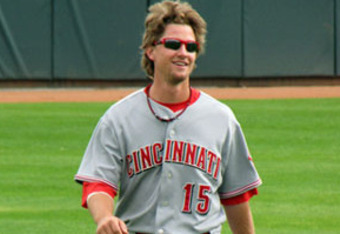 You never know what the future will bring, so sometimes it is important to live in the moment. Shields, while a steady and consistent pitcher, is currently pitching at the highest level of his career. The Rays will need to determine if he has truly broken out or merely playing above his head. The value for Shields may never get higher than it is today. As well, teams contending for the playoffs may be willing to pay more at the deadline than the offseason for Shields. The Rays, if feeling especially lucky, could request the addition of either Mike Leake or Travis Wood to the trade mix from the Reds.
2) Numbers Game: Rotation Log Jam
The Rays have been known for acquiring, developing and stockpiling pitchers in their system. This past offseason was no different, as the Rays traded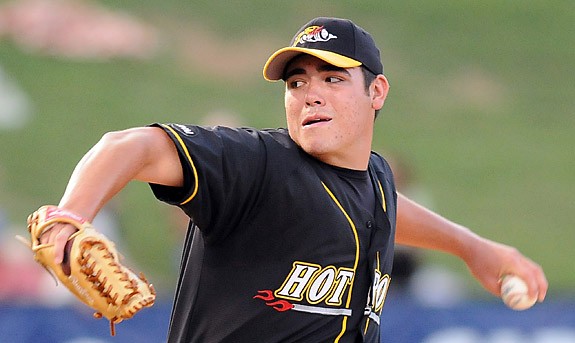 away top starter Matt Garza to the Cubs for a package of prospects, including Christopher Archer and Sam Fuld. With Jeremy Hellickson ready, willing and able to join the big club, the Rays needed to clear room for their next future star pitcher. Hellickson, combined with David Price, Wade Davis and Jeff Niemann form a formidable one through four punch in the rotation. Based on their age and salaries, none of these starters will likely be going anywhere soon. While Alex Cobb has been brought in for temporary measure to the majors, Matt Moore just got the call to join AAA Durham in anticipation of joining the Rays rotation soon. Moore, one of the top-five pitching prospects in baseball, will not likely be kept on the farm too long given his dominance over minor league hitters to-date. That is how the baseball system works. Prospects are developed and either traded for veterans or take over for departed veterans from major league teams. As the Rays have no intention of trading Moore, a spot will have to open up for him. Unfortunately for James Shields, he is the veteran most likely to go. From there, it will only be a matter of time before Archer is ready to join the big club and the cycle will continue.
3) Dollars and Cents
 It is no secret that the Rays are on a very tight budget. Low attendance figures, despite continued recent major league success including a World Series appearance in 2008, has meant that the Rays cannot afford to hang onto high priced veterans. Shown the door in recent years were Carlos Pena, Matt Garza and Rafael Soriano, among others for financial considerations. While James may have what is considered a team friendly contract, paying him close to $10 million or so per year for each of the next three seasons does not work for the Rays budget. Moore, combined with Alonso and Grandal, would fill three positions for the Rays at a combined salary that will be a fraction of what Shields makes. In other words, Shields is a luxury that the Rays cannot afford and can fill quite adequately within at a cheaper cost. While we do not like to think about the economics of the game, it can drive roster decisions on the same level as talent and ability.
4) Innings- Wear and Tear
James Shields is starting to enter a zone that many MLB teams dread. The 200-innings per season for over five seasons club. While an informal group,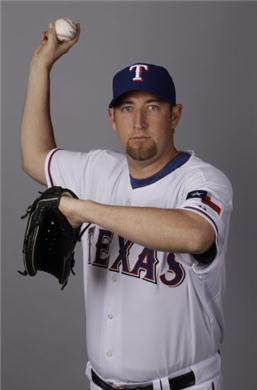 there has been much talk in baseball circles that most pitchers after their first 1000 innings pitched have a high risk of injuries and decline. Pitchers like Brandon Webb and to a lesser extent Ben Sheets, are shown as examples of modern pitchers that have arm/shoulder problems after pitching many major league innings over a span of 5+ years. While Shields has not shown any risks yet of developing injuries, his numbers going into this season were of concern for the Rays. So while Shields is having a Cy Young caliber season, the Rays may be fearful that he will be susceptible to injuries or declining performance very soon.
5) Pitchers Need Run Support
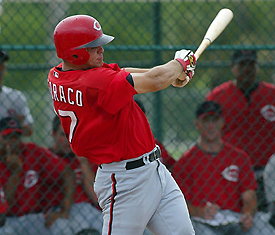 In the same way a fast car needs a powerful engine and reliable tires, a major league team needs both offense and strong pitching. The current build of the Rays is starting to mirror the San Francisco Giants. Great young pitching but not enough hitting. The Rays can stockpile as much pitching as they like, but if they cannot score runs they will have a difficult time making the playoffs, let alone win a World Series title. Yonder Alonso and Yasmani Grandal are two superstar bats in the making that the Rays desperately need and do not have in their own system. The expression goes that teams “develop pitching and buy bats.” In this case, the Rays will be taking to buying the bats that they themselves cannot produce. With a starting lineup of nine hitters, that Rays will be instantly filling over 20% of their lineup by way of this trade. The hit the rotation by losing Shields would be absorbed by the addition of Matt Moore to the major league club. But the boost to the team’s offense as a result of the addition of Alonso and Grandal is invaluable.
Verdict: The bottom line is that the Tampa Bay Rays are in a quandary. James Shields is the heart and soul of their pitching staff, the go-to guy who has earned his nickname of “big game.” But as the most expensive starter on the staff, with the team’s top prospect almost ready to receive the call to the show and the team desperately needing good young hitting, the Rays have no choice but to consider moving Shields at the trade deadline. As the team is still in contention, management will have to be careful of not sending a message that they are throwing in the towel on the season. But to get the biggest reward, the team will have to pay a big price. It will be difficult in the short-term to accept the trade of James Shields from Tampa Bay. But considering the hitting that the Reds would be sending to the Rays, this is a deal that the Rays cannot afford to miss out on. Keep an eye on Tampa Bay as the team will continue to improve, get younger at a competitive payroll come deadline day and still remain in contention. If this is truly James Shield’s last week in a Rays uniform, please be sure to catch his last start live or on television from Oakland this coming Wednesday July 27th. With Desmond Jennings and Dane De La Rosa just recalled by the Rays from AAA, the cycle of player and prospect replenishment has already begun again in Tampa Bay.
Please e-mail us at: MLBreports@gmail.com with any questions and feedback. You can follow us on Twitter and become a fan on Facebook . To subscribe to our website and have the daily Reports sent directly to your inbox , click here and follow the link at the top of our homepage.

Jair Jurrjens: Braves Ace of the Future or Trade Candidate?
Wednesday July 20, 2011
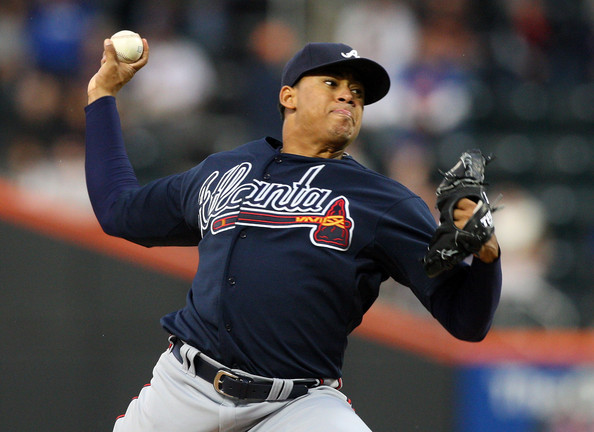
Rob Bland (Intern- MLB Reports): Now that the trade deadline is fast approaching, teams in contention are scrambling to find the pieces they desperately need to reach the playoffs. Teams that are out of contention are scouring other teams’ minor league affiliates in search of suitable trade partners. One man who is terribly busy fielding on calls on one of his biggest talents is the GM of the Atlanta Braves, Frank Wren. Opposing GMs have coveted his ace pitcher, Jair Jurrjens over the past few years. But now that Jurrjens has developed into a solid dependable pitcher who has exceeded his potential, Wren’s phone will be ringing right up until the July 31st non-waiver trade deadline.
Why Atlanta should hold on to their ace
Jair Jurrjens is young and controllable with an inexpensive contract. He is an inning eater, and a dependable arm that will give 6+ innings per game. Jurrjens is in his fourth full season, with the key variable that many people forget is that he is only 25 years old. At the halfway mark of this season, Jurrjens has a 12-3 record with a sparkling 2.26 ERA. Jair also induces a ton of ground balls, with a GB% of 48.2. When a guy can throw strikes consistently, it makes it much easier to be successful. Three walks per nine innings is a pretty good career mark, and he has seemingly improved almost every year, as Jurrjens currently sits at a 2.10 BB/9 for 2011. A young, controllable ace that is continually improving might be something that the Braves want to hold onto. Further, the Braves should even consider giving a long-term extension to Jurrjens given what he means to the ballclub.
Why Atlanta should trade Jurrjens
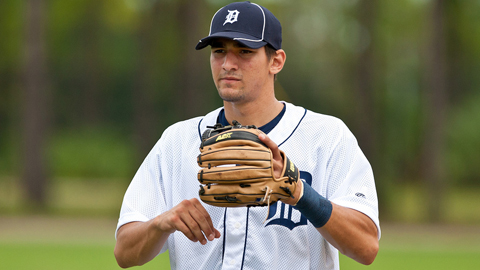 Why would a contending team trade their ace, you might ask? Well, a guy like Jurrjens might be overachieving for a few reasons. First of all, the velocity on his fastball has dipped every season since his rookie campaign. His average fastball was once 93 mph, whereas it sits at 89 now. Now this could mean a couple of things, such as he has learned how to pitch and doesn’t need the velocity. However, his extra reliance on his change-up and slider; each of them up in usage about 3% over previous years, tells me that he knows his fastball isn’t quite as effective. Jurrjens doesn’t strike many guys out, and there is almost no way that he can maintain a 4.1% homerun per fly ball rate. His xFIP is exactly a run and a half higher than his ERA at 3.76, so a measure of his performance has been attributed to luck. Numbers can be sometimes be deceiving and in Jurrjens case, he might not be as good as his statistics appear to show. Sometimes its good to maximize a return when the market is at its peak and Jurjjens may very well be sitting at the top of his ceiling of potential. Otherwise, if Jurrjens does regress, he value will never be higher than it is at the moment.
Which teams could trade for Jurrjens
If the Detroit Tigers are willing to give up a ton of prospects for Ubaldo Jimenez, I believe they would do the same for Jurrjens. Same goes with the Red Sox and Yankees. Detroit has at least kicked the tires on many starting pitchers, including Derek Lowe, Aaron Harang, and Jeremy Guthrie. I see Jurrjens as an upgrade over those pitchers, so it would take a decent package to steal him away. The Rockies covet four top prospects for Jimenez, so I don’t see why the Braves wouldn’t try to get at least three top prospects for Jurrjens. He may not have the electric stuff that Ubaldo has, but he certainly has a track record of success.
Another fit to trade for Jurrjens that may fly under the radar could be the Indians. Mitch Talbot and Fausto Carmona have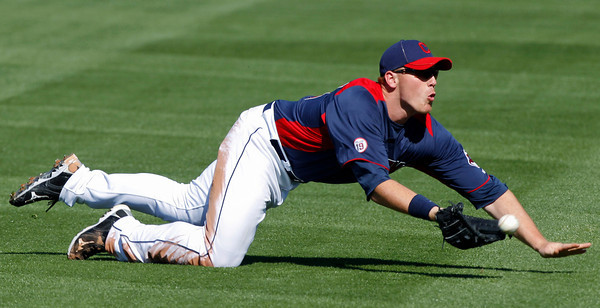 underperformed, and they desperately need an upgrade if they are to contend. This could cause a bidding war for Jurrjens. I can see righty Alex White, lefty Drew Pomeranz and outfielder Nick Weglarz being involved in such a deal. Prospects Jacob Turner (RHP), Andy Oliver (LHP) and Nick Castellanos (3B) may be included in a potential deal with Detroit.
In the NL, if the St. Louis Cardinals decide to make a push in the wide open Central Division, they may be looking at starting pitching help. Kyle McLellan and Jake Westbrook have both struggled, so it could be a possibility they get in the mix. Third baseman Zack Cox and starting pitcher Shelby Miller are possible candidates to be moved in such a scenario.
Verdict
Atlanta doesn’t appear to be actively shopping Jurrjens, but it would be in their best interest to at least gauge the interest of other teams. The Braves could get a return for Jurrjens that would be impossible to refuse. With some of the prospects named, the Braves could still contend, and restock their system for years to come. Until then, we expect Jurrjens to remain a Brave unless Frank Wren gets blown away a trade proposal. With the active trade winds blowing this year and numerous contending teams desperate for starting pitching help, anything is possible.
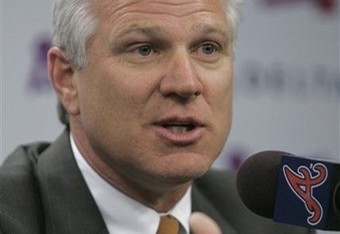
Editor’s Note: Today’s feature was prepared by our Intern, Rob Bland. Rob was selected from the many candidates who applied to write for MLB reports. Please feel free to leave comments and to welcome Rob aboard. You can also follow Rob on Twitter.***
Please e-mail us at: MLBreports@gmail.com with any questions and feedback. You can follow us on Twitter and become a fan on Facebook . To subscribe to our website and have the daily Reports sent directly to your inbox , click here and follow the link at the top of our homepage.

Welcome Back Dontrelle Willis: D-Train Comeback with the Reds
Friday July 15, 2011

MLB reports: The D-Train is back baby. Kind of. It’s too early to tell. Dontrelle Willis burst onto the scene and looked to be a star in the making once upon a time. After four solid campaigns in Florida, 2007 was seen as an off-year for the ace of the Marlins. Drafted originally by the Cubs in the 8th round in the 2000 draft, Willis was shifted in a package of players including Julian Tavarez for Matt Clement and Antonio Alfonseca. Willis became an instant star in Florida and throughout the MLB community. He had his own television commercials promoting the sport and was considered one of baseball’s greatest ambassadors. In his 2003 NL ROY campaign, Willis made the All-Star team and won a World Series. Not a bad way to start a career. From there, Willis made his second and last appearance at an All-Star game in 2005 and finished second in the NL CY Young voting for top pitcher. With such a solid start to his career, few observers blinked when Willis was relatively ineffective in 2007. However, the misery was the sign of things to come. The road became bumpy and full of twists and turns that few expected. From the majors to the minors, back and forth, until few expected to see him back. Until this past Sunday, July 10th, when Dontrelle Willis returned to the major leagues, this time in a Reds uniform.
 Although the blip in 2007 may not have scared off most observers, it was enough to put the Marlins in a tailspin. On December 5, 2007, the Marlins shipped off their franchise hitter and pitcher in Miguel Cabrera and Dontrelle Willis to the Detroit Tigers, in exchange for prospects Cameron Maybin, Andrew Miller and four others. As legend has it, Tigers GM Dave Dombrowski approached the Marlins and gave a list of available prospects. The Marlins made their selections and the trade took no time to put together. Shortly after, Willis signed a 3-year, $29 million contract and Cabrera signed his monster contract to make him one of the top paid players in the game. The move of Cabrera was seen at the time as partially motivated by the clearing of Willis’ salary off the Marlins’ books. Despite off-field incidents involving alcohol related arrests and domestic abuse, Cabrera has been a perennial MVP candidate since joining the Tigers. Miller and Maybin, the centerpieces of the deal for the Marlins, have not played to expectations and have since moved on to the Red Sox and Padres respectively. Then there was Willis. While viewed at the time as giving the Tigers a top-of-the-rotation starter, Willis proved to be anything but. As the story goes, when Willis came to Detroit, he did not bring his fastball or his control and was run out-of-town in 2010 as a result.
Willis suffered for two and a bit seasons in Detroit, receiving his walking papers officially on May 30, 2010. During his stay in Detroit, Willis played for three different minor league teams in two years, making it all the way down to A-ball at different points. While a demotion to A-ball may have benefitted Roy Halladay in his younger years, the same could not be said for Willis. The jumping started, from the Diamondbacks to the minor league levels pitching for the San Francisco Giants organization. Then Willis signed with the Reds this past off-season a minor league deal with an invite to spring training. Despite playing well in spring training, Willis was still sent to pitch in AAA for Louisville to start the 2011 season.
Here are the career numbers of Dontrelle Willis as they stand today:
| Year | Tm | W | L | ERA | G | GS | IP | H | BB | SO |
|---|---|---|---|---|---|---|---|---|---|---|
| 2003 | FLA | 14 | 6 | 3.30 | 27 | 27 | 160.2 | 148 | 58 | 142 |
| 2004 | FLA | 10 | 11 | 4.02 | 32 | 32 | 197.0 | 210 | 61 | 139 |
| 2005 | FLA | 22 | 10 | 2.63 | 34 | 34 | 236.1 | 213 | 55 | 170 |
| 2006 | FLA | 12 | 12 | 3.87 | 34 | 34 | 223.1 | 234 | 83 | 160 |
| 2007 | FLA | 10 | 15 | 5.17 | 35 | 35 | 205.1 | 241 | 87 | 146 |
| 2008 | DET | 0 | 2 | 9.38 | 8 | 7 | 24.0 | 18 | 35 | 18 |
| 2009 | DET | 1 | 4 | 7.49 | 7 | 7 | 33.2 | 37 | 28 | 17 |
| 2010 | TOT | 2 | 3 | 5.62 | 15 | 13 | 65.2 | 72 | 56 | 47 |
| 2010 | DET | 1 | 2 | 4.98 | 9 | 8 | 43.1 | 48 | 29 | 33 |
| 2010 | ARI | 1 | 1 | 6.85 | 6 | 5 | 22.1 | 24 | 27 | 14 |
| 2011 | CIN | 0 | 0 | 3.00 | 1 | 1 | 6.0 | 4 | 4 | 4 |
| 9 Seasons | 71 | 63 | 4.11 | 193 | 190 | 1152.0 | 1177 | 467 | 843 | |
| 162 Game Avg. | 13 | 11 | 4.11 | 34 | 34 | 205 | 209 | 83 | 150 | |
| FLA (5 yrs) | 68 | 54 | 3.78 | 162 | 162 | 1022.2 | 1046 | 344 | 757 | |
| DET (3 yrs) | 2 | 8 | 6.86 | 24 | 22 | 101.0 | 103 | 92 | 68 | |
| ARI (1 yr) | 1 | 1 | 6.85 | 6 | 5 | 22.1 | 24 | 27 | 14 | |
| CIN (1 yr) | 0 | 0 | 3.00 | 1 | 1 | 6.0 | 4 | 4 | 4 | |
| NL (7 yrs) | 69 | 55 | 3.84 | 169 | 168 | 1051.0 | 1074 | 375 | 775 | |
| AL (3 yrs) | 2 | 8 | 6.86 | 24 | 22 | 101.0 | 103 | 92 | 68 | |
Since leaving Florida, Willis at best has been inconsistent to unusable. A starting pitchers that cannot consistently throw strikes and get hitters out will not last in the majors. Dontrelle Willis proved this in 2007, when his shrinking talent led him to a ticket out of Florida as he continued to bounce around, until last week when Willis pitched for the Reds. Quite a performance for a pitcher not expected to ever pitch again in the minors. Willis proved last Sunday he was back, if only for one shining moment.
On July 10, 2011, Dontrelle Willis made his first MLB start in over a year against the Milwaukee Brewers. Willis pitched 6 innings, giving up 2 hits, 4 earned runs and a 4/4 BB/K. Willis gets his next kick at the can this coming Monday, July 18th vs. the Pirates and James McDonald. Should be a powerhouse game, keep an eye on it if you can. This is no surprise, given how well Willis pitched for the Bats this year. In 13 starts, Willis had a 5-2 record, 2.63 ERA, 67 SO in 75.1 IP and only 20 walks, good for a 1.2o8 WHIP. Considering that Willis struggled at both the major league and minor league levels from 2008-2010, his strong start in AAA was seen as a possible sign of a comeback. Now after having his first MLB start under the belt, Willis can go out and simply pitch his game.
Willis was seen as battling an anxiety disorder during his time in Detroit and many experts were ready to write him off. Believe it or not, Dontrelle Willis still isn’t even 30 years-old yet, with his birthday coming up on January 12 2012. He is still young and has the potential inside of him. Without any major physical injuries or setbacks, Willis still has a good arm and has many innings in him to pitch. This year, watching Willis in spring training, he looked to have his head back on straight. He was playing the game the right way. Strong pitching and timely hitting to boot. But despite his spring success, Reds management decided to send Willis to AAA until his recall last week. It looks like Willis has undergone a transformation as far as simplifying his delivery and avoiding his non-traditional leg kick. From the Reds point of view, they may have landed the steal of the year with Willis in their rotation.
This story till boil down to the confidence and mental health of Dontrelle Willis. As long as the man can think positive thoughts and do his thing on the mound, good things will happen. As long as Willis stays healthy, he will succeed provided he keeps his head on straight. With more and more MLB players admitting to depression and anxiety disorders, it is clear that today’s game is as much mental as it is physical. One great thing about sports, especially baseball, is that fans love an underdog that makes a comeback. For a guy with a ROY, World Series ring and two All-Star appearances, you don’t see many comebacks bigger than that of Dontrelle Willis. With one start under his belt and another one coming back next Monday, Willis is making baby steps. Given his age and track record, the potential is there. Here is hoping that Willis can fulfill it.

Please e-mail us at: MLBreports@gmail.com with any questions and feedback. You can follow us on Twitter and become a fan on Facebook . To subscribe to our website and have the daily Reports sent directly to your inbox , click here and follow the link at the top of our homepage.

Final Results and Recap: 2011 MLB Home Run Derby and All-Star Futures Game
Tuesday July 12, 2011

Rob Bland (Intern Candidate for MLB Reports): The MLB Home Run Derby is one of the greatest events in comparison to the All-Star games of any sport. Fans flock in droves to watch the event, hoping to catch an amazing feat such as Josh Hamilton hitting 28 in the first round in 2008, only to come in 2nd place, and Bobby Abreu hitting 41 total home runs on his way to winning the title in 2005.
 When the teams were announced, the fans booed both Prince Fielder and Rickie Weeks. Fielder was chastised for his selection of Weeks, as most casual fans were not aware of the pure power that he possesses. Weeks was chosen over Justin Upton, who would have been great in front of his Arizona hometown crowd.
Early on this Derby lacked excitement, save for Robinson Cano’s first round, in which he had his father, former major leaguer, Jose Cano, pitching to him. Cano blasted a number of balls deep into the right center field bleachers, his longest being 472 ft. Jose Bautista was a bit of a disappointment, smashing only 4 home runs and ended up being eliminated in the first round of the derby. Other disappointments included the aforementioned Rickie Weeks and Matt Kemp, who hit 3 and 2 home runs, respectively.
There was some excitement at the end, as both David Ortiz and Fielder hit 5 home runs a piece to tie Matt Holliday, forcing a 3-player swing-off for 3rd and 4th place. In this swing-off, each player received 5 swings in which to hit as many home runs as possible. Holliday led off with 5, Ortiz hit 4, and Fielder hit a perfect 5, two of which were mammoth shots.
The second round started off with Ortiz, and he began to show his age. Ortiz was likely tired after the first round plus enduring the sudden death swing-off. Ortiz hit only 4 home runs in the second round, and his average distance was 426 ft. Then came the Robinson Cano Show again. Cano launched 12 home runs in the second round, averaging 436 ft. His swing was picture perfect, and it seemed as though any time he didn’t hit a home run, his dad would be upset with him. Robinson’s dad knows his son’s strengths, and was confident he could hit that many. That is likely why Cano was named Robinson by his father, after the late and great Jackie Robinson.
Gonzalez was also able to put on a show in the second round, consistently pounding the ball 430+ft. He put on a display, hitting the ball to the opposite field, and straightaway center field on his way to finishing with 11 in the round, and 20 total, tying him with Cano. Fielder was up next, and aside from his first swing, that he hit 474 ft, he was not able to do much else. He finished with 4 in the round, 9 in total. So, it came down to the Yankees and Red Sox again. Cano and Gonzalez square off in the finals.
Gonzalez immediately impressed, hitting 8 home runs in his first 3 outs. He cooled off and finished with 11 in the finals. With the most impressive rounds of the night, Cano hit 10 in his first 16 swings, needing only 1 more to tie Gonzalez. The crowd erupted as he hit a home run over 470 ft to tie it up. The very next swing was the one that did it, as he hit it out to right center field. Gonzalez had a record 11 home runs in the last round, and Cano was clutch in beating that.
What started off as a slow, uneventful night, wound up being a compelling night of watching the Yankees battle the Red Sox in a pure power slugfest. Robinson and his dad embracing by the mound. The American League beating the National League. All in all, this year’s edition of the Home Run Derby was nothing short of spectacular.

| Chase Field, Phoenix — AL 76 defeats NL 19 | ||||||
|---|---|---|---|---|---|---|
| Player | Team | Round 1 | Round 2 | Subtotal | Finals | Total |
| Robinson Cano | Yankees | 8 | 12 | 20 | 12 | 32 |
| Adrian Gonzalez | Red Sox | 9 | 11 | 20 | 11 | 31 |
| Prince Fielder | Brewers | 5 | 4 | 9 | – | 9 |
| David Ortiz | Red Sox | 5 | 4 | 9 | – | 9 |
| Matt Holliday | Cardinals | 5 | – | 5 | – | 5 |
| Jose Bautista | Blue Jays | 4 | – | 4 | – | 4 |
| Rickie Weeks | Brewers | 3 | – | 3 | – | 3 |
| Matt Kemp | Dodgers | 2 | – | 2 | – | 2 |

In a game showcasing most of baseball’s brightest shining up and coming stars, there were several players who stood out from the pack. Although Bryce Harper (WAS) stole the spotlight in both the pre-game and post-game festivities, he did not shine quite as bright during the game. He was 0 for 4 with 2 strikeouts and 2 ground outs to first. One of which was hit fairly hard but a nice play by Yonder Alonso got the out.
Aside from two big innings, a 4-run 6th inning by the World Team hitters off of Drew Pomeranz, and a 3-run 8th inning off of Kelvin Herrera by Team USA, this was a game largely dominated by flame-throwing pitchers.
 For the US Team, my standout hitters were Jason Kipnis, (CLE) who led off the bottom of the 1st with a home run over the right-centre field wall, and Grant Green (OAK). Green crushed a double off the top of the wall in straight-away center that I thought would have been gone in any other park. He also stroked another double, going 2 for 2 with 2 doubles, a run scored and RBI on his way to earning MVP of the game. On the mound, I was blown away by Matt Moore, Tampa Bay’s mega pitching prospect. He threw 11 pitches, 9 of which were strikes. His fastball was clocked consistently between 94 and 98 mph, and he was also throwing a devastating slider at 86 mph. Phillies prospect Jared Cosart was also very impressive. He racked up 2 strikeouts and a fly out on 10 pitches; 8 strikes. Sitting at 96 with the heater, he also displayed a plus change-up.
Jose Altuve (HOU) is a guy that doesn’t get much credit, because he stands at about 5’6”. However, the Venezuelan native has hit everywhere he has played. He was 2 for 3 with a single and a double, and I came away impressed with the diminutive infielder. Jurickson Profar (TEX) may have been the youngest player there, but he was not overmatched, as he stroked a triple off Drew Pomeranz and displayed his impressive speed. On the bump, Canadian James Paxton stood out to me. The University of Kentucky product threw 6 pitches; all fastballs, and induced 3 quick outs. He was between 94 and 96 and showed better control than I remember the last time I saw him. Henderson Alvarez (TOR) was also impressive, with a fastball that topped out at 98 mph, and getting Harper to ground out to first on a 95 mph sinker.
The US team jumped out to an early lead thanks to the leadoff home run by Kipnis in the first, and an RBI fielder’s choice by Wil Myers (KC) in the 2nd inning. Team USA then made it 3-0 in the 5th on Green’s first double, which scored Gary Brown after he singled and stole second. In the top of the 6th, Drew Pomeranz (CLE) struggled, and gave up 4 runs. Alfredo Silverio (LAD) homered to left, scoring Dayan Viciedo (CWS) who had singled 2 batters prior. A walk to Chih-Hisen Chiang (BOS) and a double to Sebastian Valle (PHI) spelled the end of the night for Pomeranz. With the score knotted at 3, Profar then hit his triple off Kyle Gibson (MIN), scoring Valle in the process.
Green led off the 8th with a double, and Tim Beckham (TB) drove him in with a double of his own to tie the game at 4. After an Austin Romine (NYY) single and a Nolan Arenado (COL) double to right field, the damage was done, and the US had a 6-4 lead. Jacob Turner (DET) and Matt Harvey (NYM) split duties to close out the game for the US Team.
The US has now taken a 7-6 lead in the all-time series. A good number of these players will be on Major League rosters by season’s end, so be sure to check in on the minor league squads of your favorite teams for updates.

| U.S. Futures 6, World Futures 4 | ||||||||||||
| July 10, 2011 | ||||||||||||
| 1 | 2 | 3 | 4 | 5 | 6 | 7 | 8 | 9 | R | H | E | |
| World Futures | 0 | 0 | 0 | 0 | 0 | 4 | 0 | 0 | 0 | 4 | 8 | 0 |
| U.S. Futures | 1 | 1 | 0 | 0 | 1 | 0 | 0 | 3 | x | 6 | 10 | 0 |
| World Futures | AB | R | H | RBI | BB | SO | LOB | AVG |
| Marte, CF | 3 | 0 | 1 | 0 | 0 | 0 | 0 | .333 |
| c-Fuentes, PH-CF | 2 | 0 | 0 | 0 | 0 | 0 | 1 | .000 |
| Altuve, 2B | 3 | 0 | 2 | 0 | 0 | 0 | 1 | .667 |
| Schoop, 2B | 1 | 0 | 1 | 0 | 0 | 0 | 0 | 1.000 |
| Alonso, 1B | 2 | 0 | 0 | 0 | 2 | 1 | 1 | .000 |
| Viciedo, DH | 3 | 1 | 1 | 0 | 0 | 1 | 4 | .333 |
| d-Martinez, F, PH-DH | 1 | 0 | 0 | 0 | 0 | 0 | 1 | .000 |
| Liddi, 3B | 3 | 0 | 0 | 0 | 0 | 1 | 3 | .000 |
| Marte, J, 3B | 1 | 0 | 0 | 0 | 0 | 1 | 0 | .000 |
| Silverio, RF | 4 | 1 | 1 | 2 | 0 | 1 | 0 | .250 |
| Chiang, LF | 3 | 1 | 0 | 0 | 1 | 1 | 0 | .000 |
| Rosario, W, C | 2 | 0 | 0 | 0 | 0 | 0 | 0 | .000 |
| a-Valle, PH-C | 2 | 1 | 1 | 1 | 0 | 0 | 0 | .500 |
| Lee, SS | 2 | 0 | 0 | 0 | 0 | 1 | 0 | .000 |
| b-Profar, PH-SS | 2 | 0 | 1 | 1 | 0 | 0 | 0 | .500 |
| Teheran, P | 0 | 0 | 0 | 0 | 0 | 0 | 0 | .000 |
| Hendriks, P | 0 | 0 | 0 | 0 | 0 | 0 | 0 | .000 |
| Paxton, P | 0 | 0 | 0 | 0 | 0 | 0 | 0 | .000 |
| Martinez, C, P | 0 | 0 | 0 | 0 | 0 | 0 | 0 | .000 |
| Perez, M, P | 0 | 0 | 0 | 0 | 0 | 0 | 0 | .000 |
| Alvarez, H, P | 0 | 0 | 0 | 0 | 0 | 0 | 0 | .000 |
| Vizcaino, P | 0 | 0 | 0 | 0 | 0 | 0 | 0 | .000 |
| Herrera, P | 0 | 0 | 0 | 0 | 0 | 0 | 0 | .000 |
| Marinez, P | 0 | 0 | 0 | 0 | 0 | 0 | 0 | .000 |
| Totals | 34 | 4 | 8 | 4 | 3 | 7 | 11 | .235 |
a-Doubled for Rosario, W in the 6th. b-Tripled for Lee in the 6th. c-Flied out for Marte in the 6th. d-Popped out for Viciedo in the 7th.
BATTING
2B: Altuve (1, Skaggs), Valle (1, Pomeranz).
3B: Profar (1, Gibson).
HR: Silverio (1, 6th inning off Pomeranz, 1 on, 2 out).
TB: Marte; Altuve 3; Schoop; Viciedo; Silverio 4; Valle 2; Profar 3.
RBI: Silverio 2 (2), Valle (1), Profar (1).
2-out RBI: Silverio 2; Valle; Profar.
Runners left in scoring position, 2 out: Liddi; Viciedo; Fuentes.
Team RISP: 1-for-5.
Team LOB: 6.
BASERUNNING
CS: Schoop (1, 2nd base by Gibson/Romine).
PO: Schoop (1st base by Gibson).
FIELDING
DP: 2 (Liddi-Altuve-Alonso, Lee-Altuve-Alonso).
| U.S. Futures | AB | R | H | RBI | BB | SO | LOB | AVG | |
| Kipnis, 2B | 2 | 1 | 1 | 1 | 0 | 0 | 0 | .500 | |
| a-Green, PH-2B | 2 | 1 | 2 | 1 | 0 | 0 | 0 | 1.000 | |
| Machado, SS | 2 | 0 | 0 | 0 | 0 | 0 | 0 | .000 | |
| b-Beckham, PH-SS | 2 | 1 | 1 | 1 | 0 | 1 | 1 | .500 | |
| Harper, LF | 4 | 0 | 0 | 0 | 0 | 2 | 1 | .000 | |
| Goldschmidt, 1B | 4 | 0 | 0 | 0 | 0 | 1 | 1 | .000 | |
| Mesoraco, C | 1 | 1 | 1 | 0 | 0 | 0 | 0 | 1.000 | |
| Romine, C | 2 | 1 | 2 | 1 | 0 | 0 | 0 | 1.000 | |
| Middlebrooks, 3B | 2 | 0 | 1 | 0 | 0 | 0 | 1 | .500 | |
| Arenado, 3B | 2 | 0 | 1 | 1 | 0 | 0 | 1 | .500 | |
| Darnell, DH | 3 | 0 | 0 | 0 | 1 | 1 | 3 | .000 | |
| Myers, RF | 3 | 0 | 0 | 1 | 0 | 1 | 2 | .000 | |
| Brown, G, CF | 2 | 1 | 1 | 0 | 0 | 0 | 1 | .500 | |
| Szczur, CF | 1 | 0 | 0 | 0 | 0 | 0 | 0 | .000 | |
| Skaggs, P | 0 | 0 | 0 | 0 | 0 | 0 | 0 | .000 | |
| Peacock, P | 0 | 0 | 0 | 0 | 0 | 0 | 0 | .000 | |
| Miller, S, P | 0 | 0 | 0 | 0 | 0 | 0 | 0 | .000 | |
| Moore, P | 0 | 0 | 0 | 0 | 0 | 0 | 0 | .000 | |
| Thornburg, P | 0 | 0 | 0 | 0 | 0 | 0 | 0 | .000 | |
| Pomeranz, P | 0 | 0 | 0 | 0 | 0 | 0 | 0 | .000 | |
| Gibson, P | 0 | 0 | 0 | 0 | 0 | 0 | 0 | .000 | |
| Cosart, P | 0 | 0 | 0 | 0 | 0 | 0 | 0 | .000 | |
| Turner, P | 0 | 0 | 0 | 0 | 0 | 0 | 0 | .000 | |
| Harvey, M, P | 0 | 0 | 0 | 0 | 0 | 0 | 0 | .000 | |
| Totals | 32 | 6 | 10 | 6 | 1 | 6 | 11 | .313 |
a-Doubled for Kipnis in the 5th. b-Struck out for Machado in the 5th.
BATTING
2B: Green 2 (2, Perez, M, Herrera), Beckham (1, Herrera), Arenado (1, Herrera).
HR: Kipnis (1, 1st inning off Teheran, 0 on, 0 out).
TB: Kipnis 4; Green 4; Beckham 2; Mesoraco; Romine 2; Middlebrooks; Arenado 2; Brown, G.
RBI: Kipnis (1), Myers (1), Green (1), Beckham (1), Romine (1), Arenado (1).
2-out RBI: Green; Romine; Arenado.
Runners left in scoring position, 2 out: Beckham; Darnell.
GIDP: Middlebrooks; Myers.
Team RISP: 4-for-10.
Team LOB: 4.
BASERUNNING
SB: Brown, G (1, 2nd base off Perez, M/Rosario, W).
FIELDING
Pickoffs: Gibson (Schoop at 1st base).
| World Futures | IP | H | R | ER | BB | SO | HR | ERA | |
| Teheran | 1.0 | 1 | 1 | 1 | 0 | 1 | 1 | 9.00 | |
| Hendriks | 1.0 | 2 | 1 | 1 | 0 | 0 | 0 | 9.00 | |
| Paxton | 1.0 | 0 | 0 | 0 | 0 | 0 | 0 | 0.00 | |
| Martinez, C | 1.0 | 0 | 0 | 0 | 0 | 1 | 0 | 0.00 | |
| Perez, M | 1.0 | 2 | 1 | 1 | 1 | 1 | 0 | 9.00 | |
| Alvarez, H (H, 1) | 1.0 | 1 | 0 | 0 | 0 | 0 | 0 | 0.00 | |
| Vizcaino (H, 1) | 1.0 | 0 | 0 | 0 | 0 | 1 | 0 | 0.00 | |
| Herrera (BS, 1)(L, 0-1) | 0.2 | 4 | 3 | 3 | 0 | 1 | 0 | 40.50 | |
| Marinez | 0.1 | 0 | 0 | 0 | 0 | 1 | 0 | 0.00 | |
| Totals | 8.0 | 10 | 6 | 6 | 1 | 6 | 1 | 6.75 |
| U.S. Futures | IP | H | R | ER | BB | SO | HR | ERA | |
| Skaggs | 1.0 | 1 | 0 | 0 | 1 | 1 | 0 | 0.00 | |
| Peacock (H, 1) | 1.0 | 0 | 0 | 0 | 0 | 1 | 0 | 0.00 | |
| Miller, S (H, 1) | 1.0 | 1 | 0 | 0 | 1 | 1 | 0 | 0.00 | |
| Moore (H, 1) | 1.0 | 0 | 0 | 0 | 0 | 1 | 0 | 0.00 | |
| Thornburg (H, 1) | 1.0 | 1 | 0 | 0 | 0 | 0 | 0 | 0.00 | |
| Pomeranz (BS, 1) | 0.2 | 3 | 4 | 4 | 1 | 1 | 1 | 54.00 | |
| Gibson | 1.1 | 2 | 0 | 0 | 0 | 0 | 0 | 0.00 | |
| Cosart (W, 1-0) | 1.0 | 0 | 0 | 0 | 0 | 2 | 0 | 0.00 | |
| Turner (H, 1) | 0.2 | 0 | 0 | 0 | 0 | 0 | 0 | 0.00 | |
| Harvey, M (S, 1) | 0.1 | 0 | 0 | 0 | 0 | 0 | 0 | 0.00 | |
| Totals | 9.0 | 8 | 4 | 4 | 3 | 7 | 1 | 4.00 |
Balk: Perez, M.
HBP: Mesoraco (by Martinez, C).
Pitches-strikes: Teheran 19-13, Hendriks 18-10, Paxton 6-4, Martinez, C 11-6, Perez, M 23-11, Alvarez, H 11-6, Vizcaino 6-5, Herrera 23-14, Marinez 11-8, Skaggs 17-11, Peacock 9-7, Miller, S 20-12, Moore 11-9, Thornburg 10-7, Pomeranz 23-14, Gibson 16-11, Cosart 10-8, Turner 9-6, Harvey, M 3-1.
Groundouts-flyouts: Teheran 1-1, Hendriks 2-1, Paxton 2-1, Martinez, C 1-0, Perez, M 1-0, Alvarez, H 2-1, Vizcaino 2-0, Herrera 0-1, Marinez 0-0, Skaggs 1-1, Peacock 1-0, Miller, S 2-0, Moore 2-0, Thornburg 2-1, Pomeranz 0-0, Gibson 0-2, Cosart 0-1, Turner 0-1, Harvey, M 1-0.
Batters faced: Teheran 4, Hendriks 5, Paxton 3, Martinez, C 3, Perez, M 5, Alvarez, H 4, Vizcaino 3, Herrera 6, Marinez 1, Skaggs 5, Peacock 3, Miller, S 5, Moore 3, Thornburg 4, Pomeranz 6, Gibson 5, Cosart 3, Turner 2, Harvey, M 1.
Inherited runners-scored: Marinez 1-0, Gibson 1-1.
Umpires: HP: Ben May. 1B: Will Little. 2B: Jimmy Volpi. 3B: Scott Mahoney.
Weather: 74 degrees, roof closed.
Wind: 1 mph, Varies.
T: 2:38.
***Thank you to Rob Bland for preparing today’s article on the 2011 Home Run Derby and All-Star Futures Game. You can follow Rob on Twitter.***
Please e-mail us at: MLBreports@gmail.com with any questions and feedback. You can follow us on Twitter and become a fan on Facebook . To subscribe to our website and have the daily Reports sent directly to your inbox, click here and follow the link at the top of our homepage.

Team USA: Preview of the 2011 MLB All-Star Futures Game
Friday, July 8, 2011
Rob Bland (Intern Candidate for MLB Reports): With the World Team roster covered here on the Reports, we now bring you the potent line-up of Team USA. They are highlighted by standouts Mike Trout (LAA) [named to the squad but just called up to the Angels] and Bryce Harper (WAS). Team USA also boasts an electric mix of pitching arms, including Shelby Miller (STL) and Jacob Turner (DET).

PITCHERS
Jarred Cosart – RHP –Texas – PHI –Clearwater Threshers – A – Florida State League
Jarred sits in the mid 90s and has touched 99 in some starts. This is his second straight year at the Futures Game, although he did not pitch last year. He has average command, as witnessed by his 36 walks in 92 innings, but if he can improve upon that, many scouts see him as a frontline starter.
Kyle Gibson – RHP –Indiana – MIN –Rochester Red Wings – AAA – International League
Gibson has the look of a middle of the rotation innings eater. His fastball has late sink, which gets him a ton of ground balls. With better defense as he moves up, and his ability to throw strikes, he could be a fairly useful 3rd starter.
Matt Harvey – RHP –Connecticut – NYM –Binghamton Mets – AA – Eastern League
Harvey pretty much carved up the Florida State League earlier in the year, but in 3 starts in AA, he has not been able to get past the 5th inning. He strikes a lot of guys out, and doesn’t walk many. As he matures and makes adjustments, he should succeed. He is expected to fast track to the Mets rotation, possibly as early as 2012.
Shelby Miller – RHP –Texas – STL –Springfield Cardinals – AA –Texas League
Ranked as the 4th pitcher in Baseball America’s Midseason Top 50 Prospects List, Miller has been skyrocketing through the ranks, as he got to AA before his 21st birthday. Miller has struck out 119 batters in 91 innings, while his WHIP sits at 1.10. His fastball usually sits in the low 90s with sink and run. He also possesses an above average changeup and a good curveball. Miller has all the tools to win a Cy Young Award someday.
Matt Moore – LHP –Florida – TB –Montgomery Biscuits – AA – Southern League
Moore is rated 3rd overall on BA’s list, and has top of the rotation stuff. He led the minor leagues in strikeouts in both 2009 and 2010, collecting 384K in 267 IP between High-A and AA. Moore has picked up where he left off, with 125 K already this season. His best pitch is a curveball from a low ¾ arm slot.
Brad Peacock – RHP –Florida – WAS –Harrisburg Senators – AA – Eastern League
Another pitcher who seems to finally have put it all together, he has 129 K and hitters have a paltry .179 average against him. Peacock is wiry and should fill out to increase his velocity. I see him as a mid rotation guy with a good fastball and breaking ball and decent change.
Drew Pomeranz – LHP –Tennessee – CLE –Kinston Indians – A –Carolina League
Pomeranz sits at 92 with his fastball, with good command. His breaking ball can be a plus, although it is inconsistent. He keeps the ball in the yard, and due to his large workhorse type frame, he could be an innings eater at the number 2 or 3 spot in a rotation.
Tyler Skaggs – LHP –California – ARI –Visalia Rawhide – A –California League
Skaggs has gained 15 pounds over the offseason, which has allowed him to raise his velocity a couple notches. For a lefty who throws from a ¾ slot, he has surprisingly little movement. His changeup has improved this year, which makes me believe his ceiling could be as a number 2 starter, but most likely settles in the 3-4 range.
Tyler Thornburg – RHP –Texas – MIL –Brevard County Manatees – A –FloridaState League
This 3rd rounder in 2010 has simply overmatched his competition so far this year. With an ERA under 2.00, and opponents hitting under .200 against him, even after a move up to the Florida State League, Thornburg has the tools to succeed. He has a good fastball and a power curve while his changeup needs time to develop. If it doesn’t, a career in a setup role is possible.
Jacob Turner – RHP –Missouri – DET –Erie Sea Wolves – AA – Eastern League
Turner has a heavy fastball with late life that sits around 93, touching 95. He has a sharp, but inconsistent curveball, which if he polishes, could be a devastating combo out of the pen. For a guy who just turned 20 playing AA, Turner has pitched very well with a K:BB ratio at 2.7:1. Opponents have also only hit .233 off of him.

CATCHERS
Devin Mesoraco – C –Pennsylvania – CIN –Louisville Bats – AAA – International League
Catchers with 25-30 homerun power are so rare that they often get moved to first base or even the outfield. Mesoraco’s defense is average at best, so the move does seem likely in a few years. Mesoraco walks a fair amount and is a doubles hitting machine, which makes me think he will be an above average regular by 2013.
Austin Romine – C –California – NYY –Trenton Thunder – AA – Eastern League
Romine hasn’t wowed anyone with his bat, but has shown steady improvements from year to year. In his second year of AA he has raised his average, OBP and OPS. He has a cannon for an arm and quick feet, although his receiving isn’t quite ready. He could be a solid regular in a few years if the Yankees give him the chance.

INFIELDERS
Nolan Arenado – 3B –California –COL –Modesto Nuts – A- California League
This big, strong third baseman has decent feet and an average arm, so I see him being Todd Helton’s replacement in the future. He has a power bat that should develop even further as he matures. Arenado doesn’t strike out much and walks enough to have a decent OBP, so his bat will suffice at any position.
Tim Beckham – SS – Georgia – TB –Montgomery Biscuits – AA – Southern League
Although he hasn’t quite lived up to the hype of his number 1 overall selection in the 2008 draft, he has shown enough skill to keep moving up the ladder. Every year, his numbers have improved, and I believe he is close to a breakout. He is still a plus defender which will keep him in the big leagues for a very long time.
James Darnell – 3B –California – SD –Tucson Padres – AAA –Pacific Coast League
Darnell just got called up to AAA after dominating Texas league pitching. His defense is simply average, and may have to move to a corner outfield. However, his bat is his plus tool, as he has shown even more improvements from his 2010 season in which he struggled. He already has 19 home runs, and has walked 52 times as opposed to only 48 strikeouts, so his approach at the plate is advanced.
Paul Goldschmidt – 1B –Delaware – ARI –Mobile Bay Bears – AA – Southern League
Goldschmidt has unreal power potential. He has been a solid hitter at every level, but has taken his game to another level this year. He already has 25 HR and 77 RBI, and he walks a ton. This guy could be in a big league uniform as early as this September, but more than likely will be sometime in 2012.
Grant Green – SS –California – OAK – Midland Rock Hounds – AA –Texas League
Green profiles as a true shortstop with slightly above average hands and arm, with the ability to produce good numbers offensively. He hit 20 HR last year in high-A, and the move to AA this year has stunted his power, but he still walks and gets on base at a good clip. He isn’t flashy but he gets the job done and could be one of the better regular shortstops in the league.
Jason Kipnis – 2B –Illinois – CLE –Columbus Clippers – AAA – International League
This former center fielder shifted to 2B, where his lack of range still limits him to being only an average defender. However, his bat will keep him in the big leagues for many years. His numbers have improved every year, despite moving up a level. He walks at a good rate and has some pop. Doesn’t have a high ceiling, but what you see is what you will get.
Manny Machado – SS –Florida – BAL –Frederick Keys – A –Carolina League
Machado is still thin, but looks like he could fill out, in which case a move to third would be warranted. He has a plus arm and solid footwork to go along with his very soft hands. Although he has struggled a bit since being called up to high-A, he has the IQ to really succeed at the plate. He takes pitches and isn’t afraid to hit with 2 strikes.
Will Middlebrooks – 3B –Texas – BOS –Portland Sea Dogs – AA – Eastern League
Middlebrooks has had a slow ascent through the minors, and with continued production, he could get a look at the big leagues by next year. He is a solid defender at third, with a good bat. Needs to work on discipline as his K:BB ratio is at 59:18. Could be a regular in the big leagues by 2013.

OUTFIELDERS
Gary Brown – CF –California – SF –San Jose Giants – A –California League
Brown has absolutely blazing speed, with a very good bat. He has stolen 35 bags, but also been caught 14 times, so he must learn to choose his spots more wisely. Brown also shows the ability to hit for power, stroking doubles in the gaps consistently.
Bryce Harper – RF –Nevada – WAS –Harrisburg Senators – AA – Eastern League
By now, everyone knows the legend of Bryce Harper, and he has lived up to the billing. He dominated the Arizona Fall League as a taxi squad player, and showed enough early in A-ball to warrant a call-up straight to AA. The fact that Harper could even surpass people’s expectations is astounding, and I believe he could be a September roster addition for the Nationals.
Wil Myers – OF –North Carolina – KC – Northwest Arkansas Naturals – AA –Texas League
Myers moved from catcher to outfield in the fall of 2010, and this move should pay off for him in the long run. He is aggressive at all times, and he is extremely raw still. He lost part of the season due to an infection from a cut, so he is just rounding into form now. AA has been tough for him, but his tools will shine in the long run. One of the favorites of the Reports, keep an eye on this kid.
Matthew Szczur – OF –New Jersey – CHI Cubs –Peoria Chiefs – A –Midwest League
Szczur has tremendous speed and he covers a lot of ground in the outfield. He hits well for average, but hasn’t quite developed his power yet. This could happen as he matures. He walks at a decent clip, and has the ability to steal a ton of bases, so he could be a mainstay near the top of the Cubs line-up.
**Mike Trout – CF – New Jersey – LAA –Los Angeles Angels of Anaheim – MLB
As I began writing this, it was reported that Trout had been recalled to the big league team, and no replacement has yet been named. Trout does everything well, and many people were very excited to see him play alongside Harper. He may not offer as much power as Harper, but he might be one of the fastest players in the big leagues.
Many people will be disappointed that Trout and Harper won’t be playing alongside each other in the Team USA outfield in the Worlds Game, but there is so much talent at this year’s event that nobody will leave Chase Field disappointed. MLB`s ability to showcase not only current talent, but future stars, highlighted by this year’s fanfest events, make the MLB All-Star Weekend festivities the best of any of the major sports. Get ready for an explosive Futures Game this Sunday, as the youngsters duel for the spotlight and the chance to make the major leagues one day soon.
***Thank you to Rob Bland for preparing today’s article on the All-Star Futures Game, preview of the World Team. You can follow Rob on Twitter.***
Please e-mail us at: MLBreports@gmail.com with any questions and feedback. You can follow us on Twitter and become a fan on Facebook . To subscribe to our website and have the daily Reports sent directly to your inbox, click here and follow the link at the top of our homepage.

MLB All-Star Futures Game 2011: World Team Preview
Thursday, July 7, 2011

Rob Bland (Intern Candidate for MLB Reports): Since its inception in 1999, the Futures Game, now sponsored by XM Satellite Radio, has grown steadily in popularity. The players involved are split into two squads: USA and the World team. The rosters comprise of 25 players each, with every MLB organization represented, and no more than two players from each team. This year’s game will be played at Arizona Diamondbacks’ Chase Field on Sunday, July 10th, a day before the MLB All-Star Homerun Derby.
Previous editions of the Futures Game has been littered with immense talent, and this year is no exception. The MVP of the inaugural event was Alfonso Soriano, and in other years it was Jose Reyes (2002), Grady Sizemore (2003), Aaron Hill (2004), and Billy Butler in 2006. Other notable past participants were superstars Ryan Braun of the Milwaukee Brewers, Robinson Cano of the NY Yankees, and Clayton Kershaw of the LA Dodgers.
This year’s game is no different, as 14 of MLB.com’s Preseason Top 50 Prospects List will be participating in the event. That number could very easily be higher, but more than a dozen of those 50 are currently playing in the MLB. This year’s USA crop is highlighted by Mike Trout, #1 on the top 50 list, (LAA) and Bryce Harper, #3, (WAS) sharing the same outfield. The World team boasts a strong pitching staff, led by Julio Teheran, #10, (ATL) and Henderson Alvarez of the Toronto Blue Jays.
Let’s take a close look at the featured players that will be respresenting this year’s World Team:
WORLD TEAM

PITCHERS
Henderson Alvarez – RHP -Venezuela– TOR –New Hampshire Fisher Cats – AA – Eastern League
Alvarez is a right-handed starter who is in his second turn at the Futures Game. He has always possessed plus command, walking only 1.8 batters per 9 innings in his 5 year minor league career. An increase in weight over the offseason has also helped increase his velocity, as he touches 98 mph.
Liam Hendriks – RHP -Australia – MIN –New Britain Rock Cats – AA – Eastern League
Had an appendectomy just days before last year’s game, so this is a reprise for him. Not unhittable, but throws a ton of strikes; just 18 walks in 90 innings so far. Sits in the 87-91mph range with average secondary offerings.
Kelvin Herrera – RHP -Dominican Republic – KC – Northwest Arkansas Naturals – AA –Texas League
Diminutive right-handed reliever who has been almost untouchable this season. Since his call-up to AA early in the season, he has walked 2 batters to 35 strikeouts in 26 2/3 innings. He sits around 95-96mph with a plus change-up.
Gregory Infante – RHP -Venezuela – CHISox – Charlotte Knights – AAA – International League
Another flame-throwing righty, he has managed to lower his walk rate and raise his strikeout rate in getting to AAA this year. He gets enough groundouts and doesn’t give up many homeruns. His lack of a consistent second pitch is holding him back, although his curve shows flashes of brilliance in the low 80s.
Jhan Marinez – RHP -Dominican Republic –FLA –Jacksonville Suns – AA – Southern League
Another righty reliever that can touch 98, with an exceptional 2-seamer that sits at 92. His problem, as most young arms, is control. Over his career he has average 6 BB/9, and has so far managed 7.9 BB/9 this year. He has struck out almost 12 per 9 innings though.
Carlos Martinez – RHP – Dominican Republic – STL – Palm Beach Cardinals – A – Florida State League
A Latin pitcher, thin and wiry who sits mid 90s with his fastball which has a good late cut. He has given up only 31 hits in 44 2/3 innings pitched, and is able to induce a lot of ground balls.
James Paxton – LHP -Canada – SEA – Jackson Generals – AA – Southern League
A tall, strong lefty, who didn’t sign after being selected in the supplemental first round in 2009, got a later start on his professional career after three years at the UniversityofKentucky. He sits 92-95mph with an above average curve, a power slider and average change-up. As a starter this year, he has struck out 81 batters in 60 2/3 innings.
Martin Perez – LHP -Venezuela –TEX – Frisco RoughRiders – AA –Texas League
A left handed starter with a fastball that sits around 92mph, his bread and butter is his sharp, hard-breaking curveball. His command is average, as he walks close to 4 batters per 9 innings.
Julio Teheran – RHP -Colombia – ATL – Gwinnett Braves – AAA – International League
It’s not often you see a 20-year old in AAA with his numbers. 9-1 with a 1.79 ERA in 90 2/3 IP. He possess a plus fastball that sits 92-94, with a plus plus change-up with great sink. Projects to be a #2 starter, if not a true ace in the big leagues.
Arodys Vizcaino – RHP -Dominican Republic – ATL –Mississippi Braves – AA – Southern League
Strong, well developed legs allow him to sit in the 91-94 range, topping at 95. His curve and change have yet to fully develop, but show flashes of promise. He has the ability to miss bats, as he has compiled 76 K in 78 2/3 IP.
CATCHERS
Willin Rosario – C -Dominican Republic –COL -Tulsa Drillers – AA –Texas League
He possesses 30+ HR power, but lacks discipline and doesn’t walk. He has power to all fields but strikes out in almost 20% of his at bats. If he can learn some patience, he could be one of the top young catchers in the game.
Sebastian Valle – C -Mexico – PHI –Clearwater Threshers – A –Florida State League
Valle is a catcher who has hit at every level so far, yet still lacks patience, which is very common with young backstops. If he can raise his walk rate, and keep hitting the ball to all fields, he could be a special catcher in the Phillies organization.

INFIELDERS
Yonder Alonso – 1B/OF -Cuba – CIN –Louisville Bats – AAA – International League
Alonso is a very polished hitter. He has begun to play more innings at left field, because the Reds have Joey Votto as a lock at 1B. He hits to all fields, with some pop, and he walks a fair amount, which has led to his .861 OPS in AAA.
Jose Altuve – 2B -Venezuela – HOU – Corpus Christi Hooks – AA –Texas League
Listed at 5’7”, but plays as if he was 6’3”. Altuve is currently hitting .362 with 4 HR and 22 RBI in 31 games in AA after starting the season in A-ball, where he hit over .400 in 52 games. He doesn’t walk much, but when he is hitting everything thrown at him, he doesn’t really need to.
Hak-Ju Lee – SS -South Korea – TB – Charlotte Stone Crabs – A –FloridaState League
He is a plus defender at shortstop with good speed. Lee needs to work on his base stealing to better utilize that speed. He is having the best offensive season of his career, and is really looking like a steal in the Matt Garza trade with the Cubs.
Francisco Martinez – 3B -Venezuela – DET –Erie Sea Wolves – AA – Eastern League
Martinez is a prototypical third baseman with a quick bat and strong arm. Once he fills out his athletic frame, he should develop plus power. He still strikes out too much as he adjusts to AA pitching.
Alex Liddi – SS -Italy – SEA –Tacoma Rainiers – AAA –PacificCoast League
As the first Italian position player to sign a professional contract, he was seen as a bit of a project back in 2005. He has begun to develop his power, bashing 15 HR so far this season, but strikes out a ton; around 30% of his plate appearances end with him walking back to the dugout.
Jeffry Marte – 3B – Dominican Republic – NYM – St. Lucie Mets – A –Florida State League
Marte has good gap power and has a decent eye at the plate, as well as being smart on the base paths. May not be able to stay at 3B long term, but as long as his bat continues to progress, could make it to the big leagues as an outfielder.
Jurickson Profar – SS – Curacao –TEX –Hickory Crawdads – A –South Atlantic League
Premium defender at shortstop, with speed and the ability to drive the ball all over the field. He walks more than he strikes out, and once he fills out his 165lb frame, he could eventually become a 20/20 shortstop in the big leagues.
Jonathan Schoop – 3B – Curacao – BAL –Frederick Keys – A –Carolina League
Possesses the skills to play anywhere in the infield, his long term future looks to be 3B. He has quick feet and a good arm, with a quick bat. As he gets stronger, he could be a 20 HR guy that can drive in a ton of runs.
OUTFIELDERS
Chih-Hsien Chiang – OF -Taiwan – BOS –Portland Sea Dogs – AA – Eastern League
After five years of mediocrity in the minor leagues, he seems to have put it together this year. Hitting in the middle of Portland’s line-up, he has not only driven in 58 runs and hit 14 homeruns, but also hit 26 doubles, giving him a .618 SLG. Over half of his hits have been for extra bases, with gap power, he could prove that Boston’s roots in Asia are only getting stronger.
Reymond Fuentes – CF – Puerto Rico – SD –LakeElsinore Storm – A –California League
One of the pieces in the Adrian Gonzalez deal, he should be able to man center field at Petco Park for years to come with his speed. He already has 34 stolen bases, and he gets on base quite frequently. He may never hit for power, but could be a leadoff type hitter in the big leagues.
Starling Marte – CF -Dominican Republic – PIT –Altoona Curve – AA – Eastern League
There aren’t many players in baseball that could push Andrew McCutchen to a corner outfield position, but Marte could be one of them. He possesses the speed to cover a lot of ground, and although his power hasn’t quite developed, he could be a 10-15 HR player with a good OBP if his discipline continues to progress.
Alfredo Silverio – LF -Dominican Republic – LAD –Chattanooga Lookouts – AA – Southern League
Silverio has always seemed ready to be the power/speed combination outfielder the Dodgers envisioned when they signed him in 2003, and almost eight years later, he may finally be hitting his stride. If his discipline can improve, he could be in the big leagues quickly. Lacks a good arm, so he is basically destined for left field.
Dayan Viciedo – RF -Cuba – CHI Sox – Charlotte Knights – AAA – International League
Finally moved to the outfield this year, he has a solid arm for right field, and he flat out mashes. Many see a 30 HR player in the near future, as he uses all parts of the field with a quick compact stroke.
The World team is comprised of players from twelve countries: eight from the Dominican Republic, five from Venezuela, two from Cuba and Curacao, and one each from Canada, Taiwan, South Korea, Australia, Italy, Colombia, Mexico, and Puerto Rico.
Stay tuned for analysis on the US roster.
***Thank you to Rob Bland for preparing today’s article on the All-Star Futures Game, preview of the World Team. You can follow Rob on Twitter.***
Please e-mail us at: MLBreports@gmail.com with any questions and feedback. You can follow us on Twitter and become a fan on Facebook . To subscribe to our website and have the daily Reports sent directly to your inbox, click here and follow the link at the top of our homepage.

Final Rosters are Announced: 2011 MLB All-Star Game Vote Totals and Time for the Final Vote
Monday, July 4, 2011

MLB reports: The day has finally arrived. After weeks of voting in stadiums and on-line, the 2011 final rosters for the All-Star game are set, coming up Tuesday July 12th from beautiful Arizona, hosted by the Diamondbacks. Barring injuries and players pulling out, we now know the starting lineups, pitching staffs and reserves representing the American League and National League in the All-Star game. After the fans voted in the starting lineups, the All-Star managers, Ron Washington for the AL and Bruce Bochy for the NL, filled out the rest of their rosters. There were some surprises in the announcements to say the least. We saw some last-minute changes in the voting by the fans to the starting lineups. From there, the All-Star managers made some very interesting selections as well. On the whole, the rosters are fair and well deserved. But some spots are debatable. Then once you account for the selections by the managers, we enter the realm of a week-long debate. Let’s take a look at the rosters for each league, including the starters, the pitching staffs and the reserves. From there, we will analyze the candidates for the coveted “Final Vote” spot as chosen by the fans on-line, between now and 4:00p.m. on July 7th.

American League All-Star Roster:
| Pos | Player | ||||||
 |
|||||||
| C | Alex Avila,Tigers | ||||||
|
|||||||
| 1B | Adrian Gonzalez, Red Sox | ||||||
|
|||||||
| 2B | Robinson Cano, Yankees | ||||||
|
|||||||
| 3B | Alex Rodriguez, Yankees | ||||||
|
|||||||
| SS | Derek Jeter, Yankees | ||||||
|
|||||||
| OF | Jose Bautista, Blue Jays | ||||||
|
|||||||
| OF | Curtis Granderson, Yankees | ||||||
|
|||||||
| OF | Josh Hamilton, Rangers | ||||||
|
|||||||
| DH | David Ortiz, Red Sox | ||||||
The American League starting lineup as voted by the fans took shape as projected the last few days. The infield remains with Adrian Gonzalez at first, combined with Yankees Robinson Cano, Derek Jeter and Alex Rodriguez. Despite late pushes, Asdrubal Cabrera and Adrian Beltre could not garner enough votes to make the starting lineup, although both are on their way to Arizona as reserves. David Ortiz joins Jose Bautista, Curtis Granderson and Josh Hamilton in a very heavy Yankees/Red Sox lineup. Jacoby Ellsbury also did not attain enough votes to start but will be a reserve. Hamilton, the former AL MVP, proved to be too popular on this day. The one major upset though was Alex Avila, who through very strong play and Tigers fans voting is starting next Tuesday ahead of the reserve Russell Martin. Considering that Martin held onto the spot for the majority of the voting, Tigers fans were very successful in sending the deserving Avila to Arizona.
| Pos | Player | |||||
|
||||||
| P | Josh Beckett, Red Sox | |||||
|
||||||
| P | Aaron Crow, Royals | |||||
|
||||||
| P | Gio Gonzalez, Athletics | |||||
|
||||||
| P | Felix Hernandez, Mariners | |||||
|
||||||
| P | Brandon League, Mariners | |||||
|
||||||
| P | Chris Perez, Indians | |||||
|
||||||
| P | David Price, Rays | |||||
|
||||||
| P | Mariano Rivera, Yankees | |||||
|
||||||
| P | James Shields, Rays | |||||
|
||||||
| P | Jose Valverde, Tigers | |||||
|
||||||
| P | Justin Verlander, Tigers | |||||
|
||||||
| P | Jered Weaver, Angels | |||||
|
||||||
| P | C.J. Wilson, Rangers | |||||
An incredible pitching staff to say the least, but not without its omissions. Despite such a strong selection, C.C. Sabathia, Jon Lester, Dan Haren, Jeremy Hellickson, Ricky Romero and Bartolo Colon all were left off the roster. Other pitchers deserving consideration with Jordan Walden, Sergio Santos, Kyle Farnsworth and Jonathan Papelbon. The selections of Aaron Crow, Gio Gonzalez, Brandon League and Jose Valverde will receive the most criticism in the coming days. While decent picks, there appears to be more deserving players that were cast aside for the above all-stars. A dilemma every year, I make the submission that the AL pitching staff is one that needs a second opinion given the candidates left on the board.
| Pos | Player | ||||||
|
|||||||
| C | Russell Martin, Yankees | ||||||
|
|||||||
| C | Matt Wieters, Orioles | ||||||
|
|||||||
| 1B | Miguel Cabrera, Tigers | ||||||
|
|||||||
| 2B | Howard Kendrick, Angels | ||||||
|
|||||||
| 3B | Adrian Beltre, Rangers | ||||||
|
|||||||
| SS | Asdrubal Cabrera, Indians | ||||||
|
|||||||
| OF | Michael Cuddyer, Twins | ||||||
|
|||||||
| OF | Jacoby Ellsbury, Red Sox | ||||||
|
|||||||
| OF | Matt Joyce, Rays | ||||||
|
|||||||
| OF | Carlos Quentin, White Sox | ||||||
|
|||||||
| DH | Michael Young, Rangers | ||||||
Notable absences are Paul Konerko of the White Sox and Mark Teixeira of the Yankees. Despite strong power numbers for each, the AL is only carrying two active first basemen, with Michael Young available as well. Apparently the limit of Yankees was reached and a spot could not be found for either one. Konerko though will get a second kick at the can, who together with Victor Martinez are the strongest candidates for the Final Vote spot. While credit should go to Ron Washington in the selection of Joyce and Quentin, the selection of Cuddyer will be considered curious by some. His roster spot relates more to the representation of a player for each team than being a top all-star. So as a result, deserving candidates like Konerko, Teixeira and Martinez may not be in Arizona for the big game.
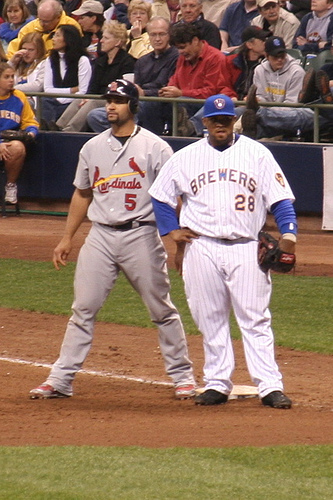
National League All-Star Roster:
| Pos | Player | ||||||
|
|||||||
| C | Brian McCann, Braves | ||||||
|
|||||||
| 1B | Prince Fielder, Brewers | ||||||
|
|||||||
| 2B | Rickie Weeks, Brewers | ||||||
|
|||||||
| 3B | Placido Polanco, Phillies | ||||||
|
|||||||
| SS | Jose Reyes, Mets | ||||||
|
|||||||
| OF | Ryan Braun, Brewers | ||||||
|
|||||||
| OF | Lance Berkman, Cardinals | ||||||
|
|||||||
| OF | Matt Kemp, Dodgers | ||||||
We are now in the senior circuit and begin with the starting lineup. The fans were very active in the final week of voting here as four members of the starting lineup were last-minute winners. Prince Fielder is in over Albert Pujols, Rickie Weeks beat out the reserve Brandon Phillips, Jose Reyes is in while Troy Tulowitzki is out of the lineup and on the bench and Matt Kemp beat out Matt Holliday for the starting position. All four were very deserving winners and represent a case where the fans pushed hard and got it right. Together with Brian McCann, Ryan Braun, Placido Polanco and Lance Berkman, the NL has a strong offensive lineup. The Polanco selection was not one of my favorites but more of a result of a very weak third base class in the NL than anything else.
| Pos | Player | ||||||
|
|||||||
| P | Heath Bell, Padres | ||||||
|
|||||||
| P | Matt Cain, Giants | ||||||
|
|||||||
| P | Tyler Clippard, Nationals | ||||||
|
|||||||
| P | Roy Halladay, Phillies | ||||||
|
|||||||
| P | Cole Hamels, Phillies | ||||||
|
|||||||
| P | Joel Hanrahan, Pirates | ||||||
|
|||||||
| P | Jair Jurrjens, Braves | ||||||
|
|||||||
| P | Clayton Kershaw, Dodgers | ||||||
|
|||||||
| P | Cliff Lee, Phillies | ||||||
|
|||||||
| P | Tim Lincecum, Giants | ||||||
|
|||||||
| P | Jonny Venters, Braves | ||||||
|
|||||||
| P | Ryan Vogelsong, Giants | ||||||
|
|||||||
| P | Brian Wilson, Giants | ||||||
The NL pitching staff is certainly controversial and as debatable as the AL squad. Absent are pitchers Craig Kimbrel, John Axford, Drew Storen, Kevin Correia, Tommy Hanson, Daniel Hudson and Ian Kennedy, among others. It is hard to argue with many if not most of the NL pitchers selected, although Ryan Vogelsong and Brian Wilson are two selections which are likely to cause the ire of the rest of the baseball world. How Correia and Hanson in particular were omitted is beyond me. But again this is part of the All-Star process. An issue that is coming up every year is the selection of too many of a team’s own players by the league manager. While Ron Washington was fair in his picks, I see Bruce Bochy as favoring his staff a little too much in this case. Hopefully this issue gets settled out soon once and for all.
| Pos | Player | ||||||
|
|||||||
| C | Yadier Molina, Cardinals | ||||||
|
|||||||
| 1B | Gaby Sanchez, Marlins | ||||||
|
|||||||
| 1B | Joey Votto, Reds | ||||||
|
|||||||
| 2B | Brandon Phillips, Reds | ||||||
|
|||||||
| 3B | Chipper Jones, Braves | ||||||
|
|||||||
| SS | Starlin Castro, Cubs | ||||||
|
|||||||
| SS | Troy Tulowitzki, Rockies | ||||||
|
|||||||
| OF | Carlos Beltran, Mets | ||||||
|
|||||||
| OF | Jay Bruce, Reds | ||||||
|
|||||||
| OF | Matt Holliday, Cardinals | ||||||
|
|||||||
| OF | Hunter Pence, Astros | ||||||
|
|||||||
| OF | Justin Upton, Diamondbacks | ||||||
Names that are missing off this list are Ryan Howard, Danny Espinosa, Mike Stanton and Andrew McCutchen, among others. Looking at the selections overall, Chipper Jones was the one that most stands out. But given the weak third base crop and Jones lifetime contributions to the game, this is actually a fairly classy move in what could be Jones swan song. But overall I am satisfied with the NL reserves. Not as many issues as the pitching staff from my standpoint.

With the All-Star rosters in place, fans now get to select the 34th roster spot for each league. A dog fight is definitely in store for Thursday.
MLB Final Vote Candidates:
AL Nominees:
-
Alex Gordon, Royals
-
Adam Jones, Orioles
-
Paul Konerko, White Sox
-
Victor Martinez, Tigers
-
Ben Zobrist, Rays
While Alex Gordon is a feel good story this year and Adam Jones and Ben Zobrist deserve consideration, this spot will come down to a popularity contest between AL Central rivals Paul Konerko and Victor Martinez. While both are very worthy candidates, it is a question of to which direction the fans will push. My pick is Paul Konerko but given the success of Alex Avila, I am forecasting Victor Martinez as the Final Vote victor here.
NL Nominees:
-
Andre Ethier, Dodgers
-
Todd Helton, Rockies
-
Ian Kennedy, Diamondbacks
-
Michael Morse, Nationals
-
Shane Victorino, Phillies
Another set of worthy candidates, this one will boil down to the Phillies faithful pushing of Shane Victorino, the hometown Diamondbacks selection of Ian Kennedy or the push for Andre Ethier of the Dodgers. My selection is Ethier but I can see Victorino landing the spot based on the passion and push of his local fans. Call it gut on this one, although I can see the worthy Kennedy squeaking in as an option.
***Get ready for a week’s worth of All-Star reporting, as MLB reports has everything All-Star covered between now and the big game on Tuesday. We will be keeping an eye on the All-Star game itself, as well as the Futures Game, Home Run Derby and everything in between. The All-Star game is a little over a week away and we will bring you all the latest All-Star game news as it develops.***
Please e-mail us at: MLBreports@gmail.com with any questions and feedback. You can follow us on Twitter and become a fan on Facebook . To subscribe to our website and have the daily Reports sent directly to your inbox, click here and follow the link at the top of our homepage.
2011 MLB ALL-STAR GAME FINAL VOTING RESULTS:
Here are the final numbers as voted by the fans for the starting lineups in the All-Star game:
American League
CATCHER — 1, Alex Avila, Tigers, 4,144,384. 2, Russell Martin, Yankees, 3,646,033. 3, Joe Mauer, Twins, 2,308,436. 4, Jarrod Saltalamacchia, Red Sox, 2,183,113. 5, Yorvit Torrealba, Rangers, 1,810,755. 6, Carlos Santana, Indians, 1,501,053. 7, J.P. Arencibia, Blue Jays, 1,024,020. 8, A.J. Pierzynski, White Sox, 963,463.
FIRST BASE — 1, Adrian Gonzalez, Red Sox, 6,034,533. 2, Mark Teixeira, Yankees, 4,174,690. 3, Miguel Cabrera, Tigers, 3,473,849. 4, Mitch Moreland, Rangers, 1,680,462. 5, Paul Konerko, White Sox, 1,323,853. 6, Adam Lind, Blue Jays, 860,203. 7, Justin Morneau, Twins, 781,717. 8, Matt LaPorta, Indians, 750,953.
SECOND BASE — 1, Robinson Cano, Yankees, 6,679,976. 2, Dustin Pedroia, Red Sox, 4,391,835. 3, Ian Kinsler, Rangers, 2,729,450. 4, Orlando Cabrera, Indians, 1,538,135. 5, Ben Zobrist, Rays, 1,245,709. 6, Howie Kendrick, Angels, 1,079,227. 7, Will Rhymes, Tigers, 671,674. 8, Aaron Hill, Blue Jays, 587,179.
THIRD BASE — 1, Alex Rodriguez, Yankees, 5,277,823. 2, Adrian Beltre, Rangers, 4,036,191. 3, Kevin Youkilis, Red Sox, 4,018,641. 4, Evan Longoria, Rays, 2,804,004. 5, Brandon Inge, Tigers, 1,113,787. 6, Maicer Izturis, Angels, 666,828. 7, Mike Aviles, Royals, 602,091. 8, Edwin Encarnacion, Blue Jays, 505,015.
SHORTSTOP — 1, Derek Jeter, Yankees, 4,536,386. 2, Asdrubal Cabrera, Indians, 4,073,992. 3, Elvis Andrus, Rangers, 2,698,902. 4, Jhonny Peralta, Tigers, 2,301,524. 5, Marco Scutaro, Red Sox, 1,642,606. 6, Yunel Escobar, Blue Jays, 1,104,761. 7, J.J. Hardy, Orioles, 956,073. 8, Alexei Ramirez, White Sox, 946,442.
DESIGNATED HITTER — 1, David Ortiz, Red Sox, 6,324,793. 2, Michael Young, Rangers, 3,072,467. 3, Victor Martinez, Tigers, 2,302,988. 4, Jorge Posada, Yankees, 1,998,551. 5, Johnny Damon, Rays, 1,303,471. 6, Travis Hafner, Indians, 1,206,971. 7, Vladimir Guerrero, Orioles, 1,136,364. 8, Billy Butler, Royals, 891,940.
OUTFIELD — 1, Jose Bautista, Blue Jays, 7,454,753. 2, Curtis Granderson, Yankees, 6,683,877. 3, Josh Hamilton, Rangers, 4,646,394. 4, Jacoby Ellsbury, Red Sox, 4,609,667. 5, Carl Crawford, Red Sox, 3,213,581. 6, Nelson Cruz, Rangers, 2,704,249. 7, Ichiro Suzuki, Mariners, 2,528,532. 8, Nick Swisher, Yankees, 2,277,856. 9, Brett Gardner, Yankees, 2,064,372. 10, J.D. Drew, Red Sox, 2,009,877. 11, Matt Joyce, Rays, 1,597,334. 12, Jeff Francoeur, Royals, 1,505,399. 13, David Murphy, Rangers, 1,458,420. 14, Grady Sizemore, Indians, 1,283,993. 15, Austin Jackson, Tigers, 1,254,267. 16, Carlos Quentin, White Sox, 1,218,968. 17, Melky Cabrera, Royals, 1,201,982. 18, Shin-Soo Choo, Indians, 1,158,749. 19, Alex Gordon, Royals, 1,120,683. 20, B.J, Upton, Rays, 1,081,270. 21, Magglio Ordonez, Tigers, 1,008,145. 22, Torii Hunter, Angels, 927,271. 23, Sam Fuld, Rays, 916,219. 24, Michael Brantley, Indians, 878,556.
National League
CATCHER — 1, Brian McCann, Braves, 4,698,838. 2, Yadier Molina, Cardinals, 2,972,786. 3, Buster Posey, Giants, 2,418,923. 4, Jonathan Lucroy, Brewers, 2,271,498. 5, Ramon Hernandez, Reds, 2,056,263. 6, Carlos Ruiz, Phillies, 1,864,675. 7, Ivan Rodriguez, Nationals, 1,225,342. 8, Miguel Montero, Diamondbacks, 1,149,461.
FIRST BASE — 1, Prince Fielder, Brewers, 4,864,523. 2, Joey Votto, Reds, 4,254,305. 3, Albert Pujols, Cardinals, 4,171,094. 4, Ryan Howard, Phillies, 2,563,736. 5, Freddie Freeman, Braves, 957,816. 6, Brandon Belt, Giants, 917,044. 7, Ike Davis, Mets, 824,681. 8, Todd Helton, Rockies, 761,928.
SECOND BASE — 1, Rickie Weeks, Brewers, 4,460,395. 2, Brandon Phillips, Reds, 4,273,079. 3, Chase Utley, Phillies, 3,345,845. 4, Freddy Sanchez, Giants, 1,627,733. 5, Dan Uggla, Braves, 1,583,903. 6, Neil Walker, Pirates, 993,369. 7, Kelly Johnson, Diamondbacks, 862,204. 8, Skip Schumaker, Cardinals, 856,658.
THIRD BASE — 1, Placido Polanco, Phillies, 4,410,701. 2, Chipper Jones, Braves, 2,849,578. 3, Scott Rolen, Reds, 2,251,425. 4, Pablo Sandoval, Giants, 2,213,057. 5, David Wright, Mets, 2,106,800. 6, Casey McGehee, Brewers, 1,877,744. 7, Aramis Ramirez, Cubs, 1,192,220. 8, Ryan Zimmerman, Nationals, 1,137,696.
SHORTSTOP — 1, Jose Reyes, Mets, 4,707,976. 2, Troy Tulowitzki, Rockies, 3,932,000. 3, Jimmy Rollins, Phillies, 2,311,689. 4, Yuniesky Betancourt, Brewers, 1,695,431. 5, Stephen Drew, Diamondbacks, 1,523,919. 6, Alex Gonzalez, Braves, 1,476,368. 7, Miguel Tejada, Giants, 1,265,544. 8, Paul Janish, Reds, 1,168,551.
OUTFIELD — 1, Ryan Braun, Brewers, 5,928,004. 2, Lance Berkman, Cardinals, 4,345,766. 3, Matt Kemp, Dodgers, 4,293,626. 4, Matt Holliday, Cardinals, 3,948,268. 5, Jay Bruce, Reds, 3,218,003. 6, Andre Ethier, Dodgers, 3,013,030. 7, Carlos Beltran, Mets, 2,631,991. 8, Shane Victorino, Phillies, 2,370,351. 9, Corey Hart, Brewers, 1,875,897. 10, Justin Upton, Diamondbacks, 1,845,385. 11, Carlos Gonzalez, Rockies, 1,733,281. 12, Jason Heyward, Braves, 1,715,925. 13, Raul Ibanez, Phillies, 1,641,389. 14, Drew Stubbs, Reds, 1,572,673. 15, Carlos Gomez, Brewers, 1,508,939. 16, Andrew McCutchen, Pirates, 1,343,144. 17, Hunter Pence, Astros, 1,315,276. 18, Jonny Gomes, Reds, 1,310,142. 19, Martin Prado, Braves, 1,296,763. 20, Alfonso Soriano, Cubs, 1,282,608. 21, Aubrey Huff, Giants, 1,240,980. 22, Chris Young, Diamondbacks, 1,151,443. 23, Ben Francisco, Phillies, 1,124,361. 24, Jason Bay, Mets, 1,114,574.

2011 MLB All-Star Game: Current Vote Totals Before Final Rosters Announced
Thursday, June 30, 2011
MLB reports: The All-Star rosters for the MLB All-Star game will be announced this Sunday, July 3rd. With the polling stations set to close shortly, we are nearing the end of the voting process. After weeks of fan voting on-line and at all MLB stadiums, decision day is upon us in three short days. But for those of you that don’t like to wait, we have the current vote totals for the AL and NL All-Star rosters by position. We also prognosticate based on the current numbers as to who will win out and make the final squads. Let’s begin in the NL, where some open races still exist:
2011 NATIONAL LEAGUE ALL-STAR BALLOTING (as of June 26)
CATCHER
Brian McCann, Braves: 3,062,884
Yadier Molina, Cardinals: 2,271,887
Buster Posey, Giants: 1,849,984
Jonathan Lucroy, Brewers: 1,451,280
Carlos Ruiz, Phillies: 1,392,944
Prediction: Brian McCann kept his lead and deserves this spot. He will be behind the plate in Arizona for the NL squad. Despite missing most of the season due to injury, Buster Posey still sits in 2nd place. The state of NL catching is weak this year to say the least. With no competition in the field, McCann is your first named starter.
FIRST BASE
Albert Pujols, Cardinals: 3,358,432
Prince Fielder, Brewers: 2,903,584
Joey Votto, Reds: 2,832,857
Ryan Howard, Phillies: 1,881,711
Freddie Freeman, Braves: 702,911
Prediction: Despite his injury and guarantee to miss the game, Albert Pujols will be voted in as a starter (in name only). Prince Fielder has been enjoying a remarkable season and deserves a better fate. While Prince will go to Arizona, it will be as a substitute for Pujols. The lead is just too large and Pujols has too strong of a name recognition for Prince to overcome.
SECOND BASE
Rickie Weeks, Brewers: 2,869,583
Brandon Phillips, Reds: 2,791,186
Chase Utley, Phillies: 2,406,965
Dan Uggla, Braves: 1,223,812
Freddy Sanchez, Giants: 1,184,145
Prediction: This one is very close to call. Based on his late push, our money is on Rickie Weeks winning out over Brandon Phillips. A recent return by Chase Utley has created a mini-push for him as well. In any other year this position would be Utley’s position to lose. But clearly fans have determined that Utley has missed too much time and Weeks is deserving of his recognition.
THIRD BASE
Placido Polanco, Phillies: 3,261,718
Chipper Jones, Braves: 2,040,594
Pablo Sandoval, Giants: 1,584,671
David Wright, Mets: 1,497,778
Scott Rolen, Reds: 1,417,248
Prediction: The Phillies fans have spoken and Placido Polanco will be starting at the All-Star game. David Wright’s free fall from stardom has paved the way for new/old faces to emerge. This has been Polanco’s spot to lose from the beginning and has steady play has been enough to win out. Sometimes slow and steady does win the race.
SHORTSTOP
Troy Tulowitzki, Rockies: 2,955,609
Jose Reyes, Mets: 2,710,777
Jimmy Rollins, Phillies: 1,724,166
Alex Gonzalez, Braves: 1,142,470
Yuniesky Betancourt, Brewers: 1,131,078
Prediction: Another very close race that is difficult to handicap. The gut feel on this one is that Jose Reyes has received enough publicity and media attention to garner the necessary votes to beat out Troy Tulowitzki. Reyes has enjoyed quite the comeback year and a starting role in Arizona would be the icing on the cake.
OUTFIELD
Ryan Braun, Brewers: 3,932,100
Lance Berkman, Cardinals: 3,208,183
Matt Holliday, Cardinals: 2,935,965
Matt Kemp, Dodgers: 2,743,927
Andre Ethier, Dodgers: 2,264,640
Jay Bruce, Reds: 2,119,267
Shane Victorino, Phillies: 1,742,128
Carlos Beltran, Mets: 1,639,362
Jason Heyward, Braves: 1,302,127
Carlos Gonzalez, Rockies: 1,253,728
Raul Ibanez, Phillies: 1,239,678
Corey Hart, Brewers: 1,217,629
Justin Upton, D-backs: 1,141,296
Carlos Gomez, Brewers: 1,016,685
Martin Prado, Braves: 1,012,084
Prediction: Ryan Braun and Lance Berkman have been foregone conclusions for some time. It is the battle for the 3rd and final outfield position that remains. For a while it was Matt Kemp and Andre Ethier on the heals of Matt Holliday. While Ethier has bowed out essentially, Kemp continues to get his push. But will it be enough? MLB reports says yes. In his breakout year, Kemp is getting the respect and attention he deserves. It appears that the fans would agree as well.
2011 AMERICAN LEAGUE ALL-STAR BALLOTING (as of June 28)
CATCHER
Russell Martin, Yankees: 2,779,592
Alex Avila, Tigers: 2,345,065
Joe Mauer, Twins: 1,699,604
Jarrod Saltalamacchia, Red Sox: 1,505,143
Yorvit Torrealba, Rangers: 1,309,802
Prediction: Detroit fans have made a solid plea for the inclusion of Alex Avila as the starting catcher for the AL squad. But the Yankee faithful have spoken otherwise and continue to lead, together with the Boston Red Sox in most spots. Catcher is one of them, with Russell Martin looking to be a lock for Arizona. The one item of note is that Joe Mauer will not be voted in. Mauer when healthy is one of the best, if not the best catchers in baseball. But this year has been a nightmare for Mauer health wise. It looks to be a chance for more new/old blood to shine.
FIRST BASE
Adrian Gonzalez, Red Sox: 4,014,722
Mark Teixeira, Yankees: 3,077,242
Miguel Cabrera, Tigers: 2,184,480
Mitch Moreland, Rangers: 1,209,258
Paul Konerko, White Sox: 932,422
Prediction: Taking a look at the numbers, 3 million votes for Mark Teixeira and 2 million votes for Miguel Cabrera is very respectable. But 4 million+ votes takes the cake in this race for Adrian Gonzalez. The current leading candidate for AL MVP according to many MLB followers has earned his start in Arizona. The Red Sox faithful are certainly not complaining.
SECOND BASE
Robinson Cano, Yankees: 4,724,816
Dustin Pedroia, Red Sox: 2,979,181
Ian Kinsler, Rangers: 1,896,259
Orlando Cabrera, Indians: 1,127,840
Ben Zobrist, Rays: 963,481
Prediction: Looking at the numbers, it is all Robinson Cano in this one. No AL second baseman has come close to matching his production and it shows in the voting. A well-earned spot for the maturing Cano who is graduating to complete superstar status in New York.
THIRD BASE
Alex Rodriguez, Yankees: 3,735,406
Adrian Beltre, Rangers: 2,935,373
Kevin Youkilis, Red Sox: 2,724,286
Evan Longoria, Rays: 2,000,379
Brandon Inge, Tigers: 633,519
Prediction: Alex Rodriguez will have yet another All-Star game appearance. While Adrian Beltre got a sudden surge, it is the popularity and steadiness of A-Rod that will win out.
SHORTSTOP
Derek Jeter, Yankees: 3,392,128
Asdrubal Cabrera, Indians: 2,885,778
Elvis Andrus, Rangers: 1,971,514
Jhonny Peralta, Tigers: 1,178,114
Marco Scutaro, Red Sox: 1,099,744
Prediction: Another fairly weak field, similar to that of third base in the NL. Derek Jeter has slumped and/or been injured all season long. But the name will win out and Yankee fans are excited to see their future hall of fame shortstop going to the All-Star. Does Jeter deserve this spot this year? Probably not. But without a strong Indians base to campaign for Cabrera, the Yankees captain will start. Just too much of a lead at this point.
DESIGNATED HITTER
David Ortiz, Red Sox: 4,237,014
Michael Young, Rangers: 2,235,504
Jorge Posada, Yankees: 1,453,385
Victor Martinez, Tigers: 1,234,879
Johnny Damon, Rays: 1,028,366
Prediction: When you think DH, think David Ortiz. He is his own universe in voting this year. The DH market is starting to thin out and Ortiz has stood head and shoulders above the rest this year.
OUTFIELD
Jose Bautista, Blue Jays: 5,263,840
Curtis Granderson, Yankees: 4,582,419
Josh Hamilton, Rangers: 3,173,000
Jacoby Ellsbury, Red Sox: 3,051,675
Carl Crawford, Red Sox: 2,294,337
Nelson Cruz, Rangers: 1,912,783
Ichiro Suzuki, Mariners: 1,912,062
Nick Swisher, Yankees: 1,648,599
Brett Gardner, Yankees: 1,499,367
J.D. Drew, Red Sox: 1,428,367
Matt Joyce, Rays: 1,226,439
Jeff Francoeur, Royals: 1,061,445
David Murphy, Rangers: 1,057,887
Grady Sizemore, Indians: 1,033,014
Shin-Soo Choo, Indians: 924,326
Prediction: The first two spots in the AL outfield have been set for some time. Jose Bautista leads all All-Stars in voting and together with Curtis Granderson will definitely be in Arizona on July 12th. Josh Hamilton has held onto the 3rd spot for some time, despite missing part of the season due to injury. Jacoby Ellsbury has narrowed the gap significantly in the last couple of weeks and looks to be a starter by the time the rosters are announced on Sunday. Ellsbury has enjoyed a solid campaign this year and Red Sox nation is making the push for his inclusion in the big game. That is usually a recipe for success.
Get ready for July 12th, as the New York Red Sox (aka the AL All-Star team) takes on the NL squad on Tuesday July 12th to determine home field advantage for the World Series. The rosters will be announced this Sunday July 3rd and MLB reports will bring you all the final details. Stay tuned!
Please e-mail us at: MLBreports@gmail.com with any questions and feedback. You can follow us on Twitter and become a fan on Facebook . To subscribe to our website and have the daily Reports sent directly to your inbox, click here and follow the link at the top of our homepage.

From Riggleman to Johnson: Davey is the New Sheriff in Washington
Saturday, June 25, 2011
MLB reports: According to several sources, the Nationals are set to announce the hiring of their new manager. Less than twenty-four hours after the abrupt resignation of Jim Riggleman (see yesterday’s feature), Mike Rizzo has apparently found the man for the job within the Nationals organization. Ex-Mets skipper, Davey Johnson is set to move from the front office to the dugout. Nationals fans couldn’t be happier.
| Year | Tm | Lg | G | W | L | W-L% | Finish |
|---|---|---|---|---|---|---|---|
| 1984 | New York Mets | NL | 162 | 90 | 72 | .556 | 2 |
| 1985 | New York Mets | NL | 162 | 98 | 64 | .605 | 2 |
| 1986 | New York Mets | NL | 162 | 108 | 54 | .667 | 1 |
| 1987 | New York Mets | NL | 162 | 92 | 70 | .568 | 2 |
| 1988 | New York Mets | NL | 160 | 100 | 60 | .625 | 1 |
| 1989 | New York Mets | NL | 162 | 87 | 75 | .537 | 2 |
| 1990 | New York Mets | NL | 42 | 20 | 22 | .476 | 2 |
| 1993 | Cincinnati Reds | NL | 118 | 53 | 65 | .449 | 5 |
| 1994 | Cincinnati Reds | NL | 115 | 66 | 48 | .579 | 1 |
| 1995 | Cincinnati Reds | NL | 144 | 85 | 59 | .590 | 1 |
| 1996 | Baltimore Orioles | AL | 163 | 88 | 74 | .543 | 2 |
| 1997 | Baltimore Orioles | AL | 162 | 98 | 64 | .605 | 1 |
| 1999 | Los Angeles Dodgers | NL | 162 | 77 | 85 | .475 | 3 |
| 2000 | Los Angeles Dodgers | NL | 162 | 86 | 76 | .531 | 2 |
| New York Mets | 1012 | 595 | 417 | .588 | 1.7 | ||
| Cincinnati Reds | 377 | 204 | 172 | .543 | 2.3 | ||
| Baltimore Orioles | 325 | 186 | 138 | .574 | 1.5 | ||
| Los Angeles Dodgers | 324 | 163 | 161 | .503 | 2.5 | ||
| 2038 | 1148 | 888 | .564 | 1.9 |
Unlike his predecessor, Davey Johnson is a proven winner. Johnson managed four teams in his career before accepting the Nationals position. As a big league manager, Johnson has a career record of 1148 wins and 888 losses, good for a .564 winning percentage. Johnson has finished 11 of his 14 seasons above .500. He won a World Series title in 1986 with the New York Mets. Looking further at the numbers, Johnson’s teams have finished first in their division five times and in second place on seven different occasion. Johnson wins everywhere he goes and the same will be expected as the new face of baseball in the nation’s capital.
With Stephen Strasburg on the mend and Bryce Harper slowly making the climb to the big leagues, the Nationals will have a strong talent base for Johnson to mold. The Nationals will be looking for its team to play “Daveyball” and try to recreate some of the Mets magic from 1986. That team was filled with young prospects that gelled together at the same time, sprinkled with key veterans. As Mike Rizzo continues to tinker with the roster, we could very well be seeing a Nationals playoff run by 2013. Coincidently, that will also be the year that new manager Davey Johnson’s contract is set to expire. Provided Johnson’s teams perform to expectations, his run in Washington will be far longer than that of Jim Riggleman.
Davey Johnson is known as a gamer. A man who played with his heart on his sleeve back in his playing days and as an intense competitor behind the bench. This is a man who refuses to lose. For an organization that seemingly refuses to win, Johnson is a breath of fresh air and should turn out to be the voice of a reason for an organization in dire need of direction. Bobby Valentine would have been a good choice as well (given the rumors surrounding him in the media). But the Nationals have their man. A former Manager of the Year (AL 1997) and World Series winner. Welcome to the new Nationals manager, Davey Johnson. Get ready to see a lot of W’s in Washington during the next few seasons.
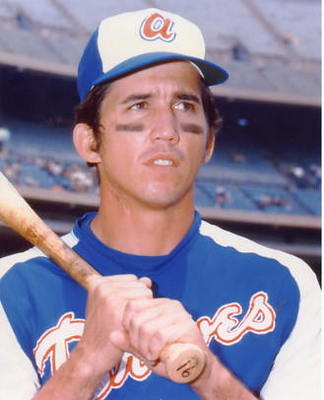
Please e-mail us at: MLBreports@gmail.com with any questions and feedback. You can follow us on Twitter and become a fan on Facebook . To subscribe to our website and have the daily Reports sent directly to your inbox , click here and follow the link at the top of our homepage.

Latest AL and NL Vote Totals: 2011 MLB All-Star Game
Thursday, June 23, 2011

MLB reports: With the MLB All-Star Game less than three weeks, the race to finalize the lineups is starting to tighten up. The majority of the starters have fairly significant leads and will be in Arizona, barring injury or declining the invitation. However, some of the races have started to tighten up, with the positions up for grabs until the final votes are in. Let’s take a look at the current leading vote getters per league and position:
AMERICAN LEAGUE ALL-STAR (as of June 21)
CATCHER
Russell Martin – Yankees: 2,226,797
Alex Avila – Tigers: 1,730,511
Joe Mauer – Twins: 1,341,474
Jarrod Saltalamacchia – Red Sox: 1,135,617
Yorvit Torrealba – Rangers: 980,697
Verdict: Martin is in unless Avila gets a huge spike in votes at the end. While many are pushing for Avila to get the nod, Martin has the numbers and the fan base to likely win out.
FIRST BASE
Adrian Gonzalez – Red Sox: 3,017,960
Mark Teixeira – Yankees: 2,407,665
Miguel Cabrera – Tigers: 1,771,893
Mitch Moreland – Rangers: 890,468
Paul Konerko – White Sox: 676,194
Verdict: A-Gonz will be starting in Arizona. Take it to the bank. He has been one of the best players in the AL this season and plays in Boston. The fans will continue to vote for him until he is announced as the winner.
SECOND BASE
Robinson Cano – Yankees: 3,664,498
Dustin Pedroia – Red Sox: 2,239,172
Ian Kinsler – Rangers: 1,452,880
Orlando Cabrera – Indians: 910,941
Ben Zobrist – Rays: 828,771
Verdict: Cano continues to lead the pack by a country mile. His season totals justify his position.
THIRD BASE
Alex Rodriguez – Yankees: 2,876,537
Adrian Beltre – Rangers: 2,307,380
Kevin Youkilis – Red Sox: 2,025,438
Evan Longoria – Rays: 1,639,405
Brandon Inge – Tigers: 490,734
Verdict: A-Rod is still A-Rod. Beltre is getting closer though and could make this one interesting.
SHORTSTOP
Derek Jeter – Yankees: 2,654,040
Asdrubal Cabrera – Indians: 2,242,157
Elvis Andrus – Rangers: 1,513,929
Jhonny Peralta – Tigers: 875,371
Marco Scutaro – Red Sox: 813,888
Verdict: Jeter, the New York Yankees captain, continues to lead the way. However, an injury and poor play this season have led Cabrera to get closer in the voting. If Cabrera has a few more strong games, there is a chance he could be in Arizona as the starter. Either way, expect Cabrera to represent the Indians at the All-Star game.
DESIGNATED HITTER
David Ortiz – Red Sox: 3,116,578
Michael Young – Rangers: 1,760,195
Jorge Posada – Yankees: 1,120,830
Victor Martinez – Tigers: 932,711
Johnny Damon – Rays: 864,535
Verdict: Papi picked a great year to have a strong campaign. A free agent at year’s end, he is a worthy All-Star pick.
OUTFIELD
Jose Bautista – Blue Jays: 4,156,940
Curtis Granderson – Yankees: 3,473,227
Josh Hamilton – Rangers: 2,400,408
Jacoby Ellsbury – Red Sox: 2,249,323
Carl Crawford – Red Sox: 1,789,097
Ichiro Suzuki – Mariners: 1,537,101
Nelson Cruz – Rangers: 1,462,426
Nick Swisher – Yankees: 1,271,843
Brett Gardner – Yankees: 1,120,179
J.D. Drew – Red Sox: 1,112,720
Matt Joyce – Rays: 1,038,098
Jeff Francoeur – Royals: 906,983
Grady Sizemore – Indians: 867,281
David Murphy – Rangers: 785,630
Shin-Soo Choo – Indians: 764,817
Verdict: Bautista and Granderson continue to lead the AL outfielders in voting and deservedly so. Hamilton and Ellsbury are battling it out for the final spot in a competition of what have you done for me lately vs. last year’s statistics. Depending on where you sit in the debate, the 2010 MVP Hamilton or the 2011 resurgent Ellsbury should be the third AL outfielder. With Hamilton banged up and Ellsbury playing so well for a first place Boston squad, expect Ellsbury to win out.

NATIONAL LEAGUE ALL-STAR (as of June 20)
CATCHER
Brian McCann – Braves: 2,301,252
Yadier Molina – Cardinals: 1,836,490
Buster Posey – Giants: 1,573,484
Jonathan Lucroy – Brewers: 1,098,507
Carlos Ruiz – Phillies: 1,095,081
Verdict: McCann is the best catcher in baseball, not just the NL. He has received the justified votes and will be starting for the NL squad.
FIRST BASE
Albert Pujols – Cardinals: 2,806,864
Joey Votto – Reds: 2,270,211
Prince Fielder – Brewers: 2,066,327
Ryan Howard – Phillies: 1,477,478
Freddie Freeman – Braves: 559,762
Verdict: Pujols was the leader and remains so despite being placed on the shelf recently. With Pujols out of the picture, Votto and Fielder will continue to duke it out for top spot. The power and flash of Prince will likely rule over the steadiness of Votto.
SECOND BASE
Brandon Phillips – Reds: 2,286,378
Rickie Weeks – Brewers: 2,094,502
Chase Utley – Phillies: 1,827,194
Dan Uggla – Braves: 1,012,370
Freddy Sanchez – Giants: 987,606
Verdict: Phillips and Weeks are neck-in-neck in one of the closest positional battles. Based on Weeks recent play, my money is on him to get the starting role.
THIRD BASE
Placido Polanco – Phillies: 2,599,925
Chipper Jones – Braves: 1,558,895
Pablo Sandoval – Giants: 1,302,098
David Wright – Mets: 1,228,710
Scott Rolen – Reds: 1,102,626
Verdict: Polanco of the NL leading Philadelphia Phillies appears to have this one locked up. Without much in the way of competition, Polanco has been the best of the bunch according to the fans.
SHORTSTOP
Troy Tulowitzki – Rockies: 2,385,991
Jose Reyes – Mets: 1,972,820
Jimmy Rollins – Phillies: 1,354,896
Alex Gonzalez – Braves: 928,992
Yuniesky Betancourt – Brewers: 860,163
Verdict: Reyes of the Mets is making a late charge but Tulo might have too big of a lead to overcome. Expect this one to go to the wire as Reyes has been getting much of the press and attention in the past few days.
OUTFIELD
Ryan Braun – Brewers: 3,034,057
Lance Berkman – Cardinals: 2,562,428
Matt Holliday – Cardinals: 2,390,118
Matt Kemp – Dodgers: 2,062,667
Andre Ethier – Dodgers: 1,889,298
Jay Bruce – Reds: 1,681,613
Shane Victorino – Phillies: 1,357,115
Carlos Beltran – Mets: 1,261,308
Jason Heyward – Braves: 1,059,581
Raul Ibanez – Phillies: 982,046
Justin Upton – D-backs: 950,047
Carlos Gonzalez – Rockies: 944,666
Corey Hart – Brewers: 910,550
Martin Prado – Braves: 830,105
Alfonso Soriano – Cubs: 804,303
Verdict: Braun has the top spot locked up with Berkman almost guaranteed a starting spot in Arizona as well. The third outfield position will come down a battle between Matt Holliday, Matt Kemp and Andre Ethier. Kemp is narrowing the margin but based on the vote numbers, St. Louis will likely have 2/3 of the starting All-Star outfield come July 12th.
MLB reports will continue to keep you up-to-date as the voting for the MLB All-Star game comes to a close. We will announce the starting lineups and rosters as they are made available and let you know on any injury replacements. This year’s field will be a competitive one and we look forward to catching all the action in Arizona, as the American League and National League battle for home field advantage in the World Series.
Please e-mail us at: MLBreports@gmail.com with any questions and feedback. You can follow us on Twitter and become a fan on Facebook . To subscribe to our website and have the daily Reports sent directly to your inbox, click here and follow the link at the top of our homepage.

McKeon, Valentine and Guillen: The Loria Marlins Manager Roller Coaster
Tuesday, June 21, 2011

MLB reports: In the world of Jeffrey Loria, nothing is ever boring. Loria, who orchestrated an Expos to Marlins trade-in back in 2002, already owns two World Series rings. The first championship ring was courtesy of manager Jack McKeon, who came on board to manage the Marlins in 2003 and won it all in his initial Florida campaign. McKeon was successful in turning around a Marlins team that started off slowly and picked up steam after his selection. The Marlins currently sit after today’s game with a 33-41 record. They are in last place in the NL East, 12.5 games behind the division leading Philadelphia Phillies. Losers of 11 out of their last 12 games, the Marlins have a 16-23 record at home and 17-18 record on the road. Something had to give and manager Edwin Rodriguez resigned abruptly yesterday. Indicating that change was in the best interest of the team, Rodriguez was out and the Marlins quickly replaced him with former manager Jack McKeon. Out with the “old” and in with the “new”.
John Aloysius (Jack) McKeon will be 81 in November of this year. A veteran manager for sixteen seasons, McKeon managed five teams in his manager league career. His record in the dugout speaks for itself, as we take a look at the numbers:
|
Year |
Tm |
Lg |
G |
W |
L |
W-L% |
| 1973 | Kansas City Royals | AL |
162 |
88 |
74 |
.543 |
| 1974 | Kansas City Royals | AL |
162 |
77 |
85 |
.475 |
| 1975 | Kansas City Royals | AL |
96 |
50 |
46 |
.521 |
| 1977 | Oakland Athletics | AL |
53 |
26 |
27 |
.491 |
| 1978 | Oakland Athletics | AL |
123 |
45 |
78 |
.366 |
| 1988 | San Diego Padres | NL |
115 |
67 |
48 |
.583 |
| 1989 | San Diego Padres | NL |
162 |
89 |
73 |
.549 |
| 1990 | San Diego Padres | NL |
80 |
37 |
43 |
.463 |
| 1997 | Cincinnati Reds | NL |
63 |
33 |
30 |
.524 |
| 1998 | Cincinnati Reds | NL |
162 |
77 |
85 |
.475 |
| 1999 | Cincinnati Reds | NL |
163 |
96 |
67 |
.589 |
| 2000 | Cincinnati Reds | NL |
163 |
85 |
77 |
.525 |
| 2003 | Florida Marlins | NL |
124 |
75 |
49 |
.605 |
| 2004 | Florida Marlins | NL |
162 |
83 |
79 |
.512 |
| 2005 | Florida Marlins | NL |
162 |
83 |
79 |
.512 |
| Kansas City Royals |
420 |
215 |
205 |
.512 |
||
| Oakland Athletics |
176 |
71 |
105 |
.403 |
||
| San Diego Padres |
357 |
193 |
164 |
.541 |
||
| Cincinnati Reds |
551 |
291 |
259 |
.529 |
||
| Florida Marlins |
448 |
241 |
207 |
.538 |
||
|
1952 |
1011 |
940 |
.518 |
 McKeon comes with some terrific credentials. He is a two-time National League Manager of the Year, winning the award in 1999 originally with the Reds and again with the Marlins in his championship 2003 season. McKeon has done it all and seen it all. But the question on everyone’s mind is whether he will have a strong impact on the Marlins and turn around their season. From there, the Marlins will need to choose their long-term manager for the 2012 season. There is much discussion and debate surrounding the Marlins, as they complete the 2011 season and move next year to their new stadium and become the “Miami Marlins.”
As much as the Marlins seemed to take a step forward this season as an organization, they are apparently still stuck at square one in some ways. Take their managerial candidates. Back in their last offseason, the Marlins were looking at Bobby Valentine and Ozzie Guillen to become their next manager. Valentine, an analyst with ESPN, could not come to terms with the team and as a result was not hired. The team inquired as well on the availability of Chicago White Sox manager Ozzie Guillen, a former coach with McKeon’s 2003 championship team. When the White Sox required a return of either super prospects Logan Morrison or Mike Stanton, the Marlins said thanks, but no thanks. Edwin Rodriguez ended up receiving the post and did not last even half a season in Florida. With the team in disarray and a fresh voice needed, the Marlins turned to their past in naming Jack McKeon their interim manager for the remainder of the season.
The cigar chomping McKeon, one of the most old-school baseball men you will ever meet, is seen as having a no-nonsense type of approach to the game. As his first move as manager, McKeon benched franchise superstar Hanley Ramirez yesterday. Reports indicate that tardiness was the cause, while others have viewed the move as a wake-up call for the team. Either way, McKeon has clearly shown that he is in charge and is not prepared to accept the Marlins losing ways. Unfortunately, as the years have progressed, baseball has become more and more of a “young man’s game.” Todays young players, part of the me-first generation, don’t often take kindly to veteran coaches that are seen as being out of touch with today’s times. This was evident before in Florida, where McKeon originally lasted only three seasons. McKeon was seen as a very stern and tough manager and had lost much of the attention of the clubhouse by the end of his tenure. Now the Marlins have gone back to the barrel to see if McKeon has one more strong season of managing in him.
In accepting the Marlins’ position, McKeon has become the second oldest manager in baseball history, just behind Connie Mack. While a great feat for McKeon, it will remain to be seen the impact that he will have on the Marlins 2011 fortunes. My gut is that the Marlins will be lucky to get much more out of the team, even with McKeon in charge. The team is dangerously close to knocking themselves out of contention by the All-Star break and anything short of a miracle at this point will change that. With most MLB teams hiring young, dynamic managers to lead the way, its surprising in some ways that Loria has gone backwards in his approach. But given Loria’s track record, he rarely does anything by the book.
After Jack McKeon completes his second tenure in Florida, the decision will still remain as to whether Bobby Valentine or Ozzie Guillen will be at the helm come 2012. Both are still in contention for the job according to reports, but neither appears in my estimation to be a great fit. Valentine and Guillen are both fiery individuals with strong wills and personalities. After watching the Joe Girardi fiasco in his battles with owner Loria, many managerial candidates have since been scared off from taking the manager’s job with the Marlins. Valentine and Guillen would both have difficult times being placed in a puppet type role as a manager and for that reason, I cannot see a either working out long-term in Florida. Loria would be well served selecting a strong baseball man for the job, but one that has extreme patience and ability to take the directions that would come from the top of the pyramid. Loria has shown in the past to be a man of little patience and self-control when it comes to the personnel of his ball club. If Bobby V or Ozzie do eventually take the job, watch out for the fireworks that will likely come in Miami. While Ozzie is signed for the 2012 season, insiders have indicated that the White Sox may grant permission for the Marlins to speak to him, if the ballclub does not return to contention by season’s end. My bet is that Ozzie will be headed one day to Miami to rejoin the Marlins as their manager. Until then, Jack McKeon will be captain of the Marlins ship.
I guess its true what they say. Everything old really is new again. The magic was there in 2003. Let’s see if the Marlins and McKeon can rekindle some of their spark eight years later.
Please e-mail us at: MLBreports@gmail.com with any questions and feedback. You can follow us on Twitter and become a fan on Facebook . To subscribe to our website and have the daily Reports sent directly to your inbox , click here and follow the link at the top of our homepage.

Top Home Run Hitters: The MLB Leaderboard
Sunday June 12, 2011
MLB reports: Another week goes by and we find that there are more changes on the MLB Home Run Leaderboard. Jose Bautista finally has some competition and the proven long ball hitters of seasons past have finally made the list. Let’s take a look at the home run leaders in Major League Baseball as of today:
Tie 1st: Jose Bautista, Toronto Blue Jays: 20
Jose Bautista hit #20 on May 28th. Since then, he has remained stuck on 20 while the rest of baseball starts to catch up. For a man in a home run draught, he still has 58/35 BB/K on the season, with a .338 AVG, .490 OBP and .692 SLG. As Bautista works to recapture his early season form, Adam Lind has come back to the Jays as a man on a mission. Lind is hitting .327 on the season with 11 home runs of his own, a beneficiary of the protection that Bautista can afford him in the lineup. Realistically speaking, Bautista was never going to hit 80 home runs this season. But he remains on pace for 50+ and Bautista may still match or exceed his 54 long balls from last year.
Tie 1st: Curtis Granderson, New York Yankees: 20
There is a 2nd sherif in town and his name is Curtis Granderson. One of three Yankees on our list, Granderson has enjoyed a rejuvenation at age 30. Granderson is close to matching his 24 home runs from last year and well on his way to exceeding his career high of 30 home runs from 2009. Granderson’s 27/65 BB/K ratio tell me that he has not necessarily changed his free swinging ways at the plate and a “market correction” may be in order here. But despite his .267 AVG, Granderson has not shown any slow downs in the power department. 2011 has been Curtis Granderson’s coming out party and if Bautista isn’t careful, we may have another home run king on the season very soon.
Tie 3rd: Matt Kemp, Los Angeles Dodgers: 19
Matt Kemp (“The Bison”) at the age of 26, has finally started to cement his place in the book of baseball superstardom. With 19 home runs on the year, to go along with his incredible .331 AVG, .408 OBP and .632 SLG, Kemp has gone from prospect to star seemingly overnight. After hitting 26 and 28 home runs over the last two seasons respectively, Kemp is on pace to hit 40-50 home runs this year. Hitting in the heart of the Dodgers lineup with Andre Ethier, Kemp has been the heart and soul of the team this year. As he matures as a person and leader, so has his game developed on the field. The sky is the limit for this young superstar, who has future MVP written all over him.
Tie 3rd: Mark Teixeira, New York Yankees: 19
The last two spots on our top-five list should come as no surprise, starting with Yankee slugger Mark Teixeira. With 39 home runs in 2009 and 43 in 2005, Teixeira has showcased his home run strengths in previous years. A consistent 30+ home run threat, Teixeira is on his way to setting a career high in the category, showing his enjoyment playing in Yankee Stadium with its short porch. Teixeira, with his smooth swing, home run park and protection in the lineup, has all the factors in his favor. By season’s end, I expect him to remain near the top of this list and could very well finish at the #1 position.
5th: Prince Fielder, Milwaukee Brewers: 18
The final spot goes to Prince Fielder, the impending free agent slugging first baseman for the Milwaukee Brewers. Prince has literally done it all this season. He has shown a great eye, with 36/31 BB/K in 2011, to go along with his .300 AVG, .410 OBP and .614 SLG. The man hit 50 home runs in 2007 and 46 in 2009. With a BIG payday ahead (rumored to be in the $200 million range), Fielder is showcasing his skills this year. At 27-years of age, Prince will be able to write his own ticket when picking his next home. He has certainly ensured to give himself the best chance to make the big bucks in the future by his strong play in the present. Fielder’s agent? None other than Scott Boras. Expect Fielder to continue to explode on the field all season with teammate Ryan Braun as the Brewers make one more giant push with its hulking first baseman steering the ship.
After looking at such an impressive top-five list, the rest of the sluggers represent the who’s-who of baseball. Bruce, Braun, Quentin, Pujols, Cabrera, A-Rod…yes, they are all here. Mike Stanton with 16 home runs has come together quickly in his 2nd season to become one of the top home run hitters in the game. As we discussed several times to start the season, the cream always rises to the top as the months go by. As we sit at almost the halfway mark of the season, the proven home run sluggers have proven just that.
The Best of the Rest:
Jay Bruce, Cincinnati Reds: 17
Carlos Quentin, Chicago White Sox: 17
Lance Berkman, St. Louis Cardinals: 16
Paul Konerko, Chicago White Sox: 16
David Ortiz, Boston Red Sox: 16
Mike Stanton, Florida Marlins: 16
Nelson Cruz, Texas Rangers: 15
Ryan Braun, Milwaukee Brewers: 14
Albert Pujols, St. Louis Cardinals: 14
Miguel Cabrera, Detroit Tigers: 13
Ryan Howard, Philadelphia Phillies: 13
Alex Rodriguez, New York Yankees: 13

Please e-mail us at: MLBreports@gmail.com with any questions and feedback. You can follow us on Twitter and become a fan on Facebook . To subscribe to our website and have the daily Reports sent directly to your inbox , click here and follow the link at the top of our homepage.

Devin Mesoraco: Catcher Cincinnati Reds, On the Verge of Getting the Call
Saturday June 11, 2011
MLB reports: With catching at an all-time premium in baseball, few teams are lucky to have one, let alone two solid catchers in its system. The Cincinnati Reds have an abundance of riches at the position, with two serviceable catchers on its major league roster and two of the brightest catching prospects in its lower levels. For all the talk of the New York Yankees and Montero, Sanchez and all of its up-and-coming catching prospects, a look to the future catching superstars of Major League Baseball points to Cincinnati.
Top catching prospect Devin Mesoraco stands 6’1″ and weighs a very solid 220 lbs. Only 22-years of age, Mesoraco was drafted in the 1st round of the 2007 MLB draft (15th overall). Catchers typically take longer to develop and Mesoraco has been slowed in his development by the injury bug. But despite missing many games over his short career, his bat has never slowed in the process. Last year at the tender age of 21, Mesoraco played through three levels and rose all the way to AAA. This year, in his first full turn at AAA, Mesoraco has been simply outstanding. With a .323 AVG, .407 OBP, .542 SLG, 8 home runs and 25/39 BB/K, Mesoraco has shown the MLB reports favorite hitting combination: power and patience. A lifetime .270 hitter in the minors with an .802 OPS, Mesoraco has only gotten stronger and better as he has risen through the Reds system. But not far behind him, there is another strong Reds catching prospect waiting in the wings by the name of Yasmani Grandal, as well as two existing roadblocks in Ramon Hernandez and Ryan Hanigan.
 Grandal is also 22-years of age. Born in Havana Cuba, he was originally drafted by the Boston Red Sox in the 27th round of the 2007 draft. After failing to sign, Grandal became the next catching 1st round pick of the Reds, being drafted 12th overall in the 2010 draft. Missing out on three years compared to Mesoraco, Grandal played eight games last year in rookie ball and currently plays high A ball in Bakersfield. With 9 home runs this year in 50 games played, combined with a .279 AVG, .878 OPS and 37/50 BB/K ratio, Grandal is proving himself to be every bit the hitter that Mesoraco is. A promotion is due shortly to AA and very soon the Reds will face a dilemma in choosing their catcher of the future. A great problem to have if you are the Cincinnati Reds, who are the envy of Major League Baseball in their ability to draft and develop talent. Grandal is also a switch-hitter to boot, which will make the Reds catching choice even that much more difficult.
Given that Mesoraco has the most experience and has played at the higher levels, he will be given the first crack at the Reds catching job. His first roadblock is veteran Ramon Hernandez, the Reds incumbent starting catcher. Hernandez at 35 should be starting to near the end of his career, having played 13 seasons for 4 different major league teams. Hernandez suffered through injuries in both the ’09 and ’10 seasons, but still received a 1-year, $3 million contract for 2011 from the Reds. Hernandez has rewarded the Reds thus far with a strong season. Hernandez on the year has hit .310, with 7 home runs and an .898 OPS. But despite his strong play, Hernandez is injury prone and has otherwise started to show a declining bat over the last couple of seasons, despite playing in a hitter’s park in Cinci. Expect an injury or slump by Hernandez to open the door for Mesoraco to get his chance sometime this year.
 Ryan Hanigan, the Reds backup catcher, was signed in the offseason to a 3-year, $4 million contract. Some observers questioned the move, given the up-and-coming catchers in the Reds system. But the Reds were smart to lock-in a highly considered backup catcher to mentor their young prospects and help groom them to be possibly the next Johnny Bench. Hanigan at the age of 30, has played parts of 5 seasons for the Reds. Last year was by far his strongest campaign, with a .300 AVG and .834 OPS. For his major league career, Hanigan has a 98/77 BB/K- thus exhibiting one of the best batting eyes I have ever seen for a catcher. Despite his slow start this season, with a .248 AVG and .673 OPS, Hanigan plays strong defense and does enough offensively to ensure that he will remain as the Reds backup catcher for the foreseeable future.
With Hanigan as the backup and Hernandez playing out the string this season, we can expect to see Mesoraco make his major league debut this year. Given that he is only 22, the world should not be expected of him yet. As mentioned earlier, catchers take a lot longer to develop into complete major league players compared to other positional player. One only has to look to Baltimore, where Matt Wieters came slowly out of the gate until he started to find his way in the big leagues. While watching Buster Posey‘s run last year with the Giants was exciting, he is definitely the exception to the rule. Scouts and analysts that I have spoken to are divided on Mesoraco and Grandal. From the people that I have spoken to, there was nearly a 50/50 split on which prospect would become the future #1 catcher in Cincinnati.
A similar situation has already developed for the Reds with the blocked path for Yonder Alonso, one of the top Reds prospects still in the minors. Alonso, a first baseman by trade, has been attempting to shift to the outfield in the hopes of eventually joining the Reds. The reports that I have received are that his defense has been graded at far below average and the Reds are not comfortable calling him up as a result. With Joey Votto entrenched at first, Alonso will only make the big leagues at this point by injury or trade. With 8 home runs already on the season in AAA, to compliment his .327 AVG and .911 OPS, the 24-year old Cuban born Alonso has a major league bat. His fellow countryman Grandal may face a similar conflict in a couple of seasons. With such a strong farm system, the Reds are building themselves for a dynasty run for several years to come. The likely quarterback of the pitching staff in the near future will be Devin Mesoraco, who will also hit in the heart of a deep lineup in a great ballpark. The sky is the limit for this great prospect who is on the verge of joining the big leagues. We look forward to watching his debut very soon and hope that Mesoraco will have a long and productive career at the most demanding position in the game.

Please e-mail us at: MLBreports@gmail.com with any questions and feedback. You can follow us on Twitter and become a fan on Facebook . To subscribe to our website and have the daily Reports sent directly to your inbox , click here and follow the link at the top of our homepage.

Ten Things About Mike Leake and His Jump to the Majors
Saturday June 4, 2011
On the Reports, we will be occasionally featuring an up-and-coming baseball writer that has come to our attention and share their work with you, the readers. Part of our mandate at MLB reports is to provide the best baseball coverage and analysis in the business. MLB reports ultimately is designed to expose our readers to the world of baseball and the stories, facts, insights and profiles behind it. In order to meet this goal, we would like to give exciting young writers the chance to showcase their talents and provide a fresh pool of ideas to our site. In today’s feature, we are excited to have the Hall of Very Good as our guest writer with their feature post on Mike Leake. Putting aside Leake’s legal troubles this year, the HOVG took a look at Mike Leake’s major league debut and his jump directly from college to the show. If you are a fan of statistics and baseball data, you will love this one. Enjoy!

Hall of Very Good (Guest Writer for MLB Reports): Heading into the 2010 season, many baseball analysts and writers seemed to be split as to which hotshot National League rookie will be taking home the Rookie of the Year award following this season.
And why wouldn’t they be?
In our nation’s capital, Stephen Strasburg has the makings of being every bit as impactful in his inaugural season for the Nationals as Fernando Valenzuela was when he made the Dodgers starting rotation in 1981 or “Doc” Gooden was three seasons later for the Mets.
Down in Atlanta, Jason Heyward became, with one swing of the bat, just the 104th Major Leaguer since 1895 to go yard in his first career plate appearance.
One guy who wasn’t in any discussions was Reds starting pitcher Mike Leake, and dude was on the cusp of doing something that neither Strasburg nor Heyward could accomplish…beginning his career on a Major League roster.
When he took the mound against the Chicago Cubs Sunday, the 22 year-old righty became the first starting pitcher to leapfrog the Minors since Jim Abbott did it in 1988 for the Angels.
Here is some more stuff you might not have known about skipping the Minors and starting your career in the show.
$2,900,000
After being selected eighth overall by Cincinnati in last year’s draft…Arizona State’s Mike Leake received a $2.9 million signing bonus. By comparison, the top pick, Stephen Strasburg, received a $7.5 million dollar bonus by putting his John Hancock on the dotted line for Washington.
2000
Do you remember where you were September 30, 2000? Maybe you were bumping around town listening to “Minority” by Green Day. Perhaps you were waiting in line to purchase tickets for “Remember the Titans.” Me? I was at the theatre enjoying “Best in Show”. True story. But if you were Xavier Nady of the Pittsburgh Pirates, you were making your Major League debut and, in turn, becoming the last guy to jump the Minors until Mike Leake accomplished the feat.
84
Since 1915, 84 players have made the jump to the Major Leagues without stopping over in the Minors. However, since 1965 (the last year of the “Bonus Baby”…more on that next) only 22 guys have made the leap.
57
Of the aforementioned 84 who made the jump straight to the Majors, 57 were deemed “Bonus Babies”. A “Bonus Baby” was the group of amateur baseball players who went straight to the Major Leagues between the years 1947-1965. In accordance with the Bonus Rule, any amateur player who had received more than $4,000 in bonuses, entered into a contract. These players’ teams were required to keep them on the 40-man roster for a full season, preventing the player from spending time in the Minors. Notable “Bonus Babies” include Hall of Famers Al Kaline, Harmon Killebrew, Sandy Koufax and Jim “Catfish” Hunter. In 1965…Major League Baseball instituted the draft.
39
It should be no surprise that the position that has the most players to skip the Minors is pitcher. On Sunday, Mike Leake became the 39th pitcher to make the jump and the first since Ariel Prieto did it in 1995 for the Oakland A’s.
12
And speaking of the A’s (intentional segue!)…when they sent pitcher Mike Morgan to the hill in 1978 for him to make his debut, it marked the first of 12 teams for the righty. And you guessed it, those 12 teams makes Morgan the most-traveled of all players that made the jump straight to the Majors.
8
While it is far too soon to determine if Mike Leake is more Mike Morgan than Sandy Koufax, one thing is certain…only eight of the players that skipped the Minors have found themselves in Cooperstown. The four “Bonus Babies” (Kaline, Killebrew, Koufax and Hunter), George Sisler, Mel Ott, Bob Feller and Dave Winfield.
7
Mike Leake became just the seventh member of the Cincinnati Reds to make the jump straight to the Majors. Other teams that have had a slew of players skip the Minors, the Pittsburgh leads all with nine call-ups…Baltimore has eight.
3
Over the last 50 years, Arizona State has produced the most players to make the jump from college to the pros…three (Eddie Bane, Bob Horner and Mike Leake). Of the three, third baseman Horner is also in an elite group among sluggers. In July 1986 (a full 16 months before Leake was born), Horner became just the eleventh player in Major League history to slug four home runs in a single game.
∞ (infinity)
In what was probably the worst pitching debut of any pitcher to have skipped the Minors, Jerry Walker failed to get an out in his inaugural outing. Walker, fittingly, walked the first two batters he faced back on July 6, 1957. The third, he greeted with a wild pitch and subsequently, he was then yanked. Unfortunately both batters he walked ended up circling the bases and left Walker with an ERA of infinity.
Mike Leake fared much better.
In six and two-thirds innings of work, the young righty gave up only one run on four hits good for a 1.35 ERA. He did channel Walker by walking seven, but he also struck out five. Leake also added two hits to become the first Reds pitcher to produce two hits in his debut since Benny Frey on Sept. 18, 1929.
***Thank you to the Hall of Very Good for preparing today’s feature article on Mike Leake and his jump directly to the Major Leagues. You can follow the Hall of Very Good on Twitter.***
Please e-mail us at: MLBreports@gmail.com with any questions and feedback. You can follow us on Twitter and become a fan on Facebook . To subscribe to our website and have the daily Reports sent directly to your inbox , click here and follow the link at the top of our homepage.

Buster Posey Out for the Season: Time for a Rule Change?
Monday May 30, 2011
On the Reports, we will be occasionally featuring an up-and-coming baseball writer that has come to our attention and share their work with you, the readers. Part of our mandate at MLB reports is to provide the best baseball coverage and analysis in the business. MLB reports ultimately is designed to expose our readers to the world of baseball and the stories, facts, insights and profiles behind it. In order to meet this goal, we would like to give exciting young writers the chance to showcase their talents and provide a fresh pool of ideas to our site. In today’s feature, we are excited to have Brian Lozier as our guest writer with his post on the Buster Posey injury. Brian’s topic was to look at the Posey injury and whether a rule change is required in baseball. Enjoy!
Brian Lozier (Guest Writer for MLB Reports): Injuries are another way of saying “Unfortunate event”. Things that are literally out of the hands of the people involved. There is nothing there to prevent injuries, slow them or make what unfolded heal any faster. Nothing can change an injury after it occurs, so people try to take measures into their own hands and prevent future occurences from happening. But at what cost to the game do we try to prevent injuries from taking place?
 In the extra-inning thriller staged in AT&T Park in San Francisco this past Wednesday, former Rookie of the Year winning catcher Buster Posey suffered a broken leg and is out for the rest of the season and possibly the start of 2012 as well. A future All-Star candidate, Posey was run over by Scott Cousins of the Marlins, who scored the go-ahead run in the 12th inning. Posey, becoming an everyday catcher last season after being called up in May, played the role of protector of home plate on the play. Posey took his destiny and the future of his team in his hands by doing all that he could to fight for his team to pull out the win. The resulting cost though to the Giants organization was devastating.
After an MRI came back showing a broken fibula and three torn ligaments, Posey’s agent, Jeff Barry reached out to Joe Torre and the MLB head office with a plead for a change of the rules in order to stop collisions at the plate. Barry stated that “You leave players vulnerable. I can tell you MLB is less than it was before [Posey’s Injury]”. Barry went on to compare the incident to a helmet to helmet collision in the NFL. “If you go helmet to helmet in the NFL, it’s a $100,000 fine. In baseball, you have a situation in which baserunners are slamming into fielders. It’s brutal. Borderline shocking. It just stinks for baseball.”
I can understand an agent’s view to wanting to keep players safe. I can see the importance of Major League Baseball taking measure to stop “senseless” injuries and preventing side-liners and career-ending plays. However, I have to draw the line when people ask to remove excitement from this great game. Train wrecks have been a part of baseball since the sport came into existence. The most famous of which might have been the 1970 All-Star Game and the Pete Rose collision at the plate. Or perhaps the collision to end game 6 of the 2003 World Series. I will let you be the judge.
Understanding one’s role and doing what it takes to win is a major part of being a Big-Leaguer. The speedster on each squad knows that it’s his job to steal bases. Consequence: Possible broken fingers. Outfielders on the other hand, are expected to catch balls on the fly. They might break a rib as a result, but it’s a part of their role. Pitchers go out knowing they could take a ball to the face or throw out an arm every time they step out onto a mound. But it’s what they do and is necessary for their respective teams to win. The above logic is no different when it is applied to the catcher. A catcher defensively at the end of the day must first and foremost, stop the baserunner. No question, no doubt.
What would happen if the rule changed and home plate collisions were a thing of the past? No one knows for certain, but it’s almost safe to say it would turn home plate into another first base. This would result in every close play into a force out situation. This would be a nightmare for teams when facing a contact pitcher. The result would be raising concern in places where most teams whole have a sigh of relief. Imagine stopping the notion of a deep sac fly to score a winning run. Or worse, stopping the suicide squeeze. Baseball would almost become a game without a soul.
I admire Jeff Barry for standing up for his client, I really do. In fact, more agents need to stand up for their players. I just wish it wasn’t at the expense of the game and the intensity of the sport that fans deserve. Why would anybody want to agree to this rule change? By abandoning home plate collisions, proponents of the rule change would be removing chance, excitement and thrill to the game of baseball. The clash of the titans at home plate during a game shows heart and guts to win a game which could possibly lead to a future World Series ring. Although not a perfect system which can result in the occasional injury, baseball needs to be played in the way it was meant to be. My baseball includes home plate collisions. It has been a part of the dynamic of baseball for all these years up to and including today and should continue to have a place in the sport for years to come.
***Thank you to Brian Lozier for preparing today’s article on Buster Posey and rule changes in baseball. You can follow Brian on Twitter.***
Please e-mail us at: MLBreports@gmail.com with any questions and feedback. You can follow us on Twitter and become a fan on Facebook . To subscribe to our website and have the daily Reports sent directly to your inbox , click here and follow the link at the top of our homepage.

MLB 2011 DL: Injury Updates

MLB reports: To answer many of our readers inquiries, here is an update on some of the casualties and wounded in the world of baseball and when each player is expected to return from the disabled list:
Phil Hughes: Yankees
Hughes went on the 15 day disabled list in mid-April with a “dead arm” and has not returned since. On April 28th Hughes received a cortisone shot and reports have indicated that his shoulder has responded well. The timetable for Hughes to return to the mound is 6-8 weeks, which would put him sometime into July. Hughes has not started throwing yet but has visited specialists who have ruled out surgery at this point. With a dead arm type injury, it is not always easy to predict where the future lies. Justin Verlander went through such an episode in his career and has come back stronger than ever. The fear though is that the velocity will not return and surgery could be lurking in the background. Until Hughes begins throwing and regains his velocity, Yankees fans will continue to huddle in prayer and hope for Hughes to come back and reclaim his 2010 form this year.
Carlos Guillen: Tigers
 Guillen has been bothered by a sore left knee and out of action since mid-March and going on the 15 day DL. Reports have indicated that Guillen is taking ground balls, but no other baseball activities at this point. The original prognosis of mid-May does not appear likely, with an end of the month or early June return a possibility. With his wonky surgically repaired knee, Guillen will likely be a DH at best if and when he returns to the Tigers lineup. There is a possibility of a relapse here, so the Tigers are progressing forward without Guillen and any contributions this year will be considered a bonus.
Joe Mauer: Twins
The $184 million dollar man is off to a dreadful start in 2011, the first season of his monster contract. After having surgery on his knee in the off-season, Mauer has been bothered by leg weakness all season. Mauer has started hitting and throwing, but his return is up in the air. Once considered to be the greatest catcher in baseball, talk has already started about a position change in his future. After moving prospect Wilson Ramos, the Twins cannot be happy about the state of Mauer’s health. Like the other members of this list thus far, Mauer’s return date is unknown at this point. With the Twins off to a terrible start this season, there is much pressure to get Mauer into the lineup to get the team going. But considering the investment in the catcher, the team will likely be cautious and continue to bring him along slowly in the fear that further damage could result in rushing him. Expect Mauer back sometime in June likely, but his catching days appear to coming to an end in the near future unfortunately.
Josh Hamilton: Rangers
 After breaking a bone in his right arm from a home plate collision early in the season, Hamilton is nearing his return to the Rangers lineup. Hamilton is taking swings and should hopefully ready soon for a couple of minor league rehab appearances. I would expect Hamilton back in the Rangers lineup in the next two weeks if all goes well. The brittle Hamilton continues to endure bad luck in the health department, with the Rangers sorely needing a healthy Hamilton in order to contend in the AL West.
Chien-Ming Wang: Nationals
After 2 missed seasons, Wang continues to try to come back from a torn shoulder capsule and pitch once again in the majors. After breaking his right foot in 2008, Wang ended up injuring his shoulder and has not returned to pitch in a professional game since. Still rehabbing in the Nationals system, it appears unlikely that we will see Wang pitch again. Fans still hope that the former back-to-back 19 game winner can find health and pitch again, but after a prolonged absence, the window of opportunity continues to close further every week/month that goes by.
Johan Santana: Mets
 Another torn shoulder capsule survivor, Santana underwent his surgery last September. Reports have indicated a possible July return for Santana, which appear to be optimistic at best. With a similar injury to Wang, there is no guarantees of when Santana and what condition he will be in. Good news in that Santana is throwing off a mound and flat ground and reported no setbacks to date. But with these types of injuries, relapses are always a possibility. If the Mets flounder this year as expected, the smart advice is to rest Santana and bring him along slowly, with a 2012 return being the better bet. Only time will tell if Santana will return and reclaim his spot as one of the top starting pitchers in baseball. At this point, I would not be counting on it.
Chase Utley: Phillies
With injuries all around in baseball, few have been more anxious than the disappearance of Chase Utley. With the Phillies offense built around Utley and Howard, a long-term absence by the second baseman was seen as damaging by the Phillies faithful. Talk at the start of the season was a possible September return by Utley, based on the knee injury. Philadelphia got a great shot in the arm when Utley’s rehab progressed so well to the point that he is already DHing this week in minor league rehab games, with a possible return by the end of the month. Far ahead of schedule, the hope is that Utley is fully recovered and will be strong for the remainder of the season. Utley’s story is one of the few bright spots in our long list of injuries in this report.
Scott Rolen: Reds
Placed on the DL at the end of April with a strained shoulder, Rolen is no stranger to baseball injuries. But being the professional he is, Rolen also works very hard and keeps himself in strong game shape to attempt to avoid long-term absences. Rolen has been taking batting practice this week and has also been running the bases and participating in fielding drills. No timetable on his return at this point, but based on his advanced baseball activity, I would expect a return by the end of this month.
Please e-mail us at: MLBreports@gmail.com with any questions and feedback. You can follow us on Twitter and become a fan on Facebook . To subscribe to our website and have the daily Reports sent directly to your inbox , click here and follow the link at the top of our homepage.

MLB Pitchers and Walks: Flirting with Trouble
MLB reports: Walks can make you and walks can break you. That is our motto here at MLB reports. If there is one stat that I use more than others to measure a player’s performance, its BB…base on balls…walks. Recently, I featured an article on patient hitters and looked at the hitters that were the MLB leaders in walks. As part of this post, I reviewed how walks could potentially improve every facet of a hitter’s game and why a good batting eye is a high indicator of future success. Based on the response to that article, today we will look at the flip side, the MLB pitchers leader board in walks allowed.
In my opinion, there is not many things that are more frustrating about pitchers than those who give up a lot of walks. Pitchers that walk hitters tend to get themselves in all sorts of trouble and create pressure on themselves as well as their team. Defenses become on guard to avoid runners advancing and scoring, especially the catcher. A stolen base, sacrifice and passed ball is all take to turn a walk into a run. Pitchers that give up walks are often young hard-throwers who have not yet learned to command the ball. They are throwers who need to develop into pitchers. A veteran pitchers who throws soft and has no command will rarely survive in baseball (unless he has a lethal knuckleball, ala Tim Wakefield). Regardless of strike outs, walks in baseball often lead to pitchers beating themselves. I often tell young hurlers to trust in their stuff and led the hitters beat them. By walking hitters, a pitcher will simply beat himself in the long run. Looking at the MLB top 5 list of walks allowed, it is a who’s who list of potential, some success and plenty of frustration.
1) Edinson Volquez, Reds: 28
The man traded for Josh Hamilton has one of the best power arms in baseball. After undergoing Tommy John surgery (apparently a must-have these days to become a top pitcher for some reason), Volquez came back strong last year to reclaim his spot on the Reds pitching staff. With a 28/38 BB/K ratio this year 38 1/3 IP, Volquez despite his 3-1 record is showing why he has unsightly 5.63 ERA. With almost a hit allowed per inning, Volquez is playing with fire every game and needs to curb the walks to ultimately find long-term success. Check out Volquez’s breakout year in 2008. 17-6 record with a 3.21 ERA. Sparkling numbers on the surface. His 93/206 BB/K ratio that year shows that when Volquez wasn’t striking guys out, he was loading them up on base. In a hitter’s park like Cincinnati, numbers like that simply will not do. Volquez has a lifetime 4.47 ERA and 1.49 WHIP. At 27 years of age, he should be entering his prime year. But Volquez is sitting on top of our leader board for a reason: he walks the most hitters compared to any other pitcher in baseball. That is a high feat and one that he should not be proud of. A top pitcher can walk maybe 50 hitters a year at most to stay successful. By walking 93 in 2008, Volquez showed that even in a breakout year he never completely figured it out. Luck can only be on a person’s side so long and if Volquez does not transition better to being a pitcher, the sub-4.00 ERA and 1.50 WHIP will result unfulfilled potential and mediocrity. The best pitchers in my opinion have figured out that sacrificing strikeouts for ground ball outs can be just as effective and less taxing on their arms and walk rates. This realization has not occurred yet to Volquez, but that will end up being the difference from becoming the next Pedro Martinez or Ramon Martinez, to a certain degree.
2) Jonathan Sanchez, Giants: 26
The poster child for walks, Jonathan Sanchez is victim #2 on our list to high walk totals. After becoming a full-time starter in 2008, Sanchez had his breakout year last year with the Giants. 13-9 record with a 3.07 ERA and 1.23 WHIP are solid numbers. His 96/205 BB/K ratio though left a lot to be desired. Almost a mirror image of Volquez from 2008 if you compare the numbers. This year, Sanchez sits at 2-2 with a 3.45 ERA, 1.45 WHIP and 26/47 BB/K ratio in 38 IP. The best starting pitchers keep their WHIPs down below 1.20 and at most sit at 1.25. Anything from 1.30 and above is considered a high WHIP, with 1.50 being unacceptable. Despite his success in 2010, Sanchez still has a 1.38 career WHIP. When people ask me why trade rumors consistently persist around Sanchez despite being 28 and in his prime, I simply point to the walk rate. Granted he has unbelievable stuff and is literally untouchable when he is on (as all of the pitchers on this list are). But one good outing for every three bad outings don’t cut it. Sanchez throws hard and can successfully strikeout over 200 batters per season if he chooses to. But with his high walk rate, he will likely suffer the same fate as Volquez. Men on base can translate into runs allowed, which is unhealthy for a team’s won-loss record and a pitcher’s ERA. Until Sanchez can cut down on those walks, I will continue to simply see him as a middle-of-the-road pitcher with unfulfilled potential. If he can cut his walk rate in half, I could see 20 wins in his future.

3) Kyle Drabek, Jays: 25
Another Tommy John surgery survivor, Drabek is the 2nd of 3 pitchers on this list that lead baseball in walks allowed and had the procedure in their careers. Is there a correlation? We will need to find out one day in another post perhaps. I could see there being a link between the motion that pitchers use to high walk rates and leading to Tommy John surgery. An interesting little sidenote. But I digress. Drabek is the only rookie on this list, as all the other pitchers have experience in the majors. None of the players on the list are vets yet, although Liriano and Volquez are starting to get there. In his first full major league campaign, Drabek has a 2-2 record in 2011 with a 4.50 ERA, unsightly 1.63 WHIP and 25/28 BB/K ratio. With almost a hit allowed per inning as well, Drabek is loading up the bases far too often in getting burnt. In my estimation, I see Drabek differing from the first two players as follows. Volquez is wild and needs to learn control. Sanchez is occasionally wild but often tries to be too perfect in making his pitches and misses his spots. Drabek quite often is trying be perfect and misses his spots, but otherwise has good control. Drabek, like Sanchez, simply need to trust their stuff and just go after the hitters. With nearly un-hittable stuff, Drabek and Sanchez would find they will beat hitters more often than not. But a walk every inning a half will not cut it in the majors. Not if Drabek is to fulfill his potential and become the Jays ace one day. The comparisons between father and son will always continue for Drabek until he makes his own way in the world and I will take a brief look at Doug’s numbers. The elder Drabek never walked more than 69 hitters in a season and finished with a career WHIP of 1.243, with 155 wins and 3.73 ERA. He also finished with 1594 career strikeouts, with a season high 177 in his final season in Pittsburgh in 1992. Kyle has the potential to succeed his dad, as son as better stuff than his dad and the potential for far more punch outs than his dad ever did. If Drabek Jr. will figure that out one day, the Jays will have their ace for the next decade guaranteed.
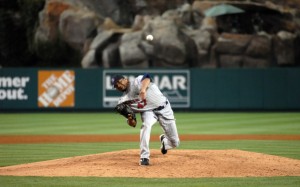
T4) Francisco Liriano, Twins: 24
The fourth member of our list of frustration, Liriano proved this week how utterly frustrating he can be. Consider this: Liriano this week threw a no-hitter against the White Sox. Perhaps a no-hitter by the records, but the rest of his numbers were by no means special. Liriano threw almost as many balls as strikes, finishing with 6 walks and only 2 strike outs. These numbers translate to little or no control, but somehow not giving up a hit in otherwise poor pitching performance. The no-hitter actually is in line with Liriano’s start to the season. 2-4 record, 6.61 ERA, 1.56 WHIP, 24/20 BB/K ratio in 2011. Not only is Liriano now not striking guys out, but he is walking hitters at an astronomical rate. Liriano had one incredible partial season: In 2006 he had a 2.16 ERA, 1.00 WHIP, 32/144 BB/SO ratio in 121 IP. Superstar numbers and an ace in the making. Since then, health issues and poor performance have plagued the hurler for the most part. The 3rd Tommy John survivor on our list, Liriano appears to have the same Volquez type control issues. Last season I thought that we had seen a rebound from Liriano. 14-10 record, 3.62 ERA, 1.26 WHIP and 58/201 BB/SO ratio. Maybe not ace numbers, but very solid pitching numbers. Believe it or not, Liriano is on pace for approximately 150 walks this season. Just when he looked like he might be coming around, Liriano regresses. Then he goes out and throws a no-hitter and nobody knows what to think. But I will tell you this much, walking hitters is a disaster…while walks and few strike outs means a complete implosion. I suspect that there may be more to this story than meets the eye, as Liriano may be having health issues that is leading to his poor numbers. Otherwise, at 27 years of age, Liriano may be continuing his hurler mode rather than becoming a fine-tuned pitcher as is preached by the Twins organization. The potential is there, but until we know his health situation is better, all bets are off.
T4) Charlie Morton, Pirates: 24
The last member of our group may not be a Tommy John survivor, but he is a 27 something year old pitcher (only Drabek is the youngster at 23). Morton is also not on his original team, as he has been traded together with all the members of our list except Sanchez. It is not a coincidence in my estimation that young hurlers with control issues would be moved by a major league team. Liriano, Volquez and Morton were all seen as expandable by their respective teams in order to obtain needed talent. Sanchez has been mentioned in trade whispers for years now and Drabek was moved, but only because the Jays demanded him in the Halladay swap. Morton was moved in the McLouth deal, with the Braves moving an extra arm and the Pirates stocking up on much-needed pitching talent. After previous frustrating campaigns, Morton appears to finally be coming around this year. His 2011 record sits at 4-1 with a sparkling 3.13 ERA. He is allowed less than a hit per inning, which is promising. His 24/24 BB/K ratio means that Morton is striking out as many batters as he is walking. The 1.41 WHIP is the issue with Morton, as it is with all the hurlers on this list. Morton has a career 1.57 WHIP, so he is improving in the category. Once he is able to put it together, Morton is able to get major league hitters out. He may not have the stuff of the other members of this list, but he apparently knows how to get major league hitters out. While not an ace, developing into a solid #2 or #3 starter could be in his future. If Morton could limit his walks to approximately 50 in a season, I would love to see what he could do over the course of that year. I see potential and improvements to warrant hope. For a pitcher that used to give up over a hit per inning, those numbers are vastly improved. Time will tell if the rest of his numbers will fall in line.
With young hurlers that have little control, teams do not often know what they are ultimately going to have. In the time that it takes for a pitcher to learn control, the issue becomes whether a pitcher will be able to get major league hitters out by going for ground ball outs and fly outs while reducing walk totals. Roy Halladay is the poster child for high strike outs and low walks. With ERAs in the low 2.00s, WHIPs in the low 1.00s, 20 wins consistently, Halladay is everything that a pitcher strives to be. But then take a pitchers like Andy Sonnanstine. One of my faves on the Rays, Sonnanstine rarely walks hitters. But without striking out many hitters either, Sonnanstine unfortunately does not have the stuff to get major league hitters out on a consistent basis and gets hit hard often. As a result, Sonnanstine is constantly shuttling between the rotation, bullpen and minors. If you take Sonnanstine’s control and the stuff of any of the pitchers on this list, you would have Roy Halladay. Perhaps a touch oversimplified, but you get my message. For pitchers like Jonathan Sanchez and Kyle Drabek, my advice is just go after and trust your stuff, good things will happen. For Edinson Volquez and Francisco Liriano, I think a change in mechanics and approach is in order. I see too much wildness with little change in the future. If these pitchers do not change their walking ways, the potential that each has will never be fulfilled and talent will end up being wasted. With the emphasis in baseball on strike outs, pitchers like Volquez and Liriano fall into the trap in concentrating on punch outs and disregarding the finer points of the game. The emphasis is on pitching, not throwing: I hope these guys understand that one day. Unfulfilled potential at the end of the day is just failure in my book. Remember that the next time when you watch these hurlers flirting with trouble in their next starts.
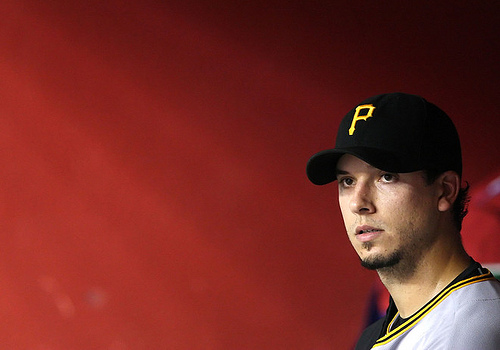
Please e-mail us at: MLBreports@gmail.com with any questions and feedback. You can follow us on Twitter and become a fan on Facebook . To subscribe to our website and have the daily Reports sent directly to your inbox , click here and follow the link at the top of our homepage.

Patient Hitters: The Leaders in Walks

MLB reports: As many of you know from my past articles and tweets, the one quality I look for the most in hitters is patience: the ability to take walks. The art of the base on balls was exemplified somewhat in the “moneyball” Oakland approach and has been adopted by the Red Sox team in particular, among others. People often ask me why I value hitters that take walks so highly. Very simply, walks in my mind lead often to the overall development of every facet of a hitters game. A hitter that has good judgement of the strike zone and take walks should get on base at a high rate. A hitter that takes many walks is more likely to judge better pitches to hit, which should increase their number of hits and home runs correspondingly. When I used to play fantasy baseball, I often looked for batters with high walk totals in filling out my rosters. These hitters would win championships for me, as they do often for baseball teams in real life.
Patient hitters have a high value in baseball, this has become a fact of life. Putting this theory to the test, let’s take a look at which batters sit among the leader board in walks as of today. It will be interesting to see which of these players are considered top players, historically and coming into their own as of today. Has the number of walks taken this year helped each player in other statistical categories? Are each of these players better hitters for having many walks? The results may surprise you.
1st: Jose Bautista, Toronto Blue Jays (19)
 Last year 100 walks went hand-in-hand with a league leading 54 home runs. This year, Bautista leads the league with 19 walks and 8 home runs. For a man who hit .260 last year, the high walk has remained while the average has jumped to a league leading .364. Interesting to note, none of Batista’s walks have been intentional. Bautista for me is the poster boy of how patience and power are inter-twined. You almost cannot have one without the other. For anyone that doubts the value of walks, go look up Bautista’s stats again…they will astound you.
T-2nd: Bobby Abreu, Los Angeles Angels of Anaheim (18)
Bobby Abreu, along with Youkilis, Adam Dunn and Swisher, is a resident in the patience club. With 1,360 career walks, Abreu always brings on-base capabilities for any team he plays for. Long seen as having declining power, Abreu still hit a decent 20 home runs last year. Combined with his 87 walks, Abreu managed a .352 OBP despite a .255 AVG. This year, with a puny one home run and .244 AVG, Abreu is sitting at an unacceptable .329 SLG. But with a .388 OBP, the 37-year-old Abreu still has some value. In his prime, Abreu showed that 100+ walks and a .300+ AVG could lead to 40+ home runs in a season. But Abreu, the elder of the list, only has walks to show for any value left in his tank and is likely dependant on those walks for still receiving any playing time at all. The end is near, but the walks continue.
T-2nd: Joey Votto, Cincinatti Reds (18)
As a rookie, I read that Dusty Baker told Joey Votto that he should becoming more free-swinging and less patient to develop as a hitter. Fortunately for Votto and all Reds fans, the Canadian ignored the advice and continued to grow as a hitter….his way. Last year Votto had 91 walks, which translated to 37 home runs and a league leading .400 OBP and .600 SLG. Hitting .324 along the way, Votto was intentionally walked eight times. Votto fits the bill perfectly- a hitter that picks his spots, waits for the right pitches to hit and avoids the bad ones to get on base. This year, votto has 18 walks to only 11 strike outs. The knock on some patient hitters is that they take too many called third strikes and often hit for low averages. As part of the core of this top list, Votto is able to not only hit many home runs but keep his average steady to high in the process. Many experts see Votto as having surpassed Albert Pujols as the king of the NL. Based on his numbers-to-date, I have a hard time arguing. Votto’s bread and butter has been his eye at the plate. The 2010 MVP and runner-up 2008 ROY can thank his walks for much of his success in baseball.
4th: Jonny Gomes, Cincinatti Reds (17)
The fourth member of our list is the only real head scratcher in the bunch. While all the other listed hitters are known “walkers”, Gomes has basically come out of nowhere to join the group this year. With a career high of 61 walks in 2006 being far and away his highest season total, few people envisioned Jonny Gomes learning true patience at the age of 30. Perhaps spending time with Votto has helped his transition. But then, his .211 AVG would seem to indicate that he might not be fully paying attention in emulating Votto. At a season total of six home runs, Gomes is on pace to set a career high of 35 home runs. But looking at the full numbers, Gomes is the outlier. Hitting in the standard Nick Swisher mold, Gomes has compensated base hits for walks. With his 18 walks has come 23 strikeouts…which shows that he is missing as many pitches as he is taking. It is not a bad thing that Gomes is taking many walks, but unfortunately he is swinging for the fences and striking out at a Rob Deer frequency with too few base hits. Gomes may continue the walks, but without a steadier number of base hits to match, he may not be as productive as one may think.
T-5th: Daric Barton, Oakland Athletics (16)
Seemingly playing forever, the 25-year-old is entering his 5th season in the bigs. With a .368 career OBP and 110 walks last year (leading the AL), Barton is patience personified. The only knock on Barton has been his low batting average and power. 2011 has done nothing to calm those fears, as Barton is hitting .205 with zero home runs. Along with Gomes, Barton is sacrificing base hits for walks, but not seeing the tangible results that should come along with them. Well…at least Gomes is hitting home runs, I really can’t see what value Barton has other than walks. With ten home runs, Barton is slowly becoming another Travis Buck. As Barton continues to keep first base warm for Chris Carter, I am sad to see that his patience at the plate never translated to greater things for him offensively. Judging on his 17/20 BB/K ratio, Barton clearly is either not patient enough or judging the right pitches to hit. Based on this slow start, it appears the one-time A’s prospect has graduated into a full-fledged suspect.
T-5th: Miguel Cabrera, Detroit Tigers (16)
 One of my favorite hitters in the game, I always wondered what levels he could reach if he could take more walks. Always known for a solid average and home run bat, the answer to my question started to be answered last year. Cabrera set a career high with 89 walks last year and had correspondingly a career high 38 home runs. This year, with a 17/12 BB/K ratio, Cabrera has already five home runs, to go with his .338 AVG, .458 OBP and .610 SLG. These are really…really…really good numbers. Finishing second last year in MVP, the re-born Cabrera has become everything I could have imagined as a hitter. Together with Bautista in the AL and Joey Votto in NL, we are looking at three of the most complete hitters in the game. Taking many walks, hitting many home runs, hitting for a high average and not striking out a ton. Patience at the plate, waiting for the right pitches to hit and taking advantage of those pitches. Hitting perfection.
T-5th: Kevin Youkilis, Boston Red Sox (16)
No conversation on walks is complete without including the Greek God of Walks himself, Kevin Youkilis. A .292 career hitter with a lifetime .394 OBP and .497 SLG, Youk fit the mold of the perfect hitter as I discussed above. But something has happened to Youk in 2011. Despite his high walks and decent number of home runs (4), his average sits at .222. Considering that Youk has hit .300+ the last three seasons, I do not expect a huge regression at the age of 32. As long as he stays healthy, Youk should be at .290, .390 and 25 home runs. That’s just how steady Youk is. But given his career low average this year, I actually suspect there may be an injury concern. I do not see Youk turning into Jonny Gomes overnight. Everything seems to even out in the long run and over the course of the season, the real Youk should emerge. Walks will always be there, but the rest of the game should follow as well. But even if he remains slumping, as Bobby Abreu and Daric Barton have shown, at least taking walks brings some contribution to the table. But unlike those two, at least Youk can still swing a power stick. Walks truly begin and end with Youk.
Thank you for reading today’s feature on walks and the hitters who take them. While we all have theories on the subject, think of all the best all around hitters of all time and take a look at their walk totals. While there may have been many home run kings with low averages or hit kings with poor power, take a look at the best all around hitters and see how many times they walked. Then tell me what you think about the value of the combination of power and patience and if you now subscribe to this theory. I certainly hope that you do.
Please e-mail us at: MLBreports@gmail.com with any questions and feedback. You can follow us on Twitter and become a fan on Facebook . To subscribe to our website and have the daily Reports sent directly to your inbox , click here and follow the link at the top of our homepage.
MLB Opening Day: Survival List and Highlights

MLB reports: Going into day-two of the MLB opening day schedule, I will be in Toronto tonight to watch the hometown Blue Jays face the Minnesota Twins. With a sold-out, packed stadium of over 50,000 screaming fans, tonight will be awesome. Opening day is the greatest baseball day of the year and should never be missed. I have attended all-star games and World Baseball Classic matchups and I can still say that opening day is number one. I have not yet attended any world series games, which has its own energy and excitement.. But the start of the year, the start of the season, with hope and optimism all around- opening day is king.
With hope comes reality. Opening day, while a great deal of fun to watch, should still be prepared for ahead of time. For those experienced fans who have been through this before but need a refresher after a long offseason and for those new to the game, I have prepared the following tips for you. Opening day is most enjoyable when you come to the game ready. Here is what you need to do in order to enjoy the experience to the fullest.
1) Pack food and water: Check the policy of your stadium on this, but most will allow you to bring in any food and a sealed bottled of water. Opening day gets pretty hectic, as the stadium will be full and the concessions are not yet in mid-season form. To avoid missing any of the action in long lineups, plan ahead and bring your own munchies.
 2) Wear baseball gear: Coming to opening day without a baseball top/cap is unacceptable. Preferably you should wear the colors of your home team, but any baseball clothing will do. To get into the excitement, you have to dress the part.
3) Bring a camera: Opening day will last three to four hours, but pictures last a lifetime. Be sure to capture all the moments of the game and your surroundings. The more friends an family that you have at the game, the better the photo opportunities.
4) Bring people: Coming to the game with a buddy or loved one is great. But the more people that join you in your section, the greater the feeling you will have at the game. I have seven people in total in my group coming today, it will be a blast.
5) Strategic bathroom breaks: Try to go right before the game starts. The bathrooms will be crowded all game long and hopefully your bladder can hold up for most, if not the entire game.
6) Arrive early: On a Friday, traffic is usually bad no matter where we live. Add to that the number of people attending the game, the slow pace of the ushers in welcoming people, checking tickets and giving away free stuff- and you have a recipe for disaster. Try to be at your stadium approximately two hours before game time to make sure that you can easily get in, check out the concessions and all the pre-game festivities in a relaxed manner.
7) Bring your Smartphone: If you have a blackberry or iphone, sending the occasional updates through twitter or facebook will make you leading edge and gives the people that follow you a chance to share in your experience. Photo updates get bonus points.
 8) Get into the game: Socializing throughout the game is fun. But if you are at the point that you have no idea what inning it is and the score, clearly you are not paying enough attention. Keep focused so that you miss any of the key game highlights and bring the game into your discussion. The greater experience you have on opening day, the more likely you will be out for future games this season.
9) Watch the lineup: Your home team likely has some new faces. Learn the roster and get to know the players on your team. You will see them for 162 games this year and watching them live to start the year will help your knowledge. I look for things like batting stances, pitching deliveries, names/numbers etc. Learn your team as the better you know your guys, the harder you will support them.
10) Savor the moment: Enjoy every second that you are there. Take in every sight, sound and smell from opening day from the second you enter the stadium to the time you leave. You will only get one crack at opening day every season, enjoy this one.
I wish everyone a great MLB opening day! Hopefully you will get to attend a game in person over the course of the last two days. If not, try to make sure that you are enjoying an opening day game, if it is on your computer, television or radio. Then try to make the effort to get to a game as soon as you can to get into the spirit of the start of the MLB season. Plan a road trip for the summer to watch some games at a park that you have never seen. But at the end of the day, just enjoy baseball. It is the greatest game in the world and its back for the next seven months. It’s truly the best time of year to be a baseball fan.

MLB reports from Opening Day- Thursday March 31st:
1) Some shaky closers to start the year as Axford imploded as the Brewers lost to the Reds, Broxton and Franklin both gave up long balls in their initial outings and Rodney got the save in a high WHIP fashion. Remember, there will be new closers on 30-40% of teams by the end of the year. Closer is the most volatile position in baseball.
2) Alex Gordon, batting third for the Royals, went 0-5 with 3 SO. My preseason pick to have a strong bounce back year, I hope that he doesn’t fail me.
3) Checking my predictions for the opening day schedule, I finished with a 5-1 record yesterday. The only game I missed on was the Cardinals and Padres game. Little did I know that Pujols would ground into three double plays. It was just one of those games. We shall see how I do on the rest of my predictions later today. You can view my opening day matchups and predictions on http://mlbreports.com posted on Tuesday.
4) The Dodgers/Giants game proved to be a pitching matchup for the ages. Kershaw and Lincecum went head-to-head and did not disappoint. Key moment of the game occurred when the Dodgers had a 1-0 lead in the 6th with the bases loaded and two outs. Mattingly decided to let Kershaw bat for himself. In a tight game with little offensive opportunities, the Dodger’s manager could have cost himself the game. In an early game and Kershaw likely to go only one more inning (which he did), you need to play to win. Hopefully someone can explain the National League to Donny as the season progresses. Otherwise, Kershaw looks like he is ready to break out into a superstar and Lincecum will be solid yet again.
5) The Padres are in big trouble. Now that Adrian Gonzalez is gone, the smoke and mirrors can be removed and the carriage is now back into being a pumpkin. When Venable is your leadoff hitter and Orlando Hudson is batting third, you know that it will be a long year. It looked to me like Buddy Black created a lineup by drawing names out of a hat. With so little talent, maybe he is on to something.
6) Jered Weaver looked great to start the year and should be in Cy Young form. The Angels as a team are yet again the impatient hackers on offense that they always seem to be. Against a scuffling Luke Hochevar, the Angels stranded 15 men on base and only took one walk as a team. The Angels will have to rely on their pitching if they hope to contend in the AL West. Vernon Wells had a typical Vernon night. Anaheim fans will be calling for his head by June.
7) Great start by the Braves. Lowe was spectacular and Heyward is mature beyond his years. He will be the face of the franchise for the next ten to twelve years if he stays healthy.
8) Phil Coke, the named fifth starter for the Tigers had a shaky relief outing against the Yankees. This cannot help his chances to keep a starting role. Hopefully the Tigers give him a chance to start and show what he can for at least a month.
Please e-mail us at: MLBreports@gmail.com with any questions and feedback. You can follow us on Twitter and become a fan on Facebook . To subscribe to our website and have the daily Reports sent directly to your inbox , click here and follow the link at the top of our homepage.
Opening Day 2011: No-Hitter?

MLB reports: With the 2011 MLB season commencing today, I started to think about milestones and achievements. Recalling Doc’s no-hitter in last year’s playoffs, I started to blend no-hitter and opening day in my mind. What did I come up with? The only man to throw a no-hitter on opening day, the one and only Bob Feller of the Cleveland Indians.
On April 16, 1940, in the old Comiskey Park in Chicago, Feller and the Indians beat the White Sox by a 1-0 score. A tight pitchers duel, Feller and Eddie Smith of the Sox were on their games that day. A cold and blustery day, the hitters could not get their bats going. But Feller at the tender age of twenty-one made in his mark in history.
 Bob Feller went on to throw two more no-hitters in his career, during the 1946 and 1951 seasons. Just imagine in that perspective what Roy Halladay was able to accomplish in 2010. Roy threw a perfect game against the Marlins in Miami at the start of the year and then the second no-hitter in post-season history, joining Don Larsen. A perfect game and no-hitter in the playoffs. Boggles the mind doesn’t it? Another entry in the history book is the back-to-back no-hitters thrown by Johnny Vander Meer in 1938 against the Boston Braves and Brooklyn Dodgers. It is doubtful that we will ever see that feat again, although I’m sure many pitchers will continue to try.
Halladay broke new ground last year by throwing a no-hitter in the playoffs against the Reds, ensuring that Don Larsen would forever have company in the record books. Vander Meer’s record is likely to remain intact until the end of time, as the probability of a pitcher in this day and age throwing back-to-back no-hitters is likely nil. Thus the next record to go is the opening day no-hitter. Feller, who passed away last December at the age of 92 was a great pitcher and one of the best of all time. Will any pitchers join him this year in the record books? The story will unfold today and tomorrow. Although very unlikely, there a couple of pitchers going who have a chance. The truth is that on any given day, everyone has the chance to be great. That is part of why we all love baseball so much. Enjoy opening day and thank you for walking down memory lane with me. Lets play ball!

Please e-mail us at: MLBreports@gmail.com with any questions and feedback. You can follow us on Twitter and become a fan on Facebook . To subscribe to our website and have the daily Reports sent directly to your inbox , click here and follow the link at the top of our homepage.
MLB Opening Day Preview: Schedule and Pitching Previews

MLB reports: With the 2011 MLB season about to commence, literally hours away at this moment- my thoughts continue to centre on the Holy Grail: Opening Day. This year, there are 12 teams playing on Thursday March 31st with the remaining teams playing the next day. For each MLB fan rooting for their respective team, there are 15 different opening day games that will be the focal point for them. Regardless of the city you live in or the team you root for, the first game of the year is the most exciting. It is time to shake the snow off your boots, grab your jersey and tickets and get ready for the start of baseball. For you, the diehards, I present the matchups and probable pitchers for each game.
In my brief analysis of each game, I have taken a slight twist in my analysis. I have decided not to crunch the numbers and take the stats route. To predict the outcomes of games, most stat-heads tend to look at historical opening day numbers for each team, head-to-head records, home/away records, day/night games, etc. This article contains none of the above. I am simply looking at the teams, taking a feel for each lineup and starting pitcher for each team, in performing my discussion. I was planning to post this article in a couple of days but with the enthusiasm of opening day on the horizon, I simply could not wait. Thus MLB fans, I present to you: The breakdown of the MLB Opening Day lineup. (Note: all game times are EST. Starting pitchers are subject to change, especially for injuries. Games may be delayed due to weather conditions)
Thursday March 31, 2011
1) Atlanta Braves at Washington Nationals:
1:05pm: Derek Lowe vs. Livian Hernandez
There will be 2 games to start the year on Thursday at 1:05pm and this will be the first game previewed. America’s team, the Braves vs. the Nationals in the Nation’s capital. The Nationals are a nice, young exciting team with a great deal of buzz surrounding the team. Unfortunately, neither of its 2 brightest stars-to-be, Strasburg and Harper will not be a part of the opening day lineup. The Braves have a strong, young team led by Heyward and Freeman. Derek Lowe is an experienced veteran who gets the opening day nod out of respect. Livian Hernandez, on the other hand, is the opening day starter by default. The Nationals fans will be likely going home disappointed on this day, as the Braves will be the victors in a high scoring opener.
2) Detroit Tigers at New York Yankees
1:05pm: Justin Verlander vs. C.C. Sabathia
 The next opening game of the year to start the year comes from new Yankee Stadium, as 2 historical teams matchup in what should be an excellent pitching matchup. Verlander and Sabathia are 2 of the strongest pitchers in the majors and should go toe-to-toe in this game. While I see the hitters having the advantage in this game while the pitchers break into the season in a strong hitting park, smart money is the Yankees taking the win in their home park.
3) Milwaukee Brewers at Cincinnati Reds
2:10pm: Yovanni Gallardo vs. Edinson Volquez
 This game is the one that will catch my attention the most on Thursday. Two of the most exciting offensive teams in the majors, each led by their young strikeout artists. Gallardo and Volquez are cut from the same mold: when on, both are untouchable. When both are having difficulties, they can be time bombs. In the Cincinnati bandbox, I am predicting a high scoring game and a Reds victory. I am a big Gallardo supporter, but I can’t see opening in Cincinnati working well for him.
4) L.A. Angels at Kansas City Royals
4:10pm: Jered Weaver vs. Luke Hochevar
On paper this matchup looks very easy to analyze and in reality, it is. Weaver is a stud hurler for the Angels, a team with strong defense and fairly balanced offense. The Royals have Cabrera and Francouer in the outfield and Hochevar as their “ace”. The Royals fans are fortunate to be opening the season at home. This will be the last of their fortunes on this day as Weaver and the Angels should easily have their way with a Royals team in their final year of rebuilding as respectability begins for them in 2012.
5) San Diego Padres at St. Louis Cardinals
4:15pm: Tim Stauffer vs. Chris Carpenter
The young and surprising Padres bring their smoke and mirror show to St. Louis to face the Cards and Chris Carpenter. With one of my hyped young hurlers Matt Latos on the shelf, Tim Stauffer gets the nod for the opener for the Padres. With Adrian Gonzalez in Boston, the Padres will find a difficult time to score runs this year. Stauffer, stellar in the bullpen and spot starts for the Padres in 2010, is now moved into the rotation full time this year. Carpenter, one of the best pitchers in the game, will prove to be stingy at home. Regardless of how many runs the Cardinals score on this day, 2 runs will be enough for the Cardinals to start their year with a win.
6) San Francisco Giants vs. L.A. Dodgers
8:00pm: Tim Lincecum vs. Clayton Kershaw
 This will be a premier matchup, as the World Series champions Giants face their arch-rivals, the Los Angeles Dodgers. Lincecum vs. Kershaw will be a pitching matchup for the ages. I see these pitchers battling all night, with the Dodgers emerging victorious. Opening night will be exciting for the Giants, but the hangover effect on the road leans to an advantage to L.A. on this night.
Friday April 1, 2011
7) Houston Astros at Philadelphia Phillies
1:05pm: Brett Myers vs. Roy Halladay
Day 2 of Opening Day finds Brett Myers coming back to his old stomping grounds to face Halladay and the Phillies. I don’t want to formally go on record and say that Halladay will throw a no-no in the opener…so….let’s just say, I have already said enough. The Phillies fans will be smelling blood and it should not take long for Myers to be shaken as the Phillies hitters have their way with him. Houston goes down quietly and quickly in this one.
8) Pittsburgh Pirates at Chicago Cubs
2:20pm: Kevin Correia vs. Ryan Dempster
Unless you are a Pirates or Cubs fans…I imagine that only the diehards will be watching this one. Kevin Correia in my estimation was a solid pickup for the Pirates and with decent run support will win at least 12 games in Pittsburgh. Dempster, as a steady pitcher for the Cubs will prove to be a worthy adversary. This game will boil down to which team gets the better pitching and my crystal balls sees a Pirates victory in this one.
9) Chicago White Sox at Cleveland Indians
3:05pm: Mark Buehrle vs. Fausto Carmona
In the seemingly never-ending Opening Day matchup between the Chisox and Indians, Buehrle and Carmona face off in Cleveland. As most White Sox fans will attest, Buehrle can be steady at the best of times and extremely frustrating in others. The Opening Day nod was given to Buehrle by Ozzie out of respect and years of service, which is well deserved and applauded. But with the hot hand of Fausto going into the opener, the Indians will squeak out a victory in the opener in one of the few bright moments that will likely shine in Cleveland’s otherwise rebuilding 2011 season.
10) Boston Red Sox at Texas Rangers
4:05pm: Jon Lester vs. C.J. Wilson
 I would have loved to be at this game, as this game features the matchup of two of the best MLB offenses and dynamic left-handed pitchers. This game is being in played Texas, which tends to favor the hitters in the summer…but alas, this game is being played in April. The Red Sox will be buzzing with excitement with the additions of Gonzalez and Crawford, with the home return of Salty. After falling short in the World Series, I foresee the Rangers coming to the game focused and determined. Wilson will be on his game as the Rangers start 2011 with a hard fought victory over the Red Sox in a low scoring game.
11) Arizona Diamondbacks at Colorado Rockies
4:10pm: Ian Kennedy v. Ubaldo Jimenez
One word: Ubaldo. The man with what, a 0.70 ERA in the first half of last year? Ubaldo translates from Spanish to English to mean unhittable. The Rockies take this game in 2 hours or less.
12) Minnesota Twins at Toronto Blue Jays
7:07pm: Carl Pavano vs. Ricky Romero
My live Opening Day game is in Toronto, Canada as Pavano and the Twins take on Romero and the Jays. Both pitchers come into this game after difficult final outings in their last respective spring training games. I was impressed with the Pavano re-signing with the Twins, as there is an excellent fit for him with this team. Romero, while a young exciting pitcher, is still growing into his role as ace on an up-and-coming Toronto team. While game 2 of this series features the true exciting pitching matchup of Liriano and Drabek, the fans attending opening day will have to settle to watch a decent game which will feature a victorious Twins team.
13) Baltimore Orioles at Tampa Bay Rays
7:10pm: Mark Guthrie vs. David Price
David Price, who will prove to be a serious Cy-Young candidate this year, faces the Orioles at home. My preseason favorites to win the AL East, this game should be a cake walk for the Rays and Price. While the Orioles will have a .500 team this year, Opening Night will not be their night.
14) New York Mets at Florida Marlins
7:10pm: Mike Pelfrey vs. Josh Johnson
Josh Johnson, when healthy, is one of the top pitchers in baseball. Mike Pelfrey, pitching for the bottom-feeder Mets, is like a lamb being led to the slaughter. Playing their final opener in their current home park, the soon-to-be Miami Marlins will give the Mets the first of their likely 90+ losses of the year. Not even close.
15) Seattle Mariners at Oakland Athletics
10:05pm: Felix Hernandez at Trevor Cahill
The final game of the year features the “Moneyball” Oakland A’s hosting King Felix and the Mariners. The A’s will have an exciting young team that has some of the strongest pitching in the AL with an improved offense that should finish 2nd in the AL West, with the chance of a division win. The Mariners, a young team in rebuild mode, have the reigning AL Cy Young winner on the hill. Despite many bumps ahead in their season, I would never bet against King Felix. Opening Day ends with a Mariners victory and the season being completely underway.
As you, I cannot wait for the season to start. Spring training has been exciting and now it is time for the game and stats to count. While March has been about the hitters and pitchers to get their innings and at-bats in, Opening Day means that the games will be played the way they are meant to. It’s a long MLB season, with 162 games ahead for each of our teams. But with all the teams starting with a 0-0 record, everyone has an equal chance of success. With that in mind and knowing the matchups, let’s get ready for 3 more nights of sleep and then it will be time to play ball. Have a great season everyone; I have a feeling 2011 will be one of the best MLB seasons of all time.

Please e-mail us at: MLBreports@gmail.com with any questions and feedback. You can follow us on Twitter and become a fan on Facebook . To subscribe to our website and have the daily Reports sent directly to your inbox , click here and follow the link at the top of our homepage.
Changing Baseball Pitching – Cuba Style

MLB reports: The handling of pitchers and pitching staffs has evolved over the years in baseball. Once upon a time, pitchers were expected to complete all or almost all games they completed. Slowly the use of relievers expanded. From there, the invention of pitch counts started- 100 approximately per start. Innings limits, per start and per year are now prevalent. Teams are getting wiser as to watch the innings pitched in a year from the time a pitcher is a rookie and most create yearly caps. The strategy of handling pitchers seems to get stricter every year.
Tony LaRussa and Dave Duncan are often credited with the modern game use of pitchers. The notion is for starters to pitch approximately 5 innings, with relievers for innings 6-7. The setup man pitches inning 8 and closer for the 9th. The above standard is adopted by all teams at this point in the MLB. But is this the right system? It is hard to know. Pitchers today seem to be stronger than ever and throwing less innings, yet injuries are at an all-time high. From a results standpoint, are MLB teams maximizing production from their pitching staffs? That is the million dollar question. Now I throw another hat into the ring- let’s try playing Cuban baseball instead. Perhaps its time for a shift.
My suggestion is a variation of the Cuban style of baseball, but I will simplify it for this article. Here goes the idea in a nutshell. A team would employ the closer for the first 2 innings of a game. The start of a game is the most crucial, to set the tone against the opposing team. Rather than start the traditional starting pitcher, who often takes time to get warmed up, start the closer who knows how to come into a game cold. The closer would pitch the first two innings and hopefully make short work of the opposing team. From there, the starter would come in, after warming in the pen during the game, for innings 3-9. If problems start near the end of the game, bring in the 2nd closer for inning 9, or 8-9 depending on need.
The above system is based on the Cuban style of ball. Watching the previous WBC in 2009, the Cuban system would have Aroldis Chapman starting the game, going anywhere from 1-4 innings. From there, Pedro Lazo, the workhorse starter would pitch the rest or close to the rest of the game. Imagine today for the Cinci Reds pitching Chapman to start a game, Volquez pitching innings 3-8 and Cordero with the 9th. How scary would that be? The opposing team would have no rhythm to start the game and would never likely get going from there.
Baseball has evolved over time and will continue to do so over time. Nolan Ryan is trying to get more innings under his pitchers’ belts to build stamina and endurance on the Texas Rangers. I like the system personally, but it doesn’t work for everyone. The concept I propose above is not my invention but based on the Cuban game. All I am saying is that perhaps its time for a change in the MLB. It will make the game more exciting and perhaps even revolutionize it…yet again.

Please e-mail us at: MLBreports@gmail.com with any questions and feedback. You can follow us on Twitter and become a fan on Facebook . To subscribe to our website and have the daily Reports sent directly to your inbox , click here and follow the link at the top of our homepage.


 MLB Reports
You must be logged in to post a comment.