Blog Archives

A Great DH Can Mean Winning the AL Pennant
Wednesday December 28, 2011

Doug Booth- Guest Baseball Writer:
Watching the 2011 season, something really resonated with me while watching the American League: ‘Where have all the great designated hitters in MLB gone?’ It seemed only a few years ago that every team had a bopper capable of hitting .300 with 30 HR’S and 100 RBI’s. Upon further investigation, I found out some interesting facts. First, let us look at the top-3 DH’s this past 2011 season. Michael Young of the Rangers hit .338, 11 HR’S and 106 RBI, which was the best performance by any DH, in helping to win the Rangers a 2nd straight ALCS Pennant. A close second would go to Victor Martinez, who spent 112 games at DH and hit .330 with 12 HR’S and 103 RBI. The 3rd best DH was David Ortiz, who hit .309 with 29 HR’s and 96 RBI. The rest of the DH’s were average to below average.
The Yankees struggled with Posada and a rotation of Andruw Jones/Jesus Montero, although they hit about 30 HR’s combined. The Blue Jays never had a set DH, but received decent production from Encarnacion and Lind. The Baltimore Orioles had Vlad Guerrero, who had his worst year ever, as did the Angels’ Bobby Abreu and the Rays’ Johnny Damon. The Seattle Mariners had washed up Jack Cust and the likes of Willy Mo Pena by the end of the year. Oakland has steady Hideki Matsui, but not even a decent second half had him anywhere near his career average totals. Kansas City has been placing Billy Butler back onto the field, so his DH role was limited this season. Adam Dunn soon became a four letter word in Chicago’s South side. Aging and injury prone players Grady Sizemore and Travis Hafner saw the most amount of work for the Cleveland Indians at DH, so yet again these players were far from being in their most productive years.
So what is the underlying theme here? If you have a great DH, you may just make the playoffs and win it all. Young, Martinez, Ortiz had their teams in contention all year for the playoffs. The Tampa Bay Rays were the 4th team in the playoff chase and managed to overcome the position thanks to superior pitching. One could definitely say that Michael Young vs. Bobby Abreu is worth a definite amount of wins at that position, considering what they each produced in the AL West.
I am going to go through the last 20 years of ALCS Pennant Winners as part of my study. 80% of the time (the team with a great DH) was in the World Series:
1992 TORONTO-Dave Winfield .290 26 HR’S 108 RBI
1993 TORONTO-Paul Molitor .332 22 HR’S 111 RBI
1994 WORLD SERIES CANCELLED
1995 CLEVELAND-Eddie Murray .323 21 HR’S 82 RBI
1996 NEW YORK-Cecil Fielder 39 HR’S 117 RBI (Acquired at deadline by NYY)
1997 CLEVELAND-David Justice .329 33 HR’S 101 RBI
1998 NEW YORK-Darryl Strawberry 24 HR’S 57 RBI (295 AB IN 101 GAMES)
1999 NEW YORK-Chili Davis/Darryl Strawberry (not the greatest year-but in middle of NYY dynasty of 6 ALCS IN 7 YRS)
2000 NEW YORK-David Justice .286 41 HR’S 118 RBI
2001 NEW YORK-David Justice (not the greatest year but it was a solid NYY team. Edgar Martinez led SEA to a 116-46 record and were prohibitive favorites but lost to the Yankees-Martinez year was .306 23 HR’s AND 106 RBI
2002 ANAHEIM-Brad Fullmer (hit .289 with 60 XBH in 130 games and a slugging % of .531)
2003 NEW YORK-Jason Giambi 41 HR’S 107 RBI
2004 BOSTON-David Ortiz .301 41 HR’S 139 RBI
2005 CHICAGO-Carl Everett 23 HR’S 87 RBI in 135 games
2006 Detroit Tigers-Dmitri Young (They did not have a definite DH after Young’s injury so this year so was the worst out of the 20 years.)
2007 BOSTON-David Ortiz-.305 35 HR’S 117 RBI
2008 TAMPA BAY-Cliff Floyd/Wille Aybar 22 HR’S 72 RBI combined (Again great pitching carried TB.)
2009 NEW YORK-Hideki Matsui .274 28 HR 90 RBI IN 456 AB
2010 TEXAS-Vlad Guerrero .300 29 HR’S 115 RBI
2011 TEXAS-Michael Young .338 11 HR’S 106 RBI
In 2006, half of the league possessed great DH’s: Ortiz .287 54 HR 137 RBI, Hafner .308 42 HR’S 117 RBI, Giambi 37 HR’S 113 RBI, Thome .288 42 HR’S 109 RBI, and Thomas hit 39 HR’S 114 RBI. This group is far more productive than the 2011 bunch. Given this Information, why wouldn’t more teams elect for permanent DH slots just to gain an edge over their competition? The Seattle Mariners had an incredible run from 1994-2004 with Edgar Martinez as a permanent DH. The Boston Red Sox have won 2 World Series titles and are perennial playoff contenders with David Ortiz as their DH. The Yankees have not been the same since Hideki Matsui has left the club as their DH. This leads me to the Toronto Blue Jays pitching an offer to Prince Fielder and making Adam Lind a permanent DH.
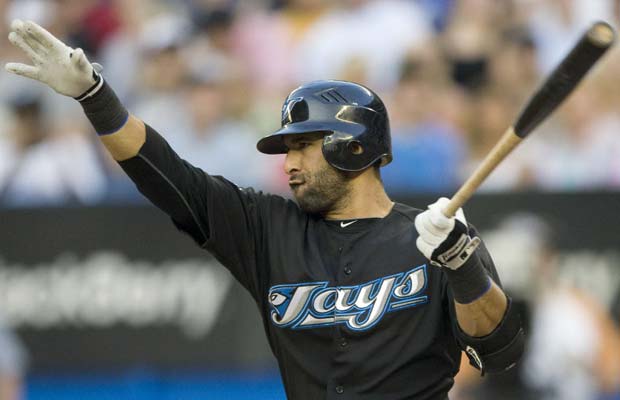 With a signing of Fielder, the Jays could move Adam Lind to just a DH. Could you dare envision a lineup of: Escobar SS, Rasmus CF, Bautista RF, Fielder 1B, Lawrie 3B, Lind DH, Arencibia C, Johnson 2B, and your pick of Thames or Snyder? This would free up your club to make a trade as well. If you are the Jays, and offered Yu Darvish the posting bid of over $50 million and another $60-75 million in salary, why wouldn’t you offer Fielder a 7 year deal in the $140-150 Million range? With Fielder signed, I think his presence would potentially alter the attendance by 8,000-10,000 fans per game to justify his salary (not to mention merchandise and television ratings). With a 3-4-5 lineup of Bautista, Fielder and Lawrie, I could see 120 HR’S and 350 RBI combined each year. The best aspect of these guys is that they are patient. If you add Adam Lind as the #6 hitter with 30 HR 100 RBI capability, then it will become lookout time for the rest of the league.
The Angels signing of Albert Pujols should not cause concern about his production. Even into his early 40’s, Pujols should be able to hit well given his dedication to personal fitness. The question is: why wait to move him to DH right now with the amount of 1st baseman they already possess with Trumbo and maybe a return from Morales? It is my belief that aging players should be shipped off to the National League when they can’t post impressive offensive numbers. A good example of this are recent NL pinch hitters Jason Giambi and Matt Stairs making a living off pinch such roles after failing as DH’s late into their careers. If the AL teams persist in signing aging players past their prime for the DH role, then I believe they will struggle. Vlad Guerrero and Johnny Damon would be perfect for an NL team at this stage of their respective careers considering this rationale.
So whatever players are ultimately signed by each team from this point forward or already have signed, whichever AL teams have the best Designated Hitters in the league for the 2012 season will likely have the best shot at winning the AL Pennant.
 *** Thank you to our Guest Baseball Writer- Doug Booth for joining us today on MLB reports. To learn more about “The Fastest 30 Ballgames” and Doug Booth, you can follow Doug on Twitter (@ChuckBooth3024) and click here for Doug’s website, fastestthirtyballgames.com***
Please e-mail us at: MLBreports@gmail.com with any questions and feedback. You can follow us on Twitter and become a fan on Facebook . To subscribe to our website and have the daily Reports sent directly to your inbox , click here and follow the link at the top of our homepage.

MLB Ballpark Traditions: American League
Monday December 19, 2011
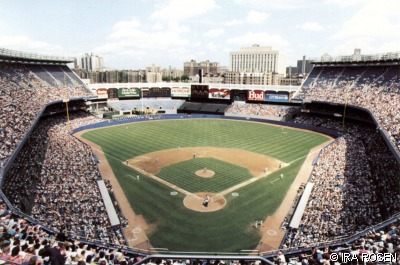
Doug Booth- Guest Baseball Writer: Since I finished writing the book on my experiences in chasing down the World Record by going to all the baseball parks, I decided to ask for help in my research. I went to every ballpark for two years in a row from 2008-2009, and am always fascinated by traditions and things each city does at a ballpark. Like Sweet Caroline is always played in the bottom of 8th at Fenway or…. Tailgate parties that I have seen in Oakland, New York and Minnesota. This could be something on field, in the air, outside the ballpark, after or before the game. Fans have their own way of celebrating. This is just what I have picked up. What else am I missing?
New York Yankees-Yankee-Stadium
1. They take roll call for every position player–and it comes from the bleachers once the game starts. Each 9 starting fielders in the TOP of the first gets their name called. The fans chant each of the BALLPLAYERS until they wave their hats back to acknowledge them.
2. Frank Sinatra’s “New York, New York” is played at the end of every game in an infinite loop.
3. You got the ‘DEREK JETER’ with rhythmic clapping after wards
4. They chant HIP-HIP JORGE for Jorge Posada–or they say his name to the famous chant of soccer—JORGE-JORGE-JORGE-JORGE-JORGE-JORGE.
5. Of course there are the famous calls of John Sterling for each player. Example,-“Teixeira sends a TEX MESSAGE TO RIGHT FIELD oh you are on the ‘MARK’ Teixeira.
6. Of course booing all the opposition is common.
7. Still play “GOD BLESS AMERICA’ before “TAKE ME OUT TO THE BALLGAME.”
Boston Red Sox-Fenway Park
 1. Play the song Sweet Caroline in the bottom of the eighth.
2. They boo the catcher and pitcher of the opposite team every time they meet at the mound.
Toronto Blue Jays.-Rogers Center
1. They start at the time of 37-or 07 after the hour to accommodate both the Canadian and American anthem.
2. They have a chant in the stands where a guy counts from 10-1 and then everyone screams.
3. Other cities have called the some of the worst fans in baseball—they do the wave when they are down 10 runs—do you think they would do the wave in New York or Boston if their team was behind by 10 runs?
Baltimore Orioles-Oriole Park at Camden Yards
1. They chant “Oh” really loud at the time of the national anthem when the part says Oh say does that star spangle….”
2. There was a kid who would sprint out with a player’s jacket whenever there was a pitcher called in relief from the bullpen-is he still there?
Tampa Bay Rays-Tropicana Field
1. They play the “HEY RAYS” song when they win.
2. They post the starting lineups on a scoreboard outside the park whenever they are playing that day.
3. They light up the lights outside the ‘TROP’ on nights they win so that motorists can tell the home team won.
4. They have cowbells they use in the stands ‘for effect’
Chicago White Sox-US Cellular Field
1. Their come out song is “Thunderstruck.”
2. They always shoot fireworks after the home runs.
3. They have an old-time song they sing every game, what is it?
Detroit Tigers-Comerica Park
 1. They have one of the only names retired instead of numbers with “TY COBB”S’ name being displayed but no number ahead of his name.
2. They play “Detroit Rock City”, by Kiss before the game
Kansas City Royals-Kauffman Stadium
1. They shoot the water fountains high between innings.
2. One of the only clubs that play western music, this includes a rendition of “I got friends in low places.”
Minnesota Twins-Target Field
1.TC(the Twins Mascot)-hits batting practice with a lucky fan before every game.
Cleveland Indians-Progressive Field
1. They have the loyal drummer in right field that attends every game.
2. They usually play the song “CLEVELAND ROCKS” at some point in the game.
3. There is always a clip from ‘MAJOR LEAGUE’ used too.
Seattle Mariners-Safeco Field
1. There is a train that comes through about every 10 minutes in the background-almost as frequent as planes at CITI FIELD.
2. They were the ‘original team’ of the theme “ZOMBIE NATION” by KernKraft 400.
Oakland A’s-McaFee Coliseum/now O.Overstock Coliseum
1. Get there early enough and you are sure to find half the parking lot tailgating. Note: “Worst park to where opposition gear, after all, A’s fan is also “RAIDER FAN.”
2. I would never suggest public transportation in this area, serious safety concern–pay the excruciating 17 dollars and park outside the stadium for easy access in and out.
Texas Rangers-The Ballpark in Arlington
1. They play the “Natural” theme song whenever there is a homer hit by the home team.
2. “They sing the STARS AT NIGHT SONG” as do the Astros.
Los Angeles Angels of Anaheim-Angels Stadium
1. The staff used to wear the 20’s usher outfits until recently but they still all wear straw hats like lots of other staffs.
2. They have the waterfall going a lot-and they also have fireworks every time there is a homer hit.
These traditions make baseball great. I would appreciate any other traditions that you know of. If you are the game it makes the experience so much greater in participating. Booth7629@gmail.com
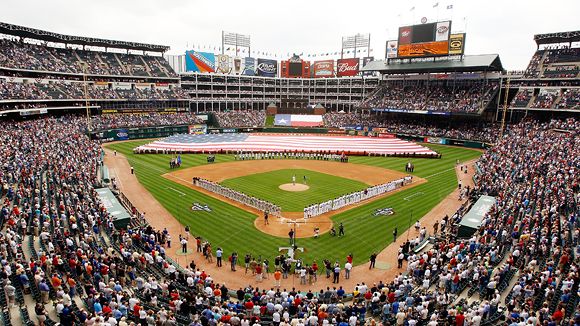
Get ready for Part 2 of Doug Booth’s Ballpark Traditions feature on MLB reports, with a look at the National League Traditions. Coming up this week on MLB reports!
*** Thank you to our Guest Baseball Writer- Doug Booth for joining us today on MLB reports. To learn more about “The Fastest 30 Ballgames” and Doug Booth, you can follow Doug on Twitter (@ChuckBooth3024) and click here for Doug’s website, fastestthirtyballgames.com***
Please e-mail us at: MLBreports@gmail.com with any questions and feedback. You can follow us on Twitter and become a fan on Facebook . To subscribe to our website and have the daily Reports sent directly to your inbox , click here and follow the link at the top of our homepage.

Is Expansion of Interleague Play a Good Idea?
Monday November 28, 2011
Sam Evans: When Major League baseball first instituted interleague play in 1997 it was supposed to draw fans back to the game. It worked, as attendances rose around baseball whenever teams from the other league were in town. Now, in the year 2011, MLB is searching for a new way to draw fans back to the game and level the playing field for teams at the same time.
This offseason, Major League Baseball decided to realign the Astros to the American League. With balance leagues of 15 teams each side, this means that there will be at least one interleague game on days when all thirty teams are playing (Friday, Saturday, Sunday, Opening Day, etc). MLB is trying to make the leagues and divisions more fair, but by doing so they are making interleague play less meaningful. In “Elmo Saves Christmas,” Elmo wishes that he could have Christmas every day. However, when Elmo’s wish comes true, he discovers Christmas is not as fun anymore. I am frightened that this will happen to baseball, and the result is that interleague play will not be as special.
For myself and many other baseball fans, the current interleague schedule is perfect. The summer months are a great time to go watch a team that you otherwise would not normally get to watch. I am afraid that with MLB’s new proposed schedule, the concept of separate leagues will lose almost all of their meaning outside of the postseason. The All-Star game will also not be as exciting because we would have already seen most of these players face each other throughout the year.
If I was Bud Selig, I would recognize that baseball needs to regain popularity among younger people. Baseball needs new ideas in marketing to become more popular around the world. If this new increased interleague schedule is destined to happen, then I would have only one interleague game on those required days and make it nationally televised. This would be similar to NBC’s Game of the Week which was televised and extremely popular from 1960 to 1990.
I think that interleague play over a whole season will have the opportunity to bring more fans to the game. However, I think there is more of a chance that it has little to no impact. Major League baseball needs to focus on getting people talking, to create a buzz. We have seen this idea work when fans are drawn to exciting players such as Strasburg and when fans see other people talking about the game.
If Major League Baseball ends up increasing the interleague games, they definitely shouldn’t have more than two interleague games per day, and they should advertise these games as much as possible. I didn’t find many problems with the current alignment, and I think it would have worked best if they had just stuck with the present schedule. Advances in the game can be great and revolutionize the sport. Increasing interleague play is not the answer in that regard. Expect more schedule and realignments changes to come until Major League Baseball gets it right.

 ***Today’s feature was prepared by our Baseball Writer, Sam Evans. We highly encourage you to leave your comments and feedback at the bottom of the page and share in the discussion with our readers. You can also follow Sam on Twitter***
Please e-mail us at: MLBreports@gmail.com with any questions and feedback. You can follow us on Twitter (@MLBreports) and become a fan on Facebook . To subscribe to our website and have the daily Reports sent directly to your inbox , click here and follow the link at the top of our homepage.

The Astros Move To The AL West
Sunday October 30, 2011

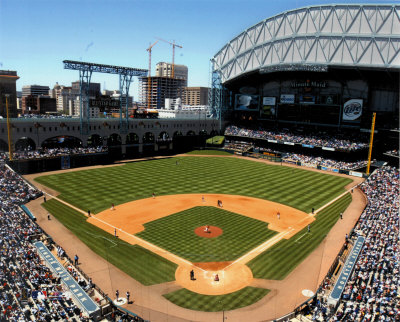
MLB reports – Sam Evans: As an amazing 2011 MLB postseason has come to a close, it’s time to look ahead to next year. The Houston Astros have been,” looking forward to the next year,” since the last time they made the playoffs in 2006. It’s time for a change in Houston and Bud Selig and Jim Crane are currently working on a plan to make a big-time change for baseball’s future in Houston.
Times have been hard recently for Astros fans. Widely considered the worst team in baseball, the Astros home attendance has steadily decreased every year since 2006. They haven’t had a winning season since 2008 and their minor league system shows only small glimmers of hope on the way.
In the middle of June, rumors began floating around that the Astros would move to the American League, as early as the 2013 season. This would provide each league with an even fifteen teams and six five team divisions. Also, you have to think that Major League Baseball wants to start a rivalry between the Astros and the Rangers. Well now in October, these rumors have become more serious and now it appears inevitable that the Astros will be realigned to the American League West.
Although we don’t know when exactly this move will take place,we have figured out that it will happen. It will be interesting to see if the Astros shop for a DH this or next offseason because if they do move by 2013, having nine Major League quality hitters in their lineup would be a big asset. It would make sense for them to bring back Carlos Lee if they were indeed moving to the AL, because he would be a much more productive DH than an outfielder.
I actually think that this would be a good move both for MLB and for the Astros. For MLB, they finally fix the glaring trivia answer which is, why there is an uneven number of teams in each league. Balanced divisions, until increased to 32 Major League teams by way of expansion, will lead to an unbalanced schedule. 15 teams per league means that there will need to be an interleague game scheduled every week. Some love the concept of interleague play, while other detest it. But for whatever people think of it, interleague is here to stay in the world of Major League Baseball. Having weekly interleague match-ups will actually help solve the unbalanced interleague issue. In current play, some fans have complained that the same interleague match-ups are in place every year- with not all teams from each of the different leagues matching up. Having weekly interleague games means that all AL and NL teams will face-off during the season at some point. Greater exposure for each of the teams in each MLB city should lead to greater enthusiasm for the fans and a more balanced approach to scheduling interleague games. It is not a perfect system- far from it. But until Major League Baseball brings in 2 more teams and creates a 16/16 league split, having the 15/15 split will at least allow for balanced divisions and equal chances to make the playoffs.
For the Astros, I seriously believe they could start one of the best rivalries in baseball with the Rangers. This would be beneficial not only for the Astros as an organization, but their fans and attendance as well. Let’s make one thing clear though in the interim: the current “rivalry” between the Astros and Rangers is a joke. The ony time they face off is in interleague games, and neither team has any more incentives in those games as compared to any other games. However, I think if they actually played each other as division rivals frequently, and the fans became passionate about those games, then they could actually start a strong rivalry for years to come.
Astros fans have been against this move for two main reasons. The first is that they would lose their history with the National League (and specifically, NL Central teams). The main reason however, is that they would play West Coast teams more, which would mean that games against Seattle, Oakland, and Anaheim would start at a later time. I can fully understand and appreciate the Astros fans feelings on the subject. The only counterexample I can offer is what Rangers fans already go through with this same dilemma and they same to have done just fine.
At the end of the day, I think the Astros should move to the American League West. It makes sense for the current MLB system. Furthermore, this franchise looks in need of a fresh start and maybe a new division could help provide that.
 Today’s feature was prepared by our Intern, Sam Evans. We highly encourage you to leave your comments and feedback at the bottom of the page and share in the discussion with our readers. You can also follow Sam on Twitter.
Please e-mail us at: MLBreports@gmail.com with any questions and feedback. You can follow us on Twitter and become a fan onFacebook . To subscribe to our website and have the daily Reports sent directly to your inbox , click here and follow the link at the top of our homepage.

New York Yankees: 6-Man Rotation and Implications
Tuesday August 9, 2011

Rob Bland (Intern- MLB Reports): When you look at the New York Yankees pitching staff in 2011, two things come to mind. C.C. Sabathia is the only frontline starter they currently have, and he has a pretty decent supporting cast. That being said, last week, the Yankees have decided to go with a 6-man rotation for the time being. This could be a motivational tool for Phil Hughes, who has struggled with injuries and command this season. It also could be a way to limit some of the other starters’ inning totals. Here is a quick look at all six members of the current rotation and how they stack up.
C.C. Sabathia is a true ace. A workhorse. A throwback to a generation where pitchers routinely threw 210+ innings in a season. In his first 10 Major League seasons, Sabathia averaged over 210 innings per season. This season, he is on pace for close to 250 innings. Sabathia is once again this season one of the strongest frontrunners for the AL Cy Young Award.
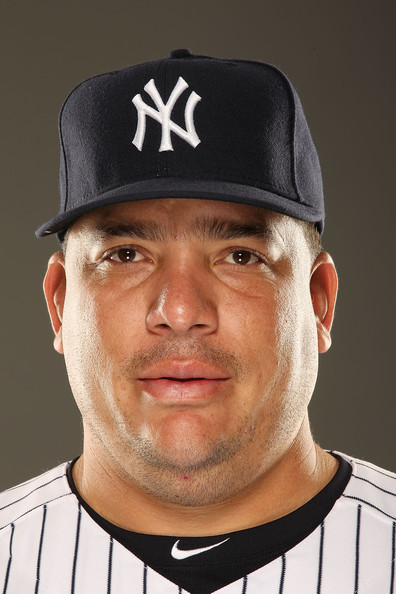 Bartolo Colon is having a resurgence nobody could have predicted. His ERA+ (a stat that compares his ERA with league average as well as adjusting to ballparks) of 126 is the highest it has been since 2002 when he was traded from Cleveland to Montreal. He has thrown 113 2/3 innings already, which is more than he threw from 2008-2010. Although it is fair to say he didn’t pitch in the big leagues in 2010. Colon hasn’t thrown this many innings since 2005, when he threw 222 2/3 on his way to a Cy Young Award. Colon is throwing strikes and eating innings. Since joining the rotation, Colon has averaged over 6 innings per start. Colon is a candidate to tire and wear down due to his large frame and weight, as well as the number of innings he has thrown in the last 5-years.
A.J. Burnetthas again been under-performing in relation to the 5-year $80M contract he signed before the 2009 season. Burnett has always been touted as a pitcher with electric stuff, but unable it seems to figure it out. Last year he was atrocious. This year he is better, but still not very good. He is on pace to lead the league in wild pitches for the second time in three years; in 2010 he was 2nd. Burnett’s walk rate of 4 per 9 innings is not good, and he is giving up home runs at an alarming rate of 1.3 per 9 innings.
If we thought that Colon has been good this year, then Freddy Garcia has been great. Once considered a great inning eater, with 7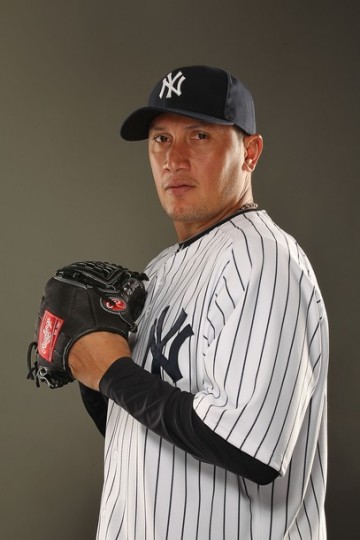 of his first 8 MLB seasons throwing over 200 innings, he is back to his old tricks. Garcia doesn’t throw with the same velocity as he once did; his fastball averaged 93 mph in 2002, whereas it sits around 87 now. He knows this is the case, and actually only throws his heater 37.2% of the time, compared to 63% in 2002. The biggest difference is that he now throws a split-finger 21.5% of the time, which he didn’t begin throwing with any regularity until 2006. Garcia threw 157 innings last year, so I don’t see him wearing down yet as evidenced by his 3.16 ERA in 122 1/3 innings this season.
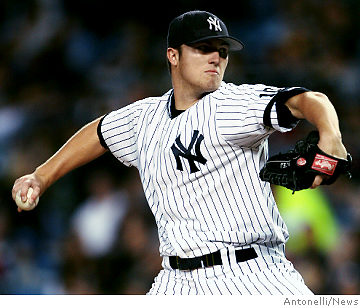 Phil Hughes has not had the 2011 that the Yankees dreamed of after his terrific 2010 season, where he went 18-8 with a 4.19 ERA. Hughes has only started 8 games this year, and has not pitched very well. His main problem is that he is simply not missing any bats. His K rate sits at 4.74/9 IP. Hitters are hitting more line drives, and less ground balls off Hughes, which is a reason for a spike in his BABIP of .343 as compared to .274 last year. The Yankees could be using his next couple of starts to see if they will stick with a 6-man rotation. Hughes has been unable to last more than 6 innings in a start this year. It should be noted though that his last start on August 2nd was an encouraging one, as he threw 6 innings, allowing only 3 hits and induceing 9 ground balls.
Ivan Nova had been dangled in trade talks seemingly from the end of the last World Series until this year’s trade deadline, where the Yankees pulled him back to keep for themselves. GM Brian Cashman has said that they feel Ivan Nova is as good as the current version of Ubaldo Jimenez, so they held on to him, hoping to harness his ability. When Hughes returned from the disabled list, Nova was initially optioned to AAA to make room in the rotation. Nova has been pretty good all season, as his sinking fastball induces a ton of ground balls. His 10-4 record with a 3.81 ERA has been impressive, but he still doesn’t strike out many hitters. Nova threw almost 190 innings last year, so he will have no restrictions this year as he currently sits at 122 IP in the MLB and AAA combined.
The Yankees have a pretty good problem to have in that four of their starters are pitching well., one starter has been working back from an injury and is improving, and the other is a guy with tremendous talent. The choice that many would like to see is Burnett being pushed to a bullpen role, but I don’t see that happening. One more turn in the rotation should prove that the Yankees need to cut down on Garcia and Colon’s innings, and that Burnett should throw on 5 days rest instead of the usual four. Garcia and Colon may also get skipped in the rotation a couple of times down the stretch to save their arms for the playoffs.
For the playoffs, most teams use a three or four-man rotation, using their fifth guy in a long relief role. The Yankees can make a case for a four-man rotation, using Sabathia, Nova, Colon and Garcia if they all stay healthy. That is a lot of talent and experience to utilize in a short playoff matchup. Hughes has never been that impressive to me, but if he rounds into form, he could easily slot into the fourth spot, pushing out Colon or Garcia, depending on who loses the battle at the end.
The bottom line is that the Yankees have depth at the Major League level. They have successfully held on to many of their top prospects in the last few years, while adding crafty veteran free agents to the mix. The result is that the Yankees should continue contending for the American League East division title this year and for many years to come.

***Today’s feature was prepared by our Intern, Rob Bland. We highly encourage you to leave your comments and feedback at the bottom of the page and share in the discussion with our readers. You can also follow Rob on Twitter.***
Please e-mail us at: MLBreports@gmail.com with any questions and feedback. You can follow us on Twitter and become a fan on Facebook . To subscribe to our website and have the daily Reports sent directly to your inbox , click here and follow the link at the top of our homepage.

2011 MLB All-Star Game Recap: National League Defeats the American League for 2nd Year in a Row
Wednesday July 13, 2011

 Rob Bland (Intern Candidate for MLB Reports): This year’s edition of the Midsummer Classic, the 2011 MLB All-Star Game, had a record-setting vote-getter. Jose Bautista of the Toronto Blue Jays received over 7.4 million votes in fan voting. This game was said to have lost some of its lustre due to the amount of players who elected not to participate. A total of eight players that were voted in by fans or chosen by coaches dropped out due to injury, timing or just plain wanting to rest. For the American League, David Price (TB), Derek Jeter (NYY), Mariano Rivera (NYY), Alex Rodriguez (NYY) and Jon Lester (BOS) all withdrew due to various ailments and injuries. Chipper Jones (ATL), Jose Reyes (NYM), and Placido Polanco (PHI) were the players who bowed out in the National League. One of Major League Baseball’s rules pertaining to eligibility for pitchers is that they must not start on the Sunday prior to the game. Due to this rule, CC Sabathia (NYY), James Shields (TB), Justin Verlander (DET), Felix Hernandez (SEA), Cole Hamels (PHI), and Matt Cain (SF) were ruled ineligible and unable to participate in the game.
Surely not having Price, Sabathia, Shields, Verlander, Hernandez and Rivera hurt the AL. Although he has had an impressive start to the season, CJ Wilson (TEX) probably should not have been pitching when he gave up the 3-run home run to Prince Fielder (MIL). It easily could have been one of those more accomplished aces as mentioned. However, that is the way it turned out, as the National League took advantage early and defeated the American League by a score of 5-1. The MVP of the game was Fielder, because of his huge home run that put the NL on top early and as it turned out, for good.
My pick for MVP was Roy Halladay (PHI), as he started for the National League and was dominant as only the Doc can be. He faced the minimum six batters over two innings, including Curtis Granderson (NYY), Adrian Gonzalez (BOS) and Jose Bautista (TOR); all potential MVP candidates. Halladay managed to throw only 19 pitches as part of his historical pitching performance.
In the 2nd inning, the defensive play of the game occurred when Brian McCann (ATL) hit a towering flyball in foul territory that Bautista caught as he slid into the wall. Aside from being one of the top home run hitters in baseall, Bautista is also an accomplished fielder who is capable of winning a gold glove at either third base or right field.
The scoring in the game started in the top of the 4th inning, when Adrian Gonzalez blasted a Cliff Lee (PHI) cutter over the right center field wall for a solo blast. The AL followed with three straight singles, the last of which was off Tyler Clippard (WAS). Hunter Pence fielded the ball and threw a laser to the plate to catch Bautista who tried to score from second for the third out. In the bottom of the inning, Carlos Beltran (NYM) and Matt Kemp (LAD) hit singles to set up Fielder`s massive bomb.
Jordan Walden (LAA), another player who probably didn`t deserve to play as much as the other big name starters, began to light up the radar gun last night, hitting 100 mph on his first four fastballs. Starlin Castro (CHC) came in to pinch run at first base after Troy Tulowitzki (COL) hit a leadoff single. Castro proceeded to immediately steal second and third base. He then set up another play at the plate, where Walden bare handed a weak ground ball by Rickie Weeks (MIL) and threw Castro out. Weeks stole second and came around to score when Andre Ethier (LAD) hit a single to right field, making the score 4-1.
The scoring continued in the bottom of the seventh inning when Pablo Sandoval (SF) hit a ground rule double over the wall in the left field corner. This scored Hunter Pence (HOU) after his leadoff single and a passed ball that allowed him to move to second base, and eventually score.
 Fan favorite Brian Wilson (SF) came in the top of the nineth inning with runners on second and third. A fly out and ground out later, and the game was in the books. Make the final score 5-1, as the National League wins for the All-Star Game for the second year in a row and secures home field advantage for its league in the up coming World Series in the fall.
This year`s All-Star Festivities were enjoyed by so many fans, and continually impressed me. I have had a great time covering the 2011 All-Star Game, everything from the Futures Game, Home Run Derby and of course, the All-Star Game itself. With Major League Baseball now entering the dog days of summer and the secon half of the season, it is time to speculate on trades and the calling up of prospects. Pure heaven for this baseball writer!
***EDITOR’S NOTE: With Chase Field still buzzing, the trade market has already begun. The Milwaukee Brewers announced right after the game taht they had acquired closer Francisco Rodriguez and cash considerations from the New York Mets for two players to be named later. With the Brewers acquiring Zack Greinke and Shaun Marcum in the offseason, clearly Milwaukee is going for it. Will be interesting to see if Brewers allow K-Rod’s $17.5 million option to vest for 2012, which is based on number of games finished in 2011. If K-Rod finishes 55 games, the option will vest. As he has already finsihed 34 this season, so the option could vest depending on how the Brewers use K-Rod and how close they remain to a playoff berth. It will be interesting to see what prospects go from Milwaukee to New York. Long-term this deal could hurt Milwaukee depending on which top prospects they give up. But in the short-term, this deal will make the Brewers’ fanbase happy and their slugging free agent to be, Prince Fielder, may have more thinking to do before selecting his new team for 2012. The ground work has been set with respect to the trade market. Now we will see if the K-Rod deal has indeed open the trading floodgates for the rest of baseball. ***
| 1 | 2 | 3 | 4 | 5 | 6 | 7 | 8 | 9 | R | H | E | |
| American | 0 | 0 | 0 | 1 | 0 | 0 | 0 | 0 | 0 | 1 | 6 | 0 |
| National | 0 | 0 | 0 | 3 | 1 | 0 | 1 | 0 | – | 5 | 9 | 2 |
W: T. Clippard
L: C. Wilson
S: B. Wilson
|
National All-Stars |
||||||||||
|---|---|---|---|---|---|---|---|---|---|---|
| Hitters | AB | R | H | RBI | BB | SO | #P | AVG | OBP | SLG |
| R Weeks 2B | 3 | 1 | 0 | 0 | 0 | 1 | 12 | .000 | .000 | .000 |
|
B Phillips 2B
|
1 | 0 | 0 | 0 | 0 | 0 | 3 | .000 | .000 | .000 |
| C Beltran DH | 2 | 1 | 1 | 0 | 0 | 1 | 7 | .500 | .500 | .500 |
|
a-A Ethier PH-DH
|
1 | 0 | 1 | 1 | 0 | 0 | 8 | 1.000 | 1.000 | 1.000 |
|
b-G Sanchez PH-DH
|
1 | 0 | 0 | 0 | 0 | 0 | 3 | .000 | .000 | .000 |
| M Kemp CF | 2 | 1 | 1 | 0 | 1 | 0 | 15 | .500 | .667 | .500 |
|
A McCutchen CF
|
1 | 0 | 0 | 0 | 0 | 0 | 3 | .000 | .000 | .000 |
| P Fielder 1B | 2 | 1 | 1 | 3 | 0 | 0 | 6 | .500 | .500 | 2.000 |
|
J Votto 1B
|
2 | 0 | 0 | 0 | 0 | 1 | 9 | .000 | .000 | .000 |
| B McCann C | 2 | 0 | 0 | 0 | 0 | 0 | 8 | .000 | .000 | .000 |
|
Y Molina C
|
1 | 0 | 1 | 0 | 0 | 0 | 1 | 1.000 | 1.000 | 2.000 |
|
c-J Bruce PH-RF
|
1 | 0 | 0 | 0 | 0 | 1 | 6 | .000 | .000 | .000 |
| L Berkman RF | 1 | 0 | 1 | 0 | 0 | 0 | 3 | 1.000 | 1.000 | 1.000 |
|
J Upton RF
|
2 | 0 | 0 | 0 | 0 | 0 | 3 | .000 | .000 | .000 |
|
M Montero C
|
0 | 0 | 0 | 0 | 0 | 0 | 0 | .000 | .000 | .000 |
| M Holliday LF | 1 | 0 | 0 | 0 | 0 | 1 | 7 | .000 | .000 | .000 |
|
H Pence LF
|
2 | 1 | 1 | 0 | 0 | 1 | 10 | .500 | .500 | .500 |
| T Tulowitzki SS | 2 | 0 | 1 | 0 | 0 | 0 | 5 | .500 | .500 | .500 |
|
S Castro PR-SS
|
1 | 0 | 0 | 0 | 0 | 1 | 3 | .000 | .000 | .000 |
| S Rolen 3B | 2 | 0 | 0 | 0 | 0 | 2 | 8 | .000 | .000 | .000 |
|
P Sandoval 3B
|
1 | 0 | 1 | 1 | 0 | 0 | 6 | 1.000 | 1.000 | 2.000 |
| Totals | 31 | 5 | 9 | 5 | 1 | 9 | 126 | |||
| a-singled to right for C Beltran in the 5th b-popped out to second for A Ethier in the 7th c-struck out looking for Y Molina in the 8th |
||||||||||
| BATTING 2B: Y Molina (1, C Perez); P Sandoval (1, B League) HR: P Fielder (1, 4th inning off C Wilson 2 on, 0 Out) RBI: P Fielder 3 (3), A Ethier (1), P Sandoval (1) 2-out RBI: A Ethier All-Stars RISP: 3-8 (P Fielder 1-1, J Upton 0-1, S Rolen 0-1, B Phillips 0-1, R Weeks 0-1, A Ethier 1-1, G Sanchez 0-1, P Sandoval 1-1) Team LOB: 3 |
||||||||||
| BASERUNNING SB: S Castro 2 (2, 2nd base off J Walden/A Avila, 3rd base off J Walden/A Avila); R Weeks (1, 2nd base off J Walden/A Avila) CS: L Berkman (1, 2nd base by D Robertson/A Avila) |
||||||||||
| FIELDING E: S Castro (1, throw); J Bruce (1, throw) Outfield Assist: H Pence (J Bautista at Home). |
||||||||||
|
National All-Stars |
||||||||||
|---|---|---|---|---|---|---|---|---|---|---|
| Pitchers | IP | H | R | ER | BB | SO | HR | PC-ST | ERA | |
| R Halladay | 2.0 | 0 | 0 | 0 | 0 | 1 | 0 | 19-14 | 0.00 | |
| C Lee | 1.2 | 3 | 1 | 1 | 0 | 0 | 1 | 25-16 | 5.40 | |
T Clippard |
0.1 | 1 | 0 | 0 | 0 | 0 | 0 | 3-3 | 0.00 | |
| C Kershaw (H) |
1.0 | 0 | 0 | 0 | 0 | 1 | 0 | 8-6 | 0.00 | |
| J Jurrjens (H) |
1.2 | 1 | 0 | 0 | 0 | 1 | 0 | 23-15 | 0.00 | |
| C Kimbrel (H) |
0.1 | 0 | 0 | 0 | 1 | 0 | 0 | 14-8 | 0.00 | |
| J Venters | 0.2 | 0 | 0 | 0 | 0 | 1 | 0 | 4-4 | 0.00 | |
| H Bell | 0.1 | 0 | 0 | 0 | 0 | 0 | 0 | 5-2 | 0.00 | |
| J Hanrahan | 0.1 | 1 | 0 | 0 | 0 | 1 | 0 | 14-9 | 0.00 | |
| B Wilson (S) |
0.2 | 0 | 0 | 0 | 0 | 0 | 0 | 7-5 | 0.00 | |
| Totals | 9.0 | 6 | 1 | 1 | 1 | 5 | 1 | 122-82 | ||
| PITCHING First-pitch strikes/Batters faced: R Halladay 4/6; C Lee 4/8; T Clippard 1/1; C Kershaw 1/3; J Jurrjens 5/6; C Kimbrel 0/2; J Venters 2/2; H Bell 0/1; J Hanrahan 1/3; B Wilson 2/2 Called strikes-Swinging strikes-Foul balls-In Play strikes: R Halladay 4-3-2-5; C Lee 4-1-3-8; T Clippard 1-1-0-1; C Kershaw 1-1-2-2; J Jurrjens 3-5-3-4; C Kimbrel 1-2-4-1; J Venters 1-2-0-1; H Bell 1-0-0-1; J Hanrahan 1-2-4-2; B Wilson 1-1-1-2 Ground Balls-Fly Balls: R Halladay 3-2; C Lee 4-1; T Clippard 0-0; C Kershaw 2-0; J Jurrjens 2-2; C Kimbrel 1-0; J Venters 1-0; H Bell 0-1; J Hanrahan 0-0; B Wilson 1-1 Game Scores: R Halladay 57 |
||||||||||
|
American All-Stars |
||||||||||
|---|---|---|---|---|---|---|---|---|---|---|
| Hitters | AB | R | H | RBI | BB | SO | #P | AVG | OBP | SLG |
| C Granderson CF | 2 | 0 | 0 | 0 | 0 | 0 | 3 | .000 | .000 | .000 |
|
J Ellsbury CF
|
2 | 0 | 0 | 0 | 0 | 2 | 8 | .000 | .000 | .000 |
| A Cabrera SS | 2 | 0 | 0 | 0 | 0 | 1 | 6 | .000 | .000 | .000 |
|
J Peralta SS
|
2 | 0 | 0 | 0 | 0 | 0 | 8 | .000 | .000 | .000 |
| A Gonzalez 1B | 2 | 1 | 1 | 1 | 0 | 0 | 6 | .500 | .500 | 2.000 |
|
M Cabrera 1B
|
1 | 0 | 0 | 0 | 0 | 0 | 5 | .000 | .000 | .000 |
|
M Young 3B
|
1 | 0 | 0 | 0 | 0 | 1 | 5 | .000 | .000 | .000 |
| J Bautista RF | 2 | 0 | 1 | 0 | 0 | 0 | 5 | .500 | .500 | .500 |
|
C Quentin RF
|
2 | 0 | 0 | 0 | 0 | 0 | 8 | .000 | .000 | .000 |
| J Hamilton LF | 2 | 0 | 1 | 0 | 0 | 0 | 4 | .500 | .500 | .500 |
|
M Joyce LF
|
2 | 0 | 1 | 0 | 0 | 0 | 7 | .500 | .500 | .500 |
| A Beltre 3B | 2 | 0 | 1 | 0 | 0 | 0 | 10 | .500 | .500 | .500 |
|
K Youkilis 3B
|
1 | 0 | 1 | 0 | 0 | 0 | 4 | 1.000 | 1.000 | 1.000 |
|
M Cuddyer 1B
|
1 | 0 | 0 | 0 | 0 | 0 | 1 | .000 | .000 | .000 |
| D Ortiz DH | 2 | 0 | 0 | 0 | 0 | 1 | 10 | .000 | .000 | .000 |
|
a-P Konerko PH-DH
|
1 | 0 | 0 | 0 | 1 | 0 | 13 | .000 | .500 | .000 |
| R Cano 2B | 2 | 0 | 0 | 0 | 0 | 0 | 4 | .000 | .000 | .000 |
|
H Kendrick 2B
|
1 | 0 | 0 | 0 | 0 | 0 | 7 | .000 | .000 | .000 |
| A Avila C | 2 | 0 | 0 | 0 | 0 | 0 | 7 | .000 | .000 | .000 |
|
M Wieters C
|
1 | 0 | 0 | 0 | 0 | 0 | 1 | .000 | .000 | .000 |
| Totals | 33 | 1 | 6 | 1 | 1 | 5 | 122 | |||
| a-walked for D Ortiz in the 7th | ||||||||||
| BATTING HR: A Gonzalez (1, 4th inning off C Lee 0 on, 2 Out) RBI: A Gonzalez (1) 2-out RBI: A Gonzalez All-Stars RISP: 2-5 (M Joyce 1-1, A Beltre 1-1, H Kendrick 0-1, M Cuddyer 0-1, P Konerko 0-1) Team LOB: 6 |
||||||||||
| FIELDING DP: 1 (A Avila-R Cano). PB: M Wieters. Outfield Assist: J Bautista (A Ethier at 2nd base). |
||||||||||
|
American All-Stars |
||||||||||
|---|---|---|---|---|---|---|---|---|---|---|
| Pitchers | IP | H | R | ER | BB | SO | HR | PC-ST | ERA | |
| J Weaver | 1.0 | 0 | 0 | 0 | 1 | 1 | 0 | 14-8 | 0.00 | |
| D Robertson | 1.0 | 1 | 0 | 0 | 0 | 1 | 0 | 14-7 | 0.00 | |
| M Pineda | 1.0 | 0 | 0 | 0 | 0 | 2 | 0 | 10-8 | 0.00 | |
| C Wilson (L) |
1.0 | 3 | 3 | 3 | 0 | 1 | 1 | 22-14 | 27.00 | |
| J Walden | 1.0 | 2 | 1 | 1 | 0 | 1 | 0 | 20-13 | 9.00 | |
| C Perez | 1.0 | 1 | 0 | 0 | 0 | 1 | 0 | 15-9 | 0.00 | |
| B League | 1.0 | 2 | 1 | 1 | 0 | 1 | 0 | 19-13 | 9.00 | |
| A Ogando | 0.2 | 0 | 0 | 0 | 0 | 0 | 0 | 6-5 | 0.00 | |
| G Gonzalez | 0.1 | 0 | 0 | 0 | 0 | 1 | 0 | 6-3 | 0.00 | |
| Totals | 8.0 | 9 | 5 | 5 | 1 | 9 | 1 | 126-80 | ||
| PITCHING First-pitch strikes/Batters faced: J Weaver 4/4; D Robertson 1/3; M Pineda 3/3; C Wilson 3/6; J Walden 2/4; C Perez 2/4; B League 3/5; A Ogando 2/2; G Gonzalez 1/1 Called strikes-Swinging strikes-Foul balls-In Play strikes: J Weaver 3-3-0-2; D Robertson 2-1-3-1; M Pineda 3-3-1-1; C Wilson 4-2-4-4; J Walden 2-3-5-3; C Perez 2-2-2-3; B League 1-4-4-4; A Ogando 2-0-1-2; G Gonzalez 2-1-0-0 Ground Balls-Fly Balls: J Weaver 1-1; D Robertson 0-1; M Pineda 0-1; C Wilson 0-2; J Walden 1-0; C Perez 0-2; B League 0-2; A Ogando 2-0; G Gonzalez 0-0 Game Scores: J Weaver 53 |
||||||||||

***Thank you to Rob Bland for preparing today’s article on the All-Star Game. You can follow Rob on Twitter.***
Please e-mail us at: MLBreports@gmail.com with any questions and feedback. You can follow us on Twitter and become a fan on Facebook . To subscribe to our website and have the daily Reports sent directly to your inbox, click here and follow the link at the top of our homepage.


 MLB Reports


You must be logged in to post a comment.