Author Archives: Jonathan Hacohen

From Riggleman to Johnson: Davey is the New Sheriff in Washington
Saturday, June 25, 2011
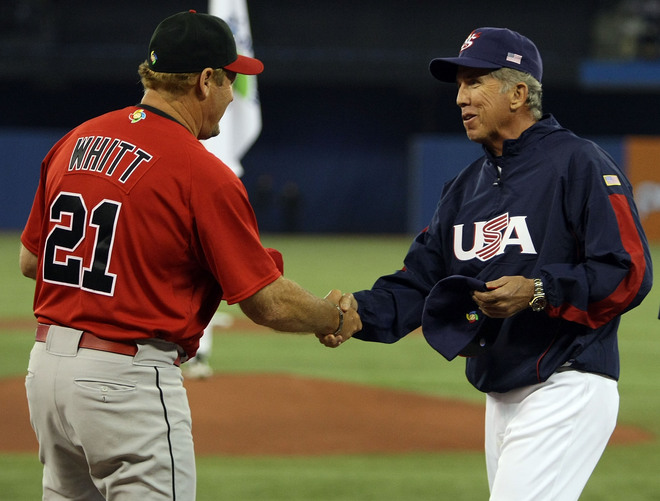
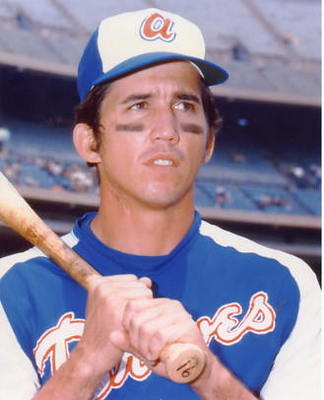
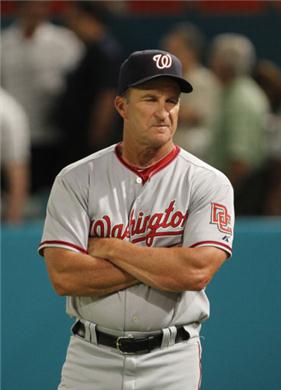
MLB reports: According to several sources, the Nationals are set to announce the hiring of their new manager. Less than twenty-four hours after the abrupt resignation of Jim Riggleman (see yesterday’s feature), Mike Rizzo has apparently found the man for the job within the Nationals organization. Ex-Mets skipper, Davey Johnson is set to move from the front office to the dugout. Nationals fans couldn’t be happier.
| Year | Tm | Lg | G | W | L | W-L% | Finish |
|---|---|---|---|---|---|---|---|
| 1984 | New York Mets | NL | 162 | 90 | 72 | .556 | 2 |
| 1985 | New York Mets | NL | 162 | 98 | 64 | .605 | 2 |
| 1986 | New York Mets | NL | 162 | 108 | 54 | .667 | 1 |
| 1987 | New York Mets | NL | 162 | 92 | 70 | .568 | 2 |
| 1988 | New York Mets | NL | 160 | 100 | 60 | .625 | 1 |
| 1989 | New York Mets | NL | 162 | 87 | 75 | .537 | 2 |
| 1990 | New York Mets | NL | 42 | 20 | 22 | .476 | 2 |
| 1993 | Cincinnati Reds | NL | 118 | 53 | 65 | .449 | 5 |
| 1994 | Cincinnati Reds | NL | 115 | 66 | 48 | .579 | 1 |
| 1995 | Cincinnati Reds | NL | 144 | 85 | 59 | .590 | 1 |
| 1996 | Baltimore Orioles | AL | 163 | 88 | 74 | .543 | 2 |
| 1997 | Baltimore Orioles | AL | 162 | 98 | 64 | .605 | 1 |
| 1999 | Los Angeles Dodgers | NL | 162 | 77 | 85 | .475 | 3 |
| 2000 | Los Angeles Dodgers | NL | 162 | 86 | 76 | .531 | 2 |
| New York Mets | 1012 | 595 | 417 | .588 | 1.7 | ||
| Cincinnati Reds | 377 | 204 | 172 | .543 | 2.3 | ||
| Baltimore Orioles | 325 | 186 | 138 | .574 | 1.5 | ||
| Los Angeles Dodgers | 324 | 163 | 161 | .503 | 2.5 | ||
| 2038 | 1148 | 888 | .564 | 1.9 |
Unlike his predecessor, Davey Johnson is a proven winner. Johnson managed four teams in his career before accepting the Nationals position. As a big league manager, Johnson has a career record of 1148 wins and 888 losses, good for a .564 winning percentage. Johnson has finished 11 of his 14 seasons above .500. He won a World Series title in 1986 with the New York Mets. Looking further at the numbers, Johnson’s teams have finished first in their division five times and in second place on seven different occasion. Johnson wins everywhere he goes and the same will be expected as the new face of baseball in the nation’s capital.
With Stephen Strasburg on the mend and Bryce Harper slowly making the climb to the big leagues, the Nationals will have a strong talent base for Johnson to mold. The Nationals will be looking for its team to play “Daveyball” and try to recreate some of the Mets magic from 1986. That team was filled with young prospects that gelled together at the same time, sprinkled with key veterans. As Mike Rizzo continues to tinker with the roster, we could very well be seeing a Nationals playoff run by 2013. Coincidently, that will also be the year that new manager Davey Johnson’s contract is set to expire. Provided Johnson’s teams perform to expectations, his run in Washington will be far longer than that of Jim Riggleman.
Davey Johnson is known as a gamer. A man who played with his heart on his sleeve back in his playing days and as an intense competitor behind the bench. This is a man who refuses to lose. For an organization that seemingly refuses to win, Johnson is a breath of fresh air and should turn out to be the voice of a reason for an organization in dire need of direction. Bobby Valentine would have been a good choice as well (given the rumors surrounding him in the media). But the Nationals have their man. A former Manager of the Year (AL 1997) and World Series winner. Welcome to the new Nationals manager, Davey Johnson. Get ready to see a lot of W’s in Washington during the next few seasons.
Please e-mail us at: MLBreports@gmail.com with any questions and feedback. You can follow us on Twitter and become a fan on Facebook . To subscribe to our website and have the daily Reports sent directly to your inbox , click here and follow the link at the top of our homepage.

Jim Riggleman Resigns from the Nationals: Treason in Washington
Friday, June 24, 2011

MLB reports: June has apparently become the month in baseball to fire your coach if you are a MLB General Manager, or to quit your team if you are a manager. Follow along the coaching carousel:
-
June 8th: Texas Rangers fire hitting coach Thad Bosley and replace him with Scott Coolbaugh
-
June 9th: Florida Marlins fire hitting coach John Mallee and replace him with Eduardo Perez
-
June 10th: Oakland Athletics fire manager Bob Geren and replace him with Bob Melvin
-
June 14th: Houston Astros fire pitching coach Brad Arnsberg and replace with him Doug Brocail
-
June 17th: Cleveland Indians fire hitting coach John Nunnally and replace him with Bruce Fields
 It looks like where there is smoke, there is fire. A lot of it apparently in the coaching ranks of baseball. Teams were getting nervous and to help jump-start their slumping players, several teams decided to change a coach rather than making wholesale roster moves, or let go of the manager and/or General Manager. On June 19th, the baseball world was stunned as manager Edwin Rodriguez of the Florida Marlins resigned and was replaced with 80-year old ex-Marlins manager Jack McKeon. Then yesterday, Jim Riggleman, manager of the Washington Nationals, got the same itch from the “quit bug” suffered by Rodriguez and announced that he was resigning his post. The captain jumped ship in Washington but unlike the Florida situation, Riggleman made his decision for all the wrong reasons. As a result, he may never coach again in baseball.
The inside story behind Riggleman leaving the Nationals was that he requested some sort of meeting from General Manager Mike Rizzo to discuss his long-term future in Washington. When Rizzo refused to discuss his contract status, Riggleman departed from the team and resigned his position as manager. Essentially Riggleman did not like the rules of the game, so in a childlike manner he took his ball and went home, so to speak.
“It’s been brewing for a while,” said Riggleman. “I know I’m not Casey Stengel, but I do feel like I know what I’m doing. It’s not a situation where I felt like I should continue on such a short leash.”
No Jim. You are certainly not Casey Stengel. Let’s take a look shall we, at Riggleman’s career managerial record:
| Year | Age | Tm | Lg | G | W | L | W-L% | Finish |
|---|---|---|---|---|---|---|---|---|
| 1992 | 39 | San Diego Padres | NL | 12 | 4 | 8 | .333 | 3 |
| 1993 | 40 | San Diego Padres | NL | 162 | 61 | 101 | .377 | 7 |
| 1994 | 41 | San Diego Padres | NL | 117 | 47 | 70 | .402 | 4 |
| 1995 | 42 | Chicago Cubs | NL | 144 | 73 | 71 | .507 | 3 |
| 1996 | 43 | Chicago Cubs | NL | 162 | 76 | 86 | .469 | 4 |
| 1997 | 44 | Chicago Cubs | NL | 162 | 68 | 94 | .420 | 5 |
| 1998 | 45 | Chicago Cubs | NL | 163 | 90 | 73 | .552 | 2 |
| 1999 | 46 | Chicago Cubs | NL | 162 | 67 | 95 | .414 | 6 |
| 2008 | 55 | Seattle Mariners | AL | 90 | 36 | 54 | .400 | 4 |
| 2009 | 56 | Washington Nationals | NL | 75 | 33 | 42 | .440 | 5 |
| 2010 | 57 | Washington Nationals | NL | 162 | 69 | 93 | .426 | 5 |
| 2011 | 58 | Washington Nationals | NL | 74 | 37 | 37 | .500 | 3 |
| San Diego Padres | 291 | 112 | 179 | .385 | ||||
| Chicago Cubs | 793 | 374 | 419 | .472 | ||||
| Seattle Mariners | 90 | 36 | 54 | .400 | ||||
| Washington Nationals | 311 | 139 | 172 | .447 | ||||
| 1485 | 661 | 824 | .445 |
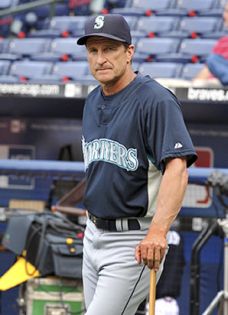 Jim Riggleman in his twelve-year managerial career has a record of 661-824, .445 winning percentage. During his three years in Washington, Riggleman finished with a 139-172 record. Riggleman’s best year was 1998 with the Cubs, where he had a 90-73 record and his team finished second in their division. He had a 73-71 record in 1995 with the Cubs and was floating at .500 this year, with a Nationals team sitting at 37-37. The man is clearly no baseball Houdini. While some may argue that Riggleman was not given much to work with at each of his stops for the most part, the man clearly was not able to get much out of his teams at most stops. A great manager should be able to turn out something out of nothing. But alas, this was not one of Riggleman’s gifts as a manager.
The reality of baseball is that coaches and managers get let go by teams all the time, as evidenced by the amount of activity among teams this month. Managers and coaches also quit sometimes. Rodriguez left his position in Florida, as did Riggleman in Washington. But when a coach leaves a team, the intention and circumstances behind the resignation are crucial. For it is the story behind the announcement that will ultimately dictate if and when said manager receives another crack at a big league post. Gonzalez left his position for the better of his team. The Marlins were floundering and in the interests of having his team recover, Gonzalez felt that a change was needed. While that should have been up to the team to decide, at least Gonzalez acted in what he felt was best for his team. His compassion and sentiments to the organization means that Gonzalez should continue coaching in baseball. In the case of Jim Riggleman, that door has been shut close in my opinion.
The Nationals were not happy to say the least with the news. “I was always taught that one of the cardinal rules of baseball was that no individual can put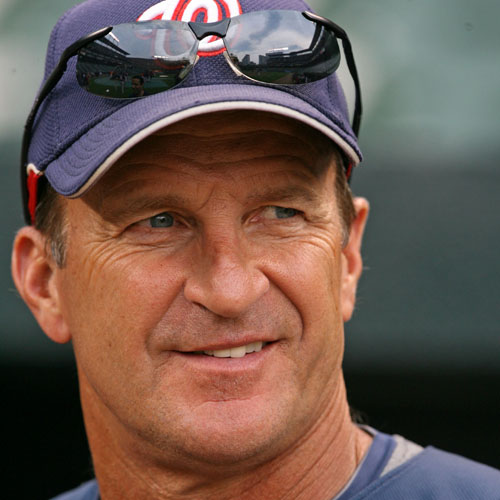 his interests before those of the team,” was the sentiments expressed by Mike Rizzo. The GM is right in this case. Many MLB managers are on one-year contracts like Jim Riggleman was in 2011. Some have a chance at long careers with their teams, while others are seen as more temporary solutions. In Riggleman’s case, he was likely more of the temporary variety. But players, coaches and managers are in this position all the time. Many veteran players sign for one-year deals, knowing full well that they will not be with a team beyond the period. The same goes for managers, who can often be brought in to manage a young team and eventually be replaced with a fresh voice as the team looks to grow and change direction. That is the rules of the game and Jim Riggleman is not better than the system. If a player was to leave his team mid-season due to contractual issues, he would be seen as selfish. Jim Riggleman as manager is no different. He let his organization, players and fans down, by jumping ship. He put his own financial and security needs ahead of those of the people around him. So Riggleman wanted a long-term contract? The best way to do it was to right the ship and lead the Nationals to their strongest possible record this year. Instead, Riggleman has likely blacklisted himself from the game and lost the chance to manage again.
 The 58-year old Riggleman does not have any excuses in my book. He was a bench coach for several years, including stints with the Dodgers and Mariners following his departure from the Cubs in 1999. He did not receive another managerial opportunity until 2008, where he was an interim manager with the Mariners. Again Riggleman received an interim managerial job with the Nationals the following year, but stayed on with the team until yesterday. Was he a lame-duck manager so to speak? Probably. But that had more to do with his managerial skills and overall record than anything else. Sure many people want job security, especially in baseball. But let’s keep this in perspective. There are only thirty MLB manager jobs out there. Period. Jim Riggleman had one but he threw it away. He wanted to be a long-term manager but yet was not prepared to do what it takes to get there. Nobody should be above the system. I would not expect the Nationals to give Riggleman a strong recommendation, or any sort of reference in that regard. Teams have long memories and will likely be very cautious with Riggleman, who is today seen as having acted as a “jilted lover.”
In looking to the future, it is interesting to read Riggleman’s take. “I’m not sure if I’ll get another opportunity,” Riggleman said. “But I’ll promise you I’ll never do a one-year deal again. I’m 58. I’m too old to be disrespected.” His comments show that he clearly does not get “it”. This is not a question of respect. There is no entitlement. The Nationals did not owe you a thing Jim. They named you manager by removing the interim label. You were working year-to-year. Your lifetime managerial record did not entitle you to more. You were very lucky to have a MLB manager’s position. Your actions were selfish and disrespectful. The truth is that the Nationals team and its fans are better off for this move. They did not want to have a manager in the dugout who did not want to be there. That would not benefit anyone and a fresh voice and style could prove to be beneficial in the long-term. There are rumors that team is looking at Davey Johnson for the position. Personally, I think that Bobby Valentine should be considered for the job. But no matter who the Nationals hire, the team will be heading in a new direction. Jim Riggleman has committed baseball treason. For that reason, it is time for him to walk the plank and plunge into the waters of baseball oblivion.

Please e-mail us at: MLBreports@gmail.com with any questions and feedback. You can follow us on Twitter and become a fan on Facebook . To subscribe to our website and have the daily Reports sent directly to your inbox , click here and follow the link at the top of our homepage.

Latest AL and NL Vote Totals: 2011 MLB All-Star Game
Thursday, June 23, 2011

MLB reports: With the MLB All-Star Game less than three weeks, the race to finalize the lineups is starting to tighten up. The majority of the starters have fairly significant leads and will be in Arizona, barring injury or declining the invitation. However, some of the races have started to tighten up, with the positions up for grabs until the final votes are in. Let’s take a look at the current leading vote getters per league and position:
AMERICAN LEAGUE ALL-STAR (as of June 21)
CATCHER
Russell Martin – Yankees: 2,226,797
Alex Avila – Tigers: 1,730,511
Joe Mauer – Twins: 1,341,474
Jarrod Saltalamacchia – Red Sox: 1,135,617
Yorvit Torrealba – Rangers: 980,697
Verdict: Martin is in unless Avila gets a huge spike in votes at the end. While many are pushing for Avila to get the nod, Martin has the numbers and the fan base to likely win out.
FIRST BASE
Adrian Gonzalez – Red Sox: 3,017,960
Mark Teixeira – Yankees: 2,407,665
Miguel Cabrera – Tigers: 1,771,893
Mitch Moreland – Rangers: 890,468
Paul Konerko – White Sox: 676,194
Verdict: A-Gonz will be starting in Arizona. Take it to the bank. He has been one of the best players in the AL this season and plays in Boston. The fans will continue to vote for him until he is announced as the winner.
SECOND BASE
Robinson Cano – Yankees: 3,664,498
Dustin Pedroia – Red Sox: 2,239,172
Ian Kinsler – Rangers: 1,452,880
Orlando Cabrera – Indians: 910,941
Ben Zobrist – Rays: 828,771
Verdict: Cano continues to lead the pack by a country mile. His season totals justify his position.
THIRD BASE
Alex Rodriguez – Yankees: 2,876,537
Adrian Beltre – Rangers: 2,307,380
Kevin Youkilis – Red Sox: 2,025,438
Evan Longoria – Rays: 1,639,405
Brandon Inge – Tigers: 490,734
Verdict: A-Rod is still A-Rod. Beltre is getting closer though and could make this one interesting.
SHORTSTOP
Derek Jeter – Yankees: 2,654,040
Asdrubal Cabrera – Indians: 2,242,157
Elvis Andrus – Rangers: 1,513,929
Jhonny Peralta – Tigers: 875,371
Marco Scutaro – Red Sox: 813,888
Verdict: Jeter, the New York Yankees captain, continues to lead the way. However, an injury and poor play this season have led Cabrera to get closer in the voting. If Cabrera has a few more strong games, there is a chance he could be in Arizona as the starter. Either way, expect Cabrera to represent the Indians at the All-Star game.
DESIGNATED HITTER
David Ortiz – Red Sox: 3,116,578
Michael Young – Rangers: 1,760,195
Jorge Posada – Yankees: 1,120,830
Victor Martinez – Tigers: 932,711
Johnny Damon – Rays: 864,535
Verdict: Papi picked a great year to have a strong campaign. A free agent at year’s end, he is a worthy All-Star pick.
OUTFIELD
Jose Bautista – Blue Jays: 4,156,940
Curtis Granderson – Yankees: 3,473,227
Josh Hamilton – Rangers: 2,400,408
Jacoby Ellsbury – Red Sox: 2,249,323
Carl Crawford – Red Sox: 1,789,097
Ichiro Suzuki – Mariners: 1,537,101
Nelson Cruz – Rangers: 1,462,426
Nick Swisher – Yankees: 1,271,843
Brett Gardner – Yankees: 1,120,179
J.D. Drew – Red Sox: 1,112,720
Matt Joyce – Rays: 1,038,098
Jeff Francoeur – Royals: 906,983
Grady Sizemore – Indians: 867,281
David Murphy – Rangers: 785,630
Shin-Soo Choo – Indians: 764,817
Verdict: Bautista and Granderson continue to lead the AL outfielders in voting and deservedly so. Hamilton and Ellsbury are battling it out for the final spot in a competition of what have you done for me lately vs. last year’s statistics. Depending on where you sit in the debate, the 2010 MVP Hamilton or the 2011 resurgent Ellsbury should be the third AL outfielder. With Hamilton banged up and Ellsbury playing so well for a first place Boston squad, expect Ellsbury to win out.

NATIONAL LEAGUE ALL-STAR (as of June 20)
CATCHER
Brian McCann – Braves: 2,301,252
Yadier Molina – Cardinals: 1,836,490
Buster Posey – Giants: 1,573,484
Jonathan Lucroy – Brewers: 1,098,507
Carlos Ruiz – Phillies: 1,095,081
Verdict: McCann is the best catcher in baseball, not just the NL. He has received the justified votes and will be starting for the NL squad.
FIRST BASE
Albert Pujols – Cardinals: 2,806,864
Joey Votto – Reds: 2,270,211
Prince Fielder – Brewers: 2,066,327
Ryan Howard – Phillies: 1,477,478
Freddie Freeman – Braves: 559,762
Verdict: Pujols was the leader and remains so despite being placed on the shelf recently. With Pujols out of the picture, Votto and Fielder will continue to duke it out for top spot. The power and flash of Prince will likely rule over the steadiness of Votto.
SECOND BASE
Brandon Phillips – Reds: 2,286,378
Rickie Weeks – Brewers: 2,094,502
Chase Utley – Phillies: 1,827,194
Dan Uggla – Braves: 1,012,370
Freddy Sanchez – Giants: 987,606
Verdict: Phillips and Weeks are neck-in-neck in one of the closest positional battles. Based on Weeks recent play, my money is on him to get the starting role.
THIRD BASE
Placido Polanco – Phillies: 2,599,925
Chipper Jones – Braves: 1,558,895
Pablo Sandoval – Giants: 1,302,098
David Wright – Mets: 1,228,710
Scott Rolen – Reds: 1,102,626
Verdict: Polanco of the NL leading Philadelphia Phillies appears to have this one locked up. Without much in the way of competition, Polanco has been the best of the bunch according to the fans.
SHORTSTOP
Troy Tulowitzki – Rockies: 2,385,991
Jose Reyes – Mets: 1,972,820
Jimmy Rollins – Phillies: 1,354,896
Alex Gonzalez – Braves: 928,992
Yuniesky Betancourt – Brewers: 860,163
Verdict: Reyes of the Mets is making a late charge but Tulo might have too big of a lead to overcome. Expect this one to go to the wire as Reyes has been getting much of the press and attention in the past few days.
OUTFIELD
Ryan Braun – Brewers: 3,034,057
Lance Berkman – Cardinals: 2,562,428
Matt Holliday – Cardinals: 2,390,118
Matt Kemp – Dodgers: 2,062,667
Andre Ethier – Dodgers: 1,889,298
Jay Bruce – Reds: 1,681,613
Shane Victorino – Phillies: 1,357,115
Carlos Beltran – Mets: 1,261,308
Jason Heyward – Braves: 1,059,581
Raul Ibanez – Phillies: 982,046
Justin Upton – D-backs: 950,047
Carlos Gonzalez – Rockies: 944,666
Corey Hart – Brewers: 910,550
Martin Prado – Braves: 830,105
Alfonso Soriano – Cubs: 804,303
Verdict: Braun has the top spot locked up with Berkman almost guaranteed a starting spot in Arizona as well. The third outfield position will come down a battle between Matt Holliday, Matt Kemp and Andre Ethier. Kemp is narrowing the margin but based on the vote numbers, St. Louis will likely have 2/3 of the starting All-Star outfield come July 12th.
MLB reports will continue to keep you up-to-date as the voting for the MLB All-Star game comes to a close. We will announce the starting lineups and rosters as they are made available and let you know on any injury replacements. This year’s field will be a competitive one and we look forward to catching all the action in Arizona, as the American League and National League battle for home field advantage in the World Series.

Please e-mail us at: MLBreports@gmail.com with any questions and feedback. You can follow us on Twitter and become a fan on Facebook . To subscribe to our website and have the daily Reports sent directly to your inbox, click here and follow the link at the top of our homepage.

A Tribute to Chad Cordero: Retired MLB Closer
Wednesday June 22, 2011

MLB reports: The man with the straightest brim in baseball, Chad Patrick Cordero formally announced his retirement from baseball on Monday, at the tender age of 29. Cordero originally suffered a torn labrum and missed most of the 2008 season. He was never able to return back to full health and form following the injury and his 2010 season with the Mariners will remain his last in the majors.
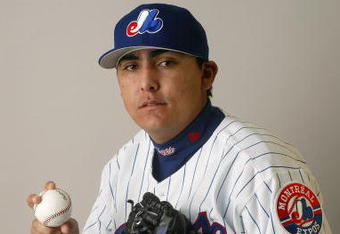 Chad Cordero was originally drafted by the San Diego Padres in the 26th round of the 2000 draft, and later was a 1st round pick of the Montreal Expos, 20th overall, in 2003. Cordero was one of the rare college closers who graduated to the same role in the majors. He attended Cal State Fullerton and made it all the way to a College World Series title. Cordero made his major league debut the same year he was drafted and stayed with the Expos/Nationals organization for the majority of his career.
Here are Chad Cordero’s final major league numbers:
| Year | Tm | W | L | ERA | SV | BB | SO | WHIP |
|---|---|---|---|---|---|---|---|---|
| 2003 | MON | 1 | 0 | 1.64 | 1 | 3 | 12 | 0.636 |
| 2004 | MON | 7 | 3 | 2.94 | 14 | 43 | 83 | 1.343 |
| 2005 | WSN | 2 | 4 | 1.82 | 47 | 17 | 61 | 0.969 |
| 2006 | WSN | 7 | 4 | 3.19 | 29 | 22 | 69 | 1.105 |
| 2007 | WSN | 3 | 3 | 3.36 | 37 | 29 | 62 | 1.387 |
| 2008 | WSN | 0 | 0 | 2.08 | 0 | 3 | 5 | 2.077 |
| 2010 | SEA | 0 | 1 | 6.52 | 0 | 5 | 6 | 1.552 |
| 7 Seasons | 20 | 15 | 2.89 | 128 | 122 | 298 | 1.208 | |
| 162 Game Avg. | 4 | 3 | 2.89 | 28 | 26 | 65 | 1.208 | |
| WSN (6 yrs) | 20 | 14 | 2.78 | 128 | 117 | 292 | 1.198 | |
| SEA (1 yr) | 0 | 1 | 6.52 | 0 | 5 | 6 | 1.552 | |
| NL (6 yrs) | 20 | 14 | 2.78 | 128 | 117 | 292 | 1.198 | |
| AL (1 yr) | 0 | 1 | 6.52 | 0 | 5 | 6 | 1.552 | |
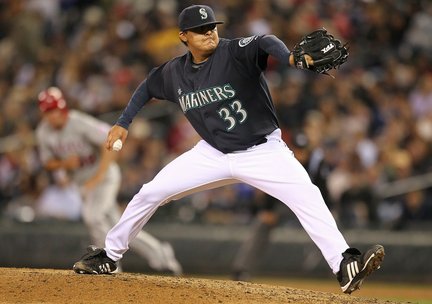
The year 2005 will always stand out as Cordero’s best, as he led the Majors with47 saves that year. Cordero was taken out of baseball in his prime and the game has lost one of its top relievers much too early. Cordero played with teamUSAin the inaugural edition of the World Baseball Classic in 2006. After departing from the Nationals in 2008, Cordero went on to play in the minors and majors for the Seattle Mariners. He also played in the minors for the New York Mets and Toronto Blue Jays organizations. Cordero was released by the Jays on May 17th and was last playing for the St. Paul Saints, an independent baseball team, before announcing his retirement on Monday.
In addition to his baseball injuries, Chad Cordero has also suffered from personal tragedy. In December 2010, Cordero and his wife lost an eleven-week old baby daughter. The cause was Sudden Infant Death Syndrome (SIDS). Cordero is quoted as saying, “I’m just using her as motivation, trying to find strength. Because I know, now, she’ll always be with me, no matter what.” From the time of his daughter’s passing, Cordero has been active in raising awareness for SIDS. It is very uplifting to hear that despite all the adversity suffered by Cordero, that he could still work so hard to try to continue his baseball career, while assisting with SIDS awareness. SIDS is a subject that must be very difficult for Cordero and his family to discuss and deal with, but he still fights on to continue the memory of his dear daughter.
A true fighter in every sense of the word, Chad Cordero gets our sympathies and respect. Cordero has faced many roadblocks and hills to climb and he has continued to see through all the hardships that life has handed to him. Still young, there is always a chance that Cordero could try to make a return to organized baseball. The torn labrum that he suffered though is not a “fixable” injury in the same category as Tommy John surgeries, which has become very common in baseball circles. It is unlikely that we will ever see the Chad Cordero of old on the mound and if he never returns to baseball, we will always remember him for the competitor he was on the mound. But given the circumstances surrounding his family, baseball and sports takes a back seat to the human element of life. We wish all the best to Chad Cordero and his family. For everyone that can go purchase a baseball hat today and leave the brim unfolded, wear your hat this week as a tribute to one of the best relievers in the game: Chad Cordero.
Please e-mail us at: MLBreports@gmail.com with any questions and feedback. You can follow us on Twitter and become a fan on Facebook . To subscribe to our website and have the daily Reports sent directly to your inbox , click here and follow the link at the top of our homepage.
***Note: The Wednesday E-mailbag is on hiatus this week so that we can bring you this tribute. The E-mailbag will return next week. Please feel free to continue to send all your baseball questions***

McKeon, Valentine and Guillen: The Loria Marlins Manager Roller Coaster
Tuesday, June 21, 2011

MLB reports: In the world of Jeffrey Loria, nothing is ever boring. Loria, who orchestrated an Expos to Marlins trade-in back in 2002, already owns two World Series rings. The first championship ring was courtesy of manager Jack McKeon, who came on board to manage the Marlins in 2003 and won it all in his initial Florida campaign. McKeon was successful in turning around a Marlins team that started off slowly and picked up steam after his selection. The Marlins currently sit after today’s game with a 33-41 record. They are in last place in the NL East, 12.5 games behind the division leading Philadelphia Phillies. Losers of 11 out of their last 12 games, the Marlins have a 16-23 record at home and 17-18 record on the road. Something had to give and manager Edwin Rodriguez resigned abruptly yesterday. Indicating that change was in the best interest of the team, Rodriguez was out and the Marlins quickly replaced him with former manager Jack McKeon. Out with the “old” and in with the “new”.
John Aloysius (Jack) McKeon will be 81 in November of this year. A veteran manager for sixteen seasons, McKeon managed five teams in his manager league career. His record in the dugout speaks for itself, as we take a look at the numbers:
|
Year |
Tm |
Lg |
G |
W |
L |
W-L% |
| 1973 | Kansas City Royals | AL |
162 |
88 |
74 |
.543 |
| 1974 | Kansas City Royals | AL |
162 |
77 |
85 |
.475 |
| 1975 | Kansas City Royals | AL |
96 |
50 |
46 |
.521 |
| 1977 | Oakland Athletics | AL |
53 |
26 |
27 |
.491 |
| 1978 | Oakland Athletics | AL |
123 |
45 |
78 |
.366 |
| 1988 | San Diego Padres | NL |
115 |
67 |
48 |
.583 |
| 1989 | San Diego Padres | NL |
162 |
89 |
73 |
.549 |
| 1990 | San Diego Padres | NL |
80 |
37 |
43 |
.463 |
| 1997 | Cincinnati Reds | NL |
63 |
33 |
30 |
.524 |
| 1998 | Cincinnati Reds | NL |
162 |
77 |
85 |
.475 |
| 1999 | Cincinnati Reds | NL |
163 |
96 |
67 |
.589 |
| 2000 | Cincinnati Reds | NL |
163 |
85 |
77 |
.525 |
| 2003 | Florida Marlins | NL |
124 |
75 |
49 |
.605 |
| 2004 | Florida Marlins | NL |
162 |
83 |
79 |
.512 |
| 2005 | Florida Marlins | NL |
162 |
83 |
79 |
.512 |
| Kansas City Royals |
420 |
215 |
205 |
.512 |
||
| Oakland Athletics |
176 |
71 |
105 |
.403 |
||
| San Diego Padres |
357 |
193 |
164 |
.541 |
||
| Cincinnati Reds |
551 |
291 |
259 |
.529 |
||
| Florida Marlins |
448 |
241 |
207 |
.538 |
||
|
1952 |
1011 |
940 |
.518 |
 McKeon comes with some terrific credentials. He is a two-time National League Manager of the Year, winning the award in 1999 originally with the Reds and again with the Marlins in his championship 2003 season. McKeon has done it all and seen it all. But the question on everyone’s mind is whether he will have a strong impact on the Marlins and turn around their season. From there, the Marlins will need to choose their long-term manager for the 2012 season. There is much discussion and debate surrounding the Marlins, as they complete the 2011 season and move next year to their new stadium and become the “Miami Marlins.”
As much as the Marlins seemed to take a step forward this season as an organization, they are apparently still stuck at square one in some ways. Take their managerial candidates. Back in their last offseason, the Marlins were looking at Bobby Valentine and Ozzie Guillen to become their next manager. Valentine, an analyst with ESPN, could not come to terms with the team and as a result was not hired. The team inquired as well on the availability of Chicago White Sox manager Ozzie Guillen, a former coach with McKeon’s 2003 championship team. When the White Sox required a return of either super prospects Logan Morrison or Mike Stanton, the Marlins said thanks, but no thanks. Edwin Rodriguez ended up receiving the post and did not last even half a season in Florida. With the team in disarray and a fresh voice needed, the Marlins turned to their past in naming Jack McKeon their interim manager for the remainder of the season.
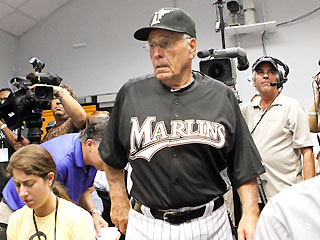
The cigar chomping McKeon, one of the most old-school baseball men you will ever meet, is seen as having a no-nonsense type of approach to the game. As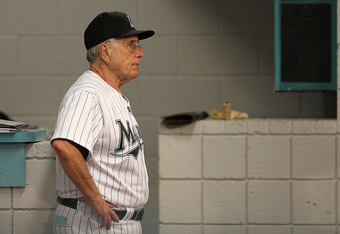 his first move as manager, McKeon benched franchise superstar Hanley Ramirez yesterday. Reports indicate that tardiness was the cause, while others have viewed the move as a wake-up call for the team. Either way, McKeon has clearly shown that he is in charge and is not prepared to accept the Marlins losing ways. Unfortunately, as the years have progressed, baseball has become more and more of a “young man’s game.” Todays young players, part of the me-first generation, don’t often take kindly to veteran coaches that are seen as being out of touch with today’s times. This was evident before in Florida, where McKeon originally lasted only three seasons. McKeon was seen as a very stern and tough manager and had lost much of the attention of the clubhouse by the end of his tenure. Now the Marlins have gone back to the barrel to see if McKeon has one more strong season of managing in him.
In accepting the Marlins’ position, McKeon has become the second oldest manager in baseball history, just behind Connie Mack. While a great feat for McKeon, it will remain to be seen the impact that he will have on the Marlins 2011 fortunes. My gut is that the Marlins will be lucky to get much more out of the team, even with McKeon in charge. The team is dangerously close to knocking themselves out of contention by the All-Star break and anything short of a miracle at this point will change that. With most MLB teams hiring young, dynamic managers to lead the way, its surprising in some ways that Loria has gone backwards in his approach. But given Loria’s track record, he rarely does anything by the book.
After Jack McKeon completes his second tenure in Florida, the decision will still remain as to whether Bobby Valentine or Ozzie Guillen will be at the helm come 2012. Both are still in contention for the job according to reports, but neither appears in my estimation to be a great fit. Valentine and Guillen are both fiery individuals with strong wills and personalities. After watching the Joe Girardi fiasco in his battles with owner Loria, many managerial candidates have since been scared off from taking the manager’s job with the Marlins. Valentine and Guillen would both have difficult times being placed in a puppet type role as a manager and for that reason, I cannot see a either working out long-term in Florida. Loria would be well served selecting a strong baseball man for the job, but one that has extreme patience and ability to take the directions that would come from the top of the pyramid. Loria has shown in the past to be a man of little patience and self-control when it comes to the personnel of his ball club. If Bobby V or Ozzie do eventually take the job, watch out for the fireworks that will likely come in Miami. While Ozzie is signed for the 2012 season, insiders have indicated that the White Sox may grant permission for the Marlins to speak to him, if the ballclub does not return to contention by season’s end. My bet is that Ozzie will be headed one day to Miami to rejoin the Marlins as their manager. Until then, Jack McKeon will be captain of the Marlins ship.
I guess its true what they say. Everything old really is new again. The magic was there in 2003. Let’s see if the Marlins and McKeon can rekindle some of their spark eight years later.
Please e-mail us at: MLBreports@gmail.com with any questions and feedback. You can follow us on Twitter and become a fan on Facebook . To subscribe to our website and have the daily Reports sent directly to your inbox , click here and follow the link at the top of our homepage.

Interview with Baseball Columnist Danny Knobler: CBSSports.com
Monday June 20, 2011
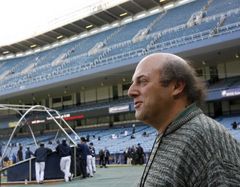
MLB reports: We introduce today on the Reports Danny Knobler, Baseball Columnist for CBSSports.com. While we all enjoy Danny’s work, today’s feature allows everyone to learn about the man behind the columns. Danny’s bio from CBSSports.com is as follows:
“After 18-plus seasons of watching the Detroit Tigers lose, Danny Knobler joined CBSSports.com in May 2008 as a national baseball writer, thankful that he can finally write about winners as well as losers. He’s teaming with Scott Miller, who once covered the Minnesota Twins through six consecutive losing seasons.
The Tigers went 1,285-1,598 in Knobler’s time on the beat, although to be fair they did make it to the 2006 World Series. It’s not like they were the Royals.
Before moving to Michigan, Knobler worked for 5½ years at Baseball America, and later covered baseball for Sport magazine, which isn’t around anymore. He also wrote for the Los Angeles Herald-Examiner and the Santa Monica Evening Outlook, neither of which is around anymore, either.
Knobler graduated from UCLA, and just to prove that he likes some winners, he still follows UCLA basketball.”
We now present Danny Knobler: Baseball Columnist for CBSSports.com:
MLB reports: Thank you for your time as part of this interview. You currently cover Major League Baseball for CBSSports.com. How long have you been with CBS and how did you originally come to work in baseball?
Knobler: I joined CBSSports.com in May 2008, after 18-plus years covering the Detroit Tigers for Booth Newspapers. Before that, I worked at Baseball America, a job I got right out of college at UCLA. At UCLA, I worked in the Sports Information Office, handling baseball PR. While I’d followed all sports, I always gravitated towards baseball, and since I’ve been in the business, I’ve always told people that baseball is the most fascinating game to write about, because of the nature of the game, because it is played every day, and because of the characters involved.
MLB reports: Being a part of the media must be very exciting. Please give our readers a glimpse as to what your job entails and the highlights of working in media.
Knobler: I love my job. I enjoy being at the ballpark, and I enjoy talking about baseball. There’s no doubt that there are times when it is a grind, but the game keeps drawing you in.
MLB reports: What teams have you found have the greatest buzz surrounding them this season? Have any particular “popular” teams seen a drop in publicity and media attention this season in your attention?
Knobler: The Yankees and Red Sox always are going to generate the biggest buzz, because they have the biggest followings. The Phillies have moved up in recent years, but they still fall slightly behind the other two in national buzz. I’m not saying I want this to be true, just that it is true. When you write about the Yankees or Red Sox, more people read it. That doesn’t mean people don’t care about other teams, not at all. All you need to do is look at the number of All-Star votes that Jose Bautista is getting to see that’s not true. As for the team that has seen its profile drop the most, it has to be the Mets. That could change in the next few weeks, depending on how serious they are about trading Jose Reyes, but the interest in the Mets now is really down.
MLB reports: How much interaction do you have with the players on a given team? Do you keep in contact with many even after they leave the team by trade, retirement, release etc.? Are there particular teams that you cover specifically or do you report on all of baseball?
Knobler: I report on all of baseball. Obviously, by spending 18-plus years covering the Tigers, I’m closer to more ex-Tigers than to other players, but I know players on every team. And yes, I keep in touch with some players after they retire. Many of them I don’t see as often, but sometimes I’ll run into a player I covered years ago. It happened last year during the playoffs, when I saw Tony Phillips at a Reds-Phillies game (Halladay’s no-hitter, as it turned out). I saw Eric Davis just last week at the draft.
MLB reports: Where did you work and study before you joined CBS Sports? How did education and previous experiences help you to your current role?
Knobler: I went to school at UCLA, and that gave me my first real inside look at baseball. And some of the players who were classmates at UCLA went on to play in the big leagues, including Mike Gallego, who still works in the big leagues as Oakland’s third-base coach. Later, at Baseball America, I covered Team USA through the 1987 Pan Am Games and the 1988 Olympics. The relationships built there with players like Robin Ventura, Tino Martinez and Jim Abbott carried on through their big-league careers and beyond.
MLB reports: What are the main departments of CBS Sports that you work with on a day-to-day basis? Do you have much interaction with the rest of the CBS squad and do you travel much as part of your role?
Knobler: At CBSSports.com, I work with a great team, the best I’ve ever been around. I work most closely with Scott Miller, our other Senior Baseball Writer, who does a great job and is maybe the nicest guy in the business. We also have a great staff in the office. I travel some, but not nearly as much as I did when I was on the beat. Living in New York helps, because with teams in both leagues, every team in baseball plays here at least one time a year.
MLB reports: What is your job like comparing the baseball season and off-season? Does the role change much and can you give our readers the insight as to what the two different times of the year are like in reporting.
 Knobler: The job does change some. People always ask, “What do you do in the offseason?” Baseball isn’t played year-round, but baseball goes on year-round. There is news basically every day of the year. The big difference is that during the season, a significant amount (but not nearly all) of the news is at the ballpark. In the winter, most of the news is gathered by phone, email and text. You spend a lot more time sitting around, but you work just as hard.
MLB reports: If you could have your future dream job, what would it be? Would it be in baseball? Where do you see yourself in 5 years from now?
Knobler: I have my dream job. I don’t want to work for a team. I love doing what I do right now, and hope to do it for a lot longer.
MLB reports: In the situation where a college graduate comes to you and asks you to give them advice on how to “work in baseball”, what would be your response? Any tips that you can give our readers would be appreciated.
Knobler: If by “work in baseball,” you mean work for a team, I would say be prepared to work long hours for very low pay, especially at the start, and in some not-so-glamorous jobs. I know people who went on to be general managers in the big leagues who talk about the time they spent in the minors, and about the days they had to go pull the tarp when it rained. Ask yourself if you’re that dedicated. If you are, then get in touch with anyone you know in the game. Baseball also sets up a job-seekers event every year at the winter meetings.
MLB reports: How has your life changed since working in baseball? Looking back, is there anything that you would have done differently? What have been the best parts of the job?
Knobler: I don’t really think of myself as working “in baseball.” But any job involved with the game, be it writer, broadcaster, team executive, coach or player has huge pluses and also some minuses. Baseball can consume your life, whether you play it, talk about it for a living or write about it. The games are at night, and on weekends. I remember Travis Fryman telling me once that a friend in Pensacola asked him, “When you’re in Detroit, what do you do on weekends?” It was a normal question you might ask any friend who moved somewhere for work, but of course, in the case of a baseball player, the answer was, “We play on weekends.” Well, we write on weekends, too, although not as often as I did as a beat writer.
MLB reports: Do you have favorite interviews that you can share and some that were more regrettable? Details Danny, details!
Knobler: Too many good ones to name. Bad ones, sure. Jason Johnson once told me, “I feel sorry for your paper.” And no, it didn’t bother me that he felt that way.
MLB reports: Who are your picks to meet in the World Series this year and why?
Knobler: When the season began, I picked the Red Sox and Braves. I’ll stick with that, although for obvious reasons I’m a little more confident about the Red Sox than the Braves right now. I never worry about picks that don’t turn out. I’m not putting money on any of my picks, and I would hope no one else would put any money down based on who I pick.
MLB reports: Thank you again for your time Danny and joining us today on MLB reports. It has been a pleasure speaking with you and we look forward to continuing to enjoy your fine work on CBSSports.com.

***A special thank you to Danny Knobler for his time and effort as part of being interviewed for this article. You can follow Danny on Twitter and click here to read Danny on CBSSports.com. To view the man in action, click on this YouTube link of Danny speaking with Reds Manager, Dusty Baker***
Please e-mail us at: MLBreports@gmail.com with any questions and feedback. You can follow us on Twitter and become a fan on Facebook . To subscribe to our website and have the daily Reports sent directly to your inbox , click here and follow the link at the top of our homepage.

Scott Kazmir: Where Will He Land? The Future of Kaz
Sunday, June 19, 2011
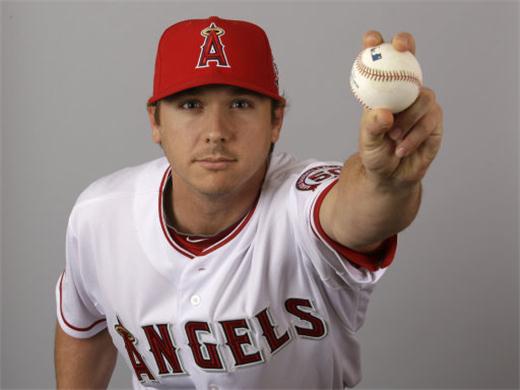
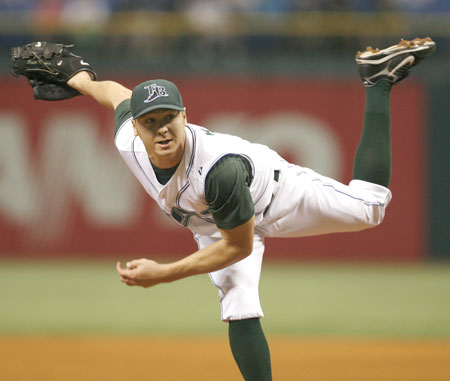
MLB reports: Things did not go as planned for Scott Kazmir. A first round pick of the New York Mets (fifteenth overall) in the 2002 draft, Scott Kazmir has gone from can’t miss prospect to baseball outcast. Only twenty-seven years old, Kazmir now sits at home awaiting to find out if he still has a baseball future. The Texas Native was traded to the Tampa Bay Rays during the 2004 season in a package for mediocre starter Victor Zambrano. Considered a steal of a deal at the time for the Rays, Kazmir played in Tampa Bay until the 2009 season when he was moved to the Angels. Despite $14.5 million in guaranteed money still due to him, the Angels saw enough after a poor 2010 season and atrocious start to the 2011 campaign. Now the rumor mill has Kazmir possibly headed back to the Mets, the team that originally gave up on him early, in order to restore his flailing career.
The debate on Kazmir is whether he is suffering from injuries, physical or mental concerns. Kazmir had shoulder and hamstring issues in 2010 and spent time on the disabled list. In 2011, Kazmir lost a great deal of velocity and control, despite reportedly being injury-free. Looking at Kazmir’s numbers in Tampa Bay in 2009 and Anaheim in 2010 and 2011, the trend of decline was becoming obvious. If you remove Kazmir’s six games played in Anaheim after the trade in 2009, we have been viewing a pitcher in a free fall since his twenty-fifth birthday. Now as Kazmir ponders his future, the baseball world is left to wonder what happened and where Kazmir will play next.
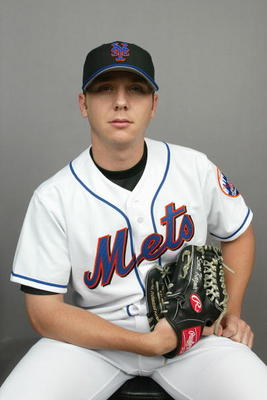 I look at Kazmir’s health record and consider his elbow issues of 2007 and 2008. Aside from the 2005 and 2007 seasons, Kazmir has never successfully completed a full season in the majors injury-free. Even though he may not be considered injured today, the number of injuries that he has suffered throughout his career have apparently finally taken a toll. Having suffered elbow and shoulder injuries at such a young age, it is difficult to ascertain if his arm and body will ever fully recover. Based on his poor showing of the last two years, the mental strain of his failed performances have likely compounded the issues further. Wherever he lands in the future, our reports are indicating that we will likely never see the All-Star Kazmir from 2006 and 2008. Even though he is only twenty-seven, the future looks bleak for Scott Kazmir.
Over the coming days we will learn more about the teams interested in signing Scott Kazmir. The two New York teams have jumped to the forefront of the race. Other teams that make sense include the Boston Red Sox, who love their scrap heap former top prospect pitchers, the St. Louis Cardinals and Texas Rangers, who have been linked to Kazmir for some time. Analysts have been speculating for the last two days that the Mets are the top destination. Our projection though is Texas landing Kazmir. Born and raised in Texas, Kazmir would likely prefer a homecoming, combined with playing for the contending Rangers and its top pitching coach, Mike Maddux.
Sometimes a player performing poorly requires a change of scenery for a rebound. Playing in a new city for a new team can reinvigorate some players. But such is not the case for all. Especially with pitchers, we have recently seen some very highly considered hurlers seemingly decline overnight. Dontrelle Willis. Rick Ankiel. Two former top prospects turned horror shows. Is Scott Kazmir next? The chance for rebound is there, but it appears to be slim at best. The Angels, long considered a team highly skilled in developing pitchers, flushed a great deal of money in writing off Kazmir. From everything I have read, I can’t see that they are wrong. While the Mets were blasted ever since trading Kazmir, the reality is that the Rays only got four very good seasons out of him. The next Nolan Ryan may in fact have become the next Victor Zambrano. Ironic how life works out sometimes.
Please e-mail us at: MLBreports@gmail.com with any questions and feedback. You can follow us on Twitter and become a fan on Facebook . To subscribe to our website and have the daily Reports sent directly to your inbox , click here and follow the link at the top of our homepage.

Baseball Book Review: Taking the Field by Howard Megdal
Saturday June 18, 2011
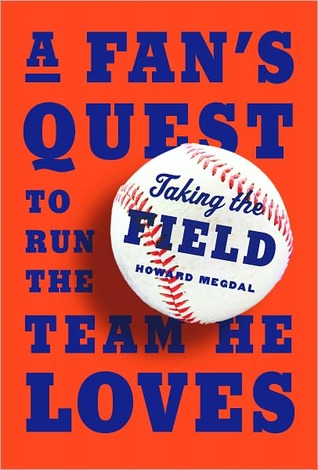
TAKING THE FIELD (A FAN’S QUEST TO RUN THE TEAM HE LOVES) BY: HOWARD MEGDAL
(Bloomsbury: 2011)
MLB reports: You will find on MLB reports a page dedicated solely to baseball book reviews. We created a baseball books review section to encourage readership, thought and analysis on the books written about the greatest game in the world. While baseball fans enjoy watching games as they happen, books are a very important component of baseball fandom as well. Reading baseball books fosters understanding and advancing one’s baseball knowledge. Baseball books can be an adventure through time, recapping games and players of years gone by. Other books educate and train on specific components of the game. Some are devoted exclusively to statics. The possibilities are endless.
Then there are those baseball books that deliver information and insights into the many components of the game. Those special books, when completed, leave an impact on you as a baseball fan and person. You walk away with a wealth of baseball knowledge to further discussions with other fans. In watching games from there, you will have a better appreciation for the sport and understanding of the “game within the game.” While I have read many great baseball books in my day, I have found few authors that have been able to speak to me and truly leave me wanting more after completing their literary works. Today I can say with confidence that I have found such an author. His name is Howard Megdal and his recently published book is titled “Taking the Field: A Fan’s Quest to Run the Team He Loves.”
 Taking the Field is Megdal’s second baseball book, with “The Baseball Talmud” representing his initial leap into the baseball publishing world. Megdal has hit a home run with Taking the Field. No sophomore jinx here. Taking the Field is basically three books in one. The main premise of the book is Megdal’s campaign to become the General Manger of the New York Mets. But the book is far more than that. Taking the Field is a historical review and analysis of the history of the New York Mets baseball club and many of the players that have been a part of the team over the years. It is also an autobiography of Megdal, from growing up as a Mets fan in Philadelphia to writing about the team to this day. Taking the Field is everything a baseball book should be. I read it page-by-page and simply could not put it down. After completing Taking the Field, I was left with many ideas and thoughts on the Mets and baseball. I was left craving more. A sign of a talented author that excels at his craft.
Let’s make this point clear. Howard Megdal is first and foremost a fan of the New York Mets. He does not try to hide his eternal devotion to his favorite team. Megdal lives for every game, every pitch and every at-bat of the Mets. Rather than try to mask his bias, Megdal embraces his love for the Mets and has turned the team into a lifestyle. We learn in Taking the Field about Megdal watching games with his father and turning his wife, Rachel and young daughter, Mirabelle, into fellow Mets disciples. He introduces us to the world of baseball blogging and the growth of baseball websites in recent years. Megdal spoke to me in the book as a writer and fan of baseball, but also as a person. He really is a “real” person and his genuineness and compassion come across in his writing. Many books can turn off readers, when the authors choose to talk down or above its readers. That is not the case with Howard Megdal. Reading Taking the Field, I got the sense that Megdal is a down to earth person. He truly appreciates being able to cover the team and sport that he loves for a living. Megdal does not take any part of his success and journey for granted. Reading his words, I felt like I was in the car with him in his younger days, driving to watch the Mets in Shea for the first time. I was there at Bard College with Megdal and his roommates when they watched the Red Sox win their first of two World Series titles in recent years. I came to care about Megdal and shared all his emotions for the Mets. The love of the team, the successes and bitter defeats, I was there with him every step of the way. Even though the Mets are not my team of choice, they became my team during my read of Taking the Field. Not an easy task to accomplish, but Megdal did it. From there, Megdal was going to graduate from fan and writer, to baseball executive and I was along for every step of the ride.
 Taking the Field captures the journey of Megdal as a fan campaigning to become the General Manager of the Mets by internet and campaign promotions. By advocating “logic”, “transparency” and “passion”, Megdal looked to turn the Mets front office into a baseball democracy, with voted leaders holding accountability to the team owners but most of all, to the fans of the team. A humorous and tongue-in-cheek inspired effort, Megdal was successful in making a political statement as to how baseball teams are run and laying out the criteria that is necessary to turn a baseball team into a contender and eventual champion. Every baseball executive at all levels of the game would be well advised to reading Taking the Field. It is an autobiography of Howard Megdal on one level. It is a baseball manual on the other. As a “how to run a baseball team for dummies” type book, Taking the Field brings together an original concept in its pages. Hopefully many teams adopt the Megdal mantra and create the successful organization that Megdal envisions in his preachings.
While I enjoyed learning about Howard Megdal and his path to attempting to become the General Manager of the Mets, the component of the book that I most enjoyed and appreciated was the history. Taking the Field covers substantially the history of the Mets, from inception to the recent hiring by the team of new General Manager, Sandy Alderson. While the book covers too many topics to list them all, some of the highlights for me were:
-
Drafting, development and trading of Nolan Ryan
-
Tom Seaver trade
-
Scott Kazmir trade
-
John Rocker incident
-
The chronicles of the 1986 World Series Champions Mets
-
The Tenure of Omar Minaya as GM
-
The legend of Benny Agbayani
The list literally goes on and on. Megdal in Taking the Field has armed me with as much Mets history and information as I ever imagined possible. After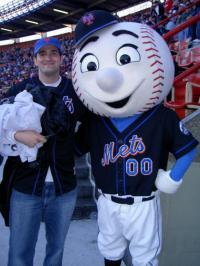 reading this book, I feel confident that I can enter a discussion/debate/argument with any fan bleeding blue and orange and not miss a beat. All Mets fans have to buy this book. That is a no-doubter. It is literally impossible to love the Mets and not enjoy this book. But even the most casual baseball fan can appreciate what Taking the Field has to offer. Anyone starting off in baseball would appreciate Megdal’s take on the game and will advance to an intermediate level after completing the book. On the flip side, even the most advanced baseball junkie will enjoy the book. There are tidbits of information spread throughout the book that many “experts” likely never knew or forgot long ago. Taking the Field will work for anyone who enjoys baseball.
The ironic component of this book is the amount of news surrounding the Mets since Megdal completed Taking the Field. Bernie Madoff. The Wilpon interview with the New Yorker. David Einhorn being introduced as minority owner of the Mets. Much has happened in New York in very recent times. But even with the amount of Mets news and changes, Taking the Field has not become outdated or irrelevant. Far from it. To fully understand what the Mets are going through today, one needs to understand the history of the Mets up till now. This history is recounted eloquently by Megdal in his book. All the recent happenings of the Mets shows that time never stands still and the history of tomorrow takes place in the present. The New York Mets of today are proving that Megdal’s preachings in Taking the Field were bang on correct. After completing Taking the Field, I look forward to Howard Megdal’s next literary works. Stick with baseball Howard. The baseball community is lucky to have you as a member. Theo Epstein made his mark in the game. With Taking the Field, you have now made yours.
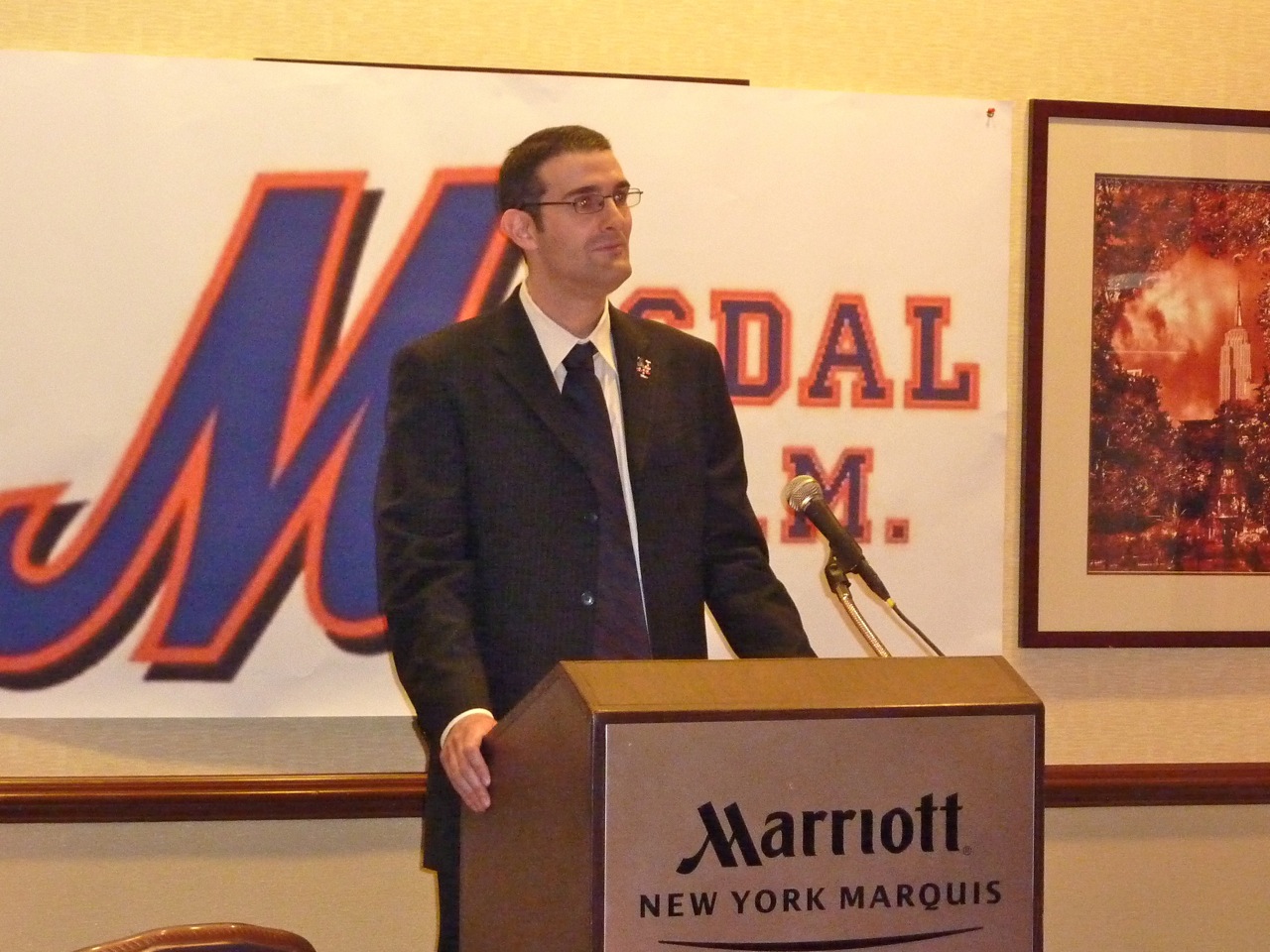
*** To learn more about “Taking the Field” and Howard Megdal, you can follow Howard on Twitter and click here for Howard’s website.***
Please e-mail us at: MLBreports@gmail.com with any questions and feedback. You can follow us on Twitter and become a fan on Facebook . To subscribe to our website and have the daily Reports sent directly to your inbox , click here and follow the link at the top of our homepage.

Moneyball the Movie: An Inside Look to Beane and Pitt

Friday, June 17, 2011
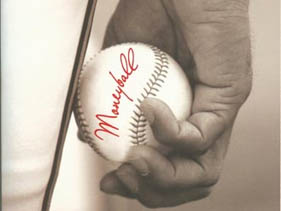 MLB reports: In 2003, author Michael Lewis released one of the most famous baseball books of all time: “Moneyball: The Art of Winning an Unfair Game.” After years of discussions and rumors, the baseball book of our generation is now coming to the big screen. Not since Major League and Bull Durham has a baseball movie received this much buzz. Brad Pitt, not Kevin Costner, will play the main character Billy Beane, General Manager of the Oakland Athletics. The movie is set to be released on September 23, 2011 and we guarantee that MLB reports will be there opening night to prepare a review. We may even catch this one early, as we are known to have a trick or two up our sleeve.
Before the movie is released, we will be reading the book again and posting a book review on the Reports in anticipation of the movie. It has been a number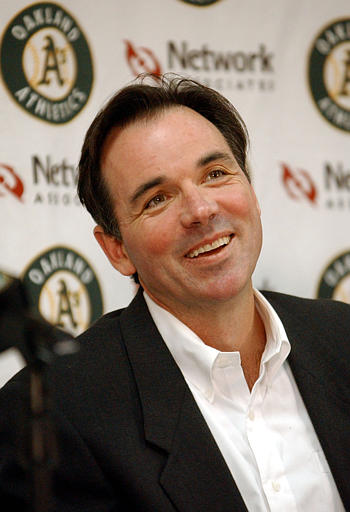 of years since many of us have read “Moneyball” and a good refresher is in order. It has been argued by many that Moneyball was a landmark book, as it changed the complexion of baseball in many ways. Moneyball brought the use of statistical analysis to the forefront of baseball and created the statistics vs. scouting debate, which still continues till this day. Billy Beane was hailed as a genius following the release of the book. Aside from remaining the General Manager of the A’s, Beane is a highly sought-after public speaker and has grown to become a minority owner of the team as well. One of the highest profile executives in baseball history, it is only fitting that actor Brad Pitt would be playing Billy Beane in the movie.
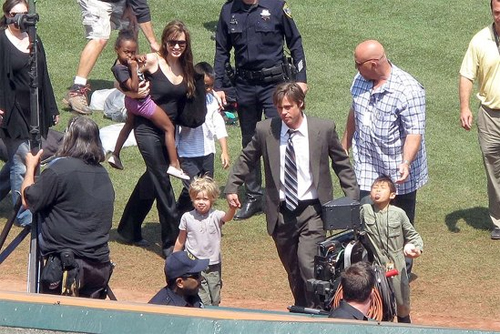 For all the years that it has taken to get this movie off the ground, there have been concerns that the final product may not be up to par with the level set by the book. After watching the trailer, I have to admit that I am very excited to watch the movie in the theatre. Even if you are not a fan of Billy Beane or the Oakland A’s, Moneyball the Movie appears to be a must see for all baseball fans that would like to catch a glimpse into the world behind the game. We took a look at the current status of the A’s and its new manager last week on the Reports, which you can read by clicking here. With the anticipation of the upcoming movie and the Athletics as a team sitting at the basement of its division, the team needed a change. If nothing else, to turn around the fortunes of the ballclub and help build hype leading to the release of the movie.
There is no denying that we all love baseball movies. Baseball fans, when not watching games in person or television, will often be found reading about baseball and watching baseball movies every chance they get. There have been countless baseball movies over the years, including: Major League, The Babe, Eight Men Out, Mr. Baseball, Mr. 3000, Field of Dreams, A league of Their Own, Rookie of the Year, etc. The list goes on and on. I have to admit that as a supporter of the game, in my opinion there is no such thing as a bad baseball movie, only some movies that are better than others. Moneyball the Movie will be released in approximately three short months. We can’t wait. Until then, to get your appetite wet and satisfy some of your curiosity, we present the recently released trailer. Watch it, enjoy it and let us know what you think. Will you be at the theatre to watch Moneyball the Movie? We hope to see everyone there.
Click “Moneyball” to watch the trailer for the most anticipated baseball movie in recent history.

Please e-mail us at: MLBreports@gmail.com with any questions and feedback. You can follow us on Twitter and become a fan on Facebook . To subscribe to our website and have the daily Reports sent directly to your inbox , click here and follow the link at the top of our homepage.

The 2013 World Baseball Classic: New Countries Join the WBC
Thursday June 16, 2011

MLB reports: The majority of sports fans know of the World Cup of soccer, held every four years. Even the most casual non-soccer fans will tend to follow their favorite team/country in the tournament when it is staged. For all the hype and legacy surrounding the World Cup, MLB reports is obsessed with another tournament all together. What the World Cup is to soccer, the World Baseball Classic is to baseball. The original WBC tournament took place in 2006, followed by the 2009 edition. From there, the WBC was to be staged every four years, to mirror the World Cup, Olympics and other international sporting tournaments. With the 2013 World Baseball Classic coming up in less than two years, our favorite international tournament has recently undergone some changes. MLB reports is here to give you the lowdown on the 2013 WBC.
The 2013 WBC will remain a sixteen team field, as was the case in previous years. There will be four teams in each of the four divisions. But with a twist. From years past, twelve of the teams will remain and automatically qualify for the tournament. The holdovers that will play in the WBC commencing March 2013 are:
-
Australia
-
China
-
Cuba
-
Dominican Republic
-
Italy
-
Japan
-
Korea
-
Mexico
-
Netherlands
-
Puerto Rico
-
United States
-
Venezuela
In terms of the remaining four spots in the WBC, for the 2013 edition, the WBC will hold for the first time a qualifying tournament. There will sixteen teams in the qualifying round, which will be held in the fall of 2012. Logistically, it was apparently impossible to hold the qualifying tournament and the WBC itself at the same time and the fall of 2012 was considered to be the best time for this inaugural for tournament. The sixteen teams invited to qualify for the WBC are:
-
Brazil
-
Canada
-
Chinese Tapai (Taiwan)
-
Columbia
-
Czech Republic
-
France
-
Germany
-
Great Britain
-
Israel
-
New Zealand
-
Nicaragua
-
Panama
-
Phillipines
-
South Africa
-
Spain
-
Thailand
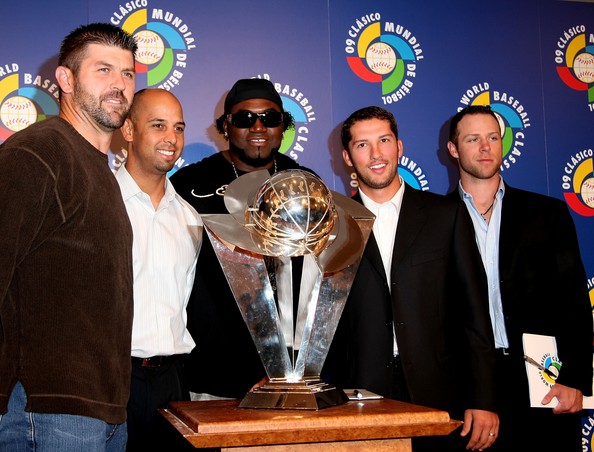 It is an extremely happy moment for baseball, as its borders continue to expand and more countries adopt the greatest sport in the world. Countries such as Columbia, Israel, Germany, France and Spain will be encouraged to develop baseball athletes. This will in turn increase the popularity of baseball in those respective countries, which will increase the fan base of baseball and the talent level of the sport. It is truly a win-win proposition for everyone. After years of lobbying for such a qualifying tournament, it is an absolute delight to announce that the WBC has expanded and moved towards becoming a truly world event.
With happiness does come a little sadness. After poor showings in the 2009 WBC, holdovers Canada, Chinese Tapai (Taiwan), Panama and South Africa are now required to qualify in order to participate in the 2013 World Baseball Classic. After having attended the first round divisional games in Toronto two years ago, as a Canadian I am dismayed that Canada has set itself back on the world stage by not having an automatic berth in the tournament. Similarly, fans in Taiwan, Panama and South Africa that have been a part of both editions of the tournament will also possibly suffer setbacks in the development of their baseball programs. But logically, only so many countries can participate in each WBC and having the qualifying tournament should help ensure that the best teams get to advance. I am surprised to say the least that Canada has to qualify while say, Italy has an automatic berth. But the field will change for every tournament and the countries that have the best showings will get to participate, that is the bottom line.
We would love to hear your thoughts on the changes for the 2013 World Baseball Classic. Tell us about the country that you cheer for and how you feel about these changes. Was your country added to the tournament? Are there any countries that were missed? Will a new country take the tile from two-time winner Japan? We want to hear from you! Please leave your comment at the bottom of the page and let’s hear what you, the readers, have to say. In the meantime, make sure to note the fall of 2012 and March 2013 in your calendars. The 2013 World Baseball Classic qualifying tournament will be upon us in little over a year. We can’t wait.

Please e-mail us at: MLBreports@gmail.com with any questions and feedback. You can follow us on Twitter and become a fan on Facebook . To subscribe to our website and have the daily Reports sent directly to your inbox , click here and follow the link at the top of our homepage.

E-MAILBAG: Ask the Reports, Wednesday June 15th
Thank you for reading the E-mailbag. Please send all your questions to mlbreports@gmail.com and please include your first name and City/Country.
We will be compiling a list of your questions from our e-mailbag and posting the responses on Wednesdays.

Wednesday June 15, 2011
Q: Do you think that the Dodgers should rid of Rafael Furcal? Dee Gordon is looking really good. From Christopher, Los Angeles.
MLB reports: Rafael Furcal is injured once again, playing in only 17 games thus far in 2011. After playing in only 97 games last year, the end might be near for the 33-year old Dominican. Signed through this year, the Dodgers hold a team option on his contract for 2012, that is almost certain to be declined. Considering his high salary and low value, chances are that Furcal will play out the string in Los Angeles. Dee Gordon has played well in limited action so far for the Dodgers. But remember, he is still only 23. At worst, Furcal is either going to be on-and-off the DL all year or be an expensive insurance policy for Dee Gordon. Not to worry, the Gordon ERA has begun in Los Angeles.
Q: Most common players last name in Major League Baseball? From London Baesball, UK.
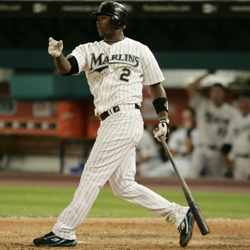 MLB reports: Great question from the UK. One would think that it is Smith or Anderson, a very common last name here in North America. But showing the global-wide spread effect of the game, the answer is Ramirez. With 11 noted players with the last name Ramirez, including Hanley, Aramis and Alexei, the most common last name in MLB is: Ramirez.
Q: With all the talk of realignment in baseball, what are the chances of us seeing the Astros in the American League? From Bill, Texas.
MLB reports: Thank you for the e-mail Bill. Realignment has been the talk of baseball in recent days based on the ESPN article that came out last week. We actually covered the topic of realignment last month, which you view in our archives by clicking here. The Astros have been a popular team included in the realignment discussion, based on the natural rivalry with the Texas Rangers. I had the Astros moving to the AL West in my proposed realignment, with the Rockies and Diamondbacks. I can see a definite fit for the Astros in the AL. As a rebuilding team, moving to a new league could lead to fan excitement and increased attendance. Given their strong hitters park, I could see the Astros having some wild games in the AL. A definite fit, this story is starting to gain even more momentum.
Q: Will the Twins rebound this season? I am very frustrated! From Kelly, Ohio.
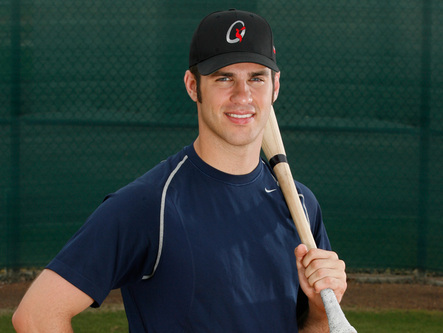 MLB reports: I do not blame you Kelly as little has gone right for the Minnesota Twins this year. While I see a good nucleus for future years, it does not appear that the playoffs are in the cards for your team in 2011. The team is sitting at 26-39 and has just lost Justin Morneau for approximately two weeks. Joe Mauer has been injured for much of the year, Nathan has not returned back to form and much of the team has either been slumping or injured for most of the year. Little has gone right and sometimes you just need to chalk things up to bad luck. I expect the team to regroup, refocus and come out strong next year. There is still a lot of baseball to be played but I would not expect higher than 3rd place this year for your Twins. Sorry.
Q: I enjoyed your profile on Mesoraco. Great prospect for the Reds. What happened to Chapman. Did he just lose it all of a sudden? Is this Dontrelle Willis all over again? From Barry, New York.
MLB reports: Hello Barry. Glad you enjoyed reading on Mesoraco and there is much to look forward to in Cincinnati. A great ballclub with many prospects on the horizon. I definitely see the Reds contending and perhaps creating a mini-dynasty in the near future. As far as Aroldis Chapman goes, there appears to be a mystery as to what has happened to the once future closer for the Reds. The 23-year old has been simply horrible, both in the majors and minors. Some have blamed mechanics, while others have said that he is battling injuries. Maturity may be an issue as well. The decline of Dontrelle Willis was a gradual one, while Chapman has lost “it” literally overnight. The Reds will have to be careful to pinpoint his issues and help straighten him out. The greatest danger is a loss of confidence, which can be very difficult for a young player to overcome. Injuries can be healed. But if mechanics are the issue, the best bet is to keep him in the minors and to get Chapman straightened out, no matter how long it takes. I would treat him with kiddie gloves at this point and hope that he gets back to form by 2012.

Thanks for the e-mails and keep them coming! mlbreports@gmail.com

E-MAILBAG ARCHIVE: Click here for the Archives of Ask the Reports
Please e-mail us at: MLBreports@gmail.com with any questions and feedback. You can follow us on Twitter and become a fan on Facebook . To subscribe to our website and have the daily Reports sent directly to your inbox , click here and follow the link at the top of our homepage.

2011 MLB All-Star Game Ballots: American League Vote Totals
Tuesday June 14, 2011

MLB reports: In part II of our All-Star game feature, we take a look at the leading vote getters for the American League squad. The MLB All-Star Game is coming up on July 12th from Phoenix, Arizona. With home field advantage on the line, the question every year is whether the American League will continue its domination in the mid-season classic. We might as well call this team the New York Red Sox or Boston Yankees given the current composition of the team. Let’s take a look at the AL vote totals as of today to consider if the fans are getting it right:
CATCHER
Russell Martin, Yankees: 1,712,156
Alex Avila, Tigers: 1,093,070
Joe Mauer, Twins: 1,041,798
Jarrod Saltalamacchia, Red Sox: 763,607
Yorvit Torrealba, Rangers: 751,858
Verdict: Round one goes to the fans as Russell Martin for the most part has been the best catcher in the American League thus far. Coming off an unproductive, injury filled 2010 season, Martin has rebounded to reclaim his all-star status. The 2nd leading vote getter, Alex Avila, has enjoyed a breakthrough campaign and deserves to be up high on the list. From there, the waters get murky. Mauer has been injured all year and Salmatlamacchia has been fairly unproductive for most of the season in Boston. Names like Arencebia and Suzuki should probably be higher up on the list, as much of this list is based on past production and/or popularity vs. actual production. But Martin is in the lead for being the best catcher in the AL, as much as he is a Yankee.
FIRST BASE
Adrian Gonzalez, Red Sox: 2,027,537
Mark Teixeira, Yankees: 1,774,024
Miguel Cabrera, Tigers: 1,295,547
Mitch Moreland, Rangers: 692,670
Paul Konerko, White Sox: 507,547
Verdict: One of the early season picks for MVP, Gonzalez has been everything that could have been expected and more for Boston. Teixeira and Cabrera have also enjoyed productive campaigns and are rightfully at the top of the voting leader board. A case could be made for any of the three to start at first in Arizona, but A-Gonz has been the best of the bunch and deserves to be at the top. He just happens to play in Boston as well.
SECOND BASE
Robinson Cano, Yankees: 2,649,737
Dustin Pedroia, Red Sox: 1,518,231
Ian Kinsler, Rangers: 1,129,023
Orlando Cabrera, Indians: 732,308
Ben Zobrist, Rays: 633,533
Verdict: A Yankee in first and a Red Sox player in 2nd in this category. Are we noticing a trend? Based on numbers alone, Cano has been far and away the best second baseman in the American League, if not all of baseball. With almost double the amount of votes compared to Pedroia, fans clearly agree. The list, one through five, appears to be bang-on with listing the top players at the position. The fans got it right yet again.
THIRD BASE
Alex Rodriguez, Yankees: 2,063,520
Adrian Beltre, Rangers: 1,752,729
Kevin Youkilis, Red Sox: 1,381,381
Evan Longoria, Rays: 1,226,770
Maicer Izturis, Angels: 364,623
Verdict: This is not your father’s third base and while this group used to be the elite of the league, the numbers are showing otherwise. With Longoria injured for must of the campaign, A-Rod continues to be the leading voting getter with Beltre close behind. I was very surprised to see Longoria as high as 4th, but based on his strong image and popularity, I guess it should have been expected. A-Rod based on the number deserves this spot, but is here as much for his numbers as the fact that he is a Yankee. His position as the top player in the game has clearly been eroding for some time. But for this season at least, A-Rod looks to remain the top third baseman in the American League.
SHORTSTOP
Derek Jeter, Yankees: 1,931,670
Asdrubal Cabrera, Indians: 1,647,802
Elvis Andrus, Rangers: 1,180,962
Yunel Escobar, Blue Jays: 640,395
Jhonny Peralta, Tigers: 540,601
Verdict: Much outcry has been heard over this vote and I will agree. For a player that has given so much to the game, Derek Jeter on the numbers does not deserve to be starting in the All-Star game. Cabrera, Andrus and Escobar have enjoyed very productive seasons for their respective teams and should be ahead of Jeter in the voting. But alas Jeter is Jeter and the fans have chosen the sizzle over the steak in this case. A big double thumbs down here.
DESIGNATED HITTER
David Ortiz, Red Sox: 1,974,918
Michael Young, Rangers: 1,428,833
Jorge Posada, Yankees: 810,672
Travis Hafner, Indians: 691,205
Johnny Damon, Rays: 672,529
Verdict: The designated hitter, the who’s-who of players playing out the string in the American League. Despite strong seasons by Young, Hafner and Damon, it is David Ortiz who has been the best DH of 2011 and as a result has a huge lead in the voting. Jorge Posada should be near the bottom of the pack, but sits in third place based on his name and team. Anyone here besides Ortiz would have been an injustice.
OUTFIELD
Jose Bautista, Blue Jays: 3,042,091
Curtis Granderson, Yankees: 2,406,946
Josh Hamilton, Rangers: 1,799,339
Jacoby Ellsbury, Red Sox: 1,447,715
Ichiro Suzuki, Mariners: 1,231,035
Carl Crawford, Red Sox: 1,222,687
Nelson Cruz, Rangers: 1,123,608
Nick Swisher, Yankees: 937,365
Brett Gardner, Yankees: 796,905
J.D. Drew, Red Sox: 778,871
Jeff Francoeur, Royals: 752,687
Grady Sizemore, Indians: 739,930
Matt Joyce, Rays: 737,377
Shin-Soo Choo, Indians: 642,387
David Murphy, Rangers: 622,160
Verdict: I will give the fans credit. Two out of three ain’t bad. The top two outfielders in the American League have been Bautista and Granderson. They sit one and two in the lead to be the starting outfielders in Arizona. Bravo fans. Bravo. Josh Hamilton though sits in third place over Jacoby Ellsbury. Based on last year’s campaign, Hamilton was a far stronger player than Ellsbury. But this year, Hamilton has missed much of the season due to injury while Ellsbury has rebounded. Despite the heavy Red Sox and Yankees mix in the lineup, I would have awarded Ellsebury the third outfield spot if given the choice between the two. But looking at the rest of the voting list, it is beyond me how Swisher, Gardner, Crawford and Drew are at the voting list. Aside from playing in Boston and New York, these players have done literally nothing to earn their votes. I am impressed to see Francoeur and Joyce with strong vote totals, proving that smaller names in even smaller markets can still be rewarded for strong play. Ichiro is also on the list despite one of his worst campaigns ever. Where I ask is Carlos Quentin, one of the top hitters this year in the American League? Playing for a poor White Sox team with little attention this year. King Carlos should be starting, but the popularity contest unfortunately did him in.

If the voting for the American League All-Star team ended today, 7/9 of the starting lineup would be made up of Red Sox and Yankees players. While most of the players deserve their positions based on the numbers, it would be curious to see what would happen if those same players were on different teams. But then if those players were on different teams, they may not end up with the same high numbers they are producing. Very perplexing. It would be nice to have greater balance in the voting to include more players from other squads. But when players like Russell Martin, David Ortiz and Curtis Granderson stand out so far from the crowd, they should be voted in regardless of the city they play in. While the bias of fans then results in Derek Jeter starting and inferior players like Drew and Swisher receiving high vote totals, looking at the lineups overall, the fans for the most part got it right. For those critics that do not agree, the best argument is get as many fans from other cities to vote on-line and at the games to make a difference. But the fans have spoken and we look forward to watching the New York Red Sox take on the National League All-Star team in Arizona on July 12th.
Please click here to read yesterday’s NL All-Star team preview.
Please e-mail us at: MLBreports@gmail.com with any questions and feedback. You can follow us on Twitter and become a fan on Facebook . To subscribe to our website and have the daily Reports sent directly to your inbox, click here and follow the link at the top of our homepage.

2011 MLB All-Star Game Ballots: National League Vote Totals
Monday June 13, 2011

MLB reports: The MLB All-Star Game is coming up on July 12th from Phoenix, Arizona. With home field advantage on the line, fans literally start debating in April who should appear as the “best of the best” representatives for each league. With the American League dominating the All-Star game for so many years, I decided to start with the NL and find out who are the current vote leaders. Looking at the fan votes, the arguments center on whether the most deserving or most popular players end up being voted in. Some people question on whether first-half stats weigh too much in the voting, as the previous year’s body of work should possibly be factored in more. Home parks are also considered, given that teams that have high attendance rates will often see sharp spikes in All-Star Game votes for its players. Let’s take a look at the NL vote totals as of today to consider if the fans are getting it right:
CATCHER
Brian McCann, Braves: 1,646,822
Yadier Molina, Cardinals: 1,345,260
Buster Posey, Giants: 1,309,521
Jonathan Lucroy, Brewers: 807,588
Carlos Ruiz, Phillies: 797,450
Verdict: McCann is the best catcher in the NL, if not all of baseball. His numbers have been consistently there throughout the years and 2011 has been no different. Bravo to the fans, they scored well in the first position reviewed. Posey, despite his season ending surgery, is still sitting at 3rd. Surprising is that Lucroy is in 4th place, showing that Brewers fans know how to vote for their own. With such a void of quality catchers behind McCann and Molina though, it is apparent based on the vote totals that the NL catching situation needs an influx of new talent soon.
FIRST BASE
Albert Pujols, Cardinals: 2,081,590
Joey Votto, Reds: 1,773,348
Prince Fielder, Brewers: 1,371,296
Ryan Howard, Phillies: 1,109,487
Freddie Freeman, Braves: 457,926
Verdict: Always the most debated position, 2011 is no different for the NL first basemen. Albert Pujols is the 2nd highest vote getting in the NL and based on his past track history, deserves it. Many others at his position have had stronger seasons, including Votto and Fielder. Based on numbers alone, including this year and 2010, Votto should be leading the votes at first base and should have the highest totals of any player overall in the NL. This vote shows how much the All-Star Game is a popularity contest, as Fielder is over 700k votes behind Pujols at this point. Albert Pujols is a solid player and an All-Star, but not the best player at his position at this point in his career. Votto’s time will come, but not this year according to the fan. Thumbs down from this analyst.
SECOND BASE
Brandon Phillips, Reds: 1,754,872
Rickie Weeks, Brewers: 1,461,383
Chase Utley, Phillies: 1,281,190
Dan Uggla, Braves: 833,610
Freddy Sanchez, Giants: 791,457
Verdict: The best way that I can describe the second base vote situation is a “mess”. Utley has been injured for most of the year, Uggla has slumped all year and Sanchez is injured again, likely gone for the year. Yet these three players consist 3/5 of the top vote getting at second base. Phillips and Weeks are neck-in-neck for top spot. Based on numbers alone, I think Weeks should have a higher total. But a strong case can be made for Brandon Phillips, who has been very consistent for years. Again a fairly feeble crop of players overall to choose from, but the fans did not make a bad choice with their top two choices. One thumb up here as Phillips is a good choice, but not the best selection.
THIRD BASE
Placido Polanco, Phillies: 1,822,129
Chipper Jones, Braves: 1,197,332
Pablo Sandoval, Giants: 1,029,380
David Wright, Mets: 934,636
Scott Rolen, Reds: 824,656
Verdict: One word: huh? Is the NL third base crop this weak? I hate…no, loathe this top-five list. Between slumping and injured players, I don’t see an all-star in the bunch. But with Zimmerman injured, Aramis slowing down, Alvarez developing…there really isn’t much to choose from here. Pick your poison in this case but based on track history alone, I could have seen Wright easily taken here. Polanco is on top mainly based on Philadelphia Popularity. While a .300 average is nice, Polanco is steady but not a superstar. The All-Star Game is meant for the games elite players and Placido is not it. Another thumbs down.
SHORTSTOP
Troy Tulowitzki, Rockies: 1,828,509
Jose Reyes, Mets: 1,241,553
Jimmy Rollins, Phillies: 999,537
Alex Gonzalez, Braves: 744,786
Stephen Drew, D-backs: 639,204
Verdict: An extremely difficult decision for the fans to choose their NL starting shortstop. Jose Reyes has been one of the best players in baseball this year, but has battled injuries and inconsistency for the last couple of seasons. Troy Tulowitzki on the other hand has been one of the steadiest shortstops in the game, when healthy. Tulo has shown better health and far better consistency than Reyes and deserves the nod in the category. Kudos to the fans. Kudos.
OUTFIELD
Ryan Braun, Brewers: 2,230,505
Lance Berkman, Cardinals: 1,878,314
Matt Holliday, Cardinals: 1,855,416
Andre Ethier, Dodgers: 1,468,537
Matt Kemp, Dodgers: 1,372,804
Jay Bruce, Reds: 1,201,224
Shane Victorino, Phillies: 1,001,749
Jason Heyward, Braves: 883,068
Carlos Beltran, Mets: 875,339
Justin Upton, D-backs: 719,937
Raul Ibanez, Phillies: 712,577
Martin Prado, Braves: 676,791
Carlos Gonzalez, Rockies: 674,282
Corey Hart, Brewers: 652,737
Alfonso Soriano, Cubs: 649,093
Verdict: The criteria for All-Star voting has its greatest upheaval in the last position: the outfield. Lance Berkman, the 2nd highest recipient of votes in the position has been one of the best hitters in the NL for years. But last year Berkman had some very pedestrian numbers, to the point that some questioned how much he had left in the tank. The same goes with Carlos Beltran at #9, who was injured for so long that many expected him to never return. While Beltran has displayed a strong comeback, it is debatable if he is worthy of being an all-star. Matt Holliday has been an excellent player for years, but missed much of the 2011 campaign with an appendectomy. Yet Holliday sits as the #3 vote getting in the NL outfield voting. Andre Ethier and Matt Kemp have both excelled this year in Los Angeles, yet are only the #4 and #5 vote getter. Having Ryan Braun at the top spot is undisputable. The man has done it for years and deserves to be the king of the castle. I may not agree but respect Berkman getting a starting spot. But Matt Kemp should be starting in Arizona and is not even the highest vote getter on his own team in the outfield. Two thumbs up for Braun, one thumb up for Berkman and two thumbs down for Holliday. Digging further, the level of votes for the often-injured Heyward, decent Victorino and declining Ibanez are signs of voting popularity by the fans, not a reward for production by the players.
Overall, we found that the fans made decent selections in voting for its NL all-stars. But with better options on the board, it appears that in too many cases the local hero won out over more deserving players. Also, the 2011 statistics often weighed heavily in favor of the voting, ahead of the total body of work of a player including the previous year’s worth of statistics. Looking at the current vote leaders in the National League, I would give one thumb up and the other thumb down. In tomorrow’s edition of the Reports, we will review the American League Vote totals and analyze the projected All-Star Game starters. All coming up, stay tuned!
Please e-mail us at: MLBreports@gmail.com with any questions and feedback. You can follow us on Twitter and become a fan on Facebook . To subscribe to our website and have the daily Reports sent directly to your inbox, click here and follow the link at the top of our homepage.

Top Home Run Hitters: The MLB Leaderboard
Sunday June 12, 2011
MLB reports: Another week goes by and we find that there are more changes on the MLB Home Run Leaderboard. Jose Bautista finally has some competition and the proven long ball hitters of seasons past have finally made the list. Let’s take a look at the home run leaders in Major League Baseball as of today:
Tie 1st: Jose Bautista, Toronto Blue Jays: 20
 Jose Bautista hit #20 on May 28th. Since then, he has remained stuck on 20 while the rest of baseball starts to catch up. For a man in a home run draught, he still has 58/35 BB/K on the season, with a .338 AVG, .490 OBP and .692 SLG. As Bautista works to recapture his early season form, Adam Lind has come back to the Jays as a man on a mission. Lind is hitting .327 on the season with 11 home runs of his own, a beneficiary of the protection that Bautista can afford him in the lineup. Realistically speaking, Bautista was never going to hit 80 home runs this season. But he remains on pace for 50+ and Bautista may still match or exceed his 54 long balls from last year.
Tie 1st: Curtis Granderson, New York Yankees: 20
There is a 2nd sherif in town and his name is Curtis Granderson. One of three Yankees on our list, Granderson has enjoyed a rejuvenation at age 30. Granderson is close to matching his 24 home runs from last year and well on his way to exceeding his career high of 30 home runs from 2009. Granderson’s 27/65 BB/K ratio tell me that he has not necessarily changed his free swinging ways at the plate and a “market correction” may be in order here. But despite his .267 AVG, Granderson has not shown any slow downs in the power department. 2011 has been Curtis Granderson’s coming out party and if Bautista isn’t careful, we may have another home run king on the season very soon.
Tie 3rd: Matt Kemp, Los Angeles Dodgers: 19
Matt Kemp (“The Bison”) at the age of 26, has finally started to cement his place in the book of baseball superstardom. With 19 home runs on the year, to go along with his incredible .331 AVG, .408 OBP and .632 SLG, Kemp has gone from prospect to star seemingly overnight. After hitting 26 and 28 home runs over the last two seasons respectively, Kemp is on pace to hit 40-50 home runs this year. Hitting in the heart of the Dodgers lineup with Andre Ethier, Kemp has been the heart and soul of the team this year. As he matures as a person and leader, so has his game developed on the field. The sky is the limit for this young superstar, who has future MVP written all over him.
Tie 3rd: Mark Teixeira, New York Yankees: 19
The last two spots on our top-five list should come as no surprise, starting with Yankee slugger Mark Teixeira. With 39 home runs in 2009 and 43 in 2005, Teixeira has showcased his home run strengths in previous years. A consistent 30+ home run threat, Teixeira is on his way to setting a career high in the category, showing his enjoyment playing in Yankee Stadium with its short porch. Teixeira, with his smooth swing, home run park and protection in the lineup, has all the factors in his favor. By season’s end, I expect him to remain near the top of this list and could very well finish at the #1 position.
5th: Prince Fielder, Milwaukee Brewers: 18
The final spot goes to Prince Fielder, the impending free agent slugging first baseman for the Milwaukee Brewers. Prince has literally done it all this season. He has shown a great eye, with 36/31 BB/K in 2011, to go along with his .300 AVG, .410 OBP and .614 SLG. The man hit 50 home runs in 2007 and 46 in 2009. With a BIG payday ahead (rumored to be in the $200 million range), Fielder is showcasing his skills this year. At 27-years of age, Prince will be able to write his own ticket when picking his next home. He has certainly ensured to give himself the best chance to make the big bucks in the future by his strong play in the present. Fielder’s agent? None other than Scott Boras. Expect Fielder to continue to explode on the field all season with teammate Ryan Braun as the Brewers make one more giant push with its hulking first baseman steering the ship.
After looking at such an impressive top-five list, the rest of the sluggers represent the who’s-who of baseball. Bruce, Braun, Quentin, Pujols, Cabrera, A-Rod…yes, they are all here. Mike Stanton with 16 home runs has come together quickly in his 2nd season to become one of the top home run hitters in the game. As we discussed several times to start the season, the cream always rises to the top as the months go by. As we sit at almost the halfway mark of the season, the proven home run sluggers have proven just that.
The Best of the Rest:
Jay Bruce, Cincinnati Reds: 17
Carlos Quentin, Chicago White Sox: 17
Lance Berkman, St. Louis Cardinals: 16
Paul Konerko, Chicago White Sox: 16
David Ortiz, Boston Red Sox: 16
Mike Stanton, Florida Marlins: 16
Nelson Cruz, Texas Rangers: 15
Ryan Braun, Milwaukee Brewers: 14
Albert Pujols, St. Louis Cardinals: 14
Miguel Cabrera, Detroit Tigers: 13
Ryan Howard, Philadelphia Phillies: 13
Alex Rodriguez, New York Yankees: 13

Please e-mail us at: MLBreports@gmail.com with any questions and feedback. You can follow us on Twitter and become a fan on Facebook . To subscribe to our website and have the daily Reports sent directly to your inbox , click here and follow the link at the top of our homepage.

Devin Mesoraco: Catcher Cincinnati Reds, On the Verge of Getting the Call
Saturday June 11, 2011

MLB reports: With catching at an all-time premium in baseball, few teams are lucky to have one, let alone two solid catchers in its system. The Cincinnati Reds have an abundance of riches at the position, with two serviceable catchers on its major league roster and two of the brightest catching prospects in its lower levels. For all the talk of the New York Yankees and Montero, Sanchez and all of its up-and-coming catching prospects, a look to the future catching superstars of Major League Baseball points to Cincinnati.
Top catching prospect Devin Mesoraco stands 6’1″ and weighs a very solid 220 lbs. Only 22-years of age, Mesoraco was drafted in the 1st round of the 2007 MLB draft (15th overall). Catchers typically take longer to develop and Mesoraco has been slowed in his development by the injury bug. But despite missing many games over his short career, his bat has never slowed in the process. Last year at the tender age of 21, Mesoraco played through three levels and rose all the way to AAA. This year, in his first full turn at AAA, Mesoraco has been simply outstanding. With a .323 AVG, .407 OBP, .542 SLG, 8 home runs and 25/39 BB/K, Mesoraco has shown the MLB reports favorite hitting combination: power and patience. A lifetime .270 hitter in the minors with an .802 OPS, Mesoraco has only gotten stronger and better as he has risen through the Reds system. But not far behind him, there is another strong Reds catching prospect waiting in the wings by the name of Yasmani Grandal, as well as two existing roadblocks in Ramon Hernandez and Ryan Hanigan.
 Grandal is also 22-years of age. Born in Havana Cuba, he was originally drafted by the Boston Red Sox in the 27th round of the 2007 draft. After failing to sign, Grandal became the next catching 1st round pick of the Reds, being drafted 12th overall in the 2010 draft. Missing out on three years compared to Mesoraco, Grandal played eight games last year in rookie ball and currently plays high A ball in Bakersfield. With 9 home runs this year in 50 games played, combined with a .279 AVG, .878 OPS and 37/50 BB/K ratio, Grandal is proving himself to be every bit the hitter that Mesoraco is. A promotion is due shortly to AA and very soon the Reds will face a dilemma in choosing their catcher of the future. A great problem to have if you are the Cincinnati Reds, who are the envy of Major League Baseball in their ability to draft and develop talent. Grandal is also a switch-hitter to boot, which will make the Reds catching choice even that much more difficult.
Given that Mesoraco has the most experience and has played at the higher levels, he will be given the first crack at the Reds catching job. His first roadblock is veteran Ramon Hernandez, the Reds incumbent starting catcher. Hernandez at 35 should be starting to near the end of his career, having played 13 seasons for 4 different major league teams. Hernandez suffered through injuries in both the ’09 and ’10 seasons, but still received a 1-year, $3 million contract for 2011 from the Reds. Hernandez has rewarded the Reds thus far with a strong season. Hernandez on the year has hit .310, with 7 home runs and an .898 OPS. But despite his strong play, Hernandez is injury prone and has otherwise started to show a declining bat over the last couple of seasons, despite playing in a hitter’s park in Cinci. Expect an injury or slump by Hernandez to open the door for Mesoraco to get his chance sometime this year.
 Ryan Hanigan, the Reds backup catcher, was signed in the offseason to a 3-year, $4 million contract. Some observers questioned the move, given the up-and-coming catchers in the Reds system. But the Reds were smart to lock-in a highly considered backup catcher to mentor their young prospects and help groom them to be possibly the next Johnny Bench. Hanigan at the age of 30, has played parts of 5 seasons for the Reds. Last year was by far his strongest campaign, with a .300 AVG and .834 OPS. For his major league career, Hanigan has a 98/77 BB/K- thus exhibiting one of the best batting eyes I have ever seen for a catcher. Despite his slow start this season, with a .248 AVG and .673 OPS, Hanigan plays strong defense and does enough offensively to ensure that he will remain as the Reds backup catcher for the foreseeable future.
With Hanigan as the backup and Hernandez playing out the string this season, we can expect to see Mesoraco make his major league debut this year. Given that he is only 22, the world should not be expected of him yet. As mentioned earlier, catchers take a lot longer to develop into complete major league players compared to other positional player. One only has to look to Baltimore, where Matt Wieters came slowly out of the gate until he started to find his way in the big leagues. While watching Buster Posey‘s run last year with the Giants was exciting, he is definitely the exception to the rule. Scouts and analysts that I have spoken to are divided on Mesoraco and Grandal. From the people that I have spoken to, there was nearly a 50/50 split on which prospect would become the future #1 catcher in Cincinnati.
A similar situation has already developed for the Reds with the blocked path for Yonder Alonso, one of the top Reds prospects still in the minors. Alonso, a first baseman by trade, has been attempting to shift to the outfield in the hopes of eventually joining the Reds. The reports that I have received are that his defense has been graded at far below average and the Reds are not comfortable calling him up as a result. With Joey Votto entrenched at first, Alonso will only make the big leagues at this point by injury or trade. With 8 home runs already on the season in AAA, to compliment his .327 AVG and .911 OPS, the 24-year old Cuban born Alonso has a major league bat. His fellow countryman Grandal may face a similar conflict in a couple of seasons. With such a strong farm system, the Reds are building themselves for a dynasty run for several years to come. The likely quarterback of the pitching staff in the near future will be Devin Mesoraco, who will also hit in the heart of a deep lineup in a great ballpark. The sky is the limit for this great prospect who is on the verge of joining the big leagues. We look forward to watching his debut very soon and hope that Mesoraco will have a long and productive career at the most demanding position in the game.

Please e-mail us at: MLBreports@gmail.com with any questions and feedback. You can follow us on Twitter and become a fan on Facebook . To subscribe to our website and have the daily Reports sent directly to your inbox , click here and follow the link at the top of our homepage.

Athletics Fire Geren and Hire Melvin- The Beane Friday Faceoff
Friday, June 10, 2011
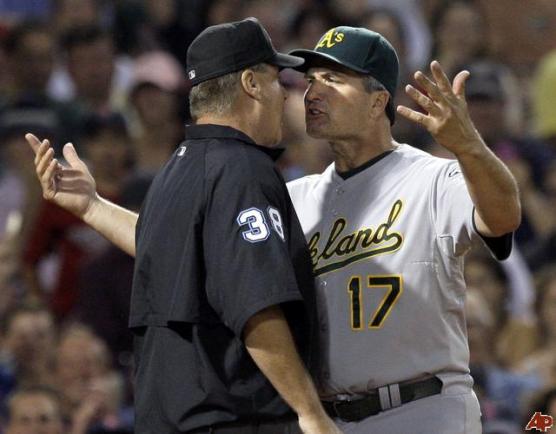
MLB reports: The Oakland Athletics record sits today at 27-37, fourth place in the AL West. So it should come as no surprise that after weeks of speculation, General Manager Billy Beane on Thursday came down with the verdict. Bob Geren is out. Bob Melvin is in. Two former catchers. Two guys named Bob, as part of the changing of the guard in Oakland.
I could be humorous and refer to the whispers that a manager in Oakland is essentially a puppet/pawn for Billy Beane. For anyone that read Moneyball, the idea is clear that Beane calls the shots and the manager complies with his moves. As long as Beane is talking to “Bob” on the telephone, it is irrelevant whether it is Geren or Melvin on the other line. But we will touch upon that shortly.
“ It felt like at this point a change was necessary,” was Beane’s immediate comments following the announcement. “It got to the point where the emphasis was on the status of the manager on a daily basis and no longer on the field. When that starts to happen, you need to shift the focus to what’s really important, which is performance. Bob Melvin will inherit some of the challenges that Bob had. Bob lost four starting pitchers in the space of three weeks. That was a tough body blow for the team. That was very difficult from Bob’s standpoint.” So begins the Oakland managerial career of Bob version 2.0.
The 49-year old Bob Geren completed his five seasons in Oakland with a 334-376 record, good for a .470 winning percentage. Despite his deep friendship with GM Billy Beane, the time was right to cut the cord as the highest the A’s finished under Geren was 2nd place in 2010, with a meager .500 record. Five years playing and five years managing in the majors represents the MLB career of Geren. The A’s tried taking a fresh approach by hiring him as their manager, but clearly he was not right fit for the role. Given his track record as manager, Geren may not find another managerial role very easily. But with his knowledge of the game, he will likely find a scouting or coaching role in the future. With Geren gone, Bob Melvin became the interim “man” in Oakland.
The 49-year old Bob Melvin (see a trend?) coached for seven years in the majors prior to joining Oakland. Two years in Seattle, five years in Arizona. In Seattle Melvin had a lifetime managerial record of 156-168 and in Arizona 337-340. The Diamondbacks originally had hired Wally Backman to manage the team before Melvin, but after legal issues came to light, Melvin got the job. Melvin enjoyed success in Arizona, including a 90-72 record in 2007 and 1st place in the division, together with being named NL Manager of the Year. Coupled with his 93-69 record in 2003 for the Mariners, Melvin apparently gets his teams firing on all cylinders when he first joins a squad. Nicknamed the “Mad Scientist”, Melvin is known to be a very-hands on manager who is not afraid to try anything and everything to pull out wins. After ten seasons of catching in the majors and seven managing, the A’s have themselves experience and a proven track record by hiring Bob Melvin.
By making this move, Billy Beane moved from inexperience to veteran leadership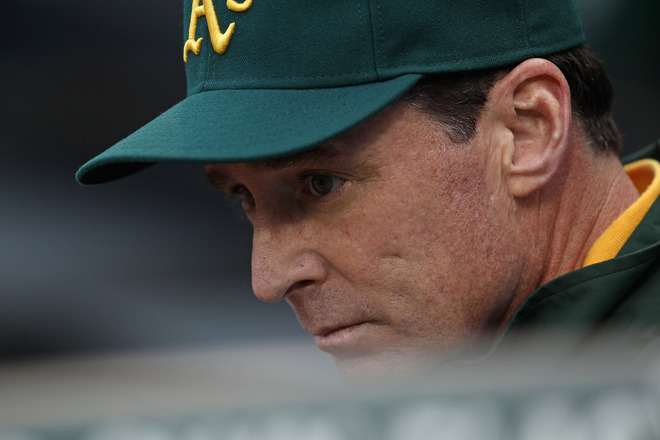 behind the bench. The million dollar question being asked by industry people today is whether Beane will finally let go of the reigns and give full autonomy to his “chef in the kitchen.” After years of watching Bob Melvin play and manage, it is hard to believe that he will agree to be Beane’s puppet. My gut feel is that this marriage will not last long, as Beane may let ease up for some time when the ball club starts winning, but he will take control again before long. Leopards do not change their spots and Beane is unlikely to change his approach in running the Athletics. Melvin surely went into this role with eyes wide open and realized the dangers of taking this job.
As the “interim” manager, Melvin will likely light the fire that is needed to get the A’s going in 2011. The A’s will almost definitely finish with a better record this season under Melvin as compared to Geren staying in the same role. With the “Moneyball” movie due out this fall, Beane had to save face and put a winning product on the field. Despite his assertions that the upcoming movie did not play a role in his decision to change managers, a genius GM played on the big screen by Brad Pitt would look much better to an audience if his team was successful at the same time. Beane did what he had to do to win today and gave his team to a proven winner in Bob Melvin. The danger will be retaining beyond this season. A good short-term move but one that will not work in the long run for the team. The Mad Scientist meets Mr. Moneyball. Let the show begin.
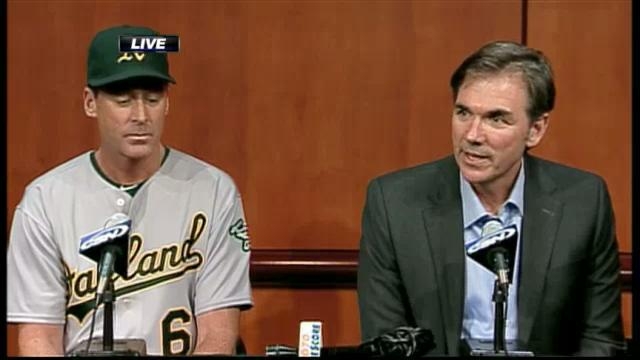
Please e-mail us at: MLBreports@gmail.com with any questions and feedback. You can follow us on Twitter and become a fan on Facebook . To subscribe to our website and have the daily Reports sent directly to your inbox , click here and follow the link at the top of our homepage.

Expanding and Changing the MLB Playoffs: Time to Add More Wild Card Teams
Thursday June 9, 2011

MLB reports: Ever since the players’ strike of 1994 and ensuing realignment of baseball and expanded playoff format (implemented as of 1995), continual debates have raged in baseball circles as to the next round of changes. With everyone still talking today on the topic of wild cards and expanding the MLB playoffs, MLB reports is ready to take this topic head on to find the solution.
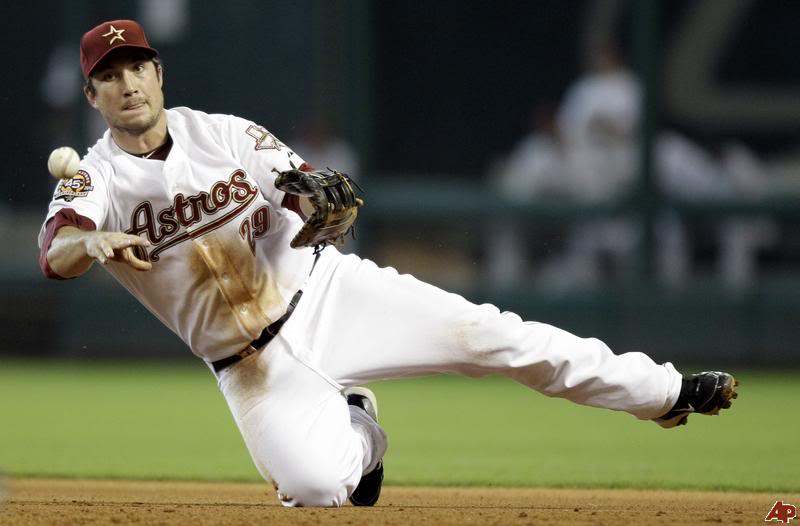 MLB realignment was already covered by us in a recent feature. After 16 seasons under the current format, clearly changes are needed. Our realignment post was just the beginning of the long process to reform and revitalize Major League Baseball. The next step is expanding the amount of wild card teams and changing parts of the MLB playoffs format which will be discussed today. From there, expansion is required to produce 32 total teams, 16 per division which will be covered on MLB reports on another day. Stay tuned.
The current MLB playoffs structure essentially looks like this:
-
Eight total teams make the playoffs
-
Four teams per league
-
One wild card team per league
-
The Division Series (ALCS and NLCS) is a best of five games format
-
The winners from the ALCS and NLCS advance to the League Championship Series (ALCS and NLCS)
-
The ALCS and NLCS are both a best of seven games series, winner of each advance to the World Series
-
World Series is a best of seven, home field based on winner of All Star Game
As part of revamping the system, it is apparent from whispers around baseball that two more wild card teams are about to be added to the mix. As a result there will now be ten total teams that make the playoffs, five per league. Taking the home field talk out of the equation, which is an article in itself, the issue today is the number of teams to make the playoffs and the best format for each playoff series.
I am writing today’s article from a realistic point of view. When I discussed realignment a couple of weeks back, it was from a hopeful and practical standpoint, but with the idea that baseball would be unlikely to accept most of my changes. For a game known for its long-standing traditions, the winds of change blow very slowly through baseball. I am presenting the revamped playoffs with the idea that Major League Baseball will not change too much. While it would be nice to have anywhere for 12-16 teams to make the playoffs according to some fans and analysts, the chances of that happening are close to nil. It was a big change to add the two wild card teams back in 1994 and only two more wild card teams will be added in the next year or so at most. Period. There are some that may want more, but it will not happen.
On the same token, the best of five vs. seven game series debating is raging as well. Some people do not agree with the short five games series in the opening round, as it creates a scenario whereby a top team can be bounced early without the ability to play a full seven games series. This topic will be addressed, but we will have to assume that likely the opening rounds will remain a best of five games series and only the League Championship and World Series would be a best of seven games series. Again this may not be the best option for all, but it is what it is and baseball is unlikely to bend on this as well.
 The last point to make before going through my playoff scenarios is the home field advantage debate, specifically awarding it based on the All Star game outcome. Most traditionalists, yours truly included, despise this format. The best team in baseball should be rewarded for a seasons worth of games played and not have home field determined based on the results of a high-profile exhibition game. After the All-Star game finished in a tie in Milwaukee during the 2002 season, baseball was left with egg on its face and scrambled to give the game more meaning. The decision to award the World Series home advantage based on the winner of the All Star game has been argued by many to have failed to give the All Star game more meaning. But assuming that this format stays in place, an injustice to the teams that finish with better records after season’s end will remain.
In adding two more wild card teams, an additional round of the playoffs will go into effect. The opening round, which we can call the wild card round for simplicity, will have the two wild card teams in each league face-off (most likely a best of five). The winner of the wild card round will advance to the Division Series. From there, the current playoff format would remain in place, with the best of five games Division Series leading to the League Championship and World Series. Part of me is inclined to allow the top seeded team in each league to have an automatic bye into the League Championship Series, with the wild card teams facing off in the Division Series and the 2nd and 3rd seeded teams in each league facing off as well in the Division Series. Allowing each top seed to have a bye directly into the League Championship would reward the highest winning team in each league. But issues would arise, including arguments that two byes for each top team would be too great of a reward and how to determine if there are ties for the top record in each league.
As a result, to keep things simple, baseball will simply have to institute a 4th round of playoffs. In my estimation, the Wild Card Round can be a best of five games, with every other round moving to a best of seven. While baseball unfortunately will likely keep the division series as a best of five games, a move to a best of seven would create more balance in making sure that the true “top” teams advance. Major League Baseball will still have to consider a way to reward the top winning team in each league eventually and that will likely be by creating a first-round bye in a further expanded playoff format, when more wild card teams are added. But until that time, the top winning teams will simply have to enjoy home field advantage. That advantage should continue right into the World Series and it is the hope of this analyst that baseball will realize that one day.
So as we head into another new world of baseball changes, I can’t foresee that the game as we know it today will get completely blown up and redone. Even though the game may need more fine tuning, most changes will come along very slowly. The expanding of the playoffs will be a good thing ultimately for the game, as each team plays a whopping 162 regular season games plus spring training and more teams deserve to be rewarded with playoff berths. An expanded playofs will give teams a better chance to make the playoffs and increase the number of cities and fans involved in the playoff races come September. Adding two more wild card teams is the next logical step and it looks like it will go into effect as soon as 2012. With so many of the other major sports in turmoil, it is good to see baseball alive and healthier than ever. It looks like Major League Baseball has learned its lessons after 1994. Hopefully the game will only continue to move forward and cement itself once again as the greatest sport in the world.

Please e-mail us at: MLBreports@gmail.com with any questions and feedback. You can follow us on Twitter and become a fan on Facebook . To subscribe to our website and have the daily Reports sent directly to your inbox , click here and follow the link at the top of our homepage.

E-MAILBAG: Ask the Reports, Wednesday June 8th
Thank you for reading the E-mailbag. Please send all your questions to mlbreports@gmail.com and please include your first name and City/Country.
We will be compiling a list of your questions from our e-mailbag and posting the responses on Wednesdays.

Wednesday June 8, 2011
Q: Do you think that Kansas city will trade Wilson Betemit to a contender while he his playing well and with Mike “Moose” starting to hit great in Triple-A? If so to whom will he get traded to possibly? From Pam
 MLB reports: Thank you for the question Pam. I see that you have beeen following the Reports closely, as you know that I enjoy discussing Royals prospects, especially the up-and-coming bats. With Hosmer on board, it is only a matter of time before Mike “Moose” Moustakas is next. In 54 games played in Omaha, the Moose has 10 home runs, 43 RBIs, 36 runs scored, .282 AVG and .835 OPS. His 18/43 BB/K ratio does not get me terribly excited, as it does not appear that Moose will ever have the batting eye of Eric Hosmer. That being said, Moustakas should hit for decent average with a ton of power. At 22 years of age and on his second tour of duty in AAA, it is only a matter of time before he gets called up. Wilson Betemit, on the other hand, has played fairly well this year, with a .297 AVG and .776 OPS. The power is down with only 2 home runs but he has 13 doubles already. I see the Royals keeping him around for insurance and versatility. With the Royals very much in contention, they do not have an incentive to trade Betemit unless they got young pitching back (which few teams would give up at this stage). Betemit also has a very affordable contract ($1 million/2011) and will not likely be moved.
Q: What do you think of the rumored group of Garvey and Hershiser to purchase the Dodgers? From Larry, Laughlin.
MLB reports: This story has surfaced and has started to gather steam. If not for Steve Garvey, I could see the Orel Hershiser name attached to the bid providing a great deal of credibility. Hershiser is seen as a clean-cut individual with great heroics in years past for the Dodgers. Garvey on the other hand, while a strong player in his day, does not have the best reputation. Based on the news that I am hearing, I think having Garvey on board will likely kill the chances of this group winning any future bids to control the Dodgers. Frank McCourt is still lurking in the background, but his time is almost done. With all the turmoil surrounding the Dodgers in recent years, MLB and Selig will take their time to find the best possible ownership situation for one of its prized franchises. Stay tuned as this story is far from over.
Q: So has Matt Purke pitcher for TCU been drafted yet? If so, where to? From Nolan, Texas
MLB reports: What a fall from grace. Purke, drafted by the Rangers 14th overall in 2010, was drafted in the 3rd round, with the 96th pick by the Washington Nationals this year. After battling a sore shoulder and having signability issues based on the Rangers failure to sign him, many teams got scared off from this prospect. I expected Purke to go in the 1st round this year, likely to the Jays or back to the Rangers. But the Nationals, who continue to stock up top prospects, landed a 1st round talent in the 3rd round. A very successful selection as Purke will become a solid #3 solid for the Nationals down the road, as early as 2013.
Q: Hosmer have a legit chance at AL ROY this year? From Jerry, Lawrence KS
MLB reports: You think? At age 21 (a year younger than Mike Moustakas), Eric Hosmer has simply dominated major league pitching since getting the call to join the Royals. In 29 games, Hosmer has 5 home runs, 20 RBIs, 14 runs, .304 AVG and .834 OPS. His batting eye has not been on par with his numbers from the minors, as he sits at a 7/22 BB/K. But with his strong average and power to-date, Hosmer will cut down the strikeouts and increase the walks as the months and years go by. We are watching the Royals first baseman for the next decade or so. He has the potential to match the bat of Will Clark and Mark Grace and the sky is the limit for this future all-star. I compare him most to Logan Morrison of the Florida Marlins, as they are very similar players. Great company to be in. Michael Pineda has been outstanding for the Mariners but as the summer is upon us, his arm may get tired and innings become limited. On the flip-side, I can see Hosmer getting hot as the season progresses and could make a strong push for the Rookie of the Year award in the American League. Definitely keep an eye on this kid.
Q: What’s your thoughts on the White Sox drafting Keenyn Walker at 47? From James, London, ON
MLB reports: I was very surprised to see Walker drafted this early. After being drafted by the Cubs in the 16th round in 2009 and the Phillies in the 38th round in 2010, I did not expect Walker to go as high as he did. The kid is a speedster, stealing 65 bases in 63 games played this year. Compared by some to Devon White, he sees himself as the next Torii Hunter. Despite his strong bat and 6’3″ frame, I have concerns if his bat will translate to the major league level. The speed and defense are definitely there, but it’s the power and batting eye that he will need to prove to advance in the minors. A good project player with a high ceiling, but much too early for the White Sox at this slot.
Q: Looks like Francisco brought his “A game” again. Why is he still closing? From Jennifer, Toronto
 MLB reports: For some reason, there is a code in baseball that you stick with your “established” closer(s) and keep trotting them out there until they absolutely cannot be trusted. Looking at the Frank Francisco’s numbers, I believe that time has come. He has given up far too many hits and runs on the season and with a 6.06 ERA and 1.78 WHIP, in my opinion he should have been pitching in middle relief long ago. With Jon Rauch also struggling to maintain consistency, many so-called experts have looked to Octavio Dotel to take the closing job in Toronto. While Dotel has been steady, he has not shown the necessary consistency in my estimation. If it were up to me, I would call upon Casey Janssen or Jason Frasor to become the new Jays stopper. Both have brilliant on the season and earned the right ot pitch in the 9th inning. Frasor has the experience but I would give the role with Janssen and see if he can run with it. The Jays are fortunate to have so many closing options and can try out different pitchers until they find the right fit. But why Francisco continues to get the call is beyond me. He is most suited to pitching the 7th or 8th inning and has proven in Toronto, like he did before in Texas, that he is not a dependable closer.
Q: What are your thoughts on the season that Jonny Venters is having so far? Also what about how terrible Uggla has been? From Kyle
MLB reports: Craig Kimbrel has pitched well this season, with 17 saves (2nd in the NL), 2.79 ERA and 1.23 WHIP. But while Kimbrel has been good, Venters has been great. All Jonny Venters has done is given up 2 ER in 35.2 innings pitched, to a the tune of a 0.50 ERA and 0.76 WHIP. Kimbrel is younger at 23 compared to Venters at 26 and was seen as a stronger prospect going into the season. Also Venters is a lefty and baseball for some reason favors right-handed closers. But the numbers don’t lie and should Kimbrel falter at all, Venters will be given the first crack at the job. The Braves are in a really good situation with these two youngsters pitching at the back end of their bullpen. If their worst problem is who should pitch the 9th, the Braves will not mind that at all. As far as the slumping Uggla goes, there are several factors for his poor season. At 31-years of age, he starting to hit his decline. He always had high strikeout numbers but his walks have taken a huge dive this season. For whatever reason, he has not been comfortable playing in Atlanta and has had troubles adjusting to his new team. Add to that the pressure of living up to his new 5-year, $62 million contract and you have a case of player that is out of place and playing under pressure. Uggla though is a solid veteran and I expect him to heat up as the summer is upon us. The only direction for him is to go up and as long as he goes back to basics and does all the little things that has made him successful in the past, he should rebound nicely. Uggla is still Uggla, give him time.
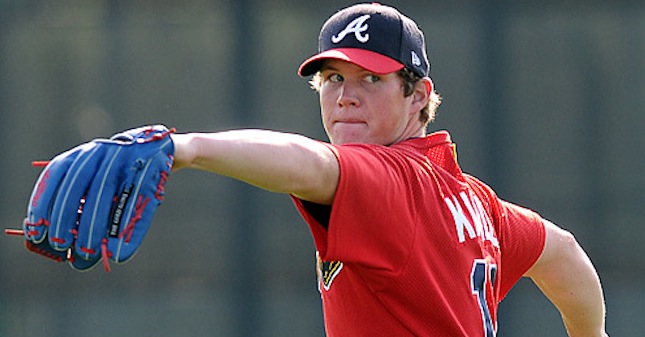
Thanks for the e-mails and keep them coming! mlbreports@gmail.com
E-MAILBAG ARCHIVE: Click here for the Archives of Ask the Reports
Please e-mail us at: MLBreports@gmail.com with any questions and feedback. You can follow us on Twitter and become a fan on Facebook . To subscribe to our website and have the daily Reports sent directly to your inbox , click here and follow the link at the top of our homepage.

Analyzing the 2011 MLB Draft: 1st Round Steals and Misses
Tuesday June 7, 2011
MLB reports: Day one of the 2011 MLB Draft is now in the books and we are moving on to Round 2. The most hyped draft in recent memory did not disappoint, as the results of Round 1 featured many surprises and shockers. With the amount of mock drafts and industry experts covering the big event, you would think that the first round results would have been more predictable. But many teams took diverse routes in making their selections in the first round and now the second-guessing begins. While the analysis may look very different in 1-5 years from now, the day after the draft- we take a look at the highlights of the first round and our most noted steals and misses.
STEALS
6. Washington Nationals: Anthony Rendon, 3B, Rice
A team is simply not supposed to land the top hitter of the draft at the #6 slot but that is exactly what the Nationals did with Rendon. If not for injury concerns, Rendon would have gone as one of the first two picks. While Rendon does carry some risk, the Nationals loved his upside and had to make the selection. The best pick of the draft for the slot in my opinion.
12. Milwaukee Brewers: Taylor Jungmann, RHP, Texas
15. Milwaukee Brewers (for unsigned 2010 first rounder Dylan Covey): Jed Bradley, LHP, Georgia Tech
The Brewers really cleaned up by landing not one but two top-ten starting pitchers by drafting Jungmann and Bradley. Jungmann is the 6’6″ gunslinging Texas pitcher and Bradley is one of the top lefty pitchers. Just like that, in one round the Brewers began the process of restocking their farm system with top pitching prospects.
19. Boston Red Sox (from Tigers for Type-A Victor Martinez): Matt Barnes, RHP, UConn
26. Boston Red Sox (from Rangers for Type-A Adrian Beltre): Blake Swihart, C, Rio Rancho (N.M.) Cleveland HS
The mighty Red sox were at it again by landing a top-ten starting pitcher and the top catching prospect in the draft with the #19 and #26 picks. Barnes was considered to go high, considering his 6’4′, 205 lbs frame and fluid delivery. Then Swihart, whom the Red Sox were known to have targeted at #19, fell all the way to them at #26. A great day for a team that knows how to draft well, plain and simple.
24. Tampa Bay Rays (from Red Sox for Type-A Carl Crawford): Taylor Guerrieri, RHP, Columbia (S.C.) Spring Valley HS
31. Tampa Bay Rays (from Yankeesfor Type-A Rafael Soriano): Mikie Mahtook, OF, LSU
With ten top picks, the Rays were armed with the means to obtain prospects and they got two great ones in Guerrieri and Mahtook. Maturity issues dogged Guerrieri and based on talent alone, he should have gone in the top-12. Mahtook was seen as a possible Mets pick at #13, with a solid glove, bat and speed. Possibly the next Carl Crawford, the Rays showed that good scouting pays off even when you draft late. The Rays may have lost Crawford and Soriano to free agency but they will have the last laugh when both Guerrieri and Mahtook make the majors one day.
MISSES
13. New York Mets: Brandon Nimmo, OF Cheyenne East (Wyo.) HS
Nimmo was picked for the most part based on signability and cost. With the Mets in financial limbo, the team passed on many far superior talents to take Nimmo at #13. The kid is considered a project as he never played high school ball and should have been a 2nd round pick. For a team that desperately needs to rebuild its system, this pick will be a miss.
16. Los Angeles Dodgers: Chris Reed, LHP, Stanford
See Nimmo at #13. The Dodgers are in poor shape financially and like the Mets made their selection based on cost and signability. For another kid that was projected to be a 2nd round pick and also likely to be a reliever, this draft slot was too much of a reach. Overall a great opportunity for Reed, but a huge blow to the Dodgers farm system.
18. Oakland Athletics: Sonny Gray, RHP, Vanderbilt
Reports have Oakland viewing Gray as a starter, but I see the #18 pick likely as a future reliever. Based on his size (5’11”), there will be questions of durability and ability to succeed at the major league level. With so many quality prospects still available, the jury is definitely out on this pick.
29. San Francisco Giants: Joe Panik, SS, St. John’s
The media will have a field day with this pick as the Giants appear to have made a “Panik” move with the selection of Joe Panik in the first round. In desperate need of offense, the Giants opted to grab a shortstop late. With Josh Bell still on the board, a higher risk/reward pick may have been in order. Panik has a strong glove and decent bat, but does not project to have first round type talent.
30. Minnesota Twins: Levi Michael, SS, North Carolina
See Panik at #29. The Twins were in the same boat as the Giants when making their selection. However, the difference is that the Giants are open to spending on draft selections while the Twins tend to be more fiscally responsible (cheap). With the new ballpark in place, the Twins should have gone after a selection with higher upside. They played it safe with Michael, but the ceiling is not high enough to warrant the selection with Bell and Purke still available.
Previous Draft Articles by MLB reports:
The 2011 MLB Draft: Recap of the Results, 1st Round Picks and Future Stars
Updating the 2011 MLB Draft: Baseball Prospects and Draft Projections
The 2011 MLB Draft: The Report and Inside Scoops
Please e-mail us at: MLBreports@gmail.com with any questions and feedback. You can follow us on Twitter and become a fan on Facebook . To subscribe to our website and have the daily Reports sent directly to your inbox , click here and follow the link at the top of our homepage.

The 2011 MLB Draft: Recap of the Results, 1st Round Picks and Future Stars
Monday June 6, 2011
MLB reports: After months of speculation, the 2011 MLB Draft arrived. One of the most debated drafts in years, many of the players were known but where they would be drafted remained a mystery right up until today. After Washington drafted Stephen Strasburg and Bryce Harper the last two years with the top overall pick, who would go #1 this year was shrouded in secrecy. Rumors had the Pirates grabbing Gerrit Cole going #1 by most outlets. However, Rendon, Hultzen and even Bundy were getting a great deal of hype.
We have prepared below a list of the First Round picks in the 2011 MLB Draft. We have listed the players by position, school, draft position and team. We have also provided our analysis and opinions. Time will tell which players end up justifying their draft positions. Some players got drafted according to talent skills. Others according to team needs and even signability played a large part for many. This was definitely one of the most exciting drafts that I have ever covered. The amount of talent available played a huge part as did the buzz generated before the draft due to the explosion of the internet and social media. Compared to the pre-draft predictions and mock drafts, the final results ended up surprising and shocking many. We definitely look forward to revisiting this draft list over the next few years and analyze which picks worked out and the ones that bombed. Half of the fun is predicting the draft and the rest is second guessing it.
The Results of the First Round of the 2011 MLB Draft are as follows:
1. Pittsburgh Pirates: Gerrit Cole, RHP, UCLA
The consensus top choice of the draft ended up going in the top spot. The top arm of the draft, teams love drafting big power arms. With Jameson Taillon, Pittsburgh will have a scary 1-2 punch and will have their future all-star catcher Tony Sanchez to handle the staff. The Yankees loss in 2008 is the Pirates gain. Cole can hit 102 mph on the radar gun. It will be interesting to see who will end up being the better starter between Cole, Hultzen and Bundy. Cole has battled some command issues this season but the ceiling is very high on this future star. A solid pick overall. I would have gone with Rendon but this was a pick that the Pirates almost had to make.
2. Seattle Mariners: Danny Hultzen, LHP, Virginia
Widely expected Anthony Rendon starts his drop. After not going #1, many expected the Mariners to take Rendon. Hultzen goes up all the way to #2 as the Mariners continue to stock up on pitching. Hultzen has three strong pitches and had a huge season for Virginia this year. The kid will look for big bucks and the Mariners will open up their wallet. The surprises have already begun to start the draft and shows that mock drafts can simply be thrown out the window once the real show begins. If the goal of teams is to build strong rotations a la the Giants and Rays, then the Mariners are well on their way to building a contender. King Felix, Prince Pineda and Hultzen should give the Mariners one of the top rotations in the AL West, if not all of baseball one day. The irony is that the Diamondbacks were picking next and had taken Hultzen out of high school in 2008. Arizona lost out on him again.
3. Arizona Diamondbacks: Trevor Bauer, RHP, UCLA
Many mock drafts got this one correctly. Only 6’0″, Bauer is drawing Lincecum comparisons. He may be one of the quicker climbs to the majors and was part of the reason why he was drafted. Diamondbacks also wanted him and didn’t think he would last until the 7th pick. So far in the year of the pitcher, all top 3 picks are starters. As the Rendon drop continues, I see him going no later than #6 to Washington who would love to add another strong bat.
4. Baltimore Orioles: Dylan Bundy, RHP, Owasso (Okla.) HS
Four picks. Four starting pitchers. Orioles love their young pitchers and Bundy will be a big addition. Bundy was expected to possibly go as high as #2 and some had him pegged at #1. He throws 100+ mph and is looking for a big contract. Joe Bundy, the brother of Dylan is also an Oriole and we may see the brothers on the field together one day. Known to have a great work ethic and should be a great addition for the Orioles. Some reports had the Royals hoping that Bundy would fall next to #5 but his potential was too much for the Orioles to pass up on.
5. Kansas City Royals: Bubba Starling, OF, Gardner Edgerton (Kan.) HS
This is the case of the local boy who made good. Starling is considered one of the best athletes in the draft and will excel in his hometown for years to come. What a scary offense he will form with Myers, Moustakas and Hosmer. Another multi-sport star, Starling will have to choose between football and baseball. The hometown advantage should win out and we will see Starling patrolling the Royals outfield one day soon. A solid pick and even better for the Nationals, who grab the former lock #1 pick going into the season, Anthony Rendon at #6.
6. Washington Nationals: Anthony Rendon, 3B, Rice
My pick to go first overall, Rendon falls all the way to #6. Not that the Nationals will complain. With injury concerns including shoulder, Rendon was seen by many as the top bat of the draft. I cannot believe that 5 other teams could pass him up and Washington fans should be dancing in the streets. Washington in 3-4 years will be a huge powerhouse team with the Royals. Perhaps a World Series matchup one day?
7. Arizona Diamondbacks (for unsigned 2010 first rounder Barret Loux): Archie Bradley, RHP, Broken Arrow (Okla.) HS
The year of the pitcher continues. Another two-sport player, Bradley will also have to pick baseball over football. A huge price tag and expected to fall into the teens, the Diamondbacks targeted their player and grabbed him. On a rebuilding team, a solid pick with a high ceiling.
8. Cleveland Indians: Francisco Lindor, SS, Montverde (Fla.) Academy
A shortstop with pop, the Indians found the future replacement for Asdrubal Cabrera. A safe pick, many expected the Indians to go with a starting pitcher here.
9. Chicago Cubs: Javier Baez, SS, Jacksonville (Fla.) Arlington Country Day School
Another hugely talented player out of Florida. A-Rod comparisons anyone? Baez is seen to have a strong bat. He may not stay at shortstop but Baez should be a solid bat for a team in dire need of offense. With Castro entrenched at short, it will be interesting to see where Baez plays on the diamond.
10. San Diego Padres (for unsigned 2010 first rounder Karsten Whitson): Cory Spangenberg, 2B, Indian River (Fla.) JC
A versatile player, Spagenberg also plays shortstop and outfield. The next Chone Figgins or Ben Zobrist? One of the top athletes of the draft, signability issues had led to experts pegging him as a late first rounder. Despite failing to sign last year’s pick, the Padres were not afraid to go with another high-risk, high-reward player. This may be the future center fielder of the Padres, with great defense and plus speed to go along with a solid bat.
11. Houston Astros: George Springer, OF, UConn
Great bat speed and huge upside. There are doubts if the kid will be a superstar but the Astros like him and grabbed him early. Not sure how well his bat will translate to the majors but has drawn Grady Sizemore comparisons. A great outfielder who will likely stay in center field, the upside was too high for the Astros to pass up on him. He will be compared to fellow draftee Bubba Starling and who will become the better player. I can’t say that I am particularly happy with this selection as Taylor Jungmann should have gone to Houston at this slot.
12. Milwaukee Brewers: Taylor Jungmann, RHP, Texas
Jungmann is a 6’6″ pitcher and considered a very advanced pitcher. I thought he might go in the top-5 and would not fall past Houston. But the Brewers got lucky and grabbed one of the best pitchers still available at #12. As a local product, Jungmann was a great fit for Houston. But as a team that needs to restock its prospects cupboard, the Brewers got one of the “can’t miss” kids. We may be looking at the future Brewers ace.
13. New York Mets: Brandon Nimmo, OF Cheyenne East (Wyo.) HS
The Mets…the Mets….what are they thinking? He did not play high school ball and was projected by some as a 2nd rounder. Lots of talents, but the comparisons to Rocco Baldelli do not get me very excited. High reward and high risk player. If he does project into a future Andy Van Slyke, the Mets will be pleased. But for a team in dire need of talent in its system, I would have gone with more certainty. Playing its home game in a pitcher’s park, I expected a pitcher here. But as this draft is showing us, you never know what will happen. Mets fans tomorrow morning will probably be angry in what is shaping as the roughest season in team history.
14. Florida Marlins: Jose Fernandez, RHP, Tampa Alonso (Fla.) HS
A local product, Fernandez is 6’4″ and 220 pounds. The Marlins love their upside pitchers and Fernandez has one of the best arms in the draft. Concerns over legal issues may have led him to fall and some expected him to go later in the 1st round. But the Marlins took the best available arm and with the need to sell seats in their new ballpark, Fernandez could not be passed up. Questions on maturity also dog him and we may be seeing another Matt Garza scenario. But if Fernandez comes close to matching Garza’s numbers in the majors, the Marlins will be pleased. A good pick that makes sense.
15. Milwaukee Brewers (for unsigned 2010 first rounder Dylan Covey): Jed Bradley, LHP, Georgia Tech
Combined with Jungmann, the Brewers are the big winners thus far. A very advanced pitcher, Bradley was a top-10 pick for me going into the draft. The Brewers always have strong scouting and it doesn’t surprise me that they did not pass up on this kid. Congrats to Milwaukee, well done.
16. Los Angeles Dodgers: Chris Reed, LHP, Stanford
A closer at Stanford, Reed is a big boy at 6’4″, 195 lbs. Reports indicate that he may move to the rotation, although at this point I see him staying in the pen. A nice pick, I had him going in the 2nd round and not drafted early by the Dodgers. I suspect signability had a lot to do with this one as the Dodgers do not likely have the money available to go with a high-profile prospect. I have never approved a selection based on money considerations and thus would label this one as likely a failure in the making.
17. Los Angeles Angels of Anaheim: C.J. Cron, 1B, Utah
The Angels were smart with this pick, as they need bats in the system and Cron had one of the biggest bats in the country. Cron was projected to be a late first-rounder but the Angels did not let him slip. Cron comes from a baseball family, as his father is a manager at AA and his brother will likely be drafted this year as well. For a team that usually goes with pitching, I’m impressed that Anaheim broke away from its mold and went with a college bat. Kudos to the Angels on their choice.
18. Oakland Athletics: Sonny Gray, RHP, Vanderbilt
Projected by some as a top-10 selection, the A’s got Gray with the 18th pick. Great stuff and despite standing at only 5’11”, the Athletics could not pass on his potential. I think that Gray will end up in the bullpen and Oakland likely sees him as a future closer. The A’s do not do many things traditionally and they obviously saw enough in Gray to take him in the 1st round. I am sitting on the fence with this pick but my guts says a strong starter would have better served the team long-term.
19. Boston Red Sox (from Tigers for Type-A Victor Martinez): Matt Barnes, RHP, UConn
Another projected top-10 pick, the Red Sox nab Barnes at #19. At 6’4″ 205 lbs, the Red Sox get themselves a great arm. Lively stuff with a smooth delivery, Red Sox nation has to be pleased with this choice. This teams knows how to draft, plain and simple. Some mock drafts had Barnes as high as #5. Somehow the Red Sox always seem to walk away with winners from the draft, despite drafting late. Strong scouting and deep pockets always help.
20. Colorado Rockies: Tyler, Anderson, LHP, Oregon
The greatest pitcher in Oregon history, Anderson is seen very close to the majors. An advanced pitcher that should do really well in Colorado. After growing up in Vegas, Anderson will be ready for the weather conditions of Colorado. A relatively safe pick, Anderson went a little higher than I expected. But with Cron and Barnes off the board, the Rockies went with their next highest rated player.
21. Toronto Blue Jays: Tyler Beede, RHP, Groton (Mass.) Lawrence Academy
The Red Sox were hoping to land this kid at #26 but the Jays nabbed the Mass. product early. I would have gone with Bell or Purke with this pick, but the Jays clearly saw a lot in this kid to make this surprise pick. Beede is planning to go to Vanderbilt but with a strong offer, he will likely sign. Theo Epstein is likely not happy after losing out on him, but the Jays should be pleased with their choice. If they are able to sign him. With a debate on signability, the Jays went high-risk and high-reward with this pick.
22. St. Louis Cardinals: Kolten Wong, 2B, Hawaii
A strong hitter and seen as a good defender, the Cardinals did really well for themselves here. Kolten Wong was seen as a late first-rounder, with average speed and power. He will be more of a project, but the Cardinals are seen as getting a kid with good makeup. It is hard to get many superstars this late, but a good solid second baseman should be seen as a nice selection if he pans out. Guerrieri, Bell and Swihart are still on the board, as is Purke who would have been higher ceiling picks. The Cardinals went safe here, but a guaranteed return has value sometimes as well.
23. Washington Nationals (from White Sox for Type-A Adam Dunn): Alex Meyer, LHP, Kentucky
Standing 6’9″, the Nationals went for a big time pitcher, literally. There is a chance that Meyer could be a starter and might be the next Randy Johnson. Or he could become the next Andrew Brackman or maybe a future closer. These types of picks are hard to project and Meyer like many tall pitchers will need to find control if he is to succeed in the majors. Still many good players on the board but after going with the safe Rendon, the Nationals went with the high ceiling project here. Future hall-of-famer or bust? We won’t know on Meyer for a few years.
24. Tampa Bay Rays (from Red Sox for Type-A Carl Crawford): Taylor Guerrieri, RHP, Columbia (S.C.) Spring Valley HS
This was a top-12 pick on many boards, but maturity issues dogged Guerrieri to drop this low. One of the best arms in the draft, the Rays have done it again. On pure talent, Guerrieri can compete with almost any pitcher in the draft. He has a very strong fastball and pitching in the Rays system, he could develop in a hurry. Clearly makeup did not scare the team and the Rays made a strong selection. After losing Carl Crawford, the Rays got back a big piece today for their organization.
25. San Diego Padres: Joe Ross, RHP, Oakland (Calif.) Bishop O’Dowd HS
The younger brother of Oakland A’s pitcher Tyson Ross, the Padres get a 6’2″, 180 lbs pitcher. Ross was expected to perhaps go to the A’s or Giants, but he still stays local and goes to San Diego. Pitching in San Diego, Ross should do very well in a pitcher’s park. I have read good reports on the kid and he should be a solid middle-of-the-rotation starter. Nice pick for the Padres.
26. Boston Red Sox (from Rangers for Type-A Adrian Beltre): Blake Swihart, C, Rio Rancho (N.M.) Cleveland HS
The Red Sox continue to clean up as they draft the strongest hitting catcher of the draft. His bat compares to Chase Utley, which is a nice comparison. The Red Sox were supposed to take Swihart at #19 but were able to nab Barnes and still get their man at #26. A win-win night for the strong drafting Red Sox.
27. Cincinnati Reds: Robert Stephenson, RHP, Martinez CA, Alhambra HS
Stephenson had back-to-back no-hitters in high-school and was seen as going to the Giants possibly at #29. This kid has huge upside and for a team that drafts exceptionally every year, the Reds have likely found themselves another winner. Especially if the Giants were looking at him as a possible choice, Stephenson will be a prospect to keep an eye on.
28. Atlanta Braves: Sean Gilmartin, LHP, Florida State
The Braves grab a college lefty late in the draft and they have gone with a more ready arm in Gilmartin. Considered a safe pick, the Braves went with a winner with a good selection of pitches and fluid delivery. Gilmartin continues the trend of the “pitcher’s draft”.
29. San Francisco Giants: Joe Panik, SS, St. John’s
A New York native, Derek Jeter is his favorite player. Not on many boards, the Giants went a little high on Panik. Did they “Panik” with this pick? Yes. With such deep pitching, the Giants had to get some bats into their system. A player who is seen as very intense and playing the game the right way, Panik could be a decent bat, strong glove for the Giants. But since he would have likely been there for them in the 2nd round, I think they reached early. I would have gone for Bell or Purke and taken my chances with a risky signing with this pick and having a higher ceiling.
30. Minnesota Twins: Levi Michael, SS, North Carolina
A switch-hitting shortstop, not a bad pick for the Twins. Some experts had him in the early 20s, but playing hurt his numbers were average. Michael plays hard and is seen as a solid defender. A Twins-type player according to Gammons, we could be looked at the future shortstop of the Twins. While Michael does not have much power, he should hit for average and should be a good gritty ballplayer. Personally, I still like the higher upside players but with budgetary concerns, the Twins like safer type picks that are signable. Michael fits the bill.
31. Tampa Bay Rays (from Yankeesfor Type-A Rafael Soriano): Mikie Mahtook, OF, LSU
A top-15 pick who falls to #31, the Rays nab a fairly strong prospect. A really strong defender, Mahtook will be a great center fielder. He can hit for average, some power and will steal many bases. Many experts will be happy with this pick and with a strong scouting staff, the Rays grabbed themselves another good one. A hard worker with lots of talent, we could see the next Carl Crawford here. The Brewers, Red Sox, Nationals and Rays are my big winners thus far.
32. Tampa Bay Rays: Jake Hager, SS, Sierra Vista HS (NV)
The Rays go with a project here but with 3 picks in the 1st round, they could afford to take an easy sign with tools. As more of a late 2nd round type selection, this pick was financially driven and not my preference. With stronger players on the board, I would have liked to see the Rays to go for more of a proven commodity.
33. Texas Rangers (from Phillies for Type-A Cliff Lee): Kevin Matthews, LHP, Richmond Hill HS (GA)
The Rangers go with pitching with the last pick of the 1st round. He is apparently destined to go to Virginia but the Rangers went for the high-risk, high-reward pick. The Rangers have all of a sudden becoming a breeding ground for pitching and Matthews fits the mold of what Texas looks for in a pitcher. Signability aside, Matthews is an extremely talented pitcher and will be a huge success if signed by the team. Otherwise, with the last pick of the first round, the Rangers were not taking a huge chance but tried to score big.
Still sitting on the board at this point were expected first round picks Larry Greene, Daniel Norris, Josh Bell, Matt Purke and Henry Owens. It goes to show you that no matter how well we try to project these drafts, surprises will always result. For curiosity, check out our recent articles in the past few days on the draft and see how our inside scouts did. You might be surprised. While it takes skill and knowledge to try to predict these drafts, it is far from an exact science. But when projections do turn into reality, it is always a great feeling.
Updating the 2011 MLB Draft: Baseball Prospects and Draft Projections
The 2011 MLB Draft: The Report and Inside Scoops
Please e-mail us at: MLBreports@gmail.com with any questions and feedback. You can follow us on Twitter and become a fan on Facebook . To subscribe to our website and have the daily Reports sent directly to your inbox , click here and follow the link at the top of our homepage.

Interview with Author Howard Megdal: “Taking the Field: A Fan’s Quest to Run the Team He Loves”
Sunday June 5, 2011
MLB reports: We are pleased to feature today our interview with baseball author Howard Megdal. After the success of his first baseball literary work “The Baseball Talmud”, Howard has followed up with his just recently published book: “Taking the Field: A Fan’s Quest to Run the Team He Loves.” The press release for the book by Bloomsbury USA describes it as “the true-life story of a baseball fan brave enough to try what all fans wish they could: take over his team and turn it around.” Howard is first and foremost a Mets fan, but loves the game of baseball as a whole. A talented writer, Howard’s books have received great acclaim. For all our baseball fans and aspiring writers, MLB reports is proud to present Howard Megdal.
MLB reports: Howard, thank you for taking the time to speak with us today. Taking a look at your resume, you have quite the extensive baseball writing background. From two published books and articles for many major publications, including the New York Times, ESPN.com, New York Baseball Digest and mlbtraderumors.com. How did you get your start in writing Howard? What led you to writing and specifically, baseball writing?
MEGDAL: Well, I’ve always loved to write. When I got to college, I found that the on-campus publication only published once every 1-2 months, so I started my own. From there, I used that experience to land a job at a daily right nearby, eventually rising to sports editor. And whenever I had the chance to cover baseball, at any level, I just loved it.
MLB reports: What was your first “big break” in your writing career? Please provide details as to how you landed your first big role and the doors that it opened for you.
MEGDAL: I’d have to point to a pair of moments. One is, Mark Healey over at Gotham Baseball gave me the opportunity to cover the Mets and Yankees. It was my first credential at each stadium, and I remember the feeling of standing on the dirt at Yankee Stadium, just awestruck. From there, getting the chance to write for the New York Observer was critical, not only for the wider exposure, but because I work with my editor from there to this day, though now at Capital New York.
MLB reports: It is the dream of all sports writers to be a published author. Your first book was the “Baseball Talmud- The definitive position-by-position ranking of baseball’s chosen players.” How did you score the book deal? In addition to getting signed, how was the topic of the “Baseball Talmud” born? Was this an original creation that you shopped around, or did you get signed first and then came up with the topic?
MEGDAL: Regarding the deal, that was just persistence. I had wanted to write that book since college, and so I wrote up a sample chapter and proposal, and sent it to around 200 literary agents. That was harder even a few years ago; most required a hard copy. But my wife helped me put together the envelopes. And I remember getting a call when I was sick with a fever, and not quite believing it.
MLB reports: How long did it take you to write your first book? Please give us an idea as to how the book writing process worked for you, from finding the topic to polishing off the final draft of the book for publishing.
MEGDAL: Like I said, I knew what I wanted to write a Jewish Bill James-style book. The process of writing it took around 14 months, and the process was pretty straightforward. I made my days about writing the book, so once I ate breakfast, a cat jumped in my lap- we have two, so they took shifts and I went to work.
MLB reports: How did your life change after the “Baseball Talmud” was published? We are curious as to the work and promotions that went into effect after the book hit stores. Did you tour much for signings and give interviews promoting the book? How did your career change post-Baseball Talmud?
MEGDAL: Well, I was fortunate to find a wide audience for the book, and had the pleasure of traveling all over the country to give talks and signings. What changed, I guess, was getting to meet people who were familiar with the work and discussing it with them- instead of just sending my pieces into the void and seeing stray comments for or against them. It was gratifying.
MLB reports: What were your goals when you entered the business and how have they evolved since?
MEGDAL: My goals have always been to figure out who I wanted to write for, and make a point of doing so. That hasn’t really changed- I still love that I get to write what I want when I want. It seems kind of ridiculous, actually.
MLB reports: The title of your new book is absolutely captivating: “Taking the Field- A fan’s quest to run the team that he loves.” Please describe how you came up with the title to the book and if you can give the readers a little teaser about what the book is about in your own words.
MEGDAL: The title came from extended brainstorming from my fantastic editor at Bloomsbury, Ben Adams. The book itself is the story of my run to become General Manager of the New York Mets, which I treated like a political campaign, and simultaneously introduced baseball to my newborn daughter, Mirabelle. I spend time in the book dissecting how the Mets should have been run, and the effect their mismanagement through the years had on my family.
MLB reports: Book #2: Was it different to obtain a publishing deal for it in comparison to your first work? How was the idea born and how did you go about writing such an interesting topic?
MEGDAL: The process was a bit different this time; I met with several publishers, and we finally settled on Bloomsbury as the best fit this time around. I knew I wanted to write something more personal this time, and I also believed the time for this idea had come. I’d batted it around in my own mind for years, simply because I wanted to find a way to make the larger points about how the New York Mets should be run. This struck me as the perfect marriage of opportunity and timing.
MLB reports: “Taking the Field” was just published and is available for orders. Where is the book available for purchase? What forms are you selling the book (i.e. hard copy, digital and on tape?) Is there a book signing tour planned?
MEGDAL: The book is available everywhere- Amazon, Barnes and Noble, the Borders shops that haven’t yet closed… also the Kindle and Nook. I’ll be appearing in a number of places- HowardMegdal.com is probably your best bet to find out tour dates/times.
MLB reports: In comparing your two books, was it easier to write a book the second time around? How did the process and time lines for the books compare?
MEGDAL: Totally different. Second time around, I was writing to a much shorter deadline, and writing about myself. It was far more intense.
MLB reports: With your second book published, what are the goals for Howard Megdal from here? Are more books planned down the road and will they only be focused on baseball?
MEGDAL: Ah, great question. Still trying to figure that out with my agent. I would be surprised if I only wrote baseball books from here, though I have so many baseball ideas alone that it could sustain me for the duration. I love not knowing, though.
MLB reports: Being an obvious baseball fan and supporter of the game, how would you best sum up the state of the sport as it stands today? What do you love about the game and are there things you would change about it?
MEGDAL: The game has never been better. What I would change is simple: I’d eliminate the DH, move the Dodgers back to Brooklyn, keep the playoffs small and mandate scheduled double-headers.
MLB reports: For the future baseball writer reading this interview, what recommendations can you give for them to crack this industry? How does a person become the next Howard Megdal and write baseball columns and become a published baseball author one day? What is the secret of your success?
MEGDAL: Persistence. Write as often as you can, and for anyone who will publish you. Keep sending out pitches to editors, and gradually you will develop a following. Really, that’s all it is; keep knocking on doors.
MLB reports: Thank you for speaking with us today Howard. We wish you the best of luck with “Taking the Field”. It was a pleasure getting to know you and we look forward to publishing our own review of the book. It sounds like a great read and we encourage our readers to check it out.
***A special thank you to Howard Megdal for his time and effort as part of being interviewed for this article. You can follow Howard on Twitter and click here for Howard’s website.***
Please e-mail us at: MLBreports@gmail.com with any questions and feedback. You can follow us on Twitter and become a fan on Facebook . To subscribe to our website and have the daily Reports sent directly to your inbox , click here and follow the link at the top of our homepage.

Ten Things About Mike Leake and His Jump to the Majors
Saturday June 4, 2011
On the Reports, we will be occasionally featuring an up-and-coming baseball writer that has come to our attention and share their work with you, the readers. Part of our mandate at MLB reports is to provide the best baseball coverage and analysis in the business. MLB reports ultimately is designed to expose our readers to the world of baseball and the stories, facts, insights and profiles behind it. In order to meet this goal, we would like to give exciting young writers the chance to showcase their talents and provide a fresh pool of ideas to our site. In today’s feature, we are excited to have the Hall of Very Good as our guest writer with their feature post on Mike Leake. Putting aside Leake’s legal troubles this year, the HOVG took a look at Mike Leake’s major league debut and his jump directly from college to the show. If you are a fan of statistics and baseball data, you will love this one. Enjoy!

Hall of Very Good (Guest Writer for MLB Reports): Heading into the 2010 season, many baseball analysts and writers seemed to be split as to which hotshot National League rookie will be taking home the Rookie of the Year award following this season.
And why wouldn’t they be?
In our nation’s capital, Stephen Strasburg has the makings of being every bit as impactful in his inaugural season for the Nationals as Fernando Valenzuela was when he made the Dodgers starting rotation in 1981 or “Doc” Gooden was three seasons later for the Mets.
Down in Atlanta, Jason Heyward became, with one swing of the bat, just the 104th Major Leaguer since 1895 to go yard in his first career plate appearance.
One guy who wasn’t in any discussions was Reds starting pitcher Mike Leake, and dude was on the cusp of doing something that neither Strasburg nor Heyward could accomplish…beginning his career on a Major League roster.
When he took the mound against the Chicago Cubs Sunday, the 22 year-old righty became the first starting pitcher to leapfrog the Minors since Jim Abbott did it in 1988 for the Angels.
Here is some more stuff you might not have known about skipping the Minors and starting your career in the show.
$2,900,000
After being selected eighth overall by Cincinnati in last year’s draft…Arizona State’s Mike Leake received a $2.9 million signing bonus. By comparison, the top pick, Stephen Strasburg, received a $7.5 million dollar bonus by putting his John Hancock on the dotted line for Washington.
2000
Do you remember where you were September 30, 2000? Maybe you were bumping around town listening to “Minority” by Green Day. Perhaps you were waiting in line to purchase tickets for “Remember the Titans.” Me? I was at the theatre enjoying “Best in Show”. True story. But if you were Xavier Nady of the Pittsburgh Pirates, you were making your Major League debut and, in turn, becoming the last guy to jump the Minors until Mike Leake accomplished the feat.
84
Since 1915, 84 players have made the jump to the Major Leagues without stopping over in the Minors. However, since 1965 (the last year of the “Bonus Baby”…more on that next) only 22 guys have made the leap.
57
Of the aforementioned 84 who made the jump straight to the Majors, 57 were deemed “Bonus Babies”. A “Bonus Baby” was the group of amateur baseball players who went straight to the Major Leagues between the years 1947-1965. In accordance with the Bonus Rule, any amateur player who had received more than $4,000 in bonuses, entered into a contract. These players’ teams were required to keep them on the 40-man roster for a full season, preventing the player from spending time in the Minors. Notable “Bonus Babies” include Hall of Famers Al Kaline, Harmon Killebrew, Sandy Koufax and Jim “Catfish” Hunter. In 1965…Major League Baseball instituted the draft.
39
It should be no surprise that the position that has the most players to skip the Minors is pitcher. On Sunday, Mike Leake became the 39th pitcher to make the jump and the first since Ariel Prieto did it in 1995 for the Oakland A’s.
12
And speaking of the A’s (intentional segue!)…when they sent pitcher Mike Morgan to the hill in 1978 for him to make his debut, it marked the first of 12 teams for the righty. And you guessed it, those 12 teams makes Morgan the most-traveled of all players that made the jump straight to the Majors.
8
While it is far too soon to determine if Mike Leake is more Mike Morgan than Sandy Koufax, one thing is certain…only eight of the players that skipped the Minors have found themselves in Cooperstown. The four “Bonus Babies” (Kaline, Killebrew, Koufax and Hunter), George Sisler, Mel Ott, Bob Feller and Dave Winfield.
7
Mike Leake became just the seventh member of the Cincinnati Reds to make the jump straight to the Majors. Other teams that have had a slew of players skip the Minors, the Pittsburgh leads all with nine call-ups…Baltimore has eight.
3
Over the last 50 years, Arizona State has produced the most players to make the jump from college to the pros…three (Eddie Bane, Bob Horner and Mike Leake). Of the three, third baseman Horner is also in an elite group among sluggers. In July 1986 (a full 16 months before Leake was born), Horner became just the eleventh player in Major League history to slug four home runs in a single game.
∞ (infinity)
In what was probably the worst pitching debut of any pitcher to have skipped the Minors, Jerry Walker failed to get an out in his inaugural outing. Walker, fittingly, walked the first two batters he faced back on July 6, 1957. The third, he greeted with a wild pitch and subsequently, he was then yanked. Unfortunately both batters he walked ended up circling the bases and left Walker with an ERA of infinity.
Mike Leake fared much better.
In six and two-thirds innings of work, the young righty gave up only one run on four hits good for a 1.35 ERA. He did channel Walker by walking seven, but he also struck out five. Leake also added two hits to become the first Reds pitcher to produce two hits in his debut since Benny Frey on Sept. 18, 1929.
***Thank you to the Hall of Very Good for preparing today’s feature article on Mike Leake and his jump directly to the Major Leagues. You can follow the Hall of Very Good on Twitter.***
Please e-mail us at: MLBreports@gmail.com with any questions and feedback. You can follow us on Twitter and become a fan on Facebook . To subscribe to our website and have the daily Reports sent directly to your inbox , click here and follow the link at the top of our homepage.
Updating the 2011 MLB Draft: Baseball Prospects and Draft Projections
Friday June 3, 2011
MLB reports: We are merely 72 hours or so away from one of the biggest baseball events of the year, the 2011 MLB Draft. As the draft slowly develops into a prime time event, the hype surrounding the draft is increasing year-by-year. 2011 has probably been the most promoted and talked about draft in my recent memory. With such a large pool of talented players available in the draft, people are started their countdowns to Monday night at 6:00p.m. when the fun begins.
Here at MLB reports, we posted a recent feature on the MLB draft, which you can view by clicking here. Given that we have received hundreds of e-mails per day requesting additional information, we went back to our insider scouts to get the last final tidbits of information before the draft. Our readers have been asking which players are rising and falling and where players are expected to land. For the inside scoops, here is the latest information from our scouts and what they had to say about key prospects and their draft projections. We have also included below the complete list of the order of selections for the first round of the draft and a top-100 prospects list.
RISING PROSPECTS
Gerrit Cole, UCLA RHP
“One scout said that Rendon and Starling are the best two players in the draft. However, Cole will hear his name when the Pirates are on the clock, just a hunch.”
Daniel Norris, Science Hill HS, TN LHP
“A once projected top-5 talent, Norris has every tool to be a special pitcher at the big league level. His commitment to Clemson may come with a price tag, but a LHP with a 92-95mph fastball will be worth every penny. Norris could go as high as #7 to the Diamondbacks, but I expect him to land somewhere in the top 15 selections.”
Robert Stephenson, Alhambra HS, CA RHP
“One scout told me that he might end up being the 3rd High School RHP off the boards with Bundy, Bradley and Howard ahead of him. If that’s the case, he may end up sneaking into the late teens. I can see a good fit with Oakland (18th) or Washington (23rd).”
Bubba Starling, Gardner-Edgerton HS, KS OF
“The best player in this draft. The only question is can the team that drafts him then sign him? With Scott Boras as his “advisor”, one would believe that this signing would go down to the wire. If Starling signs, you will be looking at a 5-tool star that an organization can build around. Another scout told me that there is “no chance” if Bubba is there that the Royals pass on him. But then again, if Dylan Bundy is available, he could be tempting as well.”
FALLING STARS
Taylor Guerrieri, Spring Valley HS, SC RHP
“Second week on the list, rumors are swirling about the gifted RHP. He has top- 10 talent and one team may gamble early (NY Mets). The newly rumored team to be considering Guerrieri could be the Blue Jays at #21. His potential is there but many teams are still concerned with the lack of communication from his camp and many of his questionable off-field decisions. Only reason why he made this list two weeks in a row is because for someone who has frontline starter written all over him, he should be going in the top 5-7 picks.”
Nick Delmonico, Farragut HS, TN C/3B
“I hate saying he will slip because I like everything about him. A weak catcher draft could have him being selected in the Supplemental 1st round. More likely thought, Delmonico is to be a 2nd round pick. He is athletic (can also play SS) and is good size for a High School senior (6’3”).”
Logan Verrett, Baylor RHP
“A projected top-100 talent by Baseball America. Multiple scouts have said that they wouldn’t expect to hear his name until the 4th or 5th round. Verrett had a good career at Baylor but is a bit undersized at 6’2” and 185 lbs. He may put wear and tear on his arm by the time it’s all said and done.”
What we are hearing: Players that Teams are Considering
Toronto Blue Jays
Levi Michael, Blake Swihart, Matt Skole, Trevor Gretzky, Nick Tropeano, Chris Marlowe
Minnesota Twins
PrestonTucker, Travis Harrison, Ronnie Richardson
San Diego Padres
Sonny Gray, George Springer, Dillon Maples, John Stilson, Dillion Peters
St. Louis Cardinals
Cory Spangenberg, Daniel Norris
Kansas City Royals
Grayson Geiner, Carlos Rodon
Milwaukee Brewers
Mikie Mahtook, John Stilson
Chicago Cubs
Bubba Starling, Chris Marlowe, Matt Maronde
Cincinnati Reds
Tyler Beede, Andrew Chafin, Zeke Devoss
Seattle Mariners
Anthony Rendon, Tyler Greene, Mason Robbins, Trevor Podratz
Please e-mail us at: MLBreports@gmail.com with any questions and feedback. You can follow us on Twitter and become a fan on Facebook . To subscribe to our website and have the daily Reports sent directly to your inbox , click here and follow the link at the top of our homepage.
Here is the Order for the 1st Round of the 2011 MLB Draft:
First Round
- Pirates
- Mariners
- Diamondbacks
- Orioles
- Royals
- Nationals
- Diamondbacks (for unsigned 2010 first rounder Barret Loux)
- Indians
- Cubs
- Padres (for unsigned 2010 first rounder Karsten Whitson)
- Astros
- Brewers
- Mets
- Marlins
- Brewers (for unsigned 2010 first rounder Dylan Covey)
- Dodgers
- Angels
- Athletics
- Red Sox (from Tigers for Type-A Victor Martinez)
- Rockies
- Blue Jays
- Cardinals
- Nationals (from White Sox for Type-A Adam Dunn)
- Rays (from Red Sox for Type-A Carl Crawford)
- Padres
- Red Sox (from Rangers for Type-A Adrian Beltre)
- Reds
- Braves
- Giants
- Twins
- Rays (from Yankees for Type-A Rafael Soriano)
- Rays
- Rangers (from Phillies for Type-A Cliff Lee)
Supplemental First Round
- Nationals (for Type-A Adam Dunn)
- Blue Jays (for Type-A Scott Downs)
- Red Sox (for Type-A Victor Martinez)
- Rangers (for Type-A Cliff Lee)
- Rays (for Type-A Carl Crawford)
- Phillies (for Type-A Jayson Werth)
- Red Sox (for Type-A Adrian Beltre)
- Rays (for Type-A Grant Balfour)
- Rays (for Type-A Rafael Soriano)
- Diamondbacks (for Type-B Adam LaRoche)
- Mets (for Type-B Pedro Feliciano)
- Rockies (for Type-B Octavio Dotel)
- Blue Jays (for Type-B John Buck)
- White Sox (for Type-B J.J. Putz)
- Padres (for Type-B Jon Garland)
- Giants (for Type-B Juan Uribe)
- Twins (for Type-B Jesse Crain)
- Yankees (for Type-B Javy Vazquez)
- Rays (for Type-B Joaquin Benoit)
- Blue Jays (for Type-B Miguel Olivo)
- Padres (for Type-B Yorvit Torrealba)
- Twins (for Type-B Orlando Hudson)
- Rays (for Type-B Randy Choate)
- Blue Jays (for Type-B Kevin Gregg)
- Padres (for Type-B Kevin Correia)
- Rays (for Type-B Brad Hawpe)
- Rays (for Type-B Chad Qualls)
Here is the top 100 Draft Prospects as presented by MLB Draft Guide:
| Rank | Player | Position | School |
|---|---|---|---|
| 1 | Dylan Bundy | RHP | Owasso HS, OK |
| 2 | Anthony Rendon | 3B | Rice |
| 3 | Trevor Bauer | RHP | UCLA |
| 4 | Gerrit Cole | RHP | UCLA |
| 5 | Bubba Starling | OF | Gardner-Edgerton HS, KS |
| 6 | Danny Hultzen | LHP | Virginia |
| 7 | Archie Bradley | RHP | Broken Arrow HS, OK |
| 8 | Matt Barnes | RHP | UConn |
| 9 | Sonny Gray | RHP | Vanderbilt |
| 10 | Taylor Jungmann | RHP | Texas |
| 11 | Francisco Lindor | SS | Montverde Academy, FL |
| 12 | Jed Bradley | LHP | Georgia Tech |
| 13 | Taylor Guerrieri | RHP | Spring Valley HS, SC |
| 14 | Josh Bell | OF | Dallas-Jesuit HS, TX |
| 15 | Matt Purke | LHP | TCU |
| 16 | George Springer | OF | UConn |
| 17 | Jose Fernandez | RHP | Alonso HS, FL |
| 18 | Daniel Norris | LHP | Science Hill HS, TN |
| 19 | Blake Swihart | C | Cleveland HS, NM |
| 20 | Mikie Mahtook | OF | LSU |
| 21 | Javier Baez | 3B/SS | Arlington Country Day School, FL |
| 22 | Alex Meyer | RHP | Kentucky |
| 23 | Tyler Beede | RHP | Lawrence Academy, MA |
| 24 | Austin Hedges | C | JSerra HS, CA |
| 25 | Henry Owens | LHP | Edison HS, CA |
| 26 | C.J. Cron | 1B | Utah |
| 27 | Kolten Wong | 2B | Hawaii |
| 28 | Robert Stephenson | RHP | Alhambra HS, CA |
| 29 | Derek Fisher | OF | Cedar Crest HS, PA |
| 30 | Trevor Story | SS | Irving HS, TX |
| 31 | Dillon Maples | RHP | Pinecrest HS, NC |
| 32 | Jackie Bradley Jr | OF | South Carolina |
| 33 | Daniel Vogelbach | 1B | Bishop Verot HS, FL |
| 34 | Levi Michael | SS/2B | North Carolina |
| 35 | Brian Goodwin | OF | Miami-Dade JC |
| 36 | Dillon Howard | RHP | Searcy HS, Ark |
| 37 | Tyler Anderson | LHP | Oregon |
| 38 | Dante Bichette Jr | 3B | Orangewood Christian HS, FL |
| 39 | John Stilson | RHP | Texas A&M |
| 40 | Joe Ross | RHP | Bishop O’Dowd HS, CA |
| 41 | Sean Gilmartin | LHP | Florida State |
| 42 | Cory Spangenberg | 3B | Indian River JC |
| 43 | Larry Greene | OF | Berrien County HS, GA |
| 44 | Dwight Smith Jr | OF | McIntosh HS, GA |
| 45 | Andrew Susac | C | Oregon State |
| 46 | Brandon Nimmo | OF | East HS, WY |
| 47 | Travis Harrison | 3B | Tustin HS, CA |
| 48 | Josh Osich | LHP | Oregon State |
| 49 | Matt Dean | 3B | The Colony HS, TX |
| 50 | Connor Barron | SS | Sumrall HS, MS |
| 51 | Aaron Westlake | 1B | Vanderbilt |
| 52 | Kyle Winkler | RHP | TCU |
| 53 | Anthony Meo | RHP | Coastal Carolina |
| 54 | Tyler Marlette | C | Hagerty HS, FL |
| 55 | Nicky Delmonico | C/3B | Farragut HS, TN |
| 56 | Andrew Chafin | LHP | Kent State |
| 57 | Tony Zych | RHP | Louisville |
| 58 | Brett Austin | C | Providence HS, NC |
| 59 | Grayson Garvin | LHP | Vanderbilt |
| 60 | Joe Panik | SS | St John’s |
| 61 | Bryan Brickhouse | RHP | The Woodlands HS, TX |
| 62 | hudson Boyd | RHP | Bishop Verot HS, FL |
| 63 | Kevin Cron | C/1B | Mountain Pointe HS, AZ |
| 64 | Chris Reed | LHP | Stanford |
| 65 | Michael Fullmer | RHP | Deer Creek HS, Ok |
| 66 | Alex Dickerson | OF | Indiana |
| 67 | Jason Esposito | 3B | Vanderbilt |
| 68 | Noe Ramirez | RHP | Cal State Fullerton |
| 69 | Brad Miller | SS | Clemson |
| 70 | Charlie Tilson | OF | New Trier HS, IL |
| 71 | Ricky Oropesa | 1B | USC |
| 72 | B.A. Vollmuth | 3B/SS | Southern Miss |
| 73 | Keenyn Walker | OF | Central Arizona JC |
| 74 | Logan Verrett | RHP | Baylor |
| 75 | Ryan Wright | 2B | Louisville |
| 76 | Jake Hager | SS | Sierra Vista HS, NV |
| 77 | Tyler Greene | SS | West Boca raton HS, FL |
| 78 | Kyle Crick | RHP | Sherman HS, TX |
| 79 | Johnny Eierman | OF | Warsaw HS, MO |
| 80 | Andrew Gagnon | RHP | Long Beach State |
| 81 | Tommy LaStella | 2B | Coastal Carolina |
| 82 | Williams Jerez | OF | Grand Street HS, NY |
| 83 | Tyler Gibson | OF | Stratford Academy, GA |
| 84 | Michael Kelly | RHP | West Boca Raton HS, FL |
| 85 | Cameron Gallagher | C | Manheim Township HS, PA |
| 86 | Roman Quinn | OF | Port St Joe HS, FL |
| 87 | Zach Cone | OF | Georgia |
| 88 | Burch Smith | RHP | Oklahoma |
| 89 | Phillip Evans | 2B/SS | La Costa Canyon HS, CA |
| 90 | Mark Pope | RHP | Georgia Tech |
| 91 | Grandon Goetzman | OF | Palmetto HS, FL |
| 92 | Peter O’Brien | C | Bethune-Cookman |
| 93 | Cody Kukuk | LHP | Free State HS, KS |
| 94 | Brandon Loy | SS | Texas |
| 95 | Jace Peterson | SS | McNeese St |
| 96 | Gerrett Buechele | 3B | Oklahoma |
| 97 | Kes Carter | OF | Western Kentucky |
| 98 | Daniel Camarena | LHP/OF | Cathedral Catholic HS, CA |
| 99 | James McCann | C | Arkansas |
| 100 | Cody Asche | 3B | Nebraska |

Brett Lawrie: On the Verge of Joining the Toronto Blue Jays
Thursday June 2, 2011

MLB reports: There is often a misconception in baseball that news and events from north of the border is often ignored. Around the Rogers Centre, there has been a strong buzz for weeks anticipating the arrival of the Blue Jays top prospect. At the tender age of 21, Brett Lawrie, the third baseman of the future for the Jays is about to arrive. But news of Lawrie’s impending promotion has spread beyond the media in Toronto and Las Vegas, the Jays AAA affiliate. The MLB community is talking, from Seattle to Washington, and Milwaukee to Florida. Everyone wants to know the same thing: When is Brett Lawrie getting the call?
 Brett Lawrie was originally drafted by the Milwaukee Brewers of the first round of the 2008 draft, going 16th overall. The team picking next? Ironically enough, the Toronto Blue Jays. With the 17th pick, the Jays went with first baseman David Cooper. The Jays had their eye on Lawrie and were all set to draft the British Columbia native Lawrie. But with Milwaukee having Canadians Doug Melvin and Gord Ash in its front office, the Brewers with a strong scouting presence in Canada were all over Lawrie. Milwaukee in 2008 made Lawrie the highest drafted Canadian born position player in major league history and fourth overall, behind Jeff Francis, Adam Loewen and Philippe Aumont. But the Jays never lost their interest in Lawrie and on December 6, 2010, Lawrie was finally coming home.
Last winter, Lawrie was moved from Milwaukee to Toronto in a straight exchange for Jays ace hurler, Shaun Marcum. Coming off arm issues and a missed 2009 season, Marcum bounced back during the 2010 season with 13 wins and almost 200 innings pitched. Now due for arbitration, the Jays capitalized on Marcum’s success to land the player they coveted for some time. Lawrie immediately moved from 2nd to 3rd and became the Jays third baseman of the future. But at 21-years of age, Lawrie was still in need of more experience and seasoning. After a fairly solid AA campaign in Huntsville, Lawrie was expected to repeat AA with the Blue Jays and slowly move to AAA near the end of the year. But that all changed come spring training.
After a solid spring campaign, there was a buzz around baseball that Lawrie almost made the Blue Jays team in time for opening day. But with Edwin Encarnacion on the roster, the Jays decided that the major league roster had its stop-gap solution until Lawrie was ready. Given his strong spring though, the Jays organization reasoned that Lawrie was ready for increased competition and designated him to AAA Las Vegas to start the campaign. Looking at the numbers, Lawrie has flourished. Going into today, Lawrie has a .354 AVG, .415 OBP, .677 SLG, 15 home runs, 19 doubles, 49 RBIs, 51 runs, and has been successful on 11/12 stolen base chances. All of this accomplished in only 52 games played. Granted, Las Vegas is known as a hitters park and the 51s play in the Pacific Coast League, a notorious slugging league. Lawrie though has earned his shot and this was week was all set to get the call. Media outlets reported that Lawrie, together with Adam Lind would be joining the Jays on Friday. But this past Tuesday night, Lawrie was hit on the hand and everything changed.
The Blue Jays and the collective baseball world held its breath as Lawrie’s left hand was x-rayed. The results came back negative and fortunately only a bruise. However, with a deep hand bruise, Lawrie’s promotion has temporarily been placed on hold. As with all good things in life, the best things come to those that wait. While surely disappointed at his misfortune, at this point Lawrie just has to come back and prove health in order to make his long-awaited major league debut.
Fantasy baseball players especially have been contacting me to find out my predictions as to how Lawrie will fare when he finally joins the Jays. My response has been that he will play at third base when given the call and likely stay there for the next decade or so. But fans of the game have a way of getting excited about MLB prospects, which is great for the game but creates some unrealistic expectations some times on the players. Looking at Lawrie’s stats, I noticed that he had 47/118 BB/K in 2010 and this year sits at 18/40 BB/K. Lawrie with a career .294 AVG in the minors clearly has a strong bat. Now he just has to develop his batting eye. Coming to the majors, he might be a little slow out of the gate as he gets his feet wet. A .250-.260 AVG is a realistic prediction at this stage of his career, but may not be enough to satisfy the demands of his loyal followers. People may expect the world from Lawrie with all the hype surrounding him, but let’s remember that he is still only 21 and maturing as baseball player and person. Coupled together with his defensive shift from 2nd to 3rd, it has been a season of adjustments for him. But Lawrie has shown the superstar potential and earned the call to the big leagues.
We will follow this story for you as it develops and continue the Reports as Lawrie is likely to join the Blue Jays next week. After landing in Toronto, the future for Brett Lawrie is wide open. He could be here to stay or may need to bounce a little between Toronto and Las Vegas before he establishes himself. Look no farther than another one time can’t miss Toronto prospect, Travis Snider. For the last two seasons, Snider made the team out of spring training with high expectations, only to land back in Las Vegas to work on his game. The baseball world looks forward to the arrival of Brett Lawrie and the next “can’t miss” prospect. After all the talk and hype, the moment of truth is almost upon us.

Please e-mail us at: MLBreports@gmail.com with any questions and feedback. You can follow us on Twitter and become a fan on Facebook . To subscribe to our website and have the daily Reports sent directly to your inbox , click here and follow the link at the top of our homepage.

E-MAILBAG: Ask the Reports, Wednesday June 1st
Thank you for reading the E-mailbag. Please send all your questions to mlbreports@gmail.com and please include your first name and City/Country.
We will be compiling a list of your questions from our e-mailbag and posting the responses on Wednesdays.

Wednesday June 1, 2011
Q: Might be late, but a question for you. I love hitting pitchers. Who are some of the best of all time? From Larry, Laughlin.
MLB reports: Larry, as our #1 fan, you really know how to come up with great questions. An interesting question but one that is a little difficult to answer. As baseball has evolved, we have seen the introduction of the designated hitter, specialized relievers and closers. As years have gone by, pitchers have been hitting less and less. If we were to look overall at the “best” hitting pitchers, the discussion would begin and end with the greatest hitter of all time, Babe Ruth. To those of you that enjoy studying baseball history, Babe actually started off as a pitcher and was very good. Babe has a 94-46 career record as a pitcher, with a 2.28 ERA and 1.159 WHIP. At those numbers, Babe would have made the hall of fame even if he had stayed on the mound. But as he spent most of his career in the outfield, most people would not think of as Babe as a great hitting pitcher, just a great hitter. Bob Gibson, Don Drysdale and Walter Johnson were also decent hitting pitchers in their days, who could pop a few home runs. Looking at hitting pitchers of today, Carlos Zambrano, Micah Owings, and Jake Peavy when he was in the NL were all strong hitters. Rick Ankiel, before moving the outfield, was probably one of the best hitting pitchers at the time. Pitchers who can hit are out there, but as you can see from the list, they are a rare breed. If I have my way and the DH is abolished, we might see more pitchers enter this list in the future.
Q: Possible question for MLB reports. I Mat Latos finally back? From Nolan, Parts Unknown.
 MLB reports: Mat Latos, the next great ace in baseball appears to have finally turned a corner. He has pitched really well in 3 of his last 4 starts and was outstanding last night, with 2 earned runs given up in 6.0 innings with 7 strike outs. After starting the year on the DL and taking time to come back to form, Latos has decent numbers on the year. A 3-6 record with a 3.97 ERA and 1.29 WHIP. Let’s remember that he pitches for a very weak Padres team that has a difficult time scoring runs and clawing out wins. Latos would be a 15-20 game winner on a contender and his numbers are telling me that he is back. By season’s end, we should see the Mat Latos that we all have come to know and admire.
Q: Your thoughts on Eric Thames thus far? From J, Toronto.
 MLB reports: I had the pleasure of meeting Mr. Thames recently at an autograph signing during the sleepover at the ballpark night at the Rogers Centre. The man has the biggest smile that you will ever see. Thames really gives the impression that he appreciates his place in the big leagues and does not take anything for granted. Watching him also during BP, he appears to be very intense and focused at developing his skills. That being said, his solid numbers in the minors have not yet translated to the majors. The 24-year old 7th round pick from the 2008 draft was hitting .342 in AAA at the time of his promotion with 6 home runs in 36 games. So far he has not hit a home run for the Jays and is batting .265. With Adam Lind due back, Lawrie about to be promoted and Travis Snider hitting .298 in AAA, the Blue Jays roster is becoming very crowded. I really like what I have seen thus far from Thames and I feel that he has a future in the Jays outfield. Having got his feet wet in the bigs, I believe that he needs a little more seasoning to develop the power side of his game and then be able to return back to Toronto with a vengeance. Thames has 20+ home runs in his bat and has shown a good eye at the plate. The potential is there and I hope that he is able to fulfil it.
Q: Will Anthony Rendon be the first overall pick in next week’s MLB draft? From Kathy, San Francisco.
MLB reports: Everything that I have read and seen from Anthony Rendon tell me that he should be the first overall pick in this year’s draft. However, injury concerns and the development of Gerrit Cole say that the Pirates will be drafting Cole next week. My prediction is that Rendon will go #2 to the Mariners and not fall past Arizona with the 3rd pick. The consensus #1 overall pick for some time, Rendon’s stock has gone up and down this year. Having broken his ankle and suffered a shoulder strain, the injury concerns will possibly scare off the Pirates from selecting him. Given the Pirates need for offense and inability to develop pitchers over the past few years, I would pick Rendon if given the choice. But the Pirates loss will likely be the Mariners gain, with Rendon and Dustin Ackley forming a 1-2 punch in their lineup for years to come.
Q: Best thing you ever ate or drank at a ballpark? I’m hungry! From Frank, Milwaukee.
MLB reports: Grab a sandwich my man, lol! I have not been to a game to watch the Brewers but I have heard that you have some great food at your park. I will say that I honestly love food and have eaten everything that you can imagine at a ball game. From nachos, hot dogs, hamburgers, turkey legs, perogies, chili, brisket sandwiches, fried chicken, stir fry….my stomach has seen and digested it all (thank goodness for tums!) My personal fave though? That’s easy. I am a true old school baseball guy and I would order hebrew national hot dogs off the grill at Comerica Park any day, with onions to boot. To wash it all down? Sometimes a blue slushy is my beverage. But in Comerica they have Cuervo green margaritas on tap. On a nice summer afternoon at the ballpark, nothing can beat that. Bottoms up and enjoy!

Thanks for the e-mails and keep them coming! mlbreports@gmail.com
E-MAILBAG ARCHIVE: Click here for the Archives of Ask the Reports
Please e-mail us at: MLBreports@gmail.com with any questions and feedback. You can follow us on Twitter and become a fan on Facebook . To subscribe to our website and have the daily Reports sent directly to your inbox , click here and follow the link at the top of our homepage.

Revisiting: Brett Wallace, Matt Holliday, Michael Taylor, Anthony Gose: 4 Players, 4 Teams, 3 Trades
Tuesday May 31, 2011
MLB reports: Brett Wallace has experienced a baseball odyssey like few others ever have. Drafted twice, traded three times and playing in 4 different baseball organizations before his 25th birthday. The man with the golden bat, Wallace has been coveted by many MLB teams yet somehow managed to move in three separate transactions over his short career. Usually in these scenarios, we would consider the player to be more of a role type player and not likely to be a superstar in the making. But considering the players and transactions involved, it is clear that Wallace has been in demand all along. Now finally entrenched in Houston and playing every day in the big leagues, Wallace is finally fulfilling his early promise and making a name for himself as a future All-Star and possibly batting champion in the National League.
Wallace first hit our radars in 2005 when the Toronto Blue Jays drafted him in the 42nd round. Unable to sign him, Wallace went on to start playing college ball for Arizona State University. From there, Wallace blossomed into a 1st round pick, 13th overall for the St. Louis Cardinals in 2008. Playing in the Cardinals minor league system at third base, Wallace was touted as the next Cards superstar hitter in the making. With Pujols entrenched at 1st base and up-and-coming slugger Colby Rasmus also in the picture, the Cardinals appeared to be set offensively for years to come.
The plan was changed on July 24, 2009, where the Cardinals making a playoff push, traded Wallace to the Oakland Athletics with Shane Peterson and Clayton Mortensen for slugging outfielder Matt Holliday. The plan worked as the Cardinals were able to make the playoffs and proceeded to sign Holliday to a long-term deal as protection in the lineup for their main superstar, Albert Pujols. Wallace, played out the season in the A’s organization and the debate started as to whether his long-term future was at third or first base.
Part of the mystery Wallace was solved as Toronto finally landed its prized target on December 15, 2009. As part of the Roy Halladay swap, the Jays acquired outfielder Michael Taylor from Philadelphia. One quick transaction later, Alex Anthopoulos and Billy Beane followed through on a Taylor for Wallace trade. Wallace was moved permanently to first base with an eye towards joining the Blue Jays as their new first baseman by 2011. Or so we all thought. As Alex Anthopoulos started to show the baseball world, he was not afraid to make multiple trades to get the players he wanted.
The Houston Astros in mid-2010 finally started their fire sale. Franchise player Lance Berkman was traded to the New York Yankees and ace pitcher Roy Oswalt was moved to Philadelphia. As part of the Oswalt trade, the Astros received young speedster outfielder Anthony Gose. The Gose acquisition actually led to two further moves. The Jays apparently were keen on Gose for sometime and were unsuccessful in originally prying him away from the Phillies in the Halladay deal. The Astros with this knowledge, were able to trade away Berkman knowing that his replacement would come from Toronto if Gose would be a part of the equation. Trade #3 was then consummated and Wallace found a home in Houston.
Sitting 1/3 of the way into the 2011 season, it is time to look at all four players involved in the three Wallace transactions and get a glimpse as to how each is performing. In the process, it is interesting to note which teams ended up benefitting from being a part of each Wallace trade. Let’s look deeper into the numbers of Brett Wallace and the Astros, Michael Taylor and the Athletics, Anthony Gose and the Jays, and Matt Holliday and the Cardinals.
Brett Wallace – Astros
So far, so good for the young Astros slugger. Having made the team out of spring training, Wallace currently has a .308 AVG, .379 OBP, .442 SLG, 19/39 BB/K, 3 home runs, 22 runs and 16 RBIs. For a young team in need of offense, the Astros could not ask more from Wallace. For a kid that always known to be able to hit, the numbers back up the hype. Having watched him play this year live, I can attest that he plays a fairly solid first base defensively as well. With the Astros now having their future cleanup hitter getting his feet wet in the majors, they look to have benefitted as a team by acquiring Wallace.
Matt Holliday – Cardinals
 Despite paying a heavy price to acquire Holliday in the first place, one cannot argue with the results. A contending team that has made the playoffs with him on its roster, the Cardinals have been a better team with Matt Holliday. Since joining the Cardinals, Holliday has since 2009 had an OPS each year of 1.023, .922 and .981. Holliday hit 13 home runs in 63 games in 2009 and 28 home runs last year. As Pujols protection, the Cardinals were able to sign Holliday to a long-term contract and bring stability to its lineup and clubhouse. If the Cardinals had not traded for Holliday, he would have not as likely signed with the team as a free agent as his time playing in St. Louis played a large role in his decision to sign. The other components of the trade, Peterson and Mortensen turned into expandable spare parts, role players at best. While the Cardinals could have used Wallace’s bat, there was no room for him at first base and his glove did not project to allow him to stay at third. The trade turned into a good win for the Cardinals, as strong of a return as the team could have ever expected.
Anthony Gose- Blue Jays
 Once we get past Wallace and Holliday, the return on the last 2 Wallace trades still remain relatively unknown. We start with Anthony Gose of the Jays. Seen as a strong defensive player and future stolen base champion, the Jays acquired a player known more for tools over the refined and polished bat of Wallace. So far in 2011, the 20-year old Gose at the advanced AA level has held his own, with a .272 AVG, .375 OBP, .391 SLG, 4 home runs, 22 RBIs, 33 runs, 27/41 BB/K ratio. Having stolen 76 bases in 2009 in the minors, speed is clearly a big part of Gose’s game. On the season, Gose already been successful 22/27 times on stolen base attempts. With Adam Lind entrenched as the new first baseman for the Jays, the team appeared to have indicated by trading Wallace that there was no room for Wallace and that the potential of Gose had a higher value to the team. With the Jays offense being up and down all year, I think the bat of Wallace rotating through first and DH would have been very useful for the team. Time will tell on this swap, but at the moment all the Jays have is potential and hype in Anthony Gose while the Astros have defined production from Wallace. Until proven otherwise, the Astros have the advantage over the Jays in the last Wallace swap.
Michael Taylor- Athletics
 The last player to be reviewed is Michael Taylor of the A’s. A highly considered outfielder once upon a time in the Phillies system, some analysts rated Taylor higher than current Phillies prospect Domonic Brown. Since joining the A’s organization, Taylor has been sidelined by injuries and has not been able to fully get himself on track. In 2010, Taylor hit .272 in AAA with 6 home runs and 16 stolen bases in 127 games played. This year, Taylor has only played 15 games with 1 home run, but has hit .333 with a .795 OPS. The potential is still there for Taylor but at 25 and in his second full season at AAA for Oakland, Taylor will have to produce to justify the A’s swap of Wallace for him. Considering that the Athletics have one of the worst offenses in baseball and could desperately use Wallace’s bat in their lineup, it is clear that the A’s came up with the shortest end of the stick, so to speak, among all the teams involved in the Wallace swaps. Considering the price that the A’s paid to get Holliday originally, including Carlos Gonzalez and Houston Street, losing Wallace and having Taylor stuck in AAA makes all of their trades look even worse. I still hold out h0pe for Taylor, but another lost year could result in a required change of scenery for him.
It will be interesting to catch up with Wallace, Gose, Holliday and Taylor in another year and then five years from now and see the stage of each player’s career at that time. Wallace and Holliday should still be proven commodities. It will be Gose and Taylor as the wild cards that will either blossom or fail as prospects. The future is bright and still unknown for both of these players. Until then, we will continue to enjoy watching Brett Wallace as he continues to develop as a player in Houston.
Please e-mail us at: MLBreports@gmail.com with any questions and feedback. You can follow us on Twitter and become a fan on Facebook . To subscribe to our website and have the daily Reports sent directly to your inbox , click here and follow the link at the top of our homepage.

Buster Posey Out for the Season: Time for a Rule Change?
Monday May 30, 2011
On the Reports, we will be occasionally featuring an up-and-coming baseball writer that has come to our attention and share their work with you, the readers. Part of our mandate at MLB reports is to provide the best baseball coverage and analysis in the business. MLB reports ultimately is designed to expose our readers to the world of baseball and the stories, facts, insights and profiles behind it. In order to meet this goal, we would like to give exciting young writers the chance to showcase their talents and provide a fresh pool of ideas to our site. In today’s feature, we are excited to have Brian Lozier as our guest writer with his post on the Buster Posey injury. Brian’s topic was to look at the Posey injury and whether a rule change is required in baseball. Enjoy!
Brian Lozier (Guest Writer for MLB Reports): Injuries are another way of saying “Unfortunate event”. Things that are literally out of the hands of the people involved. There is nothing there to prevent injuries, slow them or make what unfolded heal any faster. Nothing can change an injury after it occurs, so people try to take measures into their own hands and prevent future occurences from happening. But at what cost to the game do we try to prevent injuries from taking place?
 In the extra-inning thriller staged in AT&T Park in San Francisco this past Wednesday, former Rookie of the Year winning catcher Buster Posey suffered a broken leg and is out for the rest of the season and possibly the start of 2012 as well. A future All-Star candidate, Posey was run over by Scott Cousins of the Marlins, who scored the go-ahead run in the 12th inning. Posey, becoming an everyday catcher last season after being called up in May, played the role of protector of home plate on the play. Posey took his destiny and the future of his team in his hands by doing all that he could to fight for his team to pull out the win. The resulting cost though to the Giants organization was devastating.
After an MRI came back showing a broken fibula and three torn ligaments, Posey’s agent, Jeff Barry reached out to Joe Torre and the MLB head office with a plead for a change of the rules in order to stop collisions at the plate. Barry stated that “You leave players vulnerable. I can tell you MLB is less than it was before [Posey’s Injury]”. Barry went on to compare the incident to a helmet to helmet collision in the NFL. “If you go helmet to helmet in the NFL, it’s a $100,000 fine. In baseball, you have a situation in which baserunners are slamming into fielders. It’s brutal. Borderline shocking. It just stinks for baseball.”
I can understand an agent’s view to wanting to keep players safe. I can see the importance of Major League Baseball taking measure to stop “senseless” injuries and preventing side-liners and career-ending plays. However, I have to draw the line when people ask to remove excitement from this great game. Train wrecks have been a part of baseball since the sport came into existence. The most famous of which might have been the 1970 All-Star Game and the Pete Rose collision at the plate. Or perhaps the collision to end game 6 of the 2003 World Series. I will let you be the judge.
Understanding one’s role and doing what it takes to win is a major part of being a Big-Leaguer. The speedster on each squad knows that it’s his job to steal bases. Consequence: Possible broken fingers. Outfielders on the other hand, are expected to catch balls on the fly. They might break a rib as a result, but it’s a part of their role. Pitchers go out knowing they could take a ball to the face or throw out an arm every time they step out onto a mound. But it’s what they do and is necessary for their respective teams to win. The above logic is no different when it is applied to the catcher. A catcher defensively at the end of the day must first and foremost, stop the baserunner. No question, no doubt.
What would happen if the rule changed and home plate collisions were a thing of the past? No one knows for certain, but it’s almost safe to say it would turn home plate into another first base. This would result in every close play into a force out situation. This would be a nightmare for teams when facing a contact pitcher. The result would be raising concern in places where most teams whole have a sigh of relief. Imagine stopping the notion of a deep sac fly to score a winning run. Or worse, stopping the suicide squeeze. Baseball would almost become a game without a soul.
I admire Jeff Barry for standing up for his client, I really do. In fact, more agents need to stand up for their players. I just wish it wasn’t at the expense of the game and the intensity of the sport that fans deserve. Why would anybody want to agree to this rule change? By abandoning home plate collisions, proponents of the rule change would be removing chance, excitement and thrill to the game of baseball. The clash of the titans at home plate during a game shows heart and guts to win a game which could possibly lead to a future World Series ring. Although not a perfect system which can result in the occasional injury, baseball needs to be played in the way it was meant to be. My baseball includes home plate collisions. It has been a part of the dynamic of baseball for all these years up to and including today and should continue to have a place in the sport for years to come.
***Thank you to Brian Lozier for preparing today’s article on Buster Posey and rule changes in baseball. You can follow Brian on Twitter.***
Please e-mail us at: MLBreports@gmail.com with any questions and feedback. You can follow us on Twitter and become a fan on Facebook . To subscribe to our website and have the daily Reports sent directly to your inbox , click here and follow the link at the top of our homepage.

Where Are They Now: From Retired MLB Players to Minor League Managers and Coaches
Sunday May 29, 2011
MLB reports: Having attended many baseball games in my lifetime, I was reflecting the other day on life after retirement for baseball players. Getting to watch players for upwards of 20 years, one day each and every one departs the game eventually. Once their playing careers are over and the players hang up their spikes for the last time, fans often ask: what happens to them? This is a question I find myself asking time and time again. Some players turn into broadcasters and scouts. Some retire and live on secluded islands, never to be seen again. Some are lucky enough to find jobs in the major league level, from front office positions to on-field coaching assignments. However, many that wish to stay in the game end up going back to the minors and starting over.
Looking at the list of minor league managers and coaches, familiar names from days gone by get triggered. What I did notice though was a reoccurring theme. With the exception of few, you are unlikely to find too many hall-of-famers and superstar players in the grass-roots levels. The best coaches and managers, occurring to many industry people that I have spoken with, are within the role players and grinders that studied the game well and fought for their playing careers. Ex-catchers are often labelled as strong future managers and coaches for their knowledge of the game. A superstar often gets by on talent and skill, but their results on the field do not always translate well in the dugout. To be a good manager or coach, you have to know the game inside and out and be able to teach, motivate and get the most results out of your players and team. Grinders, catchers, utility players, bottom-end starters and middle relievers are the ones that had to fight for every day, week, month and season to be kept on a major league roster. Being able to squeeze maximum results out of limited ability often as a player will lead to success as a future coach or manager. Or so the theory goes.
Take some of today’s active big league managers. From Mike Scoscia, to Bud Black, John Farrell, Joe Girardi, and Ozzie Guillen among others, we see a list of managers that had long-lasting playing careers but were never hall-of-fame material. The above list of managers got by as players on smarts, craftiness, effort and getting the most out of their abilities. The same characteristics these men had as players, they are now forging for their respective teams as big league managers. While superstar players turned into managers have and will continue to exist, like Pete Rose and Ryne Sandberg for example, they are the exception rather than the norm. Part of the reason could be that role type players just make better managers. Other reasons could be that superstars with their lifetime playing career incomes do not have the desire to take on manager and coaching roles with little financial reward. Superstars are also less likely to take the busses and go back to the minors to work their way back to the majors. The end result though is that in most cases, it will take a certain breed of ex-players to manage and coach in the minors after their playing careers are finished.
As of the 2011 season, I have prepared a list of ex-MLB players who can be found coaching and managing in the minors. I have based this list on the better known players for reference sake. Each person on the list has their organization, level and position noted. If nothing else, this list will serve as a wonderful walk down memory lane to remember some of our favorite players from the past and find where they are managing or coaching currently.
Our noted coaches and managers in the minors are as follows: (Note SS= Short Season, Rookie= Rookie level)
Paul Abbott – SS Pitching Coach (Red Sox)
Edgardo Alfonzo – Rookie Coach (Astros)
Wally Backman – AA Manager (Mets)
Damon Berryhill – Rookie Manager (Dodgers)
Willie Blair – Low A Pitching Coach (Padres)
Ricky Bones – AAA Pitching Coach (Mets)
D.J. Boston – Rookie Coach (Braves)
Jeff Branson – AAA Coach (Pirates)
Jerry Browne – AAA Coach (Nationals)
Tom Browning – Rookie Pitching Coach (Reds)
Tom Brunansky – AA Coach (Twins)
Steve Buechele – AA Manager (Rangers)
Dave Burba – SS Pitching Coach (Rockies)
Brett Butler – AAA Manager (Diamondbacks)
Frank Castillo – Rookie Pitching Coach (Cubs)
Phil Clark – High A Coach (Indians)
Gregg Colbrunn – Low A Coach (Yankees)
Scott Coolbaugh – AAA Coach (Rangers)
Brian Daubach – Low A Manager (Nationals)
Chili Davis – AAA Coach (Red Sox)
Storm Davis – Low A Pitching Coach (Rangers)
Steve Decker – AAA Manager (Giants)
Delino DeShields – Low A Manager (Reds)
Rich Donnelly – SS Manager (Mets)
Doug Drabek – High A Pitching Coach (Diamondbacks)
Mariano Duncan – AA Coach (Cubs)
Leon Durham – AAA Coach (Tigers)
Sal Fasano – AA Manager (Jays)
Jeff Fassero – Low A Pitching Coach (Cubs)
Tom Filer – AAA Pitching Coach (Pirates)
Tony Fossas – Low A Pitching Coach (Reds)
Rich Gedman – SS Coach (Red Sox)
Jim Gott – Rookie Pitching Coach (Angels)
Tommy Gregg – AAA Coach (Royals)
Ken Griffey Sr. – High A Manager (Reds)
Brian Harper – AA Manager (Cubs)
Jeff Harris – Low A Pitching Coach (Indians)
Lenny Harris – Low A Coach (Dodgers)
Ron Hassey – High A Manager (Marlins)
Greg Hibbard – SS Pitching Coach (Indians)
Bobby Jones – AAA Manager (Rangers)
Kevin Jordan – Rookie Coach (Phillies)
Pat Kelly – Rookie Manager (Reds)
Terry Kennedy – AAA Manager (Padres)
Steve Kline – Low A Pitching Coach (Giants)
Randy Knorr – AAA Manager (Nationals)
Tim Laker – AAA Coach (White Sox)
Les Lancaster – Rookie Pitching Coach (Phillies)
Tom Lawless – AA Manager (Astros)
Matt LeCroy – High A Manager (Nationals)
Craig Lefferts – High A Pitching Coach (Athletics)
Doug Linton- AAA Pitching Coach (Rockies)
Nelson Liriano – Rookie Manager (Royals)
Dennis Martinez – High A Pitching Coach (Cardinals)
Joe McEwing – AAA Manager (White Sox)
Bob Milacki – AA Pitching Coach (Phillies)
Mickey Morandini – SS Manager (Phillies)
Phil Nevin – AAA Manager (Tigers)
Greg Norton – AAA Manager (Marlins)
Lance Painter – AA Pitching Coach (Mariners)
Phil Plantier – High A Coach (Padres)
Ariel Prieto – Rookie Pitching Coach (Athletics)
Tom Prince – Rookie Manager (Pirates)
Mike Redmond – Low A Manager (Jays)
Jody Reed – Rookie Manager (Dodgers)
Pete Rose Jr. – Rookie Manager (White Sox)
Luis Salazar – High A Manager (Braves)
Ryne Sandberg – AAA Manager (Phillies)
Dick Schofield – Rookie Coach (Angels)
Kelly Stinnett – Rookie Manager (Diamondbacks)
Franklin Stubbs – AA Coach (Dodgers)
Tim Teufel – AAA Manager (Mets)
Bobby Thigpen – High A Pitching Coach (White Sox)
Randy Tomlin – AA Pitching Coach (Nationals)
John Valentin – AAA Coach (Dodgers)
Frank Viola – SS Pitching Coach (Mets)
Matt Walbeck – Low A Manager (Braves)
Pete Walker – AA Pitching Coach (Jays)
Turner Ward – AA Manager (Diamondbacks)
U.L. Washington – Rookie Coach (Red Sox)
Trevor Wilson – Low A Pitching Coach (Angels)
Vance Wilson – Low A Manager (Royals)
Shawn Wooten – Low A Manager (Padres)
From the above list, it will be interesting to see which of these ex-players end up graduating to the big leagues and in what capacity. Many will find that the road to the show as a player was actually easier than the path as a manager or coach. We fondly remember many of these individuals for their contributions to the game of baseball on the field. We look forward to finding out which of them will be able to find similar success in the dugout.
Please e-mail us at: MLBreports@gmail.com with any questions and feedback. You can follow us on Twitter and become a fan on Facebook . To subscribe to our website and have the daily Reports sent directly to your inbox , click here and follow the link at the top of our homepage.

The 2011 MLB Draft: The Report and Inside Scoops
Saturday May 28, 2011
MLB reports: For all the baseball fans, observers and analysts, one of the happiest events in the year is almost upon us. The 2011 Major League Baseball Draft. All the standout players that we have all been tracking on-line and reading about in publications like Baseball America are about to be drafted by major league teams and hopefully signing their first professional contracts in hopes of one day making the big leagues. The draft is scheduled to run between June 6th – June 8th and will be broadcast live on mlb.com.
The talk around baseball is that changes could be in store for the MLB draft, as early as the 2012 draft year. With the expected potential of increased restrictions on entry player salaries, the word is that players will be more likely to sign this year under the current system. It will be interesting to see what percentage of drafted players sign with their teams and how many decide to re-enter the draft. With the MLB draft system in transition, the 2011 draft should turn out to be one of the most interesting baseball events in some time.
Once upon a time the MLB draft was conducted secretly over the telephone with little to no media coverage. But in our golden age of internet and instant media, the draft has become a featured event. After the Nationals recently drafted Stephen Strasburg and Bryce Harper in consecutive years, the topic of the top picks in the MLB draft has become a heated debated among baseball observers. With the high talent level this year, the discussions are raging louder than ever.
Considered to be a very deep draft pool, the 2011 class is heavy with pitching prospects. Names like Gerrit Cole, Dylan Bundy and Trevor Bauer are on the lips of all baseball analysts. Although not as strong in the hitting department, the media has worked overtime in profiling the likes of Anthony Rendon and Bubba Starling, among others. Looking at the early predictions of the “experts”, it appears that the expected draft results are literally all over the map. With the draft a little over a week away, the anxiety over the results of the draft continues to increase.
With so much talent in the 2011 draft, there appears to be a range of debate as to which team each players will be drafted by and in what draft position. Thanks to our inside scouts, MLB reports will shed some light for you today as to some of the expected results. We have compiled our list of rising and falling prospects and which teams have been linked to certain players. Are you ready for the inside scoops on the 2011 MLB draft? Let’s jump right into it and see what our scouts had to say about many of the players in the 2011 draft class (noted draft ranking by MLB.com beside each player and position):
RISING PROSPECTS
Dylan Bundy RHP (4) – Owassa HS (Okla.), Senior
“It’s not much of a rise when you are a top 5 pick, but with his strong on-field demeanor and stuff being among the best in the draft, he may end up with the best career of any 2011 draft member.”
Taylor Jungmann RHP (7) – Texas, Junior
“Looking like a great fit for #8 Indians. Cleveland has shown they have the bats in the system to compete and have stock piled arms lately. If they think they could compete in the next 3-4 years, then a college arm who could move quickly up their system is exactly what they will be looking for.”
Brandon Nimmo OF (30) – Cheyenne East HS (Wyo.), Sr.
“Big time bat that projects to move quick in nearly any system and the draft. This kid is loved by the New York Yankees but shouldn’t get past the Toronto Blue Jays or Milwaukee Brewers.”
Joshua Bell OF (23) – Jesuit College Prep (Texas), Senior
“One of the best true bats available. The Angels have outfielders spread throughout the organization, but the Angels must see a Trout/Bell outfield if he is available at #17.”
FALLING STARS
Taylor Guerrieri RHP (13) – Spring Valley HS (S.C.), Senior
“Multiple legal issues (had to switch high schools) and off-field issues could have Guerrieri slip. He is one of the top prep arms in the draft so someone will take a flyer high. If he gets by the #7 pick (Arizona), he could get into the teens.”
Kolten Wong 2B (25) – Hawaii, Junior
“Once a projected top 15 pick, many believe Wong may not go into the 1st round. The falling is for no-fault of his own. Texas Rangers, Atlanta Braves, Washington Nationals and Tampa Bay Rays amongst most interested.”
Anthony Meo RHP (26) – Coastal Carolina, Junior
“Threw a no-hitter in Big South opener. Big time success at college level and should have a nice pro career (think Blake Cooper with more upside) but there are some concerns with his delivery. Some teams see Meo as a future reliever which could see him slip. Meo was drafted previously in the 43rd round in 2008 out of High School by the Nationals.”
Jake Eliopoulos LHP (N/A)
“Once taken in the 2nd round by the Blue Jays in 2009 (higher than Jake Marisnick), he decided to turn down the Jays offer of $525,000+ to go to school. Eliopoulos then attended two schools and was drafted again, this time by the Dodgers. With an ERA above 10.00 at junior college, he is currently pitching for the Jet Box Baseball Club and went 2 IP with 10 BB and was hitting 85-86 mph as per Bob Elliot (Twitter). I would expect the Jays or even Seattle to draft him in the late 40’s with little to no signing bonus just because of his past.”
What we are hearing: Players that Teams are Considering
Oakland Athletics: Daniel Norris, Alex Meyer, George Springer
New York Mets: Brandon Nimmo, Matt Barnes, Cory Spangenberg, Jed Bradley
Toronto Blue Jays: Sean Gilmartin, Josh Bell, Daniel Norris
Kansas City Royals: Dylan Bundy, Gerrit Cole, Bubba Starling
Where the Players are Likely to Land
Nick Ahmed – SS – University of Connecticut – Oakland Athletics, St. Louis Cardinals
Peter O’Brien (40) – C – Bethune-Cookman – Florida Marlins, New York Mets
Aaron Brown – OF – Chatsworth HS – Seattle Mariners, San Diego Padres
Michael Reed – OF – Leander HS – Philadelphia Phillies, Houston Astros
Matthew Purke (27) – TCU – Toronto Blue Jays, Los Angeles Dodgers
Andrew Chafin (39) – Kent State – Boston Red Sox, Atlanta Braves
Tyler Beede (50) – Lawrence Academy HS – Boston Red Sox, Cincinnati Reds
Tom Robson – Lander, BC – Toronto Blue Jays, New York Mets
Kevin Matthews – Richmond Hill HS – Arizona Diamondbacks, Texas Rangers
Carter Capps – Mount Olive – Milwaukee Brewers
Mike Wright – East Carolina – Pittsburgh Pirates, Minnesota Twins
Steven Proscia – University of Virginia – Kansas City Royals, Philadelphia Phillies
Andrew Faulkner – South Aiken HS – Atlanta Braves, New York Mets
Carlos Rodon – Holly Springs HS – Kansas City Royals, Washington Nationals
Chuck Ghysels – University of Maryland – Toronto Blue Jays, Atlanta Braves
Justin Atkinson – North Surrey, BC – Seattle Mariners, Houston Astros
Trevor Gretzky (son of Wayne Gretzky) – Oaks Christen HS – Los Angeles Angels

Please e-mail us at: MLBreports@gmail.com with any questions and feedback. You can follow us on Twitter and become a fan on Facebook . To subscribe to our website and have the daily Reports sent directly to your inbox , click here and follow the link at the top of our homepage.

Pujols vs. Bautista: Battle of the Sluggers- Friday Faceoff
Friday, May 27, 2011
MLB reports: On the surface we appear to have a changing of the guard in baseball. Albert Pujols had been anointed the next Babe Ruth many years ago and his numbers to-date have been simply outstanding. 416 home runs over 11 seasons with a lifetime .329 AVG, .423 OBP and .617 SLG are clear hall of fame numbers. But then something seems to have happened this year. As Pujols entered his free agency year, his numbers began to drop. As Albert Pujols has fallen back down to earth, home run king Jose Bautista continues his career rise. After 54 home runs in 2010, Bautista has hit the ground running in 2011 and has the MLB world talking. After so many requests for this faceoff, let’s take a look at Albert Pujols and Jose Bautista in 2011 and determine which is the better player.
Age
Pujols is 31 years-of-age while Bautista is 30. Rumors have constantly circled Pujols that his actual age may be closer to 33-34, based on Dominican age scandals in the past. But without substantiation, we will take Pujols at his word and conclude that both players are very close in age and in the same stage of their careers. Verdict: Draw.
Power
Bautista leads the majors in home runs with 19 while Pujols has been slow out of the gate at 8. Pujols has a .407 SLG while Bautista sits at .785. There is no question that Bautista has far exceeded Pujols in the power department this year. Considering that Bautista has only had Adam Lind for part of time for protection in the lineup with few other sluggers makes the numbers even more astounding. Pujols has both Lance Berkman and Matt Holliday in the mix and should be able to see far better pitches than Bautista. This part is a no doubter. Verdict: Bautista, by a country mile.
Patience and Batting Eye
This should have been Pujols category for the taking. With a career 934/666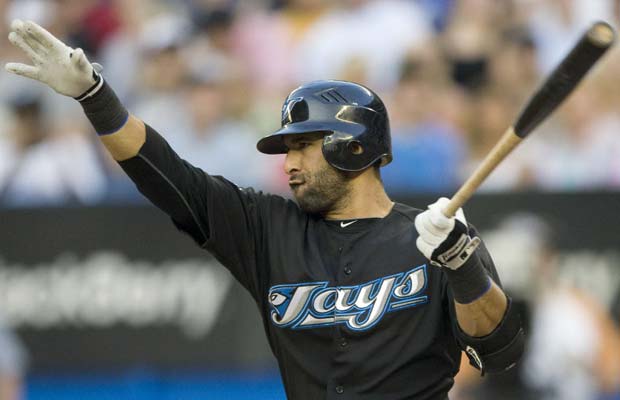 BB/K, Pujols has a batting eye that few can match. This year however, Pujols sits at 20/20 BB/K. Good numbers, but not superstar Pujols type numbers. Bautista on the other hand leads the way with 42 walks on the season and is on pace to break 150. With only 24 strike outs in 2011, Bautista has an almost 2/1 BB/K ratio. It looks like we have a new sherif in town. In 2010, Pujols was great with 103/76 BB/K while Bautista produced 100/116 BB/K. While the walks were evenly matched, Pujols was able to strike out fewer times. But that was then and this season reads a different story. Pujols has a .330 OBP and Bautista leads with a .492 OBP. Not even close. Verdict: round 3 goes to Bautista.
Batting Average
 Pujols has a lifetime .329 AVG while Bautista sits at .250. In 2010, Pujols had a .312 AVG while Bautista sat at .260. In 2011 though we have a seen a role reversal. Pujols has a .261 AVG while Bautista has a .342 AVG. Case closed again. Verdict: Bautista.
Stolen Bases
Neither player is a speed demon by any stretch. Bautista has 5 stolen bases on the year with 9 in 2010. Pujols had 14 last year but three this year. Neither gets on base with the thought of running and the stolen bases are negligible between the players. Pujols has stolen up to 16 bases in his career and stole 14 last year. But at the current pace, the numbers are fairly even. Pujols has stolen three bases without getting caught while Bautista has been 5 for 7 in his opportunities. Verdict: Draw.
Verdict
With 3 rounds going to Jose Bautista and 2 draws, this week’s competition was a no-brainer. Jose Bautista in 2011 has taken the crown of best hitter in baseball away from Albert Pujols. It almost seems like the players have somehow changed bodies. Jose Bautista has literally become the Albert Pujols of 2011, while Pujols himself has morphed into a lesser slugger in the mold of Bautista before 2010. Bautista is doing all the right things, by hitting for average, taking a lot of walks and hitting home runs with no end in sight. Pujols in contrast, has been a shell of himself this year. He is not able to do any of the things that Bautista has and will need to get himself moving if he hopes to catch up. As mentioned before, Pujols has great lineup protection and should be seeing many more fastballs and quality pitches to hit than Bautista. While Adam Lind was hot for a stretch, he is by no means Berkman or Holliday. Jose Bautista has had to produce with sub par players surrounding him in the batting order for most of the season. Pujols has also played 9 more games than Bautista, who missed games due to personal reasons and a neck strain. We shall see where these players are at come season’s end. Only time will tell. But until then, we are ready to crown Jose Bautista as the best hitter in baseball. Check the numbers, they don’t lie.
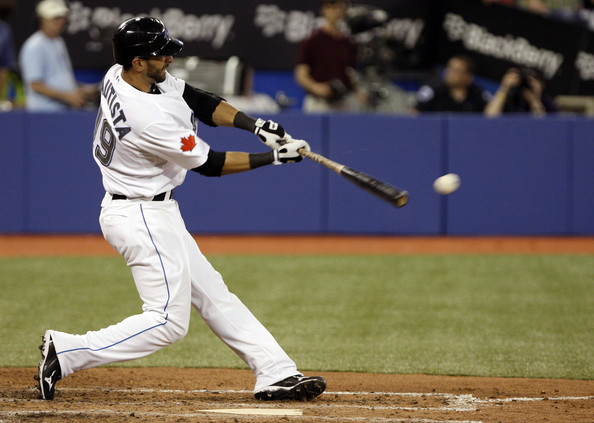
Please e-mail us at: MLBreports@gmail.com with any questions and feedback. You can follow us on Twitter and become a fan on Facebook . To subscribe to our website and have the daily Reports sent directly to your inbox , click here and follow the link at the top of our homepage.


 MLB Reports
You must be logged in to post a comment.