Why Triples Matter: Stocking Your Fantasy Team with Three-Baggers
Tuesday January 24th, 2012

Peter Stein (Fantasy Baseball Analyst – MLB reports): Many baseball fans are fascinated by triples, but it is certainly not a stat that people in standard Roto 5X5 fantasy baseball leagues pay any mind to. From an offensive standpoint, you are solely concerned with average, home runs, RBIs, and runs. Certainly triples contribute to a player’s offensive output, but by no means are they an asset to target in fantasy baseball. In reality, triples are often the product of a fortuitous bounce or carom and reflect more about a defensive player than the actual hitter. Nonetheless, triples are a rare occurrence and have a unique ability to excite the crowd and rally a team.
So, in fantasy baseball should we care about triples at all? On the surface the answer is no… but on a deeper level, it is actually yes. By no means is it wise to build a roster full of the league’s triples leaders. But a closer look at this stat can tell us a lot about a player.
In fantasy baseball and particularly in 5×5 Roto leagues, the goal is to find a player who can do it all: hit for average and power, produce and score runs, and steal bases. Not surprisingly, the league’s triples leaders are also at the top of the stolen bases leaderboard. It is the rare occurrence when you see a player like Curtis Granderson, who in 2011 showed his power with 41 home runs, as well as his speed with 10 triples and 25 stolen bases. The Granderson/Braun/Kemp/Ellsbury types of players are few and far between and are also on many championship rosters.
Before we go any further, let’s think about what it takes to hit a triple – namely a combination of power and speed. Triples are most commonly doubles, that are normally a double for a slower player. Therefore, if we look at a player like Brett Gardner with 19 doubles, 8 triples, and 9 home runs in 2011, it appears that his triple output has more to do with his speed and less about his power. For someone like Granderson with the 41 home runs and 26 doubles, it appears to be an equal combination of both. Let’s look for more examples of those types of players.
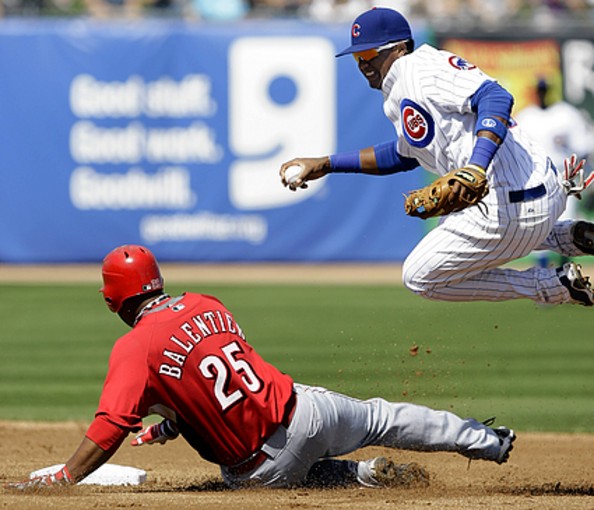
Take Michael Bourn: 61 steals, 10 triples and 2 home runs in 2011. Clearly, his double-digit triple output reflects his speed and surely not his power. When I scroll down the leaderboard and see Starlin Castro, (9 triples in 2011), light bulbs instantly begin to flash. Castro’s high triple out cannot be credited to speed alone (22 steals) because he still slugged 10 home runs and 36 doubles. At 21 years of age, Castro already has an amazing blend of power and speed, which is reflected by his ability to produce a three-base hit. By looking at Castro’s triples, we can tell that he posses this coveted five-category ability. You can only expect both his power and speed to increase and in my opinion, he has the ability to put up some Soriano-like home run/sb totals. Castro’s potential is most likely maxed out at 30/30, but this is due to the fact that he hits for average (.304 lifetime in 1137 at-bats) and is not likely to sacrifice for power. He could easily steal 40 bases and hit 30 home runs in the prime of his career.
The key is to look at the triple total for the young players who have yet to fully develop their power and speed. Triples can be a helpful future indicator of a player’s power and speed. For example, in his first full season in 2008, Adam Jones finished with 9 home runs, 7 triples and 10 stolen bases. The seven triples stand out, and although he possess great speed, the ten stolen bases indicate that he most likely did not rely solely on speed. His 9 home runs and 21 doubles demonstrate this his power also contributed to his seven three-baggers. The signs point to a player who has both speed and power. Sure enough, Adam Jones jumped to 19 home runs in 2009 and hit 25 home run with 12 stolen bases in 2011.
Triples shouldn’t even really be a concern for fantasy baseball owners, but can serve as a research aid of sorts. Look at the triples leaders and try to find the players who are not doing it on speed alone and have above average double and home run totals. If they are young and yet to reach their prime, all signs point to a player who has the ability to combine power and speed and develop into the coveted 5-category player.
 ***Today’s feature was prepared by our Fantasy Baseball Analyst, Peter Stein. We highly encourage you to leave your comments and feedback at the bottom of the page and share in the discussion with our readers. You can also follow Peter on Twitter (@peterWstein).***
Please e-mail us at: MLBreports@gmail.com with any questions and feedback. You can follow us on Twitter and become a fan onFacebook . To subscribe to our website and have the daily Reports sent directly to your inbox , click here and follow the link at the top of our homepage.

Posted on January 24, 2012, in Players: Fantasy Baseball Articles and tagged baseball, curtis granderson, fantasy baseball, michael bourn, mlb, starlin castro, triples. Bookmark the permalink. Comments Off on Why Triples Matter: Stocking Your Fantasy Team with Three-Baggers.


 MLB Reports


You must be logged in to post a comment.