Blog Archives

Ricky Romero: Aiming For 2013 As The #5 Starter
Like us on Facebook here
Tuesday March 19th, 2013
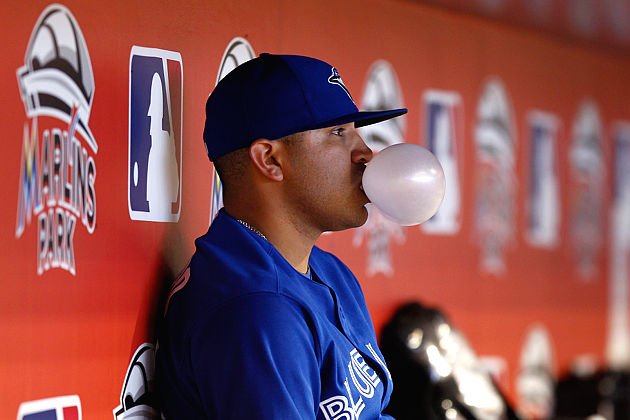
Ricky Romero led the American League with 105 Walks – and featured a brutal WHIP of 1.674 en route to a 9 – 14 campaign with a 5.77 ERA. This was only a year removed from being an ALL – Star in 2010 – and finishing 10th in AL CY Young Voting. The Blue Jays Left Handed Pitcher was 15 – 11, with a 2.92 ERA and a 1.138 WHIP. After the year, the team traded for Josh Johnson, former AL Cy Young winner Mark Buerhle – and reigning NL CY Young winner R.A. Dickey. Along with fellow returning Blue Jays Starter Brandon Morrow.
Bernie Olshansky (Baseball Writer): Follow @BernieOlshansky
At the beginning of 2012, Ricky Romero was solidified as the number one starter in a strong Toronto Blue Jays roster. In the previous three years of his career, he only had an ERA above 4.00 once (in his rookie season, 4.30), and had won more than 10 games every year.
2012 was an absolute disaster for Romero as he posted a sky-high 5.77 ERA and a 9 – 14 record. He had fans confused as to how such a solid pitcher could do a complete 180 and turn from an ace to an iffy back-of-the-rotation starter.
Romero is in a very interesting situation for 2013. The Blue Jays added two very formidable starters in Josh Johnson and Mark Buehrle when they acquired the two in a blockbuster trade with the Miami Marlins. The two former Marlins starters will help support the preexisting rotation consisting of Brandon Morrowand Romero..
Also in contention for a spot is Kyle Drabek, who has made starts over the past couple of years, but has never really stuck. Johnson, Buehrle, Morrow, and Alvarez will round out the top four spots, and Romero will most likely be the fifth starter for 2013.
Ricky Romero Interview:

MLB Pitchers and Walks: Flirting with Trouble
MLB reports: Walks can make you and walks can break you. That is our motto here at MLB reports. If there is one stat that I use more than others to measure a player’s performance, its BB…base on balls…walks. Recently, I featured an article on patient hitters and looked at the hitters that were the MLB leaders in walks. As part of this post, I reviewed how walks could potentially improve every facet of a hitter’s game and why a good batting eye is a high indicator of future success. Based on the response to that article, today we will look at the flip side, the MLB pitchers leader board in walks allowed.
In my opinion, there is not many things that are more frustrating about pitchers than those who give up a lot of walks. Pitchers that walk hitters tend to get themselves in all sorts of trouble and create pressure on themselves as well as their team. Defenses become on guard to avoid runners advancing and scoring, especially the catcher. A stolen base, sacrifice and passed ball is all take to turn a walk into a run. Pitchers that give up walks are often young hard-throwers who have not yet learned to command the ball. They are throwers who need to develop into pitchers. A veteran pitchers who throws soft and has no command will rarely survive in baseball (unless he has a lethal knuckleball, ala Tim Wakefield). Regardless of strike outs, walks in baseball often lead to pitchers beating themselves. I often tell young hurlers to trust in their stuff and led the hitters beat them. By walking hitters, a pitcher will simply beat himself in the long run. Looking at the MLB top 5 list of walks allowed, it is a who’s who list of potential, some success and plenty of frustration.
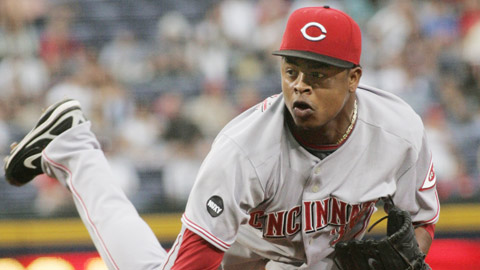
1) Edinson Volquez, Reds: 28
The man traded for Josh Hamilton has one of the best power arms in baseball. After undergoing Tommy John surgery (apparently a must-have these days to become a top pitcher for some reason), Volquez came back strong last year to reclaim his spot on the Reds pitching staff. With a 28/38 BB/K ratio this year 38 1/3 IP, Volquez despite his 3-1 record is showing why he has unsightly 5.63 ERA. With almost a hit allowed per inning, Volquez is playing with fire every game and needs to curb the walks to ultimately find long-term success. Check out Volquez’s breakout year in 2008. 17-6 record with a 3.21 ERA. Sparkling numbers on the surface. His 93/206 BB/K ratio that year shows that when Volquez wasn’t striking guys out, he was loading them up on base. In a hitter’s park like Cincinnati, numbers like that simply will not do. Volquez has a lifetime 4.47 ERA and 1.49 WHIP. At 27 years of age, he should be entering his prime year. But Volquez is sitting on top of our leader board for a reason: he walks the most hitters compared to any other pitcher in baseball. That is a high feat and one that he should not be proud of. A top pitcher can walk maybe 50 hitters a year at most to stay successful. By walking 93 in 2008, Volquez showed that even in a breakout year he never completely figured it out. Luck can only be on a person’s side so long and if Volquez does not transition better to being a pitcher, the sub-4.00 ERA and 1.50 WHIP will result unfulfilled potential and mediocrity. The best pitchers in my opinion have figured out that sacrificing strikeouts for ground ball outs can be just as effective and less taxing on their arms and walk rates. This realization has not occurred yet to Volquez, but that will end up being the difference from becoming the next Pedro Martinez or Ramon Martinez, to a certain degree.

2) Jonathan Sanchez, Giants: 26
The poster child for walks, Jonathan Sanchez is victim #2 on our list to high walk totals. After becoming a full-time starter in 2008, Sanchez had his breakout year last year with the Giants. 13-9 record with a 3.07 ERA and 1.23 WHIP are solid numbers. His 96/205 BB/K ratio though left a lot to be desired. Almost a mirror image of Volquez from 2008 if you compare the numbers. This year, Sanchez sits at 2-2 with a 3.45 ERA, 1.45 WHIP and 26/47 BB/K ratio in 38 IP. The best starting pitchers keep their WHIPs down below 1.20 and at most sit at 1.25. Anything from 1.30 and above is considered a high WHIP, with 1.50 being unacceptable. Despite his success in 2010, Sanchez still has a 1.38 career WHIP. When people ask me why trade rumors consistently persist around Sanchez despite being 28 and in his prime, I simply point to the walk rate. Granted he has unbelievable stuff and is literally untouchable when he is on (as all of the pitchers on this list are). But one good outing for every three bad outings don’t cut it. Sanchez throws hard and can successfully strikeout over 200 batters per season if he chooses to. But with his high walk rate, he will likely suffer the same fate as Volquez. Men on base can translate into runs allowed, which is unhealthy for a team’s won-loss record and a pitcher’s ERA. Until Sanchez can cut down on those walks, I will continue to simply see him as a middle-of-the-road pitcher with unfulfilled potential. If he can cut his walk rate in half, I could see 20 wins in his future.

3) Kyle Drabek, Jays: 25
Another Tommy John surgery survivor, Drabek is the 2nd of 3 pitchers on this list that lead baseball in walks allowed and had the procedure in their careers. Is there a correlation? We will need to find out one day in another post perhaps. I could see there being a link between the motion that pitchers use to high walk rates and leading to Tommy John surgery. An interesting little sidenote. But I digress. Drabek is the only rookie on this list, as all the other pitchers have experience in the majors. None of the players on the list are vets yet, although Liriano and Volquez are starting to get there. In his first full major league campaign, Drabek has a 2-2 record in 2011 with a 4.50 ERA, unsightly 1.63 WHIP and 25/28 BB/K ratio. With almost a hit allowed per inning as well, Drabek is loading up the bases far too often in getting burnt. In my estimation, I see Drabek differing from the first two players as follows. Volquez is wild and needs to learn control. Sanchez is occasionally wild but often tries to be too perfect in making his pitches and misses his spots. Drabek quite often is trying be perfect and misses his spots, but otherwise has good control. Drabek, like Sanchez, simply need to trust their stuff and just go after the hitters. With nearly un-hittable stuff, Drabek and Sanchez would find they will beat hitters more often than not. But a walk every inning a half will not cut it in the majors. Not if Drabek is to fulfill his potential and become the Jays ace one day. The comparisons between father and son will always continue for Drabek until he makes his own way in the world and I will take a brief look at Doug’s numbers. The elder Drabek never walked more than 69 hitters in a season and finished with a career WHIP of 1.243, with 155 wins and 3.73 ERA. He also finished with 1594 career strikeouts, with a season high 177 in his final season in Pittsburgh in 1992. Kyle has the potential to succeed his dad, as son as better stuff than his dad and the potential for far more punch outs than his dad ever did. If Drabek Jr. will figure that out one day, the Jays will have their ace for the next decade guaranteed.
T4) Francisco Liriano, Twins: 24
The fourth member of our list of frustration, Liriano proved this week how utterly frustrating he can be. Consider this: Liriano this week threw a no-hitter against the White Sox. Perhaps a no-hitter by the records, but the rest of his numbers were by no means special. Liriano threw almost as many balls as strikes, finishing with 6 walks and only 2 strike outs. These numbers translate to little or no control, but somehow not giving up a hit in otherwise poor pitching performance. The no-hitter actually is in line with Liriano’s start to the season. 2-4 record, 6.61 ERA, 1.56 WHIP, 24/20 BB/K ratio in 2011. Not only is Liriano now not striking guys out, but he is walking hitters at an astronomical rate. Liriano had one incredible partial season: In 2006 he had a 2.16 ERA, 1.00 WHIP, 32/144 BB/SO ratio in 121 IP. Superstar numbers and an ace in the making. Since then, health issues and poor performance have plagued the hurler for the most part. The 3rd Tommy John survivor on our list, Liriano appears to have the same Volquez type control issues. Last season I thought that we had seen a rebound from Liriano. 14-10 record, 3.62 ERA, 1.26 WHIP and 58/201 BB/SO ratio. Maybe not ace numbers, but very solid pitching numbers. Believe it or not, Liriano is on pace for approximately 150 walks this season. Just when he looked like he might be coming around, Liriano regresses. Then he goes out and throws a no-hitter and nobody knows what to think. But I will tell you this much, walking hitters is a disaster…while walks and few strike outs means a complete implosion. I suspect that there may be more to this story than meets the eye, as Liriano may be having health issues that is leading to his poor numbers. Otherwise, at 27 years of age, Liriano may be continuing his hurler mode rather than becoming a fine-tuned pitcher as is preached by the Twins organization. The potential is there, but until we know his health situation is better, all bets are off.
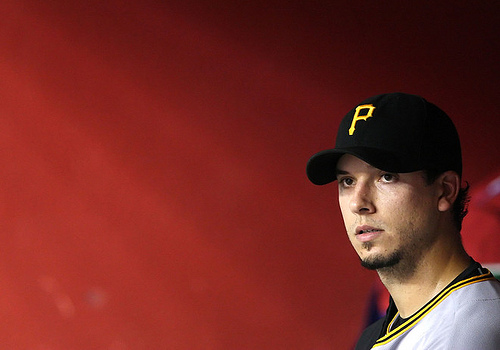
T4) Charlie Morton, Pirates: 24
The last member of our group may not be a Tommy John survivor, but he is a 27 something year old pitcher (only Drabek is the youngster at 23). Morton is also not on his original team, as he has been traded together with all the members of our list except Sanchez. It is not a coincidence in my estimation that young hurlers with control issues would be moved by a major league team. Liriano, Volquez and Morton were all seen as expandable by their respective teams in order to obtain needed talent. Sanchez has been mentioned in trade whispers for years now and Drabek was moved, but only because the Jays demanded him in the Halladay swap. Morton was moved in the McLouth deal, with the Braves moving an extra arm and the Pirates stocking up on much-needed pitching talent. After previous frustrating campaigns, Morton appears to finally be coming around this year. His 2011 record sits at 4-1 with a sparkling 3.13 ERA. He is allowed less than a hit per inning, which is promising. His 24/24 BB/K ratio means that Morton is striking out as many batters as he is walking. The 1.41 WHIP is the issue with Morton, as it is with all the hurlers on this list. Morton has a career 1.57 WHIP, so he is improving in the category. Once he is able to put it together, Morton is able to get major league hitters out. He may not have the stuff of the other members of this list, but he apparently knows how to get major league hitters out. While not an ace, developing into a solid #2 or #3 starter could be in his future. If Morton could limit his walks to approximately 50 in a season, I would love to see what he could do over the course of that year. I see potential and improvements to warrant hope. For a pitcher that used to give up over a hit per inning, those numbers are vastly improved. Time will tell if the rest of his numbers will fall in line.
With young hurlers that have little control, teams do not often know what they are ultimately going to have. In the time that it takes for a pitcher to learn control, the issue becomes whether a pitcher will be able to get major league hitters out by going for ground ball outs and fly outs while reducing walk totals. Roy Halladay is the poster child for high strike outs and low walks. With ERAs in the low 2.00s, WHIPs in the low 1.00s, 20 wins consistently, Halladay is everything that a pitcher strives to be. But then take a pitchers like Andy Sonnanstine. One of my faves on the Rays, Sonnanstine rarely walks hitters. But without striking out many hitters either, Sonnanstine unfortunately does not have the stuff to get major league hitters out on a consistent basis and gets hit hard often. As a result, Sonnanstine is constantly shuttling between the rotation, bullpen and minors. If you take Sonnanstine’s control and the stuff of any of the pitchers on this list, you would have Roy Halladay. Perhaps a touch oversimplified, but you get my message. For pitchers like Jonathan Sanchez and Kyle Drabek, my advice is just go after and trust your stuff, good things will happen. For Edinson Volquez and Francisco Liriano, I think a change in mechanics and approach is in order. I see too much wildness with little change in the future. If these pitchers do not change their walking ways, the potential that each has will never be fulfilled and talent will end up being wasted. With the emphasis in baseball on strike outs, pitchers like Volquez and Liriano fall into the trap in concentrating on punch outs and disregarding the finer points of the game. The emphasis is on pitching, not throwing: I hope these guys understand that one day. Unfulfilled potential at the end of the day is just failure in my book. Remember that the next time when you watch these hurlers flirting with trouble in their next starts.
Please e-mail us at: MLBreports@gmail.com with any questions and feedback. You can follow us on Twitter and become a fan on Facebook . To subscribe to our website and have the daily Reports sent directly to your inbox , click here and follow the link at the top of our homepage.

Patient Hitters: The Leaders in Walks

MLB reports: As many of you know from my past articles and tweets, the one quality I look for the most in hitters is patience: the ability to take walks. The art of the base on balls was exemplified somewhat in the “moneyball” Oakland approach and has been adopted by the Red Sox team in particular, among others. People often ask me why I value hitters that take walks so highly. Very simply, walks in my mind lead often to the overall development of every facet of a hitters game. A hitter that has good judgement of the strike zone and take walks should get on base at a high rate. A hitter that takes many walks is more likely to judge better pitches to hit, which should increase their number of hits and home runs correspondingly. When I used to play fantasy baseball, I often looked for batters with high walk totals in filling out my rosters. These hitters would win championships for me, as they do often for baseball teams in real life.
Patient hitters have a high value in baseball, this has become a fact of life. Putting this theory to the test, let’s take a look at which batters sit among the leader board in walks as of today. It will be interesting to see which of these players are considered top players, historically and coming into their own as of today. Has the number of walks taken this year helped each player in other statistical categories? Are each of these players better hitters for having many walks? The results may surprise you.
1st: Jose Bautista, Toronto Blue Jays (19)
 Last year 100 walks went hand-in-hand with a league leading 54 home runs. This year, Bautista leads the league with 19 walks and 8 home runs. For a man who hit .260 last year, the high walk has remained while the average has jumped to a league leading .364. Interesting to note, none of Batista’s walks have been intentional. Bautista for me is the poster boy of how patience and power are inter-twined. You almost cannot have one without the other. For anyone that doubts the value of walks, go look up Bautista’s stats again…they will astound you.
T-2nd: Bobby Abreu, Los Angeles Angels of Anaheim (18)
Bobby Abreu, along with Youkilis, Adam Dunn and Swisher, is a resident in the patience club. With 1,360 career walks, Abreu always brings on-base capabilities for any team he plays for. Long seen as having declining power, Abreu still hit a decent 20 home runs last year. Combined with his 87 walks, Abreu managed a .352 OBP despite a .255 AVG. This year, with a puny one home run and .244 AVG, Abreu is sitting at an unacceptable .329 SLG. But with a .388 OBP, the 37-year-old Abreu still has some value. In his prime, Abreu showed that 100+ walks and a .300+ AVG could lead to 40+ home runs in a season. But Abreu, the elder of the list, only has walks to show for any value left in his tank and is likely dependant on those walks for still receiving any playing time at all. The end is near, but the walks continue.
T-2nd: Joey Votto, Cincinatti Reds (18)
As a rookie, I read that Dusty Baker told Joey Votto that he should becoming more free-swinging and less patient to develop as a hitter. Fortunately for Votto and all Reds fans, the Canadian ignored the advice and continued to grow as a hitter….his way. Last year Votto had 91 walks, which translated to 37 home runs and a league leading .400 OBP and .600 SLG. Hitting .324 along the way, Votto was intentionally walked eight times. Votto fits the bill perfectly- a hitter that picks his spots, waits for the right pitches to hit and avoids the bad ones to get on base. This year, votto has 18 walks to only 11 strike outs. The knock on some patient hitters is that they take too many called third strikes and often hit for low averages. As part of the core of this top list, Votto is able to not only hit many home runs but keep his average steady to high in the process. Many experts see Votto as having surpassed Albert Pujols as the king of the NL. Based on his numbers-to-date, I have a hard time arguing. Votto’s bread and butter has been his eye at the plate. The 2010 MVP and runner-up 2008 ROY can thank his walks for much of his success in baseball.
4th: Jonny Gomes, Cincinatti Reds (17)
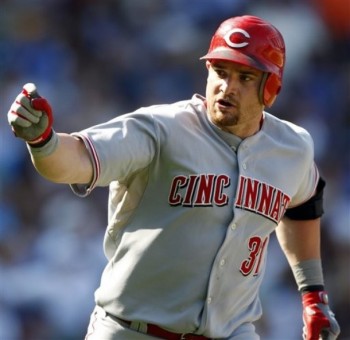 The fourth member of our list is the only real head scratcher in the bunch. While all the other listed hitters are known “walkers”, Gomes has basically come out of nowhere to join the group this year. With a career high of 61 walks in 2006 being far and away his highest season total, few people envisioned Jonny Gomes learning true patience at the age of 30. Perhaps spending time with Votto has helped his transition. But then, his .211 AVG would seem to indicate that he might not be fully paying attention in emulating Votto. At a season total of six home runs, Gomes is on pace to set a career high of 35 home runs. But looking at the full numbers, Gomes is the outlier. Hitting in the standard Nick Swisher mold, Gomes has compensated base hits for walks. With his 18 walks has come 23 strikeouts…which shows that he is missing as many pitches as he is taking. It is not a bad thing that Gomes is taking many walks, but unfortunately he is swinging for the fences and striking out at a Rob Deer frequency with too few base hits. Gomes may continue the walks, but without a steadier number of base hits to match, he may not be as productive as one may think.
T-5th: Daric Barton, Oakland Athletics (16)
Seemingly playing forever, the 25-year-old is entering his 5th season in the bigs. With a .368 career OBP and 110 walks last year (leading the AL), Barton is patience personified. The only knock on Barton has been his low batting average and power. 2011 has done nothing to calm those fears, as Barton is hitting .205 with zero home runs. Along with Gomes, Barton is sacrificing base hits for walks, but not seeing the tangible results that should come along with them. Well…at least Gomes is hitting home runs, I really can’t see what value Barton has other than walks. With ten home runs, Barton is slowly becoming another Travis Buck. As Barton continues to keep first base warm for Chris Carter, I am sad to see that his patience at the plate never translated to greater things for him offensively. Judging on his 17/20 BB/K ratio, Barton clearly is either not patient enough or judging the right pitches to hit. Based on this slow start, it appears the one-time A’s prospect has graduated into a full-fledged suspect.
T-5th: Miguel Cabrera, Detroit Tigers (16)
 One of my favorite hitters in the game, I always wondered what levels he could reach if he could take more walks. Always known for a solid average and home run bat, the answer to my question started to be answered last year. Cabrera set a career high with 89 walks last year and had correspondingly a career high 38 home runs. This year, with a 17/12 BB/K ratio, Cabrera has already five home runs, to go with his .338 AVG, .458 OBP and .610 SLG. These are really…really…really good numbers. Finishing second last year in MVP, the re-born Cabrera has become everything I could have imagined as a hitter. Together with Bautista in the AL and Joey Votto in NL, we are looking at three of the most complete hitters in the game. Taking many walks, hitting many home runs, hitting for a high average and not striking out a ton. Patience at the plate, waiting for the right pitches to hit and taking advantage of those pitches. Hitting perfection.
T-5th: Kevin Youkilis, Boston Red Sox (16)
No conversation on walks is complete without including the Greek God of Walks himself, Kevin Youkilis. A .292 career hitter with a lifetime .394 OBP and .497 SLG, Youk fit the mold of the perfect hitter as I discussed above. But something has happened to Youk in 2011. Despite his high walks and decent number of home runs (4), his average sits at .222. Considering that Youk has hit .300+ the last three seasons, I do not expect a huge regression at the age of 32. As long as he stays healthy, Youk should be at .290, .390 and 25 home runs. That’s just how steady Youk is. But given his career low average this year, I actually suspect there may be an injury concern. I do not see Youk turning into Jonny Gomes overnight. Everything seems to even out in the long run and over the course of the season, the real Youk should emerge. Walks will always be there, but the rest of the game should follow as well. But even if he remains slumping, as Bobby Abreu and Daric Barton have shown, at least taking walks brings some contribution to the table. But unlike those two, at least Youk can still swing a power stick. Walks truly begin and end with Youk.
Thank you for reading today’s feature on walks and the hitters who take them. While we all have theories on the subject, think of all the best all around hitters of all time and take a look at their walk totals. While there may have been many home run kings with low averages or hit kings with poor power, take a look at the best all around hitters and see how many times they walked. Then tell me what you think about the value of the combination of power and patience and if you now subscribe to this theory. I certainly hope that you do.

Please e-mail us at: MLBreports@gmail.com with any questions and feedback. You can follow us on Twitter and become a fan on Facebook . To subscribe to our website and have the daily Reports sent directly to your inbox , click here and follow the link at the top of our homepage.


 MLB Reports
You must be logged in to post a comment.