Blog Archives

Week 4 – MLB 2012 Season: Fantasy Baseball Report
Monday April 30th, 2012
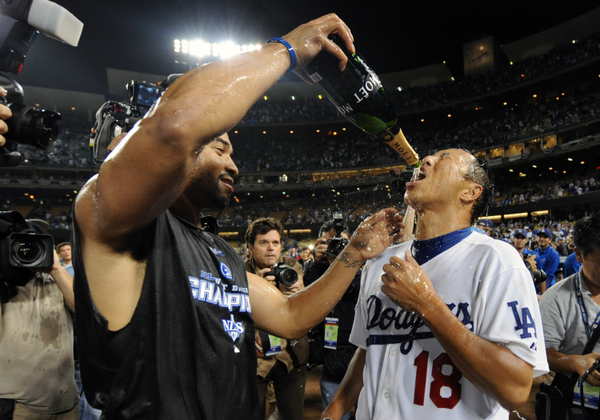
Peter Stein (Fantasy Baseball Analyst – MLB reports): This offseason, I told myself (and others) to stay away from names like Matt Kemp and Josh Hamilton. It wasn’t even a question. There was no way Kemp could repeat his 2011 season (and his .380 BAPIP). But he appears to be on his way to surpassing last year and making a hard push towards the triple crown. Josh Hamilton, who I also intentionally stayed away from, simply cannot be counted on to play 150 games. Hamilton has had a Kemp-like start to the season and is also single-handedly carrying fantasy teams throughout the first month of the season. However, he did leave Sunday’s game with back tightness (out Monday as well) and this could be a start of a trend that we have seen in seasons past.
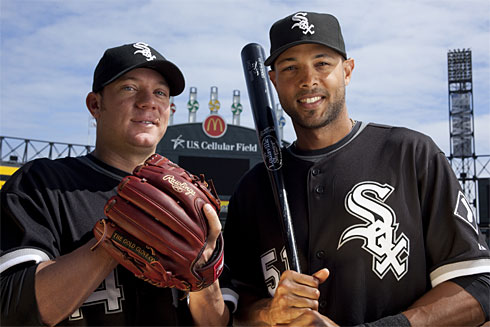
On the pitching side, Jake Peavy was another guy who fell in the same category as Hamilton, having only made 39 starts in his 2.5 seasons with the White Sox. Furthermore, the results were poor in those starts as he transitioned from a pitcher friendly park in baseball’s weakest hitting division to the American League. But even more of an afterthought in addition to the health concerns, was Peavy’s transition from the NL West and the most pitcher friendly park to the hitting friendly confines of U.S. Cellular Field. However, Peavy looks like the Peavy of old and is pitching like a number one type pitcher again. But will that last? Are you prepared to take that gamble? Read the rest of this entry

Week 3 – MLB 2012 Season: Sell High and Buy Low Candidates in Fantasy Baseball
Monday April 23rd, 2012

Peter Stein (Fantasy Baseball Analyst – MLB reports): The name of the game in fantasy baseball is sell high and buy low. This is the best method to improve your team. But it takes careful consideration and analysis to determine who is legit and who is fluking. As we are approximately 16 games through the season, remember that you are playing for a 162 games of stats and thus we are only 10% through the 2012 season. Trust the preseason predictions, and make an upgrade whenever possible. Therefore, in this week’s fantasy focus, I highlight which guys to target and which guys to sell.
Sell High:
Josh Hamilton is currently playing t-ball (.418/7/17/1). We have seen Hamilton go on stretches like this before, but we know his expected 162 game season still places him outside of the top-ten. Furthermore, we simply cannot expect a full 162 games out of Hamilton. Perhaps he was undervalued heading into this year, and he is playing for a contract, but his hot start has the potential to net you a safer option in one of the buy low candidates listed below.
David Freese I talked about last week, because he will not keep up his current pace (.333/3/15) and has plenty of name recognition after last October. Furthermore, he is prone to prolonged absences due to injury and offers nothing in the stolen base category. He is certainly an above average fantasy third baseman, but you might as well try to capitalize at his peak value. Read the rest of this entry

It is Amazing How People Overreact to a Small Statistical Sample Size
Tuesday April 17th, 2012
Peter Stein (Fantasy Baseball Analyst – MLB reports): The opening of the 2012 baseball season remains interesting and unpredictable. Although we are dealing with such a small sample size and people tend to overreact (approximately 10 games), there a lot of early season performances to that deserved to be examined a little closer.
Before we go making Matt Kemp comparisons, Chris Young is clearly benefiting from a new approach at the plate. Young has always displayed the ability to hit for great power and speed, but just lacked in the average department. However, he made significant mechanical adjustments in the offseason and his new approach has been successful since the spring, when he batted .400. His .405/5/13/2 stat line is clearly unsustainable, but lets not forget he is only 28 years of age and might finally be figuring out how to consistently put it together. What might be most telling of his improvement is his 4:5 strikeout to walk total after 10 games, from a guy who has throughout his career averaged a ratio of 3.3:7.4. This could be the year that the average is .270-280 to accompany his 30/30 potential, making him a top-level talent. Read the rest of this entry

Batting Average and Earned Run Average: Are They Still Useful Baseball Stats?
Wednesday January 18th, 2012

Peter Stein (Fantasy Baseball Analyst – MLB reports): Just as baseball cards have become outdated, so too are the statistics that many of us memorized on the backs of those same cards as kids. The statistics that I am referring to are the generic stats used to measure a player’s success, particularly batting average for hitters and earned run average (ERA) for pitchers. Sabermetrics has taught us that there are better methods to more measure a player’s worth or success on the diamond. Far too often, numbers like ERA or batting average are skewed and do not accurately depict a player’s true level of skill.
However, batting average and ERA are statistics that are fixtures in the game, particularly in fantasy baseball. They are used to define players and probably will continue to do so. For those of us in standard 5X5 Roto Leagues, batting average and ERA account for two essential categories.
In 500 at bats, the difference between a .250 and .300 hitter is 25 hits. With six months in a season (approximately 24 weeks), that comes to about 1 hit per week. I repeat, one hit per week! I think I first heard this statistic from Major League I. Remember the old catcher with the bad knees, Jake Taylor?
If you have ever watched baseball, you know how much luck can play a factor. A guy can hit the ball on the screws four times- yet make four outs… but just as easily, getting three hits without hitting the ball out of the infield. Likewise, a pitcher’s ERA can be entirely skewed based on circumstances beyond their control. Therefore, I introduce to you two sabermetric statistics that are key in determining a player’s “true” batting average and ERA.
According to Fangraphs, Fielding Independent Pitching (FIP) “measures what a player’s ERA should have looked like over a give time period, assuming that performance on balls in play and timing were league average.”
The equation for FIP: ((13*HR)+(3*(BB+HBP-IBB))-(2*K))/IP + constant
XFIP takes it even a step further by replacing a pitcher’s homerun rate with the league average (10.6% HR/FB), since this statistic is subject to high volatility.
Considering the above, Fielding Independent Pitching and Expected Fielding Independent Pitching are great determinants for what a pitcher’s ERA should be. It can tell you if a player is overachieving or perhaps pitching better than their ERA might indicate. This is the key to fantasy baseball. Target the guys who have FIP’s lower than their actual ERA and sell high on the pitcher who’s FIP is much higher than their actual ERA. By no means is the stat perfect, but it certainly gives you insight into a player’s performance and is a better indicator of future success than ERA alone.
For batters, the key statistic in determining batting average is Batting Average on Balls in Play (BABIP), which according to Fangraphs “While typically around 30% of all balls in play fall for hits, there are three main variables that can affect BABIP rates for individual players: defense, luck, and changes in talent level.”
The average BABIP for players is between .290 and .310, although some hitters can maintain a much higher level. For example, Ichiro Suzuki has maintained a career BABIP of .351, well above the league average. Therefore, you can look at a player’s BABIP to see how well they are actually doing at the plate. Buy low on a guy whose BAPIP is thirty points lower than his career total. Chances are his batting average is suffering and he is a good buy-low candidate. The lower BAPIP indicates that has a victim of bad luck. Likewise, the guy who is sporting a .400 BAPIP simply cannot maintain that level and will see a major regression to the mean. In this case: sell, sell, sell!
A perfect BAPIP example is Austin Jackson, who exploded onto the fantasy scene as a rookie in 2010. With a .293 batting average and good speed, he was an attractive young player with a rising stock. However, his.293 batting average in 2010 coincided with a .396 BABIP. We know Jackson is not Ichiro (.351 BAPIP) and therefore we had to expect a major regression in 2011. Sure enough, his BAPIP dropped to .340 (still well above the league average) and as result, he finished the season with a .249 average. Therefore, I would not touch Jackson with a ten-foot pole in most leagues, at least not until he can cut down his strikeout rates and put the ball in play on a more consistent basis. Although he has proven he can produce a hit more often than most when he makes contact, he simply does not make enough contact at this point in his career to be a .300 hitter.
The young guns are generally the guys who are most difficult to read. With the veterans, you at least have their career BAPIP to use as a reference. However, do not be afraid to look at the minor league stats, which usually prove to be solid enough indicators. At the same time, never take too much stock in minor league numbers and make a hitter prove himself at the major league level.
Overall, stats like FIP and BAPIP are really just cheats for your fantasy baseball league. Batting average and ERA are statistics that are so deep-rooted that they will most likely be used forever to define a player’s success and as a result, will continue to be used in fantasy baseball. However, do not look at ERA and batting average to value a player and trying to predict their future ERA and batting average. FIP and BAPIP give you a more accurate story and are better indicators for future success- by at least attempting to eliminate the many variables that exist in the wonderful game of baseball.

 ***Today’s feature was prepared by our Fantasy Baseball Analyst, Peter Stein. We highly encourage you to leave your comments and feedback at the bottom of the page and share in the discussion with our readers. You can also follow Peter on Twitter (@peterWstein).***
Please e-mail us at: MLBreports@gmail.com with any questions and feedback. You can follow us on Twitter and become a fan onFacebook . To subscribe to our website and have the daily Reports sent directly to your inbox , click here and follow the link at the top of our homepage.

Wins Above Replacement (WAR): Analyzing MLB Statistics using Sabermetrics
Wednesday January 11th, 2012
Peter Stein (Fantasy Baseball Analyst – MLB reports): Although WAR (Wins Above Replacement) is not the best of the sabermetric stats for fantasy baseball purposes, it has certainly transformed the way in which we can truly understand a given major league baseball player’s contribution (or lack there of) to his team. WAR attempts to epitomize a player’s total value in one sole statistic, taking into account both the offensive and defensive aspects of the game. FanGraphs (the sabermetrics bible) aptly describes the essence of WAR: “If this player got injured and their team had to replace them with a minor leaguer or someone from their bench, how much value would the team be losing.” A player is measured in “Wins” for a season (i.e. 3.4), while an average full-time player is worth 2 wins and a replacement player represents 0 wins. Furthermore an average staring pitcher is worth 2.0 WAR, while 1.0 WAR represents a strong season for a relief pitcher.
Here are the 2011 leaders in WAR:
Batting
-
Jacoby Ellsbury – 9.4
-
Matt Kemp – 8.7
-
Jose Bautista – 8.3
-
Dustin Pedroia – 8.0
-
Ryan Braun – 7.8
-
Ian Kinsler – 7.7
-
Miguel Cabrera – 7.3
-
Alex Gordon 6.9
-
Joey Votto 6.9
Pitching
-
Roy Halladay – 8.2
-
C.C. Sabathia – 7.1
-
Justin Verlander – 7.0
-
Clayton Kershaw – 6.8
-
Cliff Lee – 6.7
-
C.J. Wilson – 6.4
-
Jered Weaver – 5.9
-
Doug Fister – 5.6
-
Felix Hernandez – 5.6
The statistic actually defines a player’s value, something that MVP (Most Valuable Players) voters should perhaps consider come each October. For batters, the stat itself is calculated by taking into account two stats: wRAA (Weighted Runs Above Average) and UZR (Ultimate Zone Rating), which represent a batter’s offensive and defensive values, respectively. Pitching WAR replaces these two sabermetric stats with FIP (Fielding Independent Pitching), a stat that normalizes ERA for the “uncontrollable,” in conjunction with numbers of innings pitched. The Uncontrollable refers to what happens after the ball leaves the pitcher’s hand, because obviously pitchers have almost no control over the balls that are in play. They are ultimately at the mercy of their defense.
Fangraphs site the formula for FIP as the following:
FIP: ((13*HR)+(3*(BB+HBP-IBB))-(2*K))/IP + constant
If you are unfamiliar with Sabermetrics and WAR, this should feel like a mix between learning a foreign language and a calculus problem. However, don’t let this intimidate you. Spend some time on FanGraphs (It’s okay take it slowly) and it will change the way in which you think about the game of baseball. Please note that Baseball Reference has a slightly different formula/method to calculate WAR.
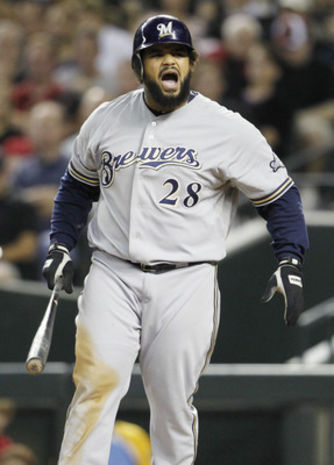 The beauty of WAR, however, is that it not only takes in account a player’s defensive skills (using UZR), but also the difficulty of the position. Therefore, someone like Dustin Pedroia at second base is significantly more valuable than a slugging Prince Fielder, at the first base position where power and production is demanded. Perhaps that is why Fielder is still fielding offers and has not landed a contract within his desired range. Not too shabby of statistic for a General Manager, huh? My hope is that this analysis paints the complexity of WAR and the many factors used to determine the number of wins that a player is ultimately worth to his team.
Let it be clear that by no means is WAR perfect. From a rather cynical standpoint, the very philosophy of WAR, which is calculated with so many components, professes that you cannot use one sole determinant to measure a player’s value. Furthermore, the positional adjustment numbers are the most arbitrary difficult to calculate. Can we really determine that a Center Fielder, due to difficulty to play the position itself, is worth 1.5 more wins than a first baseman? It is also difficult to determine the UZR for a first baseman, a position in which success is defined less by range and more by the ability to field throws. Paul Konerko certainly does not have great range, but he is universally regarded as one of the league’s top defensive first baseman, most likely saving Alexei Ramirez a handful of errors each season. Likewise, you cannot measure range for catchers, which use the fielding component of Stolen Base Runs Saved (rSB). We also know that much of catcher’s true value is related to his ability to call a smart game (which cannot be measured by any given statistic).
However, from a fantasy perspective, we do not care about defense, and therefore wRAA is a more accurate indicator of offensive output. FIP can be used as well. For example, if a pitcher’s FIP indicates that his defense is frequently letting him down, and said pitcher joins a top rated defensive team; you have acquired knowledge about a player’s ability not represented by the generic stats out there. This is how you will earn surplus value and land the “surprises”, the “bounce-back” players, and avoid the “busts”.
I admit, when I first familiarized myself with FanGraphs, I felt like I was cheating in my fantasy baseball leagues. However, after joining more competitive leagues and with sabermetrics entering the mainstream, I have learned that this only provides a slight advantage. Just as it holds true for every other aspect of life, it is impossible to predict the future in the world of baseball. However, in a game of numbers- only the slightest advantage is needed to set your team apart from the competition.
WAR is a one of a kind stat. It helps us more thoroughly examine a player’s worth, especially when compared to their salary. Ultimately, the stat serves as a good building block to work back from to understand the intricacies and essence of sabermetrics.

***Today’s feature was prepared by our Fantasy Baseball Analyst, Peter Stein. We highly encourage you to leave your comments and feedback at the bottom of the page and share in the discussion with our readers. You can also follow Peter on Twitter (@peterWstein).***
Please e-mail us at: MLBreports@gmail.com with any questions and feedback. You can follow us on Twitter and become a fan onFacebook . To subscribe to our website and have the daily Reports sent directly to your inbox , click here and follow the link at the top of our homepage.


 MLB Reports


You must be logged in to post a comment.