Blog Archives

Mike Maddux: The Next Great MLB Manager and the End of the Rangers
Saturday November 5, 2011

MLB reports – Jonathan Hacohen: I rarely get excited about coaches in the game. Not for the reasons that you may think. Many coaches are great at their craft. But most MLB coaches work behind the scenes and are rarely heard from or spoken to. In the MLB revolving door game, it seems that many players, as well as coaches, are seen be teams as interchangeable commodities. When teams hit slumps or fail to meet expectations, it is easier to change the coach(es)/manager than it is to replace twenty-five players on the roster. So when a coach stands out and gets me excited, you know that he is a game-changer in my opinion. Two such coaches currently exist in the ranks. Both are pitching coaches and both are being reviewed for changes in employment. The first is Dave Duncan in St. Louis and the second is Mike Maddux in Texas.
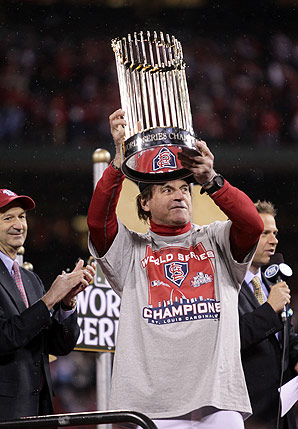 With the retirement of Tony La Russa in St. Louis, many have wondered as to the future of his former pitching coach, Dave Duncan. Widely seen as one of the best in the business, Duncan’s control and shaping of his pitching staff is seen as one of the overriding factors in helping Tony La Russa achieve his success in the game. No Duncan = inferior pitching = no championships. This is the man who took Jeff Weaver and Joel Pineiro and made them into the second coming of Cy Young. Ok…so many Duncan isn’t such an effective miracle worker. But the man is damn good at what he does and all else being equal, there would be 29 other teams that would love to discuss employment if he was available. But rather than seek a managerial position, Duncan- who start coaching in the late 1970s with Cleveland, has indicated that he will be honoring his contract and remain the pitching coach in St. Louis. The man clearly knows his strengths and his goals in the game. For the future manager of St. Louis, he will be inheriting a right-hand man to guide his pitchers like no others.
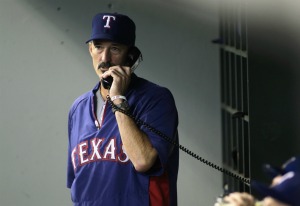
Well…with the exception of one man perhaps. While Duncan is seen as one of the game’s greatest pitching coaches of all time- Mike Maddux has grown into the being the next best coach, if not “the” best. In his 9 seasons as pitching coach, Maddux has successfully transformed the Brewers pitching staff (during his time in Milwaukee) into one of the best in the game. From there, Maddux has taken a Rangers squad that has been known seemingly forever as being all bats and no arms. The Rangers have had one of the worst statistical pitching staffs for much of its stay in Texas. Maddux has successfully lowered the team ERA every year in the past three years and has helped transform the Rangers pitchers into stars. C.J. has gone from middle reliever/occasional closer into the staff ace. Alexi Ogando excelled in the rotation, as has Neftali Feliz as closer. Some may argue that the Rangers have more pitching talent in the history of organization. That may be true on many levels, but the team still plays half of its games in one of the most dangerous hitters’ ballparks in baseball. By working his magic with the Rangers pitching staff, considering its home ballpark, Mike Maddux is a miracle worker to me.
It is my understanding that Mike Maddux is the highest, or one of the highest paid pitching coaches in the game. To get him to leave his status in Texas, he would need to be offered a strong position that presented a challenging and rewarding opportunity in the game. As the Chicago Cubs and Boston Red Sox both come calling this week, Mike Maddux will likely be choosing soon whether he is ready to take on the top leadership on the field of one of the two top franchises in the game. The Rangers have already granted Maddux permission, as Nolan Ryan and company do not wish to stand in the way of Mike Maddux’s success. With Ron Washington leading the Rangers to two straight World Series appearances, the managerial position was unlikely to be offered to Maddux any time soon in Texas. So the draw will likely come down to Theo Epstein and Jed Hoyer in Chicago convincing Maddux to lead the Cubs, while Ben Cherington does the same in Boston.
Is Mike Maddux up for the role? Hard to say. A great pitching coach won’t necessarily lead to success as a manager. But Maddux has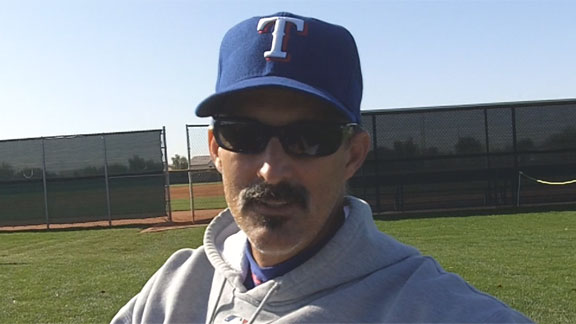 many of the essential intangibles for success. He is known as a hard worker, dependable, well liked but respected by his players. For all the years I have watched him, he always seemed to be a calming influence over his pitchers. If he can exercise that same attitude for the other coaches of a team and its players, we may be forming the next great MLB manager. Other managerial positions may open up, but for the time being, it appears that the Cubs and Red Sox have the edge in luring him away from Texas. Both are major markets and present the chance to build/groom winning ball clubs. The Red Sox have more talent, but also have the older squad with referenced difficult players and personalities to manage. The Cubs, while younger and less talented, may be more moldeable for Maddux if named manager.
Mike Maddux did pitch for the Red Sox over two seasons. While he never played in Chicago, he will know the Cubs and Wrigley well from his Brewers coaching days. Mike’s younger brother, Greg was a star pitcher for many years for the Cubs and can give him much insight into the team. The decision will boil down to fit. Does Mike Maddux want to manage? Likely, the answer is yes. With his experience and reputation at the game, it will be difficult to not want to take on the job of a lifetime. Money will be no object, as both squads could offer Maddux 3-5 year contracts at approximately $3 million per season. So the answer will come down to where Maddux would most want to manage. The answer will likely be Chicago.
Having coached in the division for some time and having his brother’s experiences as a strong influence, I see Mike Maddux being attracted to being a manager in Wrigley. For all its talent and fandom, the mix of veterans and difficult personalities will likely be more than Maddux as a rookie manager will want to handle. The Cubs, with more youth present a bigger challenge for Maddux. Yet, the team will also likely be more moldeable under him. Mike Maddux looks to me like a long-term thinker. After taking the Rangers youngsters and turning their pitchers into stars, Maddux will likely want to do the same in Chicago. Both teams will go aggressively after him, but at the end of the day, I expect Maddux to be wearing the “C” cap by opening day. Theo Epstein started the groundwork for Mike Maddux while still running the Red Sox. He seems to be a sharp guy and what Theo wants, he usually gets. As the Jays denied the opportunity for John Farrell to be available, Epstein will now need to seek another former pitching coach turned manager. Mike Maddux appears to be his man.
What does this all mean for the Texas Rangers? I can’t say they will regress back to the old poor pitching squad of yesteryear, but I certainly think the team will suffer greatly if Mike Maddux departs. As today’s MLB is strongly built on pitching, the Rangers would be losing their not-so-secret weapon if Mike Maddux was to jump ship. This is a loss that the team most cannot afford to occur. All else being equal, retaining Mike Maddux in my opinion is more important than having C.J. Wilson on the squad. This is the value of Mike Maddux. But after giving Maddux the biggest coach’s contract to come Texas, there is little the Rangers can do to keep Mike Maddux as they cannot offer him a promotion. Nolan Ryan would need to be very creative if he had hoped to keep his pitching coach. But at the end of the day, money is one factor. Job title is another. The Rangers clearly have realized this as they granted teams permission to talk to Mike Maddux. While showing good faith in rewarding their pitching coach for a job well done, the team is likely shooting itself in the foot and risking its long-term viability if Mike Maddux does end up leaving.
I expect Mike Maddux to be successful wherever he goes. If he joins the Cubs or Red Sox, it is almost guaranteed that the team will have a fantastic pitching staff. Will the rest of the team excel and contend? A good question, which will come down to whether Mike Maddux surrounds himself with smart coaches as a manager. For the 50-year old Maddux with the younger brother who is a future hall-of-famer, he is clearly building his own legacy in the game. My expectation is that we will have an announcement in the next 7-10 days, confirming Mike Maddux as the new manager for either the Cubs or Red Sox. If that is the case, expect those teams to be playoff regulars in the near future. In the same token, expect the Rangers run of World Series appearances to end as soon as Mike Maddux to leave. He may not have been their everything, but should he depart, the secret weapon of the Rangers will disappear as well. Good luck to Mike Maddux: he has exciting but difficult decisions to make in the near future.
 Jonathan Hacohen is the Lead Baseball Columnist & Editor for MLB reports: You can follow Jonathan on Twitter (@JHacohen)
Please e-mail us at: MLBreports@gmail.com with any questions and feedback. You can follow us on Twitter and become a fan on Facebook . To subscribe to our website and have the daily Reports sent directly to your inbox , click here and follow the link at the top of our homepage.

Interview with Steve Karsay: Reflections on a MLB Pitching Career
Friday November 4, 2011

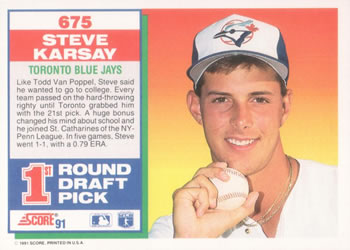
Jonathan Hacohen: While I get to interview many current MLB prospects and stars on the Reports, it is rare that I have the opportunity to talk baseball with a former great that I watched growing up. As a personal bonus to me, that chance recently came up when I was able to connect with Steve Karsay, former major league pitcher. Steve was originally drafted by the Toronto Blue Jays in the 1st round (22nd overall in the 1990 draft). After being a part of the famed 1993 trade to Oakland for hall-of-famer Rickey Henderson, Steve played 11 major league seasons for 5 different squads. Steve played his final season in 1996.
I reflected with Steve Karsay on his career, from his time with the Blue Jays organization, through to his final season. Steve was very candid in his responses and certainly did not hold back. For all the readers that grew up idolizing Steve Karsay and wondering about his future baseball plans- today you will receive your answers.
Featured on MLB reports, I proudly present my interview with former Major League pitcher, Steve Karsay:
_________________________________________________________________________________________________________
MLB reports: Welcome to MLB reports Steve. Let’s start today’s interview from the beginning. A 1st round pick in 1990 with Toronto. What was the feeling when you got the call? Did you expect to be drafted by the Jays? Thoughts/feelings at the time?
Steve Karsay: Wow! Going back a few years. That is correct- I was the 22nd pick overall in the 1990 draft by the Blue Jays. What a great time and what a great organization I was drafted by. The Blue Jays and their organization taught me so much to make me the player I was over my 16 year career. I will always be grateful to the Blue Jays organization and the coaches for the years I spent there. I did not know I was drafted until late in the afternoon for the fact that I was playing for my high school championship at Yankee stadium at the time. The feeling when I did receive the call was shock. I was not sure I was going to get drafted in the first round and had my sights set on going to LSU in the fall. But when it sunk in and realized the opportunity that I had and the feeling of shock turned to joy and excitement made the decision to sign and start my career in St. Catharines.
MLB reports: You will forever be linked to hall of famer Rickey Henderson, being traded for him in July 1993. What was your reaction when you learned of the trade? Have you ever spoken to Rickey about it?
 Steve Karsay: First being traded at the time for Rickey was a great honor. I was only 21 at the time in 93′ when the trade happened so learning I was traded I had a mix of feelings. I was disappointed because I wanted to reach the big leagues with the team that drafted me. But realizing that I may get my opportunity to pitch in the big leagues faster, I understood that these are the things that happen when the big club is trying to position itself to win a World Series. After the trade I ended up making my Major League debut two weeks later against the Brewers at the Oakland Coliseum. So that is what made the trade worth it. As far as talking with Rickey, we had a brief conversation when he returned to Oakland the very next year.
MLB reports: After being in the Toronto organization your whole life, what was it like joining the A’s and playing for them for three seasons?
Steve Karsay: Being with Toronto for three years and going to Oakland was an adjustment, but for me was an easy transition. I enjoyed the A’S organization very much. Working with Dave Duncan and having Tony La Russa as my first manager was great. They were both mentors and I credit them for helping me transition to pitching in the big leagues.
MLB reports: Injuries took a big toll on your career- especially your surgeries in 1995 and 1996. After undergoing Tommy John, did you think your career was finished? Give us an idea as to what the surgeries/rehabs were like and your road to continue playing baseball.
Steve Karsay: To be quite honest I wasn’t sure what to expect. I knew I had had to have Tommy John and back in 1995, it was not nearly as perfected as it is today. So I knew there was a chance that I may never play at the big league level again. The surgeries were lengthy and the rehab tedious, but I always had the drive to get healthy and pitch in the big leagues again. I was never one to give up. It was a long three years but in the end to resume my career and compete at the highest level was an accomplishment in itself.
MLB reports: Your career actually took off when you joined the Indians. Your four years in Cleveland represent some of your finest major league numbers. What was the secret of your success with the tribe?
Steve Karsay: I guess if there was any secret to my years in Cleveland, it was that I was finally healthy. I had gone through some tough years with injuries and rehab and when I finally got traded in 97′ to Cleveland, I felt like I turned the corner and it was just all coming together. In Cleveland they decided to put me in the bullpen and really got into a nice niche of what I was really capable of doing. But ultimately I would have to say that the four years in Cleveland I was as healthy as I have ever been throughout my career.
MLB reports: Aside from the occasional start, you became a full-time reliever in 1998. What was the process like to transition from starting to the pen? After coming up as a starter, how did you feel about becoming a reliever?
Steve Karsay: As a starter you have routines and you know what days you’re going to pitch and who you are going to pitch against. As a reliever you just have to be prepared every day. The transition was fairly easy for me because I had some great mentors when I did it in Cleveland. Mike Jackson, Paul Shuey, Paul Assenmacher, and a few others, so I got to learn from some guys who tough me well. I wasn’t excited at first to become a reliever but it definitely grew on me and felt after having success in the bullpen that is where I was supposed to be. It also gave me a new found respect of how hard the bullpen is.
MLB reports: You finished your career with 41 saves. Looking back, do you wish that you had more 9th inning opportunities- was the “closer” role something that you had in the back of your mind?
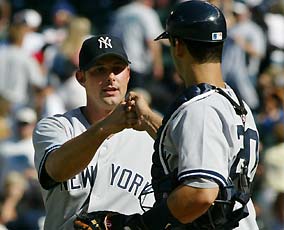
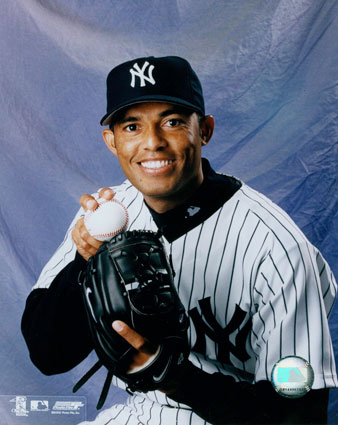 Steve Karsay: I was very fortunate to have the opportunity to be a closer for a bit in Cleveland and fill in New York when Mariano Rivera was injured. I always had the “closer” role in my mind but was never what drove me to play. I figured opportunities would present themselves if I pitched well enough. My saying was ”How well you are pitching will determine where you pitch in the game coming out of the pen”. When I signed as a free agent, I had the opportunity to go to a couple other clubs to compete for that job but chose to go to NY to set-up. At that point, winning was more important to me than closing. That was a tough choice I had to make.
MLB reports: Your career ended in 2006, after pitching 9 games with the A’s. Why the decision to hang up the glove at that point? Any regrets?
Steve Karsay: I have absolutely no regrets about my decision to retire in 06′. At that particular point, I was still having problems with my shoulder (after having surgery on my rotator cuff in 03′). I was pitching with pain and I felt personally like I couldn’t compete at that level with an injured shoulder. It was not fun any more coming to the ballpark, and I had always told myself that if I felt that I couldn’t compete at the highest level, I wanted to walk away from the game as a player on a respectable note. After retiring I had one last shoulder surgery to repair my rotator cuff for a final time. I came to realize that I was pitching with my rotator cuff torn the whole time in 2006. So looking back, I felt the choice I made was 100% correct.
MLB reports: You pitched for 5 major league teams (A’s, Indians, Braves, Yankees and Rangers). Favorite team(s) that you played for and why?
 Steve Karsay: All of the teams hold a special place in my heart. I had great memories with all of them. I had the opportunity to meet and play with some of the best players in the history of the game over my career. I will always be grateful for the Blue Jays for drafting me and giving me the chance to start my career in professional baseball. Then the A’s for giving me my first shot in the Major leagues. The Indians is where I had my most productive years and had the chance to experience playoff baseball for the first time. Atlanta and playing for the great Bobby Cox. He is a player’s manager and a great man. Also having the opportunity to have great teammates in every spot that I played. Too long of a list to compile, but to name a few of the greats I played with: Mark McGwire, Dennis Eckersley, Ron Darling, Rickey Henderson, Jim Thome, Sandy Alomar Jr., Robbie Alomar, Omar Vizquel, Greg Maddux, Tom Glavine, John Smoltz, Chipper Jones, Derek Jeter, Roger Clemens, Andy Pettitte, Bernie Williams, Mike Mussina. I know I am probably missing many other great ones I played with. Overall, the experiences were priceless. It was the most exciting time in my life with the exception of the birth of my son Kingston.
MLB reports: Do you still keep in touch with many of your ex-teammates- any ones in particular?
Steve Karsay: I don’t keep in touch per say with them, but whenever I get the opportunity to see them when they come into town I always like to stop by the ballpark and say hello.
MLB reports: Growing up so close to Shea Stadium, it must have been a dream come true to play in New York. Were you a Mets fan growing up- did you consider playing for them at one point?
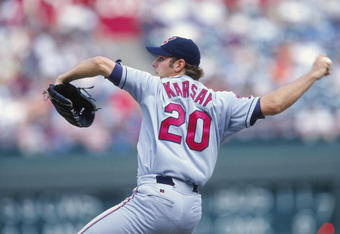 Steve Karsay: Growing up in NY and so close to Shea was great. I was a baseball fan growing up. I liked players more than I did teams. I watched both the Yankees and the Mets. I went to more Mets games as a kid because it was just a short train ride away. I never had the opportunity to play for the Mets over my career, but playing for the Yankees and the tradition of the Yankees was definitely a highlight of my playing days.
MLB reports: Since you left the game, what has been life been like for Steve Karsay? What are you up to these days Steve?
Steve Karsay: Life has been wonderful since retiring in 2006. After being able to have a 16 year career in baseball I wanted to step away from the game for a short time to pursue a few things that I was not able to do while I was playing- like travel and explore different countries. I also became involved in my friend’s company in Aerospace Manufacturing which has been exciting and to say the least interesting. And last but not least, the birth of my son which has been more work than all of the above. With that being said, baseball is my life and I am pursing opportunities to get back in the game in some capacity. The time off was great, but I want to be able to pass along the knowledge of baseball that I learned while I was playing and help young kids fulfill their dreams of hopefully getting to the big leagues.
MLB reports: If you could give one piece of advice to a young baseball player trying to make it to the show, what would it be?
Steve Karsay: My advice would be to work hard, be consistent, and do not take anything for granted because you never know when it will come to an end.
MLB reports: Will we be seeing you in the future in the major leagues in another capacity, perhaps a broadcaster or coach/manager?
Steve Karsay: I hope so. I am pursuing some things as we speak and would love to get back in the game in any capacity, either as a broadcaster, front office or on the field coach. Baseball is my passion and it what I love.
MLB reports: Final question Steve: everyone at the end of the day wants to leave a mark on the game. What do you most want to be remembered for as a professional baseball player?
Steve Karsay: Looking back I would want to be known for every time I stepped between the white lines I gave everything I had and I did not take anything for granted. I wanted to be the best player I could be when I stepped out on the mound. The fire for competition was always burning when I played. If I can be remembered for that, I would be very proud.
MLB reports: Thank you very much for taking your time out of your busy schedule so we can have you with us. Much appreciated!
Thank you again to Steve Karsay for taking the time to join us today on MLB reports. We highly encourage our readers to post at the bottom of the article any questions and/or comments that you may have for Steve. As well, please follow Steve on Twitter (@Steve_Karsay)
Jonathan Hacohen is the Lead Baseball Columnist & Editor for MLB reports: You can follow Jonathan on Twitter (@JHacohen)
Please e-mail us at: MLBreports@gmail.com with any questions and feedback. You can follow us on Twitter and become a fan on Facebook . To subscribe to our website and have the daily Reports sent directly to your inbox , click here and follow the link at the top of our homepage.
Changing Baseball Pitching – Cuba Style

MLB reports: The handling of pitchers and pitching staffs has evolved over the years in baseball. Once upon a time, pitchers were expected to complete all or almost all games they completed. Slowly the use of relievers expanded. From there, the invention of pitch counts started- 100 approximately per start. Innings limits, per start and per year are now prevalent. Teams are getting wiser as to watch the innings pitched in a year from the time a pitcher is a rookie and most create yearly caps. The strategy of handling pitchers seems to get stricter every year.
Tony LaRussa and Dave Duncan are often credited with the modern game use of pitchers. The notion is for starters to pitch approximately 5 innings, with relievers for innings 6-7. The setup man pitches inning 8 and closer for the 9th. The above standard is adopted by all teams at this point in the MLB. But is this the right system? It is hard to know. Pitchers today seem to be stronger than ever and throwing less innings, yet injuries are at an all-time high. From a results standpoint, are MLB teams maximizing production from their pitching staffs? That is the million dollar question. Now I throw another hat into the ring- let’s try playing Cuban baseball instead. Perhaps its time for a shift.
My suggestion is a variation of the Cuban style of baseball, but I will simplify it for this article. Here goes the idea in a nutshell. A team would employ the closer for the first 2 innings of a game. The start of a game is the most crucial, to set the tone against the opposing team. Rather than start the traditional starting pitcher, who often takes time to get warmed up, start the closer who knows how to come into a game cold. The closer would pitch the first two innings and hopefully make short work of the opposing team. From there, the starter would come in, after warming in the pen during the game, for innings 3-9. If problems start near the end of the game, bring in the 2nd closer for inning 9, or 8-9 depending on need.
The above system is based on the Cuban style of ball. Watching the previous WBC in 2009, the Cuban system would have Aroldis Chapman starting the game, going anywhere from 1-4 innings. From there, Pedro Lazo, the workhorse starter would pitch the rest or close to the rest of the game. Imagine today for the Cinci Reds pitching Chapman to start a game, Volquez pitching innings 3-8 and Cordero with the 9th. How scary would that be? The opposing team would have no rhythm to start the game and would never likely get going from there.
Baseball has evolved over time and will continue to do so over time. Nolan Ryan is trying to get more innings under his pitchers’ belts to build stamina and endurance on the Texas Rangers. I like the system personally, but it doesn’t work for everyone. The concept I propose above is not my invention but based on the Cuban game. All I am saying is that perhaps its time for a change in the MLB. It will make the game more exciting and perhaps even revolutionize it…yet again.

Please e-mail us at: MLBreports@gmail.com with any questions and feedback. You can follow us on Twitter and become a fan on Facebook . To subscribe to our website and have the daily Reports sent directly to your inbox , click here and follow the link at the top of our homepage.


 MLB Reports

You must be logged in to post a comment.