Blog Archives

Daniel Bard: Future Red Sox Ace?

Thursday March 15, 2012
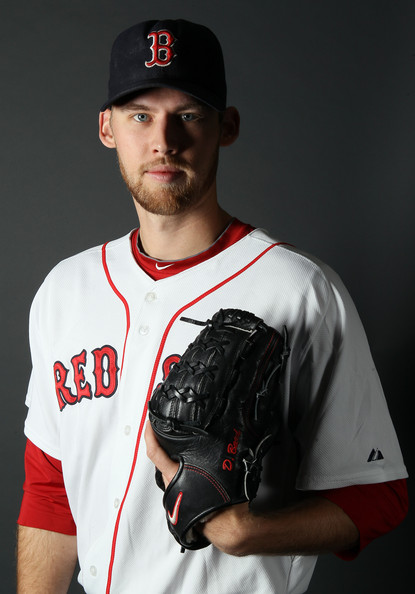
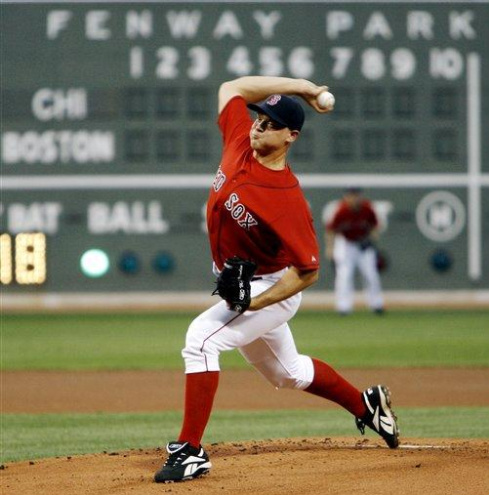
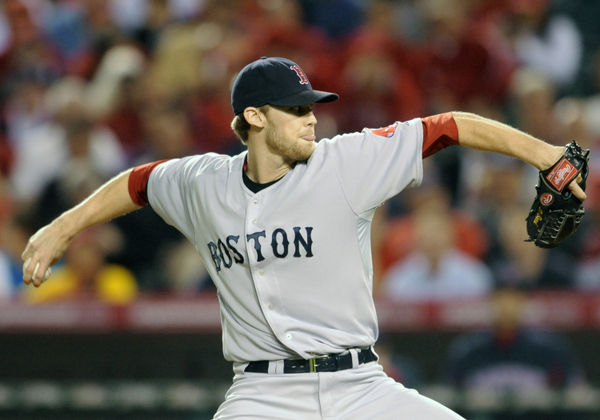
Rob Bland (Baseball Writer):  With most of Red Sox Nation knowing that big time closer Jonathan Papelbon would be leaving the team via free agency after the 2011 season, many thought that it would be a seamless transition to throw Daniel Bard into the mix as the closer for the foreseeable future.  However, new Red Sox GM Ben Cherington surprised many when he announced that Bard would be stretched out as a starter in the spring.

Now, it’s not the first time a good reliever has been turned into a starter, and many of them have turned into useful starters.  C.J. Wilson is just one of these successful conversions, having been the Texas Rangers’ closer from 2007-2009, then shifting into the rotation for 2010 and 2011.  Wilson earned 46 saves in those 3 seasons, and after his move to the rotation, he went 31-15 and accumulated 10.5 WAR, putting him in the upper echelon of starters.
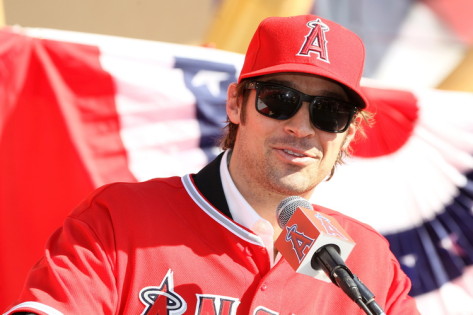
This year, another closer for the Rangers will be shifting to the rotation in Neftali Feliz.  Many believe that he will struggle. But if C.J. Wilson, who was a decent reliever can do it, why not Feliz?  Why not Bard?

Bard has an electric fastball, averaging over 97 mph over his MLB career.  He also has a solid slider that sits around 84 mph.  Bard has induced ground balls at an extremely high rate; 48.6% over 197 IP.  Bard has lowered his walk rate, as well as HR/FB while maintaining an extremely low BABIP over the last two seasons, .215 and .224, respectively.
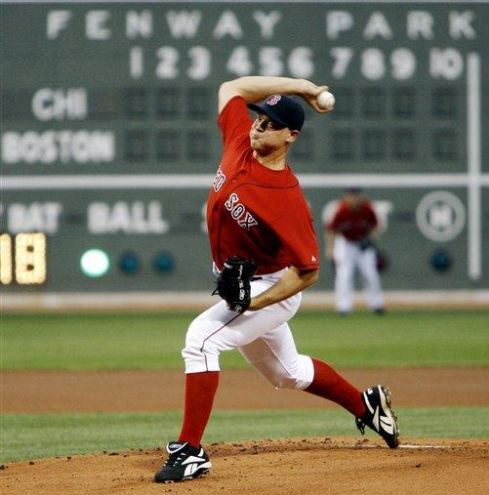
Bard hasn’t started a game since 2007 when he was in single-A ball.  He threw 75 innings of 7.08 ERA, striking out 47 and walking 78.  Obviously a lot of those control issues are behind him, as evidenced by his shrinking BB/9; 4.01, 3.62, and 2.96 in 2009, 2010, and 2011, respectively.  Bard has been able to get guys out with a fastball that touches 100 mph, and a plus slider.  The problem here is that he only ever threw one inning at a time, and thus rarely needed a third pitch.  According to brooksbaseball.net, in 2011, Bard threw his change-up 83 times, which is only 7.5% of all his pitches, in contrast to 64% on his fastball, and 25% on his slider.  He also threw 46 sinkers, around 4.1%.

In such a small sample size of changeups, one should definitely not get too excited over the results.  However, in 2011, Bard fared pretty well with his change-up.  He was able to induce swings on 48.19% of his changeups, and 25% of those were swing-and-misses.  His changeup was put in play 23% of the time, and had a ground ball rate of 63%.
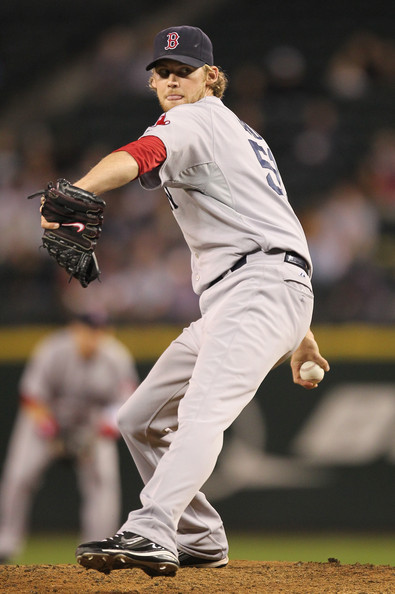
In no way does this mean it is a good changeup. However, it does seem promising.  It is also possible that Bard just throws them at the most opportune time, and delivers when necessary.  It could also mean that he is incredibly lucky.

With Bard having to throw 6+ innings every 5th day, how will his arm hold up moving to the rotation?  Most relievers have a limit in their first years starting as to how many innings they will throw.

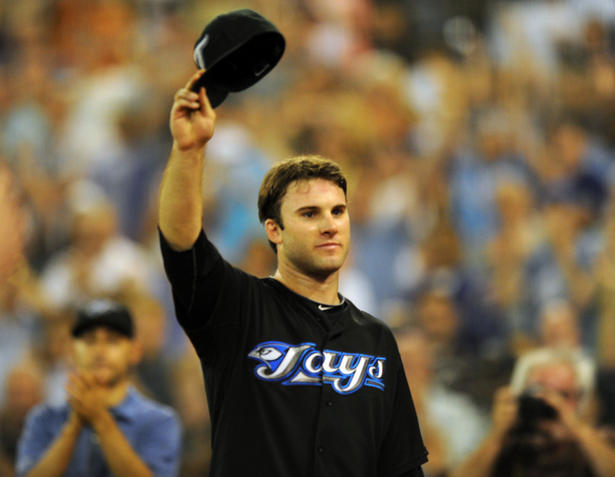
Brandon Morrow was moved to the rotation full time when he was traded to the Toronto Blue Jays, and was shut down after 146 innings in 2010, and threw only 179 innings in 2011. This year, there will be no limitations on the hard throwing righty, whose profile closely fits that of Bard.  Morrow can get his fastball in the upper 90s as well as having a devastating slider.  His success has been only moderate due to mediocre offerings in his curve ball and changeup.
Bard’s development as a starter rests mostly on the development of his changeup.  If he is able to use it more often and maintain success with it, he could be a solid starter this year and going forward.  The other extremely important thing to look at is whether new manager Bobby Valentine will limit his innings, or let him go for the full season, as the Rangers did with Wilson in 2010 (204 IP).

I see Bard throwing somewhere around 170 innings this year, and performing fairly well, getting acclimated to throwing every 5th day.  His changeup is developing, and if he harnesses it, he could be a deadly addition to a rotation that includes Josh Beckett, Jon Lester, and Clay Buchholz.

***Today’s feature was prepared by Baseball Writer, Rob Bland.  We highly encourage you to leave your comments and feedback at the bottom of the page and share in the discussion with our readers.  You can also follow Rob on Twitter.***

Please e-mail us at: mlbreports@me.com with any questions and feedback.  You can follow us on Twitter and become a fan on FacebookTo subscribe to our website and have the daily Reports sent directly to your inbox , click here and follow the link at the top of our homepage.

The Aroldis Effect: What’s In Store for the Game’s Hardest Throwing Pitcher?

Thursday February 16th, 2012

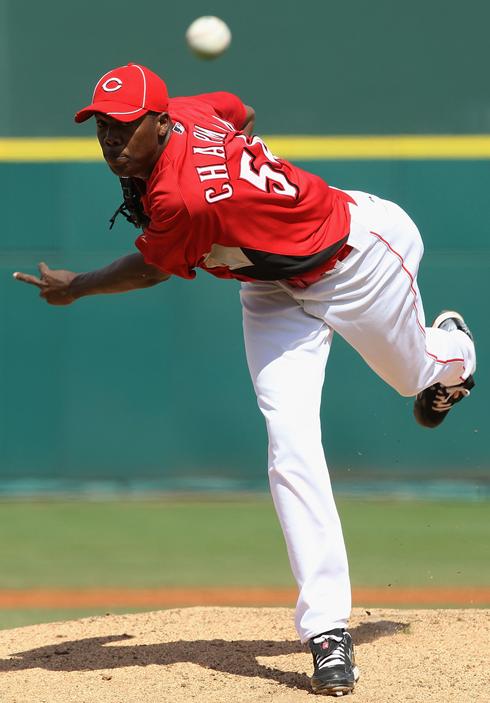
Sam Evans: In the history of baseball, no pitcher has ever thrown a baseball faster than Aroldis Chapman. In 1876, when the National League was founded, Alexander Graham Bell made the first ever telephone call. The athleticism of baseball players and overall talent in the league has improved significantly since then, but it is amazing that we now have over four hundred Major League pitchers that have an average fastball speed that’s at least 90 MPH. Aroldis Chapman is a phenomenal talent, who with the right coaching, has a chance to make more than a few All-Star teams. Read the rest of this entry

The Future of Alfredo Simon

Sunday January 29th, 2012

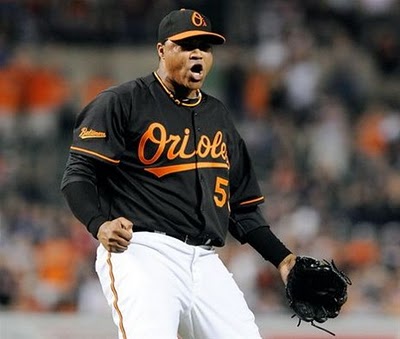
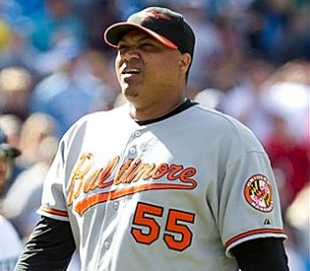
Sam Evans: Alfredo Simon has not had the Major League career that most people grew up dreaming about. He’s never maintained success in his four years in the big leagues, plus he was accused of murdering a man during the last offseason. Luckily for Simon, he has a chance to be a starter in Baltimore’s talent-deprived rotation. He is still a promising player with a good build and a fastball that can touch up to 95 MPH.

Simon should be an inspiration to all minor league players. He spent seven years in the minors before he ever reached the majors. During those seven minor league years, he played for the Rangers, Orioles, Dodgers, Phillies, and the Giants. Simon never posted amazing minor league numbers and had problems with his offspeed pitches. What kept Simon on teams was his fastball in the upper 90’s and positive veteran influence. In 2008, Simon finally got his chance. The Orioles called him up to the majors and gave him a chance to showcase his abilities against major league hitters.

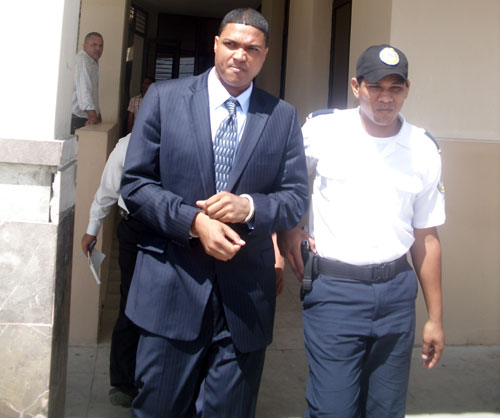
When Alfredo Simon signed with the Phillies over ten years ago, he claimed to be almost two years younger than he was, as he went by the name Carlos Cabrera. This wasn’t a huge deal, but eventually the information about Simon’s name and age was released to the public. Little did Simon know, this was just the start of his legal issues. Last year, on New Year’s, Simon was accused of killing Michel Castillo Almonte and wounding his own brother. As the story was told, the locals were all bringing in the New Year at a huge party, with Simon celebrated by firing his gun into the air twice. I’m not a lawyer, but this seems very suspicious. If Simon was firing his gun up into the air, how did he kill someone? I don’t speak very fluent spanish, but according to a Dominican news telecast, Simon was at a street block filled with hundreds of people, away from Almonte at the time of the murder.

The justice system in the Dominican Republic is far from perfect. Simon could have just paid off people to cover this up after he actually did murder Almonte.  Or this could have been a misunderstanding or tragic accident. However, the court found indisputable evidence that Simon was not the murderer. He had approximately three hundred witnesses testifying his innocence. What I find amusing is that almost all of them showed up for the court appearance, dressed in Orioles gear and Simon’s jerseys. On November 8th, Simon was acquitted of all charges of involuntary manslaughter.

Back to baseball, Simon has never been able to maintain success for long periods of time in the majors. He has shown glimpses of being an electric closer at times. He’s also had moments where he looks like a potential innings-eater starter. Nobody, even Simon, knows where this talented veteran will fit into the Orioles roster. Whether it’s as a starter, or as a late-inning bullpen arm, Simon could be a breakout player in 2012.  Or he could end up on waivers.

Simón can still heat up the radar gun, even now at age thirty. Last year, his average fastball was 94.4MPH. He threw his fastball almost 1 MPH faster in 2010, but that’s likely because he was used out of the bullpen. Speaking of 2010, that was the year when Orioles fans got to see the potential of this 6’6” giant. Due to a Mike Gonzalez injury, and a dreadful Orioles bullpen, Alfredo Simón was name the O’s closer. Simon took complete advantage of the situation and he finished with 17 saves in 21 chances.

Simon’s peripherals suggest that he has been consistently getting lucky during his time in Baltimore. He has a 5.23 career FIP, but only a 4.19 career SIERA (Skill-Interactive ERA). Simon is starting to look like another pitcher who consistently outperforms what their sabermetrical numbers suggest they should be. Sabermetrics are far from perfected statistics always and they could be misleading, in terms of Simon’s production.

In 2011, Simon returned to starting pitching. He had sixteen starts and he threw more innings in one year (115.2), than he’d thrown since 2007. He still missed time due to hamstring issues, but overall, Simon threw some quality ballgames for Baltimore. Eight of his sixteen starts were for six innings or more. If Simon can perfect his offspeed pitches better, I could see him having a Carlos Silva in 2004-esue year. That’d make him one of the Orioles best pitchers and he would then be due for a payday in 2013.

Recently, both Manager Buck Showalter, and General Manager Dan Duquette, have made it clear that they want to have players competing in Spring Training for a spot in the Orioles rotation. According to Orioles beat writer, Brittany Ghiroli, Simon has lost ten pounds this offseason and he’s been preparing to be a starter. There will be approximately eleven players competing for five spots in the Orioles rotation this spring. Fortunately for Simon, the majority of them are not very good.

If the Orioles coaching staff can ameliorate Simon into a starter who goes deep into games, without losing his velocity or blocking a younger prospect, then they will have gem of a pitcher at a fraction of the cost of most top starting pitchers. I really do believe in Simon’s capabilities. He has the potential and given that he has a good opportunity coming up this spring, I don’t see any reason why he can’t spend the entire year in the Orioles rotation (health permitting).

If starting doesn’t work out for Simon, he can still be an effective late-inning arm. The Orioles need to develop their pitchers better and stop messing with their roles. They can tell Simon if they want him to be a starter, or a reliever, but the worst thing they can do is have him switch back and forth. For Simon’s career, it’s now or never. 2012 will be the most important year of his career and the Orioles need him to produce at the Major-League level so that they don’t have to rush their young prospects any further.

***Today’s feature was prepared by our Baseball Writer, Sam Evans.  We highly encourage you to leave your comments and feedback at the bottom of the page and share in the discussion with our readers.  You can also follow Sam on Twitter***


Please e-mail us at: MLBreports@gmail.com with any questions and feedback.  You can follow us onTwitter and become a fan on Facebook .  To subscribe to our website and have the daily Reports sent directly to your inbox , click hereand follow the link at the top of our homepage.

What to do with the Red Sox Bullpen?

Wednesday January 4th, 2012

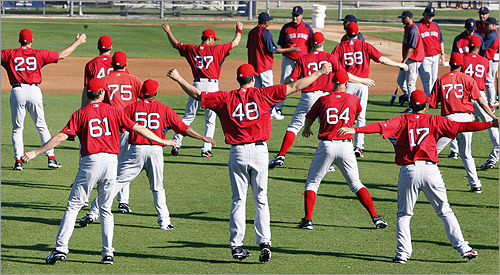
Sam Evans: The Red Sox new management has already made a lot of moves to bolster their pitching staff this offseason. The one main idea that new General Manager Ben Cherington has brought to the Sox this year is competition. The Red Sox are looking for as many players to compete not only for a rotation spot, but for a chance to be the Red Sox closer in 2012.

My first reaction to hearing that Boston wanted to move Alfredo Aceves to the rotation was very negative. Aceves is a 29 year-old reliever who throws a fastball in the low nineties. Last year, Aceves threw 114 innings and had a 2.61 ERA. Going into Spring Training, the Red Sox are going to try out Aceves in the rotation. There is no way to know whether or not this move is going to work, but it’s a risky move for sure. Nonetheless, if the Red Sox only have Aceves throw one hundred and fifty innings this season, his workload would not be dramatically increased from 2011.

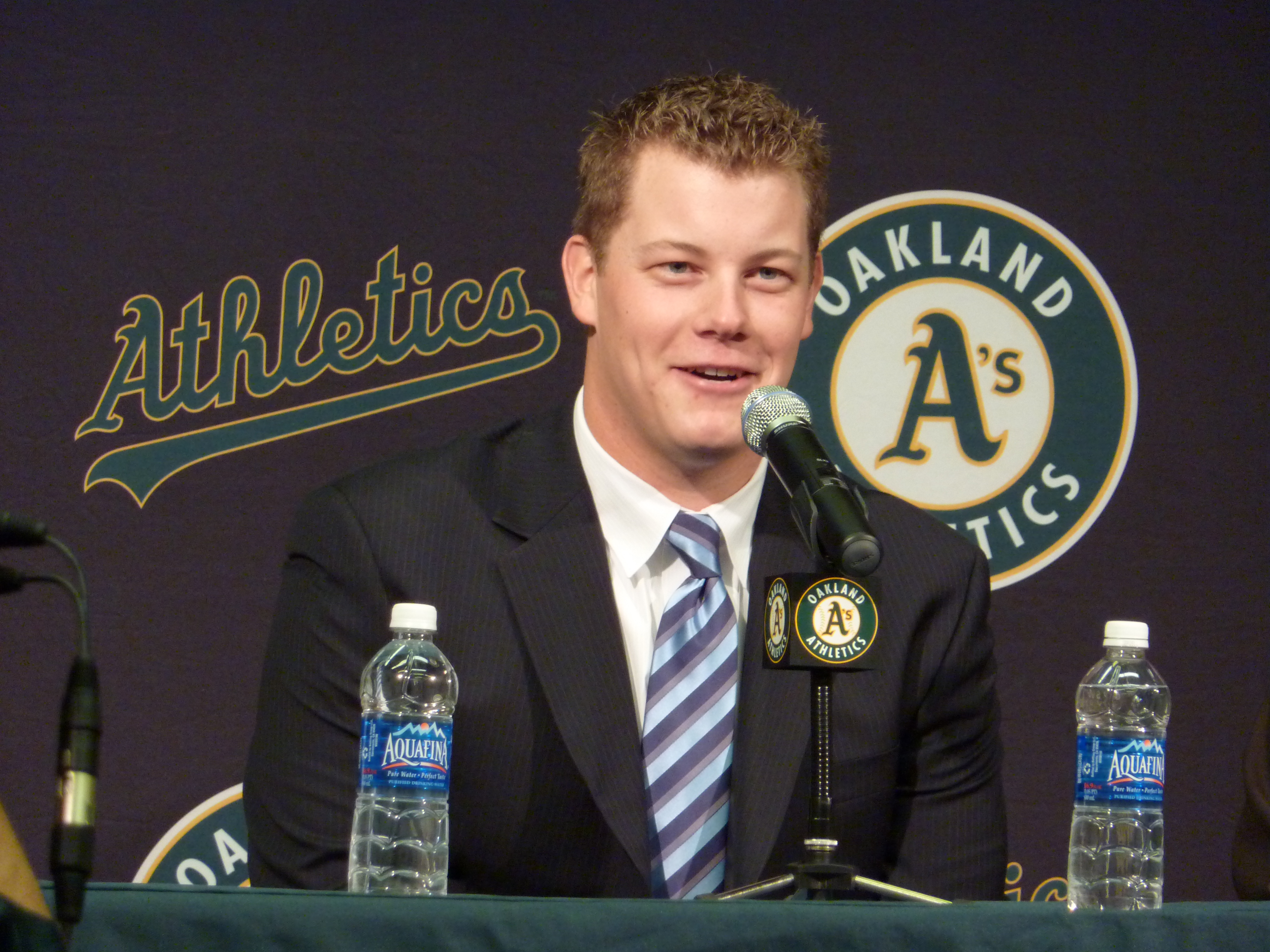
This past Wednesday, the Red Sox and A’s confirmed a five player trade which sent 2009 AL Rookie of the Year Andrew Bailey to Boston. The Red Sox made it clear that they acquired Bailey to be their closer, and only that. Bailey has a lengthy injury history which is not good for a 27-year-old. He made the 2009 and 2010 All-Star teams but in 2011, he struggled due to his injuries. The Red Sox can always move Bard back to the closer spot if needbe, but for the time being it’s Bailey’s job to lose.

Daniel Bard was always waiting to take Jonathan Papelbon‘s closer role. Now, with Papelbon signing a 4- year, $50 million deal with the Phillies, one would think that Bard would slide into the back-end of the bullpen. With the Bailey acquisition, the Red Sox have made it crystal clear that Bard is heading to the rotation. In my opinion, this is not a great idea because Bard always struggled as a starter and doesn’t appear able to handle the workload. If everything goes wrong for Bard as a starter during Spring Training, he will take to becoming the Sox setup man. However, if Bard’s nasty slider can propel him to a successful spring, then he will replace the injured John Lackey and take over as Boston’s fifth starter.

The Red Sox haven’t improved much, if any at any other position other than their bullpen this offseason. I don’t like the trade that the Red Sox made, trading Jed Lowrie and Kyle Weiland for Mark Melancon. But Melancon is a nice piece to have in your bullpen. The former Yankee took advantage of Houston’s sparse bullpen last year, collecting twenty saves with a 2.78 ERA. If Bard stays in the rotation, Melancon will be the setup man. Otherwise, he will probably slide into the 7th inning role. Keep in mind that GM Ben Cherington and new manager Bobby Valentine have not ruled out the possibility that Melancon could close in 2012.

The Red Sox have other options in their bullpen, but none as strong as the previous four. Franklin Morales is a young one-time Baseball America top-ten prospect that has never had success with any breaking pitches. Bobby Jenks is due to make six million dollars in 2012, but he’s fallen off a cliff since 2009. Maybe the Sox saw the Yankees looking victorious with their big man, (C.C. Sabathia) and they took a chance on Jenks. Matt Albers, Scott Atchison, and Alex Wilson could all see time in the bullpen this year, but none pose a serious threat to take over the closer job.

Overall, the Red Sox have shown great effort this offseason to improve their bullpen. Despite losing their most valuable relief arm, the Sox have improved the quality of their bullpen across the board. The Red Sox have a big year coming in 2012, and with the recent additions to the their bullpen, it’s starting to look like they’ll be back in the playoffs once again.

***Today’s feature was prepared by our Baseball Writer, Sam Evans.  We highly encourage you to leave your comments and feedback at the bottom of the page and share in the discussion with our readers.  You can also follow Sam on Twitter***


Please e-mail us at: MLBreports@gmail.com with any questions and feedback.  You can follow us on Twitter and become a fan on Facebook .  To subscribe to our website and have the daily Reports sent directly to your inbox , click here and follow the link at the top of our homepage.

Ryan Madson: A Free Agent Closer with no Job?

Thursday December 8, 2011

MLB reports – Jonathan Hacohen:  With the Winter Meetings at an end, players/teams/agents are left standing to look over the game of musical chairs and who is left standing.  A particularly interesting position was closer- with more eligible players than open positions.  In the past few weeks, we have seen many signings and trades in this area.  Jonathan Papelbon to the Phillies.  Sergio Santos to the Blue Jays.  Huston Street to the Padres.  Francisco Rodriguez accepted arbitration from the Brewers.  Heath Bell to the Marlins.  Joe Nathan to the Rangers.  Andrew Bailey is openly being discussed in the trade market as leaving the A’s.  Frank Francisco and Jon Rauch joined the Mets.  As a result, one big name is left standing with no dance partner.  Ryan Madson is still on the open market with few promising prospects ahead.

As the story goes, Madson was supposed to re-sign with the Phillies.  A reported 4-year, estimated $44 million contract was put on the table by the Phillies early in free agency.  Player and agent (Scott Boras) happily accepted and a Philadelphia return was in order.  Not so fast.  There are conflicting stories on what transpired.  Needless to say, there was never a firm deal in place and the Phillies moved quickly to sign the top closer on the free agent market, Jonathan Papelbon.  Since then, there has been little discussion on Madson.  There have been reports throughout the process linking him to the Jays, Marlins and Red Sox.  Well…the first 2 teams have filled their vacancies.  The Red Sox have Daniel Bard as the incumbent set-up man who could get a look at the closing position- although he may end up in the rotation.  Other than that, there seems to be little hope for Madson.

Last night, Madson chose not to the K-Rod route and accept salary arbitration.  As a result, he remains out in the market waiting for his next contract offer.  Francisco Cordero is in the same boat, although he is still likely to go back to the Reds on a 1-2 year contract from the whispers around the league.  But even if the Reds do not retain Cordero, it is unlikely that they will sign Madson- especially given the young players they still need to lock-up to extensions.  So what other options exist for Madson?  Perhaps the Orioles.  Maybe the Rays.  The options are getting bleak.

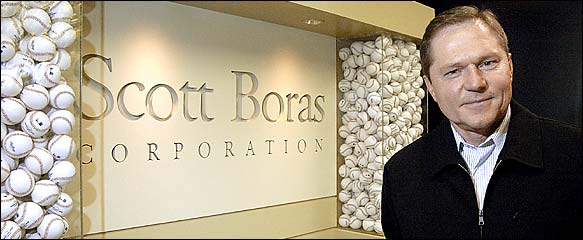
This is one of the few times that you will see Scott Boras caught “with his pants down” so to speak.  For an agent that is well known to be able to create and stimulate markets and demands for his clients, Boras has come up short for Madson.  The perception is that the Phillies did what was best for them in signing Papelbon, which left Boras outraged and in a bind.  With little to no teams looking for closers, Boras essentially only has the Red Sox to work with.  At this point, he may need to take a 1-2 year deal for Madson, in the $7-10 million range to rebuild his value and try again on the open market in the future.  A risky proposition, but with few options- Madson may have no other choice.

I was actually quite surprised that Madson didn’t take the Phillies offer of arbitration.  Based on his stellar 2011 numbers, he could have expected a strong 1-year contract at least.  Now Boras and Madson are left to take their chances on the open market.  For a closer with only 1 full year on the job, time is not on Madson’s side.  A proven closer like Francisco Cordero knows that he find a contract soon.  Heck, even K-Rod knows that he just needs another solid season under his belt and his next deal will follow shortly after.  Madson was in line for his first and only big payday this offseason.  If he gets hurt or becomes ineffective in 2012, that dream vanishes. Scott Boras better work overtime to get the Red Sox biting on his closer client.  Otherwise, it may not turn out to be a very Merry Christmas in the Madson household this year.


Jonathan Hacohen is the Lead Baseball Columnist & Editor for MLB reports:  You can follow Jonathan on Twitter (@JHacohen)

Please e-mail us at: MLBreports@gmail.com with any questions and feedback.  You can follow us on Twitter and become a fan on Facebook .  To subscribe to our website and have the daily Reports sent directly to your inbox , click here and follow the link at the top of our homepage.

Time Has Come For the Royals to Trade Soria

Tuesday November 15, 2011

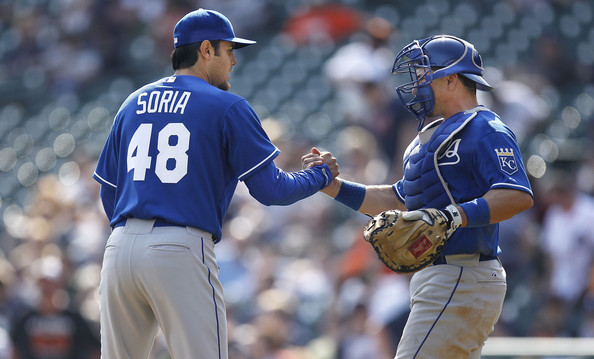
MLB reports – Jonathan Hacohen:  With the free agency season in full swing, some teams may not be happy with the sticker prices on available players.  Especially when it comes to pitching, including closers.  Jonathan Papelbon recently grabbed $50 million from the Phillies and reports have Ryan Madson looking at a deal in the $40 million range.  These figures make existing closers signed to reasonable deals an attractive trade commodity, despite the amount of available relief pitchers on the market.  There may be a quantity of closers, but certainly not quality.  Outside of Mariano Rivera and Papelbon, there are few sure-fire closers currently in baseball.  Enter Joakim Soria of the Kansas City Royals.

A 2-time All-Star, Soria has put up some impressive numbers in his 5 seasons in Kansas City.  Two seasons of 40+ saves, Soria has a career 2.40 ERA and 1.043 WHIP.  Soria will only be 28 next year and could theoretically be a building block for the next few seasons in Kansas City.  However, closers are generally considered to be foundational players.  Soria is no exception.  2011 was his most difficult seasons in the majors, as he did save 28 games but put up a 4.03 ERA and 1.276 WHIP (all career worsts).  Soria is signed for $6 million this coming season and has 2 more team options at roughly $8 million per season.  The Royals are faced with a decision: hold onto their star closer, or cash in while his market is at its peak.

The Royals are on the way up.  No doubt about it.  Mike Moustakas, Erik Hosmer, Wil Myers, John Lamb and company are expected to come together at the same time to make the Royals the next powerhouse squad.  By my estimation, they should be World Series contenders by 2015.  But with a couple of more seasons of growing pains ahead, can they afford the luxury of Soria?  My argument is no.  Soria’s salary in 2012 is still considered a “deal”, but from 2013 go-forward at $8 million, the Royals would be wise to spend their salary dollars in other areas.  There are still holes to fill on the squad, including 1-2 more bats and starting pitching.  The team will also need to lock up some of its young star players early to avoid unaffordable contract demands down the road.  Joakim Soria can bring back a nice haul to fill needs and stock the team for a future championship.  The team needs to be realistic of where it is today, where it is going in the future and the players it needs to get there.

The Royals also have options to replace Soria.  Aaron Crow (if he is not moved into the rotation) and Tim Collins could all get a shot.  Luke Hochevar, who has been hot/cold during his career in the rotation may eventually settle into the bullpen.  Options are there.  Heck, the Royals plunked Soria from the Rule-5 draft and transformed him from a Padres outcast into a star closer.  With the risk of injury and ineffectiveness always hanging over closers, the Royals may be gambling if they hang onto Soria much longer.  Another season like 2011 could severely damage his trade value, while he could bring in a nice crop of 2-3 prospects if traded this offseason.  The Royals need to do some soul-searching and realize that Soria is worth more in a trade than on their roster.

Teams will surely line-up if Joakim Soria is made available.  The Blue Jays, Red Sox, Yankees, Rays, Angels, Tigers, Rangers, Nationals and Cardinals would all surely inquire as to his availability.   From all reports, the Yankees and Blue Jays are the strongest contenders to land the Royals closer.  Don’t get me wrong- I am a Joakim Soria fan.  I believe the kid is immensely talented and has the talent and determination to remain a top MLB closer for another decade (health permitting).  But on a losing ballclub that is rebuilding, Joakim Soria is a luxury that the Royals simply cannot afford.  If the team has to trade a Moustakas or Hosmer given their budget but retain Soria, that would be a big mistake in my estimation.  The team needs to build for 2015- not 2012.  This offseason represents a golden opportunity for the Royals to continue to replenish its roster and fill more holes.  The Melky Cabrera for Jonathan Sanchez was that type of step in the right direction.  If Melky was a Prince, it is time for the Royals to flip their King for a pair of Wild Cards.  It could prove to be their ultimate winning hand.

Jonathan Hacohen is the Lead Baseball Columnist & Editor for MLB reports:  You can follow Jonathan on Twitter (@JHacohen)

Please e-mail us at: MLBreports@gmail.com with any questions and feedback.  You can follow us on Twitter and become a fan on Facebook .  To subscribe to our website and have the daily Reports sent directly to your inbox , click here and follow the link at the top of our homepage.

Phillies Sign Papelbon Over Madson: The Stare Arrives in Philadelphia

Saturday November 12, 2011

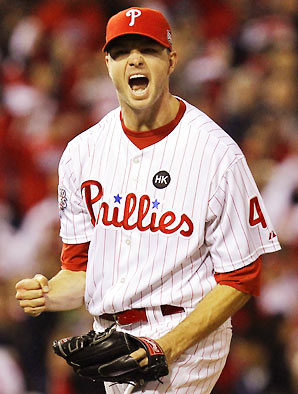
MLB reports – Jonathan Hacohen:  The Philadelphia Phillies seemingly fooled everyone this week.  Earlier in the week, reports indicated that the team had locked up its incumbent closer, Ryan Madson for a 4-year, $44 million contract which could climb all the way up to a $57 million deal with an additional option year.  Reactions were for the most part negative, as the baseball world could not believe that the team would pay (overpay) for a reliever coming off his first season as a full-time closer by handing out one of the largest contracts ever to a non-starting pitcher.  At that money, people began to wonder why the Phillies did not seek out the best closer on the market and one of the best overall in the game, Jonathan Papelbon.  The Red Sox closer, after endless 1-year pacts with Boston was in his first free agency period in 2011.  But then something interesting happened.  The Madson deal, which required the approval of the team’s higher brass all of a sudden was delayed and then fell apart.  A couple of days later, Papelbon became a Philly!  At 4-years and $50 million, Jonathan Papelbon finally received the long-term deal he has craved all of these years and Philadelphia signed a lock-down closer.  But what happened?  How did the Phillies switch to Papelbon mid-stream after coming so far along in negotiations with Madson?

The marketing term for what the Phillies did is called a “bait and switch”, meant when a retailer will advertise a discounted product and will then offer you a higher priced replacement when you arrive at the location to find that the advertised good has mysteriously sold out.  Often, that discounted good was never actually available, but was a merely a ploy to get the consumer to first get to the store and secondly, buy a more expensive product.  In the case of the Philadelphia Phillies, I do not believe that the team ever planned on signing Ryan Madson to the reported high-end contract.  While being groomed to be a future for many seasons, the team was never completely sold on his true sustainability at the position.  While Madson received the occasional closing opportunities in his 8-year career leading up to 2011, he actually converted only 20 saves going into this season.  But something funny happened this season.  Madson became solid.  So solid, that he saved 32 games with a 2.37 ERA and 1.154 WHIP.  With Scott Boras as his agent, the Phillies knew that Madson would not come cheap.  But the Phillies faithful for the most part loved Madson and would mourn his departure.  The Phillies needed to secure themselves at the closer position while softening the blow of not signing Ryan Madson.  The team’s actions this week were a stroke of genius and the team played its cards perfectly.

The plan for 2011 was to have Brad Lidge close for 1 more season, with Ryan Madson as the set-up man and fill-in closer.  In the offseason, the Phillies were going to target Jonathan Papelbon and sign him to a  large pact.  But Lidge was injured and ineffective in 2011, forcing the Phillies to use Madson as their primary closer for most of the season.  The reliever that they were hoping to sign for a reasonable 3-years, $21-$24 million deals was about to cost them almost double to retain.  But how could the team sign another reliever and let their incumbent closer go?  Simple.  Propose a deal with Ryan Madson and float the scenario out to the public to record and evaluate the reaction of the public.  The possibility existed that the fans, writers and analysts would applaud the deal, in which case the Phillies could consider actually proceeding with it.  But in all likelihood, the team knew that the outcry would be against the deal.  By then pulling the Madson deal and reaching out to sign Papelbon, the approval rating would be through the roof.  It is almost the same as proposing a 20% tax hike and then only increasing taxes by 5%.  Throw out a worst-case scenario and set expectations low- then substitute a better plan and watch people jumping for joy.

The Phillies in my estimation used Ryan Madson as a pawn.  While Scott Boras has been the master for years at playing teams against one another to benefit the pocketbook of his clients, the Phillies in this case used Boras and Madson to get what they wanted.  If the Phillies had gone out right away at the start of free agency to sign Jonathan Papelbon, fans and critics would have blasted the team for overpaying and proposing that the team should have kept Ryan Madson at a hometown discount.  The Phillies were able to eliminate such sentiments by showing that Madson would have cost them top dollar to stay put.  At an additional $1.5 million per season for the same 4-year contract, the Phillies replaced a closer with 1 full year of closing experience with a closer (Papelbon) who is the same age (31), has 6 full years of full-time closing experience in one of baseball’s biggest and highest pressure markets (Boston) of 30+ saves per season, to go along with an almost perfect postseason resume.  The Phillies traded in a solid Buick for a Mercedes, with still plenty of mileage to be driven.

For those of you that may doubt the “conspiracy theory”, just take a close look at the Phillies rotation.  Since Spring Training, I have been calling for the Phillies to sign Papelbon.  The team has shown to seek out the best pitchers on the market and bring them on board.  Roy Halladay.  Cliff Lee.  Now Jonathan Papelbon.  When the Phillies go shopping for pitching, they do not shop in the bargain bin.  Aside from obtaining Mariano Rivera, the team signed the best available closer for their staff.  So while Ryan Madson would have been a nice luxury to keep on the staff for insurance and to set-up, the team knew it would be seeking Jonathan Papelbon all the way.  The plan would have worked to have both Papelbon and Madson on the team, had Madson not closed out so many games this past season.  As a middle reliever setting-up, his contract would have been affordable.  But an outstanding closing record in 2011 along with Scott Boras as his agent, meant that Madson was priced out of the Phillies budget.  With Papelbon set to come on board, there would be no room for Madson.

The Phillies faithful have to be pleased today.  While they will miss Ryan Madson, most will know that there was no guarantees he could duplicate his numbers over the life of a 4-5 year contract.  At the numbers that were tabled for him to stay in Philadelphia, the team by all accounts did the right thing to sign the superior Papelbon.  While he will cost the team its 2012 first-round pick, a pick should be recovered, along with a supplemental pick, when Madson is signed by another team.  The cost/benefit of this move was essentially a no-brainer.  The Phillies went with more of a sure-thing by signing Papelbon.  While there are no guarantees in baseball, especially with pitchers (arm problems) and especially closers (who can lose their jobs at a moment’s notice), Jonathan Papelbon is as money in the bank as they come.

A couple of last points that helped trigger the change of closers.  By continually signing 1-year deals in Boston, many expected Papelbon to bolt once he was eligible for free agency.  The team could not lock the player down to a long-term deal and with the max-exodus of players during this past offseason, it seemed that Papelbon was another candidate to seek a change of scenery.  But some people may not remember that not too long ago that Ryan Madson’s wife, Sarah, making negative comments on Phillies fans.  At the time, it seemed like a ticket out-of-town for Madson, but his success this season seemingly made the comments disappear.  Except that the Phillies brass did not forget and the publicity that surrounded the event at the time was one that likely set a chain reaction for the plan for Madson to leave at the end of the season.  Baseball is a game of short-term memories, but not for all.

When I floated the idea of a Jonathan Papelbon signing all season long, Phillies fans did not have one positive comment back to me.  Their fans, as well as most in baseball, had very negative things to say about Papelbon.  Outside of Boston it seems, many were unable to or refused to recognize his talent.  But while Papelbon was beloved in Boston until now, those sentiments will transfer over to Philadelphia by next season.  The stare, as it is known, will become one of the most famed times in Philadelphia Phillies history as the team and its fans get revved up watching Jonathan Papelbon close out games for the next 4-seasons.  There is a changing of the guard in Philadelphia.  The Phillies have Halladay, Lee and Hamels to start things off and now can rely on Papelbon to close them out.  The stare now makes its residence in the city of brotherly love.  Another World Series may not be far behind.

Jonathan Hacohen is the Lead Baseball Columnist & Editor for MLB reports:  You can follow Jonathan on Twitter (@JHacohen)

Please e-mail us at: MLBreports@gmail.com with any questions and feedback.  You can follow us on Twitter and become a fan on Facebook .  To subscribe to our website and have the daily Reports sent directly to your inbox , click here and follow the link at the top of our homepage.

Top 10 Closers: MLB Saves Leaders

Thursday August 25, 2011


Rob Bland (Intern- MLB reports):  Closers are a topic a lot of people ask about, but I never really got around to writing about.  Mainly because, in my opinion, it is a position that is completely overrated.  While it certainly helps to have a guy that can go in and slam the door and collect saves for over a decade a la Mariano Rivera, it isn’t necessary to have a “closer” to be a contending team.  One need only to look at the top 20 leaders in saves in baseball to notice that the Texas Rangers’ closer Neftali Feliz sits 19th with 25 saves, and Philadelphia Phillies’ Ryan Madson is 20th with 23 saves.  It also doesn’t guarantee success, as Heath Bell, Drew Storen, Leo Nunez, Joel Hanrahan are all in the top 10 in saves, while their teams are not in playoff contention.


Top 10 Saves Leaders in MLB as of today:

Pitcher Team Saves K/9 BB/9 ERA FIP WAR
Craig Kimbrel Atlanta Braves 40 14.56 3.53 1.70 1.20 3.1
John Axford Milwaukee Brewers 37 10.86 3.32 2.26 2.36 1.7
Jose Valverde Detroit Tigers 37 8.31 4.79 2.72 4.08 0.2
Brian Wilson San Francisco Giants 35 8.72 5.20 3.19 3.40 0.7
Heath Bell San Diego Padres 35 6.79 3.23 2.55 3.07 0.7
Drew Storen Washington Nationals 34 8.03 2.19 2.77 3.48 0.6
Mariano Rivera New York Yankees 33 8.45 0.92 2.20 2.23 1.8
Leo Nunez Florida Marlins 33 8.31 2.88 4.63 4.02 0.1
Joel Hanrahan Pittsburgh Pirates 32 7.85 2.04 1.73 2.17 1.8
JJ Putz Arizona Diamondbacks 32 8.28 2.17 2.76 3.10 1.0

I look at this list and a few things come to mind:

1)      Craig Kimbrel is absolutely filthy.

2)      Mariano Rivera is still one of the very best.

3)      Closers are more overrated than I originally expected.

4)      A lot of saves does not equal success.

5)      Craig Kimbrel.  Wow.

Craig Kimbrel is having the best year ever for a rookie closer.  It isn’t even September and he has 40 saves.  Not only that, but he is striking out more than 14 batters per 9 innings.  His FIP is a ridiculous 1.20, and his WAR is at 3.1, which is 1.3 higher than any other closer in the Major Leagues.  His ground ball rate is 43.7% and has only given up 1 home run in 63 2/3 innings.  If the Braves end up winning the Wild Card and have a lead late in games, the shutdown duo of Johnny Venters and Kimbrel should be able to save the game for the Braves in most instances.

John Axford has had a strange way to becoming one of the premier closers in all of baseball.  It took him many years to get there, but under the tutelage of Trevor Hoffman, the career saves leader, whom Axford took his job from, he has flourished.  In 2010, Axford had 24 saves after taking over for Hoffman mid-season, and this year’s 37 so far are tied for 2nd in the big leagues.  Axford gets over 50% ground balls, and keeps the ball in the yard, two main factors for his success.

Jose Valverde is one of the closers whom I find to be overrated.  Part of his success can be attributed to a lucky .250 BABIP.   He also walks close to 5 batters per 9 innings, which is extremely high, especially when he does not strike out a very high number of batters.  Valverde may appear to be very good with 37 saves, but his 0.2 WAR suggests that he is basically a replacement level pitcher.  Surely he is not worth the $7M he is being paid.

Brian Wilson is loved by many in the game.  He is funny, has a strange personality, (which seems to be perfectly suited for the bullpen) and he has an outrageous beard.  Since 2008, he has accumulated 162 saves, so he is very valuable at the back-end of the Giants’ bullpen.  He keeps the ball on the ground, with a career 50% ground ball rate, but he walks a ton of batters (5.20/9IP).  He gets a lot of save opportunities because the starting rotation is very good, and his team doesn’t score many runs, so there are a lot of close games. 

Heath Bell has put up some ridiculous numbers over the last few years, but these numbers come with half of his games played in the cavernous PETCO Park.  While his last two seasons had his K rate over 10, he sits at 6.79 for this season.  His ground ball rate is also down 5% to 43.  Although his ERA is a good 2.55, his xFIP is 3.89, and like Wilson, gets saves because of an anaemic offense that results in his team often being in close games.

Drew Storen is another of the Washington Nationals’ young phenoms.  He moved up the ranks, throwing only 53 2/3 innings in the minor leagues before making his debut in 2010.  He has been a tad lucky as his BABIP is .241, but he gets a lot of ground balls, so the hits will even out.  He also gives up a higher than average home run per fly ball rate at 11.1%.  Storen doesn’t walk many, and as he matures, should probably strike out a higher number.  When Washington starts winning more games, he will have even more opportunities for saves.

Mariano Rivera is up to his usual tricks. Even at 41 years old, he is carving up hitters with his signature cut fastball.  Rivera has a ridiculous 9:1 K:BB ratio, as well as getting ground balls 47% of the time.  His WAR sits at 1.8, tied for second best for closers.  The only question is when will this guy ever slow down?

Leo Nunez of the Florida Marlins may be the most overrated closer in baseball.  Nunez doesn’t get a lot of ground balls, nor does he strike out a ton, as he gives up a ton of fly balls (49%) and home runs (8 in 56 IP).  Nunez’s ERA of 4.63 actually looks worse than his 4.02 FIP, so he has been a little unlucky, but still not very good.

Joel Hanrahan has found a home at the back-end up the Pirates’ bullpen, and is thriving there.  While his K rate has dropped to 7.85/9 IP from almost 13 last year, he has walked less batters.  Hanrahan has been able to induce ground balls on over half of his plate appearances, and only given up 1 home run in 57 1/3 innings.  His stellar numbers have allowed him to tie Rivera for 2nd in closer’s WAR this year.

JJ Putz’s resurgence as a closer this year comes as no surprise to many.  Last year as a setup man for Bobby Jenks with the Chicago White Sox, Putz’s K rate was just below 11/9IP, while he walked only 2.5 per 9 innings.  He hasn’t put up the same strikeout numbers this year, but he is walking less batters.  Putz’s WAR of 1.0 puts him towards the top of the list of closers.


Out of the top 30 relievers in WAR, only 9 are full-time closers.  Francisco Rodriguez is among those pitchers, but since he does not close games since traded to the Milwaukee Brewers, he was not counted.  Although this doesn’t mean that just ANYONE can close games and earn saves, it does show that many pitchers who have not been given the opportunity probably could get the job done.  


***Today’s feature was prepared by our Intern, Rob Bland.  We highly encourage you to leave your comments and feedback at the bottom of the page and share in the discussion with our readers.  You can also follow Rob on Twitter.***

Please e-mail us at: MLBreports@gmail.com with any questions and feedback.  You can follow us on Twitter and become a fan onFacebook .  To subscribe to our website and have the daily Reports sent directly to your inbox , click here and follow the link at the top of our homepage.

Pitching Keeps Tribe Alive

Sunday May 22, 2011

On the Reports, we will be occasionally featuring an up-and-coming baseball writer that has come to our attention and share their work with you, the readers.  Part of our mandate at MLB reports is to provide the best baseball coverage and analysis in the business.  MLB reports ultimately is designed to expose our readers to the world of baseball and the stories, facts, insights and profiles behind it.  In order to meet this goal, we would like to give exciting young writers the chance to showcase their talents and provide a fresh pool of ideas to our site.  In today’s premier feature, we are excited to have Shane Miller as our first guest writer with his post on the Cleveland Indians.  Shane’s topic was to discuss the start of the Indians season and to review the success behind it.  The direction and focus of the story was up to our writer and in today’s feature, Shane takes a look at the Indians and the pitching that has been the core of the team’s success in 2011.  Enjoy! 

Shane Miller (Guest Writer for MLB Reports): As the second month of the Major League baseball season is coming to an end, the Cleveland Indians to many baseball fans surprise still sit atop the American League Central division.

Well today I am here to discuss how the Indians have managed to lead the AL Central for the first two months of the season. My observation has been that pitching has been the main component to their early season success.  As part of this article, I will be discussing the Indians pitching staff and how they have led their team to success beyond the wildest dreams of most baseball observers.

Pitching without a doubt has been the ultimate key to the Tribe’s early season success.  The Indians pitching staff has the second best ERA in the American League at 3.45 and have managed to keep the ball in the park by giving up the third fewest home runs in the AL by only giving up 28 home runs on the season. Also the Indians have also been successful in keeping runners off the base paths giving up the second fewest walks in the AL at 127.  A pitching staff that manages to keeps its walks and runs down will in most cases be successful and the Indians pitching staff of 2011 is proof that good pitching is the backbone of a winning baseball club.

A great deal of credit is due to manager Manny Acta, who has done a wonderful job with all the young pitchers he manages on the Indians.  Cleveland also happens to boast one of the youngest, if not the youngest starting rotations in major league baseball.

Fausto Carmona, Carlos Carrasco, Justin Masterson, Josh Tomlin and rookie Alex White make up the Cleveland Indians starting rotation.  On paper, not much was expected of the Indians starting five going into the season.  But success is contagious and as the season has progressed, the pitchers that few in baseball gave much credit have proven that they are for real.  The fans in Cleveland are getting excited about their Indians and the team starts and ends with its rotation.

As the newly anointed staff ace, 26-year-old Justin Masterson is enjoying a break out season.  So far Masterson is 5-2 with a 2.52 ERA, 1.22 WHIP, 48 strike outs and 19 walks in 60.2 innings pitched.  Masterson has done an excellent job this season in keeping the free passes to a minimum and keeping the ball in the park by only allowing one home run all year.  At his current pace, Masterson is a likely 2011 all-star candidate and is finally fulfilling the hype that surrounded him from the time he came up with Boston as a rookie.

Tomlin is another pitcher who is not getting enough recognition for the amazing season he has put together so far in Cleveland.  Looking at Tomlin’s stats, he is 5-1 with a 2.56 ERA, 0.85 WHIP, with 27 strike outs and nine walks in 52.2 innings pitched.  The only red flag that I could find with Tomlin is that he has given up eight home runs this season.  The number of long balls needs to go down as he only gave up 10 home runs in 73 innings pitched last season.

Another starter of note, the rookie White has pitched very good so far this season in the three games that he has started.   White has compiled a record of 1-0, 3.60 ERA, 1.53 WHIP, 13 strike outs and nine walks in 15 innings pitched.  Like I indicated with Tomlin, White also has an issue with long balls by giving up three home runs in 15 innings pitched so far.   This means that White is averaging a home run every five innings pitched.  In my opinion, if White can keep the ball in the park he will one day become an outstanding pitcher. (*Editor’s note:  at time of publishing White has been placed on the DL by the Indians with a finger injury.  While the severity is unknown, White could be lost for the season by the Indians.  As adversity tests character, the Indians rotation will be put to the test if White is lost to the team for any kind of extended period.*) 

With two of the five starting pitchers for the Indians enjoying breakout seasons and a rookie putting up great numbers in three starts, no wonder the Indians are in first place and have a record of 27-15.  The Indians bullpen has also been another source of strength of the Indians team overall.  The Indians bullpen is made up of Frank Herrmann, Joe Smith, Vinne Pestano, Tony Sipp, Chad Durbin, Rafael Perez and closer Chris Perez.  While again unimpressive on paper to start the year, the Indians relief corps has been lights out all year and one of the best in the game.

The closer, Chris Perez has been very good for the Tribe this season, going 2-1 with a 3.00 ERA, 1.22 WHIP, 11 saves, 11 strike outs and 10 walks in 18 innings pitched.  The walk totals are very high and if Perez wishes to remain a closer long-term he needs to cut down on those walks.  He is currently averaging six walks per nine innings and that needs to be at least cut in half for him to be able to remain successful.

The setup man Rafael Perez has been astounding this season with a record of 2-1 with a 1.20 ERA, 1.06 WHIP, 11 strike outs and six walks in 15 innings pitched. Rafael is one of the reasons why Cleveland has one of the best bullpens in the MLB and is sneaking up behind Chris Perez to one day take the closers role away from him.  If Rafael can continue pitching like he has this season, he could definitely be the closer by season’s end if and when  Chris falters.  Rookie middle reliever Pestano is also having a great year in the Indians pen with a 1-0 record, 1.65 ERA, 0.98 WHIP, 18 strike outs and six walks in 16.1 innings pitched. Pestano has been amazing this year with a very strong 9.9 strike outs per nine innings.

Pestano has done an excellent job in limiting walks and home runs given up and has only allowed three earned runs all season. The Indians obviously have amazing pitching from the starting rotation all the way to the deepest part of their bullpen. Without some of these rookie standouts or career years the Indians might not be in this position to possibly contend in historically one of the deepest divisions in baseball.  Time will tell where this team is headed but if the start of the year is any indication, the Indians will be players in the AL Central in 2011 and possibly for many years to come.

***Thank you to Shane Miller for preparing today’s article on the Indians.  You can follow Shane on Twitter.***

Please e-mail us at: MLBreports@gmail.com with any questions and feedback.  You can follow us on Twitter and become a fan on Facebook .  To subscribe to our website and have the daily Reports sent directly to your inbox , click here and follow the link at the top of our homepage.