Blog Archives

Jobless in 2012 – MLB Managers on the Hot Seat from 2011
Saturday September 10, 2011

Rob Bland (Baseball Writer – MLB reports): When a team has a disappointing season, the most likely candidate to lose his job is the manager. So far in the 2011 season, there has already been three managers who have either resigned or been fired. The Oakland Athletics fired Bob Geren on June 9th and replaced him with Bob Melvin. A week and a half later, Edwin Rodriguez resigned from his post as manager of the Florida Marlins. Jack McKeon became the oldest manager since Connie Mack at 80 years old. Yet another week later on June 26th, Jim Riggleman of the Washington Nationals resigned and was replaced by Davey Johnson two days later. With only a few weeks left in the regular season, who are the frontrunners to be replaced after the World Series?
With eight managers being new to their respective teams to start the 2011 season, one would think there can’t be too many jobs to lose. The first criteria I look at in order to predict who will not be returning his club is if the team was expected to contend for the playoffs, and fell short. Another thing I look at is the perception of the clubhouse, ie. if players get along, or if the manager is able to manage egos. Of course, the manager’s ability to create a lineup and manage a bullpen is taken into consideration. Other factors such as injuries and expectations of players are measured as well. The list that follows are my top 3 managers who could be canned after this season.
Mike Quade, Chicago Cubs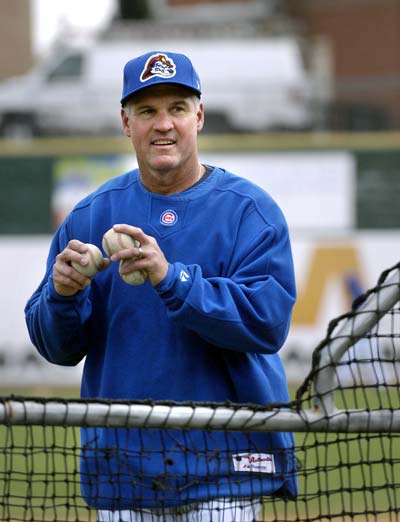
It is not oft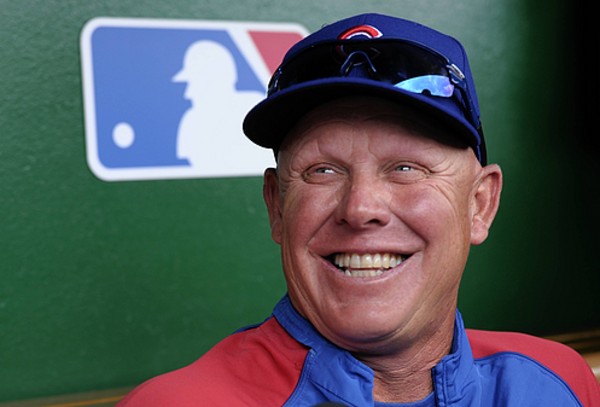 en that I would think a first year manager would be fired like this, but there are so many circumstances that make me believe he will be gone. First, there has been grumbling since day one in Chicago that Quade was hired over franchise icon Ryne Sandberg. The Cubs have been packed with talented players such as Carlos Zambrano, Aramis Ramirez, Alfonso Soriano, Geovany Soto, Ryan Dempster and Carlos Marmol. Add in Matt Garza and Starlin Castro, and you would think they could at least come close in the terrible NL Central. They are 22 games behind the streaking Milwaukee Brewers, and 21.5 behind Atlanta for the Wild Card. Their record is 62-81 with a 35-40 record at Wrigley Field.
Bud Black, San Diego Padres
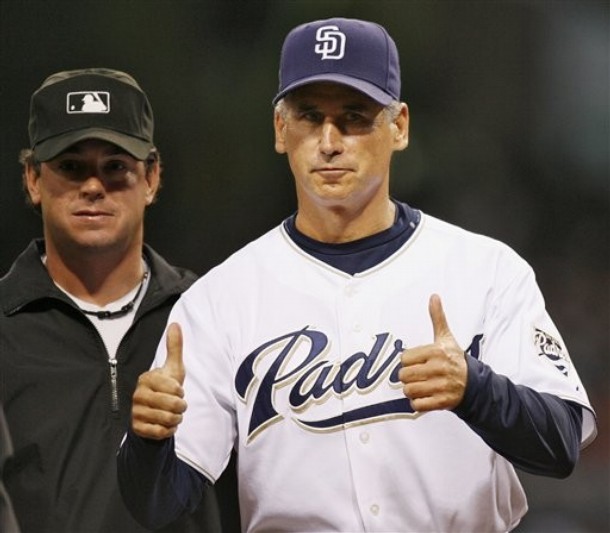 With 2011 being Black’s 5th season with the Padres, a 62-82 record and already 21 games behind Arizona for the NL West title, he could be on the way out. The Padres have yet to reach the postseason under Black, however they were involved in a 1-game playoff with Colorado for the Wild Card title in 2007 that many of us will never forget as one of the most exciting games we have ever witnessed. In 2010, the Padres held a 6.5 game lead over eventual World Series Champs San Francisco Giants on August 25th. After a 10 game losing streak, the Padres were still in contention, and were not officially eliminated from the playoffs until the final day of the regular season with a 90-72 record. Those were the only winnings seasons in Black’s tenure and his time in San Diego may be up.
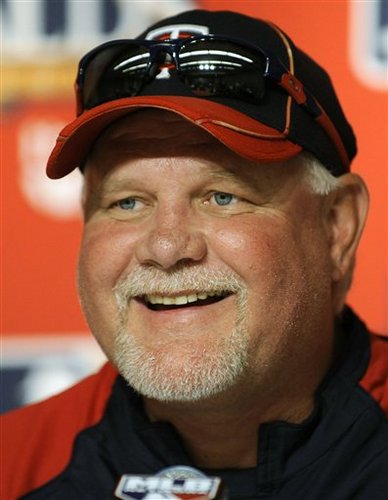
Ron Gardenhire, Minnesota Twins
Is it really fair to say Gardenhire’s job is in jeopardy? Probably not, but it definitely is possible. Over his 10 year career with the Twins, he has amassed an 861-740 record and they have been in the playoffs 6 times. However, they have only won 6 games, 4 of which were in one series, in Gardenhire’s first season; 2002. The Twins have not won a playoff game since 2004, being swept in 2006, 2009 and 2010 in the American League Division Series. This year, Gardenhire has had to deal with crippling injuries of former AL MVP’s Justin Morneau and Joe Mauer. Statistically, the best hitter has been Michael Cuddyer, hitting .282 with 18 home runs and 64 RBI. The best pitcher has been Scott Baker who is 8-6 with a 3.21 ERA and 1.19 WHIP in 131 2/3 innings. Francisco Liriano has not been the same as he was before undergoing Tommy John surgery after the 2006 season, and aside from his no-hitter against the White Sox on May 3, he has been downright awful and is now on the 15-day disabled list. When the best players don’t perform, or are hurt, the manager is forced to do the best he can with what he is given. However a 59-84 record may just be the straw that broke the proverbial camel’s back for Gardenhire.
This year, with 3 mid-season changes already, and eight new managers at the beginning of the season, shouldn’t see too much activity. I do believe that with the Cubs’ search for a new general manager under way, Quade’s days are numbered in Chicago. I also believe that Black’s inability to get the always promising Padres to the next level will leave him without a job by November. Gardenhire has not proven to me that he can bring the Twins to the World Series, and that is what the job description entails. Has it ever happened where both Managers of the Year from their respective leagues gets fired the following year? It could happen if Black and Gardenhire are let go.
***Today’s feature was prepared by our Baseball Writer, Rob Bland. We highly encourage you to leave your comments and feedback at the bottom of the page and share in the discussion with our readers. You can also follow Rob on Twitter.***
Please e-mail us at: MLBreports@gmail.com with any questions and feedback. You can follow us on Twitter and become a fan onFacebook . To subscribe to our website and have the daily Reports sent directly to your inbox , click here and follow the link at the top of our homepage.

2011 MLB All-Star Game Recap: National League Defeats the American League for 2nd Year in a Row
Wednesday July 13, 2011

 Rob Bland (Intern Candidate for MLB Reports): This year’s edition of the Midsummer Classic, the 2011 MLB All-Star Game, had a record-setting vote-getter. Jose Bautista of the Toronto Blue Jays received over 7.4 million votes in fan voting. This game was said to have lost some of its lustre due to the amount of players who elected not to participate. A total of eight players that were voted in by fans or chosen by coaches dropped out due to injury, timing or just plain wanting to rest. For the American League, David Price (TB), Derek Jeter (NYY), Mariano Rivera (NYY), Alex Rodriguez (NYY) and Jon Lester (BOS) all withdrew due to various ailments and injuries. Chipper Jones (ATL), Jose Reyes (NYM), and Placido Polanco (PHI) were the players who bowed out in the National League. One of Major League Baseball’s rules pertaining to eligibility for pitchers is that they must not start on the Sunday prior to the game. Due to this rule, CC Sabathia (NYY), James Shields (TB), Justin Verlander (DET), Felix Hernandez (SEA), Cole Hamels (PHI), and Matt Cain (SF) were ruled ineligible and unable to participate in the game.
Surely not having Price, Sabathia, Shields, Verlander, Hernandez and Rivera hurt the AL. Although he has had an impressive start to the season, CJ Wilson (TEX) probably should not have been pitching when he gave up the 3-run home run to Prince Fielder (MIL). It easily could have been one of those more accomplished aces as mentioned. However, that is the way it turned out, as the National League took advantage early and defeated the American League by a score of 5-1. The MVP of the game was Fielder, because of his huge home run that put the NL on top early and as it turned out, for good.
My pick for MVP was Roy Halladay (PHI), as he started for the National League and was dominant as only the Doc can be. He faced the minimum six batters over two innings, including Curtis Granderson (NYY), Adrian Gonzalez (BOS) and Jose Bautista (TOR); all potential MVP candidates. Halladay managed to throw only 19 pitches as part of his historical pitching performance.
In the 2nd inning, the defensive play of the game occurred when Brian McCann (ATL) hit a towering flyball in foul territory that Bautista caught as he slid into the wall. Aside from being one of the top home run hitters in baseall, Bautista is also an accomplished fielder who is capable of winning a gold glove at either third base or right field.
The scoring in the game started in the top of the 4th inning, when Adrian Gonzalez blasted a Cliff Lee (PHI) cutter over the right center field wall for a solo blast. The AL followed with three straight singles, the last of which was off Tyler Clippard (WAS). Hunter Pence fielded the ball and threw a laser to the plate to catch Bautista who tried to score from second for the third out. In the bottom of the inning, Carlos Beltran (NYM) and Matt Kemp (LAD) hit singles to set up Fielder`s massive bomb.
Jordan Walden (LAA), another player who probably didn`t deserve to play as much as the other big name starters, began to light up the radar gun last night, hitting 100 mph on his first four fastballs. Starlin Castro (CHC) came in to pinch run at first base after Troy Tulowitzki (COL) hit a leadoff single. Castro proceeded to immediately steal second and third base. He then set up another play at the plate, where Walden bare handed a weak ground ball by Rickie Weeks (MIL) and threw Castro out. Weeks stole second and came around to score when Andre Ethier (LAD) hit a single to right field, making the score 4-1.
The scoring continued in the bottom of the seventh inning when Pablo Sandoval (SF) hit a ground rule double over the wall in the left field corner. This scored Hunter Pence (HOU) after his leadoff single and a passed ball that allowed him to move to second base, and eventually score.
 Fan favorite Brian Wilson (SF) came in the top of the nineth inning with runners on second and third. A fly out and ground out later, and the game was in the books. Make the final score 5-1, as the National League wins for the All-Star Game for the second year in a row and secures home field advantage for its league in the up coming World Series in the fall.
This year`s All-Star Festivities were enjoyed by so many fans, and continually impressed me. I have had a great time covering the 2011 All-Star Game, everything from the Futures Game, Home Run Derby and of course, the All-Star Game itself. With Major League Baseball now entering the dog days of summer and the secon half of the season, it is time to speculate on trades and the calling up of prospects. Pure heaven for this baseball writer!
***EDITOR’S NOTE: With Chase Field still buzzing, the trade market has already begun. The Milwaukee Brewers announced right after the game taht they had acquired closer Francisco Rodriguez and cash considerations from the New York Mets for two players to be named later. With the Brewers acquiring Zack Greinke and Shaun Marcum in the offseason, clearly Milwaukee is going for it. Will be interesting to see if Brewers allow K-Rod’s $17.5 million option to vest for 2012, which is based on number of games finished in 2011. If K-Rod finishes 55 games, the option will vest. As he has already finsihed 34 this season, so the option could vest depending on how the Brewers use K-Rod and how close they remain to a playoff berth. It will be interesting to see what prospects go from Milwaukee to New York. Long-term this deal could hurt Milwaukee depending on which top prospects they give up. But in the short-term, this deal will make the Brewers’ fanbase happy and their slugging free agent to be, Prince Fielder, may have more thinking to do before selecting his new team for 2012. The ground work has been set with respect to the trade market. Now we will see if the K-Rod deal has indeed open the trading floodgates for the rest of baseball. ***
| 1 | 2 | 3 | 4 | 5 | 6 | 7 | 8 | 9 | R | H | E | |
| American | 0 | 0 | 0 | 1 | 0 | 0 | 0 | 0 | 0 | 1 | 6 | 0 |
| National | 0 | 0 | 0 | 3 | 1 | 0 | 1 | 0 | – | 5 | 9 | 2 |
W: T. Clippard
L: C. Wilson
S: B. Wilson
|
National All-Stars |
||||||||||
|---|---|---|---|---|---|---|---|---|---|---|
| Hitters | AB | R | H | RBI | BB | SO | #P | AVG | OBP | SLG |
| R Weeks 2B | 3 | 1 | 0 | 0 | 0 | 1 | 12 | .000 | .000 | .000 |
|
B Phillips 2B
|
1 | 0 | 0 | 0 | 0 | 0 | 3 | .000 | .000 | .000 |
| C Beltran DH | 2 | 1 | 1 | 0 | 0 | 1 | 7 | .500 | .500 | .500 |
|
a-A Ethier PH-DH
|
1 | 0 | 1 | 1 | 0 | 0 | 8 | 1.000 | 1.000 | 1.000 |
|
b-G Sanchez PH-DH
|
1 | 0 | 0 | 0 | 0 | 0 | 3 | .000 | .000 | .000 |
| M Kemp CF | 2 | 1 | 1 | 0 | 1 | 0 | 15 | .500 | .667 | .500 |
|
A McCutchen CF
|
1 | 0 | 0 | 0 | 0 | 0 | 3 | .000 | .000 | .000 |
| P Fielder 1B | 2 | 1 | 1 | 3 | 0 | 0 | 6 | .500 | .500 | 2.000 |
|
J Votto 1B
|
2 | 0 | 0 | 0 | 0 | 1 | 9 | .000 | .000 | .000 |
| B McCann C | 2 | 0 | 0 | 0 | 0 | 0 | 8 | .000 | .000 | .000 |
|
Y Molina C
|
1 | 0 | 1 | 0 | 0 | 0 | 1 | 1.000 | 1.000 | 2.000 |
|
c-J Bruce PH-RF
|
1 | 0 | 0 | 0 | 0 | 1 | 6 | .000 | .000 | .000 |
| L Berkman RF | 1 | 0 | 1 | 0 | 0 | 0 | 3 | 1.000 | 1.000 | 1.000 |
|
J Upton RF
|
2 | 0 | 0 | 0 | 0 | 0 | 3 | .000 | .000 | .000 |
|
M Montero C
|
0 | 0 | 0 | 0 | 0 | 0 | 0 | .000 | .000 | .000 |
| M Holliday LF | 1 | 0 | 0 | 0 | 0 | 1 | 7 | .000 | .000 | .000 |
|
H Pence LF
|
2 | 1 | 1 | 0 | 0 | 1 | 10 | .500 | .500 | .500 |
| T Tulowitzki SS | 2 | 0 | 1 | 0 | 0 | 0 | 5 | .500 | .500 | .500 |
|
S Castro PR-SS
|
1 | 0 | 0 | 0 | 0 | 1 | 3 | .000 | .000 | .000 |
| S Rolen 3B | 2 | 0 | 0 | 0 | 0 | 2 | 8 | .000 | .000 | .000 |
|
P Sandoval 3B
|
1 | 0 | 1 | 1 | 0 | 0 | 6 | 1.000 | 1.000 | 2.000 |
| Totals | 31 | 5 | 9 | 5 | 1 | 9 | 126 | |||
| a-singled to right for C Beltran in the 5th b-popped out to second for A Ethier in the 7th c-struck out looking for Y Molina in the 8th |
||||||||||
| BATTING 2B: Y Molina (1, C Perez); P Sandoval (1, B League) HR: P Fielder (1, 4th inning off C Wilson 2 on, 0 Out) RBI: P Fielder 3 (3), A Ethier (1), P Sandoval (1) 2-out RBI: A Ethier All-Stars RISP: 3-8 (P Fielder 1-1, J Upton 0-1, S Rolen 0-1, B Phillips 0-1, R Weeks 0-1, A Ethier 1-1, G Sanchez 0-1, P Sandoval 1-1) Team LOB: 3 |
||||||||||
| BASERUNNING SB: S Castro 2 (2, 2nd base off J Walden/A Avila, 3rd base off J Walden/A Avila); R Weeks (1, 2nd base off J Walden/A Avila) CS: L Berkman (1, 2nd base by D Robertson/A Avila) |
||||||||||
| FIELDING E: S Castro (1, throw); J Bruce (1, throw) Outfield Assist: H Pence (J Bautista at Home). |
||||||||||
|
National All-Stars |
||||||||||
|---|---|---|---|---|---|---|---|---|---|---|
| Pitchers | IP | H | R | ER | BB | SO | HR | PC-ST | ERA | |
| R Halladay | 2.0 | 0 | 0 | 0 | 0 | 1 | 0 | 19-14 | 0.00 | |
| C Lee | 1.2 | 3 | 1 | 1 | 0 | 0 | 1 | 25-16 | 5.40 | |
T Clippard |
0.1 | 1 | 0 | 0 | 0 | 0 | 0 | 3-3 | 0.00 | |
| C Kershaw (H) |
1.0 | 0 | 0 | 0 | 0 | 1 | 0 | 8-6 | 0.00 | |
| J Jurrjens (H) |
1.2 | 1 | 0 | 0 | 0 | 1 | 0 | 23-15 | 0.00 | |
| C Kimbrel (H) |
0.1 | 0 | 0 | 0 | 1 | 0 | 0 | 14-8 | 0.00 | |
| J Venters | 0.2 | 0 | 0 | 0 | 0 | 1 | 0 | 4-4 | 0.00 | |
| H Bell | 0.1 | 0 | 0 | 0 | 0 | 0 | 0 | 5-2 | 0.00 | |
| J Hanrahan | 0.1 | 1 | 0 | 0 | 0 | 1 | 0 | 14-9 | 0.00 | |
| B Wilson (S) |
0.2 | 0 | 0 | 0 | 0 | 0 | 0 | 7-5 | 0.00 | |
| Totals | 9.0 | 6 | 1 | 1 | 1 | 5 | 1 | 122-82 | ||
| PITCHING First-pitch strikes/Batters faced: R Halladay 4/6; C Lee 4/8; T Clippard 1/1; C Kershaw 1/3; J Jurrjens 5/6; C Kimbrel 0/2; J Venters 2/2; H Bell 0/1; J Hanrahan 1/3; B Wilson 2/2 Called strikes-Swinging strikes-Foul balls-In Play strikes: R Halladay 4-3-2-5; C Lee 4-1-3-8; T Clippard 1-1-0-1; C Kershaw 1-1-2-2; J Jurrjens 3-5-3-4; C Kimbrel 1-2-4-1; J Venters 1-2-0-1; H Bell 1-0-0-1; J Hanrahan 1-2-4-2; B Wilson 1-1-1-2 Ground Balls-Fly Balls: R Halladay 3-2; C Lee 4-1; T Clippard 0-0; C Kershaw 2-0; J Jurrjens 2-2; C Kimbrel 1-0; J Venters 1-0; H Bell 0-1; J Hanrahan 0-0; B Wilson 1-1 Game Scores: R Halladay 57 |
||||||||||
|
American All-Stars |
||||||||||
|---|---|---|---|---|---|---|---|---|---|---|
| Hitters | AB | R | H | RBI | BB | SO | #P | AVG | OBP | SLG |
| C Granderson CF | 2 | 0 | 0 | 0 | 0 | 0 | 3 | .000 | .000 | .000 |
|
J Ellsbury CF
|
2 | 0 | 0 | 0 | 0 | 2 | 8 | .000 | .000 | .000 |
| A Cabrera SS | 2 | 0 | 0 | 0 | 0 | 1 | 6 | .000 | .000 | .000 |
|
J Peralta SS
|
2 | 0 | 0 | 0 | 0 | 0 | 8 | .000 | .000 | .000 |
| A Gonzalez 1B | 2 | 1 | 1 | 1 | 0 | 0 | 6 | .500 | .500 | 2.000 |
|
M Cabrera 1B
|
1 | 0 | 0 | 0 | 0 | 0 | 5 | .000 | .000 | .000 |
|
M Young 3B
|
1 | 0 | 0 | 0 | 0 | 1 | 5 | .000 | .000 | .000 |
| J Bautista RF | 2 | 0 | 1 | 0 | 0 | 0 | 5 | .500 | .500 | .500 |
|
C Quentin RF
|
2 | 0 | 0 | 0 | 0 | 0 | 8 | .000 | .000 | .000 |
| J Hamilton LF | 2 | 0 | 1 | 0 | 0 | 0 | 4 | .500 | .500 | .500 |
|
M Joyce LF
|
2 | 0 | 1 | 0 | 0 | 0 | 7 | .500 | .500 | .500 |
| A Beltre 3B | 2 | 0 | 1 | 0 | 0 | 0 | 10 | .500 | .500 | .500 |
|
K Youkilis 3B
|
1 | 0 | 1 | 0 | 0 | 0 | 4 | 1.000 | 1.000 | 1.000 |
|
M Cuddyer 1B
|
1 | 0 | 0 | 0 | 0 | 0 | 1 | .000 | .000 | .000 |
| D Ortiz DH | 2 | 0 | 0 | 0 | 0 | 1 | 10 | .000 | .000 | .000 |
|
a-P Konerko PH-DH
|
1 | 0 | 0 | 0 | 1 | 0 | 13 | .000 | .500 | .000 |
| R Cano 2B | 2 | 0 | 0 | 0 | 0 | 0 | 4 | .000 | .000 | .000 |
|
H Kendrick 2B
|
1 | 0 | 0 | 0 | 0 | 0 | 7 | .000 | .000 | .000 |
| A Avila C | 2 | 0 | 0 | 0 | 0 | 0 | 7 | .000 | .000 | .000 |
|
M Wieters C
|
1 | 0 | 0 | 0 | 0 | 0 | 1 | .000 | .000 | .000 |
| Totals | 33 | 1 | 6 | 1 | 1 | 5 | 122 | |||
| a-walked for D Ortiz in the 7th | ||||||||||
| BATTING HR: A Gonzalez (1, 4th inning off C Lee 0 on, 2 Out) RBI: A Gonzalez (1) 2-out RBI: A Gonzalez All-Stars RISP: 2-5 (M Joyce 1-1, A Beltre 1-1, H Kendrick 0-1, M Cuddyer 0-1, P Konerko 0-1) Team LOB: 6 |
||||||||||
| FIELDING DP: 1 (A Avila-R Cano). PB: M Wieters. Outfield Assist: J Bautista (A Ethier at 2nd base). |
||||||||||
|
American All-Stars |
||||||||||
|---|---|---|---|---|---|---|---|---|---|---|
| Pitchers | IP | H | R | ER | BB | SO | HR | PC-ST | ERA | |
| J Weaver | 1.0 | 0 | 0 | 0 | 1 | 1 | 0 | 14-8 | 0.00 | |
| D Robertson | 1.0 | 1 | 0 | 0 | 0 | 1 | 0 | 14-7 | 0.00 | |
| M Pineda | 1.0 | 0 | 0 | 0 | 0 | 2 | 0 | 10-8 | 0.00 | |
| C Wilson (L) |
1.0 | 3 | 3 | 3 | 0 | 1 | 1 | 22-14 | 27.00 | |
| J Walden | 1.0 | 2 | 1 | 1 | 0 | 1 | 0 | 20-13 | 9.00 | |
| C Perez | 1.0 | 1 | 0 | 0 | 0 | 1 | 0 | 15-9 | 0.00 | |
| B League | 1.0 | 2 | 1 | 1 | 0 | 1 | 0 | 19-13 | 9.00 | |
| A Ogando | 0.2 | 0 | 0 | 0 | 0 | 0 | 0 | 6-5 | 0.00 | |
| G Gonzalez | 0.1 | 0 | 0 | 0 | 0 | 1 | 0 | 6-3 | 0.00 | |
| Totals | 8.0 | 9 | 5 | 5 | 1 | 9 | 1 | 126-80 | ||
| PITCHING First-pitch strikes/Batters faced: J Weaver 4/4; D Robertson 1/3; M Pineda 3/3; C Wilson 3/6; J Walden 2/4; C Perez 2/4; B League 3/5; A Ogando 2/2; G Gonzalez 1/1 Called strikes-Swinging strikes-Foul balls-In Play strikes: J Weaver 3-3-0-2; D Robertson 2-1-3-1; M Pineda 3-3-1-1; C Wilson 4-2-4-4; J Walden 2-3-5-3; C Perez 2-2-2-3; B League 1-4-4-4; A Ogando 2-0-1-2; G Gonzalez 2-1-0-0 Ground Balls-Fly Balls: J Weaver 1-1; D Robertson 0-1; M Pineda 0-1; C Wilson 0-2; J Walden 1-0; C Perez 0-2; B League 0-2; A Ogando 2-0; G Gonzalez 0-0 Game Scores: J Weaver 53 |
||||||||||

***Thank you to Rob Bland for preparing today’s article on the All-Star Game. You can follow Rob on Twitter.***
Please e-mail us at: MLBreports@gmail.com with any questions and feedback. You can follow us on Twitter and become a fan on Facebook . To subscribe to our website and have the daily Reports sent directly to your inbox, click here and follow the link at the top of our homepage.
E-MAILBAG: Ask the Reports, Wednesday May 18th
Thank you for reading the E-mailbag. Please send all your questions to mlbreports@gmail.com and please include your first name and City/Country.
We will be compiling a list of your questions from our e-mailbag and posting the responses on Wednesdays.
Wednesday May 18, 2011
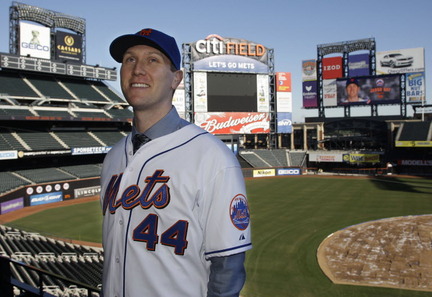
Q: Have the dimensions of Citi Field been to the detriment of the Mets franchise? From Yair, Bat Yam, Israel
MLB reports: Great question Yair and shalom (hell0) to you in Israel! With the lacklustre play of the Mets the last few seasons, its great to see that they still have so many fans, even internationally. Getting to your question, the topic of Citi Field has been a continuous one since its opening back in 2009. The $850 million structure replaced Shea Stadium and has not played out in the same way that new Yankee Stadium has to say the least. At a capacity of 41,800, the stadium holds 15,000 fewer fans than Shea and was meant to be more intimate. Citi Field has some interesting features in its design. Citi Field’s fences are not the same size, ranging in height from being 15 feet in left field and 18 feet in right. Shea Stadium had outfield fences that were all 8 feet in comparison. The dimensions overall are not far different from Shea, with approximately 335 feet to the field lines and 408 feet to center. Shea was never a great hitters ballpark to begin with and Citi Field is no better. I would attribute the height of the fences as being a major issue for the team in terms of hurting the amount of home runs in the park. As well, the shortage of quality hitters on the current Mets squad is the main reason for any offensive issues. As a ball park, Citi Field ranks 11th currently in terms of home runs but 27th last year. It will be interesting to see how the field plays out this season. But the bottom line, is that the Mets have the same advantages and disadvantages at Citi Field as all opposing teams. As a pitcher’s park, the team needs strong pitching and defense to remain competitive on its home turf, with good timely hitting. This may sound obvious, but team talent and not the stadium will decide the team’s fate at the end of the day.
Q: Ok how about this? I am not yet dropping Derek Jeter from fantasy team. Can I drop Brett Wallace or Mark Trumbo for Yunel Escobar as insurance for Jeter? From Maury, Boston
 MLB reports: Hell0 Maury and no, you cannot make this move. As much as Jeter is struggling, dropping talents like Wallace and Trumbo do not make sense at this point. Wallace is hitting .321 in 2011 with 3 home runs and .869 OPS. Trumbo, while starting to struggle somewhat with a .244 AVG has 6 home runs and 18 RBIs. If you must make this move, then drop Trumbo and grab Escobar, who is hitting .295, with 3 home runs and .775 OPS. Quality numbers for a shortstop. But Jeter is still Jeter and will rebound in my estimation. Keep plugging the Yankees captain in your lineup and expect a rebound soon.
Q: Can the Cubs please just leave Starlin Castro in a fixed spot in the lineup? Like, say, leadoff? Hitting him 3rd is (^*&&*%$! From Reuben, parts unknown
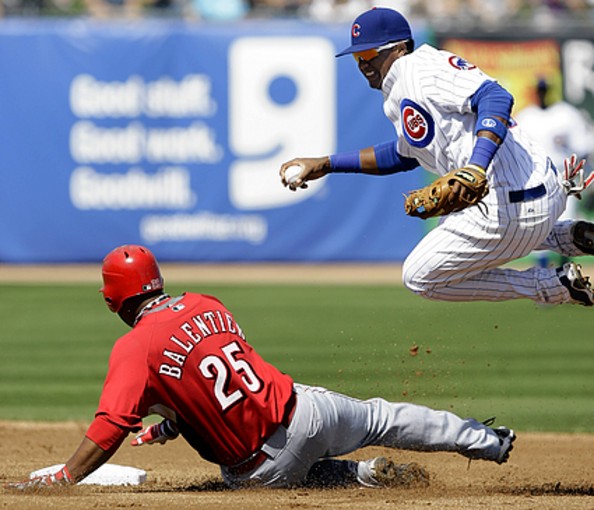 MLB reports: I can’t argue with Castro’s numbers to start the season. .327 AVG, .789 OPS, 23 runs scored, 18 runs driven in, 4 stolen bases and 6/14 BB/K ratio. As a leadoff hitter or hitting in the second slot, Castro has strong abilities to get timely hits and create runs. I couldn’t agree with you more that batting Castro in the third slot does not make sense. With one home run this year and three all of last year, the power is not there for the Cubs shortstop. The move to hit him third would be out of desperation than anything else. It is a relection on the Cubs for a lack of other options, than Castro as a new power guy. As the Cubs continue to gel through the season, expect Castro to have a permanent lineup slot soon. Leadoff appears to be most likely his destination.
Q: Do you think Aaron Hill might be enough to protect Bautista in the Jays lineup? I obviously don’t mean full protection, but maybe just enough for the Blue Jays to be a force. Another great article by the way, I enjoyed reading your feature on Jose Bautista! From Nolan, parts unknown
MLB reports: Thank you for reading the reports, I always appreciate the feedback. The Bautista article was a lot of fun to write and I enjoyed giving the readers a look into the Jays home run king (You can click to read our piece on Bautista). As far as AaRon Hill coming back and providing good protection in the lineup, I will admit that I have my doubts to say the least. Hill has missed several games this year due to injury and when he has been able to play, has hit to the tune of a .237 AVG, no home runs and .573 OPS. If you take aside 2009, Hill has never shown to be a really good hitter and in my opinion, that season has been an outlier rather than the standard. Aaron was actually the subject of the first ever article on MLB reports. If you would like to read more about Aaron and his future on the Jays, please click here. But if you want the brief synopsis: Hill is more likely a candidate for a trade/release over the next year than any guarantee of production. I do not have very much faith in him and neither should you.

Thanks for the e-mails and keep them coming! mlbreports@gmail.com

E-MAILBAG ARCHIVE: Click here for the Archives of Ask the Reports
Please e-mail us at: MLBreports@gmail.com with any questions and feedback. You can follow us on Twitter and become a fan on Facebook . To subscribe to our website and have the daily Reports sent directly to your inbox , click here and follow the link at the top of our homepage.

Meet Dr. Antonio Castro: Team Doctor for Cuba and Son of Fidel

MLB reports: In part 3 of my impromptu 3-part feature on Cuban baseball, I am featuring Antonio Castro Soto del Valle, team doctor for the Cuban national team, Olympics and WBC. Dr. Castro, a top orthopedic surgeon in Cuba, just happens to be as well the son of Fidel Castro. Fact or fiction you may ask? Fact. The story of Castro is one for the baseball ages that I first stumbled upon during the 1996 edition of the World Baseball Classic that I will be sharing with you today.
One of my favorite parts of baseball is the obscure news items and pieces of information that are out of the “normal” realm. The Glenallen Hill arachnophobia incident, when Chuck Finley was attacked with a female pump by his then-wife Tawny Kitaen, Wade Boggs eating fried chicken before every game…well, you get the idea. One part of the 1996 Cuban WBC team really stuck out in my mind at the time. It seemed that every time Cuba was about to change a pitcher, the team manager for Cuba was always consulting with team physician. In fact, the doctor was talking to the players before and after at-bats, sitting down with pitchers between innings and jumping out of the dugout to be the first person to congratulate the players as Cuba scored each of their runs. This seemed a little strange in mind, so I tried to focus on the team doctor to get the scoop. Looking into the Cuban dugout on the television, I further noticed that the manager never left the team doctor’s side. The team doctor further seemed to enjoy talking on his cellular phone, even during games. By the time the 1999 edition of the classic was upon us, I figured out all the mystery behind Cuba’s team doctor. Only a one-word answer was required: Castro.
 Dr. Antonio Castro Soto del Valle was apparently a great athlete in his day and played 3B in Cuba. Much his like father Fidel, a pitcher with a legendary curveball (See the book Castro’s Curveball, by Tim Wendel), baseball was always in Antonio’s blood. But apparently baseball was not in the boy’s future, much like his father before him. Fidel gave Antonio 2 choices: go to medical school or fight in the military. Wisely choosing medicine, Antonio grew to become one of Cuba’s top orthopedic surgeons. But his fame and popularity have evolved from his role as the physician for Cuba’s baseball national teams. Before games, Castro is often spotted signing autographs for fans and taking pictures. The connection between the name “Castro” and baseball is too rich for most diehard fans to pass up. Extending beyond medical capabilities, the issue on my mind is the true part that Antonio plays with Cuban baseball. Further, the extended role of Fidel on the team through his son. The likelihood of the Castro connection in managing and controlling the Cuban team is too high to ignore.
In all the interviews with Antonio Castro that I have read, he has always denied direct or indirect involvement in managing the Cuban baseball team. Further inquiries as to whether Fidel contacts him during games to advise the manager of the team has always been responded to with laughs and denials by Antonio. However, if you go back and watch any of the Cuban WBC games, the sight of Antonio on his cell during games and speaking with the manager throughout is one that seems very murky to say the least. If I had to hazard a professional guess, I would say that the Cuban manager was rarely if ever making a move without some form of feedback from Castro. To the naïve or unknowing viewer, Castro would appear to be a bench coach, hitting or pitching instructor based on his role in the dugout during games. I will admit that I made this mistake during my first observations of Castro. In fact, I can even recall watching Castro making a mound visit during a game to speak to the pitcher without any medical or injury concerns. Much pressure on any pitcher, as the feeling would be as significant as if Fidel himself was speaking to the pitcher.
Cuba is faced with a significant loss of talent to the MLB through defections. Articles I have read have indicated that based on his age (late 30s) and strong rapport with the players, Antonio Castro has the unofficial role of raising the morale of players and reducing defections. There has even been talk of Cuba moving to a system of taxing its players’ salaries in exchange for the permission to leave Cuba and pursue professional baseball in other countries. Antonio Castro in fact, is one of the leading proponents for this system. With the U.S./Cuba trade restrictions, such a system may be impossibility, but the mere fact that a Castro is leading the push for reform appears to be a good sign for Cuban baseball. Taking the above roles in baseball out of the equation, the hiring of Fidel Castro’s son as the team doctor for the Cuban national team boils down to a very simple logic and explanation in my mind. By seeing Antonio Castro in the dugout and field, the players cannot help but work harder and play stronger. Having Castro travelling with the team and in the hotels likely serves as a deterrent or hindrance for many players in their mind from defecting. Do I think that Fidel talks to his son during games on his cell phone? Without proof, I would answer without a doubt. Do I think that Antonio talking to the manager during games is in reality Fidel giving instructions to the manager? Absolutely. If Billy Beane was able to contact his managers during games as discussed in “moneyball”, I cannot see why Fidel would be any different. Cuba is ruled by a dictatorship, why should its baseball team be any different?
Don’t get me wrong. I love Cuban baseball to its absolute core. I would rather view a Cuba Series Nacionale game than an MLB game any day of the week. I am a passionate major leagues supporter, but Cuban baseball is played at a much different level and intensity. The players will do whatever it takes to pull out wins and the managers will not hold back any punches in the process. Cuba embodies everything that is professional baseball, especially through the Castro family. You may agree or disagree with Cuba’s political stances and approaches, but its game of baseball is still the same as ours. Only Cuban baseball is played in the same way the game was played in our neck of the woods many years ago, in an era long gone by. Dr. Antonio Castro is a similar throwback to the glory days of baseball, as was Ariel Pestano and the use of pitchers in Cuban baseball featured in the previous 2 parts featured on MLB reports. If you have never seen Antonio Castro before, check out some of his team’s games. Otherwise, I trust that you are now more familiar with Cuban baseball after reading these features and were able to see that there is more to the game and culture of baseball outside of the MLB.

Please e-mail us at: MLBreports@gmail.com with any questions and feedback. You can follow us on Twitter and become a fan on Facebook . To subscribe to our website and have the daily Reports sent directly to your inbox , click here and follow the link at the top of our homepage.


 MLB Reports
You must be logged in to post a comment.