
Johnny Anderson Interview: The Baseball Comeback Kid… “Never Say Never”
Thursday January 26, 2012
MLB reports – Jonathan Hacohen: Get ready for the complete baseball ride tonight, as we jump into the world of Johnny Anderson. The Blue Jays pitching prospect was born in Pleasanton, California (ever see the movie Pleasantville? Same idea.) The left-handed starting pitcher was drafted by the Jays back in 2008. Only 23 years-of-age, the sky should be the limit for Anderson. He has big dreams. Owning a collection of fancy rides. Getting acquainted with the women of Toronto. The Blue Jays prospect wants it all! But as is the case with many young pitchers, a road bump presented itself. Here is the video (beware, it is not for the faint of heart):
I will give you a hint. The surgery that followed has the intials T.J. in it and involves a certain famous doctor in Alabama. If you follow baseball closely, you know what I am talking about. Dr. James Andrews and Tommy John surgery. The good news in the case of Johnny Anderson is that he is feeling great and well on the road to recovery. Facing adversity has not slowed down Johnny Anderson. It has only made him stronger. Today we learn about the Jays prospect, from the draft to his experiences in professional baseball. You can call him John Anderson. Or call him Johnny. Get ready to laugh. Get ready to cry. Get ready to sigh. Get ready to cheer. Today on MLB reports, we present our interview with Blue Jays prospect, Johnny Anderson:
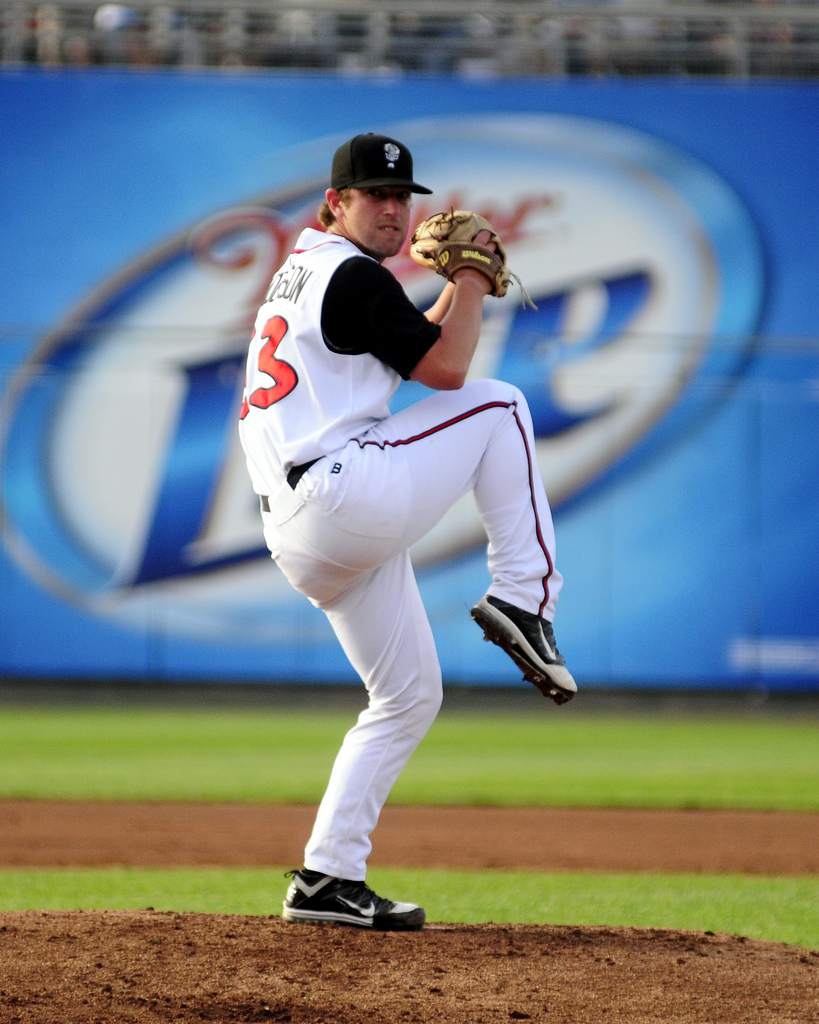
MLB reports: Welcome to MLB reports! Our fave starting question: who was your favorite baseball player growing up, that you most idolized and patterned your game after?
Johnny Anderson: Being a kid growing up in the greater California Bay Area, I always was within a stones throw from Candlestick and the Oakland Coliseum. Seeing the A’s “Big 3” was quite the treat. I modeled my pitching after Zito, which might be why I got hammered around when I was younger. There was also another soft-tossing lefty that some may remember; Noah Lowry (Editor’s Note: BIG Lowry fan. Nice call Johnny!) We pitched almost identically to each other, so it was always a treat to see him throw.
MLB reports: Which current MLB star do you most admire and why?
Johnny Anderson: With the Blue Jays graduating so many pitchers over the last couple years, it’s pretty cool to see guys I’ve played with over the years in the Show. With me being in and out of action the past couple years, I’ve been in the training room with a lot of pitchers that have been well established at the major league level. I’ve spent time around guys like Brandon Morrow, Shaun Marcum, Doc Halladay and others. It’s always fun to pick their brain and hear what they have to say.
MLB reports: Reflecting on your career to-date, what are your proudest accomplishments on the baseball field?
Johnny Anderson: Over all the years I’ve played, I’ve never won many awards or accolades. I’ve been the guy that’s always flown under the radar… and I’m completely content with that. I played 2 years at the Junior College level and without a doubt, they were the most memorable. We were so close to winning a State Championship, but one strike away each year. I was Conference Pitcher of the Year in 2008 and I cherish that honor more than anything thus far.
MLB reports: When you first found out you were drafted, what were your reactions?
Johnny Anderson: I previously held a commitment with Oklahoma State University before the draft in 2008. I knew I had a shot at getting selected pretty high, but had no clue what was about to take place. I had an agent/advisor that helped me with the whole draft process so that I’d be prepared if the right deal was in place. The day before, I had close to 20 different teams call me asking me if I’d sign. I gave all of them my agent’s number and let him do the negotiations. If the price and opportunity was there, teams were supposed to know that I was more than willing to forego school and sign. Lo and behold, my agent asks for an outrageous number and I slide to the 28th round. The Jays called my name and I was ecstatic. I knew my life was about to change FOREVER!
MLB reports: You have gone through a very difficult and long baseball road. Tell us about your journeys through your various surgeries…and what is Dr. Andrews really like?
Johnny Anderson: When I was younger I wasn’t much of an athlete. I was the chubby kid that was just happy to be out there playing. I didn’t make any all-star teams or blow anyone away, I just had the love for the game. I’ve always had a pretty decent arm. I started pitching when I was 12. I played my first 3 years of high school ball and then didn’t even have the opportunity my Senior year. Yes, you read that right. I’m no MIchael Jordan. The next year I walked on to the local Junior College and I made the team. After two outstanding seasons, I signed with the Blue Jays in 2008. Two years later, I show up for Spring Training ready to compete for a job at the Hi-A level. First game of spring, the unthinkable happens. I feel a pop, and I hit the ground. I knew it as soon as it happened. I was going to need Tommy John surgery and be out for the season. I thought to myself “Ok, I’ll get a brand spanking new elbow and I’ll be ready to rock and roll next year.”
I rehabbed for a year and I felt stronger than ever. My velocity was off the charts, and I felt like a completely different pitcher. The Jays sent me to Lansing last year and after a couple of games, I began to have the symptoms that it was going to happen again. Tenderness, loss of range of motion and unusual soreness. I worked hard to get back to a healthy state and then…it happened again. I was in complete shock. I fly out to Pensacola to see the famed Dr. James Andrews. He’s your typical Southern gentleman. He has a thick cajun accent and is definitely the best in the business. He sees my MRI results and looks dumbfounded. He tells me he’s hasn’t seen a tear of this magnitude in years. To quote him, he said “it was a 1 in one million” type of injury. Not only was my UCL replacement completely disintegrated, but I had torn my Flexor-Pronator tendon as well. It was going to be a long road ahead. As of now, I’m 7 months out of surgery and feeling stronger than ever. I’m feeling extremely confident about the upcoming season and ready to compete for a job.
MLB reports: Tell us about your current offseason? How is the rehab going?
Johnny Anderson: To state it frankly, I’m in the best shape of my life! (editor’s note: music to my ears. Always a great sign!) I’ve been throwing for close to 3 months pain-free. If all goes well I should be ready to join a squad before the All-Star break.
MLB reports: Your 2011 season was very encouraging based on the numbers. It must give you great hope for the future.
Johnny Anderson: I was pretty satisfied with how my season went, even considering how short-lived it was. I took the mound with a bulldog mentality and knew that I could blow the hitters away with my stuff. If I can keep the same mindset- the sky is the limit.
MLB reports: What do you have in your bag of pitching tricks- what do you throw?
Johnny Anderson: I guess you can say I’m the prototypical lefty. I throw both a 2 and 4-seam fastball and complement it with a straight change-up and 12-6 curveball. The renowned Mel Queen (RIP) taught me how to throw a cutter. The same one he taught Halladay when he had his early career woes. It’s a tough pitch to master, but I’ve been working on it over the years.
MLB reports: Any plans on going the knuckleball route? A lefty knuckler would be sweet.
Johnny Anderson: As a matter of fact, I think I have a pretty decent knuckle. The rule of thumb is that you only use a knuckleball if you don’t have a fastball. So, as long as I can hit 90 I’ll stick with the fastball. We’ll see what happens down the road…
MLB reports: What facets of your game do you most wish to improve upon?
Johnny Anderson: I always like to be challenged. I’d love to play at a higher level, as I only have one game of experience at Hi-A. I want to show everyone that I can compete with the big boys. I may not be a high-acclaim prospect, but if given the opportunity I know I can perform at any level.
MLB reports: What do you do for fun when you are not playing baseball? Best friend(s) on the team that you most hang out with and what do you guys like to do to chill?
Johnny Anderson: During Spring Training me and Kevin Ahrens spend our off time confined in the team hotel playing Call of Duty. Yes, I’m quite the video game nerd. In the offseason, I enjoy working out and seeing concerts. There are tons of venues in the San Francisco area to see live shows. I love all sorts of music especially Electronic stuff. Not quite sure if this “dubstep” thing is a fad…for now I’ll listen.
MLB reports: Have your visited Toronto the city yet? Have you met Alex Anthopoulos? How have you found the city and their GM thus far?
Johnny Anderson: No! As a matter of fact I’ve never even left the States before. I’ve heard nothing but great things about Toronto and Canada. Especially the women (wink wink). I met AA in 2008 at our Instructional League. He knows more about the game than just about anyone I’ve ever met. Jays fans must be pretty excited about the future. This team is going up and up.
MLB reports: What do you think of Toronto Blue Jays fans?
Johnny Anderson: I’ve spoken to many through various social media outlets and I love them all. They are extremely passionate about their team and interact with all the players. What more could you ask for?
MLB reports: If you hadn’t picked baseball- what would you be doing today?
Johnny Anderson: Baseball will always be around me, I love this game more than anything. In the offseason, I teach pitching to younger kids with a couple of other minor league guys from the area. I could definitely see myself being a coach sometime in the future. Also, my father is a recently retired Police Officer. My Plan B is to finish my degree and follow in his footsteps.
MLB reports: Dream car?
Johnny Anderson: Anything fast and loud. I’ve driven a couple super cars in my time, and I can definitely say that I want one for myself. So if I ever make it to Toronto, you can count on me having a couple of Mercedes’ and American Muscle cars in my garage.
MLB reports: If you could look into a crystal ball- where do you see yourself in five years?
Johnny Anderson: Hopefully still lacing up the cleats! If my time has come, I can definitely see myself being a Police Officer and a High School pitching coach.
MLB reports: Final thoughts?
Johnny Anderson: I’d like to thank MLBreports.com giving me the opportunity to share my story and the Blue Jays for sticking with me, even after everything I’ve gone through. I love all of my fans (the few I have) and interacting with them. I’ve become quite the Twitteraholic as of late and I can be followed at @jma32. I enjoy interacting with everyone, so give me a follow!
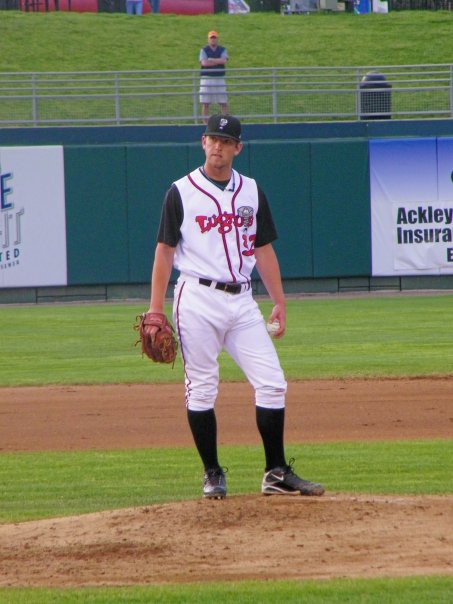
***Thank you to Johnny Anderson for taking the time today to speak with us on MLB reports (and the pictures/video used in todays’ feature)! Johnny LOVES Twitter- so follow him ASAP!!! 2012 is a big year for Johnny as he continues on his road to recovery. Best of luck Johnny: we’re proud of ya!***
 Jonathan Hacohen is the Lead Baseball Columnist & Editor for MLB reports: You can follow Jonathan on Twitter (@JHacohen)
Please e-mail us at: MLBreports@gmail.com with any questions and feedback. You can follow us on Twitter and become a fan on Facebook . To subscribe to our website and have the daily Reports sent directly to your inbox , click here and follow the link at the top of our homepage.

How Jon Daniels Turned the Rangers into a Perennial Playoff Contender
Thursday January 26th, 2012

Sam Evans: As hard as it is to rank GM’s in baseball, Texas General Manager Jon Daniels has to be considered one of the best in the game. Daniels hasn’t been perfect running the Rangers, but he’s been as close as you can get. He has completely turned around the direction of the Rangers franchise and he’s due to receive much of the credit for the recent success of the franchise.
Jon Daniels got his start in baseball as an intern for the Rockies in 2001. In 2004, he was named the Rangers assistant GM. Then, in 2005, Jon Daniels became the youngest General Manager in baseball history. Right after Daniels took over, he made a gutsy trade: moving Alfonso Soriano, the Rangers best player to the Washington Nationals.
In 2005, it had been six years since the Rangers made the playoffs. Now, seven years later, the Rangers have made two straight World Series appearances. Not to mention they have had one of the best farm systems in baseball for the last four years. It seems like every time the Rangers graduate prospects to the majors, there are even more future stars waiting in the wings.
Jon Daniels doesn’t deserve all the credit. His scouting department is the best in the majors (in my opinion). I recently watched a show about Gray wolves. The Gray wolf has evolved over the years and it has learned that hunting with fellow wolves is easier than hunting alone. Jon Daniels and his scouts are very similar to these wolves. The Rangers employ one of the largest scouting department in the majors. So similar to the wolves, the Rangers believe in strength in numbers.
The Rangers have an extremely diverse 40-man roster. Not even in terms of nationalities, but in how the Rangers acquired each of the players. On the Rangers 40-man, 15 of their players were acquired via trade, 1 was acquired through the rule five draft, 7 were international free agents, only 4 were MLB free agents, and 1 was acquired from McDonald’s. Sorry, Mark Hamburger. I couldn’t help it. A large part of the Rangers success is because of the Jon Daniels and the ability of his scouts to recognize and acquire talent through all aspects of the game.
Most of Texas’s new talent is coming from overseas, Latin America in particular. Elvis Andrus, Jurickson Profar, and Ronald Guzman were all signed at a young age by the Rangers scouts. The Rangers haven’t been afraid to hand out large bonuses to get these talented youngsters to sign. Rangers outfielder Leonys Martin, for example, was signed to a record-setting 5-year, $15.5 million contract out of Cuba.
Texas recently signed Daniels through the 2015 season. So Rangers fans won’t have to worry about Daniels going anywhere. Thanks to Daniels and his staff, Texas will be a hard team to beat in 2012. They have depth at every position and more talented players close to the big leagues. At the rate the Rangers are producing talent, they’re not going anywhere. The Rangers are going to be a consistent playoff contender for a long time to come.

 ***Today’s feature was prepared by our Baseball Writer, Sam Evans. We highly encourage you to leave your comments and feedback at the bottom of the page and share in the discussion with our readers. You can also follow Sam on Twitter***
Please e-mail us at: MLBreports@gmail.com with any questions and feedback. You can follow us onTwitter and become a fan on Facebook . To subscribe to our website and have the daily Reports sent directly to your inbox , click hereand follow the link at the top of our homepage.
Follow @mlbreports
The Maggie McCracken Interview: One on One with the Star of Baseball Wives
Thursday January 26, 2012
MLB reports – Jonathan Hacohen: Today on MLB reports, we break new ground. First we started in Hollywood. I have enjoyed many opportunities to speak to actor Casey Bond, who portrays Chad Bradford in the hit movie Moneyball. Now we move from the baseball big screen to your television set, as I share my conversation with Maggie McCracken. The VH1 show “Baseball Wives” is a huge hit and I am excited to be speaking to one of its cast mates (our first, wink). Maggie is married to former major league outfielder, Quinton McCracken. Quinton played 12 major league seasons for 6 different clubs. He was known for hitting for a solid average, his ability to get on base and of course, dynamite defense. Quinton is still very active in the game of baseball, as a member of the Arizona Diamondbacks front office. According to Maggie, he also reads MLB reports on a daily basis. You know that means we love ya Q!
Today, I reveal my interview with Q’s better half. Maggie is an absolute bundle of energy. It has been uplifting to get to know Maggie and learn her baseball story. What we all see on television is one thing. But sometimes there is more to the story than meets the eye. While the Maggie McCracken we see on television is her…there are other sides of the Baseball Wives star that we wanted to reveal to our readers. Maggie’s family, including her precious little boy Isaiah. Maggie is a passionate mom. She founded the charity “Miracles Do Happen” and is very social conscience in making a difference. Did I mention that she is an avid boxer as well? From marrying Quinton to joining the baseball reality television world and everything in between, this is the Maggie McCracken story. Where she came from and where she is going. Today we learn all!
Get ready for a great baseball story as we proudly present our interview with the one and only, Maggie McCracken:

MLB reports: Maggie- it is a pleasure to be speaking with you and thank you for joining us today on MLB reports. Let me start off with our favorite topic: Baseball. What does the sport mean to you?
Maggie McCracken: Thank you for having me, I am honored. Quinton and I have been together for 11 years and Baseball has been a part of our life for our entire relationship. That being said, my feelings for the sport have changed over time. In the beginning it was fairly new to me. It was exciting to watch the games from a different view. Over time, your world starts to revolve around every game and then the game is over. Q has changed gears and is now in the front office. So now I see the other side of the sport which is tough. It’s hard to see the stress and agony in Q’s face when he has to make those hard decisions, when a guy doesn’t make the team it affects his entire world. That’s hard. So it has been a roller coaster. But Baseball has been good to Q and our Family and there’s a bond in Baseball that can never be broken.
MLB reports: Prior to entering the world of reality television, tell us about the life of Maggie McCracken. Mother, wife- what was life like before Baseball Wives?
Maggie McCracken: My life was already very busy. We have a two-year old son, Isaiah, who was born at just 23.6 weeks. Isaiah is the youngest baby born in Scottsdale to survive. Viability is 24 weeks, so my life before the show consisted of being Isaiah’s Mommy and trying to find ways to pay it forward. I became an Advocate and an Ambassador for The March of Dimes. In those roles, I help bring awareness and education to the community and mentor families going through the same thing our family went through. During my work with the March of Dimes, I founded our Charity, Miracles Do Happen. Our largest event, which is held every year in April, is a silent auction and raffle; all proceeds benefit the March of Dimes. As you can see, before the show, I was still very busy conquering the world with Isaiah and taking care of our family!
MLB reports: How did you meet Quinton? What was the wedding like and how would you describe Quinton McCracken the husband?
 Maggie McCracken: A mutual friend introduced us and at first Q told me he was a shoes sales man (LOL), so I thought well if it doesn’t work out, I could always get a discount on shoes. What woman wouldn’t want that? He eventually told me the truth and I believe I said “so no free shoes?” Q is exactly who you see on TV and on the field! He is loving, passionate, caring and a lot of fun. He is also very quiet and methodical, he thinks everything out. He loves deeply and there isn’t anything he wouldn’t do for his family. Our wedding was at Duke University (Which is where Q went to school). It was beautiful; it was fun and full of love. Looking back, I wouldn’t change a thing!
MLB reports: You just mentioned that Quinton is now working with the Diamondbacks front office. How has life changed for the both of you since his career switch?
Maggie McCracken: Yes! Q is back with the Dbacks in the front office and he loves it! It is something I knew he would enjoy and be great at. He knows so much about his craft and he is also very compassionate. It can be hard at times; we went from having him home every day for almost two years to him now being so busy that we don’t see him very much. But he is happy and we are a team- so you just make it work.
MLB reports: Did you ever have any doubts or reservations about becoming a Baseball Wife? What were your expectations when you became a Baseball Wife?
Maggie McCracken: I had reservations about marrying an athlete period. I heard all the same stories everyone else has heard: the groupies, the traveling, the ego’s…etc. But I married Q the man- not the baseball player and it was the best thing I could have ever done.
MLB reports: What did you study growing up? What was your career vision as youngster?
Maggie McCracken: I studied Early Childhood Education. I love kids of all ages, there’s an honesty about them that you rarely see from adults anymore. They are our future and I love being a part of teaching them about the world and watching them soar. When I was younger I wanted be a doctor, but holy cow- that’s a lot of school! If I am being honest, I went to school to be with my friends so eight years of school seemed like way too much (giggle).
MLB reports: How did you first find out about Baseball Wives: Did VH1 approach you or did you approach them?
 Maggie McCracken: Tanya Grace (who is on the show) asked if I was interested. I said why not, I will shoot one scene and see what it is all about. I did a shoot for a lunch scene with Tanya, Erika Williams and Brooke Villone. After that shoot, the producers asked me to shoot again so I did. When they asked for a third time, I said “we need to talk about a contract”, as I have learned from Q’s career. I felt it was a reasonable request seeing that I was putting my life out there and all. At first I was told to just “hang in there” and sooner or later they would offer me a contract. I stood my ground and said I wouldn’t continue without one. All of a sudden “poof”: on my fax machine was a contract! I had a trip planned to go to Miami with one of my best friends. I decided I would take that time to really think about what this all would mean.
MLB reports: Was it a difficult decision to decide to do the show? What were your husband’s thoughts on the subject?
Maggie McCracken: The decision to do the show was extremely difficult; if I only had myself to think about ,I am positive it would have been an easier one. But I have my family to think about and any decision I make from here on out affects them as well. I remember thinking if I decide to do the show, the world gets to see our ups and downs, our highs and lows. Above all, by making the decision to be on TV I am now a role model, like it or not. The only decision I had left was what type of role model I wanted to be. That decision was simple! I promised my family, friends and myself that I would continue to stand up for what I believed to be right, to only be involved in “fights” that involved conversation and not the stereotypical fights you see on Reality TV (such as hair pulling and putting your hands on another woman). I wanted other women and young girls who watch these shows to see that courage is being able to speak up for others even when you may be the only person doing so, to be secure and confident in what you have to say – to see that what you have to say matters and it should be heard. I wanted women to see that there actually are women on Reality TV who don’t feel it necessary to call another woman out just to get a point across and who are secure in themselves to help build other women up and help them succeed. As long as I stayed true to myself and what I believed, Quinton was by my side the entire way.
MLB reports: How well did you know any of your cast mates before the show?
Maggie McCracken: I was very good friends with Tanya Grace and Erika Williams before the show. I really wish they would have shown more of those friendships. Tanya and Erika are very involved in my charity work. Erika emceed last year’s Miracles Do Happen event. We shot some great scenes that focused on our friendships and life’s hardships, but unfortunately the viewers didn’t get to see that. I knew Brooke from when we were with the Mariners, but I got to know more of her during the show. The rest of the women I met during filming.
MLB reports: Who are your friends/enemies from the show? Do you really like/dislike each other?
 Maggie McCracken: I have to say this question/s is the number one question asked (LOL)! I hold the word “friend” close to my heart. I work hard to be the GREATEST FRIEND I can be to those extraordinary people in my life that I do call a “friend”. I don’t have enemies. If I think of you as an enemy, that would mean I would actually let you affect my life and life is just too short. That being said, I took something away from each of these Ladies that I can honestly say made me a better person. Erika has this unspoken grace and sophistication about her, Tanya has an unconditional love for others, Anna has a way to get you to laugh at life when you have the worst of days, Brooke helped me realize that I could sometimes listen more and talk less (chuckle), Jordana takes the time to stop and appreciate life and what it has to offer, Cheri has a huge giving heart and Chantel has an unbreakable courage about her. Yes, we actually do talk, text and hang when the cameras are off!
MLB reports: Knowing what you know now- would you still have decided to appear on Baseball Wives?
Maggie McCracken: Without question I would do the show all over again, because I stayed true to who I am.
MLB reports: How do you feel that you are portrayed on the show? Are you the same Maggie off-screen?
Maggie McCracken: I was portrayed on the show exactly how I am in real life! I was portrayed that way because I NEVER said anything just for the show and I NEVER did anything just for the show. Some may say I should have been more dramatic or done this or said that and I would have gotten more air time. I have never blamed others for what may have gone right or wrong in my life, or for not going the way I wanted it to go. I take responsibility for who I am, what I say and how I treat others. Who you watched on TV is who you will meet in real life!
MLB reports: How have you found reactions generally to the show? From the public and media perspectives.
Maggie McCracken: The reactions vary from episode to episode. If the episode is Brooke and I not getting a long for five minutes then the next thing you know I am getting tons of tweets from Brooke’s fans attacking me for something I said… and vice versa I am sure. Overall, it seems like the public enjoys a fresh new show that doesn’t show women physically attacking each other, although there is some verbal attacking going on, I guess that is unfortunately the nature of reality TV. I do have to say I enjoy the feedback from fans, the good, the bad and the ugly (grin).
MLB reports: How has your life changed since the premiere of Baseball Wives?
Maggie McCracken: I feel like the timing of the show couldn’t have been better. At this time in my life I am surrounded by such wonderful, supportive people who I am so honored to call my family and friends. What makes this crazy ride so much fun is being able to share it with all of them! It has opened doors for our charity (Miracles do Happen) and given us a bigger platform to speak from. I am so grateful for that!
MLB reports: What do you do for fun in your spare time?
 Maggie McCracken: I enjoy spending my spare time with Isaiah, we play, we laugh, we dance, and this little boy has moves, let me tell you! I love being at home, I love cooking for my family and trying out new dishes on my lovies (my best girlfriends). Lately the McCracken Casa has been the hangout for us girls, we cook and drink wine. We have girl talk and solve the world problems, or just each other’s (big smile). I enjoy being a part of different causes like the Multiple Sclerosis Society. One of my best friends has MS and we walk every year and help her raise money for the cause. I am also involved in MASK (Mothers Awareness of School Aged Kids). Isaiah is in school now so when he is there and it’s just me, I go and see my trainer Rico Hoye at his gym in Scottsdale and hit the bags (BOXING)! Boxing is my passion, I love learning the craft, I love watching it on TV and it’s where I can let it all out!
MLB reports: What is the future for Maggie McCracken- where do you see your life heading? Will we see another reality show, movies, television, book….?
Maggie McCracken: I am open to the possibilities. We have one shot at this thing we call life and I am blessed to be here and blessed to be where I am. For that I will make the most of it and do my very best. So bring IT!
MLB reports: What does it take at the end of the day to be a successful “Baseball Wife”? With so many demands on your time, how do you juggle everything?
Maggie McCracken: Well, first and foremost, I have to be a successful me before I can be a good wife, mother or friend. I try to always keep my priorities in line, to me that is very important. Yes, I enjoy hanging out and having fun. I enjoy traveling and I also enjoy just being at home. But certain things come first in my life and if those things are not taken care of me first, then I feel unbalanced and I don’t feel good about myself. It frustrates me to hear people always complain about the troubles in their life and all they have to really do is look at themselves and prioritize.
MLB reports: What advice would you give to a young lady dating a baseball player and aspiring to be a Baseball Wife?
Maggie McCracken: Most importantly, I would say NEVER ASPIRE TO BE A BASEBALL WIFE or any title wife for that matter! It’s so easy to lose yourself in a relationship, to lose who you are, what you want, where you’re going etc. That comes with any relationship. More so in one that requires the other to travel a lot. I lost myself for a short period while Q and I were dating. I always wanted to be whereever he was; it was fun and exciting and I was young and in love. When this happens, life has a funny or harsh way of reminding you that you’re an individual. Maintain your own goals and dreams, believe in them and in yourself. The rest will happen.
MLB reports: Tell us about your charity and son Isaiah. We would love to hear about his story.
Maggie McCracken: Isaiah was born at just 23.6 weeks viability is 24 weeks. At just 1.7 lbs and less than a 10% chance of surviving he did and he is thriving. He is a miracle and he is my Hero. I adore him and I worship the ground he walks on. He inspired me to create our Charity (Miracles Do Happen), benefiting the March of Dimes AZ Chapter. Each year we have an event that is open to the public. We hold a silent auction, raffle items from boutiques, restaurants, local businesses, etc. There is great food, drinks and entertainment. Local celebrities come out to support and it just keeps getting bigger and better every year. This year it will be on Saturday April 7th at The Rock Bar in Old Town Scottsdale.
MLB reports: Any final words to all the Maggie McCracken fans?
Maggie McCracken: Thank you!!!! Thank you to all of you who have been so supportive and who continue to support me, my family, my friends, and our causes. Thank you for being a part of my life my journey and Miracles Do Happen. Thank you for joining me in making a difference. If you see me out and about- please say hello. Give me ideas and feel free to express your opinions. I love hearing from you! Most of all, be you and stay true!
Maggie

*** It has been a pleasure getting to know Maggie McCracken and we thank Maggie for her time and effort as part of being interviewed for this feature. You can follow Maggie on Twitter (@MagMcCracken) and tell her MLB reports sent you…she could follow you back! Also you can “like” her fanpage on Facebook. Maggie is a wonderful person and we simply can’t get enough of her! We look forward to Maggie returning to MLB reports in a recurring role…. Stay tuned!***
Jonathan Hacohen is the Lead Baseball Columnist & Editor for MLB reports: You can follow Jonathan on Twitter (@JHacohen)
Please e-mail us at: MLBreports@gmail.com with any questions and feedback. You can follow us on Twitter and become a fan on Facebook . To subscribe to our website and have the daily Reports sent directly to your inbox , click here and follow the link at the top of our homepage.

On the Verge: Talking Baseball with Jays Prospect Dwight Smith Jr.
Tuesday January 24, 2012
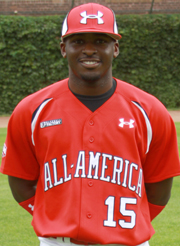
MLB reports – Jonathan Hacohen: Being based in Toronto, we have heard the name Dwight Smith Jr. discussed frequently this year. Smith, drafted 53rd overall by the Jays in the recent 2011 draft, has Jays fans excited about him patrolling the Rogers Centre outfield one day soon. I was able to catch up with Dwight recently to discuss his offseason and future goals. As a second generation baseball player, Dwight enters the professional ranks with expectations already attached to him. The benefit/curse of being a high draft pick and carrying on a famous baseball name. But Dwight is ready to take on those challenges and make his name in the game.
Like many young players, Dwight grew up admiring Ken Griffey Jr. Probably one of the best all-around talents this game has ever seen, Griffey is a great player to look up to. Interestingly though, it was Albert Pujols who Dwight favorites today. “He has so much success and yet he is still humble.” If every baseball prospect could keep that approach, the game would definitely have more future stars in its ranks! In addition to baseball, Dwight played basketball. Many top athletes are involved in multiple sports based on their high athleticism. When asked why he chose baseball, Dwight replied, “I played basketball until my senior year, but I chose baseball because I always loved it.” With Dwight Smith as his father, I have no doubt that Jr. grew up around the game and developed a deep love for the sport. But it’s not like Smith did not have choices. If he hadn’t signed with the Jays, he would have attended Georgia Tech and played college ball. When I asked Smith if he expected to go the Jays in the draft, he said that he did not…but “was grateful they picked me.” The baseball gods smiled down on draft day upon this outfield prospect, as I see a very good fit between the player and organization. With his strong tools and power/speed potential, Smith could be in Toronto one day very soon.
 I actually grew up watching his father, Dwight Smith (Sr.) and outfield partner Jerome Walton patrolling the Wrigley outfield for the Cubs. While his dad was not a hall of famer, he was a good overall player who did everything right. He played solid defense and contributed timely hits with the bat. I asked Dwight about the influence that his dad had on his career. Talking about his dad, Dwight replied that “he was a huge influence on me and the reason why I picked up a glove and bat. I learned so much from him not only about baseball but about life that helps me each everyday perform.” I was glad to see the strong bond between father and son. But it led to me wonder how being a “jr” affected Dwight and the type of pressure it put on him as a player. Dwight responded that “…it’s a blessing and a curse because being a 2nd generation ballplayer, so much is expected from you early and when you succeed they say it’s because your dad. Which isn’t fair to anybody because my dad never played a game for me but life isn’t fair. However, I never really felt much pressure because I have to play my game.” I found it very refreshing that Dwight could so clearly conceptualize the reality of being a 2nd generation player, but still stay focused and keep his position in the game in perspective. It is this type of thinking that I believe will lead Dwight far in the game of baseball.
Whenever I talk to a young player, I always ask them when they expect/hope to make the big leagues. Most are unwilling to put a timetable on their progress, while trying to work hard and hope that everything works out for them in the end. Dwight was a little different, as he set the goal for himself to make the show in 2-3 years. The secret for his success will be “hard work, dedication and if the good lord keeps him healthy.” Dwight cannot wait for the 2012 season to begin, as he is looking forward to his first year of professional baseball. After this year though, life will never be the same for him. Imagine the changes. One minute he was playing the high school ball…the next he is a member of the Toronto Blue Jays! Life can change in an instant. At the end of the day, his great baseball tools got Dwight Smith Jr. drafted and part of a Major League team. But it is focus and ambition that will carry him at the end of the day. For a team longing for more stars on its roster, help is on the way.
The Toronto Blue Jays have one of the best farm systems in all of baseball. Dwight Smith Jr. is definitely part of the new-look Jays prospects. He wants to work hard on every facet of his game until he becomes a complete player. Will we see the next Ken Griffey Jr. or Albert Pujols? Time will tell. But he definitely set the bar high for himself. Getting to know Dwight Smith Jr., he wouldn’t have it any other way.
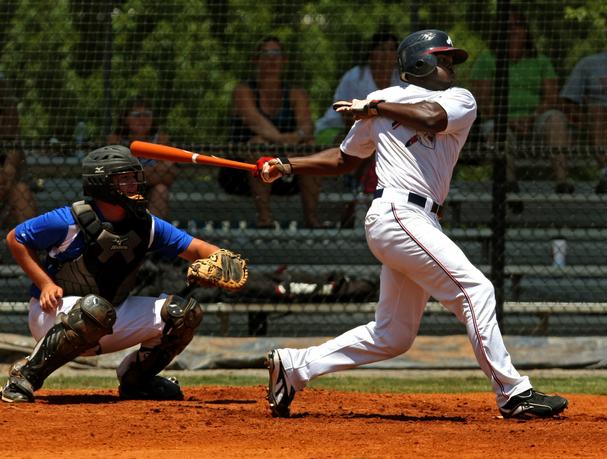
***Thank you to Dwight Smith Jr. for taking the time to speak with MLB reports! You can follow Dwight on Twitter (@dsmith25blujay). Dwight enjoys speaking with his fans, so please feel free to send him any questions/comments you have. Or just wish him good luck on the season!***
Jonathan Hacohen is the Lead Baseball Columnist & Editor for MLB reports: You can follow Jonathan on Twitter (@JHacohen)
Please e-mail us at: MLBreports@gmail.com with any questions and feedback. You can follow us on Twitter and become a fan on Facebook . To subscribe to our website and have the daily Reports sent directly to your inbox , click here and follow the link at the top of our homepage.

Why Triples Matter: Stocking Your Fantasy Team with Three-Baggers
Tuesday January 24th, 2012

Peter Stein (Fantasy Baseball Analyst – MLB reports): Many baseball fans are fascinated by triples, but it is certainly not a stat that people in standard Roto 5X5 fantasy baseball leagues pay any mind to. From an offensive standpoint, you are solely concerned with average, home runs, RBIs, and runs. Certainly triples contribute to a player’s offensive output, but by no means are they an asset to target in fantasy baseball. In reality, triples are often the product of a fortuitous bounce or carom and reflect more about a defensive player than the actual hitter. Nonetheless, triples are a rare occurrence and have a unique ability to excite the crowd and rally a team.
So, in fantasy baseball should we care about triples at all? On the surface the answer is no… but on a deeper level, it is actually yes. By no means is it wise to build a roster full of the league’s triples leaders. But a closer look at this stat can tell us a lot about a player.
In fantasy baseball and particularly in 5×5 Roto leagues, the goal is to find a player who can do it all: hit for average and power, produce and score runs, and steal bases. Not surprisingly, the league’s triples leaders are also at the top of the stolen bases leaderboard. It is the rare occurrence when you see a player like Curtis Granderson, who in 2011 showed his power with 41 home runs, as well as his speed with 10 triples and 25 stolen bases. The Granderson/Braun/Kemp/Ellsbury types of players are few and far between and are also on many championship rosters.
Before we go any further, let’s think about what it takes to hit a triple – namely a combination of power and speed. Triples are most commonly doubles, that are normally a double for a slower player. Therefore, if we look at a player like Brett Gardner with 19 doubles, 8 triples, and 9 home runs in 2011, it appears that his triple output has more to do with his speed and less about his power. For someone like Granderson with the 41 home runs and 26 doubles, it appears to be an equal combination of both. Let’s look for more examples of those types of players.
Take Michael Bourn: 61 steals, 10 triples and 2 home runs in 2011. Clearly, his double-digit triple output reflects his speed and surely not his power. When I scroll down the leaderboard and see Starlin Castro, (9 triples in 2011), light bulbs instantly begin to flash. Castro’s high triple out cannot be credited to speed alone (22 steals) because he still slugged 10 home runs and 36 doubles. At 21 years of age, Castro already has an amazing blend of power and speed, which is reflected by his ability to produce a three-base hit. By looking at Castro’s triples, we can tell that he posses this coveted five-category ability. You can only expect both his power and speed to increase and in my opinion, he has the ability to put up some Soriano-like home run/sb totals. Castro’s potential is most likely maxed out at 30/30, but this is due to the fact that he hits for average (.304 lifetime in 1137 at-bats) and is not likely to sacrifice for power. He could easily steal 40 bases and hit 30 home runs in the prime of his career.
The key is to look at the triple total for the young players who have yet to fully develop their power and speed. Triples can be a helpful future indicator of a player’s power and speed. For example, in his first full season in 2008, Adam Jones finished with 9 home runs, 7 triples and 10 stolen bases. The seven triples stand out, and although he possess great speed, the ten stolen bases indicate that he most likely did not rely solely on speed. His 9 home runs and 21 doubles demonstrate this his power also contributed to his seven three-baggers. The signs point to a player who has both speed and power. Sure enough, Adam Jones jumped to 19 home runs in 2009 and hit 25 home run with 12 stolen bases in 2011.
Triples shouldn’t even really be a concern for fantasy baseball owners, but can serve as a research aid of sorts. Look at the triples leaders and try to find the players who are not doing it on speed alone and have above average double and home run totals. If they are young and yet to reach their prime, all signs point to a player who has the ability to combine power and speed and develop into the coveted 5-category player.
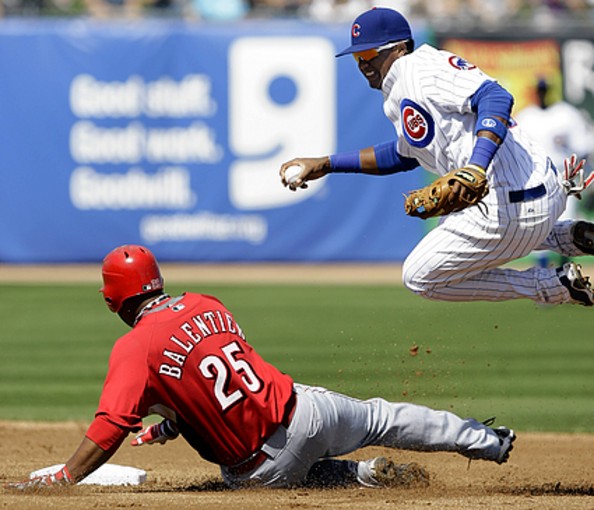
 ***Today’s feature was prepared by our Fantasy Baseball Analyst, Peter Stein. We highly encourage you to leave your comments and feedback at the bottom of the page and share in the discussion with our readers. You can also follow Peter on Twitter (@peterWstein).***
Please e-mail us at: MLBreports@gmail.com with any questions and feedback. You can follow us on Twitter and become a fan onFacebook . To subscribe to our website and have the daily Reports sent directly to your inbox , click here and follow the link at the top of our homepage.

Omar Vizquel to the Jays: Toronto Adds Future Hall of Famer to the Mix
Tuesday January 24, 2012
Jonathan Hacohen: The Blue Jays signed today a backup infielder to a minor league contract with an invite to spring training. But not just any infielder. Omar Vizquel. Yes, the same Omar Vizquel that will be turning 45 years of age this coming April. Entering his 24th major league season. The ageless wonder. The infield answer to Jamie Moyer. Vizquel and his 11 gold gloves will be coming to Toronto in an attempt to earn a spot on the major league roster for the coming season.
I like this move by the Jays on many levels. With a current infield including Yunel Esobar, Kelly Johnson and Brett Lawrie, Vizquel provides depth and insurance. He is still strong defensively and can be a quality late-inning replacement. Believe it or not, he can also still hit and chip in the occasional stolen base. With Yunel Escobar still maturing on and off the field, Vizquel could prove to be the role model and mentor that the young shortstop needs to be able to take his game to the next level. Vizquel in essence would be a quasi-player-coach on the Jays, helping Lawrie and Johnson tighten their games as well. Every championship caliber team needs strong role players, regardless of the sport. For the Jays to jump to the next level, they will need Omar Vizquel type players on its roster. There are no guarantees that Vizquel will make the team out of spring training, or last a full season. But if he does, Jays fans will enjoy what they see from the Venezuelan fielding magician.
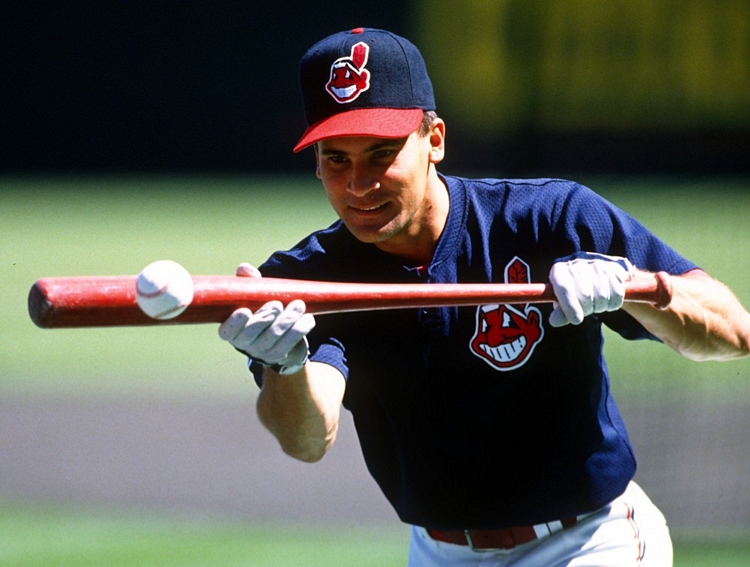 This article is as much about appreciating what value Vizquel brings to a baseball team today, as a reflection of his career to-date. I remember meeting Omar in the early 1990’s. He was a skinny guy on the Mariners and still hadn’t come into his own. I will never forget the t-shirt he was wearing during batting practice that day. It was an “Omar Vizquel” shirt, with his name and picture. This great fielding and no-hit shortstop stood at the first base line and signed autographs for over 30 minutes. He literally did not leave until every fan was looked after. Fast forward to the Vizquel today…and nothing has changed. Sure, the “Omar Vizquel” t-shirt is long gone. But he is the same Omar, engaging the fans and proud to be a major league baseball player. For a guy that has won 11 gold gloves and had a fairly good bat for a shortstop- I only have one question. Why are we not discussing him more as a future hall of famer?
Omar Vizquel is built in the mold of many superior fielding Venezuelan shortstops before him. Luis Aparicio and Dave Conception are the most famous examples that come to mind. I always have a comparison though that I throw in every time the words Vizquel and Cooperstown are said in the same sentence. Ozzie Smith. The Wizard of Oz. I watched both players for the majority of their careers and I am at a loss for words. By no means do I want to take anything away from Ozzie Smith. Far from it. But when I start to compare the two shortstops, I see many similarities. Similar bats. Similar gloves. The numbers are there. You can argue that Ozzie was a better base stealer, or that Omar had more power. The difference in their offensive numbers are negligible. Watching both players, I would tell you that they were at similar levels with a bat in their hands. With a glove, the numbers again are not far off. Ozzie was flashier and made more errors- but then he took more chances than Omar. But to argue that either one was a better defensive shortstop would be a difficult argument to make. The Wizard had the backflips and the all-star game appearances. Omar had an almost equal amount of gold gloves (11 to 13), but less notoriety. Ozzie made 15 all-star teams. Omar was on 3. But if Ozzie is a first-ballot hall of famer, then so is Omar.
Where I believe that Omar’s hall of fame chances are minimized are in his personality and era that he played in. While the 1980’s still had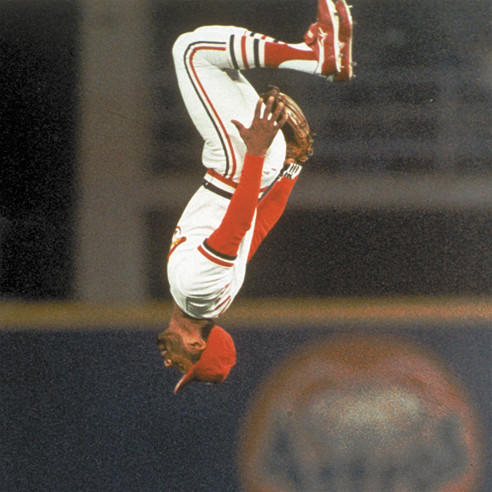 the belief of the all glove and no hit shortstops, the game evolved in the 1990’s. Cal Ripken type all-around players became the standard, with Alex Rodriguez, Derek Jeter and Nomar Garciaparra entering the mix. Backflips and all, Ozzie would have faced a difficult task in unseating those offensive beasts in order to gain election to multiple all-star games. Then when you take into account that Omar Vizquel is the steady/silent type- he just simply never received the headlines that he deserved. Yes, he won countless gold gloves. But rarely do I ever hear of a discussion where he is accounted for as one of the best at his position of all time. Again, if you consider Ozzie Smith one of the best- then you have to do the same for Omar Vizquel. I know this in my heart, but I have my doubts if all the hall of famer voters will see things the same way.
As the years have gone by, so have standards and criteria for election into Cooperstown. Given though the recent ‘steroid era’ and the difficult decisions faced by the voters with candidates such as Mark McGwire and Rafael Palmeiro, a candidate one day like Omar Vizquel should be an easy choice. While 3000 hits and 500 home runs used to be automatic markers for induction, offensive numbers are not as critical as they were in recent years. When I reflect on Omar Vizquel, I see a ballplayer that played the game the right way. He stayed fairly healthy for most of his career. He had a decent to very good bat for his position. He certainly never embarrassed himself at the plate. But first and foremost, he was a premiere shortstop. One of the best, if not THE best, that baseball has ever seen. He was steady as they come. Balls hit to Omar were usually automatic outs. He certainly earned each of his gold gloves and certainly could have earned even more. I am sure when the Mariners reflect on Omar Vizquel, they wish they would have kept him rather than moving him in 1993 for Felix Fermin. That year, Omar earned the first of his gold gloves. The first of many to come.
So in considering today’s signing, this is not an ordinary minor league deal. This is a story of a baseball warrior that is beating all odds, including father time. In an age when players are retiring earlier and the game is becoming a young man’s sport, Omar Vizquel continues to hang on. Only 159 hits away from 3000, I certainly could see him reaching that mark in 2013. But regardless of whether that magic number is hit, for everything that he has produced on the baseball diamond to-date, Omar Vizquel should be in Cooperstown in the next few years. I have enjoyed watching him play all of these years and look forward to cheering his name at least one more time before he hangs up his glove for good. Check the numbers again and begin your own thought process of whether you feel that Omar Vizquel deserves a place in Cooperstown. But hopefully we can hold off on that debate for at least a couple of more years.

Jonathan Hacohen is the Lead Baseball Columnist & Editor for MLB reports: You can follow Jonathan on Twitter (@JHacohen)
Please e-mail us at: MLBreports@gmail.com with any questions and feedback. You can follow us on Twitter and become a fan on Facebook . To subscribe to our website and have the daily Reports sent directly to your inbox , click here and follow the link at the top of our homepage.

Forget Strikeouts: Hit ’Em Where They Ain’t!
Monday January 23, 2012
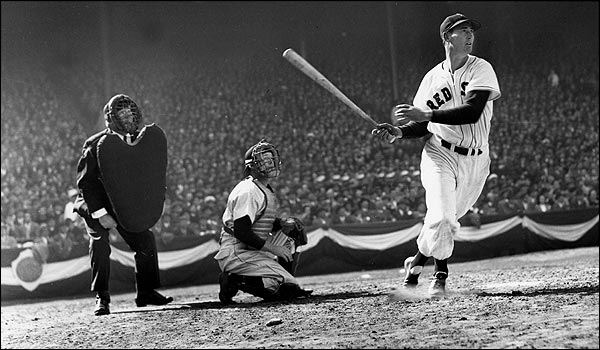
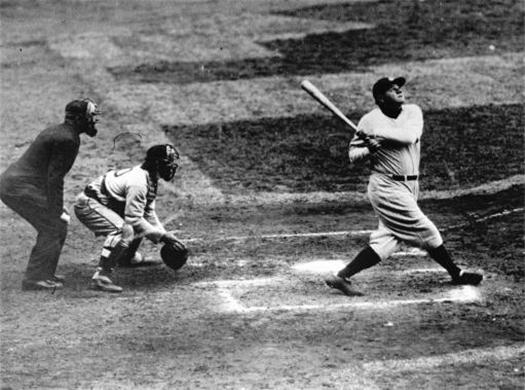
Douglas “Chuck” Booth- Baseball Writer: Back in the turn of the 20th century, baseball was a different game. Players had second jobs to supplement their baseball salaries, teams carried few pitchers and they used the same baseball for as much of the game as they could. There was a player named Willie Keeler who coined the phrase: “Hit ’em where they ain’t!” It was a slang term for hitting the baseball where outfielders were not located. This term would hold up for baseball players until Babe Ruth graced the baseball world with the retort, “I like to him them over the fence because the fielders are definitely not there.” Strikeouts were a different situation back then as opposed to the modern-day game.
Old time baseball players were ashamed of strikeouts. To them, you had done nothing to help your team in advancing the offence. While I never played baseball at a higher level than age 19, I came from this very philosophy and this was twenty years ago. My teammates and I all took turns throwing temper tantrums over striking out in Little League Baseball. Some kids even resorted to crying. The coaches of the teams all preached young men to cut down their strikeouts in favor of just making some contact. For the longest time I believed that the Major League Players thought along these lines. Media articles and sports broadcasters still interview retired players about striking out. All of them say that it bothered them a great deal. So what happened to change the philosophy? Was it Money Ball? How about Sabermetrics? I think that these both had a role in the ever rising strikeout totals the current players are experiencing each and every year. There are other factors like hard throwing relief pitchers and teams spending more money to keep aging veterans who have lost plate coverage, thus increasing their k rates.
 In the 1990’s we also experienced the steroid era, where the bandbox stadiums were built and MLB went with the advertising campaign, “chicks dig the long ball!” It all had led to the increased strikeout total. To see just how far the epidemic had come, let’s go back 85 years; in 1927 Babe Ruth led the Major Leagues with 89 strikeouts. Oh yeah, he also hit .356 with 60 HRs and drove in 164 RBIs in 540 ABs. Lou Gehrig finished in 2nd that year with 84 strikeouts- but he hit .373 with 47 HRs and a whopping 175 RBIs in 580 ABs. Both men walked over 100 times each and slugged over .750. Yes pitching was not as tough as it is today. But these guys played in the dead ball era with humongous baseball stadiums.
Fast forward to 1961. 10 players had over 100 strikeouts that year. Much like 1927, the New York Yankees had two players leading the charge in offense with Roger Maris and Mickey Mantle. Despite hitting a record 61 HRs that season, Roger Maris had a keen eye for the plate in only striking out 67 times. There was a shift starting with the other players in league. A player by the name of Jake Wood stuck out a league leading 141 times. Amongst the other players to top the 100 strikeouts mark were Hall of Famers Mickey Mantle and Harmon Killebrew. It was a change in contrast to the power hitters of the league striking out on a more frequent basis. Players like Joe Dimaggio (369 SO, 361 HRs), Ted Williams (760 SO and 521 HRs) and Stan Musial (696 SO and 475 HRs) were standing out on the pier as players who adopted the contact concept. But they were becoming a rare breed of player.
In 1986, the number of players with 100 strikeouts escalated to 40. Yes there were an increase in the number of teams due to expansion. However, the rate of the players striking out 100 times a year far outweighed those added teams. There were definitely a few exceptions to the rule. Don Mattingly only struck out 444 times in 7721 Plate Appearances during his career. Wade Boggs only struck out only 745 times in nearly 11000 Plate Appearances. It should be noted the Boggs walked 1412 times and routinely fouled off pitches with two strikes deliberately to wear down opposing pitchers; otherwise his whiffs would have been much lower. The best of this era was Tony Gwynn, who only struck out 434 times in 10200 Plate Appearances. All 3 of these players were part of a baseball decade in which the 1-2 hitters were purely average contact hitters who did not strikeout very much and stole bases, while playing hit and run ball. Your power hitters belonged in the 3-4-5 slots and that was the only place to have an acceptable amount of high strikeout totals. The 6-8 hitters were also average contact hitters with speed.
In 2011, 80 players finished with over 100 strikeouts. There is one thing though that has remained constant. The home runs are still up way higher from the rate of the 1980’s. Now steroid testing has slowed down the balls leaving the yard from 10-15 years back, but more players still hit 30 homers a year than in the 25 years before the steroid era. You might want to also throw in the decreasing strike zone the umpires seem to implement each progressive season. Do not count on the umpires calling more strikes either, as it easier to pinpoint the botched strike calls now more than ever with technology. Umpires are simply not willing for the most part to give much leniency to the pitchers. Higher counts in ABs as a result will reflect in both more strikeouts and walks.
The baseball world has come to this. It is now acceptable for players (including the management and front office backing of the idea), to carry high strikeout totals and low batting averages- if the on base percentage/power numbers are still there. Leadoff hitters are not even immune to striking out on a regular basis. It is a mentality that has changed the game forever. So the next time you are wondering why all of the baseball games seem to last forever now: remember that more strikeouts equals more pitches seen. Which means the length of time each game lasts will be affected.
 *** Thank you to our Baseball Writer- Doug Booth for preparing today’s feature on MLB reports. To learn more about “The Fastest 30 Ballgames” and Doug Booth, you can follow Doug on Twitter (@ChuckBooth3024) and click here for Doug’s website, fastestthirtyballgames.com***
Please e-mail us at: MLBreports@gmail.com with any questions and feedback. You can follow us on Twitter and become a fan on Facebook . To subscribe to our website and have the daily Reports sent directly to your inbox , click here and follow the link at the top of our homepage.
Ian Kadish MLB Guest Blog: I Owe It All to Them…
Sunday January 22, 2012

Ian Kadish (Guest MLB Blogger): Once again, I was lucky enough to be asked back to write another blog post for MLB Reports! I always love being asked to write for them! This time they asked me to write about the biggest baseball influences in my life…and I’m warning you, this could take a while! I have been playing baseball for as long as I can remember, so obviously I am going to have many people that have influenced my baseball career. If I don’t mention you specifically, I am sorry, but the list is way too long and I have to pick the biggest influential people in my baseball career.
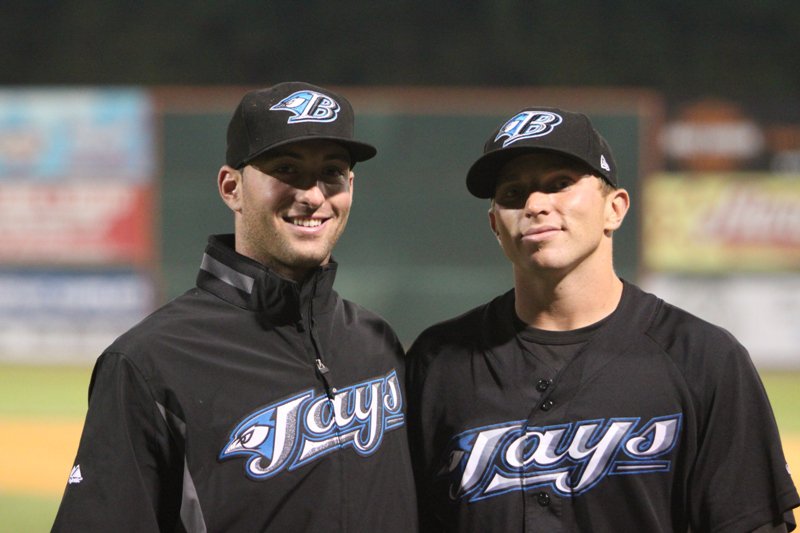 I am going to start by saying my parents are easily the single biggest influence in my life, whether it be on or off the field. They have molded me into the man (sometimes little kid) that I am today and I am a product of them. They have always supported me no matter what I do and they have always been there for me through thick and thin. They have been there for the hardest times and have somehow always gotten me through it. They have taught me to chase a childhood dream and put everything I have into it. They taught me to never give up, they taught me to work harder than anybody else, they taught me to play the game right, the list could go on for days of what they have taught me and I could never thank them enough. For that and everything else they have done for me, I owe it all to them. I love you Mom and Dad!
The second biggest influence in my baseball career is an easy choice. It is a guy named Mike Maundrell. He was my pitching coach when I played at Midland and started the molding process of the pitcher that I am today. He has taught me literally everything I know about pitching and is still teaching me today. I have known him since I was 16 and he completely changed me as a pitcher and as a person. He was the first coach I had who taught me what hard work really was and what I had to do to better myself. I still work with him to this day and I have been training with him this offseason here in Cincinnati. I can honestly say, I would not still be playing baseball if I had never met Coach Maundrell. He knows more about pitching than any human probably should know and he could talk about pitching for days on end. I am so thankful to have had the opportunity to work with him for several years and will forever be in debt to him for everything he has taught/ is teaching me about pitching.
Another big influence in my baseball career is Tim Adkins. He and I both will admit we had our tough times together, but he was the one that gave me the great opportunity to play collegiate baseball at Marshall University. He was the pitching coach at Marshall at the time and he pushed me to great lengths. He pushed me to the breaking point, but he made me as strong as I am today because he pushed me to such great lengths and found that breaking point. He was the one that truly found out what made me tick and what got me going. I learned so much from him not just on the baseball field, but off as well. He continued to teach me what hard work is and he taught me to find out what works for me. I owe him a tremendous amount of credit because he developed me into the hard worker that I am and taught me that if I want something to go get it and let nothing get in my way. Along with Coach Adkins, I owe Coach Waggoner a tremendous amount of credit as well. He was my head coach at Marshall University and he has always been there for me. He always told me if I ever need anything at all to call him and he would be there for my family and me. He genuinely cared about my family and me and I can’t stress enough how much I appreciate it. He always had confidence in me whether I was really good that day or extremely bad. He deserves a great amount of credit for how much he stood behind me and I thank him for that.
Coach Adkins departed from Marshall University after my Sophomore year and was replaced by Joe Renner. Coach Renner and Coach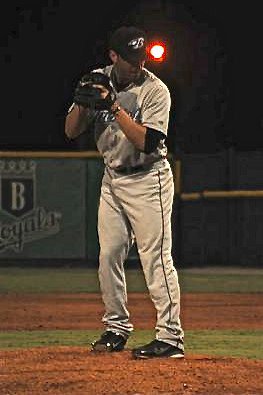 Maundrell are like brothers and they both teach the same concepts. Coach Renner continued to teach me what Coach Maundrell taught me. Coach Renner and I grew to become extremely close in just 2 years. I feel like I can go to him with anything and talk about it and he will help me through it to the best of his ability. It was extremely sad to walk off the field after my last collegiate game and see tears in his eyes because it was the last game he would coach me in. It brought tears to my eyes and I will never forget the 2 years I worked with him. He worked extremely hard to get me to the next level and I am very thankful for everything he has done for me. I know we will remain in contact for years to come!
The last person that I want to mention who has been tremendously influential in my baseball career is Clarence Mitchell. He was my baseball coach when I was 13-15 years old and I am telling you what, he was the strictest coach I have ever had. He taught me the true meaning of discipline and made sure he engraved it in our heads. I still remember to this day taking a ground ball to the eye during infield practice and the eye swelling up instantly and bleeding profusely, but refusing to come out because of the discipline he preached or the running for hours on end if we messed up or did something the wrong way. He taught me what hustling is and I still to this day have everything he taught engraved into my baseball actions and life in general.
Other people that were influential in my baseball career include Chris Fiehrer (my high school coach), Scott Humes (Midland Coach), Jeff Newman (Midland Coach), and Bernie Barre, Although Bernie Barre wasn’t a baseball coach and had nothing to do with baseball, he taught me life lessons I can use on the baseball field. He was my football coach and was one of the best football coaches in the history of Ohio High School Football.
I also want to mention Dennis Holmberg. He was my very first professional baseball manager and he taught me so much more about the game of baseball that I never knew. I made sure I wrote down everything he taught me so it will be with me forever. He made my first professional season one that I will never forget.
I can’t begin to express how much I appreciate everybody that has had an influence on my baseball career. I owe them all a HUGE thank you and I would not be where I am today without them. I am so grateful for everybody that has influenced me so Thank You from the bottom of my heart! Ian

Thank you to Ian Kadish for preparing today’s MLB Guest Blog. Please feel free to contact Ian on Twitter (@BearJew36) or through his website (http://livinginthelifeofian.blogspot.com) for comments and questions. We also thank Ian for sharing the photographs used in today’s feature from his own private collection.
Previous Ian Kadish Guest MLB Blog Entries on MLB reports:
Ian Kadish Guest MLB Blog: Part 2 – Offseason and Expectations for 2012 October 3, 2011
Ian Kadish Guest MLB Blog: Part 1 – Recap of My 2011 Season September 30, 2011
Ian Kadish Guest MLB Blog: My Baseball Journey September 11, 2011
Please e-mail us at: MLBreports@gmail.com with any questions and feedback. You can follow us on Twitter and become a fan on Facebook . To subscribe to our website and have the daily Reports sent directly to your inbox , click here and follow the link at the top of our homepage.

Ask the Reports: Your Baseball Questions Answered – Sunday January 22nd, 2012
Sunday January 22nd, 2012
Jonathan Hacohen: Posted every Weekend: Your top baseball questions from the past week are answered. E-mail all questions to mlbreports@gmail.com, message us on Twitter and post on our Facebook Wall!
Let’s get to your top questions of the week:

Q: Pirates chances in the semi-weakened NL Central this year? John
MLB reports: Great question John. Many Pirates fans are very hopeful this year. But in the opening may not be as clear as some would think. Houston we have to figure is in rebuilding mode and heading to the AL West in 2013. That leaves the Cardinals, Reds, Brewers and Cubs as the main competitors. The Cubs are going to be better, but still have ways away. New management needs time to rebuild the farm and create a lineup in the image that they foresee. That leaves the Reds, Cardinals and Brewers. Even assuming that Prince Fielder is gone and Ryan Braun is lost to suspension, the Brewers are incredibly strong. Gallardo and Greinke to head up the rotation, Axford and Rodriguez at the back of the pen. The Brewers are unlikely to make the playoffs, but will still be in the race. Same goes with the Cardinals, sans Pujols and La Russa. They still have an offense led by Holliday, Berkman and Beltran, with one of the best rotations heads in Carpenter and Wainwright. They will be finding their way this year, but the Cardinals are still the defending champs. Lastly, the Reds will be the team to beat. Latos will now be their ace and Ryan Madson the closer. In between, this team is fairly stacked and can hurt you in so many ways, led by Votto and Phillips. The best that I can see the Pirates finish is 3rd…and that is a long-shot. To me, I see 4th place as being the likely scenario with anything higher being gravy. As far as anything higher? Wait 2 years or so until their farm starts harvesting some really key prospects to the majors.
Q: Question on ’13 HoF vote. Do most of the voters believe Barry Bonds was a HoF’er before using (clear/cream) possible PEDs? Old Man Mack
MLB reports: There is no doubt in most “experts” minds that Barry Bonds was going to Cooperstown before the whole performance enhancing drugs issue arose. Before bulking up in San Francisco and reinventing himself as the home run champion, Barry Bonds was one of the best players in the game. He could do it all and was one of the best 5-tool players the game ever saw. But the reality is that most voters will not look or think in that manner. All they will remember is Balco and the question marks that surround Bonds. Looking at the McGwire and Juan Gonzalez vote totals, I am seeing writers that are not prepared to vote in certified or even heavily suspected PED users. The vote on Bonds, like Roger Clemens, will be very interesting. Without clear criteria and guidelines, voters won’t know which way to go. Some will vote Bonds in, by consideration that he was a worthy candidate even before the Balco mess. Others will consider that he did use PEDs and as a result, should not go to Cooperstown. If Bonds gets 50% of the vote based on what I’m hearing, I will consider that a high total. The 2013 Hall of Fame ballot will be one of the most difficult ones in history. We all look forward to seeing what will transpire.

Q: Are the Red Sox in a rebuilding year or waiting on a certain sign from the Baseball Gods to replenish the rotation and the B-pen? Nick
MLB reports: LOL. The Red Sox are never rebuilding. They may have a new manager and GM, but they are still the Red Sox. Adrian Gonzalez. Jacoby Ellsbury. Dustin Pedroia. Josh Beckett. Kevin Youkilis. This team still has the horses to make a run for a playoff berth. Yes, they just traded away Marco Scutaro, in a rumored attempt to make a run at Roy Oswalt. So no, the Red Sox are not waiting for any signs. They are just staying in a budget and putting the best team that they can put together within their means. Their bullpen is still loaded to the max. Andrew Bailey, Mark Melancon and Daniel Bard (if he doesn’t win a rotation spot). These Red Sox are maybe one starting pitcher away. Some tweaking may still be ahead…but rebuilding, no no no. Far from it.
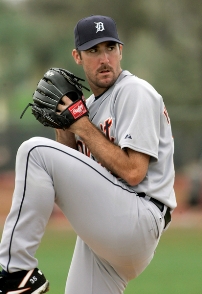
Q: Do you think Tigers Pitcher Justin Verlander Deserved to win the AL MVP Award last Season? Pitchers don’t win MVP Awards often! Marty
MLB reports: Another great question Marty. You always ask the right questions! Let’s take it another way: if I had a vote, would I have given Justin Verlander the MVP award. Absolutely- yes. I have heard all the arguments why pitchers should not win the MVP award. They have their own award- it’s called the CY Young award. They don’t play everyday and thus are not as valuable as top hitters. It goes on and on. I get it. In 2011, the fact remains that Verlander was the most valuable player on his team. Look at the stats- they are mind boggling. 24 wins in 34 starts. 2.40 ERA. 251 innings pitched. 250 strikeouts and only 57 walks allowed. A 0.920 WHIP. The man won the pitching triple crown and dominated hitters consistently all year long. If you take Verlander off the team, they do not make the playoffs. There were many great players in the American League last year. Jose Bautista. Adrian Gonzalez. Jacoby Ellsbury. Curtis Granderson. But until they make a hitters-only award, the Most Valuable Player award means any player. That player was Justin Verlander in 2011 and yes, he definitely deserved his award.
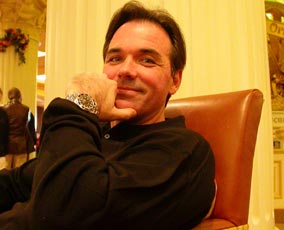
Final Question: I hope the A’s make Playoffs this year! That would be Something special! Eric
MLB reports: Eric. Eric. Eric. I love your passion and commitment to your team. But I am sorry to be the one to tell you this- ain’t happening. The A’s are in yet another rebuilding mode. The team was destined for 3rd or 4th place before trading Gio Gonzalez, Trevor Cahill and Andrew Bailey. Not to mention the losses of Josh Willingham and Hideki Matsui. The return of Coco Crisp just won’t cut it. While the Mariners should be an improved squad, the A’s have a ton of young talent that will come together in 3-4 years. I’m sure all A’s fans would love a pennant. For now, they will need to settle for last place and a chance at a high draft pick. Until the stadium issue is resolved and the team can figure out a permanent and financially viable stadium option, winning Oakland baseball will continue to be a rarity for the foreseeable future.
ARCHIVE: Click here for Past Issues of Ask the Reports
Please e-mail us at: MLBreports@gmail.com with any questions and feedback. You can follow us on Twitter and become a fan onFacebook . To subscribe to our website and have the daily Reports sent directly to your inbox , click here and follow the link at the top of our homepage.

Jonathan Hacohen is the Lead Baseball Columnist & Editor for MLB reports: You can follow Jonathan on Twitter (@JHacohen) Follow @mlbreports

Garlic Fries and Baseball: The Book Review
Sunday January 22, 2012
“Garlic Fries and Baseball: The Book” – By Ronni Redmond (2011)
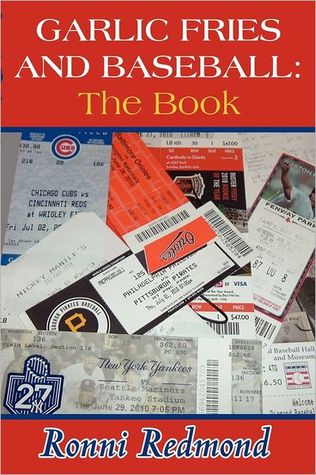
MLB reports – Jonathan Hacohen: From baseball blogger to author. This is the story of Ronni Redmond and her website: “Garlic Fries and Baseball.” As you have probably guessed from the title, Ronni loves ballpark food. Heck, she loves everything baseball. I had no idea what to expect from this book. Perhaps a list of top ballpark foods. A ballpark recipe book. It could have gone in many directions. It turned out to be a bit of everything. Probably one of the easiest and funniest baseball reads you will ever find. Garlic Fries and Baseball: The Book, turned out to be an enjoyable baseball journey. Ronni threw just about everything but the kitchen sink into this one and produced a book to be proud of.
 Ronni Redmond is not the Shakespeare or Hemingway of the baseball writing world. Nor does she profess to be. Ronni is a baseball fan, pure and simple. She loves talking about the game and sharing her insights. She does some deep level baseball thinking and likes to share her questions with the readers. GF&B is a book born from her website. From logging a baseball trip on-line (and you know I LOVE baseball trips), the website was born. In the book, Ronni shares the details of the road trip, from the parks she visited, the food she ate, to the hotels she stayed at. For anyone who has ever attempted or completed a baseball vacation, Ronni’s story will be one that you will appreciated. But once the trip was done, Ronni didn’t stop writing about baseball and her website exploded. It grew so much, that she felt the need to write this book. I am certainly glad she did.
A San Francisco Giants fan, Ronni is not afraid or apologetic for sharing the love of her favorite team. That is an art that is missing sometimes in baseball writing. Even if a person writes and analyzes baseball, there is nothing wrong with having an allegiance to a certain team and/or players. Most, if not all, baseball writers are deeply rooted baseball fans from birth. We can love something and still be objective. It is an acquired skill, but definitely can be done. In GF&B, Ronni talks about her team’s climb to the World Series championship in 2010. To hear the story from a fan’s point of view was interesting and heartwarming. Baseball fans live to see their teams go all the way. In 2010, Ronni got to experience those emotions and I enjoyed the ride through her eyes.
From baseball trips and a World Series win, Ronni then covers many more baseball topics. Derek Jeter. Stephen Strasburg. George Steinbrenner. Joe Mauer and shampoo. Recipes. Ronni has a little bit of everything in this one. If I could consider this book in Seinfeld terms: it is a baseball book about nothing that seems to talk about everything. Sometimes I like reading autobiographies. Sometimes historical pieces. Other times give me statistical analysis manuals. But when I have had a hard day and just want to read, laugh and enjoy myself, GF&B was a good comfort book. A little chicken soup to the baseball soul.
Ronni Redmond: when I finished this book, I had a smile on my face. I laughed. I smirked. Sometimes I agreed with you. Sometimes I shook my head. But you got me thinking and talking baseball. Thus your book, Garlic Fries & Baseball is a success in my estimation. Well done for a first-time author. It will be enjoyed by baseball fans of all levels and ages. Also…I can’t wait to get my hands on some garlic fries. I love baseball food and they sound delicious!

***Garlic Fries and Baseball: The Book is available to purchase as a kindle e-book and can also be found on the GF&B website: http://garlicfriesandbaseball.wordpress.com. Be sure to pick up your copy today and let us know your thoughts and comments. Half the fun of reading a baseball book is to share your experiences with our fans and readers!***
Jonathan Hacohen is the Lead Baseball Columnist & Editor for MLB reports: You can follow Jonathan on Twitter (@JHacohen)
Please e-mail us at: MLBreports@gmail.com with any questions and feedback. You can follow us on Twitter and become a fan on Facebook . To subscribe to our website and have the daily Reports sent directly to your inbox , click here and follow the link at the top of our homepage.

Can the Yankees Win It All in 2012?
Sunday January 22nd, 2012

Sam Evans: Last year, the Yankees won 97 games in the talented American League East. 97 wins was enough for the Yankees to win the division and guarantee themselves home field advantage in the playoffs. Unfortunately for the Yankees, they ran into the Tigers and their superb pitching staff. The Yankees long season came to a early close when the underdog Tigers took three out of five from New York in the ALDS. Now, with only a couple of new faces on a veteran roster, the Yankees will try yet again in 2012 to return to the World Series.
If the Yankees win the World Series, it will be with their veterans leading the way. The average age of the Yankees Opening Day lineup will be 32. This might be something that Yankees GM Brian Cashman should be worried about in the future, but not especially in 2012. Position by position, the Yankees are one of the strongest teams in baseball. Their weak spots are obvious, but let’s see how they stack up against the other teams in the A.L. East.
Catcher: Russell Martin: Martin struggled in 2011. He had a 57 wRC and hit only .237 in 125 games. Part of his offensive struggles were due to a .252 BABIP; but the reality is that he has never been able to play at the level he did in 2007. For 2012, Martin should play five days a week with Francisco Cervelli getting the other starts. I love watching Cervelli play because of his competitive grittiness. If he could learn how to hit, he’d be one of the best catchers in the league. Overall, the Yankees catchers aren’t very good. Luckily for them, they have top prospect catchers Gary Sanchez and Austin Romine on the way. In two years, the Yankees will have some of the best catchers in the league.
Rank at the Catcher position out of A.L. East teams: 3 out of 5
First base: Mark Teixeira: Tex had just an average 2011. He is still one of the best offensive and defensive first basemen in the American League. Teixeira hit .248 with 39 home runs. A lot of his bad average was due to his miniscule BABIP ( .239)- which compared to Matt Kemp‘s .380 BABIP, shows how unfortunate Teixeira was. Teixeira should see some of his numbers get back to where they were before last year.
Rank at the First Base position out of A.L. East teams: 2 out of 5
Second Base: Robinson Cano: Robinson Cano wasn’t ever considered a highly touted prospect, but he never failed at any level the Yankees had him at. Ever since Cano was called up in 2005, he has been morphing into a perennial All-Star. 2011 was a great year for Cano. He won a Silver Slugger award, the Home Run Derby and he was the second best hitter in a loaded Yankees lineup. In 2012, Cano could improve his defense and keep producing offensively, in order to improve as a player and possibly become the best second baseman in the game.
Rank at the Second Base position out of A.L. East teams: (A close) 2 out of 5
 Shortstop: Derek Jeter: Derek Jeter has seen his overall production plummet in the last two years. He had a solid second half in 2011, but you have to wonder how many more years he’ll be the Yankees starting shortstop. There’s no question that the thirty-seven year old will be a first-ballot Hall-of-Famer one day. However, there will be a time when the Yankees need to find a new shortstop… and that time is coming soon. 2012 could be Jeter’s last year at the position, and I’m sure he’d like nothing more than another World Series championship.
Rank at the shortstop position among A.L. East teams: 3 out of 5
Third Base: Alex Rodriguez: As much as I can’t stand him, A-Rod is one of the best players in baseball. The only thing that has kept Rodriguez from numerous MVP awards is his health. He hit 16 homers in 99 games in 2011. This offseason, A-Rod went to Germany to have an experimental procedure done on his knee. In the NBA, Kobe did a similar thing, in going to Germany receive some sort of voodoo procedure on his knee. He came back feeling rejuvenated with a new healed knee. I’m not sure that the surgery will work for Alex Rodriguez, but if it does- it could add a year or two to his career. If A-Rod is healthy this year, the Yankees will have a huge boost to their lineup.
Rank at the hot corner amongst A.L. East teams: 2 out of 5
Corner Outfield: Nick Swisher: Nick Swisher is known as one of the most likeable and funny players in the league. The one time Oakland Athletic has been a solid outfielder for the Yankees the last three years. Swisher got off to a rough start in 2011. He hit only .213 up until June, causing Yankees fans to wonder if they would need to trade for a new outfielder. Then all of a sudden, Swisher starting making solid contact and he hit .326 and .323 in the coming months. Swisher is a solid outfielder who is capable of hitting .260 with 25 homers and ninety walks in the coming year.
Corner Outfield: Brett Gardner: Gardner is one of the best players on the Yankees, but he never seems to get enough recognition. The pesky outfielder played resplendent defense and posted 5.1 WAR last year. He stole 49 bases in 2011, and in 2012 he should get the steal sign from his coaches more often. The biggest mistake the Yankees could make would be to trade Gardner away.
Rank among other A.L. East Corner Outfielder pairs: 1st out of 5
Center Field: Curtis Granderson: The ” Grandy Man” has become one of New York’s most beloved players in recent memory. Granderson had a bounce back year in 2011, hitting 41 home runs. Granderson’s contract has a team option in 2013, which they Yankees will most likely pick up. For 2012, Granderson probably won’t hit forty home runs again, but he could easily take advantage of the short porch in right field at Yankee Stadium and hit 30 to 35 bombs.
Rank among other A.L. East Center Fielders: 2nd out of 5
Rotation: C.C. Sabathia is one of the best pitchers in the games and the perfect candidate to lead the Yankees pitching staff. With his large frame, it should come as no surprise that Sabathia has thrown over 180 innings eleven straight years. Sabathia showed no signs of age last year. He posted a 2.88 FIP and struck out 230 batters during the regular season. Sabathia’s 2011 WAR ( 7.1), was worth over $32.2 million according to fangraphs. Sabathia is set to make $23 million in 2012. So while it might not look like it, the Yankees are actually getting a bargain for Sabathia’s production.
 A week ago, the Yankees traded their most promising young bat (Jesus Montero) for Michael Pineda. The Yankees are betting that Pineda will evolve into a top of the rotation arm for years to come. Pineda is by no means a complete pitcher. He has an above-average fastball and slider, but his changeup is below par. The impressive thing about Pineda is that he’s already learned how to control his pitches and he demonstrates great command. If he wants to take his game to the next level, then he is going to have to improve his changeup.
On the same day the Yankees acquired Pineda, they also signed former Dodger Hiroki Kuroda to a 1 year, $10 million deal. This is a low risk deal for a team with such a high payroll. Kuroda didn’t come cheap, but this looks like a solid acquisition for the Yankees. In 2011, Kuroda had a 3.07 ERA in thirty-two starts. His numbers might not be as strong moving from a pitcher’s park to the hitter friendly Yankee Stadium. I could see Kuroda struggling somewhat in New York, but he brings much-needed talent to the Yankees rotation.
C.C. Sabathia was the only Yankees pitcher who threw two hundred innings in 2011. The Yankees need their pitchers to work deeper into games, so they don’t have to overwork the bullpen. The back-end of the rotation will be critical for the Yankees success. They have the veterans A.J. Burnett and Freddy Garcia, and then the younger pitchers Ivan Nova and Phil Hughes. Most likely, all of these guys will see time starting in 2012. I think that Nova is the best of the bunch, but Burnett might have a slight advantage for a rotation spot with his huge contract.
Starting Rotation rank out of A.L. East teams: 2nd out of 5. They would’ve been third or fourth without adding Pineda and Kuroda. Adding those pitchers were good moves, since they want to keep up with the best teams in the East.
Bullpen: is as strong as it’s been in years. As all Yankee fans know, Mariano Rivera doesn’t age so he should be ready for another year of closing for NY. David Robertson was last year’s unsung hero out of the Yankees ‘pen. The difference between Robertson in 2011 and the Robertson of old, is simple. In 2011, he increased his fastball velocity. This led to a higher strikeout rate (13.50 K/9 in 2011, 10.42 K/9 in 2010) and a lower amount of home runs allowed(0.14 HR/9 in 2011, 0.73 HR/9 in 2010).
The Yankees bullpen should also include Joba Chamberlain, who fell into a nice groove as the Yanks 7th inning man last year before falling to Tommy John surgery, should be back. He will face competition from those pitchers who lose the race to become the Yankees’ fifth starter. Dellin Betances, considered by most as one of the Yankees top prospects, might see more innings this year as a long reliever. The loss of Noesi will hurt, but the Yankees have the pieces in place to trade midseason for extra bullpen help as they have done in the past.
Bullpen Rank out of A.L East Teams: 2nd out of 5
With a loaded team and a smart General Manager who knows how to operate a large payroll, Manager Joe Girardi should led the Yankees back to the playoffs in 2012. There are not very many teams that can compete with this Yankees offense… and if Pineda and Kuroda thrive in New York, they will have a very solid rotation. Yankees fans have a lot to be excited about for the upcoming year. But then again, don’t they always?
***Today’s feature was prepared by our Baseball Writer, Sam Evans. We highly encourage you to leave your comments and feedback at the bottom of the page and share in the discussion with our readers. You can also follow Sam on Twitter***
Please e-mail us at: MLBreports@gmail.com with any questions and feedback. You can follow us onTwitter and become a fan on Facebook . To subscribe to our website and have the daily Reports sent directly to your inbox , click here and follow the link at the top of our homepage.
Follow @mlbreportsSteven Bumbry Interview: The Baseball Story of an Orioles Prospect
Saturday January 21, 2012
MLB reports – Jonathan Hacohen: Imagine this scenario. Your dad played fourteen seasons in the big leagues, all but one with the Baltimore Orioles. Now you get to play pro ball as a second generation player, working your way up the ladder for that same big league organization. Welcome to the world of Steven Bumbry! When Manny Ramirez calls you to wish you a happy birthday at 11-years old, you know that you are strongly linked to the game. You may know the last name “Bumbry”, but today you get to learn about the man known as Steven Bumbry. The Killer B has been around the game is whole life. From growing up in clubhouses and baseball diamonds, Steven is a member of the Baltimore Orioles organization as an outfield prospect. He completed last season playing for the Frederick Keys of the Carolina League. Steven will be 24 by opening day and looking to make the climb up to Baltimore in the future. Today we sat down with the Killer B to discuss his baseball life and story. From the baseball he equipment he uses- to autographing strange body parts. Today on MLB reports, we are proud to present the Killer B- Steven Bumbry:
MLB reports: Welcome to MLB reports! Steven- you play professional baseball for a living. Has that sunk in yet?
Steven Bumbry: During my first offseason: when all of my college teammates were heading back to school and I literally had nothing on my plate besides keeping in shape. While they were worrying about going to classes and study hall, is when it really sunk in. Although I haven’t completed my degree yet, I wouldn’t trade anything for the time and experiences I’ve had since I started my pro career.
MLB reports: What is your brand choice for bat and glove?
Steven Bumbry: I prefer to use a Rawlings glove with the H-Web. My first two years I stuck to the good ‘ol Louisville Slugger bats. But in the middle of 2011, I was introduced to an up and coming company called DS Wood Bats. They are made outside of Harrisburg, Pennsylvania and this offseason they gave me the opportunity to visit their factory and customize a model bat for myself. So I have made the switch to them and I feel that they are very comparable, if not better than what I was getting from Louisville Slugger. I hope to continue to grow my relationship with them as I continue my career.
MLB reports: Did you have a favorite player growing up?
 Steven Bumbry: Manny Ramirez was by far my favorite player and still is at the top of the list today. When my father was coaching with the Cleveland Indians in 1998, I had the chance to visit and travel with the team during the summer when I wasn’t in school. I was only 10 at the time and all of the guys treated me so well, giving me gloves and bats all the time. But Manny was one of the guys who I could stand with during team batting practice and we would play shagging games in the outfield. I thought that was the coolest thing until April of the next year when the phone rang on my birthday and it was a call from Manny personally wishing me a happy birthday. I don’t think there was anything in the world when I was 11-years old that would have been a cooler birthday present.
MLB reports: Which current MLB star do you most admire and why?
Steven Bumbry: I admire the hard work and the type of game that Justin Morneau plays. I have the opportunity of working out with him and about 15 other current major leaguers in the offseason here in Phoenix and I enjoy picking their brains about the game. I think that Justin is a great role model both on and off the field.
MLB reports: What are your goals going into the 2012 season?
Steven Bumbry: My number one goal is to stay healthy, I don’t want to miss a game. Unfortunately I haven’t had a season in the last 4 years where I didn’t miss any time. While fighting off the injury bug, I have taken some encouraging steps in my game both offensively and defensively. So when healthy, I will put it all together and hopefully have a break out season in 2012.
MLB reports: You were drafted by the Orioles in the 12th round of the 2009 draft. Tell us about that process.
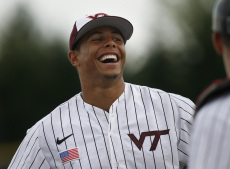 Steven Bumbry: I first started to realize that I would have the opportunity to play professionally my senior year of High School because Dean Albany (the scout who signed me with the Orioles) had been asking me to play with his summer wood bat team in the Cal Ripken League. After going undrafted in High School, I moved on to Virginia Tech and he continued to show a lot of interest in me, asking me back to play with him after my freshman and sophomore years there. The attention continued throughout my Junior year and I had been in pretty frequent contact with the Orioles and a handful of others in the months leading up to the draft. I eventually went to a couple of pre-draft workouts, one being at home in Baltimore for the Orioles. Then two weeks later, it was draft day and we had calls going back and forth between two teams and it was kind of a roller coaster ride back and forth. But it ended up being the Orioles who called my name and myself and my whole family were ecstatic.
MLB reports: You just finished your third full professional season, playing mainly for the Frederick Keys. How did you find your season overall?
Steven Bumbry: I learned a lot about myself and the game this past season. The game really tests you every da. You have to be able to handle the successes the same way you handle the adversity that happens in this game. The game really humbles you and teaches you to stay level-headed. As far as on the field- I think it was a pretty big success. Our team won the Carolina League Championship and I had some career highs in a couple of categories offensively.
MLB reports: You have played every outfield position in your career. Is the outfield your long-term position?
Steven Bumbry: I think that will be my home for the rest of my career. Being left-handed limits me to only a few positions and I have never really pitched seriously. I am also a little undersized for the typical first baseman.
MLB reports: What do you consider your greatest baseball skill(s)?
 Steven Bumbry: My defense is something that really stands out when you look at my game. I can play all three outfield positions interchangeably and my arm is one of my best tools. I also think that with more experience at the plate, my offensive tools will continue to develop. It will be interesting to see how they pan out and what type of player I become as I continue to mature and learn- as I get the opportunity to play.
MLB reports: What facets of your game do you most wish to improve upon?
Steven Bumbry: I think the most successful players in the game are also the most consistent at everything they do. If I continue to learn the game and about myself, I think that my consistency will improve and that is something that I want to continue to work on each and every day.
MLB reports: If you had to look into a crystal ball, when do you see your expected time of arrival in the big leagues and what do you think you need to do most to get there?
Steven Bumbry: I don’t necessarily like putting time frames on things… because I know anything can happen. I don’t want to be caught off-guard with any moves or decisions that are made because ultimately, they are really out of my control. I just like to focus on doing what I have to do and I know that if I do that and take care of myself and continue to work on my game, that things will happen when they’re supposed to happen.
MLB reports: When did you sign your first autograph? What is the strangest autograph request that you have ever had?
Steven Bumbry: I think I probably signed my first autograph when I was in middle school tagging along with my dad when he was still coaching. I don’t exactly remember the story behind it but I know it was long before I knew that I would be playing baseball as my career. But the strangest request probably had to be these three sisters that all wanted me to sign their arms, but to personalize them with each of their names. I just had to laugh and smile and go along with it. I’m still not sure that they have washed that part of their body.
MLB reports: Final Thoughts?
Steven Bumbry: Thank you for selecting me to be a part of this piece and your website. Let’s go O’s!
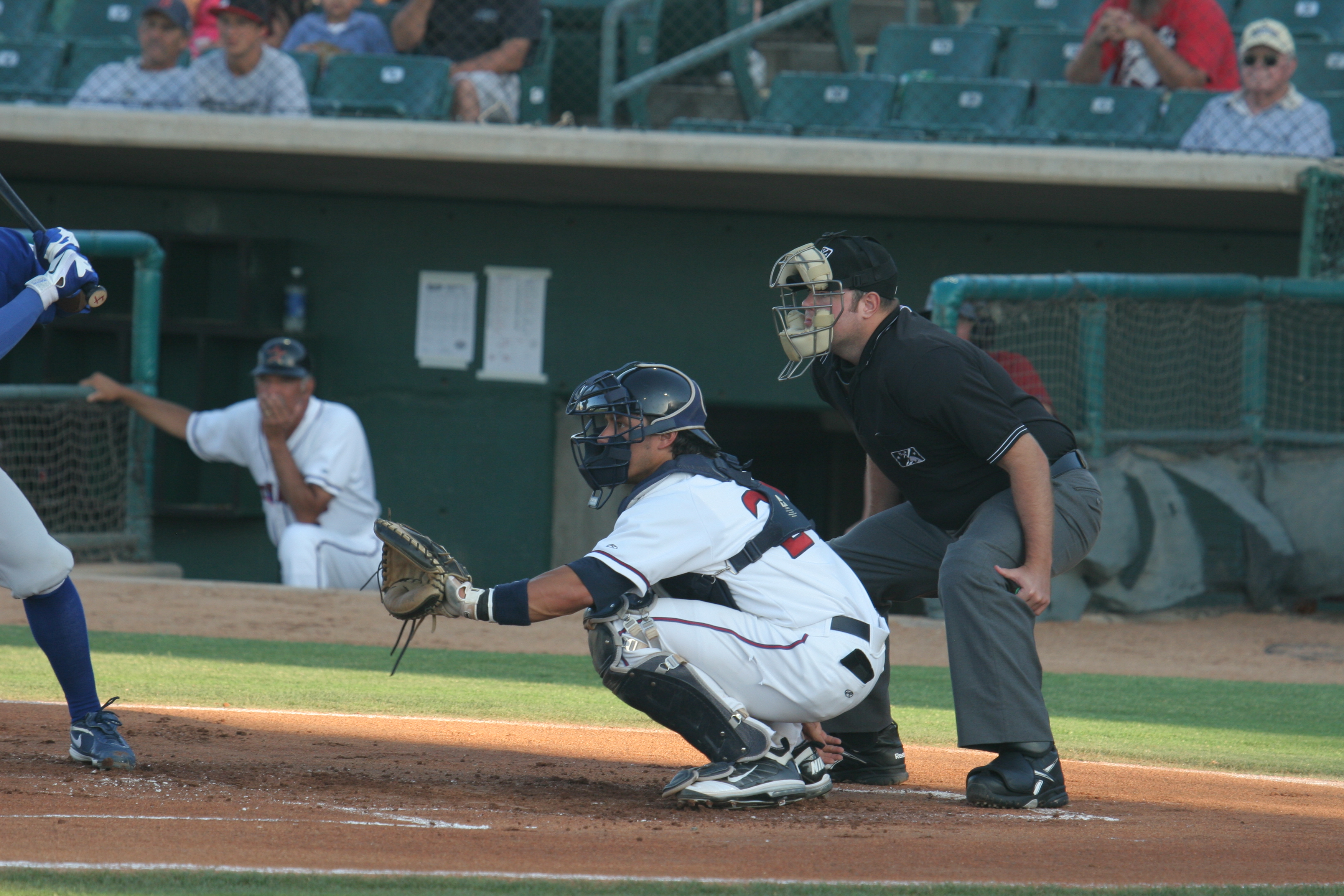
***Thank you to Steven Bumbry for taking the time today to speak with us on MLB reports (and for most of the pictures used in todays’ feature)! You can follow Steven on Twitter (@SBumbry). Please feel free to send Steven any questions/comments you have- he would love to hear from his fans!***
Jonathan Hacohen is the Lead Baseball Columnist & Editor for MLB reports: You can follow Jonathan on Twitter (@JHacohen)
Please e-mail us at: MLBreports@gmail.com with any questions and feedback. You can follow us on Twitter and become a fan on Facebook . To subscribe to our website and have the daily Reports sent directly to your inbox , click here and follow the link at the top of our homepage.

Jesus Lands in Seattle: Montero to Save the Mariners’ Offense
Friday January 20th, 2012
Bryan Sheehan (MLB reports Intern Candidate): It’s no secret that the Seattle Mariners struggled in 2011. Their offensive numbers were the worst in the league in many categories, as the team’s .233 batting average, .640 OPS and 534 RBIs ranked dead last, pushing them to a 67-95 record. So, coming into this offseason, the Mariners’ objective was clear: go out and acquire a hitter.
Last Friday, the Mariners found salvation as the club dealt young pitching talent Michael Pineda and right-handed pitcher Jose Campos to the New York Yankees for top prospect Jesus Montero and righty Hector Noesi. Pineda, 23, had an impressive rookie campaign, with a 1.10 WHIP and .211 BAA. His record of 9-10 may look less than stellar on paper, but of his 28 starts, his team scored less than three runs in ten games.
As for Montero, his future looks extremely bright, even in the cloudy landscape of Seattle. At age 22, Montero has only played 18 games at the MLB level but brings skill and potential that could make him a superstar. In 2011, he hit .288 with 67 RBIs in 109 games for Triple-A Scranton (considered a down year for the .308 career hitter) and was a September call-up for the Yankees, where he hit .328 with 12 RBIs in those 18 games. A catcher by trade, Montero will most likely start the year as the M’s designated hitter, with eight-year-veteran Miguel Olivo as the anchor behind the plate.
Ranked as the third best prospect in the league by Baseball America coming into last season, Montero has much to prove. First, he has to prove that he can hit in the pitcher’s heaven/ batter’s worst nightmare that is Safeco Field. He went 2/9 at Safeco last year, but his career slugging percentage (in the minors) is a respectable .501. In 2011, Montero held a slugging percentage of .429 at PNC Field, the home of the Yankees’ Triple-A affiliate that is almost identical dimensionally to Safeco. This is a really promising sign, as Montero should feel right at home in Seattle’s ballpark.
A big question that arises is where Montero will fit into the M’s batting order. He’s had experience hitting in every position after clean-up for the offensively strong Yankees, starting the most games in the seven-hole. In 2012 he’ll be higher up in the order for the M’s, and taking into consideration his power- he will likely bat third or fifth. If he can keep his pace from 2011, Montero could drive in over 100 RBIs, which is almost twice what Seattle’s leading hitter, Miguel Olivo, hit last season (Olivo had 62 RBIs). The offensive spark that Montero provides will help bring life to the middle of the order, which includes young infielders Dustin Ackley and Justin Smoak. The M’s may not be a breakout team or a playoff contender in 2012, but adding Montero to their core of young hitters will definitely prove beneficial in a few years as the team’s young hitters hopefully come into their own together.
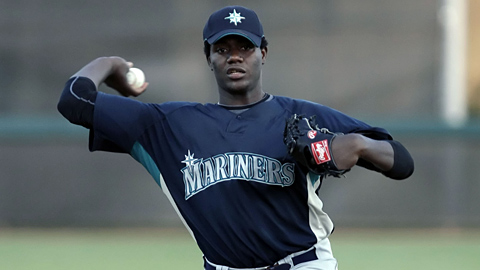
Today’s feature was prepared by our Intern Candidate, Bryan Sheehan. You can follow Bryan on Twitter (@Sheehan99), read his interviews with Phillies’ minor league prospects at PhightingOn.com, and catch him writing the occasional article for BleacherReport.com (search his name). Tweet him about this article and he will follow you back!
Please e-mail us at: MLBreports@gmail.com with any questions and feedback. You can follow us on Twitter and become a fan onFacebook . To subscribe to our website and have the daily Reports sent directly to your inbox , click here and follow the link at the top of our homepage.

Jordan Comadena Interview: Funky Astros Catching Prospect
Thursday January 19, 2012
MLB reports – Jonathan Hacohen: We welcome today to MLB reports: Jordan Comadena, Astros catching prospect. If you know Jordan well, then just call him Funky. With the last name Comadena- how could you not? But besides having one of the best nicknames in the business, Jordan is also busting his behind to make his baseball dreams come true. After playing for Purdue, Jordan signed with the Astros and played his first professional season in 2009. Now heading in 2012, Jordan is looking forward to the upcoming season and the opportunities that lie ahead. From the bat that he swings to the strangest autographs that he has signed, get into the mind of a baseball prospect- as we chat exclusively with Jordan Comadena. Playing for a young organization in search of its next big league players, Jordan Comadena is looking to move up the Astros ladder. Today we learn what he will need to do to get there. After a breakout 2011 campaign, we look forward to tracking Jordan’s progress this season as he continues his baseball journey. For the life and times of the man they call Funky, I proudly present my interview with Jordan Comadena:
MLB reports: First question: You play professional baseball for a living. Has that sunk in yet?
Jordan Comadena: This offseason I am preparing for my fourth professional season. So at this point in my career I have a nice routine- and the fact that I am playing baseball for a living has certainly sunk in. I have a good feel for my body and I have learned how to manage the offseason and get myself into the best shape possible to report to spring training.
MLB reports: What is your brand choice for bat and glove/catching gear?
Jordan Comadena: I swing a 33 inch 31 oz J155 made by DS Wood Bats. They are a newer company to Major League Baseball (within the last 2 years). The founder of the company is a very good friend of mine that I played baseball with at Purdue University. They make a great product and they have been very accommodating to me over the last couple years. As long as I am playing, I will be swinging DS. As far as other equipment, I love the All Star system 7 catchers gear and I use an All Star CM3000BT catchers mitt. When I play outfield or any other position, all my gloves are made by Rawlings. (I really like Franklin batting gloves as well, I wear them at the plate).
MLB reports: Did you have a favorite player growing up?
Jordan Comadena: When I was very young my favorite player was Andy Van Slyke of the Pittsburgh Pirates. My parents are from western PA, so I have always been a huge Pittsburgh sports fan and he was certainly my favorite growing up. As I got to high school and I primarily played catcher, I really enjoyed watching MLB games on TV and I tried to really focus on the catcher. I loved just watching how they received the ball and how they moved around behind the plate. I especially enjoyed watching Javy Lopez, Eddie Perez and Mike Matheny. I tried to emulate them and use parts of their game and make myself better.
MLB reports: Which current MLB star do you most admire and why?
Jordan Comadena: I currently enjoy watching Koyie Hill catch because I feel like we are very similar behind the plate. He’s not an overly big guy and he is primarily used in a back up role, much like I am. I also really like watching Dustin Pedroia. He is an undersized guy who works really hard and plays the game every day with everything he’s got. He has always had to prove people wrong and I like that about him. I have faced that same kind of skepticism throughout my career as well and I will continue to have a lot of people think that I can’t make it. I use that as motivation to prove them wrong.
MLB reports: What are your goals going into the 2012 season?
Jordan Comadena: First of all I want to have a very productive spring training and continue to show everyone that I can play at any level. In my opinion, my spring training performance has been better each of the last three years and I expect this year to be the best one yet. As for the season, my goal is to make the AA roster out of camp and go there and contribute to that team. I feel like I have a lot to offer as a baseball player and if given that opportunity, I will certainly make the most of it. Last season I played more outfield than I caught- so I hope that I am able to do more of that this year. Ideally, I would like to be able to help a team by playing some corner outfield, some first base and catch. I caught sparingly in college. I primarily played in the outfield and I played a lot of first base in summer ball in the Northwoods League. I feel very confident in my abilities to play any of those positions at a high level.
MLB reports: You joined the Astros organization in 2009. Tell us about that process.
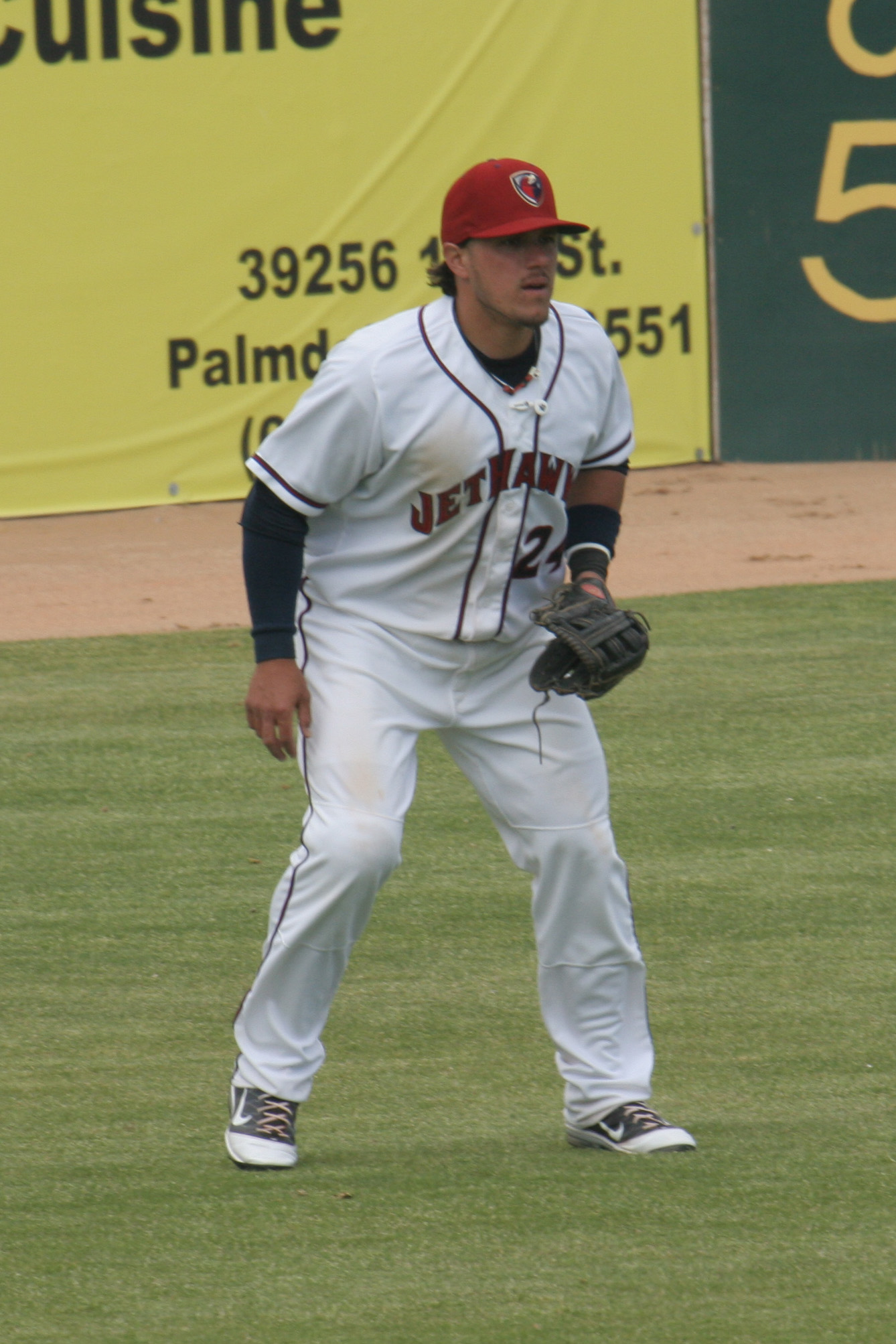 Jordan Comadena: Like I stated earlier, I played my college ball at Purdue University (2005-2008) and I played my summer ball in Madison Wisconsin (2005-2007) as a member of the Madison Mallards of the Northwoods League. I played four years at Purdue and three summers in Madison. Throughout my time in Madison, I had a lot of success and was a key contributor to three good teams. I was even fortunate enough to have my number 14 retired by the Mallards during the summer of 2008.
I had an up and down freshman and sophomore year and Purdue but my junior season I got off to a terrific start and was hitting the ball as well as I ever had. I hit in the leadoff spot and I was hitting for a high average as well as for power. I was always on base and I had five home runs (18 extra base hits) in the first month of the season. During our spring trip at Purdue, I broke the hamate bone in my left hand taking a swing. For the next 2-3 weeks, I tried to play through it. But the pain got worse and worse and I was forced to have surgery. I missed roughly the last 40 games of the season. I got healthy and had my best year in Wisconsin. My senior year at Purdue was very frustrating and I was never able to regain the rhythm I had the previous year. As the season came to an end I was hoping that my total body of work, including what I had accomplished in Madison, was enough for someone to take a chance on me in the draft.
The 2008 MLB draft came and went without my name being called and to say I was disappointed would be an understatement. Playing professional baseball is all I have ever wanted to do and being drafted by a team would have been a dream come true. With that not being the case, I immediately started calling and contacting anyone and everyone that I knew with a connection in professional baseball. I was hoping that I could sign on that summer as a free agent. I called everyone that I could think of and I even worked out for a couple of independent teams but no one wanted to sign me. As August approached I decided to stop trying and get ready for my final semester at Purdue. I would keep myself in shape and pursue signing with someone over the winter.
Every year at the end of August the Madison Mallards host an alumni game where a number of former Mallards players come back to town and play in a friendly game for the fans. Mallards players dating back to the team’s first year in 2001 are in attendance and mixed in with a number of former MLB stars from the 70’s, 80’s, and 90’s. Steve Schmitt, the Mallards owner, knows a lot of people throughout baseball and puts this event together for the fans. During my time in Madison we would average around 7,000 people in the stands every night. Even this alumni game got about 4,000 people in the stadium. At first, when I was invited to participate in this event I was apprehensive about going because I did not want to be bothered by people asking me why I wasn’t playing professionally anywhere. After being a fan favorite for three summers, I was a little embarrassed to return to Madison in this capacity. But I took into account everything that the Mallards had done for me and I felt like I owed it to the front office staff to show up and be a part of the festivities.
I played shortstop during the game and went 2-3 with 2 doubles and 4 RBI. I hit doubles off Vida Blue and Blue Moon Odom respectively. After the game, in which I was named the MVP, I was approached by former Colt .45 and Houston Astros star Jimmy Wynn. He was in attendance that night and took time out of his day to come talk to me. He asked me why I wasn’t playing anywhere and I expressed to him how I very much wanted to continue my baseball career. He was very friendly and told me that night that he would talk to the Astros on my behalf. I was very gracious. Despite everything we talked about that night I did not really expect anything to come of it. Over the course of the next few months, he and I corresponded via e-mail and he did tell me that the Astros were interested. In the interim, I had signed a contract with an independent team, the Gary Rail Cats of the Northern League. January of 2009 rolled around and I got a call form the Astros scouting department saying that they had talked with Jimmy Wynn and the Mallards front office staff. The Houston Astros wanted to sign me and bring me to spring training. They asked me that night what position I wanted to play and I told them I wanted to catch. Despite not really catching in college, I knew that was something I could do and I felt like it would provide me with the best opportunity to win a spot somewhere.
MLB reports: You just finished your third full professional season, playing mainly for Lancaster. How did you find your season overall?
Jordan Comadena: Overall, for the opportunity that I was given, I felt like it was very productive. When I was in the lineup I played very well and the fact that I showed I could do more than just catch was an added bonus. At one point in the summer I had an 8-game hitting streak and was arguably our hottest hitter.
MLB reports: You showed great improvement in 2011- you were really able to put it together. What changed last year?
Jordan Comadena: I think a big key this year was simply just being a year older and more experienced. I didn’t try to do too much at the plate. I tried to keep things as simple as possible and really look for good pitches to hit. Another key, honestly, was going back to a 33 inch bat and sticking with the same model all year. I went back to the same bat that I swung in Madison in college. For some reason I had gotten away from that model bat. I went back to it and it really felt good in my hands. From now on, I will only swing that kind of bat.
MLB reports: You have played mainly at the catcher position in your career. However, you did play the outfield quite a bit in 2011. Why the change in position and is either the outfield or catcher your long-term position?
Jordan Comadena: We had some injuries in the outfield last season and it got to a point where we needed someone to fill in out there for a little bit. I expressed to the coaching staff that I played outfield throughout college and I won a mini tryout against a couple other players on the team for the opportunity to play in the outfield. I view myself as a baseball player who happens to be able to play the catcher position. I am able to play a number of different positions and I hope that as my career goes on, I am able to continue to do that. Catchers are often negatively labeled as un-athletic and not able to run well. I take offense to that stereotype as I do not fit that description. I think of myself as baseball player, capable of taking on whatever is put in front of me.
MLB reports: What do you consider your greatest baseball skill(s)?
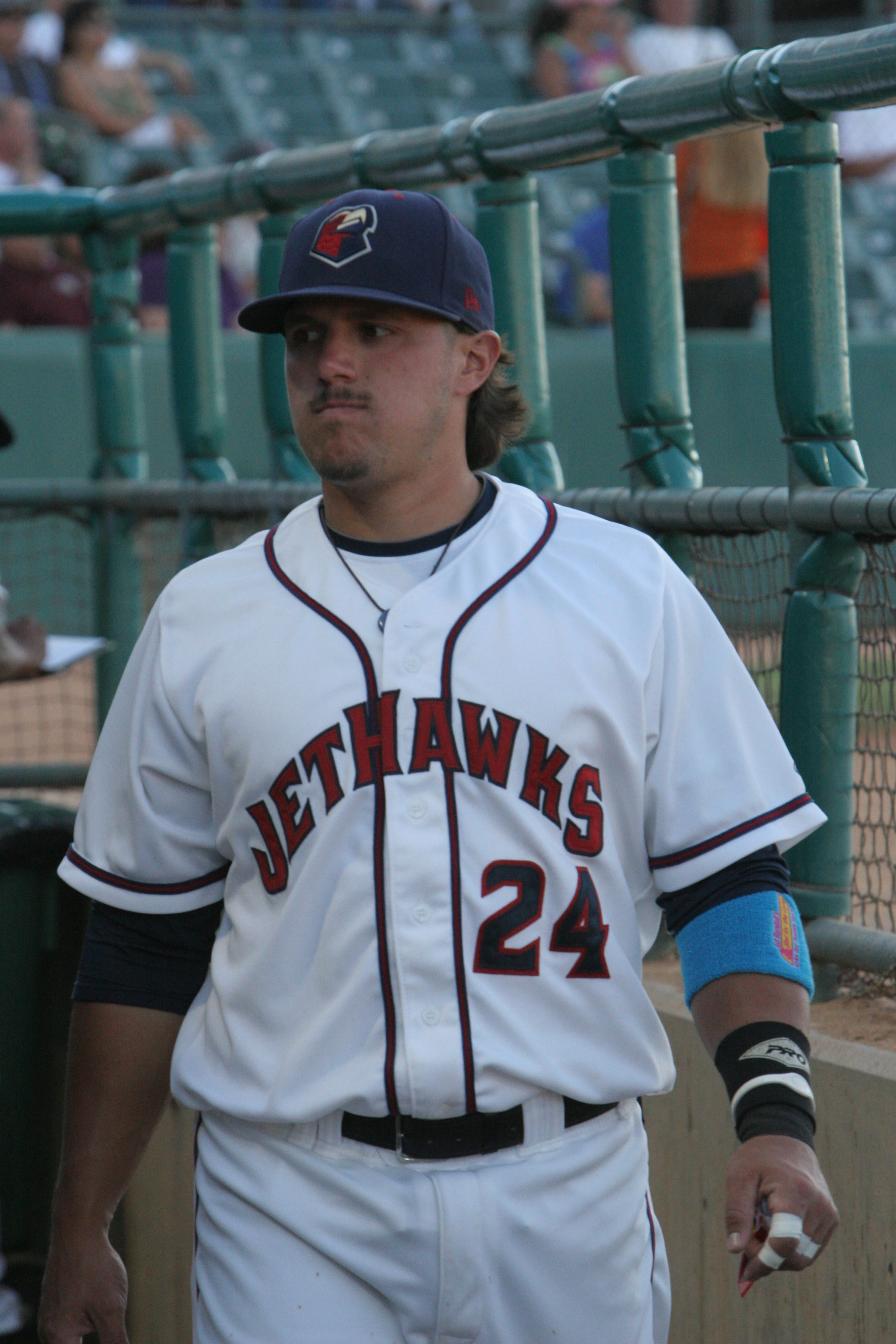 Jordan Comadena: I am not the kind of player that would turn a bunch of heads at a private workout. But I do feel that I play the game the right way and I can do a number of things well. I can handle the bat and execute different situations that come up throughout the course of the game. I have also had a very high success rate getting sac bunts down in my career. I take pride in playing the game the right way and doing all the little things well. Defensively, I feel like I am reliable in that where ever I am on the field the team will not miss a beat. I have always had a good rapport with the pitchers I have worked with and I know that they enjoy throwing to me. As a reserve player, my main goal when I am in the lineup is to have a positive impact on the game in some fashion.
MLB reports: What facets of your game do you most wish to improve upon?
Jordan Comadena: Every player at every level should always be working on something. I am always trying to improve my arm strength and improve my catch and throw abilities behind the plate. I try to do something in early work everyday to make myself better. It’s part of my routine in getting myself ready to play.
MLB reports: What do you need to do in order to be successful in this game?
Jordan Comadena: I would say the most important thing is have a good mental approach everyday. You need to be able to stay within yourself and not try to do too much. Stay within yourself and play the game you are expected to play. Trying to do more than you are capable of will only get you off your game. Keep things simple and make the most of every day.
MLB reports: If you had to look into a crystal ball, when do you see your expected time of arrival in the big leagues?
Jordan Comadena: Well it’s kind of hard for me to answer this question- simply because I have not had a season in which I have had more than 100 at-bats. I do however, truly believe that if I were to get 200-250 at-bats in a season- I could do a lot with those at-bats and move up in the organization. I feel like if I were to get that many at-bats per year over the next couple years, I could make it to the big leagues.
MLB reports: When did you sign your first autograph? What is the strangest autograph request that you have ever had?
Jordan Comadena: I really started signing a lot of autographs when I played summer ball in Madison. We would get thousands of fans every night and they would want us to sign anything they could get their hands on. I would say the strangest request was signing someone’s shoe. Taking a shoe straight off their foot and having me sign it. I would always say, “Are you sure you want me to sign the top of your shoe?” You would see a little bit of everything up there.
MLB reports: Funky Comadena – ever get that nickname before?
Jordan Comadena: From the first day I showed up at spring training in 2009 ,I have been known throughout the Astros organization as Funky. Obviously it works very well given my last name… and I do like the nickname. I have Funky written on my batting gloves, bats, shoes and all my undergarments. Pretty much everything I have in my locker is labeled with the nickname.
And yes, at various points throughout my life I have heard people refer to me with that nickname. But it wasn’t until 2009 that the nickname really stuck.
MLB reports: Final Thoughts?
Jordan Comadena: Thank you very much for allowing me to do this for you guys. It’s been a lot of fun. I hope everyone enjoys reading this!
***Thank you to Jordan Comadena for taking the time today to speak with us on MLB reports (and the pictures used in todays’ feature)! You can follow Jordan on Twitter (@Funky2414). Please feel free to send Jordan any questions/comments you have- he would love to hear from his fans!***
Jonathan Hacohen is the Lead Baseball Columnist & Editor for MLB reports: You can follow Jonathan on Twitter (@JHacohen)
Please e-mail us at: MLBreports@gmail.com with any questions and feedback. You can follow us on Twitter and become a fan on Facebook . To subscribe to our website and have the daily Reports sent directly to your inbox , click here and follow the link at the top of our homepage.

Yu Better Believe It: Darvish to the Rangers
Thursday January 19th, 2012

Sam Evans: Last night, the Texas Rangers finally agreed to a contract with Japanese pitcher Yu Darvish. The Rangers, who won the bidding to exclusively negotiate with Darvish last month, are acquiring a talented young starting pitcher. They definitely didn’t pay a small price for Darvish. We shall see if it was a worthy investment in the years to come.
Yesterday was the last day of bartering between the two sides. If Darvish and the Rangers could not come to terms on a contract, then Darvish would have pitched in Japan for the upcoming year. Luckily, they came to an agreement and we will see Darvish in the major leagues this year.
 After the Rangers paid $51.7 million to negotiate with Darvish, it became clear that Darvish wasn’t going to come cheap. Darvish signed a 6-year, $60 million contract, making him the fourth highest paid player on the Rangers. In total, the Rangers are paying over $110 million for Darvish. On the other hand, C.J. Wilson who showed a desire to stay in Texas, wasn’t offered a contract. He ended up signing with the Angels for 5-years, $77.5 million.
One thing Yu Darvish has shown in Japan is the ability to carry a heavy workload. Darvish has pitched over two hundred innings in Japan every year for the last five years. Unlike other aspects of the game, an inning in Japan is the exact same thing as an inning in the majors. Conversely, I’m worried about the quality of hitters Darvish will be facing in North American. Japanese professional baseball is often compared to Triple-A. Both are considered to be leagues with hitters who don’t rely as much on scouting reports and can be overwhelmed with a fastball. In the majors, Darvish is going to have to deal with advanced scouting watching every game he pitches, and then analyzing and finding a way for opposing hitters to beat Darvish.
In my opinion, it’s crazy that the Rangers are paying this much for a player who has never even pitched in the minor leagues. This is a huge risk that the Rangers have shown that they’re willing to take. Personally, I would rather have C.J. Wilson for thirty million dollars less. Darvish should be a successful pitcher in the major leagues. His awesome array of pitches will likely baffle Major League hitters this year. Not to mention, the shuuto he throws will be something that most MLB hitters have never seen. Nevertheless, the Rangers are paying Darvish thirty million more than Justin Verlander, Felix Hernandez, and Chris Carpenter.
With his contract, Darvish will have to be an immediate ace for the Texas rotation in order to be worth the money. If I were the Rangers, I’d rather have used that money to go after Prince Fielder and sign him to a short-term deal. Fielder would be a bigger upgrade for the Rangers at first base over Mitch Moreland than Darvish will be over say, Alexi Ogando. The Rangers could have possibly signed Fielder to a 3-year deal, and brought in a veteran pitcher like Roy Oswalt to fill out the rotation. The Rangers would have had a much superior team than they will have with just Darvish… for the same price. I’m not doubting Texas GM Jon Daniels, but I think the Rangers might have gotten a little bit carried away in the Darvish extravaganza. Besides his on-field performance, the Rangers are betting that between international merchandise sales and marketing exposure, Darvish will literally pay himself. Time will tell on that one.
For 2012, the Rangers will be looking to compete with the Angels to take the AL West. While the Angels overall roster has a slight edge on the Rangers, Texas has enough minor league talent to go and acquire a star first basemen at the trade deadline if Prince does not come aboard. Overall, Rangers fans should not be worried about the Darvish contract. The Rangers may have overpaid, but Darvish will bring youth and potential to a Rangers rotation that needs it. If everything goes well, the Rangers will have six years of Darvish to keep them continually in the running for a World Series title.

***Today’s feature was prepared by our Baseball Writer, Sam Evans. We highly encourage you to leave your comments and feedback at the bottom of the page and share in the discussion with our readers. You can also follow Sam on Twitter***
Please e-mail us at: MLBreports@gmail.com with any questions and feedback. You can follow us on Twitter and become a fan onFacebook . To subscribe to our website and have the daily Reports sent directly to your inbox , click here and follow the link at the top of our homepage.
Follow @mlbreports
Batting Average and Earned Run Average: Are They Still Useful Baseball Stats?
Wednesday January 18th, 2012

Peter Stein (Fantasy Baseball Analyst – MLB reports): Just as baseball cards have become outdated, so too are the statistics that many of us memorized on the backs of those same cards as kids. The statistics that I am referring to are the generic stats used to measure a player’s success, particularly batting average for hitters and earned run average (ERA) for pitchers. Sabermetrics has taught us that there are better methods to more measure a player’s worth or success on the diamond. Far too often, numbers like ERA or batting average are skewed and do not accurately depict a player’s true level of skill.
However, batting average and ERA are statistics that are fixtures in the game, particularly in fantasy baseball. They are used to define players and probably will continue to do so. For those of us in standard 5X5 Roto Leagues, batting average and ERA account for two essential categories.
In 500 at bats, the difference between a .250 and .300 hitter is 25 hits. With six months in a season (approximately 24 weeks), that comes to about 1 hit per week. I repeat, one hit per week! I think I first heard this statistic from Major League I. Remember the old catcher with the bad knees, Jake Taylor?
If you have ever watched baseball, you know how much luck can play a factor. A guy can hit the ball on the screws four times- yet make four outs… but just as easily, getting three hits without hitting the ball out of the infield. Likewise, a pitcher’s ERA can be entirely skewed based on circumstances beyond their control. Therefore, I introduce to you two sabermetric statistics that are key in determining a player’s “true” batting average and ERA.
According to Fangraphs, Fielding Independent Pitching (FIP) “measures what a player’s ERA should have looked like over a give time period, assuming that performance on balls in play and timing were league average.”
The equation for FIP: ((13*HR)+(3*(BB+HBP-IBB))-(2*K))/IP + constant
XFIP takes it even a step further by replacing a pitcher’s homerun rate with the league average (10.6% HR/FB), since this statistic is subject to high volatility.
Considering the above, Fielding Independent Pitching and Expected Fielding Independent Pitching are great determinants for what a pitcher’s ERA should be. It can tell you if a player is overachieving or perhaps pitching better than their ERA might indicate. This is the key to fantasy baseball. Target the guys who have FIP’s lower than their actual ERA and sell high on the pitcher who’s FIP is much higher than their actual ERA. By no means is the stat perfect, but it certainly gives you insight into a player’s performance and is a better indicator of future success than ERA alone.
For batters, the key statistic in determining batting average is Batting Average on Balls in Play (BABIP), which according to Fangraphs “While typically around 30% of all balls in play fall for hits, there are three main variables that can affect BABIP rates for individual players: defense, luck, and changes in talent level.”
The average BABIP for players is between .290 and .310, although some hitters can maintain a much higher level. For example, Ichiro Suzuki has maintained a career BABIP of .351, well above the league average. Therefore, you can look at a player’s BABIP to see how well they are actually doing at the plate. Buy low on a guy whose BAPIP is thirty points lower than his career total. Chances are his batting average is suffering and he is a good buy-low candidate. The lower BAPIP indicates that has a victim of bad luck. Likewise, the guy who is sporting a .400 BAPIP simply cannot maintain that level and will see a major regression to the mean. In this case: sell, sell, sell!
A perfect BAPIP example is Austin Jackson, who exploded onto the fantasy scene as a rookie in 2010. With a .293 batting average and good speed, he was an attractive young player with a rising stock. However, his.293 batting average in 2010 coincided with a .396 BABIP. We know Jackson is not Ichiro (.351 BAPIP) and therefore we had to expect a major regression in 2011. Sure enough, his BAPIP dropped to .340 (still well above the league average) and as result, he finished the season with a .249 average. Therefore, I would not touch Jackson with a ten-foot pole in most leagues, at least not until he can cut down his strikeout rates and put the ball in play on a more consistent basis. Although he has proven he can produce a hit more often than most when he makes contact, he simply does not make enough contact at this point in his career to be a .300 hitter.
The young guns are generally the guys who are most difficult to read. With the veterans, you at least have their career BAPIP to use as a reference. However, do not be afraid to look at the minor league stats, which usually prove to be solid enough indicators. At the same time, never take too much stock in minor league numbers and make a hitter prove himself at the major league level.
Overall, stats like FIP and BAPIP are really just cheats for your fantasy baseball league. Batting average and ERA are statistics that are so deep-rooted that they will most likely be used forever to define a player’s success and as a result, will continue to be used in fantasy baseball. However, do not look at ERA and batting average to value a player and trying to predict their future ERA and batting average. FIP and BAPIP give you a more accurate story and are better indicators for future success- by at least attempting to eliminate the many variables that exist in the wonderful game of baseball.

***Today’s feature was prepared by our Fantasy Baseball Analyst, Peter Stein. We highly encourage you to leave your comments and feedback at the bottom of the page and share in the discussion with our readers. You can also follow Peter on Twitter (@peterWstein).***
Please e-mail us at: MLBreports@gmail.com with any questions and feedback. You can follow us on Twitter and become a fan onFacebook . To subscribe to our website and have the daily Reports sent directly to your inbox , click here and follow the link at the top of our homepage.

Chris Swauger Blog: Swags’ Baseball Gear
Tuesday January 17, 2012
Chris Swauger- MLB reports Blog (Swags’ Hotspot): I was given an idea for this blog and I tried to run with it. I ended up plowing headfirst into a brick wall. The idea was to write about how I choose my equipment. How do I decide on what gear to arm myself with to go into baseball battle? I started thinking about it and writing about it… when I realized something: it doesn’t matter. As a minor leaguer grinding and struggling my way up the food chain, I will take anything I can get. I don’t care if I have the latest batting gloves or the newest cleats. There are no style points awarded in this game. Any and all equipment provided for me is acceptable. If I don’t have to pay for it, that’s a huge plus. One of my teammates and I came up with a saying, “FREE is in the budget.” Truer words have never been spoken.

Contemplating this equipment idea led me to two alternatives. The first was I could talk about the brands I use and prefer, and possibly galvanize any other company into belly-laughing the next time I or my agent called them to talk about supplying me with gear or a contract. So that was out. Then I started thinking about the fact that I have used so much different equipment over the years. So many different gloves, batting gloves and cleats. So many different bats. So many different models. Why? I concluded that I was looking for an edge. I’ve been searching for the next best thing to make me better. I constantly adjusted and changed until I found tools that were comfortable and useful to me and my skill set. I realized that all the time (and money) I’ve spent playing guinea pig and copycat with my coaches’ and teammates’ gear suggestions mirrored my playing career. It’s all about adjustments.
Adjustments are the main reason I am still playing. While I would never be so ignorant as to say I have no talent, I will say that I was not a 26th round senior-sign for nothing. I have always been a productive player everywhere I have gone, but that is definitely not because it has come easy to me. Any success I’ve had has been because of hard work and adjusting to what I see, feel, and hear on the diamond. I believe in and repeat my routines daily, but I am not scared to tweak them and look for alternatives based on what I feel that day. I try to be consistent with the bats or gloves that make me feel confident on the field, but if something is not working- then it’s time to adjust.
I would estimate I have used about 20 different bat models in my four years playing professionally. Sometimes I had to change out of necessity, because I have a penchant for buzz-sawing bats faster than factories can ship them to me. Other times, it was because I got curious what works for other players. Maybe their “magic sticks” could work for me. While I’ve never been one to completely throw my hands in the air by blowing up everything I have been working on and radically change my approach, I will shake things up when I think it is necessary. I have never been accused of being superstitious, and I think that is because of my willingness to change anything and everything to be successful. I am consistent in what I do and stick to what works. But when it stops working, I grab my gear and move on to the next idea.
That concept is not exclusive to my preparation. Once the game starts, I take the same approach to each play, each at-bat, each pitch. I try to have a solid plan going into the game, but if I feel it’s necessary to adjust- I will. Brad Pitt has a great line in the movie “Moneyball” where he says “Adapt or die.” I love that. There is a constant chess match being played on the field between the managers, the hitter and the pitcher. Between the offense and defense. Falling behind in these tiny point/counterpoint contests usually decides the winner and the lay-HOO-zay-herrr (thank you Ace Ventura). So when I get in these situations, I’m not afraid to flip my game plan based on what the opposition seems to be doing to me or my teammates. No one on the field is going to change just for the sake of changing. Until I prove that I can adjust, players are going to continue to attack me the same way and be successful. Once I evolve, I get the edge and the pressure to change falls back on them. Casual observers don’t always see it, but this happens every pitch. That is why baseball is so fun and interesting. Especially if you pay attention.
I appreciate all of my readers’ attention. If you would like to give me even more of it, follow me on Twitter (@CSwag8). I hope everyone enjoys my insights as much as I enjoy giving them.
Until next time,
Swags
***Chris Swauger (AKA Swags) is an outfielder in the St. Louis Cardinals system. Swags played for the Springfield Cardinals (AA) in 2011. With his own Blog Page on MLB reports known as Swags’ Hotspot, Swags provides a behind the scenes look into the life of a professional baseball player. One of the funniest guys we know, these blog entries are a MUST read for every baseball fan! ***
Please e-mail us at: MLBreports@gmail.com with any questions and feedback. You can follow us on Twitter and become a fan on Facebook . To subscribe to our website and have the daily Reports sent directly to your inbox , click here and follow the link at the top of our homepage.

Casey Lawrence Interview: Blue Jays Pitching Prospect (Casey’s Got Game!)
Monday January 16, 2012
MLB reports – Jonathan Hacohen: I love talking baseball prospects. I can discuss them and debate them all day long. I get asked all the time: how do you know which prospects will make it? The truth is…picking prospects is not an exact science. Some highly touted ones end up falling off the map, while relative unknowns can shoot up and shine. But if you ask me my measuring stick, it always begins with one statistic. Walks. I look for hitting prospects that take walks and pitching prospects that give up very little walks. It is that simple. The process if far more complicated and this is an oversimplification. But if a walk total stands out, you definitely have my attention.
On the hitting side, take Jaff Decker in the Padres system. The outfield prospect took 103 walks last year in AA. Ranks him very high in my books. But as rare as it is to find a hitting prospect who can take a walk with pop in his bat, it is even more rare to find a good control pitcher in the minors that gives up few walks and punches hitters out. Let’s say I was to find you a pitcher. In his first two professional seasons combined, here are his numbers: 21-11 record, 2.80 ERA, 1.082 WHIP, 228 1/3 IP, 211 hits allowed, 172 strikeouts and…only 36 walks allowed. Interested? That is a 4.78 SO/BB ratio. Only 1.4 BB per 9 IP. At 24-years of age, welcome to the world of Casey Lawrence.
At 6’2″, Casey has good size for a pitcher. He stepped into professional baseball in 2010 and has dominated from day one. As starting pitchers goes, I really like his potential. There is a common obsession in baseball circles to favor pitchers who throw 99 mph gas but are generally wild. In my book, an out is an out. Casey Lawrence still has a good share of strikeouts, but it is his control and stinginess on walks that separates him from the pack. 2012 will be a big year for the kid who’s got game. I would like to see what he can do in AA. He has shown that he can pitch. The Jays now need to take that potential and put it up against the next level. If he continues on his current path, Toronto will not be too far behind.
For all his success to-date, Casey has not let the numbers get to his head. With his down to earth nature, Casey is not getting too far ahead of himself. He does not consider himself above the game, but rather a student of the game. This is what we call the total package- and Casey Lawrence will continue to turn heads in the coming years. Featured today on MLB reports, we are proud to present our interview with Blue Jays Pitching Prospect, Casey Lawrence:
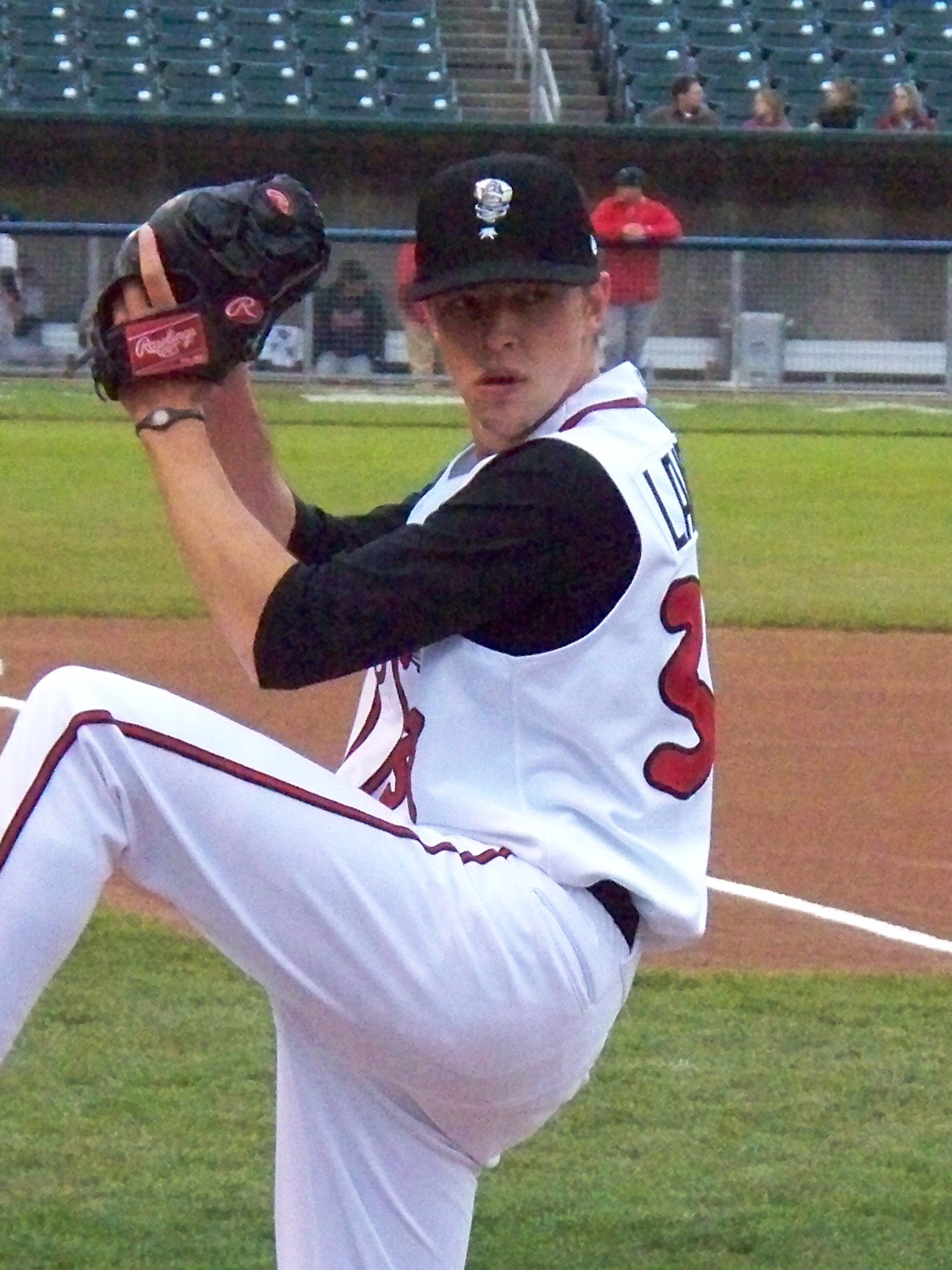
MLB reports: Welcome to the Reports Casey! First question we like to start off with: Who was your favorite baseball player growing up, that you most idolized and patterned your game after?
Casey Lawrence: The player that I most idolized growing up was Cal Ripken Jr. of the Orioles. I admired Cal for his ability to show up to the field day in and day out, without ever taking a day off and playing through injuries. I admired the way he accepted a position change from SS to 3B for the betterment of his team. I admired the way he played the game and had fun doing it.
MLB reports: Which current MLB star do you most admire and why?
Casey Lawrence: Today, I admire Derek Jeter for the way he handles himself on and off the field. He is the type of player that has become a household role model. He plays the game the way it is supposed to be played and has that “it” factor; the ability to make the big play, clutch hit, and find a way to win.
MLB reports: Reflecting on your career to-date, what are your proudest accomplishments on the baseball field?
Casey Lawrence: My most proudest accomplishment of my career-to-date would have to be a combination of two: the day I signed my contract with the Toronto Blue Jays and being given the honor of starting the 2010 New York-Penn All-Star Game. I consider both to be honors and rewards for the hard work I’ve put in each and every day.
MLB reports: You started your baseball career with the Jays organization in 2010. Did you expect to be signed by Toronto? What was that process like?
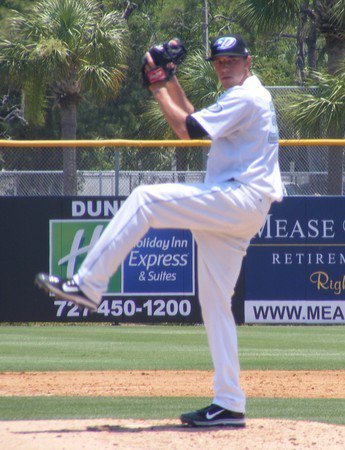 Casey Lawrence: I had been shown some interest from a few teams after my junior year at Albright College heading into the draft. While no teams took a chance then, I still had faith that my time would come after graduating my senior year. My senior year was greeted with several more teams showing interest, but yet again the draft came and went without a single phone call from any of the 30 MLB teams. That means I had been passed over in the draft 3,000 times in two years. But wasn’t the first time I had been looked over, so I had accepted the fact that I had to continue to prove people wrong each and every day. I had actually been in Florida for vacation during the 2010 draft. I returned home that Sunday and pitched in a local men’s league game for the Brushtown Bulldogs. Monday morning I received a phone call from Blue Jays scout Bobby Gandolfo saying that they would like to offer me a contract. I flew back to Florida Tuesday morning and my journey started.
MLB reports: What do you consider your greatest baseball skill(s)?
Casey Lawrence: I consider my knowledge of the game as one of my greatest baseball skills. I grew up learning and playing the game I love from my Grandfather, who was offered a professional contract from the St. Louis Browns. But he turned it down because my Grandmother insisted he stay home and take care of the family, my Father and my Uncle. I really enjoy talking the game and strategy of baseball every day and don’t know what I’d do without it.
MLB reports: What facets of your game do you most wish to improve upon?
Casey Lawrence: I am continually working to better myself within this game whether it be mentally or physically. I always keep “The Mental ABC’s of Pitching” close by me and consider it a pitcher’s Bible. I also have been striving to continue to get stronger and increasing my arm strength in order to stay healthy and consistent.
MLB reports: I am very impressed with your numbers. Good win totals, low ERA and WHIP. I am particularly blown away by your low walks rates. What’s the secret of your success?
Casey Lawrence: The secret to my success is no secret at all but rather hard work. I have always worked hard at throwing strikes, locating all my pitches, getting ground balls, and allowing the defense to make plays. My Uncle Dave (also my pitching coach at Delone Catholic High School) and Gary Yeager Jr. (my pitching coach at Albright College) always preached about pounding down in the strike zone and that hasn’t changed since signing with Toronto.
MLB reports: Long-term do you see yourself as a starter or a reliever?
Casey Lawrence: Long-term I see myself doing whatever the team asks me to do. Obviously, I’d love to continue to start; but if they feel I’d help the team more by relieving ,then that’s what I’ll do.
MLB reports: What pitches do you throw? Best pitch? Anything you are currently working on?
Casey Lawrence: My repertoire consists of a 2-seam sinking fastball, 4-seam fastball, change-up, slider and curveball. I’m continuing to develop my breaking pitches into being more consistent and sharper.
MLB reports: If you had to look into a crystal ball, when do you see your expected time of arrival in the big leagues and what do you think you need to do most to get there?
 Casey Lawrence: That’s a tough one, really putting me on the spot with this one! I’ll say this. I see my arrival in the big leagues whenever the team feels I’m ready. Obviously, everyone wants to get there sooner rather than later, but it takes a lot of hard work to get there. They are the greatest players in the world. The truth is “if you think you’re ready, you’re probably not”. Every day is another opportunity to get better and learn something new. No one is guaranteed the opportunity to play at that level and if I’m fortunate enough to one day have that opportunity, that would be a blessing.
MLB reports: What do you do for fun when you are not playing baseball?
Casey Lawrence: When I’m not playing baseball, I enjoy going to the movies, watching television, playing some video games and golfing.
MLB reports: Have you visited Toronto yet?
Casey Lawrence: I honestly have never been outside the United States. My passport is ready if the time calls for it, but I’d rather not just visit.
MLB reports: You just completed your second professional season, finishing in High-A ball. Do you know where the Jays likely plan to start you this season?
Casey Lawrence: I have no idea where the Blue Jays plan on starting me this season. I’m anxious for Spring Training to start and earn a spot on the team they feel I fit best.
MLB reports: If you could send out a message to the Jays fans, what would it be?
Casey Lawrence: My message to the fans of the Blue Jays would be to continue with their unbelievable support and that the whole entire organization is working very hard day in and day out to bring them a World Series. Hopefully in the near future!
MLB reports: Final thoughts?
Casey Lawrence: Finally I’d like to thank my family, friends, and fans for their continued support. I don’t think they get enough credit for what they have meant to me in my life. It’s truly a blessing and I thank God each and every day for the opportunity I have to play the game I love for a living.

***Thank you to Casey Lawrence for taking the time today to speak with us on MLB reports (and the pictures used in todays’ feature)! You can follow Casey on Twitter (@CaseyLawrence). Casey is very social media savy, so please feel free to send him any questions/comments you have. Good luck in 2012 Casey, the crystal ball sees big things for you this season!***
Jonathan Hacohen is the Lead Baseball Columnist & Editor for MLB reports: You can follow Jonathan on Twitter (@JHacohen)
Please e-mail us at: MLBreports@gmail.com with any questions and feedback. You can follow us on Twitter and become a fan on Facebook . To subscribe to our website and have the daily Reports sent directly to your inbox , click here and follow the link at the top of our homepage.

Was the Era In Which Juan Gonzalez Played in the Reason Why He Is Off the HOF Ballot?
Tuesday January 17th, 2012
Sam Evans: Juan Gonzalez was the finest Texas Ranger power hitter to ever roam the outfield at Arlington Stadium. He played the game with poise and stayed humble, which made him a fan favorite in Texas. In his second year of eligibility, the 2012 Hall-of-Fame voters only gave Gonzalez 4% of the vote, which is 71% less than what is needed to be elected…and took him off the ballot. Is there any chance that this vote was affected by the Steroid Era, in which Gonzalez played in?
Juan Gonzalez grew up in an impoverished barrio in Puerto Rico.He overcame adversity as a child, and is still a role model to young Puerto Rican baseball players. He was signed by the Rangers at the tender age of 16 in 1986. He shot through the minor leagues in only two years, and soon, he was considered one of the best prospects in all of baseball. After word spread of Gonzalez’s jaw dropping power, he was named AL MVP in 1996 and 1998. He never won a World Series, but he did win one of the most thrilling Home Run Derbys ever in 1993.
Gonzalez, known more commonly amongst the Rangers fan base as “Igor”, had a 17-season Major League career that was often plagued by injuries. Igor only played more than 145 games three times in his long career. Gonzalez played for the Rangers, Tigers, Indians, and Royals from 1989 to 2005, but he’s mostly remembered for his time as a Ranger.
This worldwide superstar hit 434 homers in his career with a .265 career ISO. ISO, or Isolated Power, is a stat that is used to find a batters true power. In 1996, Gonzalez hit 47 homers and had an ISO of .329. To give you an idea of how impressive that is, from 2000-2010, Albert Pujols led all baseball players with more than 1000 PA, with a .294 ISO.
 Juan Gonzalez was never a five-tool baseball player. The tall, buff outfielder always played shaky defense at best. Even as an offensive player, Gonzalez never offered much of an average, and he always was dragged down by a low OBP%. Igor had only 457 career walks. That’s only one-third of what Bobby Abreu has collected in his 16 years in the majors.
During the peak years of his career, Gonzalez was a key cog in the middle of the lineup contributing towards the Rangers success. If Gonzalez hadn’t been leading his team to wins, and dedicated owner George Bush wasn’t helping the Rangers get a new stadium, the Rangers probably wouldn’t still be based in Arlington.
Igor was a very lovable baseball player. He’ll be remembered for his smiling grimace after every big swing he took. He would shift his weight from foot to foot before every pitch, just daring the pitcher to throw him what he wanted. Then, when he swung, the ball exploded off his bat. He’d finish with the bat in one hand, and nobody had any doubt that the ball was going to leave the ballpark.
As much as it is looked down upon nowadays, Gonzalez was known for his gaudy RBI numbers. He drove in 100 runs eight times in his career.Now that we have learned that RBI is not an accurate statistic when measuring a player’s value, Gonzalez numbers just don’t look the same.
Gonzalez is simply not a Hall-of-Fame caliber player. Despite having ten years where he hit roughly .300 and over thirty dingers a year, Gonzalez wasn’t as great in other facets of the game. He was only worth 38.6 Wins Above Replacement during his career, which is less than Mike Cameron‘s total from 2000-2010. WAR is not always a great statistic for tracking defensive value, but almost all other defensive statistics show that Gonzalez was a below-average fielder.
With Juan Gonzalez not receiving enough votes to continue on his Hall-of-Fame quest, one has to wonder if it was because of steroid suspicion from the voters. It is completely unfair to judge whether or not a player took steroids based on their physical appearance. Sure, Albert Pujols looks like a freak of nature. However, maybe it is just in his genes, or maybe he works harder than anyone else during the offseason.
Unfortunately, the chances are that Gonzalez probably took steroids at one time or another during his career. Jose Canseco says that he gave Gonzalez steroids, and Gonzalez was also featured in the infamous Mitchell report. Unlike most players who have been claimed to have taken steroids, Gonzalez has had his trainer back him by saying that the drugs that the Mitchell report discussed Gonzalez taking, were actually painkiller and flu medicine.
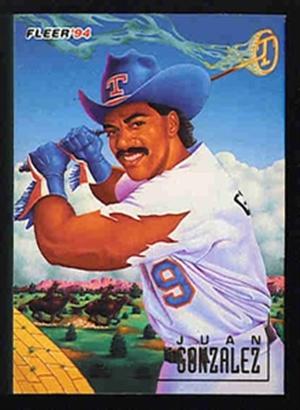 Steroids were not illegal during the 1990’s. People get so worked up about how baseball players who took steroids should be erased from the record books and forgotten forever. The fact of the matter is, steroids were a part of the game during that era. It’s impossible to tell who took them and who stayed away. So why don’t we just appreciate the great ballplayers we witnessed during that time and leave it at that?
Let’s assume that Juan Gonzalez took steroids every year of his career. Assisted by these steroids, Juan Gonzalez helped save the Rangers franchise, while he also gave more back to his hometown of Vega Baja, Puerto Rico, than most of us can even dream of. Not to mention, steroids weren’t illegal and about a third of the players were probably taking them at the time at least. Even if Juan Gonzalez used steroids, he not only to become a better baseball player, but he also narrowed the gap between Puerto Ricans and Americans playing baseball. Now, Puerto Ricans see Major League Baseball as an opportunity to make money and improve the quality of their lives, as well as those of their families.
I’m not saying that Gonzalez knowingly ever took steroids. Even though it seemed as if he was always injured, and steroids were especially popular amongst players rehabilitating from injuries, there wasn’t a clear line between steroids and painkillers back then. Igor has repeatedly denied knowingly taking steroids, and I am starting to believe him.
Juan Gonzalez is not a Hall-of-Famer, so I am not surprised he got left off the ballot. The numbers aren’t completely there and the reality is that he doesn’t measure up well against Mark McGwire and the other actual and perceived steroid users trying to be elected. I just hope that in the future, baseball voters will look past the era in which a player competed in, and look more at how each player played during their era and the effect that they had on the game of baseball as a whole.
***Today’s feature was prepared by our Baseball Writer, Sam Evans. We highly encourage you to leave your comments and feedback at the bottom of the page and share in the discussion with our readers. You can also follow Sam on Twitter***
Please e-mail us at: MLBreports@gmail.com with any questions and feedback. You can follow us on Twitter and become a fan on Facebook . To subscribe to our website and have the daily Reports sent directly to your inbox , click here and follow the link at the top of our homepage.
Follow @mlbreports
The Baseball Struggles of Tall/Heavy Players After 30: Is Prince Next?
Monday January 16, 2012
Doug Booth- Baseball Writer: I am still astounded when I hear that Prince Fielder has not been signed yet. This man is a powerhouse that would help any ball club. So what is going on? When I thought about this a little more I realized that tall/heavy hitters really have a tough time keeping their productivity up once they are near the second half of their career. It is really not that hard to figure out. A player that is taller also carries a larger strike zone, where the overweight players will only lose any speed they had as their career starts winding down. For this particular article, I choose 4 players to study this exact scenario. Those players are: Richie Sexson, Tony Clark, Mo Vaughn and Cecil Fielder.
Tall Players
Richie Sexson-(Career .261 306 HR 943 RBI), is one of the tallest players ever at 6’6″. For the first 9 years of his career, this Oregon Native terrorized pitchers and routinely deposited baseball into the bleachers. During those years, the man clubbed 270 HRs and drove in 824 RBIs, power numbers that put him amongst the best in baseball. Despite being quite thin, Richie began having problems in the field and at the plate once he hit the age of 32. In 2007, Richie Sexson only hit .205 and was striking out on the outside pitch at the knees frequently. We are talking about a professional hitter who put together 6- 100 RBI seasons. Within a year, Sexson was out of the league without any takers. It wasn’t a real gradual drop either. At age 31 Richie Sexson hit 34 HRs and 107 RBIs for Seattle, a place where half of his games were played at pitcher friendly Safeco Field.
Tony Clark-(Career .262 252 HR 824 RBI), is 6’8″ and was drafted by the Detroit Tigers in the 1990 Amateur Draft. Clark started out his first seven seasons with the Detroit Tigers by hitting .277 with 156 HRs and 514 RBIs. While he was not as potent as Richie Sexson, Clark ended his career with Tigers with a slugging percentage of .502. At age 30, the Boston Red Sox now had Clark as their 1st baseman. However, this was short-lived as he struggled badly. In 2003 and 2004, Clark spent time as injury relief for both of the New York teams. The Mets used Clark when Mo Vaughn retired in 2003, while the Yankees had him play 1st base when Jason Giambi was out for the year with stomach pains in 2004. In both cases Clark responded with 16 HRs, in half of the at-bats of a regular year. Tony Clark played regularly during the next season for the Arizona Diamondbacks, hitting 30 HRs in only 130 games, while also slugging a career best .636. Tony struggled to stay healthy after that year, although he provided some nice pop as a pinch hitter. His career as a regular had been over since he had turned 33.
Heavy Players
Mo Vaughn-(Career.293 328 HR’S 1064 RBI), is listed as weighing only 225 pounds at baseball reference.com, but for those that watched him play, knew that was way under the weight Vaughn played at once he left Boston. Vaughn spent his first 8 years with Boston hitting .304 with 230 HRs and 752 RBIs. Vaughn was named the 1995 AL MVP when he hit 44 HRs and drove in 143 RBIs. The man was a beast in his Boston days. After posting 2 decent years with the then ‘California Angels’ hitting 30 HRs and driving in 100+RBIs, Vaughn signed with the New York Mets. Vaughn showed up to camp out of shape (at age 34) and slumped in his first year with the Mets. More health issues came up the next year and a knee injury brought the man to retirement. Those were knee problems that arose very likely from carrying all that extra weight on his frame.
Cecil Fielder-(Career .255 319 HR’S 1008 RBI), is a classic example of what I am talking about. With the Toronto Blue Jays, Cecil hit 31 HRs in only 504 ABs. But there was a problem. The Jays featured AL home run king Fred McGriff at that time with John Olerud in the system. So Cecil Fielder was off to play in Japan for a season. Earlier in Cecil’s career, he was much leaner until he joined the Detroit Tigers. In 1990, ‘Big Daddy’ signed with the Detroit Tigers and went on to hit 51 HRs and drove in 132 RBIs. It was the first time a player had hit 50 homers in a year since George Foster did it in 1977. Cecil Fielder led the league in RBI for his first three years with the Tigers, and he also finished with 44 HRs to lead the league in homers for his second year with Detroit. At the age of 32, he was traded to the New York Yankees at the deadline before helping them secure New York’s first championship since 1978. After the following season, the Yanks felt they were better suited to use Darryl Strawberry at DH and Tino Martinez at 1st base, so they let Cecil leave. At age 34 Cecil was big and slow and ended his career after a great 10 year run.
So maybe this is the reason that teams have not signed Prince to a huge 8+ years contract. Based on my research, the most I would give Prince is a 5-year deal. Pay him more annually if you wish, but do not make the mistake as other teams have made in the past. I do not want to add Prince to this list after his career is over.
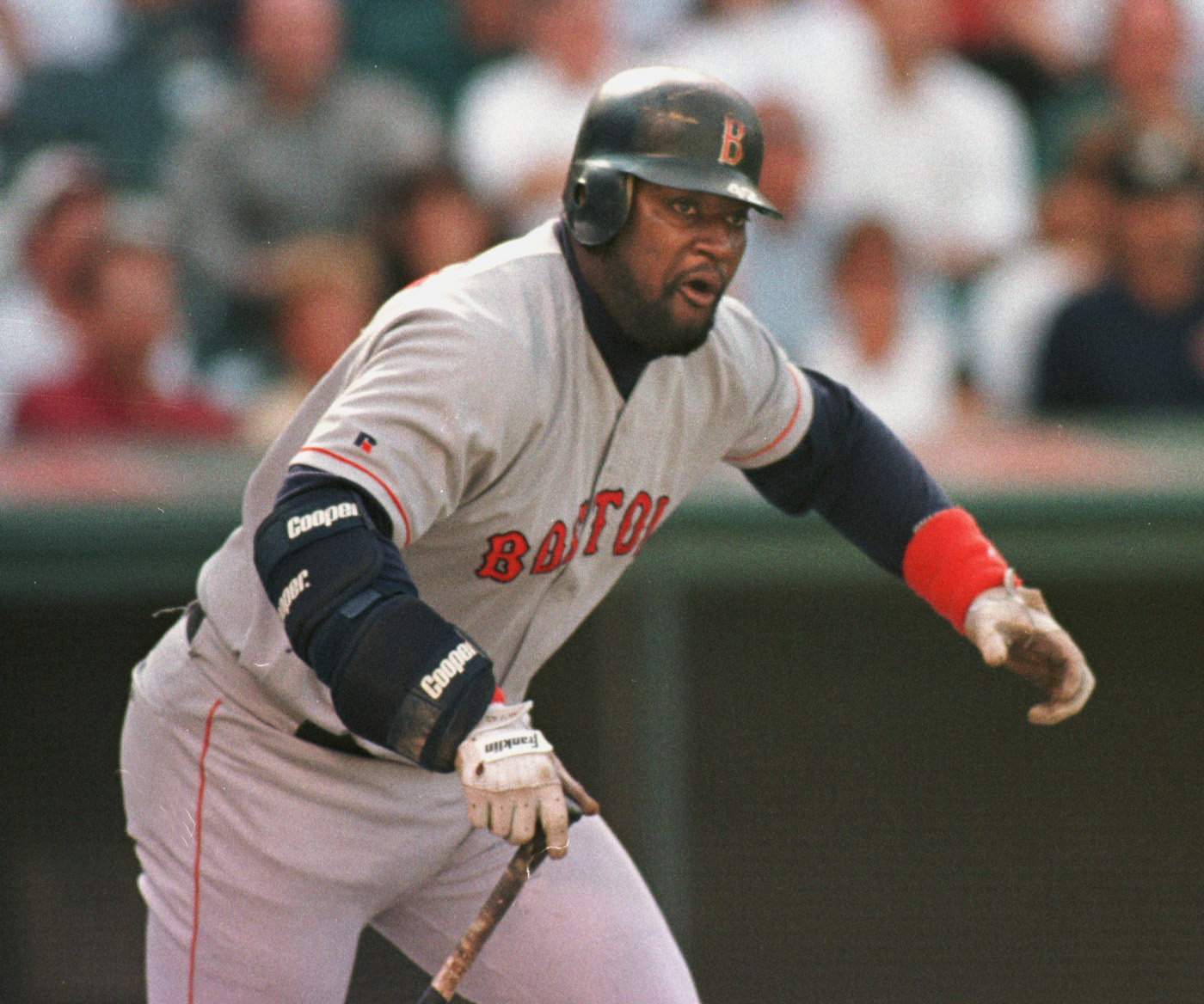
*** Thank you to our Baseball Writer- Doug Booth for preparing today’s feature on MLB reports. To learn more about “The Fastest 30 Ballgames” and Doug Booth, you can follow Doug on Twitter (@ChuckBooth3024) and click here for Doug’s website, fastestthirtyballgames.com***
Please e-mail us at: MLBreports@gmail.com with any questions and feedback. You can follow us on Twitter and become a fan on Facebook . To subscribe to our website and have the daily Reports sent directly to your inbox , click here and follow the link at the top of our homepage.

Steve Palazzolo Interview: The Pitching Tower of Pisa
Sunday January 15, 2012
MLB reports – Jonathan Hacohen: When I first spoke with Steve Palazzolo, I was blown away by his stature. How could you not be…the man stands 6’10” and throws baseballs for a living! The first images that went through my mind were Jon Rauch and Randy Johnson. Comparisons that I am sure Steve has heard his whole life. But once you get past the sheer size of the man, you find a person with an even bigger heart. A gentle giant, Steve is very well spoken and intelligent to converse with. With the shortage of quality arms in today’s major league bullpens, one would expect that available arms would be snapped up in a second. But that is not always the case, especially for Steve Palazzolo. He pitched five seasons in the minor leagues, between the Brewers, Giants and Mariners organizations. He made it all the way up to AAA before returning to Indy ball the past season and a half. Steve will be 30 by opening day and continues to battle his way to achieve his dream: making the big leagues. As we discussed in yesterday’s interview with Luis Lopez, Jerome Williams made his way from Indy ball to the Angels rotation last year. Dreams do come true. Steve Palazzolo has shown that he has the talent. Taking a look at his numbers from last year, Palazzolo pitched 53 games for the Blue Crabs- finishing with a 9-5 record, 3.06 ERA and 1.200 WHIP. He only surrendered 4 home runs while striking out 57 batters. Watching him on video and considering his talents and strong character, I would be snapping this guy up pretty quickly if I was a baseball General Manager. To succeed in baseball, you need to have talent and a chance. Steve Palazzolo has the talent. Now he is just waiting for his opportunity.
Today on MLB reports, we are proud to present pitcher Steve Palazzolo- or as we refer to him: The Pitching Tower of Pisa
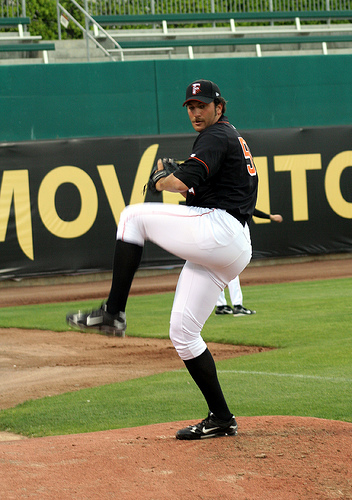
MLB reports: First question: Steve. Palazzolo is an interesting last name. Meaning and origins?
Steve Palazzolo: It comes from the Italian word Palazzo, which means palace. There is also a village in Sicily named Palazzolo. I’d definitely love to visit some day.
MLB reports: Everyone reading your profile would see: 6’10”, 29-years-old and a right-handed reliever. On paper you should be in a major league bullpen. What is your current active status?
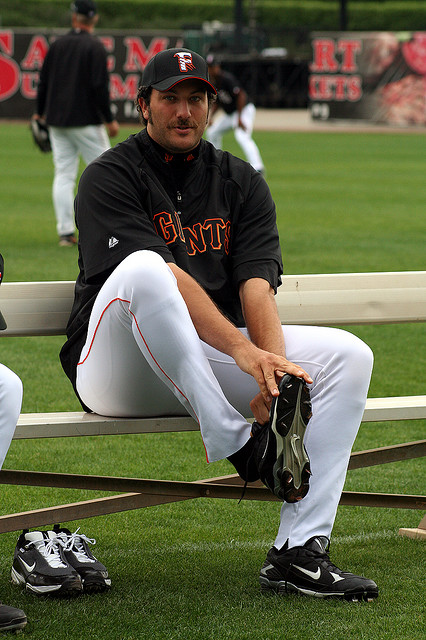 Steve Palazzolo: Current active status is “trying to join a major league bullpen.” Really, though, I’ve spent the last year and a half in the Atlantic League with the Southern Maryland Blue Crabs, just continuing to learn and get better. It’s definitely a never-ending process in baseball, and I’ve spent the last couple years adding different pitches and arm angles, while also learning different ways to attack hitters.
I’m also looking at a possible opportunity to play in Japan, so we’ll see how it all plays out.
MLB reports: We last saw you playing for AAA Tacoma in 2010. Since then you have been playing Indy ball. What led you back to playing Indy? What are the differences between Indy and playing in the minor leagues?
Steve Palazzolo: I was sent back to Indy ball in what I viewed as a three-way trade. Back in July 2010, it went something like this:
Rangers Get: Cliff Lee, Mark Lowe
Mariners Get: Blake Beaven, Justin Smoak, Josh Lueke, Matt Lawson
Blue Crabs Get: Steve Palazzolo
OK, so the Cliff Lee deal brought in a few minor league pitchers and I got the axe.
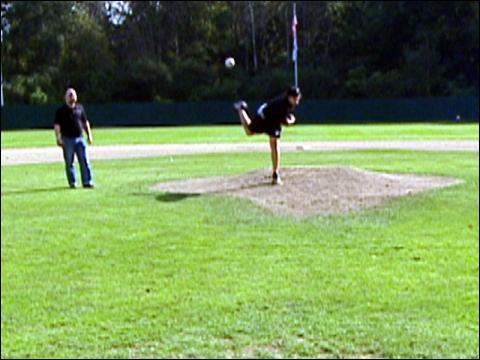 I’d say the main difference in Indy ball is the organizational structure. There is no class level, so you’re not really worried about moving up or being sent down. Just go out and do your job and do it for the team. I’d say my Indy teams have been the most closely knit teams I’ve ever been on. It’s usually the same core of guys for the entire year, and everyone wants to get back to affiliated ball, but there is a definite emphasis on winning as a team. Not to say that affiliated teams can’t be close, but there is a lot more player movement that tends to disrupt team chemistry throughout the year.
MLB reports: You have played in the Brewers, Giants and Mariners systems. Tell us about the best teams that you pitched for in your professional career.
Steve Palazzolo: As far as talent goes, the 2009 Fresno Grizzlies are near the top. Our overall record doesn’t show it, but with about three weeks to go in the season, we had the second best record in the Pacific Coast League but we were 14 games out of first place behind Sacramento.
Bullpen wise, the 2008 Connecticut Defenders was probably the most talented I’ve been a part of. We had a number of pitchers who went on to have some big league success, most notably Sergio Romo who was closing for us.
If we’re talking clubhouse unity, I mentioned the Indy teams, but the 2010 Tacoma bullpen will always hold a special place for me. Even though I was only there a short period of time, we had an outstanding group of guys who genuinely cared for each other and did a great job of staying entertained for the first five innings of every game (always an important in the bullpen).
MLB reports: What are your goals going into the 2012 season?
Steve Palazzolo: First to marry the love of my life, and best friend, Kelley Donoghue (she is looking over my shoulder as I type). Simple answer is to pitch to the best of my ability, regardless of where I’m playing.
MLB reports: You were signed as a free agent by the Brewers as your first organization in 2006. Tell us about the process in joining Milwaukee.
 Steve Palazzolo: Pretty fun story actually. I had just finished my second professional season with the Worcester Tornadoes and was sitting at my computer on a Thursday in late January when I received an email from my good friend, Will Carroll. He forwarded me an email from a Brewers scout that referenced an invitation-only tryout at their spring training complex that Saturday. Will mentioned how it was unfortunate that I was not in Arizona. I emailed him back with the title, “Last Minute Trip to Arizona?” Will sent the request back to the Brewers scout who agreed that if I could get to Arizona, I would be welcome to try out. I immediately booked a flight for Friday and made the workout on Saturday. At the workout, they suggested I mix in a couple different arm angles (which I’d experimented with before) and as it turns out, I was one of only two guys signed that day.
MLB reports: Given your size, most people would think that you would be a power pitcher. How would you describe yourself as a pitcher and tell us about what you throw.
Steve Palazzolo: I wouldn’t say power pitcher, but I do think my height gives me a big advantage and helps all of my stuff to play a little better. I throw a 4 seam fastball, slider, splitter and I just added a new changeup. My change is interesting as I started to experiment with it toward the end of last year, and I may have found a really good grip that I will stick with for good, possibly even replacing the splitter. As I mentioned, I’ve also experimented with a number of different arm angles, so I’m always mixing it up.
MLB reports: Every baseball player works towards making the big leagues. What do you need to do in order to achieve that dream?
Steve Palazzolo: At this point in my career, or anyone’s career for that matter, the phrase you hear is “right place, right time.” Pitchers mature and figure things out at various times in their careers so that’s why I’m constantly looking to improve. I think I just need another shot to play in Double or Triple A, then it’s all about pitching well. Pitch well, and if it matches up with a situation where the big league team needs a pitcher, then it can happen. I know this: I’m confident in my abilities to pitch successfully in the big leagues, it’s simply a matter of continuing to improve while also getting an opportunity.
MLB reports: If you weren’t playing baseball today- what would you be doing?
Steve Palazzolo: I’d probably be a pitching coach, and that’s what I do all offseason. On my long road through the minors, I used myself as my own science (pitching) experiment. It’s been a constant process of trial and error, and I’ve learned so much along the way. So my plan is to coach, while also developing my own business as a pitching coach. I have a couple of blog posts up at www.stevepalazzolopitching.wordpress.com, but I have to get better putting up more consistent material.
I’m also an analyst and writer for www.profootballfocus.com. Just started this year, and it’s been a lot of fun breaking down the NFL.
MLB reports: Looking back at your career to-date, would you have done anything different?
Steve Palazzolo: I do remember a hanging slider I threw in 2008 that went for a home run. I should have thrown a fastball.
Really though, I made the decision early in my career to put everything I had into it, and I’ve been very blessed along the way. No major regrets.
MLB reports: When you think of your expectations going into professional baseball, what are some of the biggest surprises you have encountered?
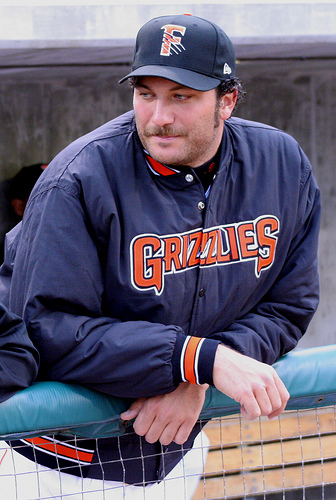 Steve Palazzolo: This is a tough question. Making me think here. As a kid, expectations are always glamorous. Everyone wants to be like their TV heroes, but when I entered pro ball, I already knew that it was a difficult grind. Not sure I can think of any major surprises, but I will mention the one thing I appreciate and that’s the uniqueness of everyone in the game. Players coming from all walks of life, all over the world, unified by the game of baseball. It’s really amazing to think of the people I’ve met along the way.
MLB reports: Choice of cleats and glove- what brands do you use?
Steve Palazzolo: Nike cleats and Spalding glove. If and when I hit, always Franklin batting gloves.
MLB reports: Given your height, how do you find clothes shopping?
Steve Palazzolo: It’s difficult. There are a few stores that carry big sizes, but I have to do a lot of my shopping online. The Big and Tall store is better for wide rather than tall, so a lot of the stuff is just way too big.
MLB reports: Which past or present MLB players would you most compare yourself to? Are either Randy Johnson or Jon Rauch a close comparison?
Steve Palazzolo: Kenny Powers. Actually, he stole my look. I’ve been rocking the mustache and long hair since ’06.
I really try to take something from everyone, whether it’s Randy Johnson or Tim Lincecum. As far as comparisons, Johnson isn’t great because he was such a hard thrower. Rauch is an OK comparison, but he has a higher arm slot than me.
The one pitcher I’ve seen who compares favorably is Kameron Loe from the Brewers. We’re not identical, but our natural arm slot is similar. He’s 6’8” tall and also likes to mix up arm angles so I can relate to his style a bit.
MLB reports: We discussed the potential of you heading to Japan. What are your thoughts on heading to the far east?
Steve Palazzolo: It would be a great opportunity. The competition is great and I’ve seen a lot of pitchers who have gone there and then come back to the states as better pitchers. It’s a different style in Japan, and I think the hitters force each pitcher to use his entire repertoire. Even though the culture change would be difficult, I’m hoping I get the chance to play there.
MLB reports: Last question: to a young pitcher in school just starting out, what advice would you give them?
Steve Palazzolo: Work hard, work smart. I don’t think the grammar is correct on that statement, but I think it gets the point across. Anyway, pitching is a lot more than throwing a ball to a target (or is it?). Preparation is extremely important, and when I work with young pitchers, I like to break it down into four main areas: mechanics, strength and conditioning, nutrition, and mental approach. Oh and it’s important to have fun while doing it. The best players love the preparation.
***Thank you to Steve Palazzolo for taking the time out of his offseason training to speak with us today on MLB reports! You can follow Luis on Twitter (@Palo50). Steve loves interacting with his fans, so please feel free to send him any questions/comments you have. Or just wish him good luck on the season, as he would appreciate your support!***
Jonathan Hacohen is the Lead Baseball Columnist & Editor for MLB reports: You can follow Jonathan on Twitter (@JHacohen)
Please e-mail us at: MLBreports@gmail.com with any questions and feedback. You can follow us on Twitter and become a fan on Facebook . To subscribe to our website and have the daily Reports sent directly to your inbox , click here and follow the link at the top of our homepage.
Ask the Reports: Your Baseball Questions Answered – Sunday January 15th, 2012
Sunday January 15th, 2012
Jonathan Hacohen: Posted every Weekend: Your top baseball questions from the past week are answered. E-mail all questions to mlbreports@gmail.com, message us on Twitter and post on our Facebook Wall!
Let’s get to your top questions of the week:
Q: Any news on moves for Derrek Lee & Casey Kotchman? With Yanks recent pitching acquisitions, does Boston pursue Roy Oswalt more aggressively? Rick
MLB reports: Great questions Rick. No and no are the answers. Sorry! To answer your first question: Lee and Kotchman are plans “c” and “d”, if that, for contending teams. Teams on the rise would prefer to use younger players at first base. So the market for both is limited at best. Both Lee and Kotchman will need to fight to get full-time jobs. Kotchman will find something based on his solid 2011 campaign. Perhaps a return to the Rays is in order. Lee on the other hand, is getting on in years. I could see him retiring at this point, or in a year from now. It just depends on how desperate some teams are to get a veteran presence on their team and if trust is there for either player. With regards to Oswalt, I see him signing very soon. Boston could use him, yes, but I am not sensing a fit. The top teams for his services appear to be the Rangers and Jays. At 1-year and $8 million, he will likely have 20+ teams pursuing him. Boston does need Roy Oswalt in the worst way at this point. He would help stabilize a rotation that needs his presence. But this decision will come down to geography and fit for the player.
Q: Is Jesus Montero– Victor Martinez good? How far is J.P. Arencibia or Travis d’Arnaud from Montero? Derek
MLB reports: The Montero questions begin! I made the comparison on the trade of the trade that Montero was comparable to V-Mart and I stand behind that one. Carlos Santana is another good comparison. Extremely strong bat, will hit for high average with good pop. Glove is questionable. Montero will be good, I am just on the fence on whether it will happen in Seattle. The hope is that with a young team, he will blossom into a superstar. It will depend on whether he feels any pressure to live up to replacing Michael Pineda and ends up putting too much pressure on himself. He seems like a confident young man, so he should do well. The V-Mart threshold is a high one to reach. But we are definitely talking in the same category. Now d’Arnaud and Arencibia are a different story. Being based in Toronto, I get asked on these guys often. Here is my take put simply. Arencibia is a good guy, with good power in his bat. He is popular in the clubhouse and seen as a developing defensive catcher. His liabilities are his low average, high strikeouts and inability to take a walk. A .219 AVG and .282 OBP don’t cut it in my book. If JP doesn’t develop, he will become the Rob Deer of catchers. Travis d’Arnaud, on the other hand, may not have JP’s power (debatable), but he will definitely hit for a much higher average. He also will need to learn to take walks and cut down on strikeouts, but he should be more consistent offensively than Arencibia. Defensively, I have heard mixed things- but both will stick at catcher. So defensively, both Arencibia and d’Arnaud are above Montero. But Montero’s bat is far superior to either of the other guys. He is major league ready now to hit, while JP and Travis are still learning to hit consistently. If I had to rate each, I would give Montero an 8/10, d’Arnaud a 6/10 and Arencibia a 5/10. Montero is far ahead, with only d’Arnaud having the best chance to close the gap.
Q: Do the Phillies really expect Ryan Howard to be fully “baseball ready” before June 1st? Old Man Mack
MLB reports: LOL. That is the hope sir. If I had to be a fly on the wall, I bet the Phillies are hoping that he will be ready before that. But if the Kendrys Morales injury has taught us anything, is that you never know how some of these freak accidents will heal. My crystal ball sees Howard back after the All-Star break. Unless he is 110% healed, why risk it? His long-term health and productivity are at risk. I would not be shocked if Howard took longer to heal and had to miss all of 2012. But chances are that he will be back, just not till sometime in July or August of 2012. If he is back sooner, he better be ready…or a setback could be around the corner. I would say the bigger question is how long he stays in the lineup, rather than when he is back.

Q: What are the Tigers chances on Yoenis Cespedes? Michael
MLB reports: The Cespedes rumors are flying fast and furious. The teams that have been most linked to him are the Marlins and the Tigers. There have been stories of 5 teams, 10, 20…all sorts of numbers thrown around about this guy. Now, people are questioning why he is playing winter ball and in fact hurting his stock. My gut feel is that there isn’t as high of a demand for him as people suspect and that teams are cautious at throwing big money at an unknown quantity. But even if he doesn’t put up the best numbers this offseason, it has to be considered that he is rusty and been away from the game for some time. People should not expect Babe Ruth immediately, just to view his tools and to see if the mechanics are there. I like the Marlins chances best at signing Cespedes. Team Latino gets a 50% chance of landing Cespedes, with the Tigers at roughly 20%.
Q: Does Vance Worley come back to earth in his sophomore season? Justin
MLB reports: Nah man, Vance never left! Just kidding, but I know what you mean. Vance Worley was unbelievable in 2011, with an 11-3 record, 3.01 ERA and 1.230 WHIP. His won/loss record will depend largely on his offensive support and bullpen, so that we will leave to fate somewhat. I see Vance throwing quality strikes and keeping his walks low. He will not be an ace, but he will be very steady. He has the minor league track record and has already proven himself at the highest stage (in one of the most pressure filled environments, Philadelphia). Expect some regression, but not too much. Vance Worley is the real deal. A sophomore jinx should be avoided, but he will still take time to develop. Remember he is only 24-years of age. By year 3 or 4, expect a stud 20 game winner to emerge.
Q: With the new players eligible for the 2013 Hall of Fame class (Bonds, Clemens, Sosa etc.): will any be inducted? Ken
MLB reports: Ken. Ken. Ken. Mr. I say that Tim Raines MUST be inducted. 🙂 He is back for more… Just playing with you Ken, you know we love ya. 48.7% of the vote Ken, I guess the voters aren’t all sold…yet. Here is my knock on Raines- get ready. Played 23 seasons. Not a bad thing in its own right. But definitely inflated some of his numbers. 980 RBIs. So he averaged less than 50 a year. 1571 runs scored. For 23 years played, not fantastic. A hall of fame leadoff man should easily be scoring 100+ per year, even on poor teams. Raines only did it 6 times. .294 AVG and .385 OBP. Very good. Like those numbers. The man did not hit many doubles or triples. He was basically a singles and stolen base machine. Now go check out our man Vince Coleman. Both in their primes, they were one of the top stolen base threats. Raines got more hits and got caught less stealing. But then Coleman appears to have attempted more stolen bases. Raines played longer and ultimately had the stronger career. But in the prime years, I can’t say that Raines was that much more spectacular than Coleman. Raines is very good and will get into the hall of fame the Jim Rice route. But it is not the Hall of Very Good. It is the Hall of Fame.
Now with your true question: Will any of the new eligible players be inducted into Cooperstown in 2013? The candidates are Bonds, Clemens, Piazza, Sosa, Schilling, Biggio and Lofton. I can tell you right now, based on Palmeiro and McGwire’s poor standings, that there is no chance in heck that Bonds, Clemens or Sosa are getting in. No way. No how. The ones I see getting in are Biggio and Piazza. Secretly, I have fantasized at night about Biggio and Bagwell getting in together. It was just meant to be. If Bagwell does not get in next year, then he will have to wait for some time. I feel next year will be his year. Piazza has to get in as a 1st ballot hall of famer. The numbers he put up as a catcher demand it. Next year is the year that hall of fame voters get their true test. If Piazza is out, then the hall of fame will really have to sit down and work out a better set of criteria for voting. The writers are going to feel like they are on a raft without paddles…it is time to fix the voting mess once and for all. Are these guys hall of famers or not? Let’s lay down the law and be done with it. No more fence-sitting. 2013 will be a big year for sure.

Q: Over/under 13.5 psychotic episodes in Miami? Sam
MLB reports: Under. Way under! I think you will see maybe 5-6 big blow ups. Carlos Zambrano will get into 1-2 confrontations. Hanley will explode about the position change once. LoMo will have one twitter incident. Ozzie will have a couple of issues likely develop. Apparently the Miami Marlins are being considered for the baseball reality show this year. If that happens, watch out. That will be Grade A television!!!

Final Q: Will the Brewers be able to win the central despite losing Prince and no Braun for first 50 games? Eric
MLB reports: My brain says no and my heart says maybe. The reality is that the Brewers are in tough. Very tough. The loss of Prince will be huge (when it happens) and same with Braun if the suspension is upheld. But even with those guys, the Brewers would still be in tough. The Cardinals, even with the loss of the Pujols and La Russa and absence of Duncan would still be a strong team. The Reds though are the team to beat, as they are frontrunners to take the NL Central this year. The Brewers still have Greinke and Gallardo, so they have a chance. But I just see the Reds as the class of the division this year. The Cardinals are going to regress and will have a tough time defending their title. But without their main offensive stars, the Brewers go from stars to ordinary. The window appears to be closing on the Brewers… and opening for the Reds in 2012.

ARCHIVE: Click here for Past Issues of Ask the Reports
Please e-mail us at: MLBreports@gmail.com with any questions and feedback. You can follow us on Twitter and become a fan onFacebook . To subscribe to our website and have the daily Reports sent directly to your inbox , click here and follow the link at the top of our homepage.
Jonathan Hacohen is the Lead Baseball Columnist & Editor for MLB reports: You can follow Jonathan on Twitter (@JHacohen) Follow @mlbreports

Jason Heyward: What Happened to the Braves Slugger in 2011?

Sunday January 15, 2012
Sam Evans: 2011 was a surprisingly rough year for Braves outfielder Jason Heyward. The former number one prospect struggled making solid contact and he ended up missing thirty-four games in the year. In order for the Braves to compete in 2012, they will need a healthy Heyward to get back to the level he was at in 2010.
Simply put, Jason Heyward was a monster during the ’10 campaign. During that preseason, there had been so much hype made about the consensus number one prospect in baseball. From hitting a 471 foot homer in his first at-bat, to finishing with 5.1 WAR, Heyward was everything Braves fans could have hoped for… and more.
 Heading into the 2011 season, the Braves were expecting an improvmeent from Heyward in his second full season. Heyward didn’t end up having a great year. When he was hurt, he couldn’t help his team. But even when he was healthy, he still struggled.
Heyward hit .192 against lefties in 104 plate appearances. The “J-Hey Kid” missed parts of the season due to issues with his right shoulder and in particular, his sore rotator cuff. Heyward finished with a .227 BA and only fourteen home runs. He could have another mediocre season in 2012, but the feeling is that Heyward will likely bounce back.
Recently, Braves GM Frank Wren was quoted as saying that Heyward will not be guaranteed a starting job in 2012. This is just crazy talk in my opinion. Despite how bad his 2011 season turned out, Heyward was a superstar up until then. Jason Heyward is still only 22 and has room to improve. But he needs major league playing time. Wren could have been just keeping his options open or trying to motivate his young player in some way. In reality though, it was not a very smart quote coming from a usually intelligent General Manager.
2012 will be a career defining year for Jason Heyward. He could continue along his 2011 path, and lead us all to wonder what happened to the clutch, young prospect we all once fell in love with. Or in the alternative, Heyward could return to his old self and lead the Braves back to the playoffs. Above all, we have to remember Heyward is only 22-years old. He is so far ahead of most players his age. So he has plenty of time to reach his full potential.

**Today’s feature was prepared by our Baseball Writer, Sam Evans. We highly encourage you to leave your comments and feedback at the bottom of the page and share in the discussion with our readers. You can also follow Sam on Twitter***
Please e-mail us at: MLBreports@gmail.com with any questions and feedback. You can follow us on Twitter and become a fan onFacebook . To subscribe to our website and have the daily Reports sent directly to your inbox , click here and follow the link at the top of our homepage.
Follow @mlbreports
Luis Lopez Interview: The Real Life Crash Davis of Baseball Worldwide
Saturday January 14, 2012
MLB reports – Jonathan Hacohen: The numbers are outstanding. Six Most Valuable Player awards. An All-Star seven times. Over 2000 hits. Over 1000 RBIs. A minor league hall of famer for sure, Luis Lopez has been playing this game his whole life. He has done it and seen it all. He played in the majors with both the Toronto Blue Jays and Montreal Expos. Played in the minors for four different MLB organizations. Luis has played in both Japan and Mexico. Indy ball. His baseball resume is quite extensive, as are his passport stamps. But at the age of 38, Luis is far from done. He still plays third and first, searching for his chance to make it back to the show. He has strong inspirations to keep him going. Julio Franco played in the major leagues until the age of 49! Even Jerome Williams, at the tender age of 30 provides hope. Away from the big leagues for four seasons, he rose up from Indy ball and back to the Bigs. Luis knows this and keeps the hope deep in his heart as he continues his baseball grind. One of the greatest baseball stories I have heard, Luis Lopez is a true blue-collar baseball player. He is everything that the game is about and a true credit to the sport. Going into his 18th professional season, Luis Lopez is still laughing and having a great time. He just plain loves baseball and will continue to do so for as long as he can.
On his road back to the Major Leagues, we are proud to feature our interview with the real life Crash Davis- Luis Lopez:
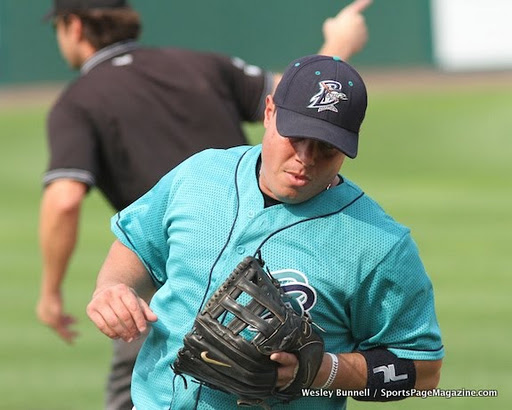
MLB reports: First question: On my count, there are three professional ballplayers named Luis Lopez. Why the popularity of the name? How often do you get mistaken for one of the other ones?
Luis Lopez: I get mistaken all the time. Their cards are sent to me to sign and I’m pretty sure mine to them. The worst part is in the airports flying out of the country. I’m asked to the little room every time for extra screening (laughs). My wife thinks I’m a delinquent cause it happens so often! (laughs harder)
MLB reports: Born in Brooklyn, New York. A baseball hot bed! What is your family’s origins? Do you have roots in New York?
Luis Lopez: My family is from Puerto Rico. My dad from Dorado and my mom from Ponce. I considered myself from PR as well even though I wasn’t born there. I was born in NYC. I’m glad I was because it gave me the drive and desire to think that I will make it!
MLB reports: You originally signed with the Jays in 1996 and made your professional debut in 2001. Tell us about your first major league game.
Luis Lopez: (laughter fills the room) Funny you ask. My first at-bat was against the Angels in Toronto. Bengie Molina was catching and I knew him from all my years playing winter ball in PR. He was talking to the pitcher Holtz and then walked back to the plate. He says in Spanish congrats Luis. I said “thanks brother, my heart about to come through my shirt.” (Grin) Delgado and a bunch of the guys had their hands in their shirts showing me how my heart was pounding! Then Bengie says “relax, we’re gonna put you on so you will hit tomorrow.” I said “what?” All of a sudden I was being intentionally walked! All I could think then was that I would be one an answer to a trivia question! (laughs hard) Not too many people on their first at-bat are walked intentionally!
MLB reports: We last saw you playing in the big leagues for the Expos in 2004- the last year of the franchise. Ironic? If the Expos come back, will you come back with them?
Luis Lopez: Would love to!
MLB reports: You have played in the Jays, Expos, A’s and Braves systems. Tell us about the best minor league teams that you played for in your professional career.
Luis Lopez: That’s tough because I learned how to play ball the right way in the Blue Jays system! They broke down everything for me. With the A’s, we won championships. Atlanta is a big league organization. They treated me like I was with them forever.
MLB reports: In recent years I have you played in the Mexican league, Japan and Indy ball. You are a baseball nomad!!! What was the process like going to Mexico and Japan? What were each of those experiences like?
Luis Lopez: After being around so long, my name is around. A lot of the time it is reports or videos that are seen and then reps get in touch with you. A phone call or e-mail usually. Baseball is baseball. You just have to get used to living in another country that’s all. That’s the biggest problem for some guys; but I can live anywhere.
MLB reports: What are your goals going into the 2012 season?
Luis Lopez: To stay healthy and win a championship! I’ve accomplished a lot of personal goals throughout my career. I just want to produce and help my team win!
MLB reports: At 38-years of age, you have seen it all and done it all. Why do you keep going- what motivates you?
 Luis Lopez: I love the competition! I feel like I still can play in the big leagues and help a team win- even one with only a little chance. I want all of my family to see me play again in a big league stadium. Especially my mom! Every time she came to see me play, I would get sent down that day. It was crazy!
MLB reports: You and I talked a lot about Julio Franco. How much of an inspiration is he to you? Do you plan to play until you are 50?
Luis Lopez: He inspires me a lot! Julio made it back at an age MUCH older than me because someone gave him a chance again. That’s all I want- a chance! If I couldn’t do it anymore, I would walk away; but I know I still have it. The mindset! (laughs) 50? Wow! Nah I don’t see that. Only God knows!
MLB reports: Favorite position to play: 1B, 3B or any others?
Luis Lopez: I love playing 3rd. Still play it. But I will play wherever to get a chance. I just want to hit! (big smile)
MLB reports: Every baseball player works towards making the big leagues. You have been there and want to get back: What do you need to do to make that dream happen?
Luis Lopez: To be honest… I don’t know! I think I have done enough to have ten years in! But I will always stay positive and keep playing hard. You never know who is watching!
MLB reports: If you weren’t playing baseball today- what would you be doing?
 Luis Lopez: I would be managing, coaching or in the front office. Something with baseball. Many of my friends and family members feel I will make it back as a manager- because they feel I have the makeup for that. I can see it!
MLB reports: Looking back at your career to-date, would you have done anything different?
Luis Lopez: (Big Smile) Wow! To be honest… I probably wouldn’t have gone to Japan. It was a great experience; but I think as a position player I went out there too young. When you try to come back, it’s harder that you think. Also Atlanta let Julio Franco sign with the Mets on a 2-year deal because they wanted me to be the righty off the bench.
MLB reports: When you think of your expectations going into professional baseball, what are some of the biggest surprises you have encountered?
Luis Lopez: It had to be when I signed and how far I got to play. I signed for two gloves and a pair of spikes as my bonus; but I made it!
MLB reports: Choice of cleats, bat and glove- what brands do you use?
Luis Lopez: Nike cleats. I use my boy ex-player Pete Tucci’s bat company. Tucci Lumber and he’s MLB approved! (Big laugh) My glove is Nike also.
MLB reports: Which past or present MLB players would you most compare yourself to?
Luis Lopez: Edgar Martinez and Kevin Millar. I would love to have a pic of all three of us! (Laughs)
MLB reports: If the major leagues are not an option, do you plan to stay in Indy ball? Will you try to make the minors for a MLB team or go to another country like Japan again?
Luis Lopez: As of right now, yes- I will be playing in Bridgeport in the Atlantic League. So hopefully someone will come find a guy (like me) that can pinch hit in the bigs and get a game winning hit! (Laughs)
MLB reports: Proudest baseball accomplishment?
Luis Lopez: There are many! I think and say thank you God for letting me be successful! HOF at Coastal Carolina University. 6 MVP’s. 7 time all-star. Over 2000 hits. Over 1000 RBI’s. All in the minors- but i feel anywhere is good! Plus I am going into my 18th year professionally.
MLB reports: You really are the real life Crash Davis. Tell us about the comparison.
 Luis Lopez: Hahaha. I’ve seen a lot of places. Many great ballplayers. I try to help everyone just like Crash did in the movies because guys need to realize that Indy ball is another path back- it’s not the end. You put in the work and you will be fine. Look at Jerome Williams! He was in Lancaster last season. Then he got picked up and was on TV again last year. This year he is slated to be the number five starter for the Angels! Way to go Jerome!
MLB reports: You must have made many friends for life in this game.
Luis Lopez: There’s too many to mention! But if I show up to spring training or any stadium, trust me that a lot of them would come up and say wassup! (Big grin)
MLB reports: Final thoughts?
Luis Lopez: Don’t ever let anyone say you can’t do something, because I’m living proof of what you can accomplish if you believe in yourself! Surround yourself around POSITIVE people especially in this sport… because it is a game of failure. Lastly: play hard or go home!
***Thank you to Luis Lopez for taking the time out of his offseason training to speak with us today on MLB reports! You can follow Luis on Twitter (@DoubleL1919). Luis is great and absolutely adores interacting with his fans, so please feel free to send him any questions/comments you have. Or just wish him good luck on the season, as he would appreciate your support!***
Jonathan Hacohen is the Lead Baseball Columnist & Editor for MLB reports: You can follow Jonathan on Twitter (@JHacohen)
Please e-mail us at: MLBreports@gmail.com with any questions and feedback. You can follow us on Twitter and become a fan on Facebook . To subscribe to our website and have the daily Reports sent directly to your inbox , click here and follow the link at the top of our homepage.

The Chicago Cubs 2012 Convention: The Inside Report
Friday January 13th, 2012

Brian Bernardoni (Guest Writer – MLB reports): The tour begins. As long as baseball is played….
For 15 years I have given tours at Wrigley Field to literally thousands of Cub Fans, tourists and the occasional Canadian. And since 1998 I have always started them the same way; with this soliloquy:
“As long as baseball is played, the memory will live of a bulbous man on matchstick leg pointing in an elegant gesture to Wrigley Field’s faraway centerfield barrier, the jibes of 50,000 Chicago fans searing his ears. There were two strikes on George Herman (Babe) Ruth like there had been many times in his career. The score was 4 to 4 in the fifth, and Ruth’s Yankees were gunning for their third straight win. Two called strikes and there stood baseball’s greatest hitter in the sunset of his career, majestically drawing a bead on a spot 400 feet away. Contemptuously the Babe held up two fingers, then pointed to the centerfield flagpole. Charlie Root pitched. He shouldn’t have done it. Like a projectile the ball left the Ruthian bat to scream on a line over the right centerfield wall.”
Any true baseball fan will recognize the story immediately. The story is of course the “Called Shot”.
 The story is really part of American folklore; its “Casey at Bat” except Casey hits the home run. Personally I have long contended that the “Called Shot” story is the work of Ruth and the massive public relations team that supported him. Charlie Root and Gabby Hartnett both presented full course presses during and after their careers were over that the story was false, as did a significant volume of others. Heck; Ruth even admitted it. But when you strip away the grandiose story, the drama of the World Series and the great imagery the myth provided Ruth with the setting for what a star is supposed do. A star, when provided the opportunity shines.
Now there are undeniable facts about the story. Fact 1: Charlie Root pitched the ball and Ruth hit it out on Sheffield Avenue.
But as a Cub fan, and a Wrigley Field tour guide the part of the story that grabs me the most is that the Ruth’s pinnacle moment didn’t happen at Ebbets Field, or Fenway, or even the house he himself built – Yankee Stadium. No. The moment that was the exclamation mark on his extraordinary career happened in Chicago and it happened at Wrigley Field, and that is Fact 2.
The 27th Annual Cubs Convention will take place Friday, January 13 through Sunday, January 15, 2012, at the Hilton Chicago, located at 720 S. Michigan Avenue. The hours of the Convention are as follows: Friday – 3 p.m. to 9 p.m.; Saturday – 9 a.m. to midnight; Sunday – 9 a.m. to 1 p.m. For Cub fans interested in what is happening at Wrigley Field during the off-season the can’t miss session is “Meet Cubs Business Management,” offering a look toward the future of the Cubs and Wrigley Field with Cubs President of Business Operations Crane Kenney, Executive Vice President, Chief Sales & Marketing Officer Wally Hayward, Executive Vice President of Community Affairs Mike Lufrano, Vice President of Stadium Operations Carl Rice, Vice President of Ticket Sales Colin Faulkner, Vice President of Business Development Alex Sugarman and Director of Fan Experiences Jahaan Blake.
The ballpark is much more than a building for me. It’s part of my own family history as my grandmother played softball there in 1933 during the World’s Fair in Chicago. My daughter took her first step on the field on Father’s Day just a few feet away from where her grandmother once played. It’s also a cruel mistress – who takes me from my family. I leave hours before I should so I can gaze upon her and sing her praises. So as I embark on blogging about her and Chicago ballparks and their rich history – I hope you enjoy the tour.
I will be tweeting at the event (should the Hilton have WiFi). Follow me on Twitter (@brianbernardoni)
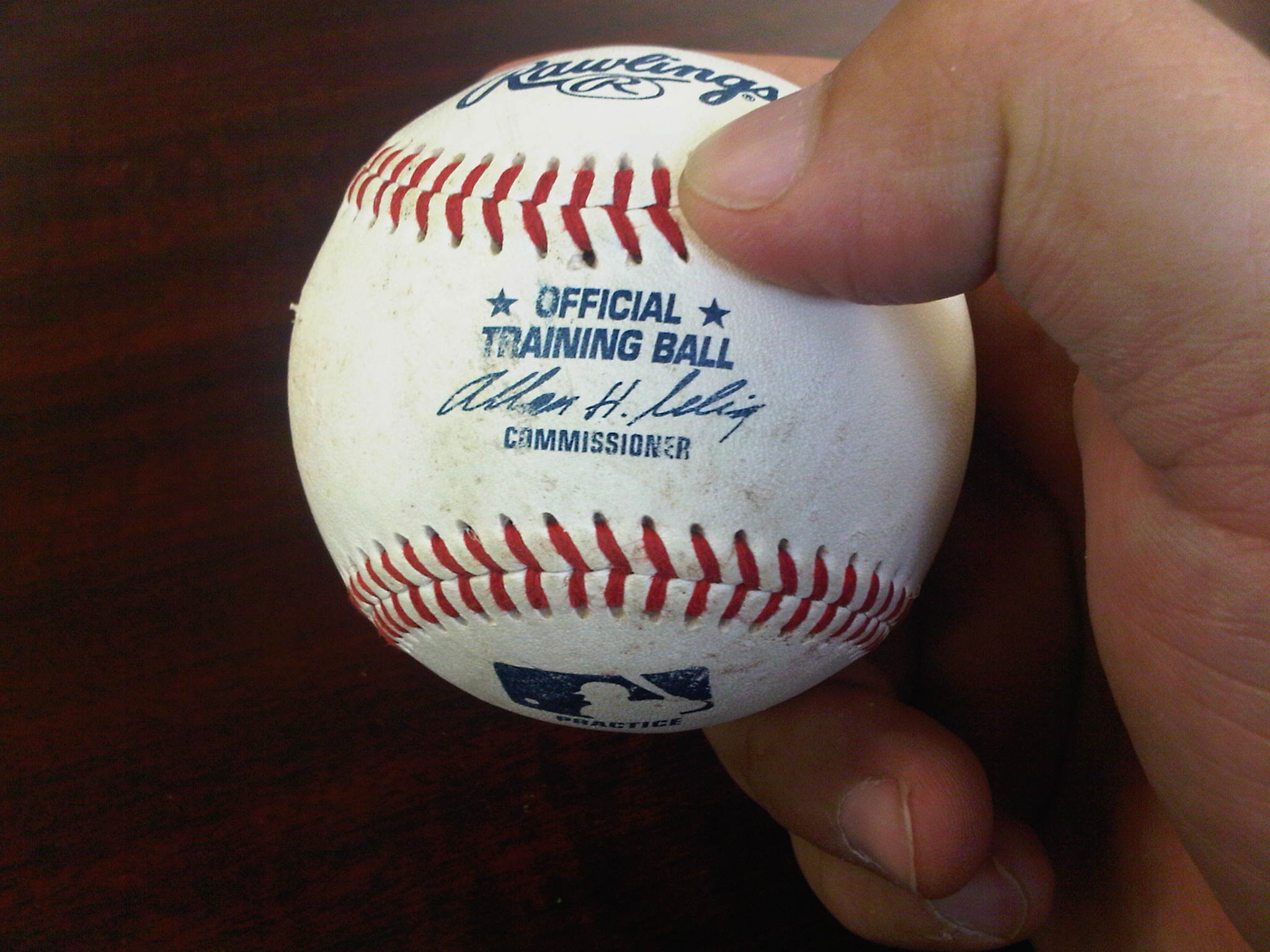
ABOUT: BRIAN A. BERNARDONI
2010 Jerome Holtzman Award Recipient
In 2012 Brian A. Bernardoni will enter his fifteenth year as a Wrigley Field Tour Guide. He is a native Chicagoan and is widely recognized and highly regarded as an expert on both the West Side Grounds and Wrigley Field.
Brian is a lifelong Chicago Cub fan who along with his colleague Michael Reischl and the “Way Out of Left Field Society” coordinated efforts to place a historic marker at the location of the West Side Grounds, where the Chicago Cubs played (1885 -1915). He has testified on behalf of the Chicago Cubs on land marking matters at before the Chicago Landmarks Commission and the Chicago City Council Committee on Buildings. He is a member of the Emil Verban Society, the Emil Rothe Chapter of SABR, the Ballparks Committee and the Old Timer’s Baseball Association of Chicago of which he was the 2008 “Old Timer of the Year”. For these efforts Brian was awarded in 2010 with the Pitch and Hit Club of Chicago’s “Jerome Holtzman” Award.
A vigorous researcher he has contributed to several books including The Cultural Encyclopedia of Baseball, Haunted Baseball, Field of Screams: Haunted Tales from the Baseball Diamond, the Locker Room, and Beyond, Classic Cubs ¬– A Tribute to the Men and Magic of Wrigley Field, Hoodoo: Unraveling the 100-Year Mystery of the Chicago Cubs and ¬Living the Dream – An Inside Account of the 2008 Cubs Season. His poetry on the Cubs can be found on Bardball.com and he is a blogger for MLB Reports. His own book on Wrigley Field with Elliott Harris is anticipated soon.
Brian and his efforts to preserve the history of Chicago Cubs ballparks have also been featured in two recent films on the Chicago Cubs; “We Believe” and “Chicago Cubs: The Heart & Soul of Chicago.” Brian was also a contributor on both films.
Brian is not only a serious baseball historian but also has played a role in some interesting Cub related events including “Burying the Curse” where he performed in a funeral home with legendary performer Tom Dressen and a séance in the room where Billy Jurges was shot at the Hotel Carlos; an inspiration for the book and subsequent film “The Natural.”
Brian and his wife Carrie are residents in the Chicagoland area and are the parents of four daughters.

Please e-mail us at: MLBreports@gmail.com with any questions and feedback. You can follow us on Twitter and become a fan onFacebook . To subscribe to our website and have the daily Reports sent directly to your inbox , click here and follow the link at the top of our homepage.
Follow @mlbreports
The 2012 Tampa Bay Rays Starting Rotation
Friday January 13th, 2012

Rob Bland: Starting pitching surplus. This is a phrase that every Major League Baseball franchise wishes they could say they possess. However, one team that is quickly becoming a power in the AL East, has just that. The Tampa Bay Rays’ rise to success began in 2008 where they were crowned the American League champions. Since then, they have won due mostly to their strong pitching. A while back, I heard someone say that the Rays franchise is like an onion: peel one layer off, and there is another layer there waiting to blossom. When they lost Carl Crawford, probably the best player in franchise history, to free agency, ultra prospect Desmond Jennings came to Tropicana Field. When Matt Garza was traded to the Chicago Cubs, hyped pitching prospect Jeremy Hellickson took over the 5th spot of the rotation and finished the season with a 13-10 record and 2.95 ERA. Oh, and he won the American League Rookie of the Year Award just to top it off. The fact of the matter is the Rays have a scary rotation already in place, with David Price, James Shields, Wade Davis, Jeff Niemann, and Hellickson.
Before the 2011 season, Baseball America ranked Hellickson the #6 prospect in baseball, with Matt Moore coming in at #15. Moore is a flame-throwing lefty who was called up to the Rays on September 12, 2011 in the middle of a pennant race. Moore threw 9.1 innings, with 15 strikeouts to 3 walks, and a 2.89 ERA. He then went on to pitch Game 1 of the American League Division Series against the Texas Rangers, and threw 7 scoreless innings on 2 hits. GM Andrew Friedman believed in his talent so much that he inked Moore to a 5-year, $14M contract that includes club options that would push the total value to $37.5M over 8 years. Moore will only be 22 years old at the beginning of the season.
Alex Cobb is another intriguing arm that is waiting in the minor leagues for his time to shine. While he wasn’t included in the Rays’ Top 10 Prospects list before the 2011 season, he turned heads while pitching most of 2011 in AAA. Cobb went 5-1 with a 1.87 ERA over 12 starts. Cobb struck out 70 with 16 walks in 67.1 innings, showing plus command of an 89-93mph fastball. Cobb projects to be an inning-eating work horse in the middle of a rotation. While he ended up with 9 starts for the Rays with success, there doesn’t seem to be a spot open for him just yet.
So it appears as though the Rays have 7 viable starting options at the moment. SEVEN. Most teams can’t even say they have four that they are actually happy with. A true embarrassment of riches!
Talent is not the only thing to consider when putting a team together, and the strapped-for-cash Rays are no exception. Even with a team salary of just over $42M, the Rays still clinched the AL Wild Card and reached the postseason for the third time in four years in the loaded AL East. James Shields has club options for 2012-2014, with a value of $7.5M, $9M and $12M, respectively. For a team with such a low payroll, a pitcher like James Shields does not quite seem to fit the team’s plans. It might be in the best interest of the club to be looking for suitable trade partners to potentially shore up the team’s needs at 1B and/or SS.
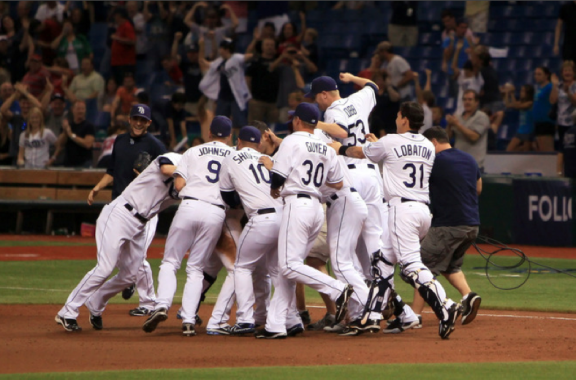 The reality is that the Rays believe that Moore is Major League-ready now, hence the multi-year contract. So therefore, one of the five starters from 2011 is either on his way out, or on his way to the bullpen. Price, Hellickson and Moore are locks for the rotation it would seem. Even though he missed all of May and half of June with back tightness after a rough start to the season in which he gave up 23 runs in 31.1 innings over 6 starts, Niemann had a very strong July and August. Niemann finished 2011 with an 11-7 record and 4.06 ERA. Davis signed a contract prior to the 2011 season that would pay him $10.1M through 2014, with options from 2015-2017 for $7M, $8M, and $10M, respectively. Davis was 11-10 in 2011 with a 4.45 ERA. The fact that his career ground ball rate is 37.8% and he has struck out under 6 batters per 9 innings doesn’t bode well for him. Davis’s stats have regressed in the last two years, and with his contract doesn’t seem likely to net a large return if traded. He could, however, find himself in a swingman type role to start the season.
In James Shields, the Rays have a HUGE trade chip. Since 2007, he has averaged over 220 innings per season. His career marks of 7.5 K/9 and 2.07 BB/9 to go along with a 44% ground ball rate make him a very good pitcher. With 3-years of control remaining, at an average of under $10M per season, Shields could net the Rays a king’s ransom type return. When Friedman traded Garza to the Cubs, he received outfielder Sam Fuld, SS Hak-Ju Lee (#6 prospect by Baseball America), RHP Chris Archer (#38 by BA), OF Brandon Guyer (#6 Rays prospect), and C Robinson Chirinos. Comparing Garza’s 2010 season and Shields’ 2011 season shows that while Garza pitched well going 15-10 and 3.91 ERA, his peripheral stats don’t quite stack up. Not only is Shields’ platform season greater, but his career statistics prove he has been the better pitcher. With the exorbitant prices some teams are paying for frontline starting pitching (see Gio Gonzalez and Matt Latos), the Rays should certainly be looking into moving Shields.
In all probability, the Rays rotation will start out as Price, Shields, Moore, Hellickson and Niemann, with Davis going to the bullpen, and Alex Cobb biding his time in AAA. The Rays could play out the first few months of the season, and look to deal one of Shields, Niemann or Davis based on where they sit in the standings, and their personal performances. Starting pitching surplus sure is a great problem to have.
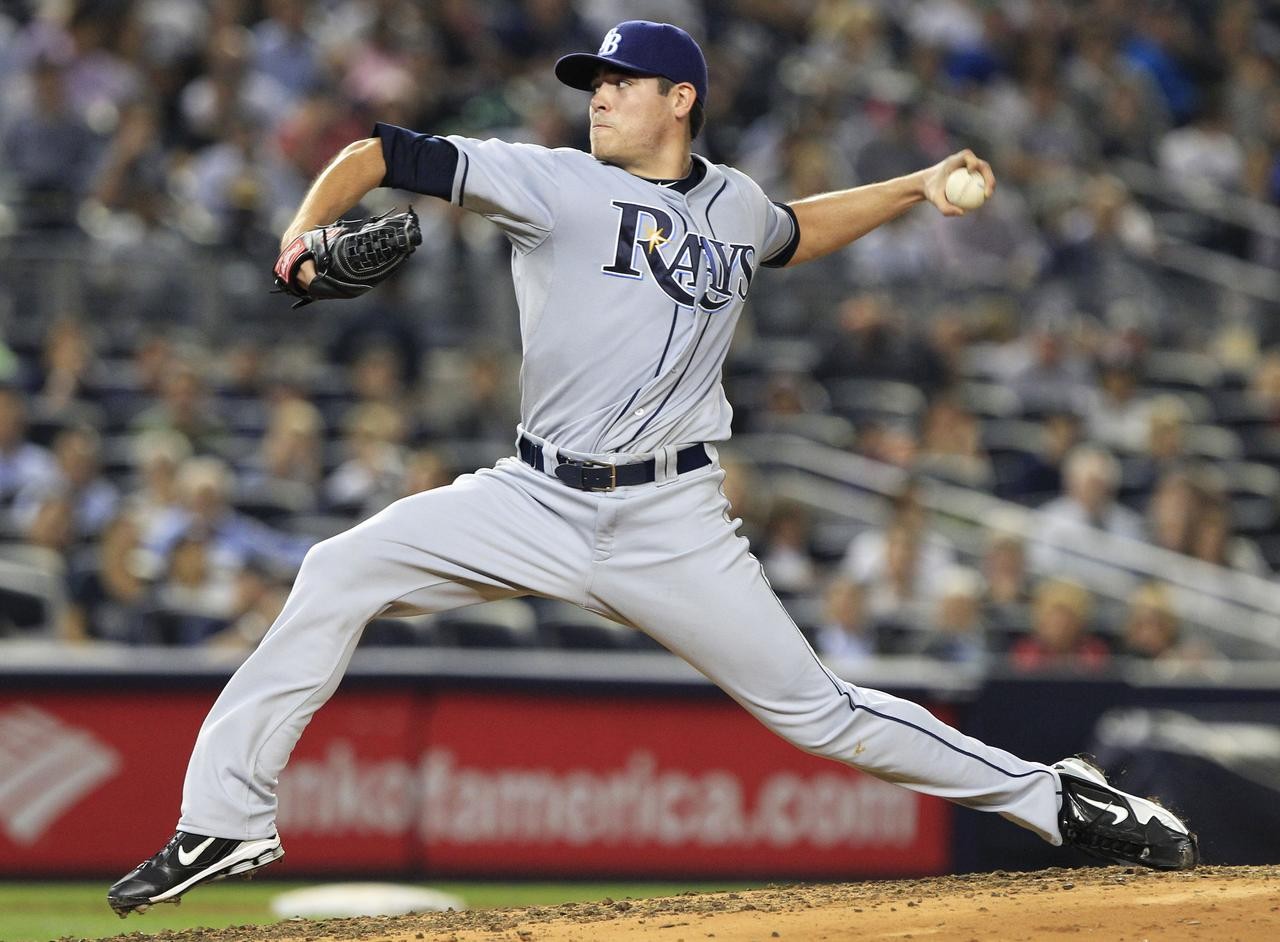
 ***Today’s feature was prepared by our Baseball Writer, Rob Bland. We highly encourage you to leave your comments and feedback at the bottom of the page and share in the discussion with our readers. You can also follow Blandy on Twitter***
Please e-mail us at: MLBreports@gmail.com with any questions and feedback. You can follow us on Twitter and become a fan onFacebook . To subscribe to our website and have the daily Reports sent directly to your inbox , click here and follow the link at the top of our homepage.

Anthony Ranaudo Interview: 2010 1st Round Draft Pick and Red Sox Uber-Prospect
Friday January 13, 2012
MLB reports – Jonathan Hacohen: Imagine that you were 6’7″, a chiseled 230 lbs and drafted in the first round (39th overall) in the 2010 MLB draft. Better yet, you were drafted by the Red Sox. This comes after you were drafted by Texas in 2007 but opted to play for a powerhouse school like Louisiana State. To top it all off, you show up to your first professional season of baseball as a 21-year old highly rated pitching prospect and you hold your own against the competition. Impossible dream? Not really…not if your name is Anthony Ranaudo. Going into 2012, Anthony is one of the top rated pitching (and overall) prospects in the game. While he has the resume and strong credentials already, Anthony is not letting anybody hand him anything in baseball. He is working hard to earn his chance and to prove that he belongs in the majors. Red Sox fans are absolutely giddy at the thought of having Anthony in their team’s rotation one day. Can you blame them? There are 29 other major league teams who would grab him for their system in a second. For a kid that grew up a Yankees fan in New Jersey, Anthony’s baseball story certainly took an interesting twist. Now a member of Red Sox nation, Anthony Renaudo is on track to land in Boston in the near future.
Featured today on MLB reports, we are proud to present Anthony Renaudo of the Boston Red Sox:

MLB reports: Welcome to MLB reports Anthony. First question: We have to know the truth. We understand that you grew up a Yankees fans. How did it feel to be drafted by the Red Sox? Was it difficult to give up the love for the pinstripes and join Red Sox nation?
Anthony Ranaudo: Haha… that is actually such a common question with all my family members and friends back home in New Jersey. But once I went to college and saw teammates and guys I played with making it to the big leagues, you become more of a fan of the game rather than of one specific team. So by the time the draft came, I was excited to be picked by the Sox and join the tradition and history behind the organization.
MLB reports: You got the call in 2007 that you were drafted by the Rangers. Was there ever a possibility of you signing with Texas or was it Louisiana State the whole way?
Anthony Ranaudo: There was a slight chance if they were willing to pay above slot. But I really had my mind-set on going to college, earning a part of my degree, and competing for a national championship at one of the best college programs in the country.
MLB reports: How did you enjoy your time in University? Do you feel you made the right choice in picking school over pro ball? (if you could go back in a time machine- would you have still made the same choice?)
Anthony Ranaudo: The time I spent at LSU was an amazing three years to say the least. I would not go back and change a thing, if I had the chance a million times over. The people I met, friendships I made, and the baseball experience I gained- is not something that I could ever replace. I am so thankful I was a part of it.
MLB reports: Not an easy subject I’m sure, but I was curious about your injury in 2010. You hurt your elbow prior the draft. How did you get injured and were you afraid that the injury would affect your draft status?
Anthony Ranaudo: It was actually a freak incident and a rare bone injury that no one really knows why it occurred. But it did happen and affected my performance and ultimately the draft. With that being said, during that time I can honestly say that I wasn’t as concerned with my draft status as I was with returning to my team and helping to defend our national championship in 09.
MLB reports: How is your health today? Any lingering issues?
Anthony Ranaudo: I am 100 percent healthy with no lingering issues.
MLB reports: Did you have a favorite player growing up?
Anthony Ranaudo: Even though he was before my time, I always idolized Nolan Ryan because he was the best pitcher of his time and always wanted to be the best. My dad would tell me stories about him and his work ethic and why he was the best. I used to collect his cards and want to be as successful as he was.
MLB reports: Which current MLB star do you most admire and why? Any current players that you pattern your game after?
 Anthony Ranaudo: I respect a lot of the players in the major leagues because obviously they have put a lot of time, effort, and energy into their life as a baseball player. Many of them are very intelligent and have learned the game well and that is why they are so successful. I can’t really say there are too many guys that I pattern myself around. But I can say that whenever I am around a major league player, I listen closely and absorb as much as I can about his career and things he has gone through.
MLB reports: What are your goals going into the 2012 season?
Anthony Ranaudo: Personally, my goals for this season are simple. I want to have a focus of getting better each and every day to make myself more of a major league ready pitcher. I think the season will dictate more of my specific goals. But if I work as hard as I can and focus on getting better, I will eventually become the pitcher I know that I can be and hopefully be a major league pitcher helping my team win.
MLB reports: You were a first round pick by the Red Sox in 2010. How did you find out you were drafted? Big party that night?
Anthony Ranaudo: Actually the opposite. The night before the draft, we were eliminated from the postseason at UCLA and had a plane ride that day and night. I found out I was picked by the Sox after we landed back in Baton Rouge.
MLB reports: Did you expect to go to the Red Sox and as high as the 1st round? Your name was discussed for some time in baseball circles as a future 1st round selection- how much of the hype reached you?
Anthony Ranaudo: Well I had heard some rumors about the Sox drafting me, but there are a lot of things your hear all the time. From the time I was a kid it was my dream to play professionally. So just to be drafted was a great honor.
MLB reports: You start off your career as a Greenville Drive and then moved on to the Salem Red Sox last season. Tell us about your first two professional teams…and what the heck is a Greenville Drive?
Anthony Ranaudo: Honestly, I played there for two months and I have no idea. This year was a lot of fun and I really enjoying playing for both teams. I met a lot of good guys and made a ton of new friends that really made this first year of pro ball very memorable.
MLB reports: How did you feel going from school to professional baseball? What was the transition like?
Anthony Ranaudo: Playing at LSU really gave a great start to the transition. There were some minor things to make adjustments to, but overall it was pretty simple.
MLB reports: Do you see yourself long-term as a starter or reliever?
 Anthony Ranaudo: I have always seen myself as a starter and I love being on the mound for seven or eight innings. With that being said, I also love having the ball in my hand when the game really matters the most in the late innings. So if it is my job to be a reliever or closer one day, I will really enjoy and embrace that role.
MLB reports: What do you consider your best pitch(es)? Any new ones that you plan to be working on this season?
Anthony Ranaudo: No new additions this year so far. I am trying to really focus on having great control and command of my three or four current pitches. To this day, my fastball and curveball are still my favorite pitches.
MLB reports: Who were the strongest baseball influences growing up? Any particular coaches that had a deep impact on your game?
Anthony Ranaudo: I would have to say my father had the greatest influence on my career. He was the one who taught me the game and was there for every step, even to this day. But without the support of my mother and father and my brothers and sisters, I would never have made it to where I am today.
MLB reports: What facets of your game do you most wish to improve upon?
Anthony Ranaudo: I need to refine my command of the strike zone and throw more quality strikes with greater consistency. Once I do that, I can focus on competing and hopefully moving up the ladder.
MLB reports: If you had to look into a crystal ball, when do you see your expected time of arrival in the big leagues and what do you think you need to do most to get there?
Anthony Ranaudo: I am glad I don’t have a crystal ball because that way I cannot worry about it. And that is the approach I take every day. Like I said earlier, I try to get better each and every day. If I can keep doing that while staying healthy, I think those decisions will be made for me, hopefully sooner rather than later.
MLB reports: Favorite baseball movie of all-time and why?
Anthony Ranaudo: For Love of The Game. No doubt. Literally tear up every time. It is the perfect description of the life of a pitcher, with the ending of a perfect game. Something that every competitive pitcher dreams of.
***Thank you to Anthony Ranaudo for taking the time to join us today on MLB reports! You can follow Anthony on Twitter (@anthony_ranaudo). Anthony enjoys speaking with his fans, so please feel free to send him any questions/comments you have. Or just wish him good luck on the season, as he works his way up to Boston!***
Jonathan Hacohen is the Lead Baseball Columnist & Editor for MLB reports: You can follow Jonathan on Twitter (@JHacohen)
Please e-mail us at: MLBreports@gmail.com with any questions and feedback. You can follow us on Twitter and become a fan on Facebook . To subscribe to our website and have the daily Reports sent directly to your inbox , click here and follow the link at the top of our homepage.

The Future of the Kansas City Royals
Thursday January 12th, 2012
Sam Evans: Over the last couple years, the Royals have finally begun the climb towards respectability in the baseball world. Not especially for their major league team, but more so due to the volume of minor league talent they have recently accumulated. In 2011, both Baseball America and Keith Law ranked the Royals first in their annual organization prospect rankings. Now, with some of their top prospects already having graduated to the majors, it’s time to see what these guys can do.
Royals GM Dayton Moore has made some questionable, and to be fair, inexplicable moves since he took over in 2006. For example, he signed Jose Guillen and Gil Meche to contracts where both players were making over ten million dollars a year. On the positive side, Moore has been valorous enough to outbid teams for young, international talent. Despite his somewhat ineffective grading of major-league talent, Moore has acquired the pieces to assemble a playoff contender in the next coming years through his development of the farm.
 Sometimes people think that Moneyball was all about on-base percentage. Actually, it is about the A’s finding a way to compete with teams with larger payrolls by exploiting market inefficiencies. It seems that over the last couple of years, other small-market teams have found a way to beat the system by paying more for talented international players. The Royals have used that, along with numerous other scouting techniques, in order to attain the talent that they otherwise could not ordinarily afford.
The Royals have talent everywhere, but most of it is a couple of good years away from making a difference in the majors. Sure, in 2012, the Royals will have young studs like Eric Hosmer and Lorenzo Cain playing every day. But they are definitely not ready yet to compete with the Tigers. Kansas City has an unexciting rotation heading into spring training, that will be probably be one of the worst in the American League, given that too many inexperienced players will be counted on to play above their heads.
The truth is that the Royals have some of the top talented prospects in the game. The top prospects don’t always pan out, while some of the lesser-known ones turn into superstars. You just have to hope to have the right combination of breakout players on your team to succeed. The Royals have built a bottom-heavy organization that is a few years away from competing. Royals fans have a lot to be excited about… in the future. 2012 will most likely be another sub-.500 year for the Royals, but it will be filled with highlights and the promise of a future playoff contending team. At least there is hope and promise!

 **Today’s feature was prepared by our Baseball Writer, Sam Evans. We highly encourage you to leave your comments and feedback at the bottom of the page and share in the discussion with our readers. You can also follow Sam on Twitter***
Please e-mail us at: MLBreports@gmail.com with any questions and feedback. You can follow us on Twitter and become a fan onFacebook . To subscribe to our website and have the daily Reports sent directly to your inbox , click here and follow the link at the top of our homepage.
Follow @mlbreports
Wins Above Replacement (WAR): Analyzing MLB Statistics using Sabermetrics
Wednesday January 11th, 2012
Peter Stein (Fantasy Baseball Analyst – MLB reports): Although WAR (Wins Above Replacement) is not the best of the sabermetric stats for fantasy baseball purposes, it has certainly transformed the way in which we can truly understand a given major league baseball player’s contribution (or lack there of) to his team. WAR attempts to epitomize a player’s total value in one sole statistic, taking into account both the offensive and defensive aspects of the game. FanGraphs (the sabermetrics bible) aptly describes the essence of WAR: “If this player got injured and their team had to replace them with a minor leaguer or someone from their bench, how much value would the team be losing.” A player is measured in “Wins” for a season (i.e. 3.4), while an average full-time player is worth 2 wins and a replacement player represents 0 wins. Furthermore an average staring pitcher is worth 2.0 WAR, while 1.0 WAR represents a strong season for a relief pitcher.
Here are the 2011 leaders in WAR:
Batting
-
Jacoby Ellsbury – 9.4
-
Matt Kemp – 8.7
-
Jose Bautista – 8.3
-
Dustin Pedroia – 8.0
-
Ryan Braun – 7.8
-
Ian Kinsler – 7.7
-
Miguel Cabrera – 7.3
-
Alex Gordon 6.9
-
Joey Votto 6.9
Pitching
-
Roy Halladay – 8.2
-
C.C. Sabathia – 7.1
-
Justin Verlander – 7.0
-
Clayton Kershaw – 6.8
-
Cliff Lee – 6.7
-
C.J. Wilson – 6.4
-
Jered Weaver – 5.9
-
Doug Fister – 5.6
-
Felix Hernandez – 5.6
The statistic actually defines a player’s value, something that MVP (Most Valuable Players) voters should perhaps consider come each October. For batters, the stat itself is calculated by taking into account two stats: wRAA (Weighted Runs Above Average) and UZR (Ultimate Zone Rating), which represent a batter’s offensive and defensive values, respectively. Pitching WAR replaces these two sabermetric stats with FIP (Fielding Independent Pitching), a stat that normalizes ERA for the “uncontrollable,” in conjunction with numbers of innings pitched. The Uncontrollable refers to what happens after the ball leaves the pitcher’s hand, because obviously pitchers have almost no control over the balls that are in play. They are ultimately at the mercy of their defense.
Fangraphs site the formula for FIP as the following:
FIP: ((13*HR)+(3*(BB+HBP-IBB))-(2*K))/IP + constant
If you are unfamiliar with Sabermetrics and WAR, this should feel like a mix between learning a foreign language and a calculus problem. However, don’t let this intimidate you. Spend some time on FanGraphs (It’s okay take it slowly) and it will change the way in which you think about the game of baseball. Please note that Baseball Reference has a slightly different formula/method to calculate WAR.
 The beauty of WAR, however, is that it not only takes in account a player’s defensive skills (using UZR), but also the difficulty of the position. Therefore, someone like Dustin Pedroia at second base is significantly more valuable than a slugging Prince Fielder, at the first base position where power and production is demanded. Perhaps that is why Fielder is still fielding offers and has not landed a contract within his desired range. Not too shabby of statistic for a General Manager, huh? My hope is that this analysis paints the complexity of WAR and the many factors used to determine the number of wins that a player is ultimately worth to his team.
Let it be clear that by no means is WAR perfect. From a rather cynical standpoint, the very philosophy of WAR, which is calculated with so many components, professes that you cannot use one sole determinant to measure a player’s value. Furthermore, the positional adjustment numbers are the most arbitrary difficult to calculate. Can we really determine that a Center Fielder, due to difficulty to play the position itself, is worth 1.5 more wins than a first baseman? It is also difficult to determine the UZR for a first baseman, a position in which success is defined less by range and more by the ability to field throws. Paul Konerko certainly does not have great range, but he is universally regarded as one of the league’s top defensive first baseman, most likely saving Alexei Ramirez a handful of errors each season. Likewise, you cannot measure range for catchers, which use the fielding component of Stolen Base Runs Saved (rSB). We also know that much of catcher’s true value is related to his ability to call a smart game (which cannot be measured by any given statistic).
However, from a fantasy perspective, we do not care about defense, and therefore wRAA is a more accurate indicator of offensive output. FIP can be used as well. For example, if a pitcher’s FIP indicates that his defense is frequently letting him down, and said pitcher joins a top rated defensive team; you have acquired knowledge about a player’s ability not represented by the generic stats out there. This is how you will earn surplus value and land the “surprises”, the “bounce-back” players, and avoid the “busts”.
I admit, when I first familiarized myself with FanGraphs, I felt like I was cheating in my fantasy baseball leagues. However, after joining more competitive leagues and with sabermetrics entering the mainstream, I have learned that this only provides a slight advantage. Just as it holds true for every other aspect of life, it is impossible to predict the future in the world of baseball. However, in a game of numbers- only the slightest advantage is needed to set your team apart from the competition.
WAR is a one of a kind stat. It helps us more thoroughly examine a player’s worth, especially when compared to their salary. Ultimately, the stat serves as a good building block to work back from to understand the intricacies and essence of sabermetrics.

***Today’s feature was prepared by our Fantasy Baseball Analyst, Peter Stein. We highly encourage you to leave your comments and feedback at the bottom of the page and share in the discussion with our readers. You can also follow Peter on Twitter (@peterWstein).***
Please e-mail us at: MLBreports@gmail.com with any questions and feedback. You can follow us on Twitter and become a fan onFacebook . To subscribe to our website and have the daily Reports sent directly to your inbox , click here and follow the link at the top of our homepage.

Do the Diamondbacks Have a Strong Enough Rotation to Win the NL West?
Wednesday January 11th, 2012
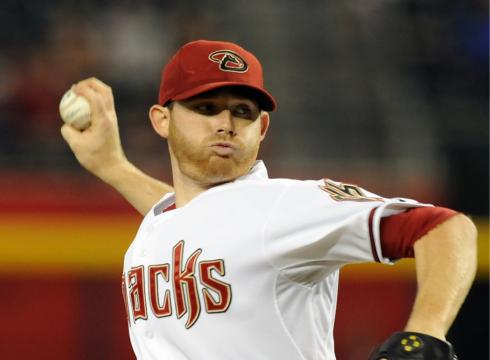
Sam Evans: Last year, the Diamondbacks came out of nowhere and won 94 games. This was thanks mostly in part to their offense. But having three pitchers throw over two hundred innings each didn’t hurt. This offseason, the Dbacks gave up some of their premium minor league talent to acquire Trevor Cahill, who should prove to be another solid pitcher in their rotation.
Last year, Arizona’s best pitcher was Ian Kennedy. He had a breakout year, finishing fourth in the NL Cy Young voting. Kennedy had a 3.22 FIP, 2.88 ERA, and was worth a 5.0 WAR. Kennedy has turned into an ace ever since coming over from the Yankees in 2010. If Kennedy can turn in another workhorse season, the Diamondbacks will have their first All-Star pitcher since Dan Haren in 2009.
 Daniel Hudson deserves almost as much credit as Kennedy for the Dbacks success. Hudson was worth a 4.9 WAR in 2011, and was better than his 3.49 ERA suggested. Another Dbacks pitcher who has less than two years of throwing two hundred innings is going to be heavily relied upon in 2012.
On December 9th, Arizona traded top prospect Jarrod Parker, outfielder Collin Cowgill, and reliever Ryan Cook for Trevor Cahill, Craig Breslow, and cash considerations. The Dbacks will probably come out on top in this trade. Jarrod Parker is going to be a stud for the A’s, but he still has some developing to do. Arizona acquired a front of the line starter, who brings much-needed consistency to the Diamondbacks rotation.
If the Diamonbacks have an area to improve in 2012, it’s their league worst GB% ( 41.9%). Cahill will already be a big boost to that, as he brings his 55.9 GB% from 2011.
After Josh Collmenter had pitched only 36.1 innings last season, he had garnered a following of non-believers. They said that once Collmenter faced the team for a second time, his effectiveness would disappear. Part of this opinion was probably formed because Collmenter was never a top prospect, yet was making the prospect experts look silly. Collmenter proved the haters wrong, finishing with a 3.38 ERA in 154 innings. This just goes to show that we can’t be right about prospects all the time.
 In 2012, Collmenter will have a bigger workload and higher expectations. But if he proved anything last year, it’s that he’s up for a challenge.
The fifth starting spot for the Diamondbacks is still unknown. The Dbacks could bring in a free agent like Hiroki Kuroda or Jeff Francis. They also have some organizational options such as Wade Miley, who started seven games last year, or even 2011 first-rounder Trevor Bauer, who seems to be major league ready.
All of the Dbacks top three starters have come in through trades. With pitchers like Tyler Skaggs and Trevor Bauer on their way to the majors, it looks like the Dbacks are starting to find homegrown talent as well.
I would say that the Dbacks rotation is second in the N.L. West only to the Giants. With a far superior offense than the Giants, it looks like Arizona has a pretty good chance of being able to win their division again in 2012.

**Today’s feature was prepared by our Baseball Writer, Sam Evans. We highly encourage you to leave your comments and feedback at the bottom of the page and share in the discussion with our readers. You can also follow Sam on Twitter***
Please e-mail us at: MLBreports@gmail.com with any questions and feedback. You can follow us on Twitter and become a fan on Facebook . To subscribe to our website and have the daily Reports sent directly to your inbox , click here and follow the link at the top of our homepage.
Follow @mlbreports


 MLB Reports


You must be logged in to post a comment.