Author Archives: Jason Rollison

The Pittsburgh Pirates Should Not Hesitate to Lean on Adam Frazier
The Pittsburgh Pirates are a team that is searching for answers. They may have a ready-made answer in Adam Frazier
Pittsburgh Pirates UT Adam Frazier has been an unexpected surprise in 2016. In a season thought to mark the debut of noted pitching prospects, a do-it-all utility man who had all of 299 plate appearances at Triple-A has shown that he is big-league ready.
So why won’t manager Clint Hurdle pencil him into the lineup more often? To be sure, there is a comfort level that has been built up with players such as Josh Harrison and David Freese. With Gregory Polanco‘s ability to get hot at any given time coupled with Starling Marte‘s consistent play, the formula for consistent playing time for Frazier gets murky.
With the club barely clinging to Wild Card contention, the time may be now for Hurdle to consider scribbling Frazier’s name on his lineup card with regularity, regardless of preference or past performance.
Major-League Ready
Despite having just those 299 PAs at Indianapolis, Frazier has consistently shown to have a major-league capable approach at the plate. A quick glance at several plate discipline and batted ball peripherals shows this to be the case.
The biggest takeaway from these statistics presented here is that Frazier is seeing more pitches in the zone than most other hitters, and doing more with them. An 85.1 percent contact rate versus just a 7.7 percent swinging strike rate shows a very patient hitter who may be more advanced at the plate than initially thought.

When Frazier does put bat-to-ball, his hard hit percentage is above league average as well as is his line drive percentage. A quality approach breeds quality contact which breeds quality hits.

Andrew McCutchen: Small Changes Add Up to Big Drop In Performance
Andrew McCutchen is slogging through the worst season of his professional career. His drop in production is a case of death by 1000 tiny cuts.
Andrew McCutchen‘s season is officially a cursed one.
What started off as an unsurprising bad start quickly mushroomed into one of the biggest storylines for the 2016 Pittsburgh Pirates. Now, something that was previously thought to be unthinkable has occurred. McCutchen has been benched for an entire series.
The search for answers is wide-ranging. Many have offered their own theories as to McCutchen’s struggles. The 29-year old center fielder is himself at a loss for words. He responded with exasperation when asked if he felt he needed to take a breather.
“I wouldn’t be taking days off”
The fact of the matter is that he is working to pull his bat out of its summer doldrums. But, as you will see, there is no easy fix. Rather, many small changes in McCutchen’s approach make up the large picture of a struggling former MVP.
Debunking The Lack Of Hittable Pitches
Andrew McCutchen has offered that he does not get many ‘hittable pitches,’ but the data culled from pitch f/x shows otherwise.
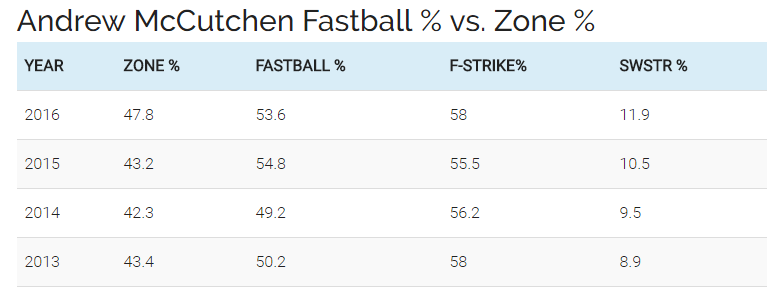
The table above shows the Zone percentages (percentage of pitches in the strike zone) as well as percentages of fastballs seen overall. McCutchen is seeing the most pitches in the zone than he ever has before, and 4.4 percent more than his 2013 MVP campaign.
On their own merits, Zone and fastball percentages can’t tell the full story. They are imperfect metrics. Just because a pitch lands in the zone doesn’t mean the pitch did not have enough deception to freeze the batter, or outright fool him. In this particular instance, fastball percentage lumps in all fastball types. Thus, we can’t fully lean on it to help explain away McCutchen’s inability to drive the ball.

What would a Nationals trade for Mark Melancon look like?
The Pittsburgh Pirates historically move closers at the right time. Is history about to repeat itself?
Today, Ken Rosenthal reported that the Pittsburgh Pirates have been in talks with teams regarding Mark Melancon.
With the Washington Nationals specifically named, how do the Pirates line up as trade partners with the franchise formerly known as the Expos?
Before we can delve into that, we should note that the Nationals were in on Aroldis Chapman. As Jon Heyman reported:
The Nats declined to give up Lucas Giolito for Chapman, then they declined to give up Joe Ross. After those two attempts by the Yankees, New York is said to have requested a four-player package centered around young pitching. Anyway, the Nats didn’t do it and never got close
First, let’s be very clear. In the closer market, there is Chapman, and then there is everyone else. We can use logic to tell us that the Nats will not give up Lucas Giolito – the consensus top pitching prospect in baseball entering 2015 – in any type of 1-for-1 deal. Thus, any deal that includes Giolito and Player X or Prospect Y likely will not work either.
Joe Ross is interesting as he can be seen as somewhat expendable. He’s been a very solid performer, with an ERA in the mid 3.5 or lower range with low-enough walk and home run per nine rates. This year he is averaging about 7.5 K/9. He is controllable through 2022, and is pre-arbitration.
Despite all these accolades, the Nationals are set at the top of their rotation with Stephen Strasburg, Max Scherzer and Giolito. Tanner Roark is in tow and controllable through 2020. Gio Gonzalez has a team option for the next two years, but the club might want to clear space for Erick Fedde, another talented starting pitching prospect.
Putting Together the Package
Taking all of that into consideration, and it would appear that Ross or Roark would be imminently available. Roark might have a slight edge over Ross in esteem due to a slightly longer track record and having slightly better control.
It is easy to envision a 1-for-1 swap of either Ross or Roark for Melancon’s services. We have seen a plethora of “baseball trades” in recent years, afterall.
But, as is often the case, trade deadline deals are rarely that easy. If we expand our criteria to see how the team’s farm systems match up, there is a lot of similarity. The Nationals have an abundance of infielders with multiple position chops as well as the usual assortment of pitching. Much like the Pittsburgh Pirates, their pipeline is surprisingly well-stocked for a team that traditionally has been built through free agency.
I could easily see a swap of B-level prospects being included in a potential deal, or a prospect going to the Pirates as a throw-in. Regardless, any deal with the Nationals would have to involve either Roark or Ross. Both are young, controllable and capable.
With just over 72 hours left until the deadline, the club might just be able to find a better deal elsewhere, but it’s clear that the Pittsburgh Pirates and Washington Nationals line up well as trade partners.

Trademas In July: A look at the potential market for Jon Niese
The Pittsburgh Pirates are shopping Jon Niese, but that may prove to be a difficult task. Our Trademas In July series kicks off with a look at the market for his services.
You hear it all the time when you speak to Pittsburgh Pirates fans who happen to be fathers. When they tell you that their young child is taking up baseball, the standard retort is always heard.
“Make him into a left handed pitcher!”
Indeed, left handed pitchers – both starters and bullpen arms – have always been a hot commodity for Major League Baseball clubs this time of year. The Pirates found themselves at the start of 2016 with not one, not two, but three left-handers in their rotation.
Now, after clawing their way back into postseason contention after a legendary June swoon, the club might have the opportunity to spin one of those left handers to fill other team needs. Those needs are debatable and ever-changing, but for now let’s focus on gauging the market for one Jon Niese.
Pirates are shopping, but is anyone buying?
Niese came to the Pirates billed as an average mid-level starter whose value gets boosted by a solid ground ball rate. Niese has made good on that bill of sale, as his 53.3 percent ground ball rate leads all Pittsburgh starters. Of course, Neal Huntington likely did not expect to be saddled with a ballooned HR/9 rate of 1.8. That figure represents more than double his home run rate for the three previous years combined (0.8).
The home runs Niese has allowed have been many and varied, but it’s not just the long ball that is leading him to an ERA of 5.13 and a FIP of 5.49. Averaging 11 hits per nine innings doesn’t help, and his walks per nine of 3.2 is an increase over the past two years as well.
Back all of this up with strikeout ability that is average at best (Niese has the lowest swinging strike percentage – 7.2 percent – of any Pirates starter with a minimum of 50 IP), and you have to start to wonder if being a left-handed pitcher with controllable years is enough to cover all of these warts.
Finding a potential fit
Nevertheless, the Pittsburgh Pirates are shopping Niese, and despite his foibles, there may yet be a market for him. His contract – Niese is owed $10 million in 2017 and $11 million in 2018 – is attractive due to the twin $500,000 buyouts tagged to each year. In this way, Niese could serve as a bridge for a team with big plans on the 2018 free agent pitching market. By most reports, the 2017 market is weak. Teams may be looking for a stop gap that can be easily shuffled off.
Due to the second wild card, at least 19 teams are expected to buyers to some degree in 2016. By virtue of this, the Pirates can scratch off the Dodgers, Marlins, Mets and Cardinals as potential dance partners. This leaves the pool a little lean, and may force the club to look to the American League for someone to bite on Niese’s services.
The prospect of Niese pitching in the junior circuit may seem ill-advised on the surface, but the wild card picture in the AL is even more jumbled than the NL. Six teams are within 5.5 games of the wild card, leaving only four teams that are truly out of the picture.
A better option even at an advanced age
Of course, chief among the many reasons teams might be reluctant to grab Niese is the abundance of flat-out better options. If we assume that teams would be interested in Niese chiefly from the combination of the flexbility of his contract combined with his left-handedness, teams may prefer to prioritize one of those factors over the other.
If other GMs take that route, Rich Hill immediately jumps to mind. Hill has resurrected his career at the age of 36 after some hard-luck years plagued by injury. We have previously wondered if he’d be a fit for the Pittsburgh Pirates, and with good reason: he comes very cheap. Making $6 million for 2016, Hill’s contract is eerily similar to J.A. Happ‘s 2015 salary of $6.7 million, which Huntington did not balk at.
By all accounts, the Oakland Athletics need to restock at key positions, and it might take a mid-level prospect not named Reese McGuire or Kevin Newman to part with him. But, don’t be surprised if Billy Beane woudl take Niese in a deal such as this. Beane has shown to make “baseball trades” at the past few years – think of Yoenis Cespedes for Jon Lester – and would need someone to eat innings before his own prospects are ready. This is where Niese’s contract could play a big role.
Whether the Pirates end up with Hill’s services or not, he represents a much better value over Niese.
A higher ceiling lurking in Tampa and elsewhere
Matt Moore is another controllable left-hander that could fetch better interest than Niese. Though Moore has had some struggles of his own, he has a bit more strikeout ability than Niese while allowing nearly the same amount of HR/9 at 1.1. However, Moore has shown considerably better flashes than Niese, including an All-Star 2013 that saw him post a 17-4 record with a 3.29 ERA/3.95 FIP in 27 starts.
Moore’s contract also contains multiple team options, but that is about where the similarities end.

Though the buyouts are more significant, teams may not balk at those if they believe they would have a better return.
There are a myriad of other options as well, perhaps none of which is a hotter name than the Padres’ Drew Pomeranz. Pomeranz has been a steady performer for the past several years, but has increased his strikeout rate to 10.1 in 2016. This newfound swing-and-miss ability has put his name on the lips of many this trade season. He, too, comes with three years of control, as he will hit his first round of arbitration after this year.
Conclusions
Though many teams can always use a starting pitcher at the deadline, the market for Niese is likely to cannibalize itself. Normally, a left-handed controllable pitcher would be in high demand, but as we see here, there are better options for a team looking for a rental, and better options for a team looking for someone with control. Niese thus falls into a strange limbo in between these two approaches.
Though the Pittsburgh Pirates may hope to salvage something from Niese, the reality of the market may have other ideas.


 MLB Reports
You must be logged in to post a comment.