The Pinstripe Magic
Like us on Facebook here
Follow @mlbreportsMonday, May.20/2013

Yankee fans consistently criticize their General Managers decision making process despite the fact that the last four years have been substantial successes. Will Yankee fans come to appreciate Cashman’s ability to find value to help sustain success?
By Nicholas Rossoletti (Yankees Correspondent/Trade Correspondent): Follow @nross56
There is a tendency for certain fan bases to panic quickly because of past failures. It can be hard to put your faith blindly in an organization that has frequently disappointed you.
The other side of that coin is that certain ball clubs deserve a bit more rope on the organizational end because of a string of impressive results.
One organization has seen such an unbelievable string of successful regular seasons over the last two decades. The New York Yankees. Despite this success, the fans of the organization ride a roller coaster quite unlike anything else in sports.
Vernon Wells Going Yard in Colorado:
[http://www.youtube.com/watch?v=Eu7IGoYtndY]


From hate to love, Vernon Wells has been a polarizing figure in the Yankee Universe through the last two months. Fans have come to appreciate the skills Wells’ brings to the game, but he may have gone from underrated to overrated based on his swing rates.
Year in and year out, the Yankees have provided fans with teams that compete for post-season appearances, and the grand majority of the time, the Yankees succeed in making the playoffs.
I understand that some Yankee fans believe that success is determined by World Series Championships, and clearly, Yankees’ management would admit that expectations in the Bronx are far different from expectations anywhere else.
With that being said, it is important to understand the fickle nature of deciding a champion for a 162 game regular season in three short playoff series.
The only way to truly judge a baseball team’s success is to analyze the entire season. In that analysis, few organizations deserve more trust and leeway than the Yankees.
This fact led to a lot of frustration from yours truly when fans turned on the Yankees’ management during the spring. A rash of injuries left the team in an uncomfortable position of having to find regular players with little to no preparation time.
Brian Cashman and his team went about filling out the roster as they have in the past. One of the aspects of Cashman’s tenure that many pay little attention to is his team’s ability to find value with veteran players who have worn out their welcome in other cities.
The problem is when you turn another man’s trash into your treasure, the fans immediately believe that the player is washed up and the money spent was a waste.
The personification of this behavior is Vernon Wells. I have never seen a player be so disliked by a fan base prior to ever even putting on the uniform. Wells was a symbol to many fans of what they perceive to be wrong with the Yankees.
A refusal to introduce youth into the lineup while paying a perceived premium on aging talent. Wells, in truth, was another in a long string of fairly astute scouting and risk taking by the Yankees.
Is he this good? I’m not so sure about that. Sorry to rain on the parade everybody. Before I get angry comments, please remember that I was one of the few, along with site owner Chuck Booth, to be in favor of the Wells addition, but the numbers do not whole heartedly support Vernon’s fast start.
Fast forward from late-March to mid-May, and the Yankee fans are singing an entirely different tune. I have seen multiple posts about Wells being an All-Star. He has been described as “clutch” and a “gamer”. Whatever that means.
In truth, that roller coaster that fans tend to ride has hit its pinnacle. Is Vernon Wells much better than what most fans thought when he was acquired? Clearly.
A cursory review of his numbers do tell us that Wells is pretty much the same guy he has been in the Strike Out and Walk areas. His career K Rate is 13.1%. His 2013 K Rate is 13.3%. His career BB Rate is 6.6%. His 2013 BB Rate is 7.0%.
So no real variation there. His ISO of .235 and BABIP of .286 are very similar to his 2010 season in Toronto, which coincides with the last time Wells was a valuable Major League regular. That year, Wells put up 31 Home Runs and with a .363 wOBA.
This year Wells has 9 Home Runs and a wOBA of .374. So far so good right? Everything seems in line with Wells being a 3-4 WAR player, which is a steal for a guy that got pulled off someone else’s roster days before the season.
As pointed out by my friend, Drew Dinkmeyer, in his blurbs for Fantistics.com (you can follow Drew for all your fantasy needs)Follow @drewdinkmeyer , where we have to worry about the 34-year old Left Fielder’s regression is in his plate discipline.
Wells’ contact rate is at a career low of 79.1% and his chase rate is also at a career high. The likelihood of his statistics remaining at a relevantly high level with these numbers seems unlikely.
The one thing I will say that I believe Wells will continue to do if given at bats is hit for power. He has moved into one of the most power-friendly ballparks in the league, and his numbers support a potential 25-30 Home Run season if given the Plate Appearances.
The slight over-performance by Vernon may very well be a theme for the entire organization. Through May 15, 2013, the Yankees had the second lowest run differential of any of the first place clubs in the game.
Team’s with low run differentials can normally thank a few things for being in first place. One would be luck.
Generally, this Yankees team has been very fortunate in one run games, which is a trend that tends to correct itself over the course of a normal MLB seasons. Anyone who chalks this run by the Yankees up to pure luck though isn’t really paying attention.
Another way that teams with low run differentials can come to play is by having a shut down bullpen. Well, Mariano Rivera and his boys have been absolutely spectacular of late so you can put a check mark in that box for now.
There are some reasons to be concerned about the long term sustainability of the bullpens performance, but when any team can go David Robertson/Rivera late in games, it provides an intense advantage over the competition. One of the larger issues that concerns me is the emergence of a younger bullpen piece (Adam Warren .)
With guys like Warren, we would like to see the strike out numbers on bullpen guys at a higher level considering the high leverage situations that can tend to occur at the end of close games.
Warren’s average strike out numbers aren’t the only c
oncern though. Warren’s Strand Rate is 91.8%, which means 91.8% of the base runners that are allowed on base do not score runs. His minor league average is closer to the 70-75% mark.
Regression to Warren’s career mean as to the Strand Rate will mean that more runs will eventually start coming around to score on him.
This means that the performance Warren is showing at this point may not be sustainable over time. The one strong statistic that the young righty is showing is a 52.6% ground ball rate.
The mans continued success would be a huge benefit to the bullpen, but we have to be realistic as to his potential future performance.
So here we are in mid-May and our topic of conversation is whether Mark Teixiera and Curtis Granderson make this team better or worse. Welcome to the twilight world of the 2013 season. Let’ just hope it continues.
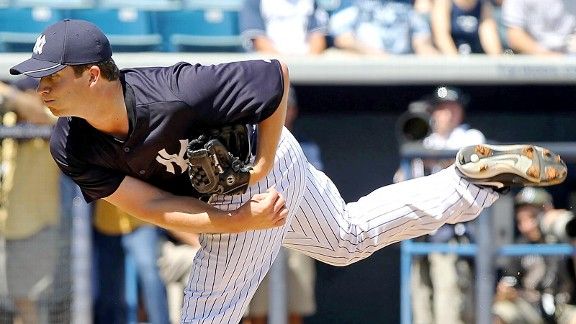
Warren has been a key portion to the ‘pen at this point, but his strand rate and strike out rate has this writer concerned about Adam Warren has gone from a fringy replacement starter to a stable set-up option for the 2013 Yankees. My concerns, which I voiced a bit on this week’s 2 & a Hook Podcast, stem from two specific stats. Warren is striking out batters at about a 19% rate which is about league average. whether what we are seeing from Warren is real.
*** The views and opinions expressed in this report are those of the author and do not necessarily reflect the views of mlbreports.com and their partners***
A big thank-you goes out to Our ‘Trade and Yankees Correspondent’ Nicholas Rossoletti for preparing today’s featured article. Nicholas is a young professional living in downtown Miami. He is a lifelong baseball fan and an avid Yankee supporter.
Having grown up during the last two decades, he counts Derek Jeter and Mariano Rivera as his favorite ball players of all time. He believes in sabermetrics and that new stats have already changed the way the baseball industry sees players.
He was for Trout over Cabrera, he thinks RBIs tell you a lot more about a team than a player and that defense and pitching, ultimately, win championships. Rational thought and introspective analysis over the narrative is how we come to understand the game we love.
The narrative is just a way to keep those who don’t really love the game watching. Feel free to follow Nicholas on twitter and talk the game of baseball Follow @NRoss56
“There are three things in my life which I really love: God, my family, and baseball. The only problem – once baseball season starts, I change the order around a bit.” ~ Al Gallagher, 1971

Please e-mail me at: mlbreports@gmail.com with any questions and feedback. You can follow us on Twitter and become a fan on Facebook. To subscribe to our website and have the Daily Reports sent directly to your inbox, click here and follow the link at the top of our homepage.
Follow @mlbreportsLike us on Facebook here
Posted on May 19, 2013, in MLB Teams: Articles and Analysis, The Rest: Everything Baseball and tagged @drewdinkmeyer, @nross56, @nross56 twitter, adam warren, brian cashman, curtis granderson, david robertson, drew dinkmeyer, fantistics, mariano rivera, mark teixeira, new York, new york yankees, nicholas rossoletti, vernon wells, yankees. Bookmark the permalink. Comments Off on The Pinstripe Magic.


 MLB Reports
You must be logged in to post a comment.