Blog Archives

Moneyball to be Released on Blu-Ray and DVD: January 10, 2012
Monday November 14, 2011

MLB reports – Jonathan Hacohen: It is very difficult to go through nearly four months of baseball withdrawal until live spring training games commence. After the last pitch of the World Series is completed, baseball fans are left to hibernate in their homes and prepare for the next season. Talk of Winter Ball. The Arizona Fall League. Free Agency. Winter Meetings. Great topics to keep the baseball talk alive during the winter. But this is not always enough. Baseball fans need their fix. In the technology age we live in, there is the internet, dvds and Blu-rays. Classic baseball games can be viewed with one press of a button. For those that long for the mix of Hollywood and baseball, there is nothing finer than baseball movies. The best one to come along in some time was the 2011 blockbuster “Moneyball”, starring Brad Pitt and Jonah Hill. If you are in need of a baseball fix, Moneyball is for you.
 On Saturday I went back to watch Moneyball in the theatre. Again. I simply can’t get enough of this film. The running time is over 2 hours long, but you don’t feel it. Moneyball, simply put, is a great movie. It has a strong story line, excellent performances by its cast and the movie just flows very well. From Brad Pitt as Billy Beane, Jonah Hill as Peter Brand (Paul DePodesta), Philip Seymour Hoffman as Art Howe, Casey Bond as Chad Bradford, Stephen Bishop as David Justice- everything clicked in this movie. The good news is that the movie will be available on DVD and Blu-Ray for your viewing pleasure. The bad news is that you have to wait until January 10th, 2012. For those of you hoping to have a copy of this movie in your hands by the holidays, you will need to wait just a little longer.
The plot of Moneyball, as a book and movie, have been discussed to a large degree already. The point that I wanted to get across to the readers today is to keep an open mind when watching this movie, if you haven’t already. While Moneyball for the most part has received strong reviews, there are some criticisms that I have read which I wish to address. The Anti-Moneyball points can be narrowed to the following:
1) The Movie is out of date: The Oakland Athletics are a losing ballclub and Moneyball is no longer relevant.
2) The movie neglects to discuss key players like Nick Swisher and Jeremy Brown, focal points in the book.
3) Art Howe is unfairly portrayed in the movie as compared to the book.
4) For all the success of Moneyball in 2002, the movie does not bring up the Big-3 of Barry Zito, Mark Mulder and Tim Hudson (who many point to being the direct reason for the team’s success, rather than Moneyball).
5) Billy Beane actually took the Red Sox job and then changed his mind.
The list goes on and on. Here is the bottom line. A Hollywood is easy to critique and find faults and mistakes. But a movie needs to be taken for what it is. A movie. Even for baseball experts, take a movie for what it is and just enjoy it. If you are going to rip fault into Moneyball for being irrelevant, think again. The Oakland Athletics did not become a losing ballclub since 2006 because Moneyball stopped working. It became a reality that every other ballclub start doing what the A’s were doing long before anyone else. Using that thought process, Moneyball is a landmark film to showcase the entire approach of Major League Baseball and how its teams changed their approaches. The Moneyball approach is very much relevant and continues to be in play today. It just so happened that everyone else caught up to Oakland and now they need to continue to adapt.
If you love baseball and you love movies, make sure you get out to a theatre to watch Moneyball one more time before it arrives on Blu-ray and DVD. Moneyball will go down as one of the best baseball movies of all time and you will want to remember the movie on the big screen for the full experience. From there, starting January 10th, 2012 (mark the date on your calendar), you will be able to enjoy the movie at home for years to come. A great baseball movie. The perfect remedy to a long baseball offseason.
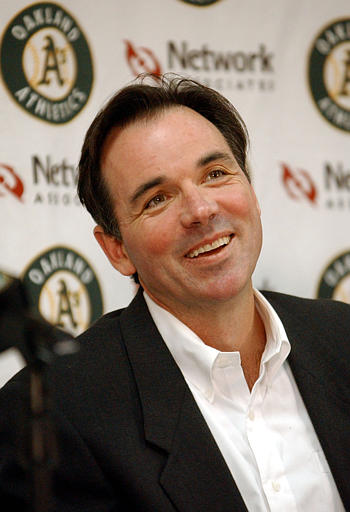
 Jonathan Hacohen is the Lead Baseball Columnist & Editor for MLB reports: You can follow Jonathan on Twitter (@JHacohen)
Please e-mail us at: MLBreports@gmail.com with any questions and feedback. You can follow us on Twitter and become a fan on Facebook . To subscribe to our website and have the daily Reports sent directly to your inbox , click here and follow the link at the top of our homepage.

John Lackey to Undergo Tommy John Surgery: The Aftermath in Boston
Wednesday October 26, 2011

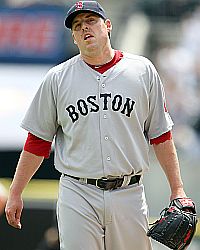
MLB reports – Jonathan Hacohen: The Boston Red Sox announced this week that starting pitching John Lackey would be undergoing Tommy John surgery, ending his 2012 season before it began. In a twist of irony, this move actually comes as relief to Red Sox nation as Lackey has been anything but stellar since coming to Boston.
In 8 seasons with the Angels, Lackey had a 102-71 record, good for a 3.81 ERA and 1.306 WHIP. In his past 2 seasons with the Red Sox, Lackey’s numbers ballooned to a 26-23 record, with an unsightly 5.26 ERA and 1.504 WHIP. Lackey’s winning record in Boston is attributable more to the Red Sox strong offense, rather than Lackey’s own production. 2011 was a miserable season statistically for Lackey with 2012 not looking much promising either.
In hindsight, John Lackey’s contract is one of the worst in baseball. Lackey is signed to a 5-year, $82.5 million deal running through 2014. For the final 3 years (2012-14), Lackey will get paid $15,250,000 per season. The one bit of relief to the Red Sox is that the injury kicks in a 2015 vesting option, whereby Lackey will only be paid $500K for that season. A small consolation given the magnitude of the money and disappointing numbers from Lackey to-date.
 For whatever reason(s), the relationship between John Lackey and the Boston Red Sox is not working out. Lackey has battled personal issues while in Boston, including his wife’s health and battle with Cancer. While clearly we can all sympathize with Lackey’s difficulties in playing while dealing with personal issues, the reports from the end of the season of his involvement with drinking in the clubhouse and eating fried chicken during games brings into question Lackey’s commitment and focus to the team and game. Before news of his surgery, many outlets were reported that the Red Sox were actively shopping Lackey in the hopes of removing him from the team. A strong rumor was a swap with the Padres and reuniting Lackey with his old pitching coach from his Angels’ days, Bud Black. The Padres and Petco would have been an ideal environment for Lackey, provided that the Red Sox would have picked up the majority of his contract in the deal.
But the reconstructive elbow surgery has brough the Lackey rumors to a halt. He will be staying in Boston for the foreseeable future. The Red Sox have faced bad luck this year with Tommy John, as pitchers Daisuke Matsuzaka and Rich Hill both underwent the same procedure in 2011. Theo Epstein was wise to include the injury provision in the Lackey contract; but then again, he may have been better off avoiding the pitcher all-together. News of the Lackey injury was the first announcement by Ben Cherington as the new Red Sox GM. From all the offseason transactions and news that will follow in Boston, this one will be taken as one of the more positive moves.
The Red Sox have many decisions facing them this offseason. The re-signing of David Ortiz and Jonathan Papelbon. The integration and structure of the organization with a new GM. The hiring of a new manager. The departure of J.D. Drew and possibly Marco Scutaro. The comeback of Carl Crawford. These are surely hectic times in Boston. The team will need to make many roster changes for 2012, including the signing of 1-2 new starting pitchers. The injury to Lackey could prove to be a blessing in disguise. The surgery may pinpoint that his terrible numbers in Boston were based more on declining health than eroding skills. With a year-off to rehabilitate and re-energize, the Red Sox may see a new and focused John Lackey. The team would have had to eat most of his contract to trade him; perhaps they are better off paying and playing him.
In the worst case scenario, the Red Sox will need to either trade or release John Lackey between now and 2014, if they do not believe that he can rebound and be a useful asset for the team. There is always the chance that Lackey is not able to recapture the form he displayed back in his Angels days. Also, there may be enough bad feelings between the player and organization that a fresh start will be in order. At this point, the Red Sox are best off to take a “break” so to speak for a year from John Lackey. Come to 2013, the team may find that they have a new valuable asset that they never counted on. John Lackey at the end of the day is a classic example of the risk involved handing a 30 something year-old pitcher a 4+ years contract for big dollars. The Red Sox in this case gambled and lost. But at least the decision can be put off for a year whether to write John Lackey off completely or try to recover pennies on the dollar. I wish John Lackey a successful surgery and healthy recovery. While I don’t expect to see him emerge as a MLB ace upon his return, my sense is that we will see an older and wiser John Lackey on the mound. The talent has always been there. Now he just needs to find the health and heart to fulfill the remainder of his potential.
Jonathan Hacohen is the Lead Baseball Columnist & Editor for MLB reports
Please e-mail us at: MLBreports@gmail.com with any questions and feedback. You can follow us on Twitter and become a fan on Facebook . To subscribe to our website and have the daily Reports sent directly to your inbox , click here and follow the link at the top of our homepage.
Take the recent MLB reports Poll: We would love to hear your opinion and comments!

Diamondbacks and Blue Jays Swap Second Basemen: Hill and McDonald for Johnson
Tuesday August 23, 2011
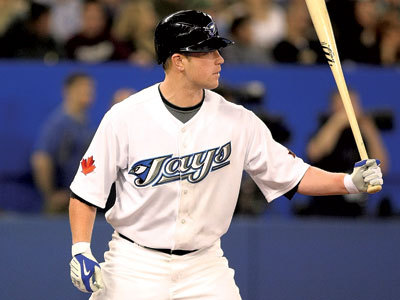
Rob Bland (Intern- MLB reports): The Arizona Diamondbacks are in the middle of a pennant race in the National League West, and yet made a change with their second baseman, Kelly Johnson. Statistics show that Johnson had been underperforming this year, and GM Kevin Towers said he wanted better defense and infield depth. With that in mind, Towers got a hold of Toronto Blue Jays’ GM Alex Anthopoulos to inquire on super utility infielder John McDonald. McDonald can play 2B, SS, and 3B at an above average level, although he doesn’t do much with the bat. With regular shortstop Stephen Drew lost for the season due to injury, the D’Backs have been forced to start Willie Bloomquist the majority of the games in his absence. That led to talks involving Toronto’s longest tenured player, second baseman Aaron Hill. The end result was Arizona acquiring Aaron Hill and John McDonald, with Kelly Johnson going to Toronto.
Aaron Hill had a terrific start to his career, which so far has peaked in 2009 when he hit .286 with 36 home runs and 108 RBI. He was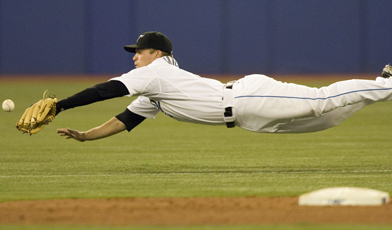 an All-Star and a Silver Slugger winner that year. He plays good defense and is a well-liked guy in the clubhouse. His contract situation is an iffy one, in that he has 2 option years left worth $8M each. By the end of 2009, it would have been a lock that those options would have been picked up, however, 2010 and 2011 have not been so kind to Hill. Last year he hit .205 with a walk rate of only 7.1%. He at least was able to club 26 home runs, which are numbers he has not been able to replicate this year. Hill in 2011 is walking in 5.4% of his plate appearances, and has only 6 home runs to go along with his paltry .225 average.
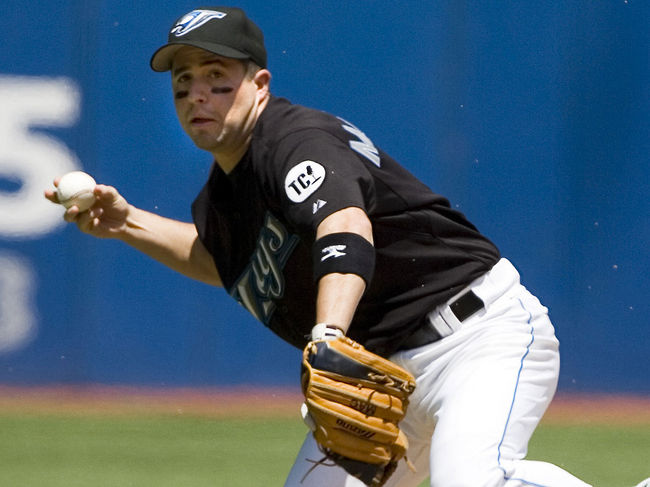 McDonald is arguably the most beloved player in Toronto, after Jose Bautista. He routinely gets standing ovations, and this writer can proudly say one of his favourite moments in MLB history was watching McDonald hit a home run in his first at bat after missing a few games. The significance was that his father had just passed away, and McDonald promised to hit a home run for him. So on Father’s Day of 2010, McDonald crushed a home run over the left field wall. The teary-eyed McDonald crossed the plate and was embraced by every member of the Blue Jays. McDonald is a phenomenal defender, often used as a pinch runner in key situations, but doesn’t hit much. In his 13 seasons, he has only 21 home runs, with 12 of them coming in his last 3 seasons. His value comes as a player that will give everything for his team, playing every position imaginable and making highlight reel plays.
Johnson is only a season removed from a .284/.370/.496 slash line, and although scouts often say his defense is sub par, th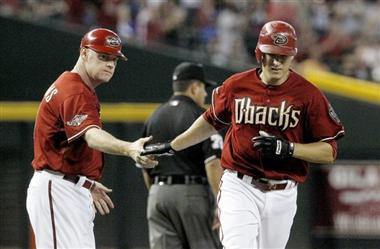 e advanced metrics tell a different story. His UZR was 7.1 last year, and 3.9 this year, where 0 is average. Johnson’s production, like Hill, has fallen off the table. He is still hitting home runs; 18 this year compared to 26 last year. He takes walks, just under 11% for his career. But his main problem has been the strikeouts. This year has been worse than usual, as he has struck out in over 27% of his plate appearances. Johnson’s line drive rate is just a tick below his career numbers, so his batting average on balls in play (BABIP) being 50 points lower than his career average is probably a good indicator of why his numbers are so low.
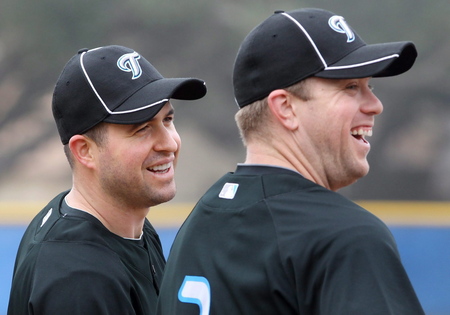 All three players are free agents at season’s end. McDonald and Hill both said during their press conference today that they are very open to returning to Toronto in 2012. Until then, the Diamondbacks will look to add to their 1.5 game lead over the San Francisco Giants with this move. Should they be propelled to the playoffs, it is likely that an infield of Hill, McDonald, Lyle Overbay, and Ryan Roberts (all former Blue Jays) could face off against another former Jay in Roy Halladay and the Philadelphia Phillies in the National League Division Series.
This deal seems strange from a Diamondbacks perspective, as Hill is a downgrade from Johnson, even with the poor season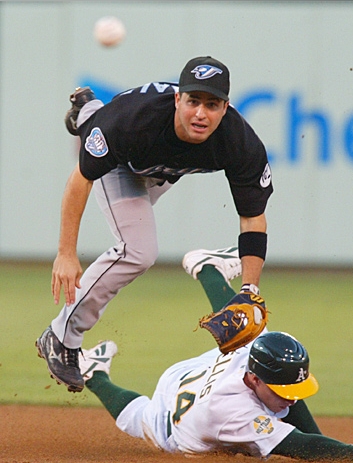 Johnson has been having in 2011. The amount of upside the Dbacks get from having McDonald over Bloomquist at shortstop is completely negated by this downgrade. However, the Dbacks get two great clubhouse characters, who will surely help the club defensively and in teaching the younger players. For the Blue Jays, this trade makes complete sense. Johnson is currently set to be a Type B free agent at the end of the year, and with a hot streak, could become a Type A. As a Type B, he would net the team a supplemental draft pick if he signs a major league deal with another team. But if Johnson reaches Type A status this offseason, he will also net a first round pick on top of the supplemental pick. The Jays can use this time to better evaluate Johnson, and by showing him what the organization has to offer, Johnson may sign with the team at the end of the year.
Aaron Hill and Kelly Johnson were two players that have been coveted by each team for the last couple of years, but no deal could have been struck. However, with both players struggling so badly this year, both players were in need of a change of scenery. A fresh start could do wonders for Hill as he could get back into the groove he was in before the 2010 season, while Johnson could return to his 2010 form.
So at the very worst, the Jays get an extra draft pick as part of this trade, and in many people’s opinions, they will also get McDonald back in 2012 to be their utility infielder. For the Dbacks, Hill’s production could seriously limit their offense and push them out of a playoff spot. Both teams are facing risks, but I believe Toronto’s level of risk was much lower, as they are not in a pennant race. The upside potential of this trade for the Jays makes them the winner in my books.
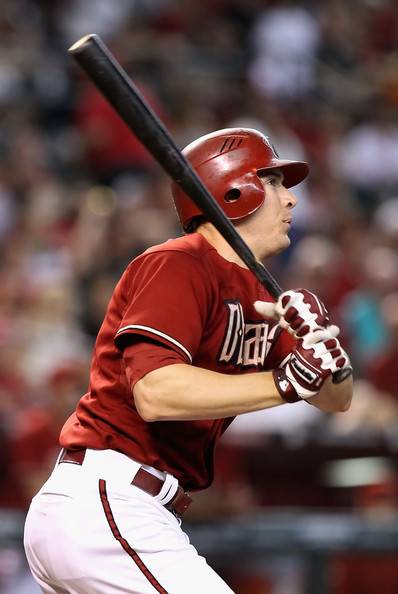
***Today’s feature was prepared by our Intern, Rob Bland. We highly encourage you to leave your comments and feedback at the bottom of the page and share in the discussion with our readers. You can also follow Rob on Twitter.***
Please e-mail us at: MLBreports@gmail.com with any questions and feedback. You can follow us on Twitter and become a fan onFacebook . To subscribe to our website and have the daily Reports sent directly to your inbox , click here and follow the link at the top of our homepage.

On the Verge: Brett Lawrie Call Up by Jays is Imminent
Thursday August 4, 2011

Rob Bland (Intern- MLB Reports): The Brett Lawrie rollercoaster started December 6th, 2010. Lawrie was sent to Toronto in exchange for Toronto’s incumbent ace, Shaun Marcum. Toronto GM Alex Anthopoulos immediately said that Lawrie would be working out at third base, switching from second base. This would be Lawrie’s third major position change in 3 years. He was drafted out of Langley, BC by the Milwaukee Brewers in the 1st round (16th overall) of the 2008 MLB draft. That year, Toronto held the 17th pick, and it was said that they coveted him greatly. They instead had to settle for college first baseman and current AAA prospect, David Cooper.
 Lawrie hit .293 in spring training this year, while playing decent enough third base to warrant a discussion of keeping him on the roster. However, Anthopoulos deemed he was not ready to play in the Major Leagues, and the fans in Toronto grumbled as the Blue Jays consistently put Edwin Encarnacion at third base to start the year. Lawrie started off hot in AAA Las Vegas, and played good defense. This still wasn’t enough, as the Jays asked him to be more patient and change his approach. Lawrie did just that, and by May 31st, was hitting over .350 with power and walking more often than he had in the past. When the Jays were on the brink of calling him up (see our Report from June 2nd), Lawrie was hit by an errant pitch on the back of his left hand. Blue Jays fans collectively held their breath, and Lawrie declared it was a bruise. Two days later when swelling subsided, it was found out that Lawrie had a non-displaced fracture.
When he finally returned to Las Vegas in the middle of July, Lawrie came right back to where he left off. He is now hitting .352 with 18 home runs and 61 RBI. More importantly, he has 26 walks and is playing much improved defense. Now, the Jays’ faithful are continuing to call for him. Anthopoulos and manager John Farrell have repeatedly said “he’s close” and that they want to get him everyday at bats before rosters expand in September.
Now, when Lawrie gets the inevitable call (my guess being Friday, August 5th, before the beginning of a road series in Baltimore), where will he play? The Jays have Jose Bautista, one of the top three players in baseball at third base. Well, the plan that Anthopoulos has set out is that Bautista would shift back to his preferred right field, creating a logjam of young and talented outfielders. Travis Snider is 23 years old and he will play every day at one of the corner positions. Colby Rasmus is 24 years old and will be in center for the foreseeable future. That leaves Eric Thames, also 24, the corner outfielder who came out of seemingly nowhere to win the love and admiration of many fans, on the bench. You could say that Thames can just DH because he isn’t the best fielder of the bunch (although more than adequate and constantly improving), but where does Edwin Encarnacion play then? Encarnacion is one of the hottest hitters in all of baseball since the beginning of July. He has 9 doubles, 4 home runs, and 14 RBI with 12 walks in 25 games over that span. Thames most likely gets optioned to AAA to get every day at bats until rosters expand in September. Here is how that lineup stacks up.
Yunel Escobar – SS
Colby Rasmus – CF
Jose Bautista – RF
Adam Lind – 1B
Edwin Encarnacion – DH
Travis Snider – LF
Brett Lawrie – 3B
J.P. Arencibia – C
Aaron Hill – 2B
 If one of these players is traded, then there won’t be a problem. The only other option barring a trade, is something that Anthopoulos has stated adamantly will not happen. Moving Lawrie to second base and sitting former Silver Slugger Aaron Hill on the bench. This could possibly be the best option available for both the short-term and long-term. With Hill underperforming (ranked 20th out of 21 qualified 2nd baseman in WAR), and his $8M option for 2012 likely to be declined, Lawrie could slot into that spot for a very long time. Anthopoulos has preached having talent and skill “in the middle of the diamond” and second base is a spot that sorely needs some stability after Hill’s last two years. The only thing that could stop this movement is if Anthopoulos sees Hill, who is a good defender, as a guy who can turn his career back around. If Hill were placed in the 9 hole, and changed his approach, he could be a very serviceable player there. One idea that has been bandied around is that the Jays decline the option on Hill, and sign him to a much smaller deal to bring him back as the second baseman.
I honestly believe that Anthopoulos has the wheels turning, and with Encarnacion being so hot, many teams would love to take him on to make a push for the playoffs. If Encarnacion is not in the picture, there is a spot for Thames as a full-time player. He and Snider would probably split time between left field and DH, with Bautista in right, and Lawrie at third.
What gets lost in all of this, is that the Opening Day center fielder, might become a 5th outfielder. Rajai Davis has 33 stolen bases, and is playing better in a part-time role since Rasmus joined the team. He will be reserved to being a pinch runner, and possibly a late inning defensive replacement for Thames.
The odd man out for this year seems to be Thames, even though the Blue Jays see him as a valuable asset for the long-term. Whether that means for him to be on the field, or using him as a trade chip remains to be seen. Lawrie will likely end up playing third base every day, proving why the Jays gave up Marcum for an unproven “troubled” prospect.

***Today’s feature was prepared by our Intern, Rob Bland. We highly encourge you to leave your comments and feedback at the bottom of the page and share in the discussion with our readers. You can also follow Rob on Twitter.***
Please e-mail us at: MLBreports@gmail.com with any questions and feedback. You can follow us on Twitter and become a fan on Facebook . To subscribe to our website and have the daily Reports sent directly to your inbox , click here and follow the link at the top of our homepage.
E-MAILBAG: Ask the Reports, Wednesday May 18th
Thank you for reading the E-mailbag. Please send all your questions to mlbreports@gmail.com and please include your first name and City/Country.
We will be compiling a list of your questions from our e-mailbag and posting the responses on Wednesdays.
Wednesday May 18, 2011
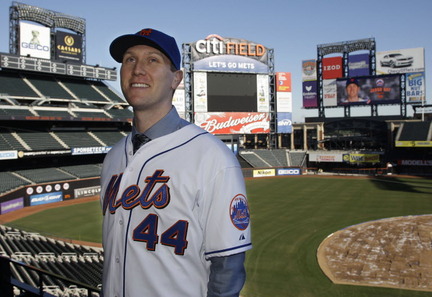
Q: Have the dimensions of Citi Field been to the detriment of the Mets franchise? From Yair, Bat Yam, Israel
MLB reports: Great question Yair and shalom (hell0) to you in Israel! With the lacklustre play of the Mets the last few seasons, its great to see that they still have so many fans, even internationally. Getting to your question, the topic of Citi Field has been a continuous one since its opening back in 2009. The $850 million structure replaced Shea Stadium and has not played out in the same way that new Yankee Stadium has to say the least. At a capacity of 41,800, the stadium holds 15,000 fewer fans than Shea and was meant to be more intimate. Citi Field has some interesting features in its design. Citi Field’s fences are not the same size, ranging in height from being 15 feet in left field and 18 feet in right. Shea Stadium had outfield fences that were all 8 feet in comparison. The dimensions overall are not far different from Shea, with approximately 335 feet to the field lines and 408 feet to center. Shea was never a great hitters ballpark to begin with and Citi Field is no better. I would attribute the height of the fences as being a major issue for the team in terms of hurting the amount of home runs in the park. As well, the shortage of quality hitters on the current Mets squad is the main reason for any offensive issues. As a ball park, Citi Field ranks 11th currently in terms of home runs but 27th last year. It will be interesting to see how the field plays out this season. But the bottom line, is that the Mets have the same advantages and disadvantages at Citi Field as all opposing teams. As a pitcher’s park, the team needs strong pitching and defense to remain competitive on its home turf, with good timely hitting. This may sound obvious, but team talent and not the stadium will decide the team’s fate at the end of the day.
Q: Ok how about this? I am not yet dropping Derek Jeter from fantasy team. Can I drop Brett Wallace or Mark Trumbo for Yunel Escobar as insurance for Jeter? From Maury, Boston
 MLB reports: Hell0 Maury and no, you cannot make this move. As much as Jeter is struggling, dropping talents like Wallace and Trumbo do not make sense at this point. Wallace is hitting .321 in 2011 with 3 home runs and .869 OPS. Trumbo, while starting to struggle somewhat with a .244 AVG has 6 home runs and 18 RBIs. If you must make this move, then drop Trumbo and grab Escobar, who is hitting .295, with 3 home runs and .775 OPS. Quality numbers for a shortstop. But Jeter is still Jeter and will rebound in my estimation. Keep plugging the Yankees captain in your lineup and expect a rebound soon.
Q: Can the Cubs please just leave Starlin Castro in a fixed spot in the lineup? Like, say, leadoff? Hitting him 3rd is (^*&&*%$! From Reuben, parts unknown
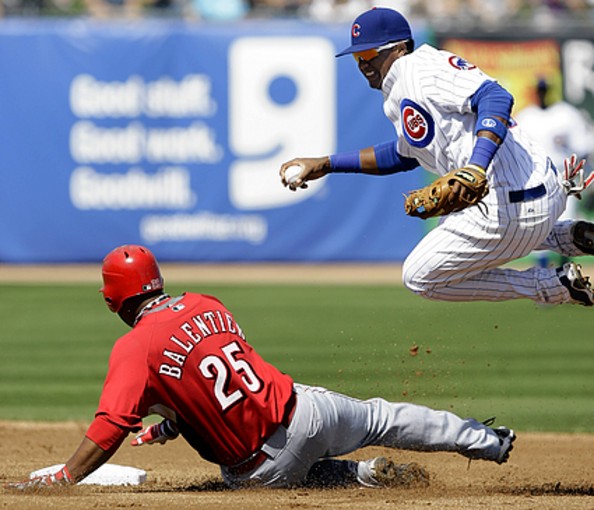 MLB reports: I can’t argue with Castro’s numbers to start the season. .327 AVG, .789 OPS, 23 runs scored, 18 runs driven in, 4 stolen bases and 6/14 BB/K ratio. As a leadoff hitter or hitting in the second slot, Castro has strong abilities to get timely hits and create runs. I couldn’t agree with you more that batting Castro in the third slot does not make sense. With one home run this year and three all of last year, the power is not there for the Cubs shortstop. The move to hit him third would be out of desperation than anything else. It is a relection on the Cubs for a lack of other options, than Castro as a new power guy. As the Cubs continue to gel through the season, expect Castro to have a permanent lineup slot soon. Leadoff appears to be most likely his destination.
Q: Do you think Aaron Hill might be enough to protect Bautista in the Jays lineup? I obviously don’t mean full protection, but maybe just enough for the Blue Jays to be a force. Another great article by the way, I enjoyed reading your feature on Jose Bautista! From Nolan, parts unknown
MLB reports: Thank you for reading the reports, I always appreciate the feedback. The Bautista article was a lot of fun to write and I enjoyed giving the readers a look into the Jays home run king (You can click to read our piece on Bautista). As far as AaRon Hill coming back and providing good protection in the lineup, I will admit that I have my doubts to say the least. Hill has missed several games this year due to injury and when he has been able to play, has hit to the tune of a .237 AVG, no home runs and .573 OPS. If you take aside 2009, Hill has never shown to be a really good hitter and in my opinion, that season has been an outlier rather than the standard. Aaron was actually the subject of the first ever article on MLB reports. If you would like to read more about Aaron and his future on the Jays, please click here. But if you want the brief synopsis: Hill is more likely a candidate for a trade/release over the next year than any guarantee of production. I do not have very much faith in him and neither should you.
Thanks for the e-mails and keep them coming! mlbreports@gmail.com

E-MAILBAG ARCHIVE: Click here for the Archives of Ask the Reports
Please e-mail us at: MLBreports@gmail.com with any questions and feedback. You can follow us on Twitter and become a fan on Facebook . To subscribe to our website and have the daily Reports sent directly to your inbox , click here and follow the link at the top of our homepage.
Welcome to Our First Ever Article: Aaron Hill, Aaron Hill: Where Art Thou Aaron Hill?

MLB reports: Greetings Readers,
Based on my early run on twitter, welcome to the 1st official article entry for mlbreports.com. Please feel free to suggest topics, otherwise I will pick topics at random that interest me and I think you will enjoy. Also all feedback is welcome, please message me any time.
So on to the article. With the help of one of my new resources, the Bill James Handbook 2011 (enjoy the plug Mr. James), I now jump into the mystery that is Aaron Hill.
2009 represented Aaron’s breakout year. A season where Hill led the AL in 682 ABs and played in all but 4 of the Jays games. 195 hits, 37 doubles, 36 home runs, 340 total bases, 103 runs, 108 rbis, .286 average and .499 slug. Fast forward to 2010. Jays fans believe the second coming of Joe Morgan is emerging in Toronto and that Hill would be the new face of this once proud franchise in the midst of rebuilding. What they got instead was the second coming of Russ Adams (exaggeration, of course, but you know what I mean). Look at Hill’s 2010 numbers last season: 108 hits, 22 doubles, 26 home runs, 208 total bases, 70 runs, 68 rbis, .205 average, .394 slug. So the question is: Which is the real Aaron Hill, the 2009 or 2010 models?
Most baseball people would argue somewhere in the middle. I would somewhat agree, but will throw in that the middle ground will lean more towards 2010. Yes I live in Toronto and no, I am not a homer or biased. Mostly. I have never been a big fan of Aaron Hill and was not ready to start engraving any hall of flame plaques after 2009. To me, Jose Bautista’s breakout is more likely to be reality than Hill’s. I see 2011 as the crossroads for Hill, where he either reclaims elite status or moves to the land of waivers, release, AAA buses etc.
There were some items of note that irked me about Hill in 2009. Walks. 42 walks, of which 1 was intentional. A .330 obp. At first glance the .286 average that Hill sported in 2009 appears impressive. But when you consider that it only translated into a .330 obp, something doesn’t sit right. Hill has the reputation in Toronto of being a gritty hitter, “great #2” who can set up the table and drive in runs. But truth be known, for the great hitter that Hill is, pitchers found it necessary to intentionally walk him only 1 time. That doesn’t show me a great deal of respect. Hill in fact only took 42 walks in 2009. In contrast, for Hill’s disastrous 2010, he was intentionally walked twice and took a total of 41 walks. No difference whatsoever. So studying Hill on this basis, he cannot take a walk whether he is hitting or not. Pitchers are apparently aware of this and are not afraid to pitch to him. 2009 tells me that even if Hill can hit for a solid .286 average, the kid will not be considered any form of on-base machine.
Why the obsession with on-base percentage? For a simple reason. Unless you can hit like Vladdy Guerrero and scrape balls out of the dirt for home runs, a bad batting eye can lead to Jeff Francouer territory. This is not the place to be. We all know Francouer and his path in the major leagues. Coming up Atlanta was seen as a hitter with power that will develop a batting eye. That unfortunately never came and now Jeff is with the Royals last I read. If I were him, I would be scouting out for apartments in Omaha. Now. But I digress. An Aaron Hill player that refuses to take a walk and is not respected enough to be intentionally walked, will rarely make it far in a baseball career. Of Hill’s 108 hits in 2010, 26 went deep. Think about it. The man was only able to have 108 hits in a full season, in 138 games and managing 528 at-bats. Hill essentially played a full season in 2010 and a full 25% of hits were home runs. Based on that rate, if Hill could have duplicated his 195 hits from 2009, he would have hit a whopping 50 home runs. We are talking Jose Bautista territory, who did hit 54 home runs in 2010…and also walked 100 times. It would take Hill 2.5 years to take that many walks. Apparently this will not happen. So even at 26 home runs, not a number generally to be sneezed at, Aaron Hill looked very weak in 2010.
The point that I am trying to make? Essentially the following. For Aaron Hill to be effective, he has to hit…and hit…and hit some more. Even at close to 200 hits, this not a player that gets on at a very high rate. Take away the hits, all the other numbers fall off the table. The Aaron Hill of 2010 to me is Pete Incaviglia or Rob Deer, just less strikeouts. In today’s mlb, players such as these are becoming less of a desired commodity. Looking at the numbers we are seeing only one other “good” season by Hill. 2007 showed 17 home runs, 87 runs, 78 rbis and a .291 average. 160 games played that season with 608 at-bats. Guess the number of walks? You got it, 41 with a .333 obp. In 4 years I don’t see any real progress, just one outlier year in 2009.
Consulting with my friend Bill James, what is expected from Hill in 2011? Am I alone in my thinking or is one of the industry gurus in agreement with me? 142 games, 531 at-bats, 22 home runs, 76 runs, 73 rbis. Ok. So far so good. But 138 hits and you guessed it, the standard 41 walks. A .260 average, .319 obp and .446 slug. My favourite whipping boy, Jeff Francouer, is projected to have a similar .318 obp. Ouch. The Aaron Hill of 2011 is an improvement of the 2010 version, but actually a regression of the 2007 model. The hype from 2009 was just that. Hype. For those in the know, there were reasons to believe that there were warning signs from the beginning on Hill and 2009 should not have tempered them. I was never a Hill backer, I will admit and have never wavered. The Jays this past off-season traded their top starting pitcher, Shaun Marcum for the top prospect in the Brewers system. A second basemen by the name of Brett Lawrie. The writing should be on the wall for Aaron at this point and it’s actually a shame. As a #7 – #9 hitter, he would have been considered steady and productive. But being thrust into batting spots such as #2 and #5, he does not have the capabilities to produce as required. As we all know in sports, especially in baseball, once expectations are thrust upon you, it is difficult to hide them.
By 2013 Aaron Hill will likely be on his 2nd or 3rd team and the above points will be moot. But as the 2011 season approaches and the Jays rebuild and look to improve, excuse me while I don’t count on Aaron Hill. I don’t expect the Toronto Blue Jays will either.
Please e-mail us at: MLBreports@gmail.com with any questions and feedback. You can follow us on Twitter and become a fan on Facebook . To subscribe to our website and have the daily Reports sent directly to your inbox , click here and follow the link at the top of our homepage.


 MLB Reports
You must be logged in to post a comment.