Blog Archives
Interview with Deck McGuire: Toronto Blue Jays Prospect and 2010 1st Round Pick
Wednesday September 28, 2011

Jeff P (Guest Writer – MLB reports): Recently I had the honor to interview Deck McGuire, top MLB pitching prospect. Speaking to McGuire, I had the sense that he has the same goal as many other baseball players: working to prove that he the real deal. McGuire is a great guy and it was a pleasure interviewing him.
Firstly, I would like to relay some information on Deck, courtesy of Wikipedia:
“William Deck McGuire (born June 23, 1989 in Greensboro, North Carolina) is a professional baseball pitcher currently in the Toronto Blue Jays organization. McGuire who spent three years at Georgia Tech was drafted by the Toronto Blue Jays in the first round of the 2010 MLB Draft and is currently assigned to the Blue Jays’ Double-A affiliate, the New Hampshire Fisher Cats.”
Considering that he was a first round selection, Deck is one of the nicest guys you will ever meet in baseball. Plus he has one of the best baseball names in the game. Featured on MLB reports, I proudly present my interview with Deck McGuire:
Jeff P: Hey, Deck. First of all, I want to thank you for being with us today, it really is an honor to have you with us. I’m sure you have a busy schedule so, let’s get this started. First off, what was your reactions to being drafted, your thoughts, and the party post-phone call?
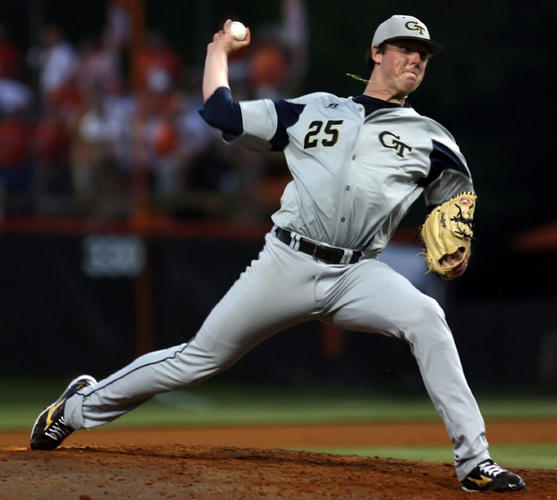 Deck McGuire: I actually didn’t get the true draft experience. We were playing against Alabama in the Regional Championship game, so I was actually in the dugout while we were playing to go to the Super Regionals. I found out in about the 5th inning but I was way more concerned with the game at that moment. Definitely the most bittersweet moment of my life because we lost, ending our season, and my time with the Jackets.
Jeff P: You recently had minor struggles going into Double-A, was it a difficult adjustment?
Deck McGuire: I don’t think it was really the adjustment but more that I never let myself get into a rhythm. I got away from some of the stuff that got me there and then I got a little banged up. I take it as a great experience and a chance to get better heading into next year.
Jeff P: Can you give us some information on your daily rituals? What do you do in the clubhouse, and what are your hobbies off the field?
Deck McGuire: I seem to get there pretty early and I love to play cards, I have a slight competitive streak! I love video games and golf off the field, probably the competitiveness again!
Jeff P: How does your height of 6’6″ affect your play on the baseball field?
 Deck McGuire: Besides being really intimidating!? Just kidding! It really helps when I’m on top of the mound because I can get the ball going down hill, so it is tougher for the hitter to pick up.
Jeff P: What do you find is the most special about playing for the different Blue Jays affiliates?
Deck McGuire: The diversity of locations! I got to play in Florida in the cold months and New Hampshire during most of the hot ones!
Jeff P: What kind of music can you find on your iPod?
Deck McGuire: Lots of country, a little rock, and even less rap.
Jeff P: Who was the most difficult hitter you have faced so far in professional, or college baseball?
Deck McGuire: Gordon Beckham. I faced him when he was at UGA and I was at Georgia Tech. His approach is unbelievable. In pro-ball it was Matt den Dekker from the Mets, same reason really, his approach changes pitch to pitch so he is really difficult to fool.
Jeff P: What baseball player would you most like to be compared to once you get to the big leagues?
Deck McGuire: I’d love to be compared to John Smoltz. He was one of my heroes growing up because he is really the player who can define a winner and a team guy wrapped into one. Starting or closing, he always got it done and did what his team needed to win.
Jeff P: As a minor leaguer, you already have several different pitches that you throw. Do you feel that your pitching arsenal will help you in your path to the big leagues?
Deck McGuire: Without a doubt! Something I have always prided myself on is my ability to throw a fastball, curveball, slider, and a change-up for strikes to any hitter and in any count.
Jeff P: I read recently that you have been compared to Jonathan Papelbon. Do you agree with this comparison?
Deck McGuire: Well the guy is a winner so that’s good, other than that I don’t think I see it. I mean he is a closer and throws fuel. I am a starter and rely more on my array of pitches to get the job done.
Jeff P: Do you think it’s fair to say that sometime next year, we will see you up in the MLB?
Deck McGuire: That would be awesome, but my goal is just to keep getting better. Whenever the Jays think I’m ready to help the big club win, then I am happy to give it my best shot.
Jeff P: You are proud to be a former Yellow Jacket. What were the big adjustments that you’ve gone through from college baseball to adjusting to professional baseball?
Deck McGuire: The 5-day rotation vs. having a week off in college.
Jeff P: I’m going to end off with this last thought. If you weren’t a baseball player, where do you think you would be right now in your life?
Deck McGuire: Gosh I’d like to think I would be in baseball somehow, but I might have played football at a smaller school or maybe gone to med school to try to be an orthopedic surgeon. I really don’t know. I know it is cliché, but being a pro baseball player has pretty much been my dream my whole life!
Jeff P: Thank you for taking your time out of your busy schedule for us today Deck. Much appreciated!
Deck McGuire: Thanks y’all!
Thank you again to Deck McGuire for taking the time to join us today on MLB reports. We highly encourage our readers to post at the bottom of the article any questions and/or comments that you may have for Deck. As well, please follow Deck on Twitter (@DeckMcGuire).
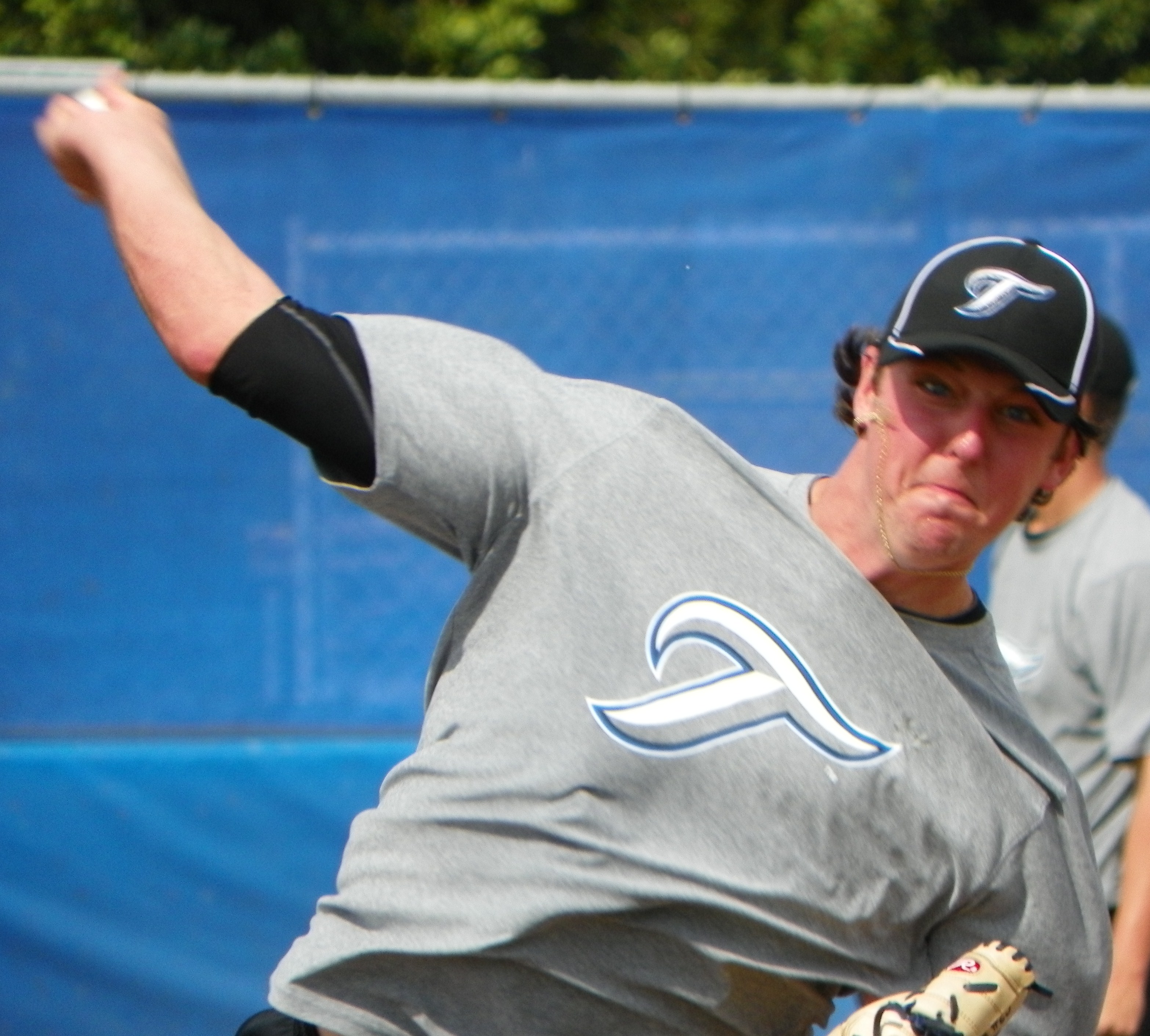
***Today’s feature was prepared by Jeff P, Guest Writer to MLB reports. We highly encourage you to leave your comments and feedback at the bottom of the page and share in the discussion with our readers. You can also follow Jeff on Twitter.***
Please e-mail us at: MLBreports@gmail.com with any questions and feedback. You can follow us on Twitter and become a fan on Facebook . To subscribe to our website and have the daily Reports sent directly to your inbox , click here and follow the link at the top of our homepage.

J.P. Arencibia vs. Travis d’Arnaud: Who is the Jays Catcher of the Future?
Saturday September 24, 2011
April Whitzman (Blue Jays Writer – MLB reports): Two weeks ago, I posted that the toughest question Blue Jays’ fans are dealing with right now is figuring out whose comeback, whether that of Dustin McGowan or Adam Loewen, is more impressive. Today I pose a question that some would say is equally hard to answer: who is the Toronto Blue Jays’ catcher of the future – J.P. Arencibia or Travis d’Arnaud?
What they have in common:
Interesting, while many people do not realize this, both catchers share their origin in common – the 2007 MLB first-year player draft. In fact, Arencibia was drafted 21st overall by the Blue Jays out of the University of Tennessee. As the 37th pick overall, the Philadelphia Phillies went with Travis d’Arnaud, out of Lakewood High School. At the time it was believed that the Jays were interested in d’Arnaud’s potential and would pick him with the 38th pick and move Arencibia to first base. Yet the Phillies chose the young star from Florida one slot before, forcing the Jays to choose left-handed pitcher, Brett Cecil. That said, a persistent GM, Alex Anthopoulos, would get his player; as the Blue Jays acquired Travis d’Arnaud two years later in the well-known Roy Halladay trade.
How they differ:
Defense
It is difficult to compare these players, as Arencibia has already made the jump to the majors while d’Arnaud just finished his season in AA New Hampshire. Arencibia has more professional experience having been drafted out of college, while d’Arnaud came out of high school. Here is a graph to compare how each player performed during their time at AA New Hampshire:

JP received the promotion from Dunedin to New Hampshire half-way through the season; his stats have been doubled to receive a more accurate comparison.
Both players are pretty evenly matched. Nevertheless, d’Arnaud has the slight advantage on errors committed, fielding percentage, and passed balls. Meanwhile, Arencibia has a higher caught-stealing percentage.
Despite one player being in the majors and the other in the minors in 2011, an interesting comparison can be depicted if we compare both catchers’ stats for this season:

With each player in their fourth year of professional baseball, these stats show how close their defensive game truly is. Having committed the same amount of errors, the same fielding percentage and only one passed ball being the difference between them, the biggest distinction is that d’Arnaud has the slight advantage throwing out base runners.
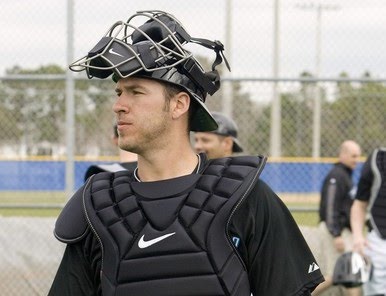 Don Wakamatsu, a former catcher himself, and now the Toronto Blue Jays bench coach has admitted that he has seen a drastic improvement in Arencibia’s defensive abilities. Wakamatsu credits the improvement to a significant amount of practice and hard work. He stated: “Arencibia has done a phenomenal job trying to understand how to get the most out of our pitching staff.”
Defensively, Arencibia has a good arm, but he struggles at times with blocking pitches in the dirt. In his minor league career, Arencibia threw out close to 30% of base stealers, though charged with 60 passed balls in 357 lifetime games.
In regards to his defense, Arencibia stated, “Defense is obviously first, and I know that, and whatever comes with the bat is secondary.” He continued: “I feel like my biggest thing is getting that pitcher through that game and I feel like I’m starting to get a real good understanding of my staff and giving us opportunities to win.” Since making these comments, Arencibia has improved his defense considerably in the second half of the season. For example, in the eighth inning of Friday night’s game against Tampa Bay, JP was able to throw out Rays outfielder B.J. Upton.
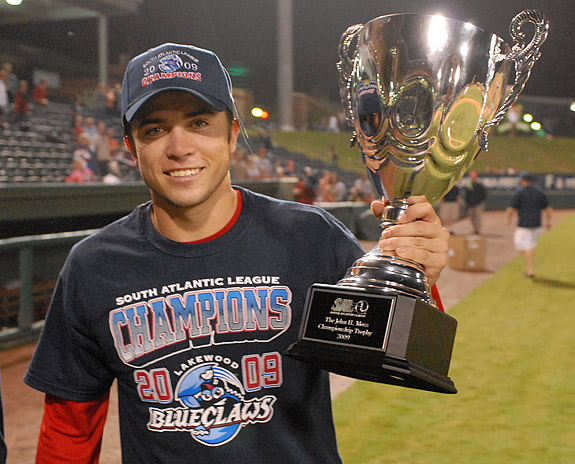
Comparatively, Travis d’Arnaud’s defensive skills are stronger. He has a great game-calling abilities and he has a strong arm. While his career caught-stealing rates have suffered due to inexperience, he has also improved his game by working on his footwork behind the plate. At 22 years old, d’Arnaud is already one of the better defensive catchers in the minors and he has plenty of time to develop into a premier defender in the big leagues. This was proven when he was named the Catcher’s Captain Award recipient for 2011 by Baseball America. The award is given to the catcher who displays strong defensive qualities, including leadership and dedication.
Offense
There is no denying that both players are also solid offensively. In 409 games in the minors, JP hit .275 with 121 doubles, 83 HR and 290 RBI. That said, he has also proven what he can do at the plate at the major league level as well. There is not a Blue Jays fan who does not remember J.P. Arencibia’s major league debut last year against the Tampa Bay Rays, as he launched the first pitch he saw over the left field wall for a home run. He later singled and doubled and capped the day with a home run to right field. That game showcased Arencebia’s talents and his ability to hit the ball for power.
Offense is where Arencibia and d’Arnaud differ most. Essentially, while JP hits for power but not average, d’Arnaud is a more complete player at the plate, as he hits for average and power. This year with the Fisher Cats, d’Arnaud was named the Eastern League MVP after hitting .313 with 20 homers and 77 RBIs. Here is how their 2011 numbers compare:

Prior to the 2011 campaign, many fans and analysts alike were not sold on d’Arnaud as anything more than a defense-first catcher.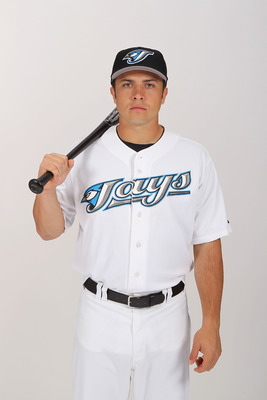 However, as his numbers this season have indicated, Travis experienced a bit of a learning curve early on in his career, as he made the jump from high school to the minor leagues. With his bat coming around this season, the offensive edge at this stage goes to d’Arnaud. It is evident that both players (as can be seen from the table above) need to work on the amount of times they strikeout, but other than that, both look solid at the plate and behind it.
Overall
Although both J.P. Arencibia and Travis d’Arnaud came from the same draft class in 2007, it appears that d’Arnaud has the greater upside. In essence, Arencibia has received the call to the majors quicker because he was able to develop in college before jumping to the professional ranks. As displayed through various charts, d’Arnaud appears to be more efficient both with his glove and bat. His numbers indicate that he could make the jump to the MLB as early as next year. In a recent interview with Fisher Cats beat reporter, Dave Gershman, d’Arnaud showed that he has the confidence to make it to the big leagues, as he stated: “Hopefully one day I can get up to Toronto, and play like I’m playing now. And who knows what will happen? Maybe I’ll be a good player.”
At the same time one cannot discredit J.P. Arencibia, as despite his quick progression to the MLB, he is still learning at the age of 25. Arencibia recently stated as much when he admitted, “On both sides of the plate I’ve been maturing and making adjustments in different things,” Arencibia says. “But it’s still a work in progress. You’re always trying to get better.” With catchers requiring the most seasoning from all the positions, Arencebia can still be considered to be at this stage ahead of the curve.
Whoever is chosen as the lead catcher, one thing is certain: the Blue Jays are blessed with two young catchers – both at the plate – and behind it! If the team’s worst problem is having two number one catchers on its roster within the next two years, then that is a great dilemma to have. It is very possible that one of the above (likely Arencibia) will be moved when both catchers have proven themselves at the major league level. Until then, with injuries and slumps being a reality of the game, the Jays will enjoy their abundance of talent behind the dish and lets the cards play themselves out.
As always, I look forward to hearing from you. Comment below, email MLBreports@gmail.com and follow me on Twitter at @Alleycat17.
Please e-mail us at: MLBreports@gmail.com with any questions and feedback. You can follow us on Twitter (@MLBreports) and become a fan on Facebook . To subscribe to our website and have the daily Reports sent directly to your inbox , click here and follow the link at the top of our homepage.

There He ‘Gose’ Again: The Future of Base-Stealing Blue Jays’ Prospect, Anthony Gose
Tuesday September 20, 2011

April Whitzman (Blue Jays Writer – MLB reports): A native of Paramount, California, outfielder Anthony Gose was the Philadelphia Phillies second round selection in the 2008 Draft. Although a top prospect with the Phillies organization, Gose found himself in Toronto by the end of the 2010 season after a three team deal also including the Houston Astros.
PRE-BLUE JAYS
Glancing at his numbers from 2009, Anthony Gose led all minor league players with 76 stolen bases while hitting .259 with 20 doubles, 13 triples, seven home runs and 27 RBI. His walk-to-strikeout ratio was a bit cumbersome, however, as he walked 45 times, but struck out 132 times. After the season, MLB prospect writer John Sickels rated Gose’s performance, stating the following: “[I] Love [his] speed, youth, and the athleticism. Don’t like the high strikeout rate for a guy without much power. Most advanced of the uber-tools players collected in this system in recent drafts.”
In 2010, at 19 years old, Gose appeared in 103 games with Clearwater and 27 games with the Dunedin Blue Jays (A+). The 6-1, 190 lb., left-handed hitter collected 20 doubles, 13 triples, and seven home runs with 27 RBI while adding 45 stolen bases. While 45 steals sounds impressive, it should be noted that he was thrown out 32 times that season. That’s only a 58% success rate.
BLUE JAYS
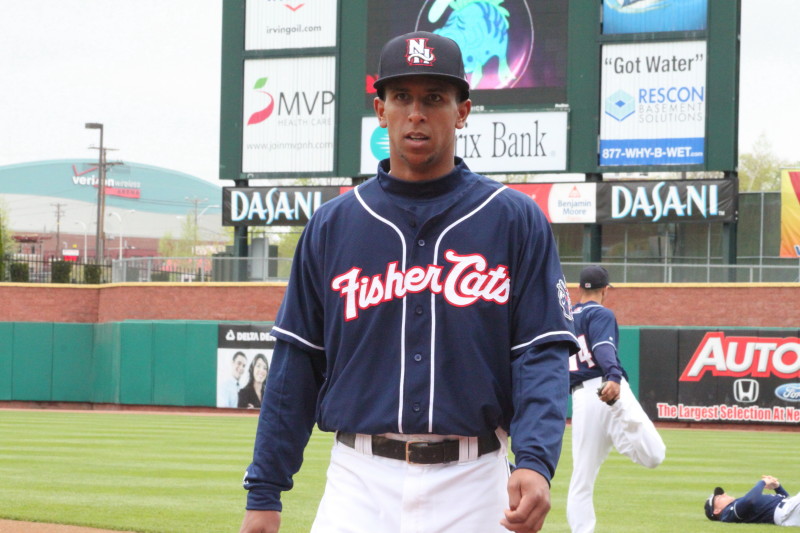 Joining the AA New Hampshire Fisher Cats in 2011, his first full season with the Blue Jays organization, Gose worked to improve his greatest asset – speed. This year he successfully stole 70 bases, only getting caught 15 times, going 23-for-24 in his last 24 attempts and increasing his stealing percentage to 82%. He then started to learn about when to steal, having the majority of his failed attempts coming at third base.
What’s more, along with base stealing, Gose saw improvement in the batters box, as he increased his power totals for the third straight year hitting 16 home runs, 20 doubles and seven triples. Unfortunately, his average has remained around the .250 mark (.253), comparable to the rest of his career in the minor leagues.
Another improvement for Anthony Gose this season was his patience at the plate. While only taking 41 walks in 2010, Gose took 62 walks in 2011 in a similar number of at-bats. He also saw though an increase in his strikeouts this season, as he had 154. Nevertheless when Gose doesn’t strike out and he does put the ball in play, he is batting .339, nearly 80 points higher than his regular average.
Not only has he improved at the plate, but Gose has also seen a rise in his game in the field. His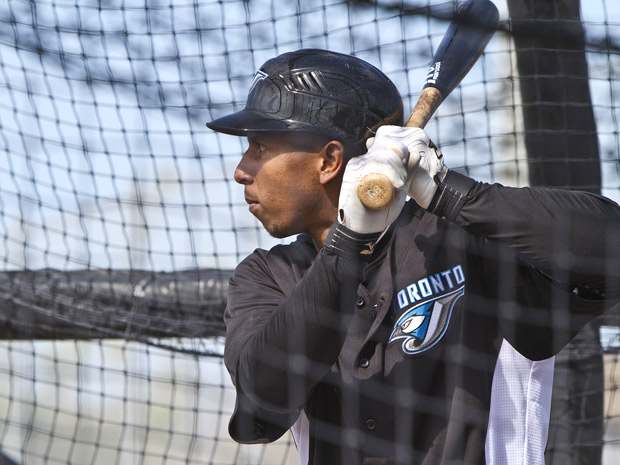 fielding was phenomenal in 2011, committing only three errors, giving him a .992 fielding percentage. Discussing his play in the field, Sal Fasano, the manager of the New Hampshire Fisher Cats, stated: “Gose has enough arm to play right or left in the majors. He caught a ball on the warning track in the right-centre, near the 375 sign, and threw out a guy at third — in the air.” Looking at the numbers, Gose had 15 outfield assists in 2010 and 14 assists this season. That can all be attributed due to his phenomenal range, as thanks to his speed, Gose is able to cover ground smoothly and regularly, making continual exciting plays in the field.
IN THE FUTURE
 In late July of this year, 24-year-old center fielder, Colby Rasmus was traded to the Toronto Blue Jays from the St. Louis Cardinals in a blockbuster deal that also involved the Chicago White Sox. The trade left many wondering if Gose still had a future with the Jays. Fasano’s response: “[Gose is] arrogant enough to think they will move players to make room for him.” However, many baseball analysts were not as optimistic and still wondered where he would fit.
There is no doubt that the Blue Jays have a deep farm system. Most would agree that the team has key players that they would be willing to move if the price was right. If nothing else, the Jays’ GM has shown a willingness to be aggressive in the trade market. With the addition of a strong and powerful first baseman, a dominating starting pitcher, and/or a ‘lights-out’ closer, the Blue Jays are likely to contend by 2013, the year that Gose will likely make the majors.
With Colby Rasmus at centre, Jose Bautista in right, and any one of Travis Snider, Eric Thames, Adam Loewen, and Rajai Davis to play left and/or be the fourth outfielder, it is anticipated that a trade will be coming during this off-season.
With the Blue Jays’ need for a first baseman, the Jays could consider a trade with the Cincinnati Reds who are in dire need of an outfielder. Could Yonder Alonso be the future first baseman for the team in blue and the speedy Gose the future Reds’ centerfielder? With the Astros also needing outfield depth, would it not be ironic if the Jays traded Gose for Brett Wallace? (While this is a very unlikely scenario, it would fill the needs for both teams). The Pittsburgh Pirates are another team in need of a solid outfielder. Thanks in part to a deep farm system, a trade with the Pirates could work. The Jays are also in need of a top starting pitcher and a closer, so any future trade could package off other prospects as well, including, but not limited to, Travis Snider and/or Eric Thames.
The future for Anthony Gose will surely become clear this off–season by recognizing what trades Alex Anthopoulos, deemed as the ‘Silent Assassin’, will make. Along with teammates Yan Gomez and Adeiny Hechavarria, Gose is also heading to the Arizona Fall League to work even more on his skills. Until a trade is consumated, it is evident with Gose, that the Blue Jays have a solid prospect that has a rare combination of top-notch speed, excellent fielding ability and top tools at the plate.
As always, I look forward to hearing from you. Comment below, email MLBreports@gmail.com and follow me on Twitter at @Alleycat17.

Please e-mail us at: MLBreports@gmail.com with any questions and feedback. You can follow us on Twitter (@MLBreports) and become a fan on Facebook . To subscribe to our website and have the daily Reports sent directly to your inbox , click here and follow the link at the top of our homepage.


 MLB Reports
You must be logged in to post a comment.