Blog Archives

Red Sox Mid-Season Update: (Pitching)
Like us on Facebook here
Thursday. July.11/2013

I think it’s safe to say that Clay Buchholz is the best pitcher on the Red Sox staff. He was looking like a strong candidate for the 2013 AL Cy Young Award until he was injured. Now he is on the road back as he threw his 1st bullpen Wednesday, and his 2nd is scheduled for Friday. Then he is set to start a rehab assignment if all goes well. I’m fine with him taking his time though. He NEEDS to be healthy for the playoffs.
By Ryan Dana (MLB Reports Writer and Red Sox Correspondent): Follow @ryandana1
The MLB All-Star game is nearly upon us, and technically we are already passed the halfway point in the season, so it seems like a good time to do an update on where the Red Sox stand at this point.
The Boston Red Sox currently hold a record of 56-37. They still sit in 1st place in the AL East, 3.5 games ahead of the 2nd place Tampa Bay Rays. The Red Sox have led the division for most of the season and continue to exceed all preseason expectations.
In the early part of the season, the Red Sox were winning with pitching and hitting that was statistically at the top of the MLB. That is no longer the case. Their offense is still near the top, but their pitching has fallen off.
The Red Sox currently lead the MLB in Runs (484) and OPS (.802) showing their offensive prowess. However, their pitching staff currently sits in 17th in the Majors with an ERA of (3.96), 17th in K/BB ratio (2.43), 24th in WHIP (1.35), and have the 6th most Blown Saves (14).
Mike Carp(e) Diem
Like us on Facebook here
Wednesday June 19th, 2013
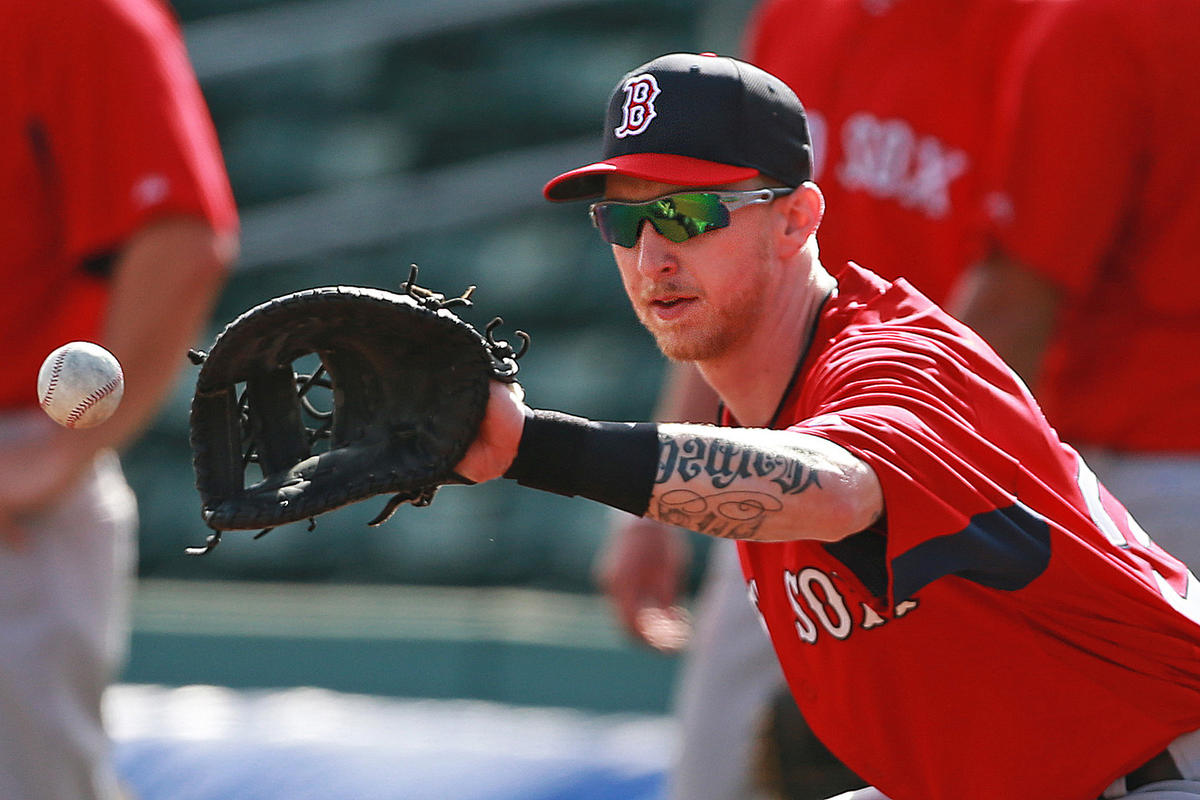
Mike Carp was originally a 9th round pick of the New York Mets out of High School in 2004. He made his Major League debut in 2009 with the Mariners at just 22 Years of Age. Over the last 4 years. he has hit for a Career 3 Slash Line of .266/.336/.796 in 650 AB. This is basically a season worth of At-Bats for the man from Long Beach. CA. With those numbers, the LHB has 26 HRs, 38 Doubles and 96 RBI. This pickup by the Red Sox may turn out to be a real bargain of the year.
By Ryan Dana (MLB Reports Writer and Red Sox Correspondent): Follow @ryandana1
I knew I would be devoting an article to this player sooner or later, but what better time than now? From top prospect to not being good enough for The Seattle Mariners 40 man roster, Mike Carp has emerged as a steady contributor to the current 1st place team in the AL East, The Boston Red Sox .
The 6 FT 2, 210 LB OF has been perhaps the most underrated pick up of the past offseason for the Boston Red Sox. At the time there was speculation whether he would even make the team, but questioning his viability as a Major League hitter has been put to rest at this point.
As Spring Training rolled around, the Red Sox were looking for depth at 1st Base behind newly signed Mike Napoli. They got Lyle Overbay into camp to compete for the spot and started giving Daniel Nava reps at the position too.
Then, falling into the Sox laps, came Mike Carp via the Seattle Mariners, the solution to the Red Sox 1B depth. All that was asked in return is the famous ‘PTBNL’ or cash.

Improving Technology in MLB Ballparks
Sunday April, 29 2012

Ryan Ritchey: With baseball being America’s past time, the game is old-fashioned to say the least. In many of the older ballparks like Fenway, which celebrated its 100th anniversary last week, the stadium is built with poles holding up the upper decks. In these ballparks fans get tickets for seats behinds poles cheaper than any seat in the stadium. Others like Kauffman Stadium have started putting in solar panels above the outfield seats to use the solar energy to power the ballpark.
With this being said does baseball need to up the ante on technology in the ballpark by adding more things for the enjoyment of the fans? In my opinion it is yes and no. There is no better feeling than going to a ballpark and smelling the peanuts and hot dogs and enjoying a nice game on a hot summer day. For those fans sitting behind those poles, do they need a special TV on the seat in front of them that will allow them to watch the game while also being there? The TVs will need headphones so you can hear the voice of the announcers which is the only bad thing. The cool thing about that would be if you could get the voice of the announcer at the ballpark and only hear what is going on within the ballpark itself. Read the rest of this entry

Doug Booth: An Inside Look at the 2011 World Series Ballparks
Sunday October 23, 2011

Jonathan Hacohen (Lead Baseball Columnist – MLB reports): We are very fortunate today to have author Doug Booth of “The Fastest 30 Ballgames”, join us today with a Guest MLB Blog. Doug, an expert on major league baseball parks, shares his knowledge on The Ballpark In Arlington (Texas) and Busch Stadium (St. Louis)- the sites of the 2011 World Series. We appreciate Doug taking the time out of his schedule to articulate his knowledge and experiences of these amazing ballparks. Enjoy.
______________________________________________________________________________________________
It’s Antlers & Claws vs. The Squirrel in the World Series
(AL)TEXAS RANGERS VS. ST. LOUIS CARDINALS (NL)
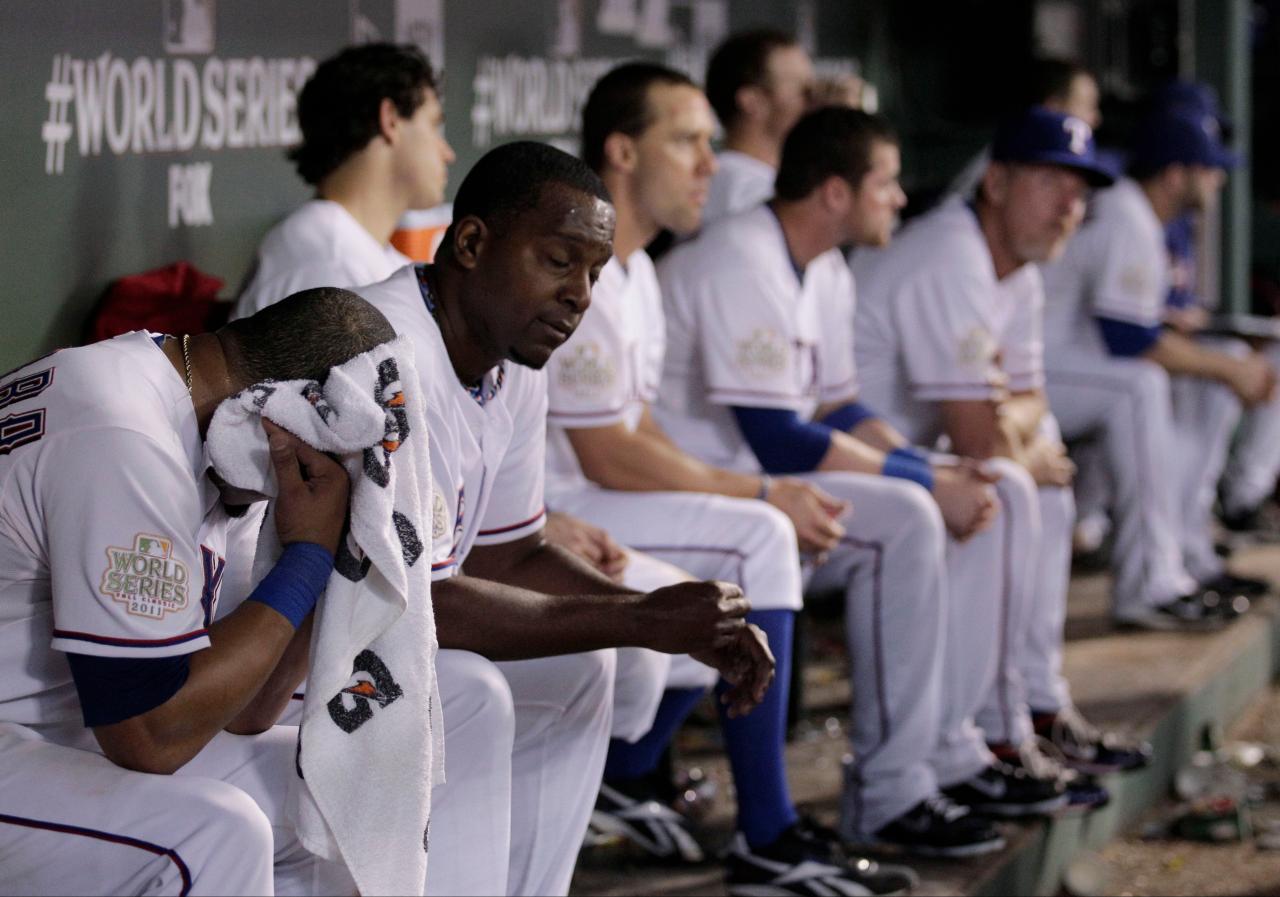 The 2011 World Series features the second ever meeting of a series between the two clubs, with only a 2004 series in Texas has been played in the whole history of interleague. The Fall Classic may display some of the unique characteristics each city, park and all of the fans to display to the rest of the world. From the new tradition of the faithful Rangers fans joining in with players to do the antlers/claws celebration when powering up-or the entire Cardinal team taking the good luck pet squirrel-(both the real live one and the stuffed squirrel that was tossed into the Cardinal bullpen-and participated in the champagne celebration of the NL Champs,) this series will be entertaining.
First you have the Texas Rangers, formerly the Washington Senators, who moved to the state of Texas in 1972 only to wait for almost forty years for their first World Series appearance and have since gone back to the second time-to the Cardinals 3rd trip since 2004-and them trying to add to their 11 World Series titles already. Ballpark fans will tell what to look for if you listen.
In Texas, and of course everything is always bigger in Texas, there will be sunny warm weather, plenty of cowboy hats and Stetsons, whereas the Cardinals fans will be decked out in their best red team shirts and jerseys. The Ballpark in Arlington will play the ‘Natural’ movie theme song every time their player takes the ball yard, while St. Louis will cheer their players for a homer with the warmest of exuberance while the weather may surface near freezing temperatures. The Rangers fans, with their loud and boisterous ways-will cheer for the Cardinals to fail at defense, meanwhile the Cardinals fans will always cheer a great baseball play even if it costs their team a chance to score and win the game.
There is plenty of tiered parking at ‘The Ballpark In Arlington.’ It is a price structure that is the fairest in the majors. The more you are willing to walk, the less you have to pay to watch an event there. Then you have the NL version of the ‘Yankees’, so much like downtown New York, in St. Louis you will be lucky to find a spot-and worst yet-you may miss your turn-offs from the highway. Busch Stadium displays one of the best iconic visuals in the Arch for the back drop of the park, in contrast-The Ballpark in Arlington has the biggest space in the outfield bleachers with the corporate offices staring down at the field. That means that the like of Nolan Ryan will always be watching even if the Cards are just practicing. If that doesn’t intimidate you at all you can always see the 1.2 billion dollar Cowboys Stadium across the street.
The fans will sing ‘Deep in the heart of Texas’ after the seventh inning stretch in Arlington. The Busch fans will probably blast ‘thank god I am a country boy, or cotton-eyed Joe’ on the loudspeaker.
After the games at Busch Stadium, the downtown district and especially Mike Shannon’s steakhouse, they will celebrate their team playing in the playoffs. In Texas, the streets that lead to the highways will be jammed causing some of the people to carry-on the partying in the parking lots or wait for other form of ground transportation by celebrating with other fans.
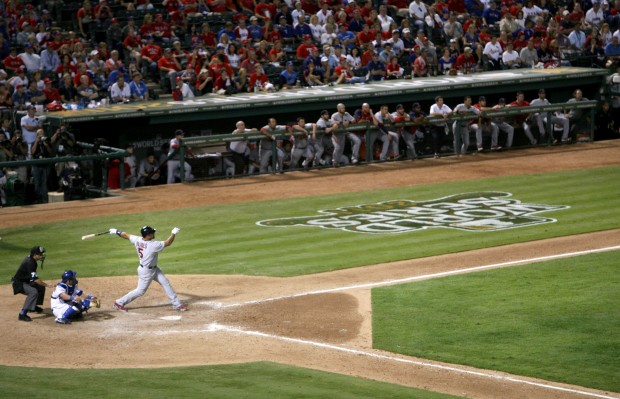 This series represents the 29th and 30th ballparks I ever saw. I had seen all other 28 ballparks in less than a month in 2008-and was delighted at the style and professionalism each ballpark displayed. The staff at Busch Stadium had my dad and me on the field being interviewed by Fox Sports-Midwest. It was an incredible gesture on their part. As for attending The Ballpark In Arlington right after, I was blown away by the size and structure of this behemoth park. I watched a game where the temperature soared into the 100’s, but don’t be afraid of attending the game-you can always cool off in centerfield by having an ice cream or smoothie in the little kids indoor concession stand that has air conditioning! Just always know what the score is because the concourses are so big you can’t see the game or scoreboard from them
So sit back and watch the baseballs fly out of both parks with what may be the best ever NL offence, and the best AL offence since the 1927 Yankees. I warn you, be prepared for all possibilities, I witnessed a 15 inning game at Busch in 2009 where they actually ran out of pop and the game ended at 1:15 Am in the morning, oh yeah and I witnessed a torrential down pour at the Ballpark In Arlington to add to my ballpark viewing resume.
The moral of the story is eat lots of food of water, be caught up in the parks different traditions-and finally stay until the final pitch is made. If the game happens to be in St. Louis and the Rangers win the World Series-watch how the ‘classiest fans in baseball’ will show the nation yet again of how nice they are. I am sure they would rather win still though.
DCB

*** Thank you to Doug Booth for joining us today on MLB reports. To learn more about “The Fastest 30 Ballgames” and Doug Booth, you can follow Doug on Twitter (@ChuckBooth3024) and click here for Doug’s website, fastestthirtyballgames.com***
Please e-mail us at: MLBreports@gmail.com with any questions and feedback. You can follow us on Twitter and become a fan on Facebook . To subscribe to our website and have the daily Reports sent directly to your inbox , click here and follow the link at the top of our homepage.

Interview with Doug Booth: Author of “The Fastest 30 Ballgames”
Sunday October 9, 2011
Jonathan Hacohen (Lead Baseball Columnist – MLB reports): I recently had the pleasure to share my book review of “The Fastest 30 Ballgames” on MLB reports. Following my review, I had a chance to correspond with one of the authors of the book, Doug Booth. We discussed the book, the life and times of Doug Booth, ballpark chasing and much more. Sit back and enjoy my interview with a man who epitomes baseball fandom- Author Doug Booth, in discussing his recently published book, “The Fastest 30 Ballgames: A Ballpark Chasers World Record Story”.
______________________________________________________________________________________________
MLB reports: It is a pleasure to have you on the Reports Doug. Thank you for joining us today. Tell us a little more about who is Doug Booth. How did you get involved with the great game of baseball?
Booth: I am a 35-year-old courier from Vancouver B.C Canada. When I was 18 years old I had a chance to play NCAA Baseball Division 1 for Liberty University, but had suffered 7 concussions and multiple knee injuries from playing various sports-so I retired from baseball prematurely. While I still followed MLB on TV and radio for the next decade, a little piece of me lost the zest for the game because I couldn’t play it anymore. To this day, I still can’t even play the game as the symptoms from my previous concussions come back with too much exertion. In 2005, I attended my first MLB Park in the USA at Safeco Field in Seattle. I had only been to Olympic Stadium in Montreal-and The Rogers Center previously as a teenager, so it was nice to find my love for the game re-invigorated. ‘It all escalated into the extreme chaser I am now.’
MLB reports: I very much enjoyed reading “The Fastest 30”, as our readers could tell from my recent book review. Considering the work and effort involved, how does it feel seeing the book as a final product- published book?
Booth: I have to tell you, there were moments where this whole book concept really frustrated me to no end. It was a lot harder to write this baseball book than it was to write my first two books that I have in circulation. It was hard trying to write a novel based on a true story. Having said that, I am very happy that I completed this journey and have all of the memories of the trip chronicled and categorized, but most importantly that there are pictures of journey with my family and friends that will be forever cemented in literature.
MLB reports: The first part of “The Fastest 30” chronicles your two attempts to set the Guinness World Record for attending all 30 MLB parks in the shortest amount of time. Why this record Doug? Why did you want to reach this particular goal so badly?
Booth: The trip originally was going to be 48 states and 30 ballparks in 45 days, but once I had enough money stored for the trip I heard my inspirational ‘hero’ Jim Maclaren had been sidelined with a devastating injury-and his foundation was raising money for him. For those that have not read the book. I heard Jim interview on the ‘Jim Rome Show’ back in 2004. Jim was a quadripeligic motivational speaker who inspired others by his ‘choose life’ motto. It took Jim hours each day to do menial tasks, but he was at a place in his life where he was happiest because he made peace with himself. Each day he would defy the odds of doctors testing his own physical and mental fortitude. But his spirits had been dampened by an accident, and I wanted to do something. I investigated about the world record for this given category and found out the record at that time was 29 days. With some quick re-tooling, and armed with a drive to raise money for the Head North Foundation, (A charity championing the cause for spinal research) I was able to put a streak chase together that would use this charity as my motivation to break the World Record. Much like Jim, I would have to tests the limits of my physical and mental capabilities to pull this off.
MLB reports: After your first unsuccessful attempt at the record in 2008, was there a thought to taking a break or perhaps giving up? What motivated you try again so quickly- no burn out?
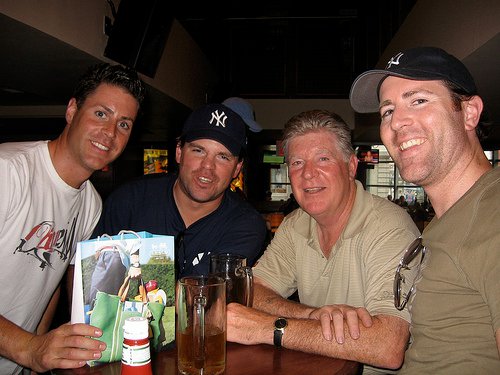 Booth: I chased the record for 41 days in the summer of 2008. I used up every ounce of my physical being, and tapped every resource of the money I had saved up in order to break the record. I had put forth a 30-29 record attempt-only to find out the record had been newly set that summer by a man Josh Robbins. The new streak record was 30 games in 26 days. I did not have to submit the record to Guinness because I was not even tied as the record holder anymore. It was all because I had a 3 day break for the All-Star Break that was unavoidable 2 weeks into my trip. I had booked off the time from work, and had bought countless plane fares, baseball tickets and hotels stays-so I was stuck with the 3 day break. That 3 day penalty, plus another day penalty I had received when I met my mother in Toronto, (instead of carrying onto Cleveland from Chicago for a game) when a plane was delayed to Toronto-thus killing my chance for to make it to the Rogers Center for first pitch. If you took those games off-I could have put a 30-25 streak submission up in the 1st year. I did complete 5 doubleheaders in the 29 day trip. It ate at me for 2 months until the schedule for 2009 came out. I saw a perfect schedule looming if it all worked out. When I put together the finances by April of 2009, I knew I had a shot at breaking the record. When an early season rainout added a 7th doubleheader attempt at Yankees Stadium for a 30-23 attempt, I knew I had an opportunity at history.
MLB reports: Please describe your feelings after you set your goal. Did you achieve fulfillment? Any other emotions kick-in post-record?
Booth: In contrast to 2008, when I felt empty and had a downward spiral for about 2-3 months, I was elated beyond control for setting the record on Aug.14/2009 at Comerica Park in Detroit. It was a 1-0 walk off homer by the hometown Tigers in the bottom of the ninth. In somewhat fitting circumstances to the journey’s end, fireworks were shot off at the park for what seemed like an eternity. I had a 10 hour drive back to my brother’s house in New Jersey the next day, during this time I contemplated what had taken place. For me, and this is what people could not understand because they could not fathom a trip of this magnitude-was that this was not the hardest part of the journey. It was the 308 days I had worked in a row in order to secure the money I needed, the rigorous schedule of 90 hour work weeks in which I battled the physical and mental fatigue-and all the times it looked bleak moving towards this , that was the hard part. Once I was out at the ballparks, I was in my world.
MLB reports: Looking back now, if you could do anything different from the second world record-setting journey, what would it be?
Booth: Not much, although I will always wonder what would have happened in Pittsburgh had I received a fluid sedan pick-up? I would have liked to have had the opportunity to make that 5:15 PM flight from the Pittsburgh Airport, leaving downtown at about 3:40 PM instead of 4:15 PM. I will tell you from that point on all of my transportation drivers were probably sick of me going over the game-plans of the pick-up/drop-off strategies.
MLB reports: The second part of the book is the Ballpark Chasers guide to all 30 MLB parks, with ratings. From your own experiences, what was your top five favorite MLB parks and why?
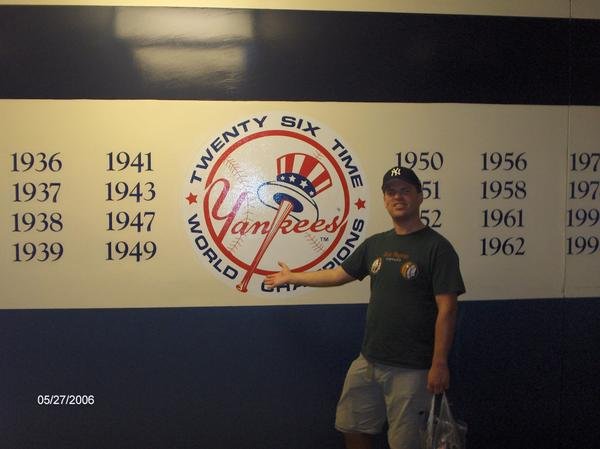 Booth: My top 5 parks in order are: 1. AT&T Park-because it is a beautiful park in the best city, and has the best food, climate and value out of all of the parks; 2. Yankee Stadium-I am a Yankees fan and nothing beats a game in the ‘Bronx’ with the fans. The steak sandwiches and Nathan’s hotdogs do a considerable amount for the park-while New York is also an awesome city to visit; 3. Wrigley Field-It is the best place to watch a game for just the game period. The Ivy, the scoreboard and the history and a little known fact, I spent more time there during the streaks than anywhere else; 4. Fenway Park-Even as a Yanks fan you have to marvel at the history of this Park. ‘The Green Monster’ is the best iconic visual of a Park anywhere in the majors; and 5. Busch Stadium-I enjoy the backdrop of the ‘Arch,’ the baseball fans in St. Louis are the classiest in the majors-and it was the only field I was interviewed on.
MLB reports: To let readers know, you had two other authors assist you with “The Fastest 30”. Why these two particular individuals? How did they get involved in the project?
Booth: My co-authors (Craig Landgren and Kenneth Lee) and I met online at http://www.ballparkchasers.com/ after the 1st streak chase in 2008. Over the course of the next year I would make my way onto the ballpark chaser scene in writing blogs, being involved in major discussions and talking about baseball. At first everyone did not know what to think of me because they had all followed Josh Robbins’30-26 trip. I had joined way after Josh at the site. Soon it would be that I gained some respect from Craig and Ken. Like me, Ken Lee has been to all 30 ballparks-and was most active with the other members. I asked him to help me chronicle my streak by writing blogs-and help post pictures/verify that I was legitimately at all of the parks for evidence reasons. We hit it off right away. It was nice to have a friend keep you motivated on this kind of record. When I decided to write the book I asked for Ken’s write-ups of the 2009 streak to be part of the novel. Craig Landgren is the founder of Ballpark Chasers. He has spent much time and devotion plying his craft of being a website master. The kind of information on all of the 30 parks come directly from all of the diligent work Craig has done in interacting with all of the members-and his own personal research. I knew the novel would be too short with just my streak attempts, and since I never spend too much time in one particular city, it was only natural that we enter this book as a partnership. I was able to add some of my own expertise to each ‘ballpark chaser guide’, so it made the work so much more rewarding. If you added all of our write-ups of expertise it made for a ‘super’ guide.
MLB reports: For readers that starting their own baseball trips, what advice would you give in “how to become a Ballpark Chaser?”
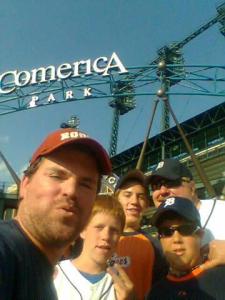 Booth: The first thing I recommend any potential chaser to do is sign up at www.ballparkchasers.com , we have some of the best traveling experts in North America offering free advice and information in a friendly manner. Ballpark Chasers also had a Facebook Group to sign up for. Also buy my book. I hope that is not too direct here, but honestly this book represents all of its members and people that have contributed to these guides via Thousands of games attended. Other than that, always budget $250-350 per road game, book your plane fares in advance, sign up for all of the MLB’ teams newsletters-that automatically send out ticket deals, learn your rewards programs for all of your car rentals, hotels and other travel partners. In addition to this, have a full schedule itinerary 24/7/168 time planner set out for your trip. Have backup plans for each city when it comes to weather, travel delays and fatigue. Doing a little bit of research goes a long way.
MLB reports: Doug, if you could do this all over again: would you? Was achieving the World Record worth the time, money, blood, sweat the tears that you invested in your journey?
Booth: Absolutely it was worth it. There is not a day that goes by when I don’t thank the game of baseball for molding me as a man in this journey-and also for the newly found friends I found. Baseball is truly the game that defines ‘pastime.’ I can’t think of another sport that can unify generations of families to be at the same place and same time. It is ageless and timeless. I have seen infant babies to a 100-year-old men and women at the game. Each of one of them at the game represents something different, but they all come for the experience. This journey has challenged me to rise up to the occasion and fight for what I believe in. I have a focus like I have never had ever before in my life.
MLB reports: What does the future hold for Doug Booth? Will we see any follow-ups to “The Fastest 30” and what are your goals professionally in the world of baseball?
Booth: I am putting together another ‘ultimate road concept’ in 2012-that will make my other baseball journeys seem like a kindergarten class for longevity. I implore anybody to follow my future journeys at my website www.fastestthirtyballgames.com. I also plan on asking MLB for a job, in firing up people in some kind of motivational capacity. I will be attending Broadcasting School in the near future and I will always continue to write about the game of baseball in some manner. My life as a ‘ballpark chaser’ has just started!
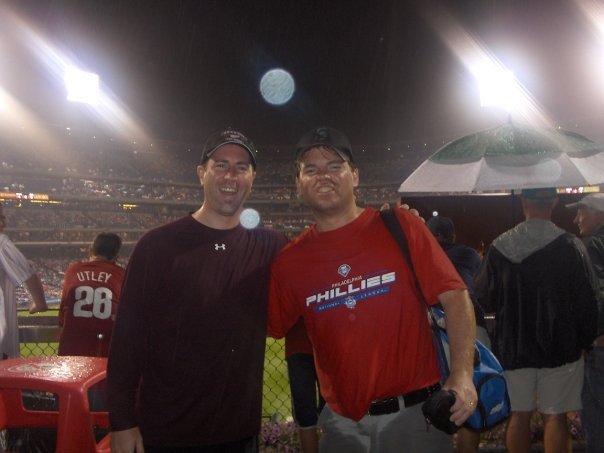
**The photographs in today’s feature are courtesy of Douglas ‘Chuck’ Booth**
*** Thank you to Doug Booth for joining us today on MLB reports. To learn more about “The Fastest 30 Ballgames” and Doug Booth, you can follow Doug on Twitter (@ChuckBooth3024) and click here for Doug’s website, fastestthirtyballgames.com***
Please e-mail us at: MLBreports@gmail.com with any questions and feedback. You can follow us on Twitter and become a fan on Facebook . To subscribe to our website and have the daily Reports sent directly to your inbox , click here and follow the link at the top of our homepage.
Baseball Book Review: The Fastest 30 Ballgames
Tuesday September 27, 2011
THE FASTEST 30 BALLGAMES – A BALLPARK CHASERS WORLD RECORD STORY; BY: DOUGLAS ‘CHUCK’ BOOTH, CRAIG B. LANDGREN & KENNETH A. LEE
(AuthorHouse: 2011)
Jonathan Hacohen (Lead Baseball Columnist – MLB reports): As you have probably guessed from my previous reviews, I have a great love for baseball books. I have read hundreds of them over the years and will read hundreds more before my time is done. As baseball seasons have gone by, it seems that the market has become more and more saturated with baseball reading material. With so many options and so little spare time, many baseball readers have a difficult time choosing which books to add to their collections. I can completely relate to this dilemma. Speaking from experience, when I select my next baseball book- I always look for an original and fresh concept. I look to learn, laugh and get lost in time. Let’s face it: with our hectic schedules, reading is supposed to be our time to unwind, relax and have an escape. I recently uncovered a baseball book that provided all of the above and more. A book that will become a must-own for every serious baseball fan. “The Fastest 30 Ballgames” is the title and is the subject of today’s book review.
Every baseball fan that I know has either just come back from a baseball trip, is going on a baseball trip or is planning to one day take a baseball trip. The bottom line is that baseball fans love their baseball outings. Fans from all corners are discussing as we speak their dream of visiting Yankee Stadium, Fenway Park, Wrigley Field…and so on. We read about all of the major league stadiums. We listen to different teams play on the radio and watch their games on television. The next logical step is to visit those same parks in person. For most, if not all baseball fans, the dream of visiting new major league parks represents the ultimate dream vacation. In his book, The Fastest 30 Ballgames, author Doug Booth takes his readers through his tour of every single MLB stadium. What fans dream of experiencing, Booth has lived it. “The Fastest 30 Ballgames” provides readers with a journey through a baseball odyssey that has never been seen before. We get to live vicariously through Doug Booth. If a great book is to be an escape for its readers, then this book is just that. A really great book. When you finally complete this book, you will not only feel like you know every baseball park, but you will also have the sense of having been there. I got completely lost in the world of Doug Booth and the wonderful universe that is baseball.
I have never read a baseball book that is as expansive as “The Fastest 30 Ballgames”. This book works on so many levels. The first part walks us through Doug Booth’s attempts to set the Guinness World Record of watching games at all 30 major league parks in the fewest amount of days. Think baseball’s version of “Planes, Trains and Automobiles” meets “The Amazing Race”. Sometimes an exercise in frustration, while other times an exhilarating ride. Booth does it all and sees it all, in setting out to fulfil his goal. What I most enjoyed about Booth’s writing style is his honesty, passion and heart. To me, the first part of “The Fastest 30 Ballgames” is a raw diary of the life of Doug Booth. From picking his mode of transportation, tickets, accommodations and route to each city and ballpark, Booth recounts in great detail his life and experiences in hopping from one baseball park to another. Booth does not hold back from sharing the personal details of his life, which make his legend and tale that much more real and rewarding to read. I felt that I was with Booth every step of the way. Booth’s use of imagery was so vivid that I could literally picture his words in my mind, creating a sense that I was along for the ride. A sign of a talented author and one that believes in his work.
Did Doug Booth set the world record you ask? Yes he did. After narrating in detail his near record-setting attempt in 2008, Booth went on to set the Guinness record the following year by watching baseball games in all 30 parks in only 24 days. If you do the math and take a look at a map, that is a very impressive feat. With weather, traffic, plane delays and countless other factors always lurking, Booth’s feat is mind-blowing. This book is worth reading just to find out how he was able to accomplish such an impossible feat. The reality is that very few of us, if any, will ever attempt what Doug Booth accomplished. When I completed “The Fastest 30 Ballgames”, I have to admit though that I felt the urge to continue my own baseball journeys. I started to calculate in my head all the baseball parks that I had already visited in my lifetime, and the ones that I still had left on my list. I started to visualize geographically where each stadium was located and how many I could visit per trip. From there, I calculated the number of trips and period of time I realistically thought it would take to complete the mission. As I was doing this, I realized that I was beginning to channel Doug Booth. I had the itch… and the only known cure was ordering tickets and getting on the road. Doug Booth had inspired me. I would assume that this was one of Booth’s goals in writing this book. By stirring the baseball excitement within me, I appreciated Booth’s own baseball travels and wanted to further trips of my own. Not only did I enjoy the book as a relaxing escape, but I was inspired and motivated. Another sign of a successful writer.
It is one thing to say that a person wants to achieve a goal. It is another thing to actually do it. Armed with my the drive to see every major league park, part 2 of the book lays out how to make it happen. Co-author Craig Landgren prepared a detailed listing and ranking of all 30 MLB parks. From where to park, sit, buy tickets, food, best months of the year to attend, nearest attractions and closest stadiums, Landgren provides the perfect “AAA” type guide to visiting baseball stadiums. A book within a book, Landgren provides the ideal cheat sheet for every stadium in the “Ballpark Chaser Guides” section, as it is referred to in the book. For those that are interested (and if you are a baseball fan, you will be), be sure to visit Landgren’s site: http://Ballparkchasers.com. Ballpark Chasers is an on-line community of baseball die-hard fans, sharing information, stories and pictures on baseball travelling. For “The Fastest 30 Ballgames”, Landgren lays out beautifully the information and images of all 30 MLB parks. In essence, Booth sets you up by inspiring you to follow his baseball trips, while Landgren teaches you how to make it happen. “The Fastest 30 Ballgames” is part autobiography and part baseball travel guide. But fully 100% baseball. Just the way we like it.
The last part of the book is real life stories of “Ballpark Chasers”, real people like you and I, telling the story of their stadium trips. Reading each of their stories, I started to think and plot in my head what story I would be telling one day on the Ballpark Chasers website. I could identify with all of the individuals, as they were the same as me. Baseball fans who loved the sport passionately and enjoying watching the games immensely. I could identify with each of these Chasers and felt that I could one day be one of them. That at the end of the day was likely the reason for including their tales. Now I was inspired by Booth, had the guide to travel from Landgren and the reinforcement from other Chasers that my planned travels could one day come true. Like Booth, it was extremely enjoyable to read each and every one of these baseball tales. This part added to the authenticity of the book that its authors strived towards. I was glad to read all of the Chasers’ tales and look forward to one day writing a baseball travel story of my own.
I have a deep dark secret I need to share. Most baseball books take me several days to complete. With professional and family commitments, I will usually take 1-2 weeks to complete a book. “The Fastest 30 Ballgames” took me several weeks to complete. This was the longest amount of time I have ever taken to complete a baseball book. This is a compliment though to how much I thoroughly enjoyed reading it. “The Fastest 30 Ballgames” travelled with me everywhere this summer. From my bedside, to doctor’s offices, the cottage and even my trip to Cooperstown, it followed me each and every step of the way. When I picked this book up, I could literally not put it down. I found myself going back to certain chapters and sections, reading and re-reading certain portions. When I was watching ballgames on television, I would pull out the book and compare its descriptions to what was seeing before me in real-time. It takes a lot to get me excited and gushing. Booth and his co-authors were able to accomplish that in their baseball masterpiece.
With the playoffs around the corner, the MLB 2012 schedule was recently released this month. Perfect timing to pick up “The Fastest 30 Ballgames” and start planning your next baseball trip. After reading all the tips and insights into each major league city and park, I would not dare to plan a meal, hotel reservation or purchase ball tickets without consulting this book. The book is an enjoyable read and provides hours of fantastic baseball tales. But at the end of the day it is not just a storybook, it is also a key reference tool. With so much baseball information and knowledge available in this book, I am certainly glad that I read it. If you are a seasoned veteran or someone just introduced to the game: do yourself a favour and pick this book up. “The Fastest 30 Ballgames” will be one of the most enjoyable baseball experiences that you ever experience. Until you get to all 30 Major League Baseball stadiums yourself one day!
**The photographs in today’s feature are courtesy of Douglas ‘Chuck’ Booth**
*** To learn more about “The Fastest 30 Ballgames” and Doug Booth, you can follow Doug on Twitter (@ChuckBooth3024) and click here for Doug’s website, fastestthirtyballgames.com***
Please e-mail us at: MLBreports@gmail.com with any questions and feedback. You can follow us on Twitter and become a fan on Facebook . To subscribe to our website and have the daily Reports sent directly to your inbox , click here and follow the link at the top of our homepage.

The Curious Case of Carl Crawford
Thursday September 23, 2011
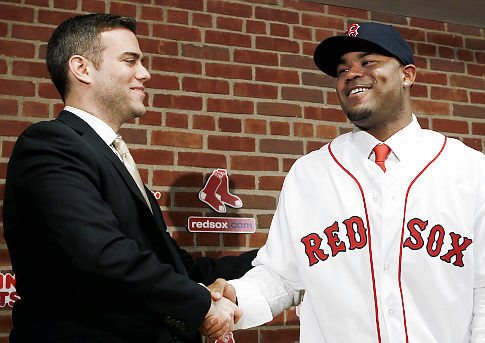
Rob Bland (Baseball Writer – MLB reports): When the 2010 season concluded, many people looked at the trio of Cliff Lee, Carl Crawford and Jayson Werth as easily the most sought after players. Lee has not disappointed in Philadelphia, where he will garner serious attention for the NL Cy Young Award. Werth and Crawford, however, have been pretty big disappointments after signing extremely lucrative contracts over 7 years. Werth received $126M, while Crawford made the biggest splash, inking a deal worth $142M. While Werth has been lucky to play in front of smaller crowds playing in Washington DC, Crawford has had to endure the masses of critics in Boston. This is on top of playing in the AL East, battling for the division title, while the team is in a free-fall where the Tampa Bay Rays are gaining ground in the AL Wild Card race.
 Crawford came to the Red Sox with HUGE expectations. Fans of the Red Sox expected him to not only repeat his career season from 2010, but exceed his statistics. In 2010 with the Rays, Crawford surpassed most of his best seasons in almost every statistical category. He hit .307 with 19 home runs and 90 RBI, while scoring 110 runs and stealing 47 bases. His on-base percentage was .356 and he slugged at a .495 clip, giving him an OPS of .851. In 2011, surrounded by all-star and MVP caliber players, he has struggled to gain any kind of consistency. He has limped into the end of September with a .255/.292/.401 slash line.
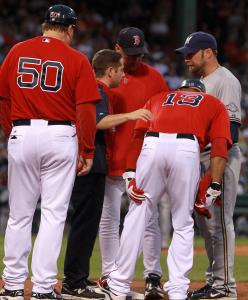
Crawford has only been able to steal 18 bases, which is by far his worst full season total in the MLB. On June 17th, Crawford sustained a grade 1 strain of his hamstring, and did not return to the lineup until July 18th. At the time, Crawford’s OBP of .275 and slugging percentage of .384 were near the bottom of the league. If Crawford had been hot until the injury, and simply fizzled out after he came back, we would have a simple answer.
Crawford has actually fared better since the injury, but I believe he has lost a step. Crawford relies on speed, and hamstrings often take a very long time to heal. His game is based on slapping balls through the infield and driving balls to the gaps, turning singles into doubles and doubles into triples. Many people thought that the Green Monster would be peppered with line drives off Crawford’s bat, as well as triples going into the deep right-center field gap. With Crawford’s hamstring issues, he doesn’t seem to be able to drive the ball as well as in recent years.
Another issue with Crawford seems to be that he has been slightly unlucky compared to other years. His BABIP over the course of his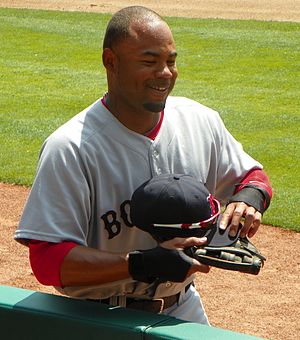 career is .329, while 2009 and 2010 it had been .342. This year, the stat sits at .300. Often, when seeing a dip in BABIP, you can look at a player’s line drive rate and see that the player is not hitting as many line drives. Crawford’s line drive rate is 17.8%, which is actually up from last year’s 16.5%. His fly ball and ground ball rates have also mostly gone unchanged. One thing I did notice was that his percentage of bunts for base hits is 0. Early in his career, Crawford would attempt to bunt upwards of 15 to 18 times per season. This year, Crawford has only attempted three bunts. This could be due to his hamstring not being 100% also.
Crawford’s dWAR, (or defensive Wins Above Replacement), which is a defensive stat that shows how a player is able to field balls inside and outside the zone of his position, has always been one of his strong points. For outfielders, he has been near the top of the league regularly over the last five years. This season, however, his dWAR is at -0.5, which negates entirely his limited offensive production.
With such close similarities in his batted ball rates, one would expect a slight drop in production due to his lower BABIP. However, with such a large gap in last year’s production to this year’s, despite a better overall line-up batting around him, one has to really think about what has happened to Crawford.
Crawford may be a multi, multi-millionaire that most of us would give up anything to be, but what most of us forget is that these MLB superstars are human. Hitting in front of 40,000 screaming, raving Red Sox lunatic fans surely cannot be an easy task. When playing in Tampa for the first 6 years of his career, he rarely faced hostility or scrutiny at home. The media has scrutinized every little move he has made this season, because he is under a microscope now. All this pressure and expectations after signing such a huge contract can take a toll on a player both psychologically and physically.
Here is a radical thought: Fenway’s odd dimensions have actually hurt Crawford offensively. Left fielders play shallower in Boston than in any other park, due to the Green Monster. This means that shallow flares, bloop pop ups and even live drive singles are taken out of the equation. While you can argue that this would then alter every other hitter’s stats, I think that the style of offense that Crawford plays, combined with bad luck, and a slight drop off in actual performance have been the main contributors to his poor statistics.
Look for Crawford to settle into the Boston atmosphere and return to his career averages in statistics in 2012. If he doesn’t, there will be many Sox fans clamouring to get rid of him at any cost.
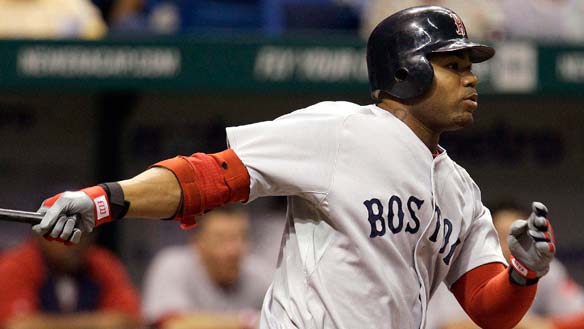
***Today’s feature was prepared by Rob Bland. We highly encourage you to leave your comments and feedback at the bottom of the page and share in the discussion with our readers. You can also follow Rob on Twitter.***
Please e-mail us at: MLBreports@gmail.com with any questions and feedback. You can follow us on Twitter and become a fan onFacebook . To subscribe to our website and have the daily Reports sent directly to your inbox , click here and follow the link at the top of our homepage.


 MLB Reports
You must be logged in to post a comment.